Percutaneous Catheterization
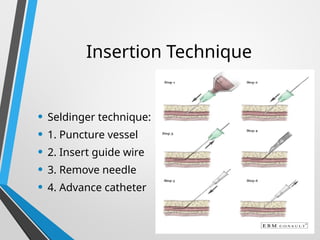
• Site,Asepsis, Guide Wire, Catheter, Pressure
Injector & Accessories
• Presented by: Dr Prashant, Dr Anamika
• Moderator: Dr Mohit
2.
Objectives
• 1. Understandsite selection and asepsis in
percutaneous catheterization
• 2. Explore guide wires and catheters
• 3. Learn about pressure injectors
• 4. Review accessories involved
3.
Definition & Indications
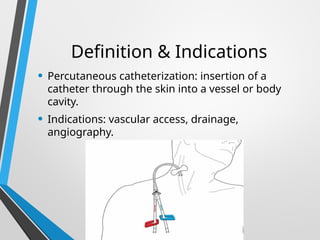
•Percutaneous catheterization: insertion of a
catheter through the skin into a vessel or body
cavity.
• Indications: vascular access, drainage,
angiography.
4.
Common Clinical Applications
•1. Central venous catheter placement
• 2. Interventional radiology
• 3. Drainage of abscesses or fluids
• 4. Angiographic procedures
Sterile Field Setup
•Includes:
• - Sterile drapes
• - Sterile tray with instruments
• - Maintaining sterile technique throughout
12.
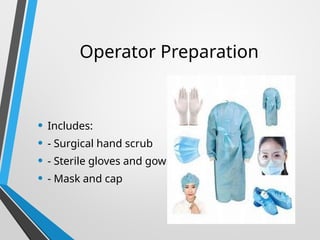
Steps in AsepticTechnique
• 1. Donning PPE
• 2. Preparing site
• 3. Using sterile tools
• 4. Avoiding contamination
13.
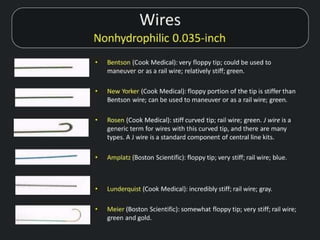
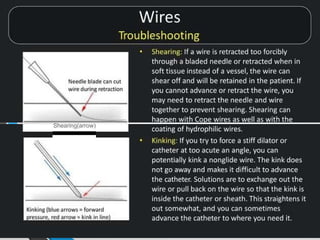
Wires
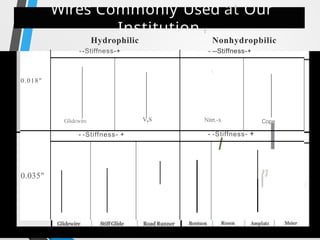
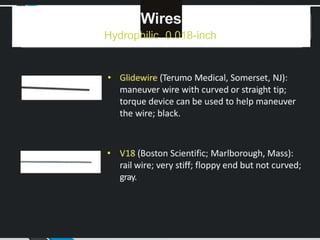
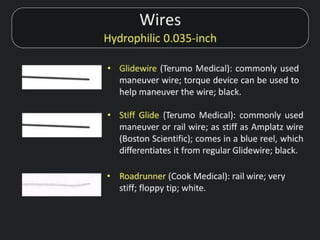
Wires have threemain properties: diameter, stiffness, and
hydrophilic or nonhydrophilic composition.
There are three basic types of wire categorized according to the
above properties:
• Access wire: simple short wire; used for access and
often quickly exchanged
• Maneuver wire: often floppier body; tip is often curved,
floppy, and hydrophilic; commonly used to subselect
vessels
• Rail wire: stiff; provides a stable platform for exchanges,
balloons, stents, and maintaining access
14.
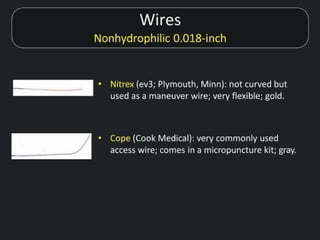
• Hydrophilic wires:useful in a fluid environment and when a
narrow area must be traversed and less resistance is desired
{eg, in small vessels, in the pylorus for percutaneous
gastrostomy).
■ Hydrophilic wires are slippery when wet and sticky when
dry {flush them and keep them wet).
• Nonhydrophilic wires: easier to grip, do not become sticky,
may offer more resistance when traversing narrow areas.
Catheters
General (Nonselective)
• Pigtailor Omniflush (Angiodynamics,
Latham, NY): pigtail end; multiple side
holes on the straight and curved portions
of the catheter; used for venography and
arteriography.
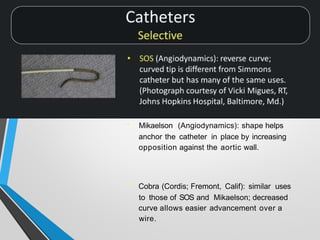
27.
• Mikaelson (Angiodynamics):shape helps
anchor the catheter in place by increasing
opposition against the aortic wall.
• Cobra (Cordis; Fremont, Calif): similar uses
to those of SOS and Mikaelson; decreased
curve allows easier advancement over a
wire.
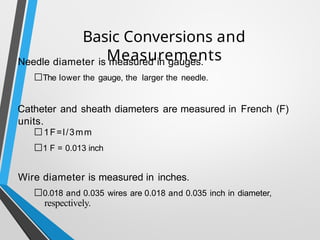
Basic Conversions and
Measurements
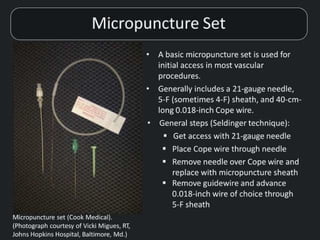
Needlediameter is measured in gauges.
□The lower the gauge, the larger the needle.
Catheter and sheath diameters are measured in French (F)
units.
□1F=l/3mm
□1 F = 0.013 inch
Wire diameter is measured in inches.
□0.018 and 0.035 wires are 0.018 and 0.035 inch in diameter,
respectively.
41.
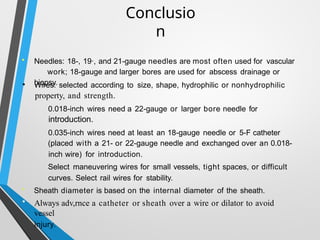
Conclusio
n
• Needles: 18-,19·, and 21-gauge needles are most often used for vascular
work; 18-gauge and larger bores are used for abscess drainage or
biopsy.
Wires: selected according to size, shape, hydrophilic or nonhydrophilic
property, and strength.
0.018-inch wires need a 22-gauge or larger bore needle for
introduction.
0.035-inch wires need at least an 18-gauge needle or 5-F catheter
•
(placed with a 21- or 22-gauge needle and exchanged over an 0.018-
inch wire) for introduction.
Select maneuvering wires for small vessels, tight spaces, or difficult
curves. Select rail wires for stability.
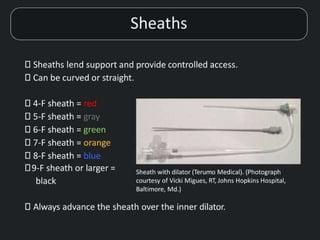
• Sheath diameter is based on the internal diameter of the sheath.
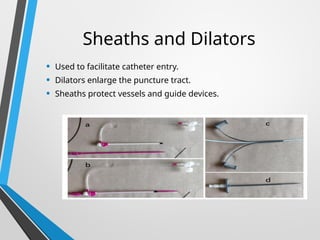
• Always adv,rnce a catheter or sheath over a wire or dilator to avoid
vessel
injury.


![Chest_xray_in_trauma and trauma[PS].pptx](https://cdn.slidesharecdn.com/ss_thumbnails/chestxrayintraumaps-250501045112-cc7e42ce-thumbnail.jpg?width=640&height=640&fit=bounds)


