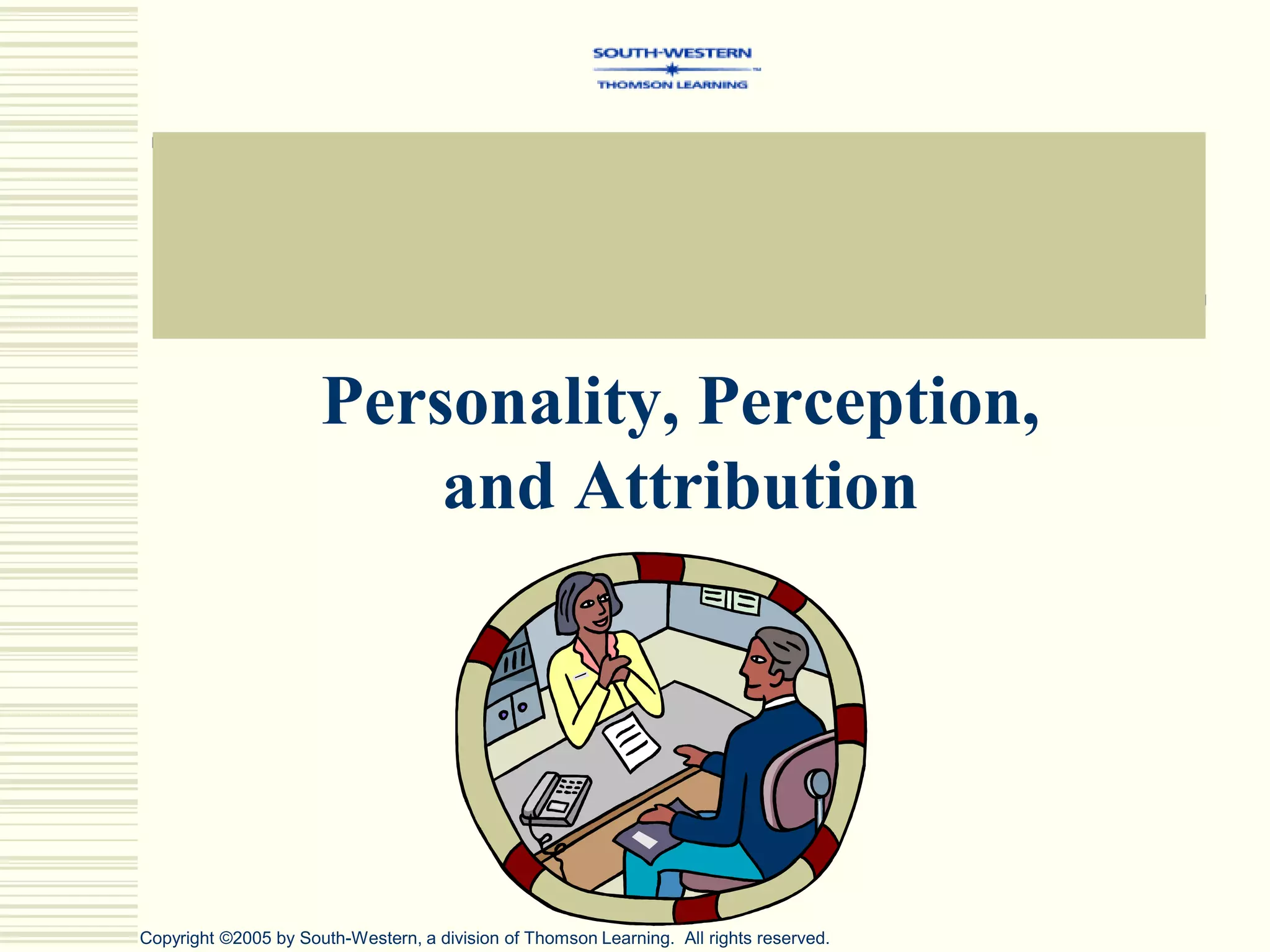
Personality, Perception,
and Attribution
Copyright ©2005 by South-Western, a division of Thomson Learning. All rights reserved.
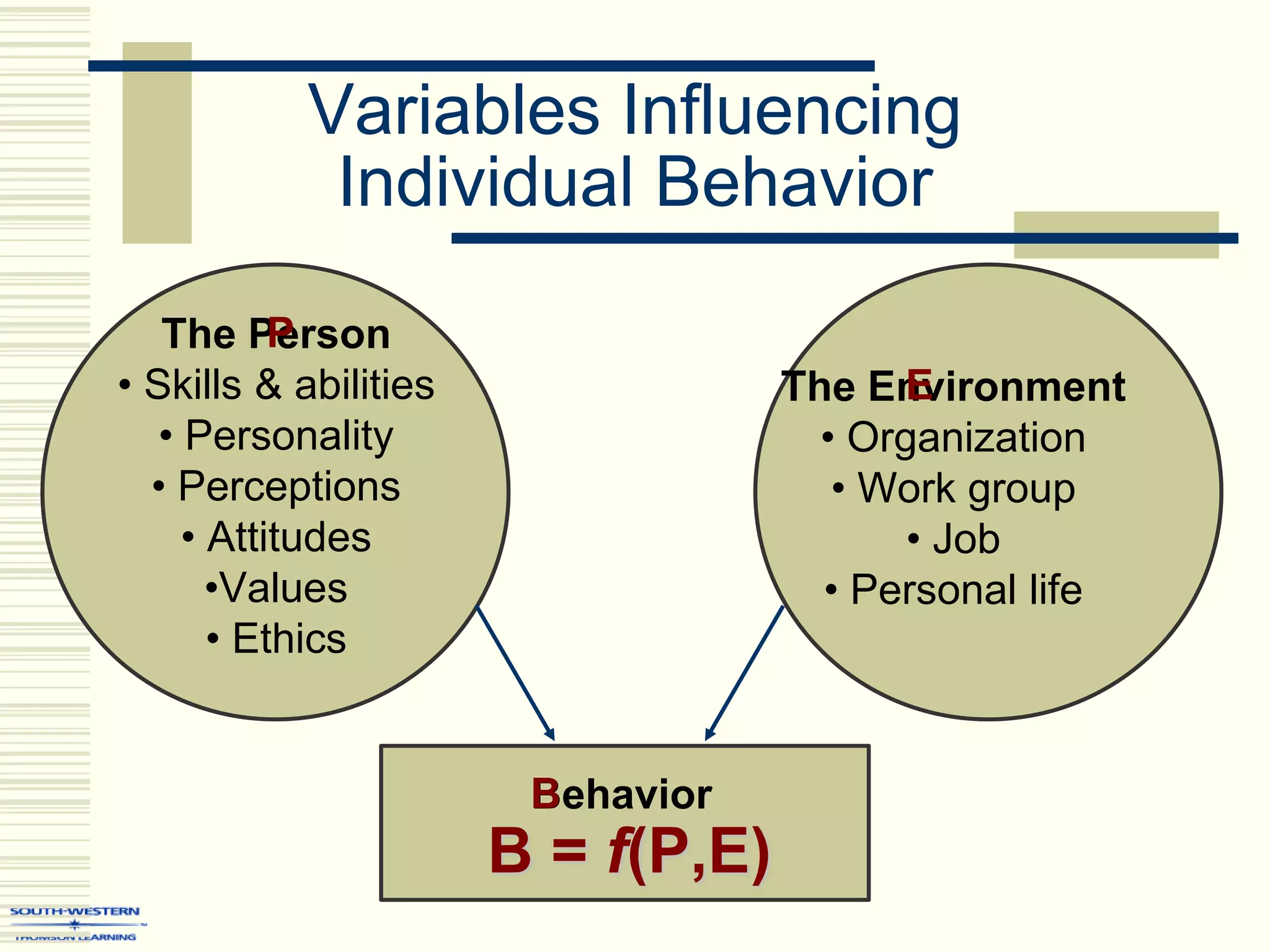
The Environment
• Organization
• Work group
• Job
• Personal life
Variables Influencing
Individual Behavior
The Person
• Skills & abilities
• Personality
• Perceptions
• Attitudes
•Values
• Ethics
Behavior
B = f(P,E)
B
E
P
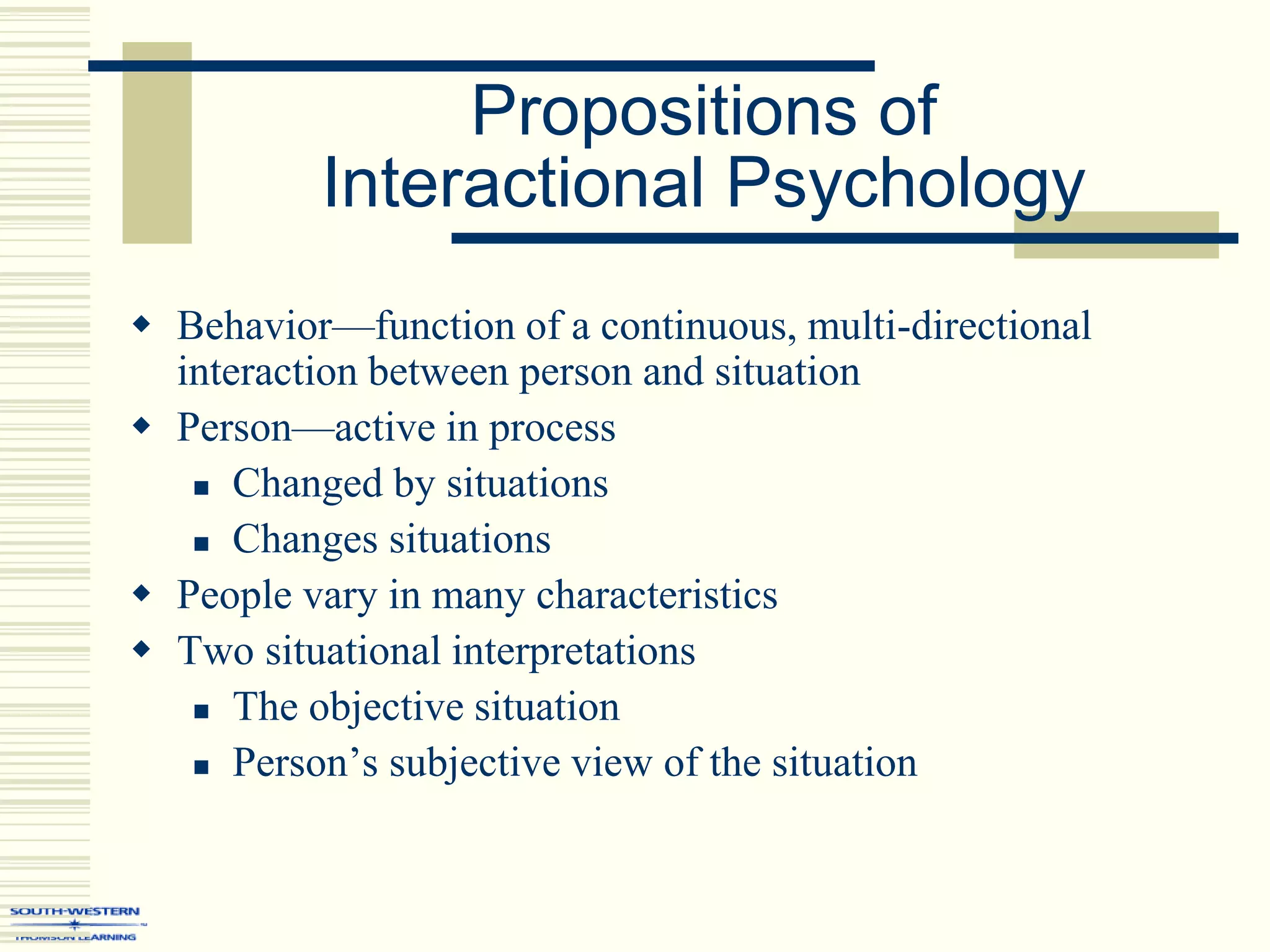
Propositions of
Interactional Psychology
 Behavior—function of a continuous, multi-directional
interaction between person and situation
 Person—active in process
 Changed by situations
 Changes situations
 People vary in many characteristics
 Two situational interpretations
 The objective situation
 Person’s subjective view of the situation
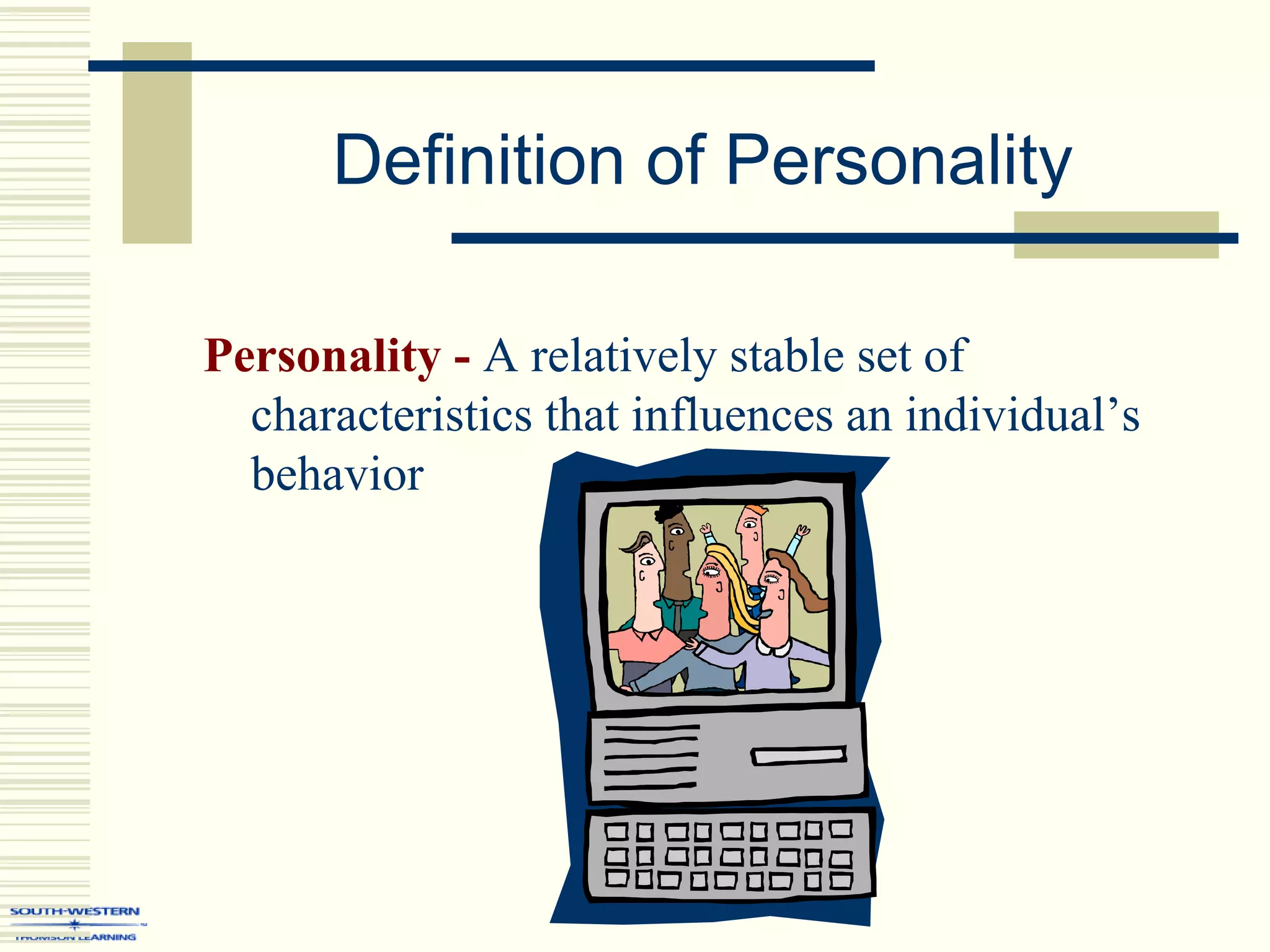
Definition of Personality
Personality - A relatively stable set of
characteristics that influences an individual’s
behavior
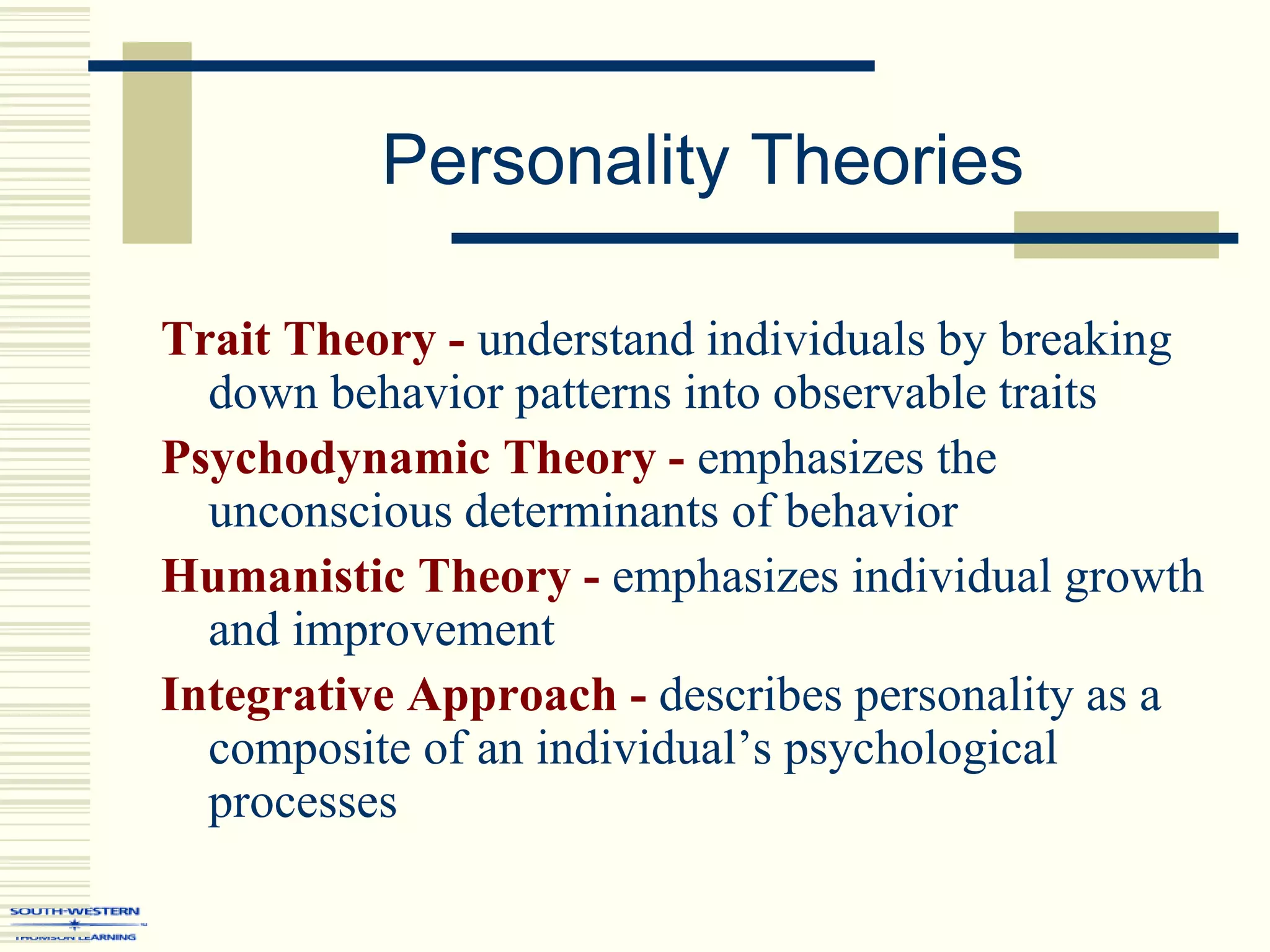
Personality Theories
Trait Theory - understand individuals by breaking
down behavior patterns into observable traits
Psychodynamic Theory - emphasizes the
unconscious determinants of behavior
Humanistic Theory - emphasizes individual growth
and improvement
Integrative Approach - describes personality as a
composite of an individual’s psychological
processes
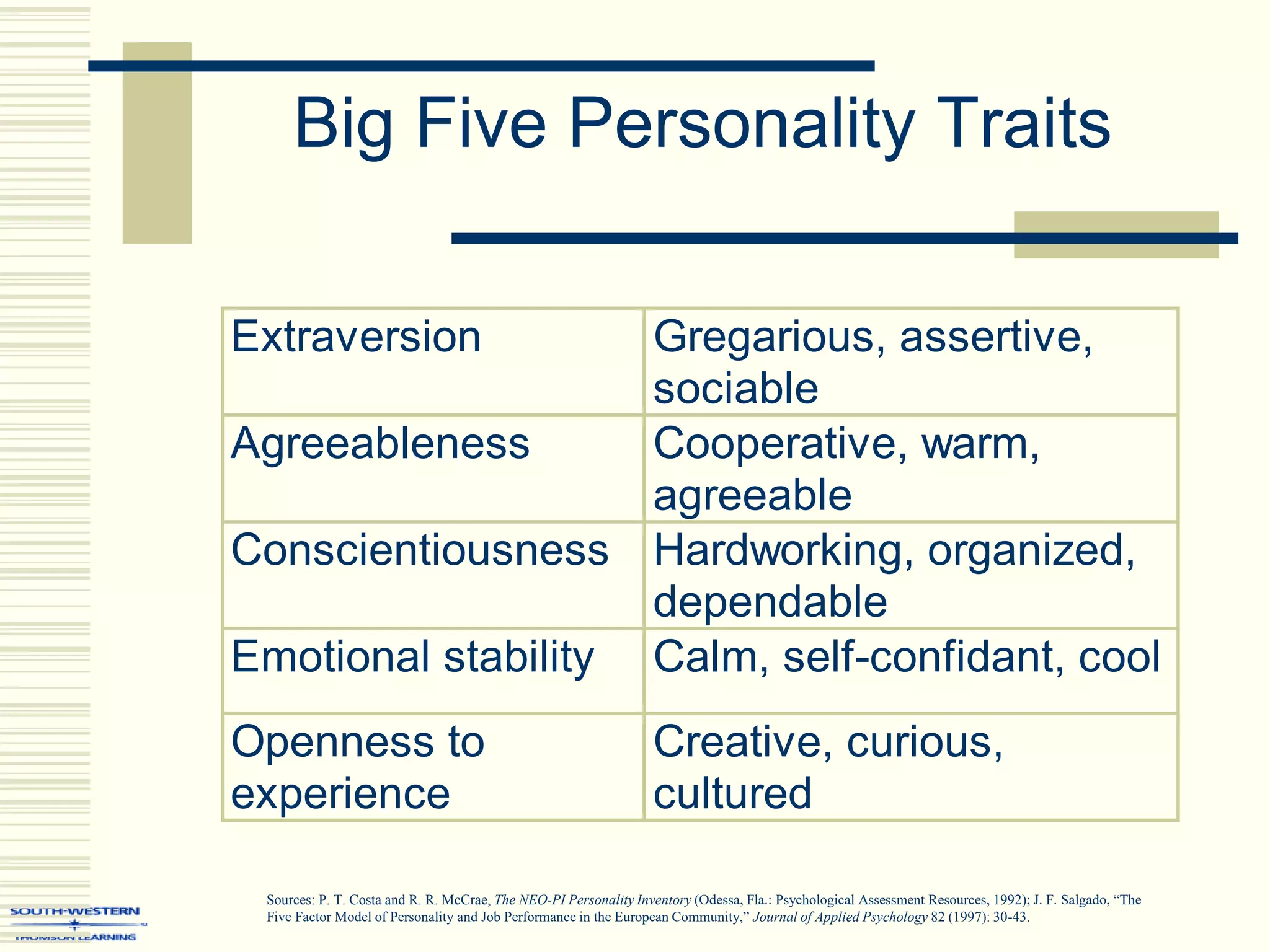
Big Five Personality Traits
Extraversion Gregarious, assertive,
sociable
Agreeableness Cooperative, warm,
agreeable
Conscientiousness Hardworking, organized,
dependable
Emotional stability Calm, self-confidant, cool
Openness to
experience
Creative, curious,
cultured
Sources: P. T. Costa and R. R. McCrae, The NEO-PI Personality Inventory (Odessa, Fla.: Psychological Assessment Resources, 1992); J. F. Salgado, “The
Five Factor Model of Personality and Job Performance in the European Community,” Journal of Applied Psychology 82 (1997): 30-43.
Personality Characteristics
in Organizations
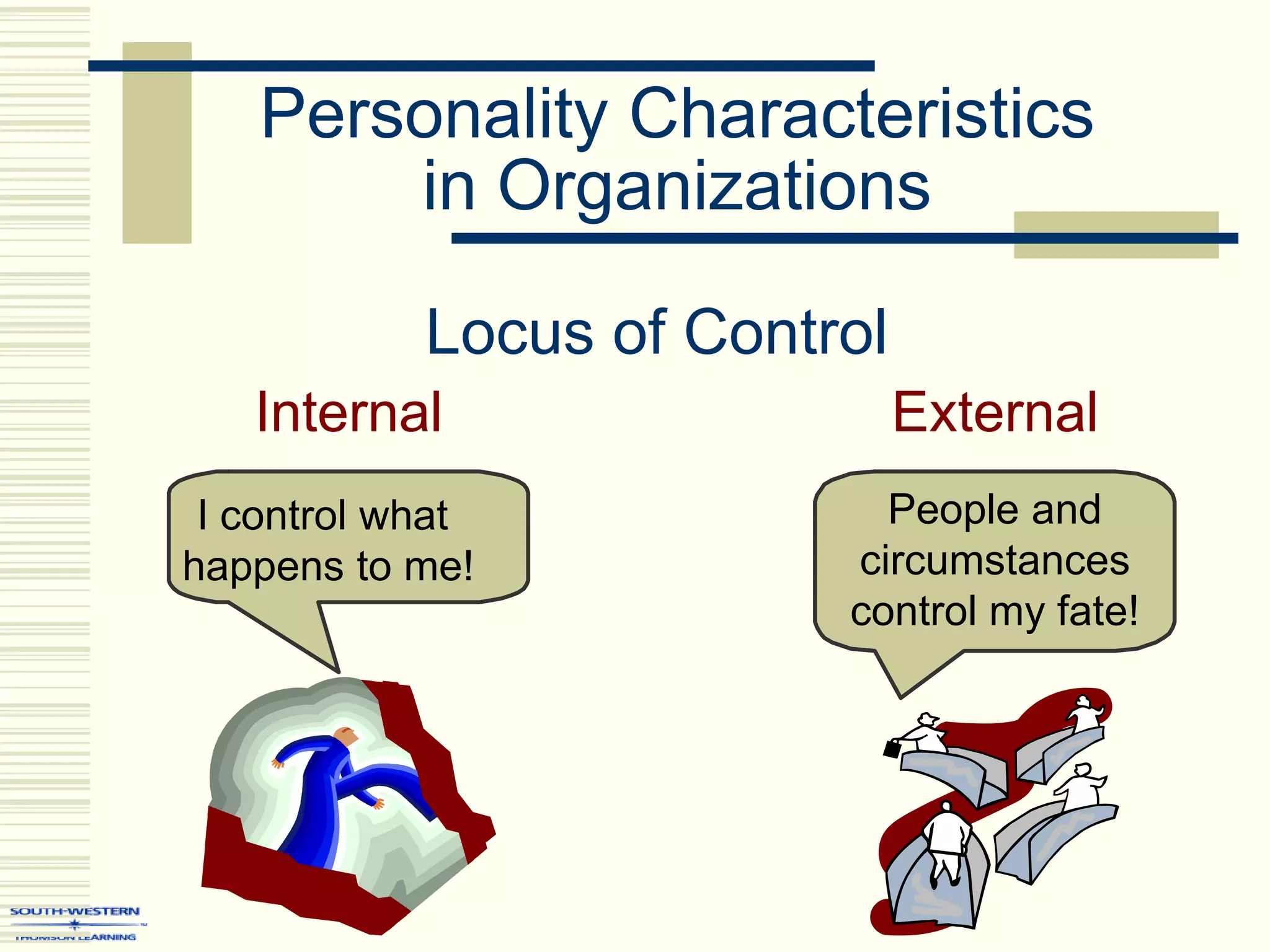
Locus of Control
Internal External
I control what
happens to me!
People and
circumstances
control my fate!
Personality Characteristics
in Organizations
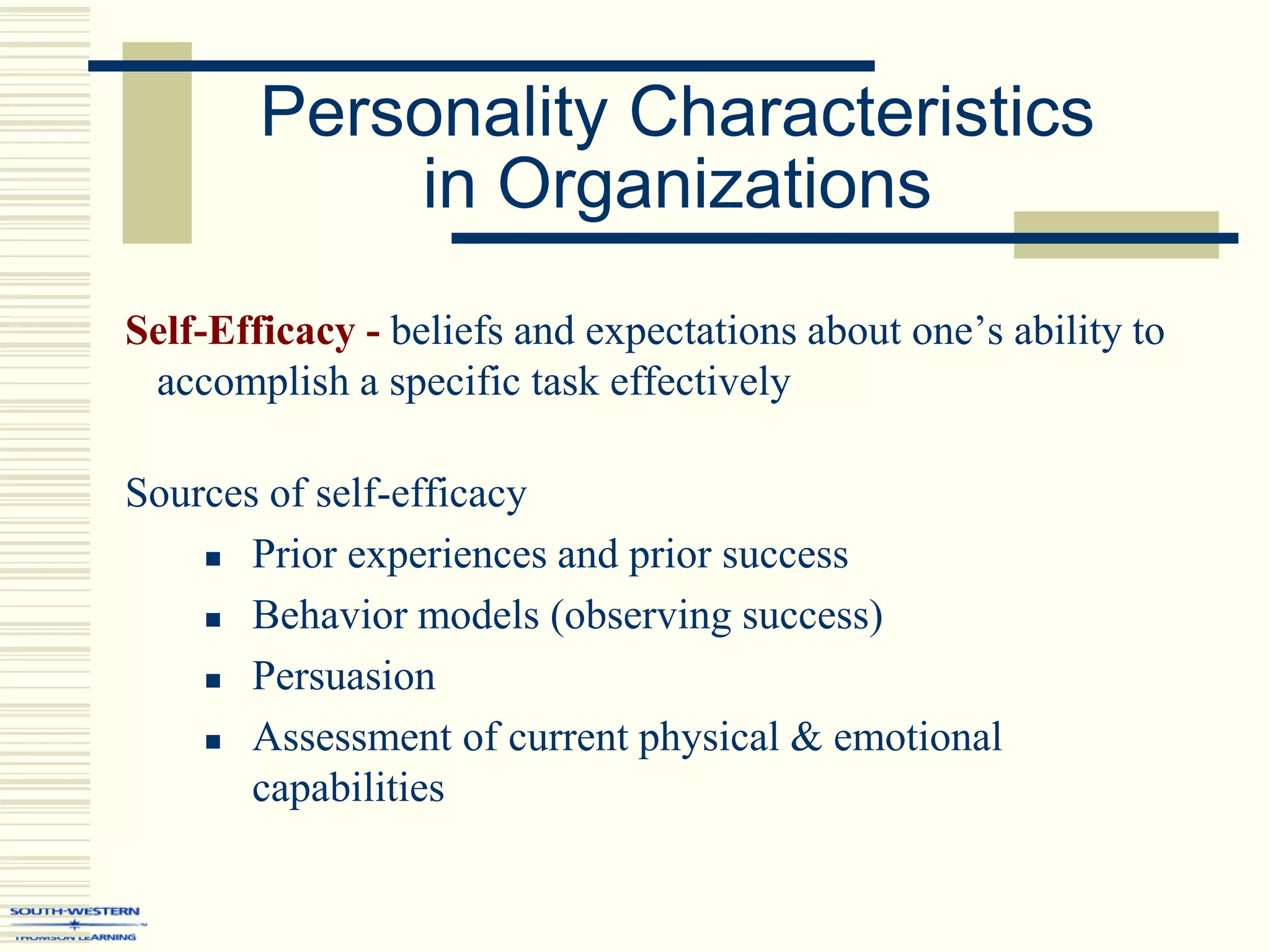
Self-Efficacy - beliefs and expectations about one’s ability to
accomplish a specific task effectively
Sources of self-efficacy
 Prior experiences and prior success
 Behavior models (observing success)
 Persuasion
 Assessment of current physical & emotional
capabilities
Personality Characteristics
in Organizations
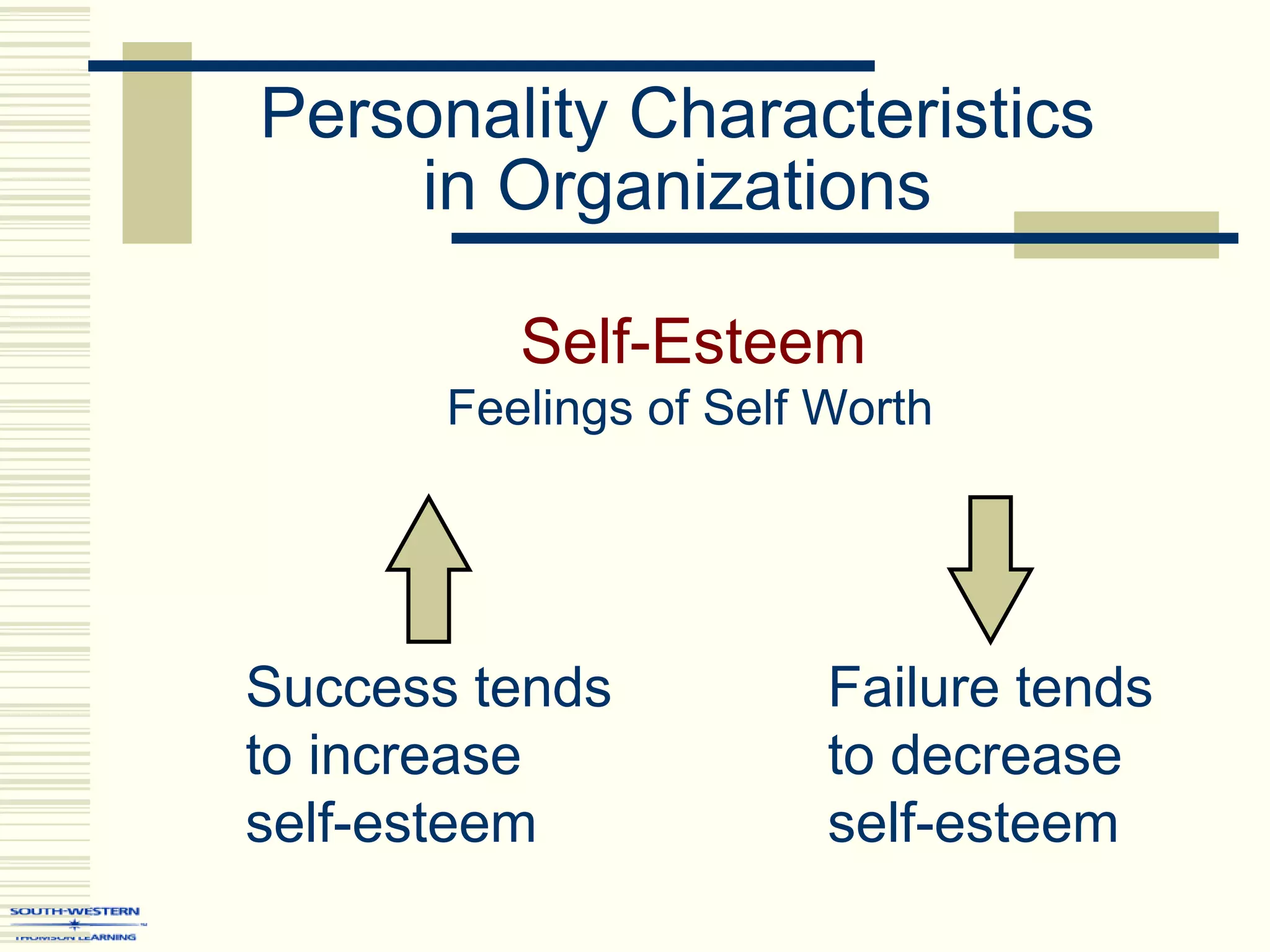
Self-Esteem
Feelings of Self Worth
Success tends
to increase
self-esteem
Failure tends
to decrease
self-esteem
Personality Characteristics
in Organizations
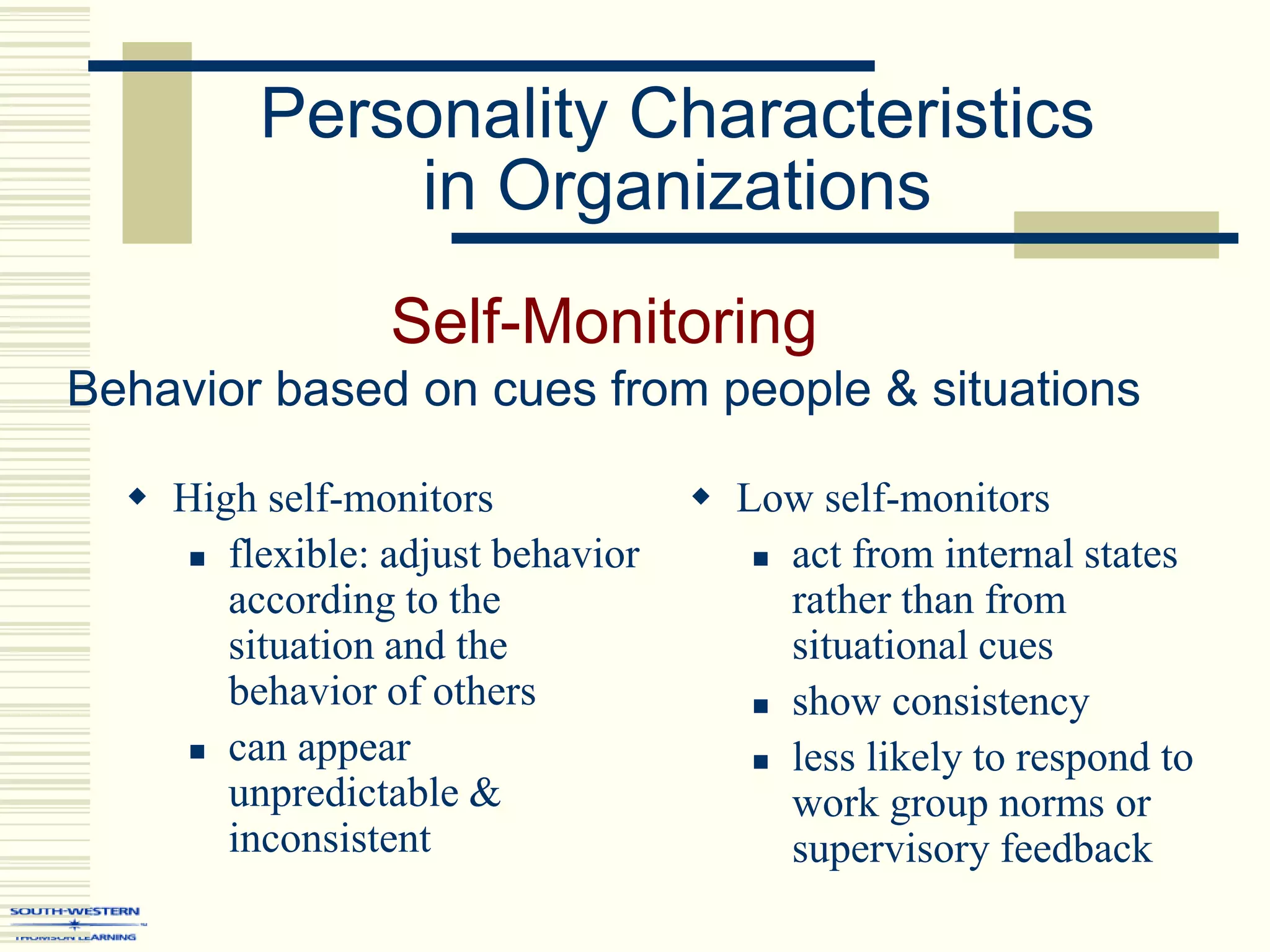
Self-Monitoring
Behavior based on cues from people & situations
 High self-monitors
 flexible: adjust behavior
according to the
situation and the
behavior of others
 can appear
unpredictable &
inconsistent
 Low self-monitors
 act from internal states
rather than from
situational cues
 show consistency
 less likely to respond to
work group norms or
supervisory feedback
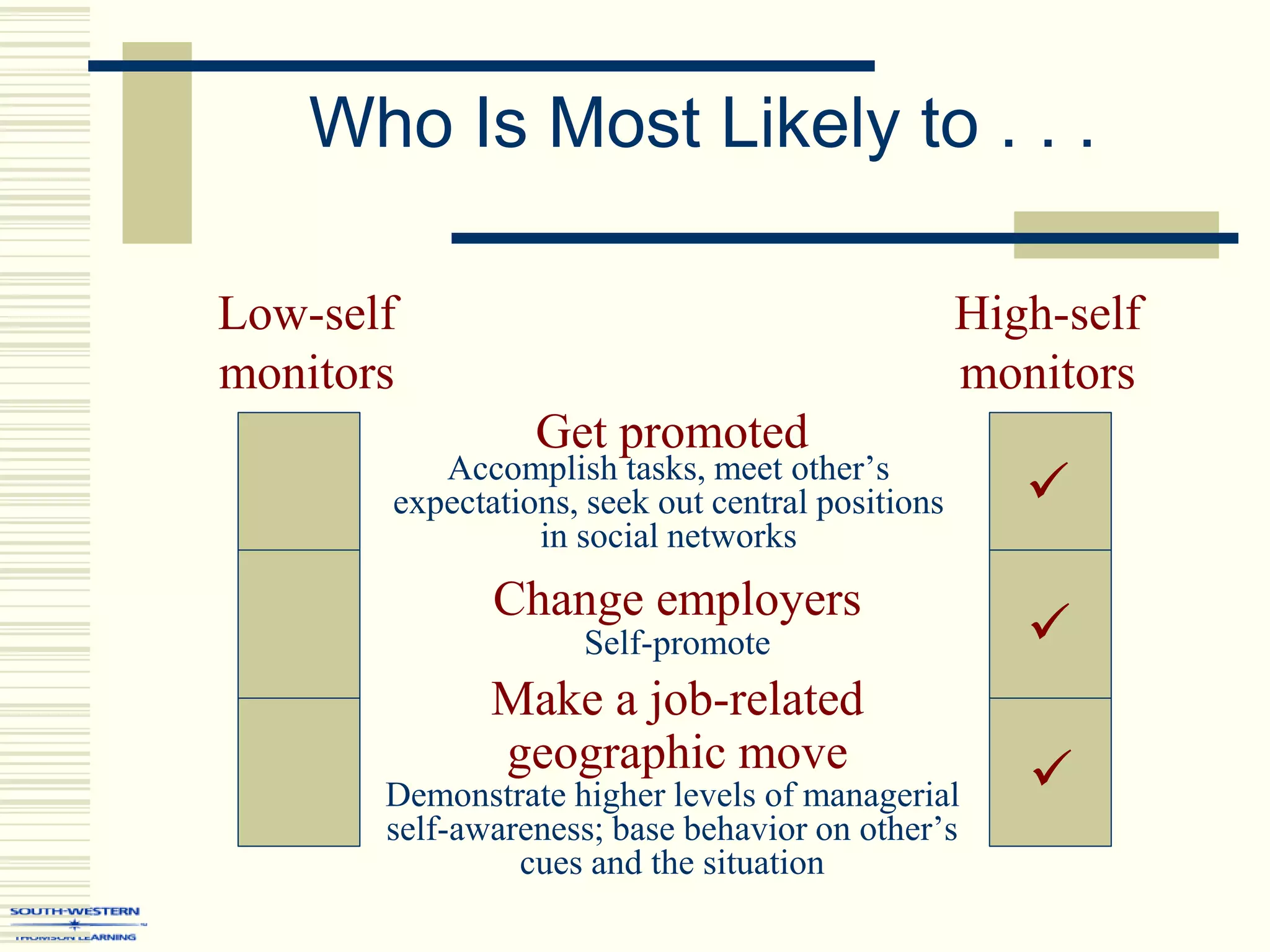
Who Is Most Likely to . . .
Low-self
monitors
High-self
monitors
Get promoted
Change employers
Make a job-related
geographic move

Accomplish tasks, meet other’s
expectations, seek out central positions
in social networks

Self-promote

Demonstrate higher levels of managerial
self-awareness; base behavior on other’s
cues and the situation
Personality Characteristics
in Organizations
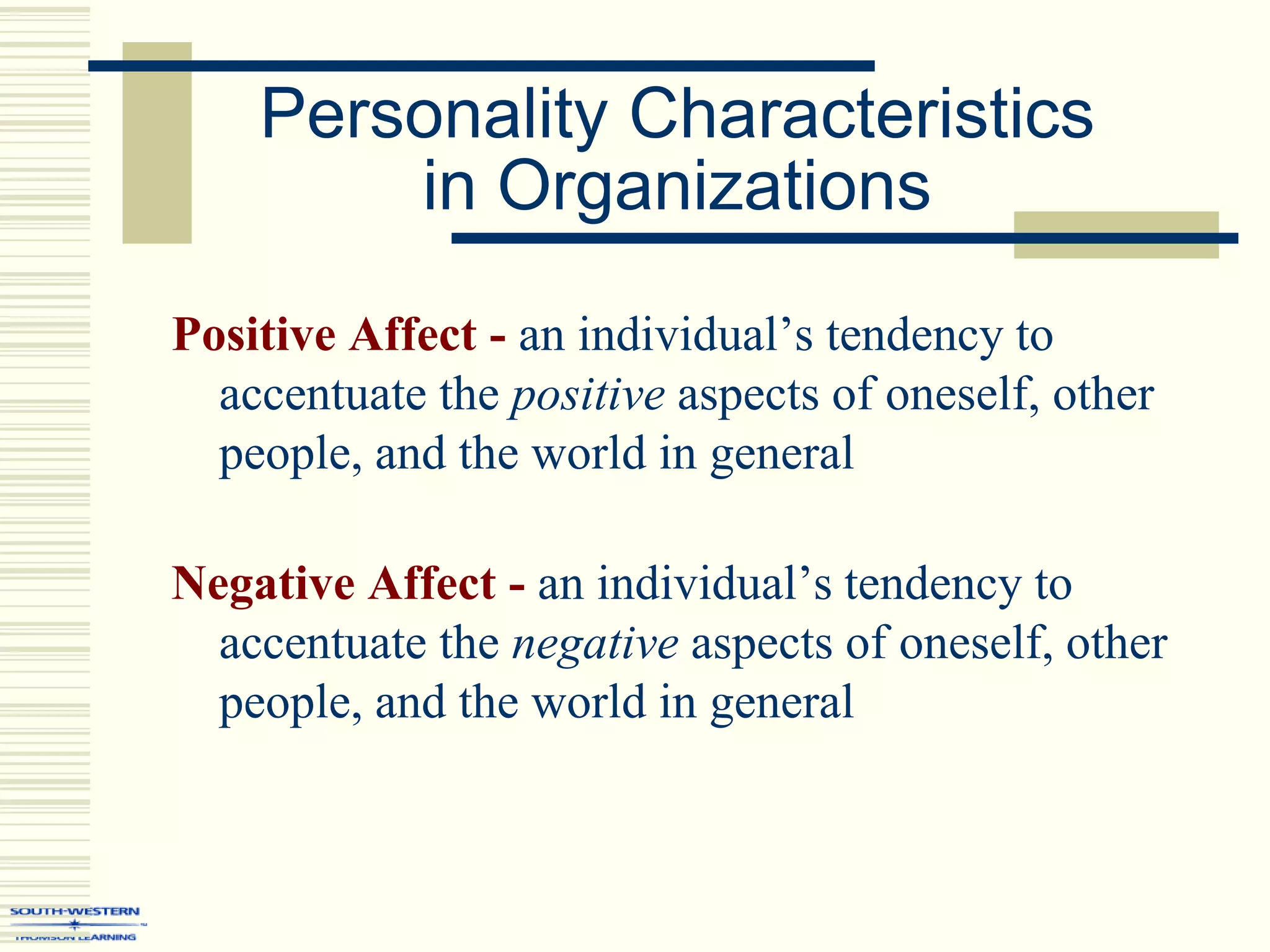
Positive Affect - an individual’s tendency to
accentuate the positive aspects of oneself, other
people, and the world in general
Negative Affect - an individual’s tendency to
accentuate the negative aspects of oneself, other
people, and the world in general
Personality Characteristics
in Organizations
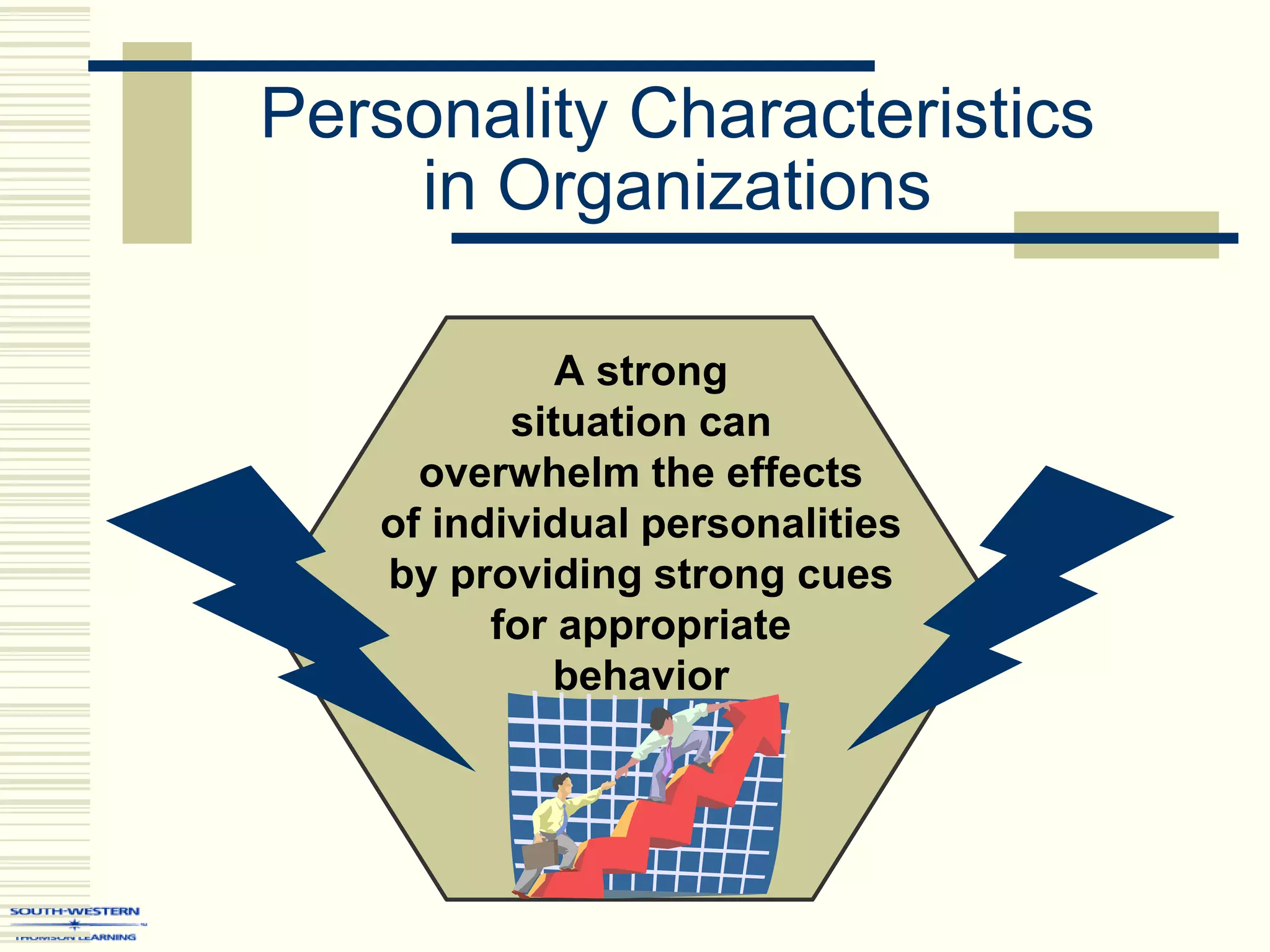
A strong
situation can
overwhelm the effects
of individual personalities
by providing strong cues
for appropriate
behavior
Personality Characteristics
in Organizations
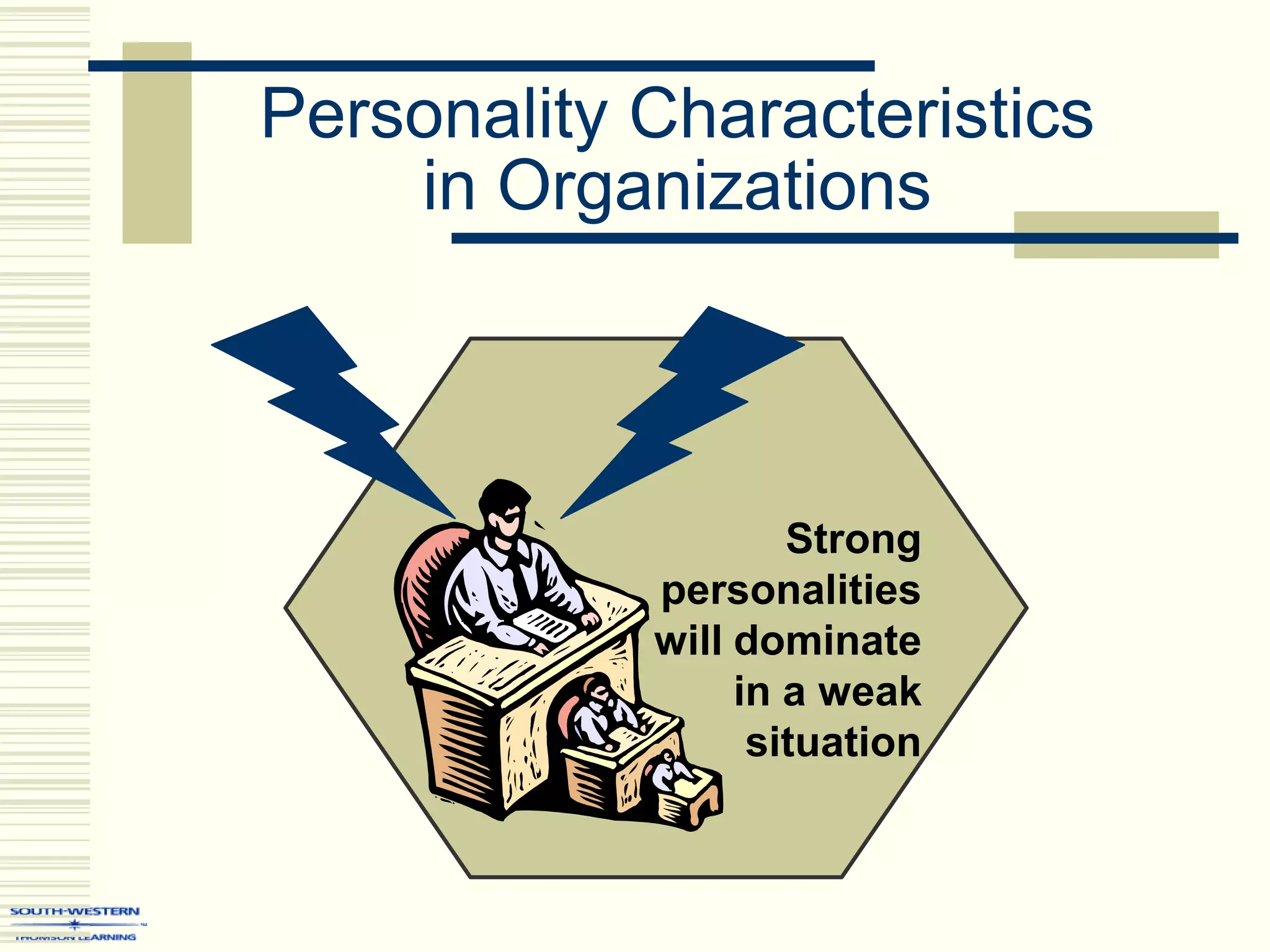
Strong
personalities
will dominate
in a weak
situation
How is Personality Measured?
Projective Test - elicits an individual’s response to
abstract stimuli
Behavioral Measures - personality assessments that
involve observing an individual’s behavior in a
controlled situation
Self-Report Questionnaire - assessment involving an
individual’s responses to questions
Myers-Briggs Type Indicator (MBTI) - instrument
measuring Jung’s theory of individual differences.
Myers-Briggs Type Indicator
 Based on Carl Jung’s work
 People are fundamentally different
 People are fundamentally alike
 People have preference combinations for
extraversion/introversion, perception, judgment
 Briggs & Myers developed the MBTI to understand
individual differences
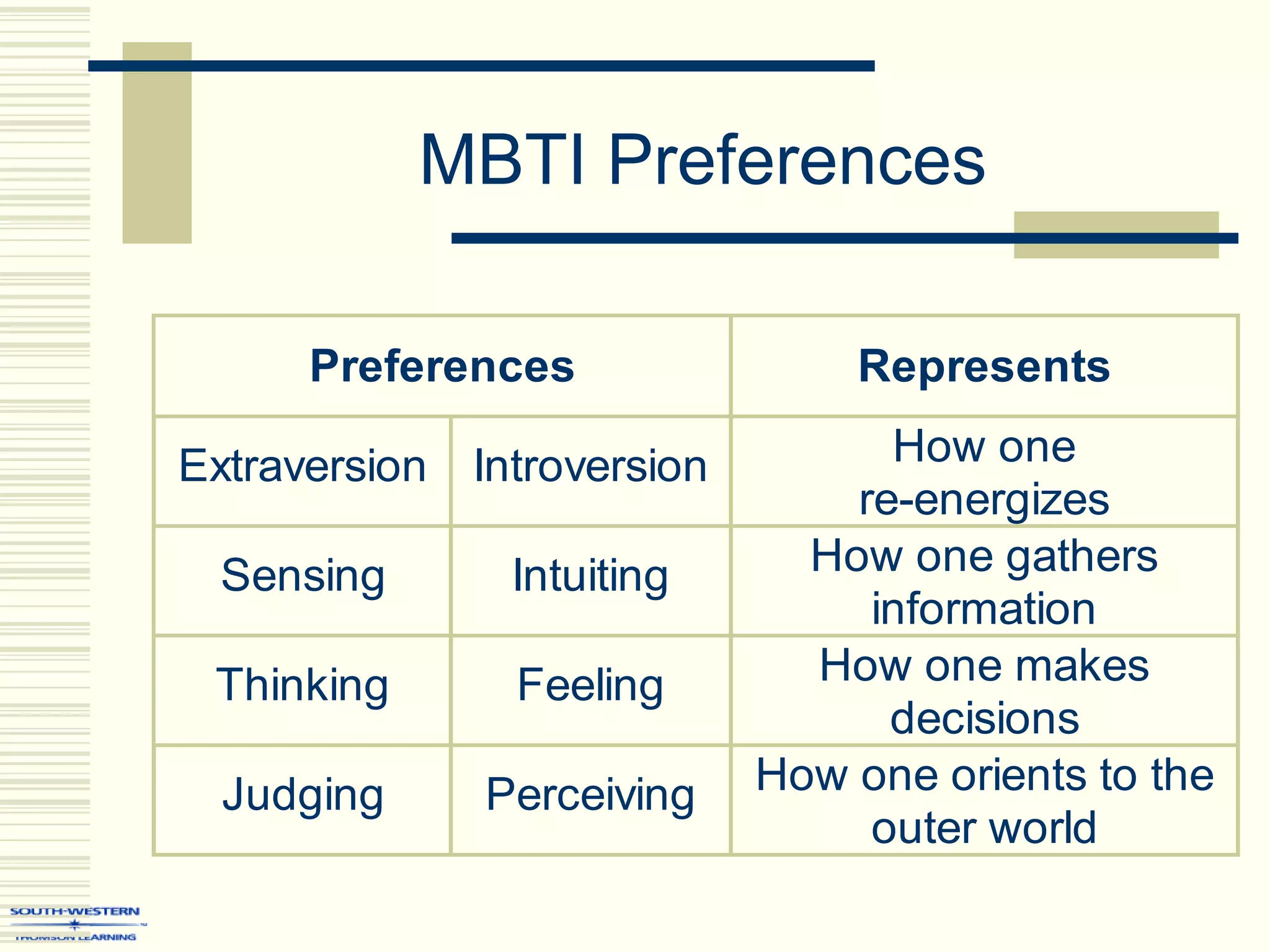
MBTI Preferences
Preferences Represents
Extraversion Introversion How one
re-energizes
Sensing Intuiting How one gathers
information
Thinking Feeling How one makes
decisions
Judging Perceiving How one orients to the
outer world
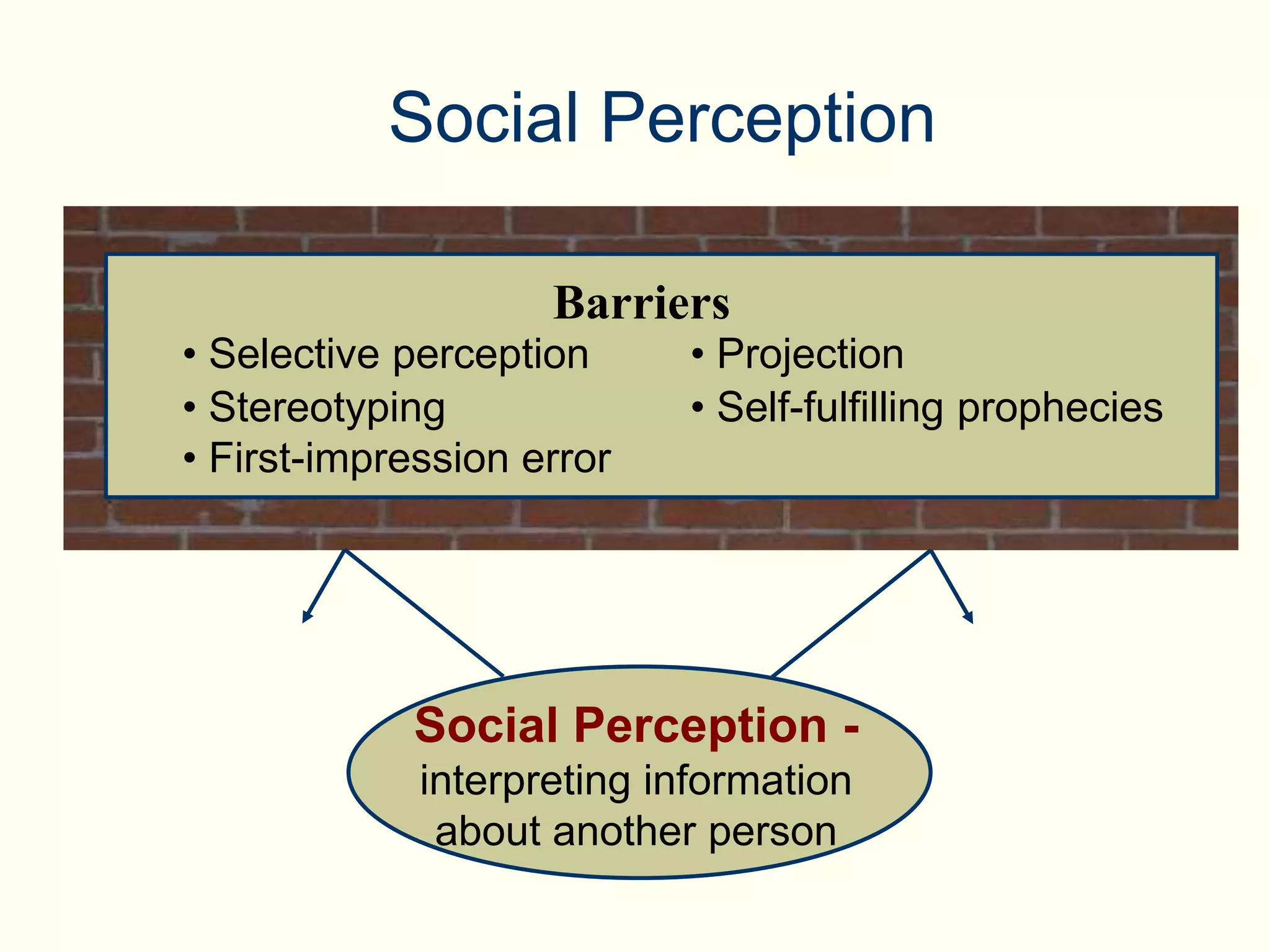
Social Perception -
interpreting information
about another person
Social Perception
Barriers
• Selective perception
• Stereotyping
• First-impression error
• Projection
• Self-fulfilling prophecies
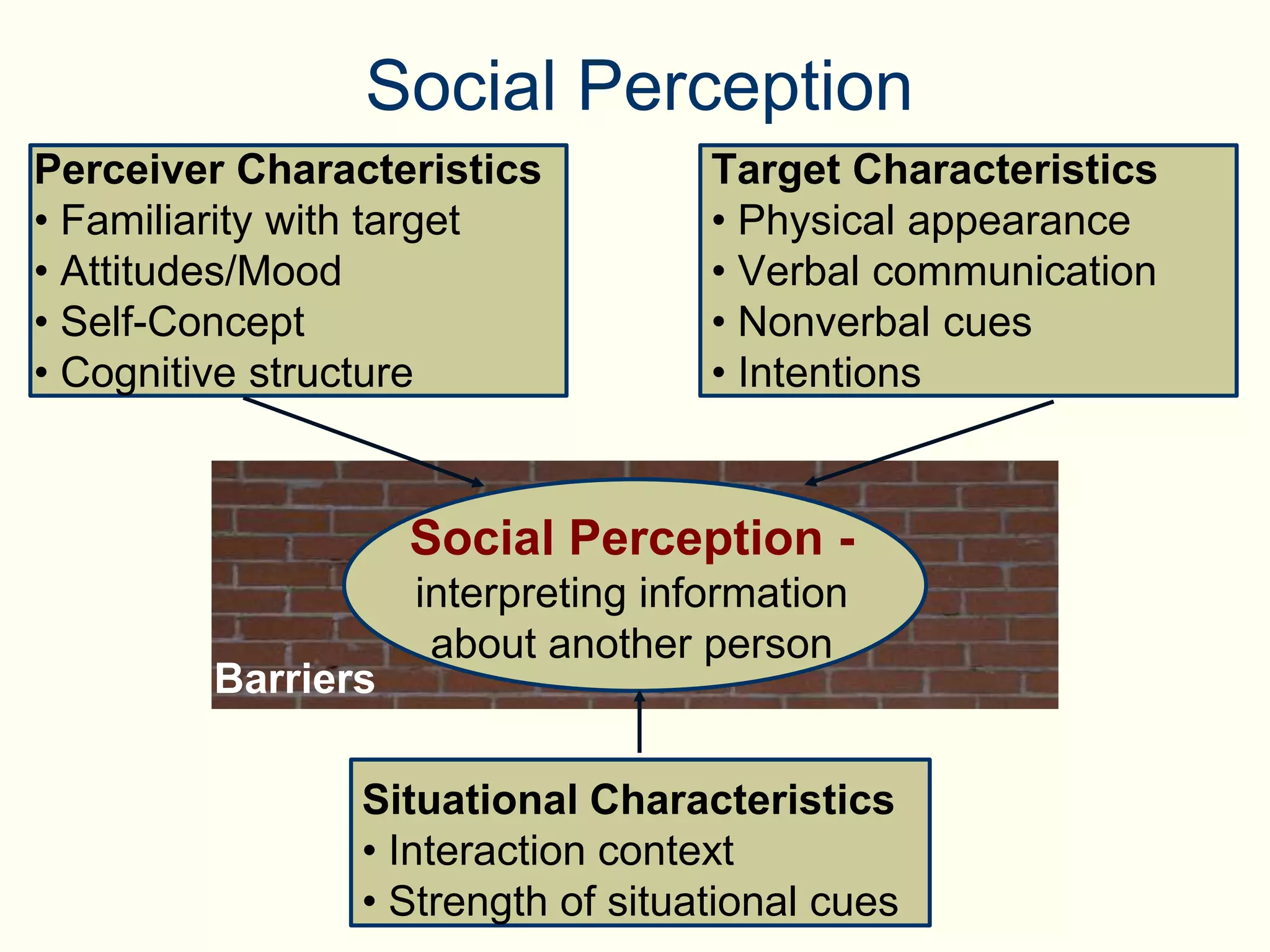
Social Perception -
interpreting information
about another person
Social Perception
Perceiver Characteristics
• Familiarity with target
• Attitudes/Mood
• Self-Concept
• Cognitive structure
Target Characteristics
• Physical appearance
• Verbal communication
• Nonverbal cues
• Intentions
Situational Characteristics
• Interaction context
• Strength of situational cues
Barriers
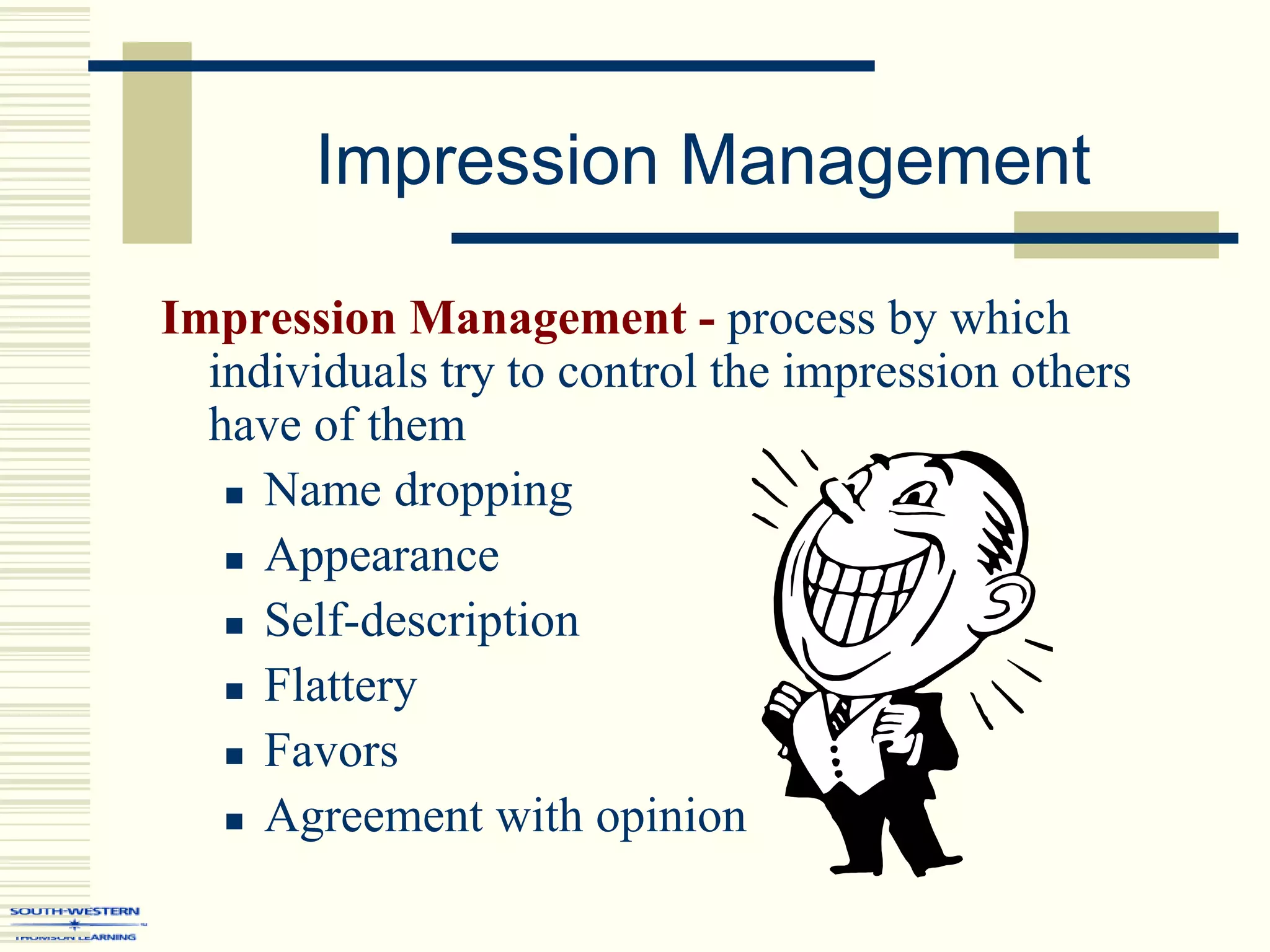
Impression Management
Impression Management - process by which
individuals try to control the impression others
have of them
 Name dropping
 Appearance
 Self-description
 Flattery
 Favors
 Agreement with opinion
Attribution Theory
Attribution theory - explains how individuals
pinpoint the causes of their own behavior or that of
others
Information cues for attribution information gathering
 consensus
 distinctiveness
 consistency
Attribution Biases
Fundamental Attribution Error - tendency
to make attributions to internal causes when
focusing on someone else’s behavior
Self-serving Bias - tendency to attribute one’s
own successes to internal causes and one’s
failures to external causes

ch03.ppt

  • 1.
    Personality, Perception, and Attribution Copyright©2005 by South-Western, a division of Thomson Learning. All rights reserved.
  • 2.
    The Environment • Organization •Work group • Job • Personal life Variables Influencing Individual Behavior The Person • Skills & abilities • Personality • Perceptions • Attitudes •Values • Ethics Behavior B = f(P,E) B E P
  • 3.
    Propositions of Interactional Psychology Behavior—function of a continuous, multi-directional interaction between person and situation  Person—active in process  Changed by situations  Changes situations  People vary in many characteristics  Two situational interpretations  The objective situation  Person’s subjective view of the situation
  • 4.
    Definition of Personality Personality- A relatively stable set of characteristics that influences an individual’s behavior
  • 5.
    Personality Theories Trait Theory- understand individuals by breaking down behavior patterns into observable traits Psychodynamic Theory - emphasizes the unconscious determinants of behavior Humanistic Theory - emphasizes individual growth and improvement Integrative Approach - describes personality as a composite of an individual’s psychological processes
  • 6.
    Big Five PersonalityTraits Extraversion Gregarious, assertive, sociable Agreeableness Cooperative, warm, agreeable Conscientiousness Hardworking, organized, dependable Emotional stability Calm, self-confidant, cool Openness to experience Creative, curious, cultured Sources: P. T. Costa and R. R. McCrae, The NEO-PI Personality Inventory (Odessa, Fla.: Psychological Assessment Resources, 1992); J. F. Salgado, “The Five Factor Model of Personality and Job Performance in the European Community,” Journal of Applied Psychology 82 (1997): 30-43.
  • 7.
    Personality Characteristics in Organizations Locusof Control Internal External I control what happens to me! People and circumstances control my fate!
  • 8.
    Personality Characteristics in Organizations Self-Efficacy- beliefs and expectations about one’s ability to accomplish a specific task effectively Sources of self-efficacy  Prior experiences and prior success  Behavior models (observing success)  Persuasion  Assessment of current physical & emotional capabilities
  • 9.
    Personality Characteristics in Organizations Self-Esteem Feelingsof Self Worth Success tends to increase self-esteem Failure tends to decrease self-esteem
  • 10.
    Personality Characteristics in Organizations Self-Monitoring Behaviorbased on cues from people & situations  High self-monitors  flexible: adjust behavior according to the situation and the behavior of others  can appear unpredictable & inconsistent  Low self-monitors  act from internal states rather than from situational cues  show consistency  less likely to respond to work group norms or supervisory feedback
  • 11.
    Who Is MostLikely to . . . Low-self monitors High-self monitors Get promoted Change employers Make a job-related geographic move  Accomplish tasks, meet other’s expectations, seek out central positions in social networks  Self-promote  Demonstrate higher levels of managerial self-awareness; base behavior on other’s cues and the situation
  • 12.
    Personality Characteristics in Organizations PositiveAffect - an individual’s tendency to accentuate the positive aspects of oneself, other people, and the world in general Negative Affect - an individual’s tendency to accentuate the negative aspects of oneself, other people, and the world in general
  • 13.
    Personality Characteristics in Organizations Astrong situation can overwhelm the effects of individual personalities by providing strong cues for appropriate behavior
  • 14.
  • 15.
    How is PersonalityMeasured? Projective Test - elicits an individual’s response to abstract stimuli Behavioral Measures - personality assessments that involve observing an individual’s behavior in a controlled situation Self-Report Questionnaire - assessment involving an individual’s responses to questions Myers-Briggs Type Indicator (MBTI) - instrument measuring Jung’s theory of individual differences.
  • 16.
    Myers-Briggs Type Indicator Based on Carl Jung’s work  People are fundamentally different  People are fundamentally alike  People have preference combinations for extraversion/introversion, perception, judgment  Briggs & Myers developed the MBTI to understand individual differences
  • 17.
    MBTI Preferences Preferences Represents ExtraversionIntroversion How one re-energizes Sensing Intuiting How one gathers information Thinking Feeling How one makes decisions Judging Perceiving How one orients to the outer world
  • 18.
    Social Perception - interpretinginformation about another person Social Perception Barriers • Selective perception • Stereotyping • First-impression error • Projection • Self-fulfilling prophecies
  • 19.
    Social Perception - interpretinginformation about another person Social Perception Perceiver Characteristics • Familiarity with target • Attitudes/Mood • Self-Concept • Cognitive structure Target Characteristics • Physical appearance • Verbal communication • Nonverbal cues • Intentions Situational Characteristics • Interaction context • Strength of situational cues Barriers
  • 20.
    Impression Management Impression Management- process by which individuals try to control the impression others have of them  Name dropping  Appearance  Self-description  Flattery  Favors  Agreement with opinion
  • 21.
    Attribution Theory Attribution theory- explains how individuals pinpoint the causes of their own behavior or that of others Information cues for attribution information gathering  consensus  distinctiveness  consistency
  • 22.
    Attribution Biases Fundamental AttributionError - tendency to make attributions to internal causes when focusing on someone else’s behavior Self-serving Bias - tendency to attribute one’s own successes to internal causes and one’s failures to external causes