
PRESENTATION ON
PERCEPTION
PRESENTING BY:-
Bhupinder Gautam(007)
Diksha Raghav(008)
Rohit Saklani(009)
Vikas Basist(011)
Anant Pandey(013)
Lakhvinder Singh(014)
Anjali Bhatt(015)
UNDER THE GUIDENCE OF
Ms. Priyanka Aneja ma’am
PRESENTATION OUTLINE
 INTRODUCTION
 MEANING
 SIGNIFICANCE
 THE PROCESS
 PERCEPTUAL MECHANISM
 PERCEPTUAL SELECTIVITY
 PERCEPTUAL ORGANISATION
 PERCEPTUAL INTERPRETATION
 CHAR. OF THE PERCEIVER
 IMPLICATIONS FOR MGT.
 ERRORS & DISTORTION
 GUIDELINES FOR IMPROVING PERCEPTION
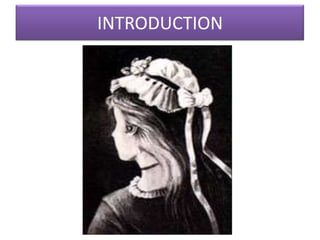
INTRODUCTION
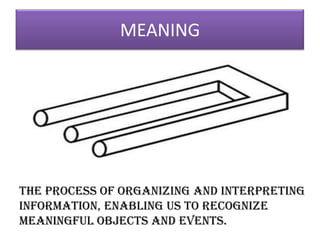
MEANING
The process of organizing and interpreting
information, enabling us to recognize
meaningful objects and events.
WHY WE STUDY PERCEPTION
• To better understand how people make
attributions about events.
• We don’t see reality. We interpret what we see
and call it reality.
• The attribution process guides our
behaviour, regardless of the truth of the
attribution.
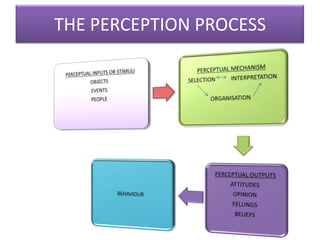
THE PERCEPTION PROCESS
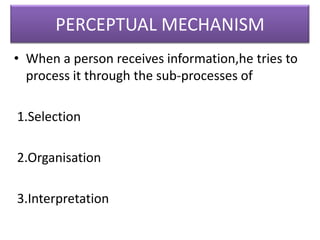
PERCEPTUAL MECHANISM
• When a person receives information,he tries to
process it through the sub-processes of
1.Selection
2.Organisation
3.Interpretation
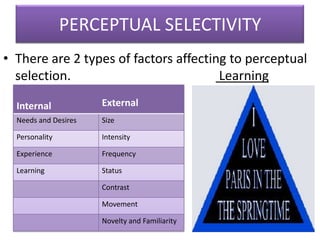
PERCEPTUAL SELECTIVITY
• There are 2 types of factors affecting to perceptual
selection. Learning
Internal External
Needs and Desires Size
Personality Intensity
Experience Frequency
Learning Status
Contrast
Movement
Novelty and Familiarity
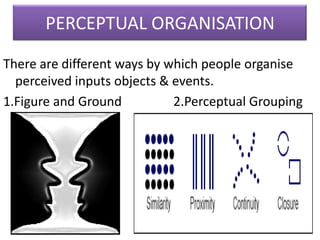
PERCEPTUAL ORGANISATION
There are different ways by which people organise
perceived inputs objects & events.
1.Figure and Ground 2.Perceptual Grouping
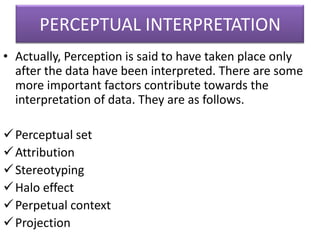
PERCEPTUAL INTERPRETATION
• Actually, Perception is said to have taken place only
after the data have been interpreted. There are some
more important factors contribute towards the
interpretation of data. They are as follows.
Perceptual set
Attribution
Stereotyping
Halo effect
Perpetual context
Projection
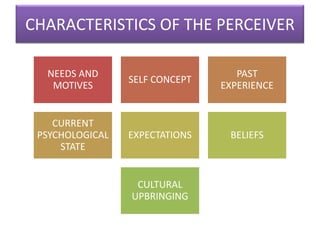
CHARACTERISTICS OF THE PERCEIVER
NEEDS AND
MOTIVES
SELF CONCEPT
PAST
EXPERIENCE
CURRENT
PSYCHOLOGICAL
STATE
EXPECTATIONS BELIEFS
CULTURAL
UPBRINGING
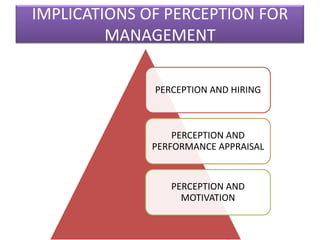
IMPLICATIONS OF PERCEPTION FOR
MANAGEMENT
PERCEPTION AND HIRING
PERCEPTION AND
PERFORMANCE APPRAISAL
PERCEPTION AND
MOTIVATION
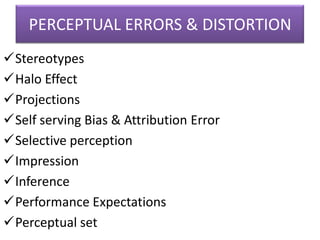
PERCEPTUAL ERRORS & DISTORTION
Stereotypes
Halo Effect
Projections
Self serving Bias & Attribution Error
Selective perception
Impression
Inference
Performance Expectations
Perceptual set
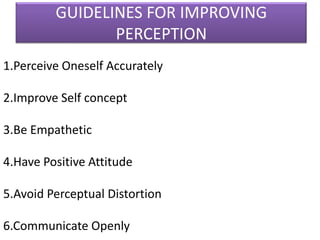
GUIDELINES FOR IMPROVING
PERCEPTION
1.Perceive Oneself Accurately
2.Improve Self concept
3.Be Empathetic
4.Have Positive Attitude
5.Avoid Perceptual Distortion
6.Communicate Openly
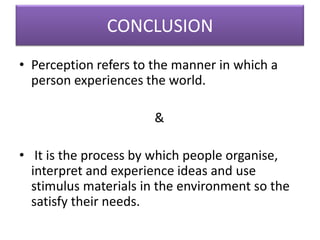
CONCLUSION
• Perception refers to the manner in which a
person experiences the world.
&
• It is the process by which people organise,
interpret and experience ideas and use
stimulus materials in the environment so the
satisfy their needs.
THANK YOU FOR
YOUR
ATTENTION

Perception

  • 1.
    PRESENTATION ON PERCEPTION PRESENTING BY:- BhupinderGautam(007) Diksha Raghav(008) Rohit Saklani(009) Vikas Basist(011) Anant Pandey(013) Lakhvinder Singh(014) Anjali Bhatt(015) UNDER THE GUIDENCE OF Ms. Priyanka Aneja ma’am
  • 2.
    PRESENTATION OUTLINE  INTRODUCTION MEANING  SIGNIFICANCE  THE PROCESS  PERCEPTUAL MECHANISM  PERCEPTUAL SELECTIVITY  PERCEPTUAL ORGANISATION  PERCEPTUAL INTERPRETATION  CHAR. OF THE PERCEIVER  IMPLICATIONS FOR MGT.  ERRORS & DISTORTION  GUIDELINES FOR IMPROVING PERCEPTION
  • 3.
  • 4.
    MEANING The process oforganizing and interpreting information, enabling us to recognize meaningful objects and events.
  • 5.
    WHY WE STUDYPERCEPTION • To better understand how people make attributions about events. • We don’t see reality. We interpret what we see and call it reality. • The attribution process guides our behaviour, regardless of the truth of the attribution.
  • 6.
  • 7.
    PERCEPTUAL MECHANISM • Whena person receives information,he tries to process it through the sub-processes of 1.Selection 2.Organisation 3.Interpretation
  • 8.
    PERCEPTUAL SELECTIVITY • Thereare 2 types of factors affecting to perceptual selection. Learning Internal External Needs and Desires Size Personality Intensity Experience Frequency Learning Status Contrast Movement Novelty and Familiarity
  • 9.
    PERCEPTUAL ORGANISATION There aredifferent ways by which people organise perceived inputs objects & events. 1.Figure and Ground 2.Perceptual Grouping
  • 10.
    PERCEPTUAL INTERPRETATION • Actually,Perception is said to have taken place only after the data have been interpreted. There are some more important factors contribute towards the interpretation of data. They are as follows. Perceptual set Attribution Stereotyping Halo effect Perpetual context Projection
  • 11.
    CHARACTERISTICS OF THEPERCEIVER NEEDS AND MOTIVES SELF CONCEPT PAST EXPERIENCE CURRENT PSYCHOLOGICAL STATE EXPECTATIONS BELIEFS CULTURAL UPBRINGING
  • 12.
    IMPLICATIONS OF PERCEPTIONFOR MANAGEMENT PERCEPTION AND HIRING PERCEPTION AND PERFORMANCE APPRAISAL PERCEPTION AND MOTIVATION
  • 13.
    PERCEPTUAL ERRORS &DISTORTION Stereotypes Halo Effect Projections Self serving Bias & Attribution Error Selective perception Impression Inference Performance Expectations Perceptual set
  • 14.
    GUIDELINES FOR IMPROVING PERCEPTION 1.PerceiveOneself Accurately 2.Improve Self concept 3.Be Empathetic 4.Have Positive Attitude 5.Avoid Perceptual Distortion 6.Communicate Openly
  • 15.
    CONCLUSION • Perception refersto the manner in which a person experiences the world. & • It is the process by which people organise, interpret and experience ideas and use stimulus materials in the environment so the satisfy their needs.
  • 16.