 Peppermint (Mentha × piperita), also known as M.
 balsamea Wild.) is a hybrid mint, a cross
 between watermint and spearmint. Peppermint was
 first described in 1753 by Carolus Linnaeus from
 specimens that had been collected in England; he
 treated it as a species, but it is now universally agreed
 to be a hybrid. The plant, indigenous to Europe, is now
 widespread in cultivation throughout all regions of the
 world. It is a herbaceous rhizomatous perennial
 plant growing to 30–90 cm (12–35 in) tall, with smooth
 stems, square in cross section. The rhizomes are wide-
 spreading, fleshy, and bare fibrous roots.
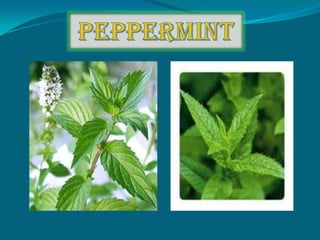
 Peppermint plants grow to about 2 - 3 feet tall. They
  bloom from July through August, sprouting tiny purple
  flowers in whorls and terminal spikes.
 Dark green, fragrant leaves grow opposite white
  flowers. Peppermint is native to Europe and Asia, is
  naturalized to North America, and grows wild in
  moist, temperate areas. Some varieties are indigenous
  to South Africa, South America, and Australia.
Peppermint typically occurs in moist
 habitats, including stream sides and drainage
 ditches. Being a hybrid, it is
 usually sterile, producing no seeds and
 reproducing only vegetative, spreading by
 its rhizomes. If placed, it can grow
 anywhere, with a few exceptions.
Outside of its native range, areas where
 peppermint was formerly grown for oil often
 have an abundance of feral plants, and it is
 considered invasive in Australia, the Galápagos
 Islands, New Zealand, and in the United States.
 Peppermint generally grows best in moist, shaded
 locations, and expands by underground stolons. Young
 shoots are taken from old stocks and dibbled into the
 ground about 1.5 feet apart. They grow quickly and
 cover the ground with runners if it is permanently
 moist. For the home gardener, it is often grown in
 containers to restrict rapid spreading. It grows best
 with a good supply of water, without being water-
 logged, and planted in areas with part-sun to shade.
 The leaves and flowering tops are used; they are
 collected as soon as the flowers begin to open and can
 be dried. The wild form of the plant is less suitable for
 this purpose, with cultivated plants having been
 selected for more and better oil content. They may be
 allowed to lie and wilt a little before distillation, or they
 may be taken directly to the still.
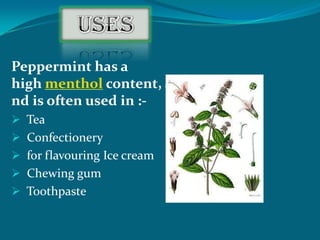
Peppermint has a
high menthol content, a
nd is often used in :-
 Tea
 Confectionery
 for flavouring Ice cream
 Chewing gum
 Toothpaste
Itching and Skin Irritations
Peppermint, when applied topically, has a soothing
and cooling effect on skin irritations caused by
hives, poison ivy, or poison oak.
 Tension Headache
One small study suggested that peppermint applied
to the forehead and temples helped reduce
headache symptoms.
 Colds and Flu
Peppermint and its main active agent, menthol, are
effective decongestants. Because menthol thins
mucus, it is also a good expectorant, meaning that it
helps loosen phlegm and breaks up coughs. It is
soothing and calming for sore throats (pharyngitis)
and dry coughs as well.
 One animal study has suggested
that Peppermint may have radio
protective effects in patients
undergoing cancer treatment.

 The aroma of peppermint has been
found to enhance memory. As such, it
can be administered by instructors to
their students before examinations, to
aid recall.

 Peppermint flowers are large nectar
producers and honey bees as well as
other nectar harvesting organisms
forage them heavily. A mild, pleasant
varietal honey can be produced if
there is a sufficient area of plants.
 Peppermint tea is prepared from dried leaves of the
  plant and is widely available commercially.
 Peppermint spirit (tincture) contains 10% peppermint
  oil and 1% peppermint leaf extract in an alcohol
  solution. A tincture can be prepared by adding 1 part
  peppermint oil to 9 parts pure grain alcohol.
 Enteric coated capsules are specially coated to allow
  the capsule to pass through the stomach and into the
  intestine (0.2 mL of peppermint oil per capsule).
 Creams or ointments (should contain 1 - 16% menthol)
 Pediatric
 Do not give peppermint to an infant or small child. Peppermint oil
  applied to the face of infants can cause life-threatening breathing
  problems. In addition, peppermint tea may cause a burning sensation in
  the mouth. For digestion and upset stomach in older children: 1 - 2 mL
  peppermint glycerite per day.
 Adult
 Tea: Steep 1 tsp. dried peppermint leaves in 1 cup boiling water for 10
  minutes; strain and cool. Drink 4 - 5 times per day between meals.
  Peppermint tea appears to be safe, even in large quantities.
 Enteric coated capsules: 1 - 2 capsules (0.2 ml of peppermint oil) 2 - 3
  times per day for IBS.
 Tension headaches: Using a tincture of 10% peppermint oil to 90%
  ethanol, lightly coat the forehead and allow the tincture to evaporate.
 Itching and skin irritations: Apply menthol, the active ingredient in
  peppermint, in a cream or ointment form no more than 3 - 4 times per
  day.
 The use of herbs is a time honored approach to
  strengthening the body and treating disease.
  Herbs, however, can trigger side effects and interact with
  other herbs, supplements, or medications. For these
  reasons, you should take herbs with care, under the
  supervision of a health care provider.
 Do not take peppermint or drink peppermint tea if you
  have gastro esophageal reflux disease (GERD -- a condition
  where stomach acids back up into the esophagus) or hiatal
  hernia. Peppermint can relax the sphincter between the
  stomach and esophagus, allowing stomach acids to flow
  back into the esophagus. (The sphincter is the muscle that
  separates the esophagus from the stomach.) By relaxing
  the sphincter, peppermint may actually make the
  symptoms of heartburn and indigestion worse.
 Peppermint, in amounts normally found in food, is
  likely to be safe during pregnancy, but not enough is
  known about the effects of larger supplemental
  amounts. Speak with your health care provider.
 Never apply peppermint oil to the face of an infant or
  small child, as it may cause spasms that inhibit
  breathing.
 Peppermint may make gallstones worse.
 Large doses of peppermint oil can be toxic. Pure
  menthol is poisonous and should never be taken
  internally. It is important not to confuse oil and
  tincture preparations.
 Menthol or peppermint oil applied to the skin can
  cause a rash.

Peppermint

  • 2.
     Peppermint (Mentha× piperita), also known as M. balsamea Wild.) is a hybrid mint, a cross between watermint and spearmint. Peppermint was first described in 1753 by Carolus Linnaeus from specimens that had been collected in England; he treated it as a species, but it is now universally agreed to be a hybrid. The plant, indigenous to Europe, is now widespread in cultivation throughout all regions of the world. It is a herbaceous rhizomatous perennial plant growing to 30–90 cm (12–35 in) tall, with smooth stems, square in cross section. The rhizomes are wide- spreading, fleshy, and bare fibrous roots.
  • 3.
     Peppermint plantsgrow to about 2 - 3 feet tall. They bloom from July through August, sprouting tiny purple flowers in whorls and terminal spikes.  Dark green, fragrant leaves grow opposite white flowers. Peppermint is native to Europe and Asia, is naturalized to North America, and grows wild in moist, temperate areas. Some varieties are indigenous to South Africa, South America, and Australia.
  • 4.
    Peppermint typically occursin moist habitats, including stream sides and drainage ditches. Being a hybrid, it is usually sterile, producing no seeds and reproducing only vegetative, spreading by its rhizomes. If placed, it can grow anywhere, with a few exceptions. Outside of its native range, areas where peppermint was formerly grown for oil often have an abundance of feral plants, and it is considered invasive in Australia, the Galápagos Islands, New Zealand, and in the United States.
  • 5.
     Peppermint generallygrows best in moist, shaded locations, and expands by underground stolons. Young shoots are taken from old stocks and dibbled into the ground about 1.5 feet apart. They grow quickly and cover the ground with runners if it is permanently moist. For the home gardener, it is often grown in containers to restrict rapid spreading. It grows best with a good supply of water, without being water- logged, and planted in areas with part-sun to shade.
  • 6.
     The leavesand flowering tops are used; they are collected as soon as the flowers begin to open and can be dried. The wild form of the plant is less suitable for this purpose, with cultivated plants having been selected for more and better oil content. They may be allowed to lie and wilt a little before distillation, or they may be taken directly to the still.
  • 7.
    Peppermint has a highmenthol content, a nd is often used in :-  Tea  Confectionery  for flavouring Ice cream  Chewing gum  Toothpaste
  • 8.
    Itching and SkinIrritations Peppermint, when applied topically, has a soothing and cooling effect on skin irritations caused by hives, poison ivy, or poison oak. Tension Headache One small study suggested that peppermint applied to the forehead and temples helped reduce headache symptoms. Colds and Flu Peppermint and its main active agent, menthol, are effective decongestants. Because menthol thins mucus, it is also a good expectorant, meaning that it helps loosen phlegm and breaks up coughs. It is soothing and calming for sore throats (pharyngitis) and dry coughs as well.
  • 9.
     One animalstudy has suggested that Peppermint may have radio protective effects in patients undergoing cancer treatment.  The aroma of peppermint has been found to enhance memory. As such, it can be administered by instructors to their students before examinations, to aid recall.  Peppermint flowers are large nectar producers and honey bees as well as other nectar harvesting organisms forage them heavily. A mild, pleasant varietal honey can be produced if there is a sufficient area of plants.
  • 10.
     Peppermint teais prepared from dried leaves of the plant and is widely available commercially.  Peppermint spirit (tincture) contains 10% peppermint oil and 1% peppermint leaf extract in an alcohol solution. A tincture can be prepared by adding 1 part peppermint oil to 9 parts pure grain alcohol.  Enteric coated capsules are specially coated to allow the capsule to pass through the stomach and into the intestine (0.2 mL of peppermint oil per capsule).  Creams or ointments (should contain 1 - 16% menthol)
  • 11.
     Pediatric  Donot give peppermint to an infant or small child. Peppermint oil applied to the face of infants can cause life-threatening breathing problems. In addition, peppermint tea may cause a burning sensation in the mouth. For digestion and upset stomach in older children: 1 - 2 mL peppermint glycerite per day.  Adult  Tea: Steep 1 tsp. dried peppermint leaves in 1 cup boiling water for 10 minutes; strain and cool. Drink 4 - 5 times per day between meals. Peppermint tea appears to be safe, even in large quantities.  Enteric coated capsules: 1 - 2 capsules (0.2 ml of peppermint oil) 2 - 3 times per day for IBS.  Tension headaches: Using a tincture of 10% peppermint oil to 90% ethanol, lightly coat the forehead and allow the tincture to evaporate.  Itching and skin irritations: Apply menthol, the active ingredient in peppermint, in a cream or ointment form no more than 3 - 4 times per day.
  • 12.
     The useof herbs is a time honored approach to strengthening the body and treating disease. Herbs, however, can trigger side effects and interact with other herbs, supplements, or medications. For these reasons, you should take herbs with care, under the supervision of a health care provider.  Do not take peppermint or drink peppermint tea if you have gastro esophageal reflux disease (GERD -- a condition where stomach acids back up into the esophagus) or hiatal hernia. Peppermint can relax the sphincter between the stomach and esophagus, allowing stomach acids to flow back into the esophagus. (The sphincter is the muscle that separates the esophagus from the stomach.) By relaxing the sphincter, peppermint may actually make the symptoms of heartburn and indigestion worse.
  • 13.
     Peppermint, inamounts normally found in food, is likely to be safe during pregnancy, but not enough is known about the effects of larger supplemental amounts. Speak with your health care provider.  Never apply peppermint oil to the face of an infant or small child, as it may cause spasms that inhibit breathing.  Peppermint may make gallstones worse.  Large doses of peppermint oil can be toxic. Pure menthol is poisonous and should never be taken internally. It is important not to confuse oil and tincture preparations.  Menthol or peppermint oil applied to the skin can cause a rash.