ANDROGRAPHIS
PANICULAT
A
ANDROGRAPHIS PANICULATA
 PREPARED BY :-
DR ABDUL SAMI
(M.Phil. Eastern Medicine)
ANDROGRAPHIS PANICULATA
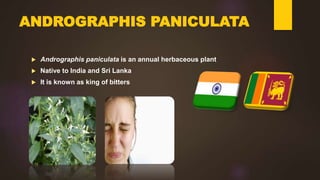
 Andrographis paniculata is an annual herbaceous plant
 Native to India and Sri Lanka
 It is known as king of bitters
FAMILY
 Acanthaceae
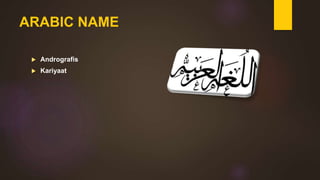
ARABIC NAME
 Andrografis
 Kariyaat
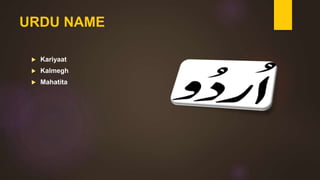
URDU NAME
 Kariyaat
 Kalmegh
 Mahatita
ENGLISH NAME
 The Creat
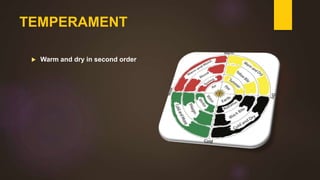
TEMPERAMENT
 Warm and dry in second order
MORPHOLOGY
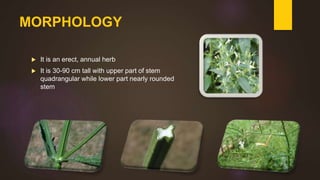
 It is an erect, annual herb
 It is 30-90 cm tall with upper part of stem
quadrangular while lower part nearly rounded
stem
PARTS USED
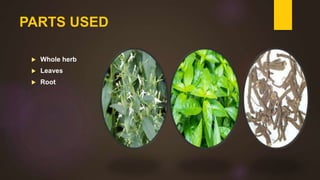
 Whole herb
 Leaves
 Root
Quality
 it tastes bitter
Cultivation
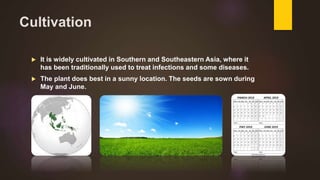
 It is widely cultivated in Southern and Southeastern Asia, where it
has been traditionally used to treat infections and some diseases.
 The plant does best in a sunny location. The seeds are sown during
May and June.
CHEMICAL CONSTITUENTS
Chemical Constituents
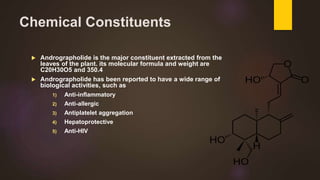
 Andrographolide is the major constituent extracted from the
leaves of the plant. its molecular formula and weight are
C20H30O5 and 350.4
 Andrographolide has been reported to have a wide range of
biological activities, such as
1) Anti-inflammatory
2) Anti-allergic
3) Antiplatelet aggregation
4) Hepatoprotective
5) Anti-HIV
Chemical Constituents
 Some known constituents are:
1) Andrographine
2) Neoandrographolide
3) Panicoline
4) Paniculide-A
5) Paniculide-B
6) Paniculide-C
PHARMACOLOGICAL
ACTIONS
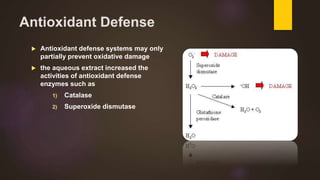
Antioxidant Defense
 Antioxidant defense systems may only
partially prevent oxidative damage
 the aqueous extract increased the
activities of antioxidant defense
enzymes such as
1) Catalase
2) Superoxide dismutase
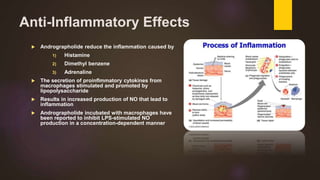
Anti-Inflammatory Effects
 Andrographolide reduce the inflammation caused by
1) Histamine
2) Dimethyl benzene
3) Adrenaline
 The secretion of proinflmmatory cytokines from
macrophages stimulated and promoted by
lipopolysaccharide
 Results in increased production of NO that lead to
inflammation
 Andrographolide incubated with macrophages have
been reported to inhibit LPS-stimulated NO
production in a concentration-dependent manner
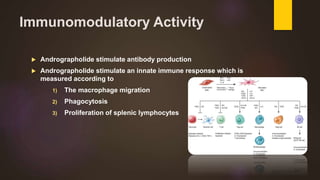
Immunomodulatory Activity
 Andrographolide stimulate antibody production
 Andrographolide stimulate an innate immune response which is
measured according to
1) The macrophage migration
2) Phagocytosis
3) Proliferation of splenic lymphocytes
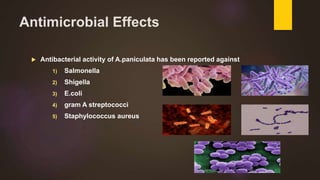
Antimicrobial Effects
 Antibacterial activity of A.paniculata has been reported against
1) Salmonella
2) Shigella
3) E.coli
4) gram A streptococci
5) Staphylococcus aureus
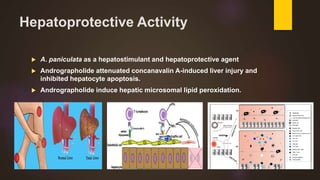
Hepatoprotective Activity
 A. paniculata as a hepatostimulant and hepatoprotective agent
 Andrographolide attenuated concanavalin A-induced liver injury and
inhibited hepatocyte apoptosis.
 Andrographolide induce hepatic microsomal lipid peroxidation.
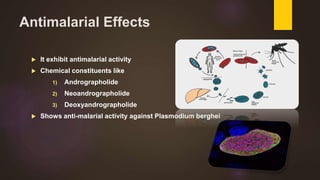
Antimalarial Effects
 It exhibit antimalarial activity
 Chemical constituents like
1) Andrographolide
2) Neoandrographolide
3) Deoxyandrographolide
 Shows anti-malarial activity against Plasmodium berghei
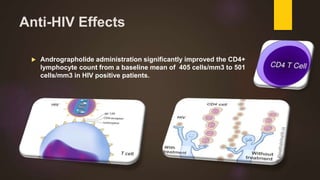
Anti-HIV Effects
 Andrographolide administration significantly improved the CD4+
lymphocyte count from a baseline mean of 405 cells/mm3 to 501
cells/mm3 in HIV positive patients.
MEDICINAL USES
Medicinal Uses
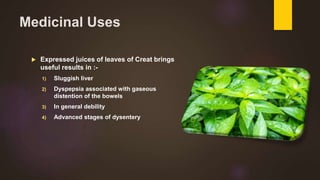
 Expressed juices of leaves of Creat brings
useful results in :-
1) Sluggish liver
2) Dyspepsia associated with gaseous
distention of the bowels
3) In general debility
4) Advanced stages of dysentery
Medicinal Uses
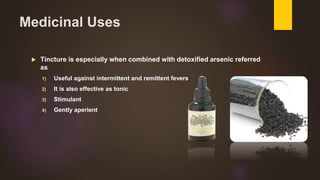
 Tincture is especially when combined with detoxified arsenic referred
as
1) Useful against intermittent and remittent fevers
2) It is also effective as tonic
3) Stimulant
4) Gently aperient
Medicinal Uses
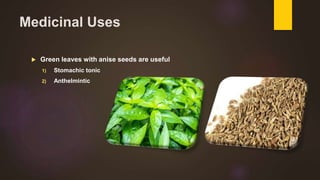
 Green leaves with anise seeds are useful
1) Stomachic tonic
2) Anthelmintic
Medicinal Uses
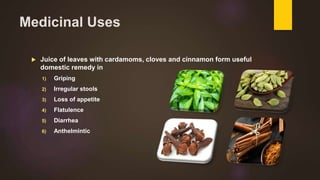
 Juice of leaves with cardamoms, cloves and cinnamon form useful
domestic remedy in
1) Griping
2) Irregular stools
3) Loss of appetite
4) Flatulence
5) Diarrhea
6) Anthelmintic
Medicinal Uses
 Used as hepatoprotective in traditional formulations.
Compound Preparations
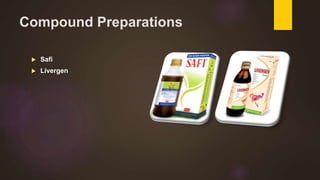
 Safi
 Livergen
Dosage
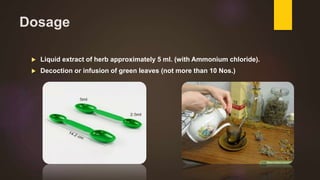
 Liquid extract of herb approximately 5 ml. (with Ammonium chloride).
 Decoction or infusion of green leaves (not more than 10 Nos.)
Corrigent
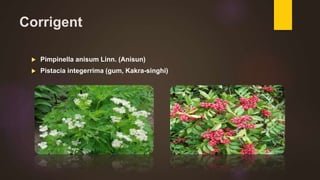
 Pimpinella anisum Linn. (Anisun)
 Pistacia integerrima (gum, Kakra-singhi)
Tenedium
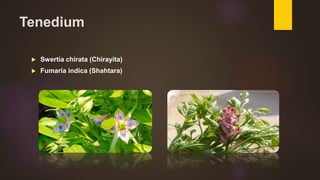
 Swertia chirata (Chirayita)
 Fumaria indica (Shahtara)
SIDE EFFECTS
 Loss of appetite
 Diarrhea
 Vomiting
 Rash
 Headache
 Runny nose
 Swollen lymph glands
 Serious allergic reactions
 Elevations of liver enzymes
Comments
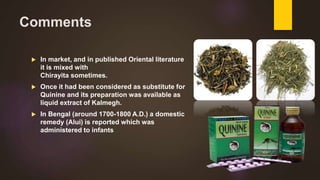
 In market, and in published Oriental literature
it is mixed with
Chirayita sometimes.
 Once it had been considered as substitute for
Quinine and its preparation was available as
liquid extract of Kalmegh.
 In Bengal (around 1700-1800 A.D.) a domestic
remedy (Alui) is reported which was
administered to infants
THANKS TO ALL