The
Cyclotron
  By: Andrea Pence
Research Question:
How did the development of the cyclotron
   influence and develop the scientific
    environment in which we live today?
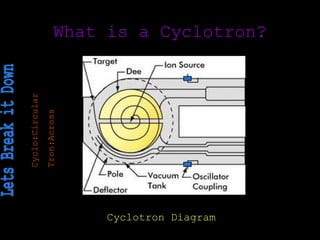
Cyclo:Circular          What is a Cyclotron?
                 Tron:Across


                               Cyclotron Diagram
A cyclotron is…
• A particle accelerator
 – Sends charged particles, which constantly
   accelerate through a ‘Dee’, through a circular
   path until they are (most likely) directed
   towards a designated target for a specific
   purpose
How it works…
• Electrons enter a vacuum in the device
  – Vacuum is suspended between two magnetic poles
• High frequency, alternating voltage is
  then applied to the ‘Dee’ electrodes
• The particles increase speed and energy as
  they travel along a spiral path
• With each turn on the spiral path they
  gain more speed, frequency, and energy
• Particles will continue on this path until
  they reach their target
  – This creates secondary particles
     • These can be measured by instruments
                                                         les
                                                   artic
                                          at   ed P
                                   cc eler
Uses of the Cyclotron
• For decades best source of high
  energy beams for physics
  experiments
• Treatment for Cancer
 – Proton Therapy
• PET imaging
Cyclotron Experiments
• Element 113 (Uut) recently discovered
• Element 115 (Uup) also recently discovered
• Dr. James Meadows used cyclotrons in an
  experiment on radionuclide production
• Resonance in silicon and germanium
Advantages
• Utilizes a single, electrical
  driver
  – This saves energy and $
• High power due to continuous
  stream of particles
• Compact design
Limitations
• Spiral beam of a cyclotron
  means it will only be efficient
  and work with Klystron type
  voltage
Problems Solved
• Until the cyclotron, the linear
  accelerator was the only way to
  produce high-frequency radio
  waves
 – Pretty crappy
• The cyclotron has better waves
  than the linear accelerator


                   <
Related Technology
• A magnetron is a accelerator
  based off of the cyclotron
 – You all know what a magnetron is,
   you have one in your kitchen
   • Magnetron = microwave
More Related Technology:
    Cyclotron Radiation
            What is it:
Electromagnetic radiation emitted
        by charged particles
• Cyclotron radiation, found
  around black holes, is an
  excellent source of information
  about distant magnetic fields
…
• Cyclotron radiation would
  likely be produced in a high-
  altitude nuclear explosion
• Gamma rays produced by this
  explosion would ionize atoms in
  the upper atmosphere
• These free electrons would
  interact with Earth’s magnetic
  feild

• Produceing cyclotron radiation
  in the form of a
  electromagnetic pulse
• EMP is a current concern of the
  military because it could
  damage solid, state equipment
The History of the Cyclotron is not some easily untangled web…
Leo Lzilard
• Invented the Cyclotron
• Other inventions
 – Nuclear Chain reaction
 – Electron microscope
 – Linear accelerator
Leo’s History
• Cyclotron: Szilard conceived this idea
  somewhere in the 1900-1930
• Nuclear Chain Reaction:
   – 1933 Ernest Rutherford gives a speech
     proclaiming that atomic energy will
     never be useful
   – Shocked, Szilard comes up with N.C.R.
     that very day
   – Helped achieve atomic bomb with
     collaboration from Einstein and various
     other scientists
   – Later in life he reported regretting
     having created the atomic bomb and
     hoped it wouldn’t be used on the public
Continued 
• 1960, Szilard is diagnosed with
  bladder cancer
• He is treated using his own
  treatment regime (radiation
  therapy (this therapy involves
  the use of cyclotrons))
• Put into remission
Going On…
• 1960, after being ‘cured’, he
  helped found Council for a
  Livable World
• C.L.W.- organization dedicated
  to protecting society from
  everything radioactive and
  atomic
Council for a Livable World

• Helps elect congressional
  candidates who support them
 – 120 U.S arms control advocates
 – 203 House of Representatives
   • Raised 1.3 million in 2010
Who Else did They
         Endorse???


October 3, 2007 C.L.W. praised senator Obama for
his pledge to improve Russian relations


C.L.W. backed B. Obama in his presidential
What Specifically has
        C.L.W. Done?
• Ratified Chemical Weapons
  Convention
 – Outlaws production/ stockpiling of
   chemical weapons
• Ratified Intermediate-Range
  Nuclear Forces treaty
 – Eliminated nuclear and
   conventional ground launched
   ballistic and cruise missiles
   between the USA and Soviet Union
Continuing On
• Ratified Strategic Arms Reduction
  Treaty
  – Barred the USA and Soviet Union from
    deploying more than 6,000 nuclear
    warheads
    • Treaty expired 12-5-09, the New START was
      signed by President Obama and went into
      effect 1-26-11
• Banned biological weapons, and
  eliminated chemical weapons programs
…
• Ensured limited deployment of
  MX missile and B2 bomber
• Blocking deployment of National
  Missile Defense
• Stopped funding for Bunker
  Buster and Reliable Replacement
  Warhead
It’s slightly ironic that
C.L.W. stands to ban basically
everything the cyclotron stands
for + without the cyclotron
C.L.W wouldn’t really exist
=ing It All Up
Leo Szilard created the cyclotron
He also invented N.C.R.       Helped
  create the atomic bomb     Remorseful
Bladder Cancer       Cured using
  invented treatment        C.L.W
Greatly influences the world we live
  in today


  *    His remorsefulness of N.C.R., and his

  invention of the cyclotron all helped fuel the
  C.L.W insanity!!!
Ernest Lawrence
• August 8, 1901- August 27, 1958
• He built, utilized, and improved the
  cyclotron
• 1939 Won Nobel Peace Prize in physics, for
  the cyclotron
• Helped with Nuclear Fission
• Found a way to smash atoms and paved the
  way for nuclear weapons
Going On…
• Lawrence Liberty Conventional
  Library
• Founded Lawrence Berkley Lab
Continued :)
• 1958, the last year of his
  life, Eisenhower sent Lawrence
  to Geneva Switzerland
• Propose treaty
• Ban nuclear war testing with
  the Soviet Union
• Chronic Colitis
Lawrence Berkley National
        Laboratory
• Contributions:
 – Manhattan Project: Develop first
   atomic bomb in WW2
 – Applied Physics Laboratory at John
   Hopkins: Proximity Fuse
 – MIT Radiation Laboratory: Radar
• 3 most useful war technologies
Princeton and the
             Cyclotron
• 2-23-1950
• Oil fire destroyed Princeton’s
  $400,000 cyclotron
  –   Cause of blaze unknown
  –   Smoldered for 11 hours
  –   Only magnets were salvageable
  –   Approx. 6 months to rebuild
• Built in 1936
• One of America’s first ‘atom
  smashers’
…
• Device had been shipped to Los
  Almos, New Mexico in WW2
• Had large role in creating the
  atomic bomb
• Was currently being used for
  research in Office of Naval
  research
The Science of the
     Cyclotron
Radionuclide
• What is a radionuclide:
 – Atom w/ unstable nucleus
 – Also known as radioisotopes
 – Undergo radio active decay
 – Occur naturally or artificially
 – Emit gamma rays
Radionuclide's and
         Cyclotrons
• Cyclotrons accelerate atomic
  particles to hit a target which
  produce radionuclide's
• Cyclotrons accelerate protons
  at a target to make positron
  emitting radioisotopes
 – Ex Fluorine 18
Nuclear Medicine
• Used for diagnoses, research, and
  treatment
• Also used in single-proton emission
  computed tomography and PET imaging
• In genetics, radioisotopes attach
  themselves to molecules and allow
  tracing. They can show DNA
  replication and amino acid transport
…
• Can be used in food
  preservation
• Industry and mining
• Geology, archaeology, and
  paleontology
Why do I care about
      radioisotopes???
• Because:
 – Americium 241 is a radioisotope
   found in smoke detectors
 – Gadolinium 153 is a a radioisotope
   used in X-ray fluorescence and
   osteoporosis screening
Fluorine 18
• Radioisotope
• Important source of positrons (+)
• Generally they’re produced by
  cyclotrons
• Used in the radiopharmaceutical
  industry
• Synthesized into fluorodeoxyglucose
  (FDG) for use in PET scans
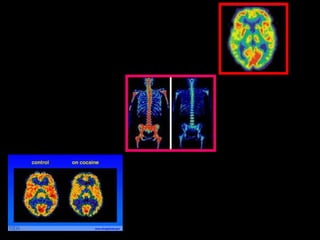
PET imaging
• Positron Emission Tomography
  – Nuclear Medicine
    • Use trace amount of radioactive material
      (radiopharmaceuticals or radiotracers) to
      diagnose and depict a disease
       – Cancer
       – Heart Disease
       – Gastrointestinal diseases

• Nuclear medicine accurately
  pinpoints molecular activity within
  the body
How it Works
• Radiotracers are injected,
  swallowed, or inhaled as a gas
• Accumulate in the organ/area being
  examined
• Radiotracers give off energy called
  a gamma ray
• Then a gamma camera, PET scanner, or
  probe detects this energy and
  converts it into a picture with the
  assistance of a computer
Cyclotrons and PET Imaging
• Cyclotrons are needed to
  generate the radiotracers
  needed for PET
• Cyclotrons produce many
  different kinds of radioactive
  isotopes
 – These must emit positrons when
   decaying
…
• Most PET installations have
  cyclotrons by the PET machine
 – Radiotracers can be synthesized
   quickly
   • Radioisotopes decay very quickly and
     need to be administered to the
     patient as quickly as possible
The Cyclotron in
         Astrophysics:
    More Specifically MSU
• Leading isotope research facility
• Built 1963
• Biggest nuclear science facility on a
  university campus
• Operates 2 superconducting cyclotrons
• Currently investigating properties of
  rare isotopes and nuclear reactions
  – Reactions that take place in stars
     • Novae + supernovae
…
• K1200 is the biggest
  accelerator in the world
• Primary goal is currently to
  understand atomic nuclei
• Isotope research taking place
  at MSU is key to understanding
  how elements, and the universe
  were formed
Cassiopeia
A supernova
remnant


       Remnants of a star
       that exploded in a
       supernova about 1000
       years ago
The Cyclotron in Particle
         Physics
• The cyclotron smashes particles
  together
• Snap shots are taken of these
  particles when they collide
• Shots capture ‘fundamental
  particles’
• Piece together what happened
  when the universe was created
• Opened up new avenues to
  particle physics and
  astrophysics
   – Allowed physicists to accelerate
     particles they wouldn’t have been
     able to otherwise
• Allows medical physicists and
  radiochemists better access to
  positron emitting radionuclide's
• Radiation therapy
Conventional Radiation
          therapy
• Uses linear accelerator
• Accelerates electrons and smashes them
  into a target, producing gamma rays
• Gamma rays are then collimated into a beam
  and used to irritate a patients tumor
                    Cons:
• G-rays also irritate the tissue
  surrounding the tumor
  – Radiation oncologists can use different
    ‘angles’ of r-therapy to seemingly ‘spare’
    tissue
Radiation Therapy
      Involving Cyclotrons
• Accelerates [cyclotron] protons to high energies
• Proton beam is then sent down a beam line and into
  a gantry
• Then directed to eradicate a portion of the
  patient
                        Pros:
• Targets specific areas of the body
                        Cons:
• Range of protons of dependent on depth of body
  – If body moves beams will miss targeted portion
• Can only be used on brain tumors

• Cost is 150 million
• PET imaging
• Sends radioisotopes into the
  body attached to a molecule,
  and then looks for decay
• Build ‘maps’ of where isotopes
  accumulate
• Helps physicians gain
  information about a patients
  disease
Answering the Research
          Question
• How did the development of the cyclotron
  influence and develop the scientific
  environment in which we live today?
◙ Indirectly linked to CLW
◙ Improved Radiation Therapy
◙ Indirectly linked to many household items
  ◙ Smoke Detector
  ◙ Microwave
◙ PET imaging
◙ Radiopharmaceuticals
◙ Benefits and brings together many types
  of sciences
THE END 

Pence: Cyclotron

  • 1.
    The Cyclotron By:Andrea Pence
  • 2.
    Research Question: How didthe development of the cyclotron influence and develop the scientific environment in which we live today?
  • 3.
    Cyclo:Circular What is a Cyclotron? Tron:Across Cyclotron Diagram
  • 4.
    A cyclotron is… •A particle accelerator – Sends charged particles, which constantly accelerate through a ‘Dee’, through a circular path until they are (most likely) directed towards a designated target for a specific purpose
  • 5.
    How it works… •Electrons enter a vacuum in the device – Vacuum is suspended between two magnetic poles • High frequency, alternating voltage is then applied to the ‘Dee’ electrodes • The particles increase speed and energy as they travel along a spiral path • With each turn on the spiral path they gain more speed, frequency, and energy • Particles will continue on this path until they reach their target – This creates secondary particles • These can be measured by instruments les artic at ed P cc eler
  • 7.
    Uses of theCyclotron • For decades best source of high energy beams for physics experiments • Treatment for Cancer – Proton Therapy • PET imaging
  • 8.
    Cyclotron Experiments • Element113 (Uut) recently discovered • Element 115 (Uup) also recently discovered • Dr. James Meadows used cyclotrons in an experiment on radionuclide production • Resonance in silicon and germanium
  • 9.
    Advantages • Utilizes asingle, electrical driver – This saves energy and $ • High power due to continuous stream of particles • Compact design
  • 10.
    Limitations • Spiral beamof a cyclotron means it will only be efficient and work with Klystron type voltage
  • 11.
    Problems Solved • Untilthe cyclotron, the linear accelerator was the only way to produce high-frequency radio waves – Pretty crappy • The cyclotron has better waves than the linear accelerator <
  • 12.
    Related Technology • Amagnetron is a accelerator based off of the cyclotron – You all know what a magnetron is, you have one in your kitchen • Magnetron = microwave
  • 13.
    More Related Technology: Cyclotron Radiation What is it: Electromagnetic radiation emitted by charged particles • Cyclotron radiation, found around black holes, is an excellent source of information about distant magnetic fields
  • 14.
    … • Cyclotron radiationwould likely be produced in a high- altitude nuclear explosion • Gamma rays produced by this explosion would ionize atoms in the upper atmosphere • These free electrons would interact with Earth’s magnetic feild
  • 15.
     • Produceing cyclotronradiation in the form of a electromagnetic pulse • EMP is a current concern of the military because it could damage solid, state equipment
  • 16.
    The History ofthe Cyclotron is not some easily untangled web…
  • 17.
    Leo Lzilard • Inventedthe Cyclotron • Other inventions – Nuclear Chain reaction – Electron microscope – Linear accelerator
  • 18.
    Leo’s History • Cyclotron:Szilard conceived this idea somewhere in the 1900-1930 • Nuclear Chain Reaction: – 1933 Ernest Rutherford gives a speech proclaiming that atomic energy will never be useful – Shocked, Szilard comes up with N.C.R. that very day – Helped achieve atomic bomb with collaboration from Einstein and various other scientists – Later in life he reported regretting having created the atomic bomb and hoped it wouldn’t be used on the public
  • 19.
    Continued  • 1960,Szilard is diagnosed with bladder cancer • He is treated using his own treatment regime (radiation therapy (this therapy involves the use of cyclotrons)) • Put into remission
  • 20.
    Going On… • 1960,after being ‘cured’, he helped found Council for a Livable World • C.L.W.- organization dedicated to protecting society from everything radioactive and atomic
  • 21.
    Council for aLivable World • Helps elect congressional candidates who support them – 120 U.S arms control advocates – 203 House of Representatives • Raised 1.3 million in 2010
  • 22.
    Who Else didThey Endorse??? October 3, 2007 C.L.W. praised senator Obama for his pledge to improve Russian relations C.L.W. backed B. Obama in his presidential
  • 23.
    What Specifically has C.L.W. Done? • Ratified Chemical Weapons Convention – Outlaws production/ stockpiling of chemical weapons • Ratified Intermediate-Range Nuclear Forces treaty – Eliminated nuclear and conventional ground launched ballistic and cruise missiles between the USA and Soviet Union
  • 24.
    Continuing On • RatifiedStrategic Arms Reduction Treaty – Barred the USA and Soviet Union from deploying more than 6,000 nuclear warheads • Treaty expired 12-5-09, the New START was signed by President Obama and went into effect 1-26-11 • Banned biological weapons, and eliminated chemical weapons programs
  • 25.
    … • Ensured limiteddeployment of MX missile and B2 bomber • Blocking deployment of National Missile Defense • Stopped funding for Bunker Buster and Reliable Replacement Warhead
  • 26.
    It’s slightly ironicthat C.L.W. stands to ban basically everything the cyclotron stands for + without the cyclotron C.L.W wouldn’t really exist
  • 27.
    =ing It AllUp Leo Szilard created the cyclotron He also invented N.C.R. Helped create the atomic bomb Remorseful Bladder Cancer Cured using invented treatment C.L.W Greatly influences the world we live in today * His remorsefulness of N.C.R., and his invention of the cyclotron all helped fuel the C.L.W insanity!!!
  • 28.
    Ernest Lawrence • August8, 1901- August 27, 1958 • He built, utilized, and improved the cyclotron • 1939 Won Nobel Peace Prize in physics, for the cyclotron • Helped with Nuclear Fission • Found a way to smash atoms and paved the way for nuclear weapons
  • 29.
    Going On… • LawrenceLiberty Conventional Library • Founded Lawrence Berkley Lab
  • 30.
    Continued :) • 1958,the last year of his life, Eisenhower sent Lawrence to Geneva Switzerland • Propose treaty • Ban nuclear war testing with the Soviet Union • Chronic Colitis
  • 31.
    Lawrence Berkley National Laboratory • Contributions: – Manhattan Project: Develop first atomic bomb in WW2 – Applied Physics Laboratory at John Hopkins: Proximity Fuse – MIT Radiation Laboratory: Radar • 3 most useful war technologies
  • 32.
    Princeton and the Cyclotron • 2-23-1950 • Oil fire destroyed Princeton’s $400,000 cyclotron – Cause of blaze unknown – Smoldered for 11 hours – Only magnets were salvageable – Approx. 6 months to rebuild • Built in 1936 • One of America’s first ‘atom smashers’
  • 33.
    … • Device hadbeen shipped to Los Almos, New Mexico in WW2 • Had large role in creating the atomic bomb • Was currently being used for research in Office of Naval research
  • 34.
    The Science ofthe Cyclotron
  • 35.
    Radionuclide • What isa radionuclide: – Atom w/ unstable nucleus – Also known as radioisotopes – Undergo radio active decay – Occur naturally or artificially – Emit gamma rays
  • 36.
    Radionuclide's and Cyclotrons • Cyclotrons accelerate atomic particles to hit a target which produce radionuclide's • Cyclotrons accelerate protons at a target to make positron emitting radioisotopes – Ex Fluorine 18
  • 37.
    Nuclear Medicine • Usedfor diagnoses, research, and treatment • Also used in single-proton emission computed tomography and PET imaging • In genetics, radioisotopes attach themselves to molecules and allow tracing. They can show DNA replication and amino acid transport
  • 38.
    … • Can beused in food preservation • Industry and mining • Geology, archaeology, and paleontology
  • 39.
    Why do Icare about radioisotopes??? • Because: – Americium 241 is a radioisotope found in smoke detectors – Gadolinium 153 is a a radioisotope used in X-ray fluorescence and osteoporosis screening
  • 40.
    Fluorine 18 • Radioisotope •Important source of positrons (+) • Generally they’re produced by cyclotrons • Used in the radiopharmaceutical industry • Synthesized into fluorodeoxyglucose (FDG) for use in PET scans
  • 41.
    PET imaging • PositronEmission Tomography – Nuclear Medicine • Use trace amount of radioactive material (radiopharmaceuticals or radiotracers) to diagnose and depict a disease – Cancer – Heart Disease – Gastrointestinal diseases • Nuclear medicine accurately pinpoints molecular activity within the body
  • 42.
    How it Works •Radiotracers are injected, swallowed, or inhaled as a gas • Accumulate in the organ/area being examined • Radiotracers give off energy called a gamma ray • Then a gamma camera, PET scanner, or probe detects this energy and converts it into a picture with the assistance of a computer
  • 44.
    Cyclotrons and PETImaging • Cyclotrons are needed to generate the radiotracers needed for PET • Cyclotrons produce many different kinds of radioactive isotopes – These must emit positrons when decaying
  • 45.
    … • Most PETinstallations have cyclotrons by the PET machine – Radiotracers can be synthesized quickly • Radioisotopes decay very quickly and need to be administered to the patient as quickly as possible
  • 46.
    The Cyclotron in Astrophysics: More Specifically MSU • Leading isotope research facility • Built 1963 • Biggest nuclear science facility on a university campus • Operates 2 superconducting cyclotrons • Currently investigating properties of rare isotopes and nuclear reactions – Reactions that take place in stars • Novae + supernovae
  • 47.
    … • K1200 isthe biggest accelerator in the world • Primary goal is currently to understand atomic nuclei • Isotope research taking place at MSU is key to understanding how elements, and the universe were formed
  • 48.
    Cassiopeia A supernova remnant Remnants of a star that exploded in a supernova about 1000 years ago
  • 49.
    The Cyclotron inParticle Physics • The cyclotron smashes particles together • Snap shots are taken of these particles when they collide • Shots capture ‘fundamental particles’ • Piece together what happened when the universe was created
  • 52.
    • Opened upnew avenues to particle physics and astrophysics – Allowed physicists to accelerate particles they wouldn’t have been able to otherwise • Allows medical physicists and radiochemists better access to positron emitting radionuclide's • Radiation therapy
  • 54.
    Conventional Radiation therapy • Uses linear accelerator • Accelerates electrons and smashes them into a target, producing gamma rays • Gamma rays are then collimated into a beam and used to irritate a patients tumor Cons: • G-rays also irritate the tissue surrounding the tumor – Radiation oncologists can use different ‘angles’ of r-therapy to seemingly ‘spare’ tissue
  • 55.
    Radiation Therapy Involving Cyclotrons • Accelerates [cyclotron] protons to high energies • Proton beam is then sent down a beam line and into a gantry • Then directed to eradicate a portion of the patient Pros: • Targets specific areas of the body Cons: • Range of protons of dependent on depth of body – If body moves beams will miss targeted portion • Can only be used on brain tumors • Cost is 150 million
  • 57.
    • PET imaging •Sends radioisotopes into the body attached to a molecule, and then looks for decay • Build ‘maps’ of where isotopes accumulate • Helps physicians gain information about a patients disease
  • 58.
    Answering the Research Question • How did the development of the cyclotron influence and develop the scientific environment in which we live today? ◙ Indirectly linked to CLW ◙ Improved Radiation Therapy ◙ Indirectly linked to many household items ◙ Smoke Detector ◙ Microwave ◙ PET imaging ◙ Radiopharmaceuticals ◙ Benefits and brings together many types of sciences
  • 59.