PIONEERING DISCOVERIES
AND TECHNOLOGICAL
BREAKTHROUGHS
1946-1972
Table Of Content
The Cold War and
New Technology
From tubes to
Chips
Discovering
DNA
High Level
Programming Language
The Space
Race Lasers
Quasars
Plate
Tectonics
Scanning the
Body
Table Of Content
Exploring the
Planets
Stopping an
Epidemic
Nuclear
Power
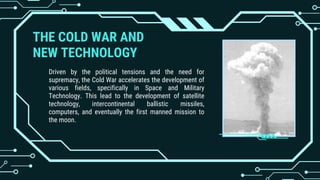
THE COLD WAR AND
NEW TECHNOLOGY
Driven by the political tensions and the need for
supremacy, the Cold War accelerates the development of
various fields, specifically in Space and Military
Technology. This lead to the development of satellite
technology, intercontinental ballistic missiles,
computers, and eventually the first manned mission to
the moon.
FROM TUBES
TO CHIPS
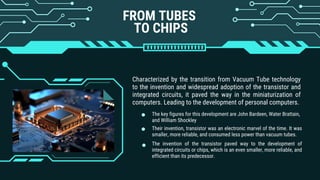
Characterized by the transition from Vacuum Tube technology
to the invention and widespread adoption of the transistor and
integrated circuits, it paved the way in the miniaturization of
computers. Leading to the development of personal computers.
The key figures for this development are John Bardeen, Water Brattain,
and William Shockley
Their invention, transistor was an electronic marvel of the time. It was
smaller, more reliable, and consumed less power than vacuum tubes.
The invention of the transistor paved way to the development of
integrated circuits or chips, which is an even smaller, more reliable, and
efficient than its predecessor.
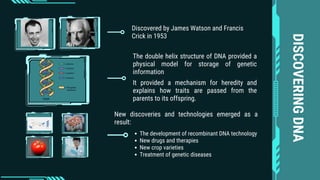
Discovered by James Watson and Francis
Crick in 1953
The double helix structure of DNA provided a
physical model for storage of genetic
information
It provided a mechanism for heredity and
explains how traits are passed from the
parents to its offspring.
The development of recombinant DNA technology
New drugs and therapies
New crop varieties
Treatment of genetic diseases
DISCOVERING
DNA
New discoveries and technologies emerged as a
result:
High Level Programming Languages
Before, each computers have its own specific
programming language.
The development of high level programming
language provided the means to use the same one
language in different computers
The development of high level programming
language provided the means to use the same one
language in different computers
Cold War
Context
Economic
Impact
1950's to 1970's
Space Race emerged from U.S.–Soviet
rivalry during the Cold War
Political, military, and ideological
competition between the superpowers
THE
SPACE
RACE
Large investments in space programs
stimulated job creation and
technological innovation in industries
like aerospace and electronics.
THE
SPACE
RACE
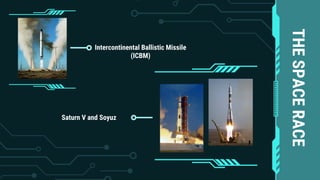
Intercontinental Ballistic Missile
(ICBM)
Saturn V and Soyuz
THE
SPACE
RACE
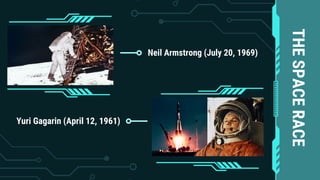
Neil Armstrong (July 20, 1969)
Yuri Gagarin (April 12, 1961)
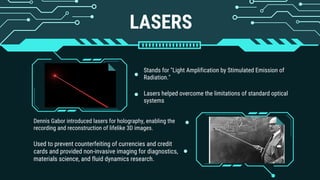
LASERS
Stands for "Light Amplification by Stimulated Emission of
Radiation."
Lasers helped overcome the limitations of standard optical
systems
Used to prevent counterfeiting of currencies and credit
cards and provided non-invasive imaging for diagnostics,
materials science, and fluid dynamics research.
Dennis Gabor introduced lasers for holography, enabling the
recording and reconstruction of lifelike 3D images.
Quasars
A quasar is a highly luminous and distant astronomical object powered by a
supermassive black hole at the center of a galaxy. It emits vast amounts of
energy, including radio waves and visible light, making it one of the brightest
objects in the universe. Quasars appear star-like through optical telescopes,
but their light comes from matter spiraling into the black hole, which releases
enormous energy.
QUASARS
Maarten Schmidt (1963) studied quasar light patterns and found that
their spectra indicated they were extremely distant. He also observed a
redshift in the hydrogen emissions, revealing that quasars are
incredibly luminous and far away objects in the universe.
Also known as a quasi-stellar
radio source.
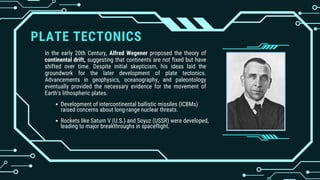
PLATE TECTONICS
In the early 20th Century, Alfred Wegener proposed the theory of
continental drift, suggesting that continents are not fixed but have
shifted over time. Despite initial skepticism, his ideas laid the
groundwork for the later development of plate tectonics.
Advancements in geophysics, oceanography, and paleontology
eventually provided the necessary evidence for the movement of
Earth's lithospheric plates.
Development of intercontinental ballistic missiles (ICBMs)
raised concerns about long-range nuclear threats.
Rockets like Saturn V (U.S.) and Soyuz (USSR) were developed,
leading to major breakthroughs in spaceflight.
Scanning
the Body
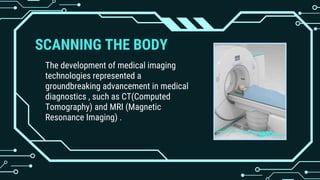
The development of medical imaging
technologies represented a
groundbreaking advancement in medical
diagnostics , such as CT(Computed
Tomography) and MRI (Magnetic
Resonance Imaging) .
SCANNING THE BODY
SCANNING THE BODY
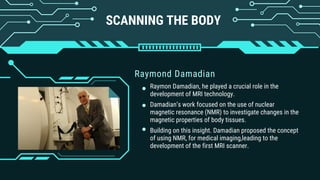
Raymond Damadian
Raymon Damadian, he played a crucial role in the
development of MRI technology.
Damadian’s work focused on the use of nuclear
magnetic resonance (NMR) to investigate changes in the
magnetic properties of body tissues.
Building on this insight. Damadian proposed the concept
of using NMR, for medical imaging,leading to the
development of the first MRI scanner.
Exploring
the Planets
EXPLORING THE
PLANETS
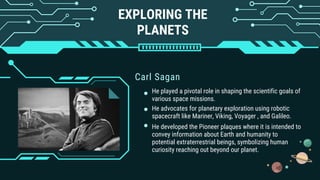
Carl Sagan
He played a pivotal role in shaping the scientific goals of
various space missions.
He advocates for planetary exploration using robotic
spacecraft like Mariner, Viking, Voyager , and Galileo.
He developed the Pioneer plaques where it is intended to
convey information about Earth and humanity to
potential extraterrestrial beings, symbolizing human
curiosity reaching out beyond our planet.
UNIFYING FORCES
The major challenge in physics during that time was the absence of a single
framework that could explain and bring all together all the fundamental forces.
Albert Einstein’s contributions, especially his theories of special and general
relativity , provided crucial insights into this effort.
In 1905 , Special relativity was published . It explored the relationship between
space and time and introduced the famous equation E=mc2 , connecting energy
and mass.
While Einstein’s theories didn’t completely unify all forces, they set the
groundwork for subsequent developments.
The pursuit of a unified theory gained momentum with later physicians, leading to
the development of quantum field theory and the electroweak theory, successfully
uniting electromagnetic and the weak nuclear force.
STOPPING PANDEMIC
• Poliomyelitis, a disease noted as far back as 1789, was not
completely understood until 1840.
• Doctor Jonas Salk developed a vaccine for polio in the 1940s.
• The vaccine was tested on the children who had never had polio
and we're resistant to virus.
• In 1954, the first test on children who had never had polio
showed that the vaccine was safe and effective.
• Salk later developed a new vaccine with a live virus stain that
boosted antibody production.
• The Sabin vaccine, approved in the United States in 1961, had
the advantage of being taken by mouth and providing immunity
to those around the vaccinated person.
Three Types of Polioviruses
NUCLEAR POWER
• After the World War II, nations explored peaceful uses for nuclear energy.
• The United States launched the first nuclear submarines in 1954.
• The Soviet Union and the U.S. connected experimental reactors to the electrical grid by
1955.
•England's Calder Hall operationalized a 50,000-kilowatt reactor in 1956,marking the global
spread of nuclear power.
• Despite environmental benefits, nuclear energy poses disaster risks, as seen in incident like
the Three Mile Island meltdown in 1979 and the Chernobyl explosion in 1986.
• Passive safety features were introduced in the 1970s, but wide U.S. adoption stalled after
1990.
Significant Personalities in the
Development and Ulitilization of
Nuclear Power
John
Dalton
Henri
Becquerel
Lesi
Meitner
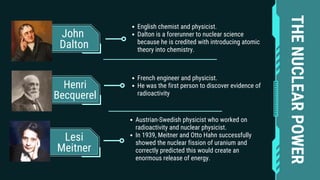
English chemist and physicist.
Dalton is a forerunner to nuclear science
because he is credited with introducing atomic
theory into chemistry.
French engineer and physicist.
He was the first person to discover evidence of
radioactivity
Austrian-Swedish physicist who worked on
radioactivity and nuclear physicist.
In 1939, Meitner and Otto Hahn successfully
showed the nuclear fission of uranium and
correctly predicted this would create an
enormous release of energy.
THE
NUCLEAR
POWER
Otto
Hahn
Viktor
Brukhanov
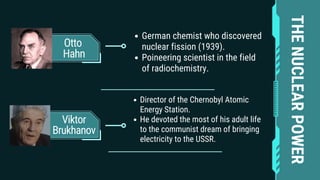
German chemist who discovered
nuclear fission (1939).
Poineering scientist in the field
of radiochemistry.
Director of the Chernobyl Atomic
Energy Station.
He devoted the most of his adult life
to the communist dream of bringing
electricity to the USSR.
THE
NUCLEAR
POWER
THANK YOU
"Almost every significant breakthrough in the field of
scientific endeavor is a break with tradition, with old
ways of thinking, with old paradigms."
-Stephen R. Covey

Science, Technology and Society Presentation

  • 1.
  • 2.
    Table Of Content TheCold War and New Technology From tubes to Chips Discovering DNA High Level Programming Language The Space Race Lasers Quasars Plate Tectonics Scanning the Body
  • 3.
    Table Of Content Exploringthe Planets Stopping an Epidemic Nuclear Power
  • 4.
    THE COLD WARAND NEW TECHNOLOGY Driven by the political tensions and the need for supremacy, the Cold War accelerates the development of various fields, specifically in Space and Military Technology. This lead to the development of satellite technology, intercontinental ballistic missiles, computers, and eventually the first manned mission to the moon.
  • 5.
    FROM TUBES TO CHIPS Characterizedby the transition from Vacuum Tube technology to the invention and widespread adoption of the transistor and integrated circuits, it paved the way in the miniaturization of computers. Leading to the development of personal computers. The key figures for this development are John Bardeen, Water Brattain, and William Shockley Their invention, transistor was an electronic marvel of the time. It was smaller, more reliable, and consumed less power than vacuum tubes. The invention of the transistor paved way to the development of integrated circuits or chips, which is an even smaller, more reliable, and efficient than its predecessor.
  • 6.
    Discovered by JamesWatson and Francis Crick in 1953 The double helix structure of DNA provided a physical model for storage of genetic information It provided a mechanism for heredity and explains how traits are passed from the parents to its offspring. The development of recombinant DNA technology New drugs and therapies New crop varieties Treatment of genetic diseases DISCOVERING DNA New discoveries and technologies emerged as a result:
  • 7.
    High Level ProgrammingLanguages Before, each computers have its own specific programming language. The development of high level programming language provided the means to use the same one language in different computers The development of high level programming language provided the means to use the same one language in different computers
  • 8.
    Cold War Context Economic Impact 1950's to1970's Space Race emerged from U.S.–Soviet rivalry during the Cold War Political, military, and ideological competition between the superpowers THE SPACE RACE Large investments in space programs stimulated job creation and technological innovation in industries like aerospace and electronics.
  • 9.
  • 10.
    THE SPACE RACE Neil Armstrong (July20, 1969) Yuri Gagarin (April 12, 1961)
  • 11.
    LASERS Stands for "LightAmplification by Stimulated Emission of Radiation." Lasers helped overcome the limitations of standard optical systems Used to prevent counterfeiting of currencies and credit cards and provided non-invasive imaging for diagnostics, materials science, and fluid dynamics research. Dennis Gabor introduced lasers for holography, enabling the recording and reconstruction of lifelike 3D images.
  • 12.
    Quasars A quasar isa highly luminous and distant astronomical object powered by a supermassive black hole at the center of a galaxy. It emits vast amounts of energy, including radio waves and visible light, making it one of the brightest objects in the universe. Quasars appear star-like through optical telescopes, but their light comes from matter spiraling into the black hole, which releases enormous energy. QUASARS Maarten Schmidt (1963) studied quasar light patterns and found that their spectra indicated they were extremely distant. He also observed a redshift in the hydrogen emissions, revealing that quasars are incredibly luminous and far away objects in the universe. Also known as a quasi-stellar radio source.
  • 13.
    PLATE TECTONICS In theearly 20th Century, Alfred Wegener proposed the theory of continental drift, suggesting that continents are not fixed but have shifted over time. Despite initial skepticism, his ideas laid the groundwork for the later development of plate tectonics. Advancements in geophysics, oceanography, and paleontology eventually provided the necessary evidence for the movement of Earth's lithospheric plates. Development of intercontinental ballistic missiles (ICBMs) raised concerns about long-range nuclear threats. Rockets like Saturn V (U.S.) and Soyuz (USSR) were developed, leading to major breakthroughs in spaceflight.
  • 14.
  • 15.
    The development ofmedical imaging technologies represented a groundbreaking advancement in medical diagnostics , such as CT(Computed Tomography) and MRI (Magnetic Resonance Imaging) . SCANNING THE BODY
  • 16.
    SCANNING THE BODY RaymondDamadian Raymon Damadian, he played a crucial role in the development of MRI technology. Damadian’s work focused on the use of nuclear magnetic resonance (NMR) to investigate changes in the magnetic properties of body tissues. Building on this insight. Damadian proposed the concept of using NMR, for medical imaging,leading to the development of the first MRI scanner.
  • 17.
  • 18.
    EXPLORING THE PLANETS Carl Sagan Heplayed a pivotal role in shaping the scientific goals of various space missions. He advocates for planetary exploration using robotic spacecraft like Mariner, Viking, Voyager , and Galileo. He developed the Pioneer plaques where it is intended to convey information about Earth and humanity to potential extraterrestrial beings, symbolizing human curiosity reaching out beyond our planet.
  • 19.
    UNIFYING FORCES The majorchallenge in physics during that time was the absence of a single framework that could explain and bring all together all the fundamental forces. Albert Einstein’s contributions, especially his theories of special and general relativity , provided crucial insights into this effort. In 1905 , Special relativity was published . It explored the relationship between space and time and introduced the famous equation E=mc2 , connecting energy and mass. While Einstein’s theories didn’t completely unify all forces, they set the groundwork for subsequent developments. The pursuit of a unified theory gained momentum with later physicians, leading to the development of quantum field theory and the electroweak theory, successfully uniting electromagnetic and the weak nuclear force.
  • 20.
    STOPPING PANDEMIC • Poliomyelitis,a disease noted as far back as 1789, was not completely understood until 1840. • Doctor Jonas Salk developed a vaccine for polio in the 1940s. • The vaccine was tested on the children who had never had polio and we're resistant to virus. • In 1954, the first test on children who had never had polio showed that the vaccine was safe and effective. • Salk later developed a new vaccine with a live virus stain that boosted antibody production. • The Sabin vaccine, approved in the United States in 1961, had the advantage of being taken by mouth and providing immunity to those around the vaccinated person. Three Types of Polioviruses
  • 21.
    NUCLEAR POWER • Afterthe World War II, nations explored peaceful uses for nuclear energy. • The United States launched the first nuclear submarines in 1954. • The Soviet Union and the U.S. connected experimental reactors to the electrical grid by 1955. •England's Calder Hall operationalized a 50,000-kilowatt reactor in 1956,marking the global spread of nuclear power. • Despite environmental benefits, nuclear energy poses disaster risks, as seen in incident like the Three Mile Island meltdown in 1979 and the Chernobyl explosion in 1986. • Passive safety features were introduced in the 1970s, but wide U.S. adoption stalled after 1990.
  • 22.
    Significant Personalities inthe Development and Ulitilization of Nuclear Power
  • 23.
    John Dalton Henri Becquerel Lesi Meitner English chemist andphysicist. Dalton is a forerunner to nuclear science because he is credited with introducing atomic theory into chemistry. French engineer and physicist. He was the first person to discover evidence of radioactivity Austrian-Swedish physicist who worked on radioactivity and nuclear physicist. In 1939, Meitner and Otto Hahn successfully showed the nuclear fission of uranium and correctly predicted this would create an enormous release of energy. THE NUCLEAR POWER
  • 24.
    Otto Hahn Viktor Brukhanov German chemist whodiscovered nuclear fission (1939). Poineering scientist in the field of radiochemistry. Director of the Chernobyl Atomic Energy Station. He devoted the most of his adult life to the communist dream of bringing electricity to the USSR. THE NUCLEAR POWER
  • 25.
    THANK YOU "Almost everysignificant breakthrough in the field of scientific endeavor is a break with tradition, with old ways of thinking, with old paradigms." -Stephen R. Covey