1964: Civil Rights in America
By: Brianna Bennett
Research Question:
 How did the Civil Rights Act of 1964 and events
 involving racial segregation during that period
 (Mississippi Burning Trial, Race riots, etc.) have
 affect on the way discrimination is viewed in
 America today?
Civil Rights Act 1964
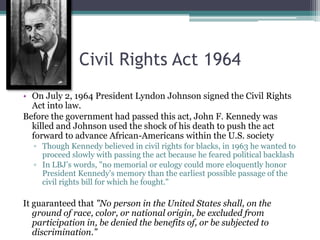
• On July 2, 1964 President Lyndon Johnson signed the Civil Rights
  Act into law.
Before the government had passed this act, John F. Kennedy was
  killed and Johnson used the shock of his death to push the act
  forward to advance African-Americans within the U.S. society
  ▫ Though Kennedy believed in civil rights for blacks, in 1963 he wanted to
    proceed slowly with passing the act because he feared political backlash
  ▫ In LBJ’s words, "no memorial or eulogy could more eloquently honor
    President Kennedy's memory than the earliest possible passage of the
    civil rights bill for which he fought."

It guaranteed that "No person in the United States shall, on the
   ground of race, color, or national origin, be excluded from
   participation in, be denied the benefits of, or be subjected to
   discrimination.”
Civil Rights Act of 1964
                    also…
authorized the Department of
 Justice to bring legal action
 against segregation
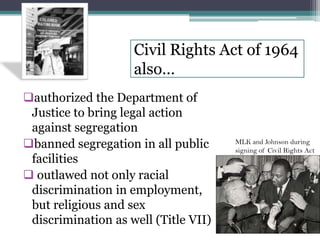
banned segregation in all public     MLK and Johnson during
                                      signing of Civil Rights Act
 facilities
 outlawed not only racial
 discrimination in employment,
 but religious and sex
 discrimination as well (Title VII)
Civil Rights Act 1964
Though the act could not change the racial opinions of
 some people in America by force, the law did have
 positive affects.
IMPACTS:
• In 1964, only two southern states (Tennessee and Texas) had more
  than 2% of their black students enrolled in integrated schools.
• Because of Title VI, about 6% of the black students in the South
  were in integrated schools by the next year.
  ▫ *Title VI protects people from discrimination based on race, color or
    national origin in programs or activities that receive Federal financial
    assistance*
Civil Rights Act of 1964
IMPACTS:
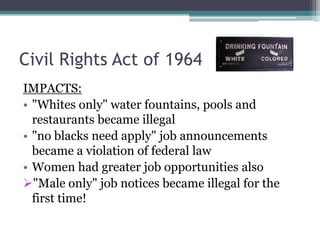
• "Whites only" water fountains, pools and
  restaurants became illegal
• "no blacks need apply" job announcements
  became a violation of federal law
• Women had greater job opportunities also
"Male only" job notices became illegal for the
  first time!
Civil Rights Act of 1964
FOLLOWING:
• Riots Occurred- some African-Americans in north-eastern cities
  believed the act did not go far enough
Following…Mississippi Freedom
Democratic Party Steps Up
• The Mississippi Freedom Democratic Party demanded to have seats
  at the Democratic Party Convention in Atlantic City
  ▫ They believed that they were more representative of the people who lived
    in Mississippi than the politicians who would usually have attended such
    conventions
About MFDP:
1. Established in April 1964


  Overall, Johnson was dismayed by the lack of public support
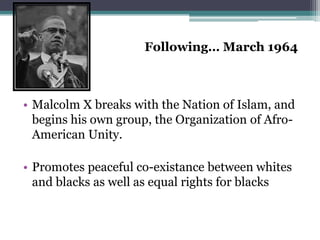
Following… March 1964


• Malcolm X breaks with the Nation of Islam, and
  begins his own group, the Organization of Afro-
  American Unity.

• Promotes peaceful co-existance between whites
  and blacks as well as equal rights for blacks
July 18, 1964
• James Powell, a 15 year old black resident of Harlem, was shot and
  killed by an off duty white police officer named Thomas G. Gilligan.
  Powell and his two other friends were involved in horseplay and,
  supposedly, were bothering and messing around with a building
  superintendent, Patrick Lynch.

• Lynch sprayed the boys with his garden hose. The two other boys
  chased Lynch and as Powell went to follow along with them, Lt.
  Gilligan intervened and shot at James twice, with the second bullet
  being fatal.

• Members of Powell’s community were outraged, and like wild fire,
  their anger spread.
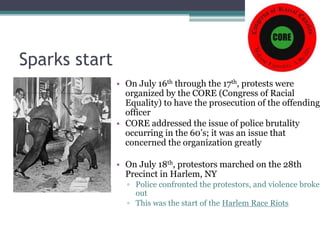
Sparks start
               • On July 16th through the 17th, protests were
                 organized by the CORE (Congress of Racial
                 Equality) to have the prosecution of the offending
                 officer
               • CORE addressed the issue of police brutality
                 occurring in the 60’s; it was an issue that
                 concerned the organization greatly

               • On July 18th, protestors marched on the 28th
                 Precinct in Harlem, NY
                 ▫ Police confronted the protestors, and violence broke
                   out
                 ▫ This was the start of the Harlem Race Riots
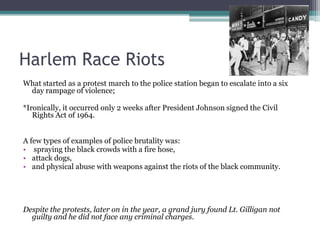
Harlem Race Riots
What started as a protest march to the police station began to escalate into a six
 day rampage of violence;

*Ironically, it occurred only 2 weeks after President Johnson signed the Civil
   Rights Act of 1964.


A few types of examples of police brutality was:
• spraying the black crowds with a fire hose,
• attack dogs,
• and physical abuse with weapons against the riots of the black community.


Despite the protests, later on in the year, a grand jury found Lt. Gilligan not
  guilty and he did not face any criminal charges.
Sounds a little similar…
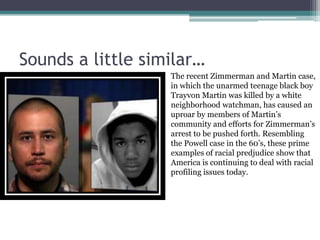
                   The recent Zimmerman and Martin case,
                   in which the unarmed teenage black boy
                   Trayvon Martin was killed by a white
                   neighborhood watchman, has caused an
                   uproar by members of Martin’s
                   community and efforts for Zimmerman’s
                   arrest to be pushed forth. Resembling
                   the Powell case in the 60’s, these prime
                   examples of racial predjudice show that
                   America is continuing to deal with racial
                   profiling issues today.
Moving Forward
• During the midst of the Civil Rights movements,
  students from Universities from the North went
  to the South to help African Americans register
  to vote and participate in the voting process- free
  from fear and intimidation. Young people were
  hoping to move the Civil Right’s Act forward by
  joining organizations and participating in
  marches for what they believed was right.
Mississippi Summer Project
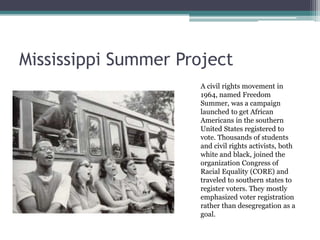
                      A civil rights movement in
                      1964, named Freedom
                      Summer, was a campaign
                      launched to get African
                      Americans in the southern
                      United States registered to
                      vote. Thousands of students
                      and civil rights activists, both
                      white and black, joined the
                      organization Congress of
                      Racial Equality (CORE) and
                      traveled to southern states to
                      register voters. They mostly
                      emphasized voter registration
                      rather than desegregation as a
                      goal.
Mississippi Summer Project
• It was launched in June, 1964 and ended in late August 1964
   ▫ GOAL: to get as many of the state’s African Americans to vote as possible
White supremacists responded by harassing, arresting,
 and attacking (in some cases fatally) the activists.

• Between June 20 and August 26, the following events had occurred in
  Mississippi:
  ▫   4 activists killed
  ▫   4 critically injured
  ▫   80 were beaten
  ▫   Roughly 1,000 were arrested
  ▫   37 churches were burned/bombed
  ▫   30 homes/businesses as well
Volunteers and Activists- Every Day
Occurances
When the buses arrived in Mississippi , protesters against the civil
  rights activists violently attacked; buses were set on fire, mobs used
  clubs to hit the volunteers, and guns were shot.
Reported witness William Orrick of the Justice Department: “People
  with no apparent connection were beaten, a boy’s leg was broken,
  and another boy had inflammable liquid poured over him and set on
  fire.”

Frank Cieciorka stated, “I was beaten once, involved in high-speed
  chases twice, and jailed four times.”

Deborah Rand recalled, “As I walked down the street with my
  Freedom School students, cars swerved trying to hit us.”
Freedom Summer Cont.
• On June 14, 1964 the first group of summer volunteers began training at
  Western College for Women in Oxford, Ohio.
• Of the approximately 1,000 volunteers, the majority were white
  northern college students from middle and upper class backgrounds.

• The training sessions were intended to:
   ▫ prepare volunteers to register black voters,
   ▫ teach literacy and civics at Freedom Schools,
   ▫ and promote the Mississippi Freedom Democratic Party’s challenge to the all-white
     Democratic delegation at that summer’s Democratic National Convention in Atlantic
     City, New Jersey.


Only one week after their meetings in Oxford, 3 civil rights workers are reported
  missing….
The Mississippi Burning Trial


On August 4 in Neshoba County, Mississippi, 3 bodies are found in a dam
  after 6 weeks of investigation by the FBI (backed by the President) Michael
  Schwerner, Andrew Goodman, and James Chaney were three civil rights
  activists involved with the Mississippi Summer Project who were killed by
  members of the Ku Klux Klan.

BEFORE THE KILLING
• Schwerner and Chaney were working near Neshoba County, Mississippi to
  accomplish tasks such as opening “Freedom Schools”, organizing black boycotts of
  white-owned businesses , and to register African-Americans to vote.
  ▫ *The work these activists were doing enraged members of the Ku Klux Klan, who
     were becoming very active in Mississippi during the 60’s. They wanted to get rid
     of as many prominent workers as they could *
The Mississippi Burning Trial
• Michael Schwerner became a target by members of the Klan because he was
  successful in organizing a boycott of a variety store in Meridian until the
  store hired its first African-American employee.

• The hatred the Klan grew for him was also because Schwerner was Jewish,
  and the KKK referred to him as “Jew Boy” or “Goatee”.

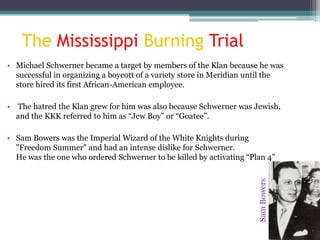
• Sam Bowers was the Imperial Wizard of the White Knights during
  "Freedom Summer" and had an intense dislike for Schwerner.
  He was the one who ordered Schwerner to be killed by activating “Plan 4”


                                                                     Sam Bowers
The Mississippi Burning Trial
PLAN 4
• The Klan was aware that Schwerner had a meeting at Mount Zion
  Church, which was to be a future location for one of the many
  Freedom Schools that were opening throughout Mississippi.
• However, the KKK were misinformed because when they showed up
  to the church, Schwerner was not there; he was actually in Oxford,
  Ohio along with Chaney and Goodman attending a seminar. With
  rage, members began beating the church members before they
  burned it to the ground.
• Learning about the fire, all 3 activists returned to investigate the
  church. It was there in Neshoba County, Mississippi that they
  learned from other community members that they were being
  targeted by some local white men.
The Mississippi Burning Trial

• Heading back to Meridian and a few miles outside of Philadelphia,
  the three driving in a blue Core-Wagon were spotted by Klan
  member, Deputy Sheriff Cecil Price.

• Price pulled the wagon over and arrested the three students for
  being under suspicion of arson in the Mount Zion Church fire.

• Price freed the three jailed men around 10 p.m. and followed them
  as they drove down Highway 19.

• The CORE group realized that Price was chasing them, and a high
  speed chase occurred until Chaney stopped the car and surrendered
  to Price.
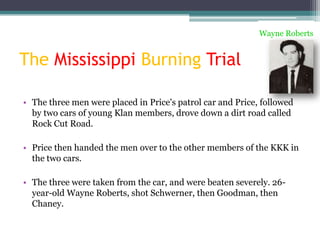
Wayne Roberts


The Mississippi Burning Trial

• The three men were placed in Price's patrol car and Price, followed
  by two cars of young Klan members, drove down a dirt road called
  Rock Cut Road.

• Price then handed the men over to the other members of the KKK in
  the two cars.

• The three were taken from the car, and were beaten severely. 26-
  year-old Wayne Roberts, shot Schwerner, then Goodman, then
  Chaney.
•On August 4, the FBI discovered their
                                                 bodies hidden in a dam lying on a
                                                 nearby farm.

                                                 •19 of the men were arrested, but a week
                                                 later, charges were dismissed by Federal
                                                 Judge William Harold Cox (extreme
                                                 segregationist)

                                                 •It was not until March, 1966 that the
                                                 U.S. Supreme Court would over-rule
                                                 Cox

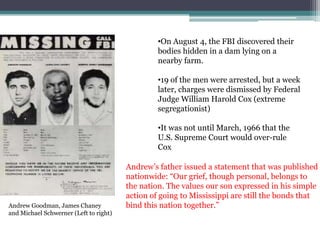
                                        Andrew’s father issued a statement that was published
                                        nationwide: “Our grief, though personal, belongs to
                                        the nation. The values our son expressed in his simple
                                        action of going to Mississippi are still the bonds that
Andrew Goodman, James Chaney            bind this nation together.”
and Michael Schwerner (Left to right)
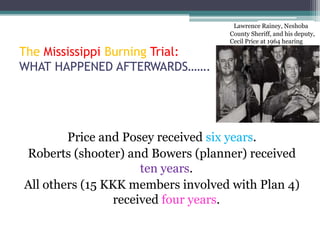
Lawrence Rainey, Neshoba
                                   County Sheriff, and his deputy,
                                   Cecil Price at 1964 hearing
The Mississippi Burning Trial:
WHAT HAPPENED AFTERWARDS…….


        Price and Posey received six years.
Roberts (shooter) and Bowers (planner) received
                      ten years.
All others (15 KKK members involved with Plan 4)
                 received four years.
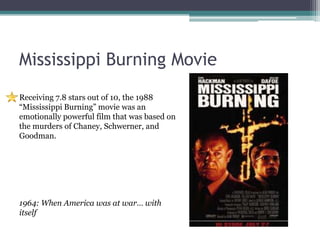
Mississippi Burning Movie
Receiving 7.8 stars out of 10, the 1988
“Mississippi Burning” movie was an
emotionally powerful film that was based on
the murders of Chaney, Schwerner, and
Goodman.


1964: When America was at war… with
itself
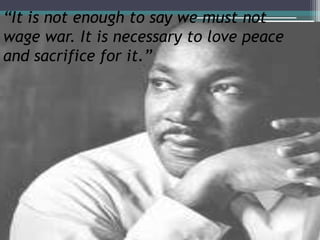
“It is not enough to say we must not
wage war. It is necessary to love peace
and sacrifice for it.”
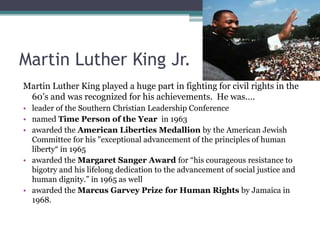
Martin Luther King Jr.
Martin Luther King played a huge part in fighting for civil rights in the
 60’s and was recognized for his achievements. He was….
• leader of the Southern Christian Leadership Conference
• named Time Person of the Year in 1963
• awarded the American Liberties Medallion by the American Jewish
  Committee for his "exceptional advancement of the principles of human
  liberty“ in 1965
• awarded the Margaret Sanger Award for “his courageous resistance to
  bigotry and his lifelong dedication to the advancement of social justice and
  human dignity.” in 1965 as well
• awarded the Marcus Garvey Prize for Human Rights by Jamaica in
  1968.
Nobel Peace Prize of 1964
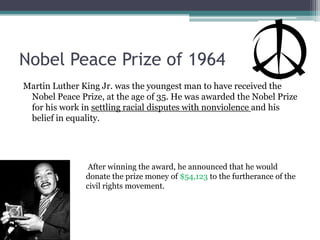
Martin Luther King Jr. was the youngest man to have received the
 Nobel Peace Prize, at the age of 35. He was awarded the Nobel Prize
 for his work in settling racial disputes with nonviolence and his
 belief in equality.


                After winning the award, he announced that he would
               donate the prize money of $54,123 to the furtherance of the
               civil rights movement.
Oral History
Who? – My great-grandma Orr

She’s in her early 80’s; during the 60’s she was
 in her 30’s.

She is a very interesting person to talk to!
Oral History
Question #1:The South was known for its strong racism in the 60’s.
    (Mississippi) Living in Ohio during the 1960’s, were there any
    signs of segregation in the North? If so, can you give me some
    examples?

Answer: “No, I do not remember any signs of segregation where I
   lived. There were definitely no separate bathrooms, eating areas,
   water fountains and such for black and whites where I lived; some
   places in the south were a whole’nother story.”
Oral History
Question #2: What do you remember about the deaths of the 3 civil
 rights workers in Neshoba, Mississippi? (near Philadelphia, Miss.)
 Was it a big deal here or did it only make headlines in the South?

Answer: “Oh, I don’t recall the names of the fellows, but I DO
  remember hearing about the murders of the civil rights workers.
  Yes, I do remember! But I don’t remember how much they talked
  about it here… I believe it was a bigger deal in some areas then
  others. I just remember hearing about it.”

[Begins talking about babysitting in Nova Scotia]
Oral History
Question #3: Many race riots occurred in the 60’s, such as the Harlem
 Race Riots. Where there any
Oral History
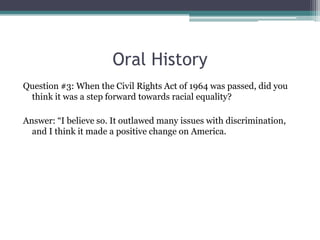
Question #3: When the Civil Rights Act of 1964 was passed, did you
 think it was a step forward towards racial equality?

Answer: “I believe so. It outlawed many issues with discrimination,
  and I think it made a positive change on America.
sources
http://www.kingian.net/ Site for teens on non
  violence and the ideas of Martin Luther King Jr.
http://www.thekingcenter.org/ Speeches,
  biography, educational activities from the
• King Center in Atlanta
• http://www.factmonster.com/ce6/history/A085
  8852.html
sources
• http://crime.about.com/od/history/p/ms_burn.
  htm
• http://www.nobelprize.org/nobel_prizes/peace/
  laureates/1964/king.html

• http://crdl.usg.edu/events/ny_race_riots/?Wel
  come james powell
• http://www.detroits-great-
  rebellion.com/Harlem-riot.html

1964 history project[1]

  • 1.
    1964: Civil Rightsin America By: Brianna Bennett
  • 2.
    Research Question: Howdid the Civil Rights Act of 1964 and events involving racial segregation during that period (Mississippi Burning Trial, Race riots, etc.) have affect on the way discrimination is viewed in America today?
  • 3.
    Civil Rights Act1964 • On July 2, 1964 President Lyndon Johnson signed the Civil Rights Act into law. Before the government had passed this act, John F. Kennedy was killed and Johnson used the shock of his death to push the act forward to advance African-Americans within the U.S. society ▫ Though Kennedy believed in civil rights for blacks, in 1963 he wanted to proceed slowly with passing the act because he feared political backlash ▫ In LBJ’s words, "no memorial or eulogy could more eloquently honor President Kennedy's memory than the earliest possible passage of the civil rights bill for which he fought." It guaranteed that "No person in the United States shall, on the ground of race, color, or national origin, be excluded from participation in, be denied the benefits of, or be subjected to discrimination.”
  • 4.
    Civil Rights Actof 1964 also… authorized the Department of Justice to bring legal action against segregation banned segregation in all public MLK and Johnson during signing of Civil Rights Act facilities  outlawed not only racial discrimination in employment, but religious and sex discrimination as well (Title VII)
  • 5.
    Civil Rights Act1964 Though the act could not change the racial opinions of some people in America by force, the law did have positive affects. IMPACTS: • In 1964, only two southern states (Tennessee and Texas) had more than 2% of their black students enrolled in integrated schools. • Because of Title VI, about 6% of the black students in the South were in integrated schools by the next year. ▫ *Title VI protects people from discrimination based on race, color or national origin in programs or activities that receive Federal financial assistance*
  • 6.
    Civil Rights Actof 1964 IMPACTS: • "Whites only" water fountains, pools and restaurants became illegal • "no blacks need apply" job announcements became a violation of federal law • Women had greater job opportunities also "Male only" job notices became illegal for the first time!
  • 7.
    Civil Rights Actof 1964 FOLLOWING: • Riots Occurred- some African-Americans in north-eastern cities believed the act did not go far enough
  • 8.
    Following…Mississippi Freedom Democratic PartySteps Up • The Mississippi Freedom Democratic Party demanded to have seats at the Democratic Party Convention in Atlantic City ▫ They believed that they were more representative of the people who lived in Mississippi than the politicians who would usually have attended such conventions About MFDP: 1. Established in April 1964 Overall, Johnson was dismayed by the lack of public support
  • 9.
    Following… March 1964 •Malcolm X breaks with the Nation of Islam, and begins his own group, the Organization of Afro- American Unity. • Promotes peaceful co-existance between whites and blacks as well as equal rights for blacks
  • 10.
    July 18, 1964 •James Powell, a 15 year old black resident of Harlem, was shot and killed by an off duty white police officer named Thomas G. Gilligan. Powell and his two other friends were involved in horseplay and, supposedly, were bothering and messing around with a building superintendent, Patrick Lynch. • Lynch sprayed the boys with his garden hose. The two other boys chased Lynch and as Powell went to follow along with them, Lt. Gilligan intervened and shot at James twice, with the second bullet being fatal. • Members of Powell’s community were outraged, and like wild fire, their anger spread.
  • 11.
    Sparks start • On July 16th through the 17th, protests were organized by the CORE (Congress of Racial Equality) to have the prosecution of the offending officer • CORE addressed the issue of police brutality occurring in the 60’s; it was an issue that concerned the organization greatly • On July 18th, protestors marched on the 28th Precinct in Harlem, NY ▫ Police confronted the protestors, and violence broke out ▫ This was the start of the Harlem Race Riots
  • 12.
    Harlem Race Riots Whatstarted as a protest march to the police station began to escalate into a six day rampage of violence; *Ironically, it occurred only 2 weeks after President Johnson signed the Civil Rights Act of 1964. A few types of examples of police brutality was: • spraying the black crowds with a fire hose, • attack dogs, • and physical abuse with weapons against the riots of the black community. Despite the protests, later on in the year, a grand jury found Lt. Gilligan not guilty and he did not face any criminal charges.
  • 13.
    Sounds a littlesimilar… The recent Zimmerman and Martin case, in which the unarmed teenage black boy Trayvon Martin was killed by a white neighborhood watchman, has caused an uproar by members of Martin’s community and efforts for Zimmerman’s arrest to be pushed forth. Resembling the Powell case in the 60’s, these prime examples of racial predjudice show that America is continuing to deal with racial profiling issues today.
  • 14.
    Moving Forward • Duringthe midst of the Civil Rights movements, students from Universities from the North went to the South to help African Americans register to vote and participate in the voting process- free from fear and intimidation. Young people were hoping to move the Civil Right’s Act forward by joining organizations and participating in marches for what they believed was right.
  • 15.
    Mississippi Summer Project A civil rights movement in 1964, named Freedom Summer, was a campaign launched to get African Americans in the southern United States registered to vote. Thousands of students and civil rights activists, both white and black, joined the organization Congress of Racial Equality (CORE) and traveled to southern states to register voters. They mostly emphasized voter registration rather than desegregation as a goal.
  • 16.
    Mississippi Summer Project •It was launched in June, 1964 and ended in late August 1964 ▫ GOAL: to get as many of the state’s African Americans to vote as possible White supremacists responded by harassing, arresting, and attacking (in some cases fatally) the activists. • Between June 20 and August 26, the following events had occurred in Mississippi: ▫ 4 activists killed ▫ 4 critically injured ▫ 80 were beaten ▫ Roughly 1,000 were arrested ▫ 37 churches were burned/bombed ▫ 30 homes/businesses as well
  • 17.
    Volunteers and Activists-Every Day Occurances When the buses arrived in Mississippi , protesters against the civil rights activists violently attacked; buses were set on fire, mobs used clubs to hit the volunteers, and guns were shot. Reported witness William Orrick of the Justice Department: “People with no apparent connection were beaten, a boy’s leg was broken, and another boy had inflammable liquid poured over him and set on fire.” Frank Cieciorka stated, “I was beaten once, involved in high-speed chases twice, and jailed four times.” Deborah Rand recalled, “As I walked down the street with my Freedom School students, cars swerved trying to hit us.”
  • 18.
    Freedom Summer Cont. •On June 14, 1964 the first group of summer volunteers began training at Western College for Women in Oxford, Ohio. • Of the approximately 1,000 volunteers, the majority were white northern college students from middle and upper class backgrounds. • The training sessions were intended to: ▫ prepare volunteers to register black voters, ▫ teach literacy and civics at Freedom Schools, ▫ and promote the Mississippi Freedom Democratic Party’s challenge to the all-white Democratic delegation at that summer’s Democratic National Convention in Atlantic City, New Jersey. Only one week after their meetings in Oxford, 3 civil rights workers are reported missing….
  • 19.
    The Mississippi BurningTrial On August 4 in Neshoba County, Mississippi, 3 bodies are found in a dam after 6 weeks of investigation by the FBI (backed by the President) Michael Schwerner, Andrew Goodman, and James Chaney were three civil rights activists involved with the Mississippi Summer Project who were killed by members of the Ku Klux Klan. BEFORE THE KILLING • Schwerner and Chaney were working near Neshoba County, Mississippi to accomplish tasks such as opening “Freedom Schools”, organizing black boycotts of white-owned businesses , and to register African-Americans to vote. ▫ *The work these activists were doing enraged members of the Ku Klux Klan, who were becoming very active in Mississippi during the 60’s. They wanted to get rid of as many prominent workers as they could *
  • 20.
    The Mississippi BurningTrial • Michael Schwerner became a target by members of the Klan because he was successful in organizing a boycott of a variety store in Meridian until the store hired its first African-American employee. • The hatred the Klan grew for him was also because Schwerner was Jewish, and the KKK referred to him as “Jew Boy” or “Goatee”. • Sam Bowers was the Imperial Wizard of the White Knights during "Freedom Summer" and had an intense dislike for Schwerner. He was the one who ordered Schwerner to be killed by activating “Plan 4” Sam Bowers
  • 21.
    The Mississippi BurningTrial PLAN 4 • The Klan was aware that Schwerner had a meeting at Mount Zion Church, which was to be a future location for one of the many Freedom Schools that were opening throughout Mississippi. • However, the KKK were misinformed because when they showed up to the church, Schwerner was not there; he was actually in Oxford, Ohio along with Chaney and Goodman attending a seminar. With rage, members began beating the church members before they burned it to the ground. • Learning about the fire, all 3 activists returned to investigate the church. It was there in Neshoba County, Mississippi that they learned from other community members that they were being targeted by some local white men.
  • 22.
    The Mississippi BurningTrial • Heading back to Meridian and a few miles outside of Philadelphia, the three driving in a blue Core-Wagon were spotted by Klan member, Deputy Sheriff Cecil Price. • Price pulled the wagon over and arrested the three students for being under suspicion of arson in the Mount Zion Church fire. • Price freed the three jailed men around 10 p.m. and followed them as they drove down Highway 19. • The CORE group realized that Price was chasing them, and a high speed chase occurred until Chaney stopped the car and surrendered to Price.
  • 23.
    Wayne Roberts The MississippiBurning Trial • The three men were placed in Price's patrol car and Price, followed by two cars of young Klan members, drove down a dirt road called Rock Cut Road. • Price then handed the men over to the other members of the KKK in the two cars. • The three were taken from the car, and were beaten severely. 26- year-old Wayne Roberts, shot Schwerner, then Goodman, then Chaney.
  • 24.
    •On August 4,the FBI discovered their bodies hidden in a dam lying on a nearby farm. •19 of the men were arrested, but a week later, charges were dismissed by Federal Judge William Harold Cox (extreme segregationist) •It was not until March, 1966 that the U.S. Supreme Court would over-rule Cox Andrew’s father issued a statement that was published nationwide: “Our grief, though personal, belongs to the nation. The values our son expressed in his simple action of going to Mississippi are still the bonds that Andrew Goodman, James Chaney bind this nation together.” and Michael Schwerner (Left to right)
  • 25.
    Lawrence Rainey, Neshoba County Sheriff, and his deputy, Cecil Price at 1964 hearing The Mississippi Burning Trial: WHAT HAPPENED AFTERWARDS……. Price and Posey received six years. Roberts (shooter) and Bowers (planner) received ten years. All others (15 KKK members involved with Plan 4) received four years.
  • 26.
    Mississippi Burning Movie Receiving7.8 stars out of 10, the 1988 “Mississippi Burning” movie was an emotionally powerful film that was based on the murders of Chaney, Schwerner, and Goodman. 1964: When America was at war… with itself
  • 27.
    “It is notenough to say we must not wage war. It is necessary to love peace and sacrifice for it.”
  • 28.
    Martin Luther KingJr. Martin Luther King played a huge part in fighting for civil rights in the 60’s and was recognized for his achievements. He was…. • leader of the Southern Christian Leadership Conference • named Time Person of the Year in 1963 • awarded the American Liberties Medallion by the American Jewish Committee for his "exceptional advancement of the principles of human liberty“ in 1965 • awarded the Margaret Sanger Award for “his courageous resistance to bigotry and his lifelong dedication to the advancement of social justice and human dignity.” in 1965 as well • awarded the Marcus Garvey Prize for Human Rights by Jamaica in 1968.
  • 29.
    Nobel Peace Prizeof 1964 Martin Luther King Jr. was the youngest man to have received the Nobel Peace Prize, at the age of 35. He was awarded the Nobel Prize for his work in settling racial disputes with nonviolence and his belief in equality. After winning the award, he announced that he would donate the prize money of $54,123 to the furtherance of the civil rights movement.
  • 30.
    Oral History Who? –My great-grandma Orr She’s in her early 80’s; during the 60’s she was in her 30’s. She is a very interesting person to talk to!
  • 31.
    Oral History Question #1:TheSouth was known for its strong racism in the 60’s. (Mississippi) Living in Ohio during the 1960’s, were there any signs of segregation in the North? If so, can you give me some examples? Answer: “No, I do not remember any signs of segregation where I lived. There were definitely no separate bathrooms, eating areas, water fountains and such for black and whites where I lived; some places in the south were a whole’nother story.”
  • 32.
    Oral History Question #2:What do you remember about the deaths of the 3 civil rights workers in Neshoba, Mississippi? (near Philadelphia, Miss.) Was it a big deal here or did it only make headlines in the South? Answer: “Oh, I don’t recall the names of the fellows, but I DO remember hearing about the murders of the civil rights workers. Yes, I do remember! But I don’t remember how much they talked about it here… I believe it was a bigger deal in some areas then others. I just remember hearing about it.” [Begins talking about babysitting in Nova Scotia]
  • 33.
    Oral History Question #3:Many race riots occurred in the 60’s, such as the Harlem Race Riots. Where there any
  • 34.
    Oral History Question #3:When the Civil Rights Act of 1964 was passed, did you think it was a step forward towards racial equality? Answer: “I believe so. It outlawed many issues with discrimination, and I think it made a positive change on America.
  • 35.
    sources http://www.kingian.net/ Site forteens on non violence and the ideas of Martin Luther King Jr. http://www.thekingcenter.org/ Speeches, biography, educational activities from the • King Center in Atlanta • http://www.factmonster.com/ce6/history/A085 8852.html
  • 36.
    sources • http://crime.about.com/od/history/p/ms_burn. htm • http://www.nobelprize.org/nobel_prizes/peace/ laureates/1964/king.html • http://crdl.usg.edu/events/ny_race_riots/?Wel come james powell • http://www.detroits-great- rebellion.com/Harlem-riot.html