Cyclotron – Theory,Design, and
Applications
An Advanced Perspective on Classical
Particle Acceleration
Presented by: Your Name
M.Sc. Physics – Nuclear/Accelerator
Physics
2.
Introduction
• A cyclotronis a circular particle accelerator
using static magnetic and alternating electric
fields.
• Invented by Ernest Lawrence in 1930.
• Used in isotope production, nuclear research,
and medical therapy.
3.
Basic Principle
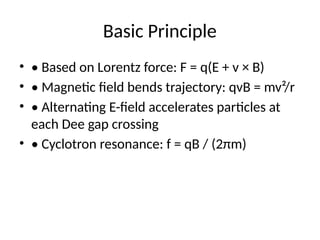
• •Based on Lorentz force: F = q(E + v × B)
• • Magnetic field bends trajectory: qvB = mv²/r
• • Alternating E-field accelerates particles at
each Dee gap crossing
• • Cyclotron resonance: f = qB / (2πm)
4.
Construction
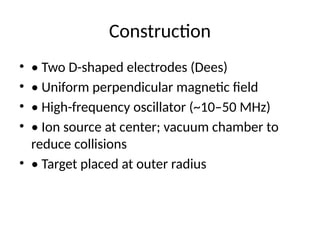
• • TwoD-shaped electrodes (Dees)
• • Uniform perpendicular magnetic field
• • High-frequency oscillator (~10–50 MHz)
• • Ion source at center; vacuum chamber to
reduce collisions
• • Target placed at outer radius
5.
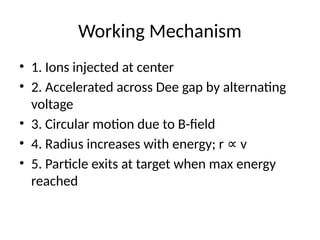
Working Mechanism
• 1.Ions injected at center
• 2. Accelerated across Dee gap by alternating
voltage
• 3. Circular motion due to B-field
• 4. Radius increases with energy; r v
∝
• 5. Particle exits at target when max energy
reached
6.
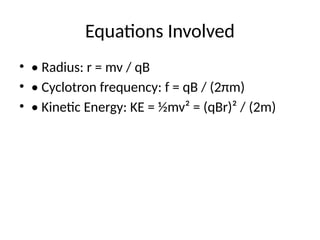
Equations Involved
• •Radius: r = mv / qB
• • Cyclotron frequency: f = qB / (2πm)
• • Kinetic Energy: KE = ½mv² = (qBr)² / (2m)
7.
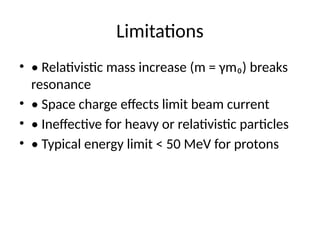
Limitations
• • Relativisticmass increase (m = γm₀) breaks
resonance
• • Space charge effects limit beam current
• • Ineffective for heavy or relativistic particles
• • Typical energy limit < 50 MeV for protons
8.
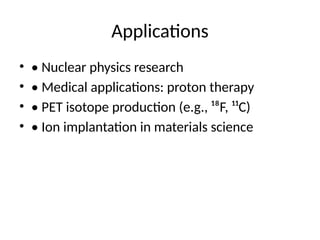
Applications
• • Nuclearphysics research
• • Medical applications: proton therapy
• • PET isotope production (e.g., ¹⁸F, ¹¹C)
• • Ion implantation in materials science
9.
Advanced Variants
• •Synchrocyclotron: varying RF frequency
• • Isochronous cyclotron: radial magnetic field
gradient
• • Compact superconducting cyclotrons for
medical use
10.
Conclusion
• • Acornerstone in classical accelerator physics
• • Still crucial in medicine and applied sciences
• • Basis for modern synchrotrons and large-
scale accelerators
11.
References
• • W.R.Leo – Techniques for Nuclear and
Particle Physics Experiments
• • D. Griffiths – Introduction to
Electrodynamics
• • IAEA publications on radionuclide
production
• • hyperphysics.phy-astr.gsu.edu