1 | P a g e
Divine Child School
Physics Investigatory Project
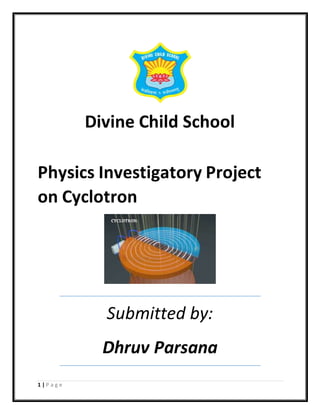
on Cyclotron
Submitted by:
Dhruv Parsana
2 | P a g e
INDEX
Certificate
Acknowledgement
Aim of Project
Introduction
Principles and Construction
Theory
Working
Limitations
Uses
Bibliography
3 | P a g e
Certificate
This is to certify that Dhruv Parsana, a
student of class XII, Divine child school
has successfully completed the project
titled Cyclotron during -the academic
year 2017-2018 towards partial
fulfillment of physics practical
examination conducted by CBSE.
Teacher Signature Principal Signature
External Examiner Signature
4 | P a g e
Acknowledgement
Primarily I would thank god for being able to
complete this project with success.Then I
would like to thank my physics teachers
Mr. Rajesh Kumar & Mr. Pawan Singh, whose
valuable guidance has been the ones that
helped me patch this project and make if full
proof successtheir suggestions and their
instructions had served as the major
contributor towards the completion of the
project.
Then I would like to thank my parents and
friends who have helped me with their valuable
suggestions and guidance has been helpful in
various phases of the completion of the project.
Last but not the least I would like to thank my
classmates who have helped me a lot.
5 | P a g e
Aim of Project
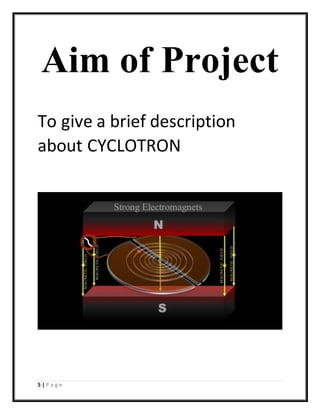
To give a brief description
about CYCLOTRON
6 | P a g e
Introduction
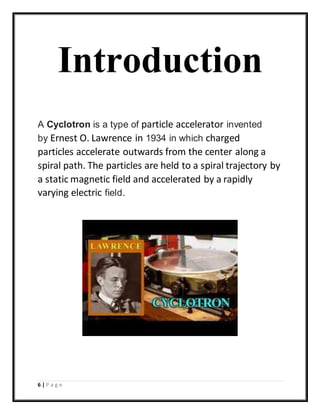
A Cyclotron is a type of particle accelerator invented
by Ernest O. Lawrence in 1934 in which charged
particles accelerate outwards from the center along a
spiral path. The particles are held to a spiral trajectory by
a static magnetic field and accelerated by a rapidly
varying electric field.
7 | P a g e
Principles and
Construction
Principle:
Cyclotron works on the principle that a charged
particle moving normal to a magnetic field
experiences magnetic Lorentz force due to which
the particle moves in a circular path.
Construction:
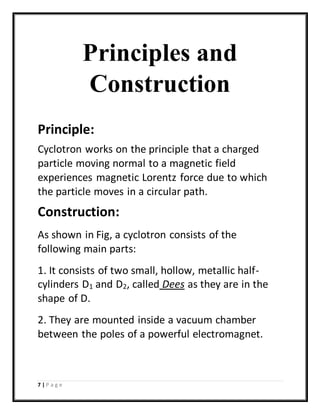
As shown in Fig, a cyclotron consists of the
following main parts:
1. It consists of two small, hollow, metallic half-
cylinders D1 and D2, called Dees as they are in the
shape of D.
2. They are mounted inside a vacuum chamber
between the poles of a powerful electromagnet.
8 | P a g e
3. The Dees are connected to the source of high
frequency alternating voltage of few hundred
kilovolts.
4. The beam of charged particles to be accelerated
is injected into the Dees near their center, in a
plane perpendicular to the magnetic field.
5. The charged particles are pulled out of the Dees
by a deflecting plate (which is negatively charged)
through a window W.
6. The whole device is in high vacuum (pressure
~10-6
mm of Hg) so that the air molecules may not
collide with the charged particles.
9 | P a g e
Theory
The positive ion P to be accelerated is placed in between the two
dees. If at any instant, D1 is at negative potential and D2 is at
positive potential, then the ion gets accelerated towards D1 but
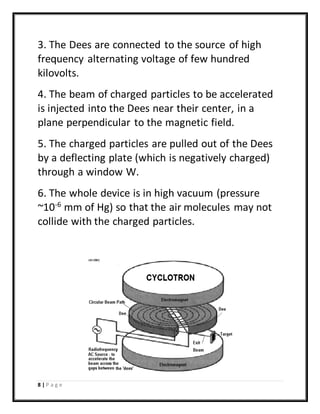
since its perpendicular to B, it describes a circular path of radius r
and Lorentz force provides the centripetal force.
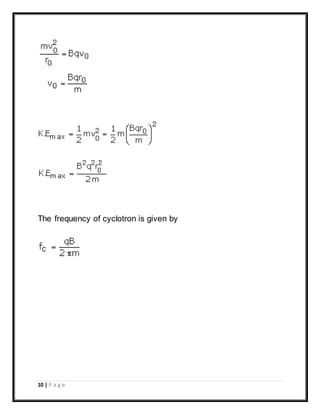
Time taken to describe a semicircle is
If this time is equal to the time during which D1 and D2 change
their polarity, the ion gets accelerated when it arrives in between
the gaps. The electric field accelerates the ion further. Once the
ion is inside the dee D2, it now describes a greater semicircle due
to the magnetic field. This process repels and the ion goes on
describing a circular path of greater radius and finally acquires a
high energy. The ion is further removed from a window W. The
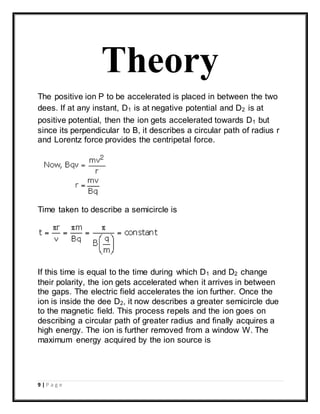
maximum energy acquired by the ion source is
10 | P a g e
The frequency of cyclotron is given by
11 | P a g e
Working
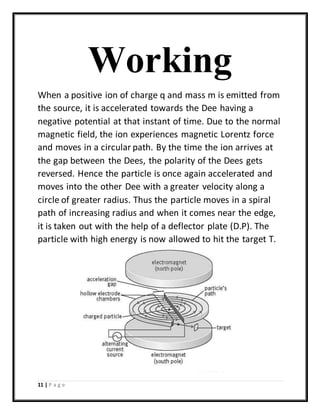
When a positive ion of charge q and mass m is emitted from
the source, it is accelerated towards the Dee having a
negative potential at that instant of time. Due to the normal
magnetic field, the ion experiences magnetic Lorentz force
and moves in a circular path. By the time the ion arrives at
the gap between the Dees, the polarity of the Dees gets
reversed. Hence the particle is once again accelerated and
moves into the other Dee with a greater velocity along a
circle of greater radius. Thus the particle moves in a spiral
path of increasing radius and when it comes near the edge,
it is taken out with the help of a deflector plate (D.P). The
particle with high energy is now allowed to hit the target T.
12 | P a g e
Limitations
 Cyclotron cannot accelerate uncharged particles like
neutrons.
 Cyclotron cannot accelerate electrons because of its small
mass.
 It cannot accelerate positivelycharged particles with large
mass due to relativisticeffect.
 Only when the speed of the circulatingion is less than 'c'
the speed of light, we find the frequency of revolutionto
be independentof its speed.
 At higher speeds, the mass of the ion will increase and this
changes the time period of the ion revolution.This results
in the ion lagging behind the electric field and it eventually
loses by collisionsagainst the wallsof the dees.
 The cyclotron is suitable for accelerating heavy charged
particles.
 It is not suited for very high kinetic energy.
13 | P a g e
Uses
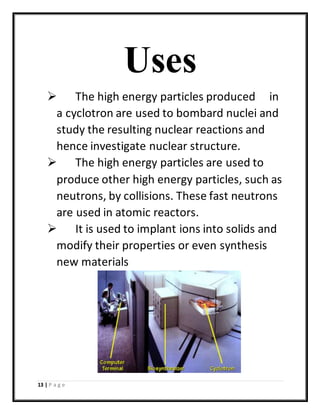
 The high energy particles produced in
a cyclotron are used to bombard nuclei and
study the resulting nuclear reactions and
hence investigate nuclear structure.
 The high energy particles are used to
produce other high energy particles, such as
neutrons, by collisions. These fast neutrons
are used in atomic reactors.
 It is used to implant ions into solids and
modify their properties or even synthesis
new materials
14 | P a g e
Bibliography
 Physics Pradeep class 12
 Google
 Wikipedia
 Science for all
 Brainkart.com

Cyclotron

  • 1.
    1 | Pa g e Divine Child School Physics Investigatory Project on Cyclotron Submitted by: Dhruv Parsana
  • 2.
    2 | Pa g e INDEX Certificate Acknowledgement Aim of Project Introduction Principles and Construction Theory Working Limitations Uses Bibliography
  • 3.
    3 | Pa g e Certificate This is to certify that Dhruv Parsana, a student of class XII, Divine child school has successfully completed the project titled Cyclotron during -the academic year 2017-2018 towards partial fulfillment of physics practical examination conducted by CBSE. Teacher Signature Principal Signature External Examiner Signature
  • 4.
    4 | Pa g e Acknowledgement Primarily I would thank god for being able to complete this project with success.Then I would like to thank my physics teachers Mr. Rajesh Kumar & Mr. Pawan Singh, whose valuable guidance has been the ones that helped me patch this project and make if full proof successtheir suggestions and their instructions had served as the major contributor towards the completion of the project. Then I would like to thank my parents and friends who have helped me with their valuable suggestions and guidance has been helpful in various phases of the completion of the project. Last but not the least I would like to thank my classmates who have helped me a lot.
  • 5.
    5 | Pa g e Aim of Project To give a brief description about CYCLOTRON
  • 6.
    6 | Pa g e Introduction A Cyclotron is a type of particle accelerator invented by Ernest O. Lawrence in 1934 in which charged particles accelerate outwards from the center along a spiral path. The particles are held to a spiral trajectory by a static magnetic field and accelerated by a rapidly varying electric field.
  • 7.
    7 | Pa g e Principles and Construction Principle: Cyclotron works on the principle that a charged particle moving normal to a magnetic field experiences magnetic Lorentz force due to which the particle moves in a circular path. Construction: As shown in Fig, a cyclotron consists of the following main parts: 1. It consists of two small, hollow, metallic half- cylinders D1 and D2, called Dees as they are in the shape of D. 2. They are mounted inside a vacuum chamber between the poles of a powerful electromagnet.
  • 8.
    8 | Pa g e 3. The Dees are connected to the source of high frequency alternating voltage of few hundred kilovolts. 4. The beam of charged particles to be accelerated is injected into the Dees near their center, in a plane perpendicular to the magnetic field. 5. The charged particles are pulled out of the Dees by a deflecting plate (which is negatively charged) through a window W. 6. The whole device is in high vacuum (pressure ~10-6 mm of Hg) so that the air molecules may not collide with the charged particles.
  • 9.
    9 | Pa g e Theory The positive ion P to be accelerated is placed in between the two dees. If at any instant, D1 is at negative potential and D2 is at positive potential, then the ion gets accelerated towards D1 but since its perpendicular to B, it describes a circular path of radius r and Lorentz force provides the centripetal force. Time taken to describe a semicircle is If this time is equal to the time during which D1 and D2 change their polarity, the ion gets accelerated when it arrives in between the gaps. The electric field accelerates the ion further. Once the ion is inside the dee D2, it now describes a greater semicircle due to the magnetic field. This process repels and the ion goes on describing a circular path of greater radius and finally acquires a high energy. The ion is further removed from a window W. The maximum energy acquired by the ion source is
  • 10.
    10 | Pa g e The frequency of cyclotron is given by
  • 11.
    11 | Pa g e Working When a positive ion of charge q and mass m is emitted from the source, it is accelerated towards the Dee having a negative potential at that instant of time. Due to the normal magnetic field, the ion experiences magnetic Lorentz force and moves in a circular path. By the time the ion arrives at the gap between the Dees, the polarity of the Dees gets reversed. Hence the particle is once again accelerated and moves into the other Dee with a greater velocity along a circle of greater radius. Thus the particle moves in a spiral path of increasing radius and when it comes near the edge, it is taken out with the help of a deflector plate (D.P). The particle with high energy is now allowed to hit the target T.
  • 12.
    12 | Pa g e Limitations  Cyclotron cannot accelerate uncharged particles like neutrons.  Cyclotron cannot accelerate electrons because of its small mass.  It cannot accelerate positivelycharged particles with large mass due to relativisticeffect.  Only when the speed of the circulatingion is less than 'c' the speed of light, we find the frequency of revolutionto be independentof its speed.  At higher speeds, the mass of the ion will increase and this changes the time period of the ion revolution.This results in the ion lagging behind the electric field and it eventually loses by collisionsagainst the wallsof the dees.  The cyclotron is suitable for accelerating heavy charged particles.  It is not suited for very high kinetic energy.
  • 13.
    13 | Pa g e Uses  The high energy particles produced in a cyclotron are used to bombard nuclei and study the resulting nuclear reactions and hence investigate nuclear structure.  The high energy particles are used to produce other high energy particles, such as neutrons, by collisions. These fast neutrons are used in atomic reactors.  It is used to implant ions into solids and modify their properties or even synthesis new materials
  • 14.
    14 | Pa g e Bibliography  Physics Pradeep class 12  Google  Wikipedia  Science for all  Brainkart.com