Pelvic Osteotomies
Dr. Dale Williams
DDH Management Overview
• 0-6 months
– Pavlik harness

• 6 Months – 2 years, failed Pavlik
– Closed reduction ± tenotomies, hip spica cast 3 months

• 2-3 years, failed closed reduction
– Open reduction

• 3+ years
– Open reduction ± femoral osteotomy ± pelvic
osteotomy
Overview
• Four general types of osteotomies
–
–
–
–

Single innominate (Salter)
Acetabuloplasty (Pemberton)
Triple innominate (Steel)
Shelf (Chiari)
Salter Single Innominate
• Age – 18 months – 6 years
• Requires concentrically reduced hip
– Open reduction at same time possible
– Iliopsoas and adductor tenotomies often required

• Covers antero-lateral acetabular deficiency
– Up to 15o of acetabular index corrected
Salter
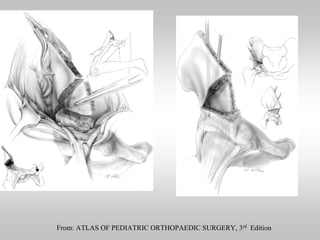
• Anterior approach to acetabulum
– Exposing inner and outer ilium
– Expose hip capsule if reduction needed
– Transverse osteotomy just above acetabulum
• G. sciatic notch to AIIS

– Rotate on pubic symphysis antero-lateral
– Hold correction with bone graft wedge & K-wires
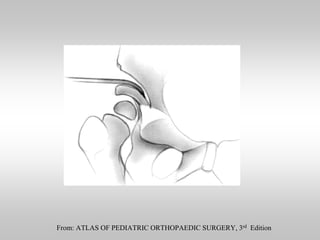
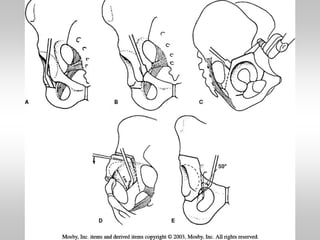
From: ATLAS OF PEDIATRIC ORTHOPAEDIC SURGERY, 3rd Edition
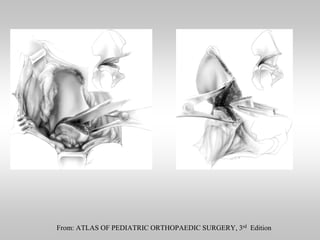
Pemberton Acetabuloplasty
• Age – 18 months – 10 years
• Requires reduced hip
• Decreases acetabular volume (small head)
– Remodeling of acetabulum required

• Corrects >15o AI
• Reduces antero-lateral acetabular defects
– Cuts altered to cover more anteriorly or laterally
Pemberton
• Anterior Approach - Exposure as for Salter
– Cut inner and outer table with small osteotome
• Anterior – transverse plane, lateral – lateral incline

– 1cm above AIIS, staying 1 cm above capsule
– Do not cut through to sciatic notch
– Lever through cut until coverage acceptable
• Levers on tri-radiate cartilage

– Hold correction with bone graft wedge
From: ATLAS OF PEDIATRIC ORTHOPAEDIC SURGERY, 3rd Edition
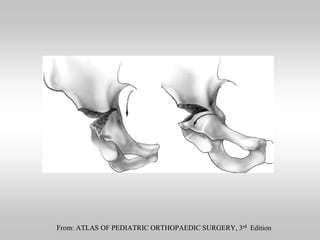
Dega Acetabuloplasty
• Similar to Pemberton
• Larger posterior hinge
– Hinges on horizontal tri-radiate limb

• Less inner table osteotomized
– More inner table – more anterior coverage
– Less inner table – more lateral coverage
From: ATLAS OF PEDIATRIC ORTHOPAEDIC SURGERY, 3rd Edition
Albee Acetabuloplasty
• Similar to Pemberton
• Outer table only osteotomized
– Cut into cancellous bone to tri-radiate cartilage
– Lever outer table laterally, hinging on triradiate cartilage
– Hold open with bone graft

• Provides some posterior coverage
– Cerebral palsy
From: ATLAS OF PEDIATRIC ORTHOPAEDIC SURGERY, 3rd Edition
Steel Triple Innominate Osteotomy
• Age – Skeletally mature
• Requires congruent hip joint
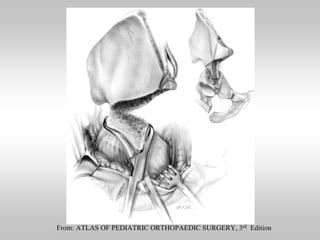
• Divides ilium, ischium and superior ramus
– Acetabulum rotationally free
– Indicated when other osteotomies not possible

• Rotates to cover any acetabular defect
Steel
• Multiple incision technique
– Posterior between gluteal and hamstrings
• Allows osteotomy of ischium

– Anterior freeing medial attachments
• Allows Salter and superior ramus osteotomy

– Rotate acetabulum as desired
• Avoid externally rotating

– Bone graft wedge, fix as per Salter type
From: ATLAS OF PEDIATRIC ORTHOPAEDIC SURGERY, 3rd Edition
Chiari Medial Displacement
• Age – skeletally mature
• Salvage operation only
– Used when no other osteotomy possible
– Possible with subluxed hip

• Covers well laterally
– Anterior and posterior augmentation may be
necessary

• May be useful in other conditions
– Coxa magna, OA in dysplasic hips
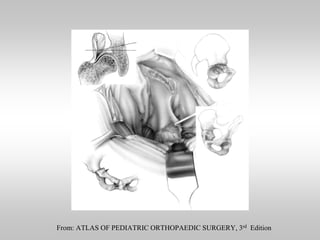
Chiari Medial Displacement
• Anterior approach – as per Salter
– Identify superior extent of capsule
– Cut from AIIS to notch following capsule curve
• Angle osteotome 10-20o cephlad

– Displace distal fragment medially 50-100%
• Ensure complete head coverage
• Leg abduction, hinges on pubic symphysis

– Secure with hardware
From: ATLAS OF PEDIATRIC ORTHOPAEDIC SURGERY, 3rd Edition
Staheli Shelf Procedure
•
•
•
•

Age – older child to skeletal maturity
Salvage operation
Indicated for non-concentric hips
Augments supero-lateral deficency
– Slotted bone graft over capsule deepening
acetabulum
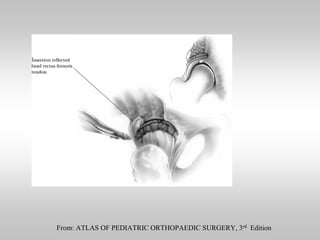
Staheli
• Anterior approach, outer wall exposure only
– Identify superior acetabular edge
– Create slot 1cm deep along edge, angled cephlad
– Remove 1 cm cortical strips from outer table
• Insert into slot, cutting at desired lateral overhang
• 2nd layer inserted lengthwise
• Use remaining to fill in above slot edge

– Hold in place with reflected fascia and adductors
From: ATLAS OF PEDIATRIC ORTHOPAEDIC SURGERY, 3rd Edition
Ganz Periacetabular Osteotomy
• Age – adults
• Osteoarthritis 2o to lateral acetabular defect
– Decreased coverage increases articular surface
stresses leading to early OA

• Easily combined with trochanteric osteotomy
• Technically extremely difficult
Ganz
• Anterior approach – lateral wall exposed
– Superior ramus osteotomy, Salter osteotomy
• stopping 1 cm from posterior edge

– Angle 120o along posterior acetabular edge
• Stop 1cm from inferior edge

– Cut along postero-inferior acetabular border
into obturator foramen
– Insert Shantz pin superior as a lever
– Fix with screws, insert bone graft as needed
Summary
• Most require remodeling
– Not as useful in older child (age>8)

• Careful match of procedure to patient
needed
• Steep learning curve for more complex
types

Pelvic osteotomies

  • 1.
  • 2.
    DDH Management Overview •0-6 months – Pavlik harness • 6 Months – 2 years, failed Pavlik – Closed reduction ± tenotomies, hip spica cast 3 months • 2-3 years, failed closed reduction – Open reduction • 3+ years – Open reduction ± femoral osteotomy ± pelvic osteotomy
  • 3.
    Overview • Four generaltypes of osteotomies – – – – Single innominate (Salter) Acetabuloplasty (Pemberton) Triple innominate (Steel) Shelf (Chiari)
  • 4.
    Salter Single Innominate •Age – 18 months – 6 years • Requires concentrically reduced hip – Open reduction at same time possible – Iliopsoas and adductor tenotomies often required • Covers antero-lateral acetabular deficiency – Up to 15o of acetabular index corrected
  • 5.
    Salter • Anterior approachto acetabulum – Exposing inner and outer ilium – Expose hip capsule if reduction needed – Transverse osteotomy just above acetabulum • G. sciatic notch to AIIS – Rotate on pubic symphysis antero-lateral – Hold correction with bone graft wedge & K-wires
  • 6.
    From: ATLAS OFPEDIATRIC ORTHOPAEDIC SURGERY, 3rd Edition
  • 7.
    Pemberton Acetabuloplasty • Age– 18 months – 10 years • Requires reduced hip • Decreases acetabular volume (small head) – Remodeling of acetabulum required • Corrects >15o AI • Reduces antero-lateral acetabular defects – Cuts altered to cover more anteriorly or laterally
  • 8.
    Pemberton • Anterior Approach- Exposure as for Salter – Cut inner and outer table with small osteotome • Anterior – transverse plane, lateral – lateral incline – 1cm above AIIS, staying 1 cm above capsule – Do not cut through to sciatic notch – Lever through cut until coverage acceptable • Levers on tri-radiate cartilage – Hold correction with bone graft wedge
  • 9.
    From: ATLAS OFPEDIATRIC ORTHOPAEDIC SURGERY, 3rd Edition
  • 10.
    Dega Acetabuloplasty • Similarto Pemberton • Larger posterior hinge – Hinges on horizontal tri-radiate limb • Less inner table osteotomized – More inner table – more anterior coverage – Less inner table – more lateral coverage
  • 11.
    From: ATLAS OFPEDIATRIC ORTHOPAEDIC SURGERY, 3rd Edition
  • 12.
    Albee Acetabuloplasty • Similarto Pemberton • Outer table only osteotomized – Cut into cancellous bone to tri-radiate cartilage – Lever outer table laterally, hinging on triradiate cartilage – Hold open with bone graft • Provides some posterior coverage – Cerebral palsy
  • 13.
    From: ATLAS OFPEDIATRIC ORTHOPAEDIC SURGERY, 3rd Edition
  • 14.
    Steel Triple InnominateOsteotomy • Age – Skeletally mature • Requires congruent hip joint • Divides ilium, ischium and superior ramus – Acetabulum rotationally free – Indicated when other osteotomies not possible • Rotates to cover any acetabular defect
  • 15.
    Steel • Multiple incisiontechnique – Posterior between gluteal and hamstrings • Allows osteotomy of ischium – Anterior freeing medial attachments • Allows Salter and superior ramus osteotomy – Rotate acetabulum as desired • Avoid externally rotating – Bone graft wedge, fix as per Salter type
  • 16.
    From: ATLAS OFPEDIATRIC ORTHOPAEDIC SURGERY, 3rd Edition
  • 17.
    Chiari Medial Displacement •Age – skeletally mature • Salvage operation only – Used when no other osteotomy possible – Possible with subluxed hip • Covers well laterally – Anterior and posterior augmentation may be necessary • May be useful in other conditions – Coxa magna, OA in dysplasic hips
  • 18.
    Chiari Medial Displacement •Anterior approach – as per Salter – Identify superior extent of capsule – Cut from AIIS to notch following capsule curve • Angle osteotome 10-20o cephlad – Displace distal fragment medially 50-100% • Ensure complete head coverage • Leg abduction, hinges on pubic symphysis – Secure with hardware
  • 19.
    From: ATLAS OFPEDIATRIC ORTHOPAEDIC SURGERY, 3rd Edition
  • 20.
    Staheli Shelf Procedure • • • • Age– older child to skeletal maturity Salvage operation Indicated for non-concentric hips Augments supero-lateral deficency – Slotted bone graft over capsule deepening acetabulum
  • 21.
    Staheli • Anterior approach,outer wall exposure only – Identify superior acetabular edge – Create slot 1cm deep along edge, angled cephlad – Remove 1 cm cortical strips from outer table • Insert into slot, cutting at desired lateral overhang • 2nd layer inserted lengthwise • Use remaining to fill in above slot edge – Hold in place with reflected fascia and adductors
  • 22.
    From: ATLAS OFPEDIATRIC ORTHOPAEDIC SURGERY, 3rd Edition
  • 23.
    Ganz Periacetabular Osteotomy •Age – adults • Osteoarthritis 2o to lateral acetabular defect – Decreased coverage increases articular surface stresses leading to early OA • Easily combined with trochanteric osteotomy • Technically extremely difficult
  • 24.
    Ganz • Anterior approach– lateral wall exposed – Superior ramus osteotomy, Salter osteotomy • stopping 1 cm from posterior edge – Angle 120o along posterior acetabular edge • Stop 1cm from inferior edge – Cut along postero-inferior acetabular border into obturator foramen – Insert Shantz pin superior as a lever – Fix with screws, insert bone graft as needed
  • 26.
    Summary • Most requireremodeling – Not as useful in older child (age>8) • Careful match of procedure to patient needed • Steep learning curve for more complex types