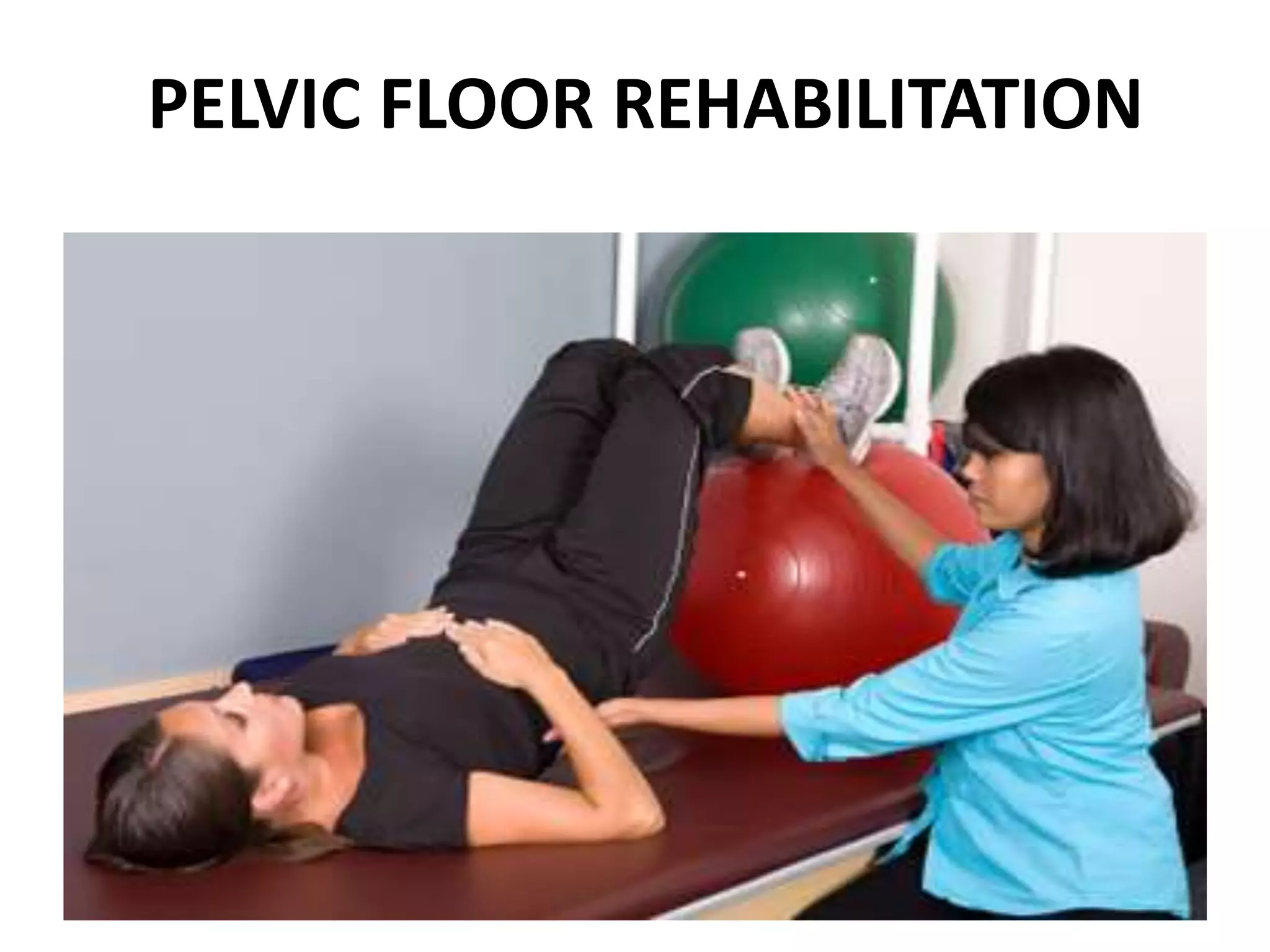
PELVIC FLOOR REHABILITATION
1Motor learning
2Pelvic floor exerecises
Identify the muscles
• First you need to find your pelvic floor
muscles.
• Try to tighten your muscles around your vagina
and back passage and lift up, as if you’re
stopping yourself passing water and wind at
the same time.
• A quick way of finding the right muscles is by
trying to stop the flow of urine when you’re in
the toilet. Don’t do this regularly because you
may start retaining urine.
• Once you've found the muscles, make sure
you relax and empty your bladder completely.
• If you're not sure you are exercising the right
muscles, put a couple of fingers into your
vagina. You should feel a gentle squeeze when
doing the exercise.
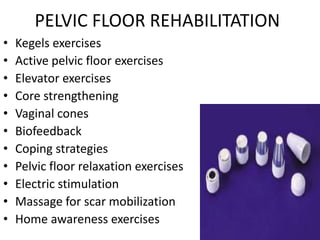
PELVIC FLOOR REHABILITATION
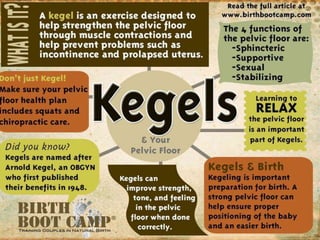
• Kegels exercises
• Active pelvic floor exercises
• Elevator exercises
• Core strengthening
• Vaginal cones
• Biofeedback
• Coping strategies
• Pelvic floor relaxation exercises
• Electric stimulation
• Massage for scar mobilization
• Home awareness exercises
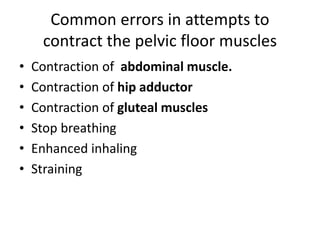
Common errors in attempts to
contract the pelvic floor muscles
• Contraction of abdominal muscle.
• Contraction of hip adductor
• Contraction of gluteal muscles
• Stop breathing
• Enhanced inhaling
• Straining
There may be several explanations why a voluntary
PFM contraction is difficult to perform:
• the PFM have a invisible location inside the pelvis.
• neither men nor women have ever learned to contract
the PFM and most people would be unaware of the
automatic contractions of the muscles;
• the muscles are small and, from a neurophysiologial
point of view, therefore more difficult to contract
voluntarily;
• the common awareness of these pelvic and perineal
area of the body may be associated with voiding and
defecation, and straining at toilet is common
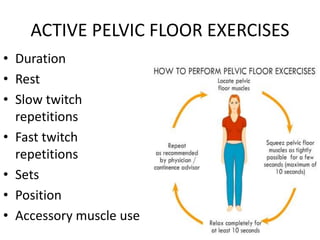
ACTIVE PELVIC FLOOR EXERCISES
• Duration
• Rest
• Slow twitch
repetitions
• Fast twitch
repetitions
• Sets
• Position
• Accessory muscle use
Contract the muscles correctly
• The movement is an upward and inward contraction, not a
bearing-down effort.
• When you first start the exercises, check that you are doing
them correctly. Put your hands on your abdomen and
buttocks to make sure you can’t feel your belly, thighs, or
buttocks moving.
• Don't hold your breath. You should be able to hold a
conversation at the same time, or try counting aloud while
you're doing the exercises.
• Don't tighten the tummy, thigh or buttock muscles - you'll
be exercising the wrong muscle groups.
• Don't squeeze your legs together.
• Duration – 3-4 sec initially and progressing to
10sec.
• Rest –increased resting tone and weak muscle
require longer rest time. Twice as much as rest
time as hold time is advised for weak muscle.
Rest time decreased as strength increases.
• A quality PFM contraction requires complete
relaxation at end of each exercise.
• Incomplete relaxation does not train a muscle in
its full range of motion and may result in
hypertonia and pain.
Slow contractions
• Slow contractions help to increase the strength of your
pelvic floor. They help your muscles to hold back the urine.
• Lift your pelvic floor muscles to a count of ten.
• Hold the muscles tight for 10 seconds.
• You may find at first that you can only hold the contraction
for one or two seconds, so concentrate on lifting your
muscles and holding the contraction for as long as you can.
• Gradually increase the time until you reach 10 seconds.
• Relax your muscles and rest for 10 seconds.
• Repeat the contractions up to 10 times.
Fast contractions
• Fast contractions help your pelvic floor to cope with
pressure, for example when you sneeze, cough or
laugh. This works the muscles that quickly shut off
the flow of urine.
• Lift your pelvic floor muscles quickly.
• Hold the contraction for one second.
• Relax the muscles and rest for one second.
• Repeat the contractions 10 times.
How Often to Do the Pelvic Muscle Exercises
• Individuals are instructed to do the pelvic
muscle exercises three times daily and,
optimally, to perform the exercises in 3
positions -- lying, sitting and standing.
• A minimum of 50-60 PMEs per day is
recommended. A gradual increase in number
of contractions over a period of PME practice
has been shown to increase muscle strength
significantly and decrease urine loss.
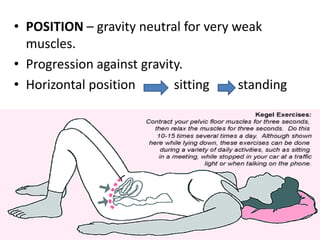
• POSITION – gravity neutral for very weak
muscles.
• Progression against gravity.
• Horizontal position sitting standing
Accessory muscle use
• contraction of abdominal ,adductor, and gluteal
muscle can results to facilitate strengthening of
weak pelvic floor.
Teaching pelvic floor exercises
• Patient education(location, function)
• Verbal cues for proper muscle contraction.
• Home awareness exercises for pelvic floor
muscle strengthening.
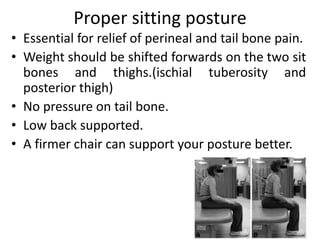
Proper sitting posture
• Essential for relief of perineal and tail bone pain.
• Weight should be shifted forwards on the two sit
bones and thighs.(ischial tuberosity and
posterior thigh)
• No pressure on tail bone.
• Low back supported.
• A firmer chair can support your posture better.
Supportive dysfunction
• Mainly impaired muscle endurance
• PFE with facilitation, biofeedback, and vaginal
cones.
• Electrical stimulation
• For coordination-biofeedback with PFE during ADL
• Impaired abdominal-abdominal ex’s proper
contraction of abdominals with function.
• Pain- modalities such as ultrasound, heat, cold and
ES.
• Mobility- scar tissue mobilization, muscle energy
technique.
Hyper tonous dysfunction
• Altered tone- muscle spasm and trigger points-
Biofeedback , relaxation, soft tissue mobilization.
• Muscle impairments and coordination impairment-
strengthening and stretching ex’s. coordination
training.
• Faulty posture- correct sitting and standing posture.
use of cushions, use of lumbar rolls.
• Pain –modalities
• Hypersensitivity of skin and mucosa- avoid perineal
irritant, ice pack.
FUNCTIONAL RETRAINING
• Maintain normal lumbar curve
• Visceral interaction- sneeze
3 errors- deep inhalation, vocalize and sneeze
and recruit little or inappropriate abdomino-
levator musculature. The consequent
downward thrust is exerted predominantly on
puboccygeus with little lateral levator support
for the viscera.
• Sneezing requires the greatest muscle power and
correct timing. Placing the hands around the lower ribs
with fingers palpating over the external oblique
muscles can aid in detecting the correct lower rib
expansion and muscle action. This lateral widening of
the lower rib cage with abdominal muscle concentric
contraction should occur in all forceful expiratory
patterns. The inspiratory phase requires rapid
diaphragmatic descent as with coughing. The second
phase of the sneeze, the compressive phase, needs to
be practised many times with increasing rapidity in
front of a mirror. As this is performed, the abdominal
wall is seen to pull in and up and the lower rib cage is
felt to widen laterally. Further abdominal pulling in
occurs in the third or expulsive phase. In all of these
expiratory patterns an awareness of vaginal tightening
must be reported
Abdominal drawing in for coughing
and lifting
• Maintain a normal lumbar curve.
• Abdominal drawing in should occur before
and held during a cough effort.
• The abdominopelvic floor co-activation is
required before the diaphragm forces air up
against a closed glottis, followed by sudden
release of the glottis and expulsion of air.
• Coughing requires stronger and faster
abdominal muscle activation. In sitting there
is some vaginal support from the chair and
this gives the patient improved awareness and
more confidence that she will not leak urine
as she practises. The retraining commences in
upright unsupported sitting using the same
pattern as for nose blowing. This pattern
becomes more effective as the abdominal
muscles gain strength. In laughing the
abdomino/PFM pattern must be able to be
repeated and sustained.

Pelvic floor rehabilitation

  • 1.
  • 2.
    PELVIC FLOOR REHABILITATION 1Motorlearning 2Pelvic floor exerecises Identify the muscles • First you need to find your pelvic floor muscles. • Try to tighten your muscles around your vagina and back passage and lift up, as if you’re stopping yourself passing water and wind at the same time.
  • 3.
    • A quickway of finding the right muscles is by trying to stop the flow of urine when you’re in the toilet. Don’t do this regularly because you may start retaining urine. • Once you've found the muscles, make sure you relax and empty your bladder completely. • If you're not sure you are exercising the right muscles, put a couple of fingers into your vagina. You should feel a gentle squeeze when doing the exercise.
  • 4.
    PELVIC FLOOR REHABILITATION •Kegels exercises • Active pelvic floor exercises • Elevator exercises • Core strengthening • Vaginal cones • Biofeedback • Coping strategies • Pelvic floor relaxation exercises • Electric stimulation • Massage for scar mobilization • Home awareness exercises
  • 7.
    Common errors inattempts to contract the pelvic floor muscles • Contraction of abdominal muscle. • Contraction of hip adductor • Contraction of gluteal muscles • Stop breathing • Enhanced inhaling • Straining
  • 8.
    There may beseveral explanations why a voluntary PFM contraction is difficult to perform: • the PFM have a invisible location inside the pelvis. • neither men nor women have ever learned to contract the PFM and most people would be unaware of the automatic contractions of the muscles; • the muscles are small and, from a neurophysiologial point of view, therefore more difficult to contract voluntarily; • the common awareness of these pelvic and perineal area of the body may be associated with voiding and defecation, and straining at toilet is common
  • 9.
    ACTIVE PELVIC FLOOREXERCISES • Duration • Rest • Slow twitch repetitions • Fast twitch repetitions • Sets • Position • Accessory muscle use
  • 10.
    Contract the musclescorrectly • The movement is an upward and inward contraction, not a bearing-down effort. • When you first start the exercises, check that you are doing them correctly. Put your hands on your abdomen and buttocks to make sure you can’t feel your belly, thighs, or buttocks moving. • Don't hold your breath. You should be able to hold a conversation at the same time, or try counting aloud while you're doing the exercises. • Don't tighten the tummy, thigh or buttock muscles - you'll be exercising the wrong muscle groups. • Don't squeeze your legs together.
  • 11.
    • Duration –3-4 sec initially and progressing to 10sec. • Rest –increased resting tone and weak muscle require longer rest time. Twice as much as rest time as hold time is advised for weak muscle. Rest time decreased as strength increases. • A quality PFM contraction requires complete relaxation at end of each exercise. • Incomplete relaxation does not train a muscle in its full range of motion and may result in hypertonia and pain.
  • 12.
    Slow contractions • Slowcontractions help to increase the strength of your pelvic floor. They help your muscles to hold back the urine. • Lift your pelvic floor muscles to a count of ten. • Hold the muscles tight for 10 seconds. • You may find at first that you can only hold the contraction for one or two seconds, so concentrate on lifting your muscles and holding the contraction for as long as you can. • Gradually increase the time until you reach 10 seconds. • Relax your muscles and rest for 10 seconds. • Repeat the contractions up to 10 times.
  • 13.
    Fast contractions • Fastcontractions help your pelvic floor to cope with pressure, for example when you sneeze, cough or laugh. This works the muscles that quickly shut off the flow of urine. • Lift your pelvic floor muscles quickly. • Hold the contraction for one second. • Relax the muscles and rest for one second. • Repeat the contractions 10 times.
  • 14.
    How Often toDo the Pelvic Muscle Exercises • Individuals are instructed to do the pelvic muscle exercises three times daily and, optimally, to perform the exercises in 3 positions -- lying, sitting and standing. • A minimum of 50-60 PMEs per day is recommended. A gradual increase in number of contractions over a period of PME practice has been shown to increase muscle strength significantly and decrease urine loss.
  • 15.
    • POSITION –gravity neutral for very weak muscles. • Progression against gravity. • Horizontal position sitting standing
  • 16.
    Accessory muscle use •contraction of abdominal ,adductor, and gluteal muscle can results to facilitate strengthening of weak pelvic floor. Teaching pelvic floor exercises • Patient education(location, function) • Verbal cues for proper muscle contraction. • Home awareness exercises for pelvic floor muscle strengthening.
  • 17.
    Proper sitting posture •Essential for relief of perineal and tail bone pain. • Weight should be shifted forwards on the two sit bones and thighs.(ischial tuberosity and posterior thigh) • No pressure on tail bone. • Low back supported. • A firmer chair can support your posture better.
  • 18.
    Supportive dysfunction • Mainlyimpaired muscle endurance • PFE with facilitation, biofeedback, and vaginal cones. • Electrical stimulation • For coordination-biofeedback with PFE during ADL • Impaired abdominal-abdominal ex’s proper contraction of abdominals with function. • Pain- modalities such as ultrasound, heat, cold and ES. • Mobility- scar tissue mobilization, muscle energy technique.
  • 19.
    Hyper tonous dysfunction •Altered tone- muscle spasm and trigger points- Biofeedback , relaxation, soft tissue mobilization. • Muscle impairments and coordination impairment- strengthening and stretching ex’s. coordination training. • Faulty posture- correct sitting and standing posture. use of cushions, use of lumbar rolls. • Pain –modalities • Hypersensitivity of skin and mucosa- avoid perineal irritant, ice pack.
  • 20.
    FUNCTIONAL RETRAINING • Maintainnormal lumbar curve • Visceral interaction- sneeze 3 errors- deep inhalation, vocalize and sneeze and recruit little or inappropriate abdomino- levator musculature. The consequent downward thrust is exerted predominantly on puboccygeus with little lateral levator support for the viscera.
  • 21.
    • Sneezing requiresthe greatest muscle power and correct timing. Placing the hands around the lower ribs with fingers palpating over the external oblique muscles can aid in detecting the correct lower rib expansion and muscle action. This lateral widening of the lower rib cage with abdominal muscle concentric contraction should occur in all forceful expiratory patterns. The inspiratory phase requires rapid diaphragmatic descent as with coughing. The second phase of the sneeze, the compressive phase, needs to be practised many times with increasing rapidity in front of a mirror. As this is performed, the abdominal wall is seen to pull in and up and the lower rib cage is felt to widen laterally. Further abdominal pulling in occurs in the third or expulsive phase. In all of these expiratory patterns an awareness of vaginal tightening must be reported
  • 22.
    Abdominal drawing infor coughing and lifting • Maintain a normal lumbar curve. • Abdominal drawing in should occur before and held during a cough effort. • The abdominopelvic floor co-activation is required before the diaphragm forces air up against a closed glottis, followed by sudden release of the glottis and expulsion of air.
  • 23.
    • Coughing requiresstronger and faster abdominal muscle activation. In sitting there is some vaginal support from the chair and this gives the patient improved awareness and more confidence that she will not leak urine as she practises. The retraining commences in upright unsupported sitting using the same pattern as for nose blowing. This pattern becomes more effective as the abdominal muscles gain strength. In laughing the abdomino/PFM pattern must be able to be repeated and sustained.