
PRESENTED BY:
PRIYANKA
BHUSAL
PELVIC FLOOR
DYSFUNCTION:
INTRODUCTION:
 Pelvic floor dysfunction is a common condition
where you’re unable to correctly relax and coordinate
the muscles in your pelvic floor to urinate or to have
a bowel movement.
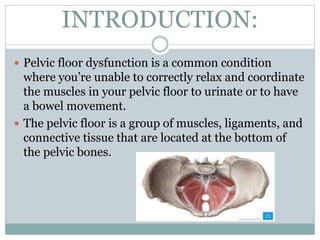
 The pelvic floor is a group of muscles, ligaments, and
connective tissue that are located at the bottom of
the pelvic bones.
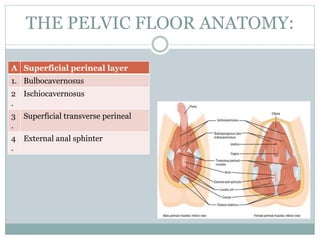
THE PELVIC FLOOR ANATOMY:
A Superficial perineal layer
1. Bulbocavernosus
2
.
Ischiocavernosus
3
.
Superficial transverse perineal
4
.
External anal sphinter
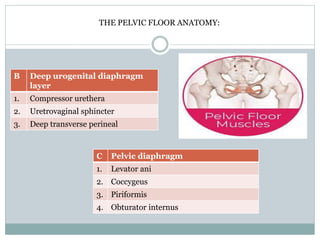
B Deep urogenital diaphragm
layer
1. Compressor urethera
2. Uretrovaginal sphincter
3. Deep transverse perineal
C Pelvic diaphragm
1. Levator ani
2. Coccygeus
3. Piriformis
4. Obturator internus
THE PELVIC FLOOR ANATOMY:
ROLE OF PELVIC FLOOR MUSCLE
1) Supports and give tone to vaginal wall
2) Relaxation for defecation/contraction
3) Supports pelvic organs against gravity
4) Prevent incontinence
5) Reinforce urethral closure during increase intra
abdominal pressure
6) Assist in unloading the spine
7) Contribute to sexual arousal and performance
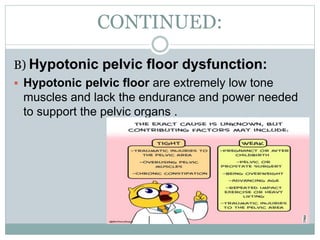
WHAT MAY CAUSE PFD???
 Traumatic injuries to the pelvic area (like a car
accident).
 Pregnancy.
 Overusing the pelvic muscles (like going to the
bathroom too often or pushing too hard), eventually
leading to poor muscle coordination.
 Pelvic surgery.
 Being overweight.
 Advancing age.
TYPES OF PELVIC FLOOR DYSFUNCTION:
A. Hypertonic pelvic floor dysfunction:
 Hypertonic pelvic floor is having a tight muscle
tone and reduced capacity of the muscle to
stretch.
 Causes may include: PCOD, trauma, anxiety,
fibroids , cystitis, pelvic inflammatory disease,
STDs
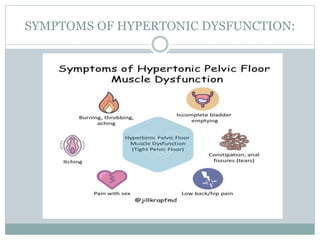
SYMPTOMS OF HYPERTONIC DYSFUNCTION:
CONTINUED:
B) Hypotonic pelvic floor dysfunction:
 Hypotonic pelvic floor are extremely low tone
muscles and lack the endurance and power needed
to support the pelvic organs .
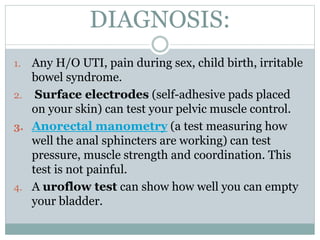
DIAGNOSIS:
1. Any H/O UTI, pain during sex, child birth, irritable
bowel syndrome.
2. Surface electrodes (self-adhesive pads placed
on your skin) can test your pelvic muscle control.
3. Anorectal manometry (a test measuring how
well the anal sphincters are working) can test
pressure, muscle strength and coordination. This
test is not painful.
4. A uroflow test can show how well you can empty
your bladder.
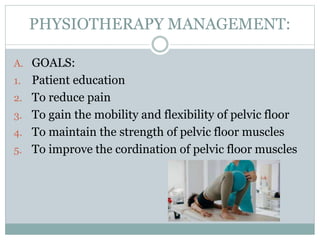
PHYSIOTHERAPY MANAGEMENT:
A. GOALS:
1. Patient education
2. To reduce pain
3. To gain the mobility and flexibility of pelvic floor
4. To maintain the strength of pelvic floor muscles
5. To improve the cordination of pelvic floor muscles
PT TREATMENT:
 Pelvic floor physical therapy (PFPT), also referred to
as pelvic floor muscle training (PFMT), is a
conservative, first-line treatment for many pelvic
floor disorders .
 PFPT is a general term for the instruction of pelvic
muscle strengthening, relaxation, and coordination
exercises by a trained physical therapist.
 Pelvic floor muscle training (PFMT) has been shown
to be beneficial for both urinary incontinence and
prolapse symptoms.
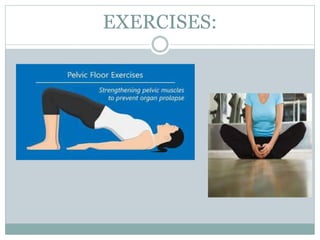
EXERCISES:
PFPT includes:
1) Electrical stimulation provides a small electrical
current to contract the pelvic floor and assist the
patient in isolation of the proper muscles.
2) Biofeedback uses a vaginal or rectal pressure
sensor to provide an audible and/or visual feedback
of the strength of the muscle contraction.
3) A vaginal weighted cone is inserted into the vagina
and held in place by pelvic muscle contractions
during activity
PHYSIOTHERAPY INTERVENTIONS:
1) Trigger point therapy: This technique puts
pressure on a spot on your body, internally or
externally, called trigger points. PT may
also inject anesthesia into the area.
2) Kegels: are a popular exercise for strengthening
the pelvic floor muscles by contracting and relaxing
them. This exercise can help relieve pain during sex
and control incontinence. PT teach you how to do
Kegels so that you can get the most out of this
exercise.
NOTE:
 Any activity that increases the tension or pain in
your pelvic floor muscles can cause your symptoms
to get worse. For example, heavy weightlifting or
repetitive jumping can increase your pelvic floor
tension and actually worsen symptoms.
PFD AND ITS PT MANAGEMENT.pptx

PFD AND ITS PT MANAGEMENT.pptx

  • 1.
  • 2.
    INTRODUCTION:  Pelvic floordysfunction is a common condition where you’re unable to correctly relax and coordinate the muscles in your pelvic floor to urinate or to have a bowel movement.  The pelvic floor is a group of muscles, ligaments, and connective tissue that are located at the bottom of the pelvic bones.
  • 3.
    THE PELVIC FLOORANATOMY: A Superficial perineal layer 1. Bulbocavernosus 2 . Ischiocavernosus 3 . Superficial transverse perineal 4 . External anal sphinter
  • 4.
    B Deep urogenitaldiaphragm layer 1. Compressor urethera 2. Uretrovaginal sphincter 3. Deep transverse perineal C Pelvic diaphragm 1. Levator ani 2. Coccygeus 3. Piriformis 4. Obturator internus THE PELVIC FLOOR ANATOMY:
  • 5.
    ROLE OF PELVICFLOOR MUSCLE 1) Supports and give tone to vaginal wall 2) Relaxation for defecation/contraction 3) Supports pelvic organs against gravity 4) Prevent incontinence 5) Reinforce urethral closure during increase intra abdominal pressure 6) Assist in unloading the spine 7) Contribute to sexual arousal and performance
  • 6.
    WHAT MAY CAUSEPFD???  Traumatic injuries to the pelvic area (like a car accident).  Pregnancy.  Overusing the pelvic muscles (like going to the bathroom too often or pushing too hard), eventually leading to poor muscle coordination.  Pelvic surgery.  Being overweight.  Advancing age.
  • 7.
    TYPES OF PELVICFLOOR DYSFUNCTION: A. Hypertonic pelvic floor dysfunction:  Hypertonic pelvic floor is having a tight muscle tone and reduced capacity of the muscle to stretch.  Causes may include: PCOD, trauma, anxiety, fibroids , cystitis, pelvic inflammatory disease, STDs
  • 8.
  • 9.
    CONTINUED: B) Hypotonic pelvicfloor dysfunction:  Hypotonic pelvic floor are extremely low tone muscles and lack the endurance and power needed to support the pelvic organs .
  • 10.
    DIAGNOSIS: 1. Any H/OUTI, pain during sex, child birth, irritable bowel syndrome. 2. Surface electrodes (self-adhesive pads placed on your skin) can test your pelvic muscle control. 3. Anorectal manometry (a test measuring how well the anal sphincters are working) can test pressure, muscle strength and coordination. This test is not painful. 4. A uroflow test can show how well you can empty your bladder.
  • 11.
    PHYSIOTHERAPY MANAGEMENT: A. GOALS: 1.Patient education 2. To reduce pain 3. To gain the mobility and flexibility of pelvic floor 4. To maintain the strength of pelvic floor muscles 5. To improve the cordination of pelvic floor muscles
  • 12.
    PT TREATMENT:  Pelvicfloor physical therapy (PFPT), also referred to as pelvic floor muscle training (PFMT), is a conservative, first-line treatment for many pelvic floor disorders .  PFPT is a general term for the instruction of pelvic muscle strengthening, relaxation, and coordination exercises by a trained physical therapist.  Pelvic floor muscle training (PFMT) has been shown to be beneficial for both urinary incontinence and prolapse symptoms.
  • 13.
  • 14.
    PFPT includes: 1) Electricalstimulation provides a small electrical current to contract the pelvic floor and assist the patient in isolation of the proper muscles. 2) Biofeedback uses a vaginal or rectal pressure sensor to provide an audible and/or visual feedback of the strength of the muscle contraction. 3) A vaginal weighted cone is inserted into the vagina and held in place by pelvic muscle contractions during activity
  • 15.
    PHYSIOTHERAPY INTERVENTIONS: 1) Triggerpoint therapy: This technique puts pressure on a spot on your body, internally or externally, called trigger points. PT may also inject anesthesia into the area. 2) Kegels: are a popular exercise for strengthening the pelvic floor muscles by contracting and relaxing them. This exercise can help relieve pain during sex and control incontinence. PT teach you how to do Kegels so that you can get the most out of this exercise.
  • 16.
    NOTE:  Any activitythat increases the tension or pain in your pelvic floor muscles can cause your symptoms to get worse. For example, heavy weightlifting or repetitive jumping can increase your pelvic floor tension and actually worsen symptoms.