Presenter: Peggy Huang
Instructor: Dr. Kate Chen
Date: 104.6.8
1
Using a Mobile-Device to Enhance
Students’ Self-confidence in
English Speaking
www.company.com
CONTENT
2
1
2
3
4
5
www.company.com
Company
LOGO
Introduction
◎ Background of the study
◎ Purpose of the study
3
www.company.com 4
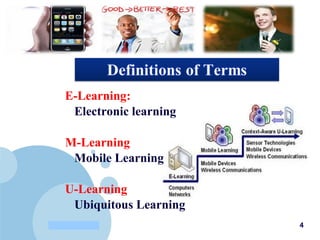
E-Learning:
Electronic learning
M-Learning
Mobile Learning
U-Learning
Ubiquitous Learning
www.company.com
Background
Introduction
5
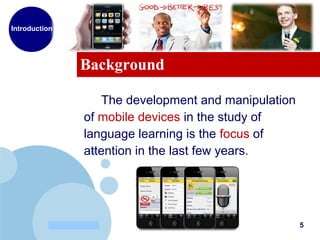
The development and manipulation
of mobile devices in the study of
language learning is the focus of
attention in the last few years.
www.company.com
Purpose of the study
6
To investigate the impact of
m-learning on EFL learners’ language
speaking skill and also explore the
reception of using mobile phones as a
learning tool in English learning.
Introduction
www.company.com
Literature review
7
Literature
review
www.company.com
M-learning
(Traxler, 2005)
8
Literature
review
Mobile learning can be defined as “
any educational provision where the
sole or dominant technologies are
handheld or palmtop devices”.
www.company.com
M-learning in Education
Literature
review
The high penetration rate of mobile
devices and high popularity among the
youth lend mobile communication
superior advantages when approaching
young students.
(International Telecommunication Union,
2002)
9
www.company.com
M-learning in Education
Literature
review
The impact of using mobile communication
technologies in learning environment has been
examined and concluded as:
enhancing availability and accessibility of
information networks
engaging students in learning-related
activities in diverse physical locations
enhancing communication and
collaborative learning in the classroom
(Liu, Wang, Liang, & Yang, 2002) 10
www.company.com
M-learning in Education
Literature
review
As the mobile learning concept implies, the
pedagogical approach places the student at
the center of the learning process. The
learners plays an active role from
determination of the goals until the evaluation
stage.
(Makoe, 2010)
11
www.company.com
M-learning in Education: learns
Literature
review
Learner’s roles are given below:
(Fezile, 2011)
Access information when they need
Responsible for own learning
Learning with their learning speed
Discover and use their learning styles
Study with their peers collaboratively
Evaluation themselves and other groups
12
www.company.com
M-learning in Education: teachers
Literature
review
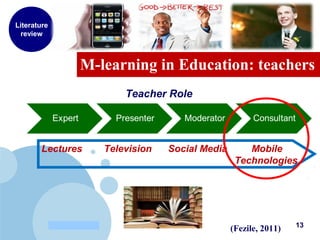
Teacher Role
(Fezile, 2011)
Lectures Television Social Media Mobile
Technologies
13
www.company.com
The trends of M-learning
Literature
review
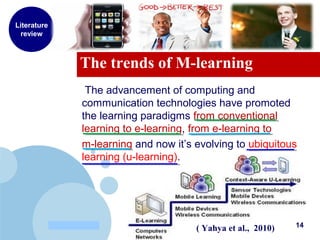
The advancement of computing and
communication technologies have promoted
the learning paradigms from conventional
learning to e-learning, from e-learning to
m-learning and now it’s evolving to ubiquitous
learning (u-learning).
14( Yahya et al., 2010)
www.company.com
Research questions
15
Does Mobile learning have any effect
on speaking ability of EFL learners?
What’s the perception of EFL learners
toward using mobile phones as a
learning tool?
www.company.com
Methodology
10
16
www.company.com
Methodology
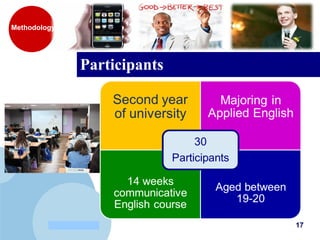
Participants
Methodology
17
www.company.com
Instruments
Methodology
18
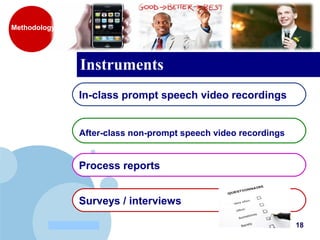
In-class prompt speech video recordings
After-class non-prompt speech video recordings
Process reports
Surveys / interviews
www.company.com
Procedure
Methodology
19
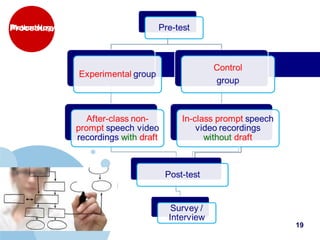
Procedure
www.company.com
Thank you!
It’s neverabout time to
give up!

Peggy proposal 0608