Digital storytelling for enhancing studnets
academic achievement, critical thinking, and
learning motivation: A year-long exerimental
study
Presenter: Ellie Lin Instructor: Teresa Hsu Date: Apr 27, 2015 1
Citation
Wu, W. C., & Yang, Y. T. (2011).
Digital storytelling for enhancing
student academic achievement,
critical thinking, and learning
motivation: A year-long experimental
study. Computer & Education, 59,
339-352.
2
Contents
• Introduction
• Method
• Results and discussion
• Conclusion
• Reflection
3
Definition of terms
DST Digital storytelling
 ITII Information technology
integrated instruction
4
Introduction
• Background
• Digital storytelling (DST)
• DST & academic achievement
• DST & critical thinking
• DST & learning motivation
• Purpose of study
• Research questions
5
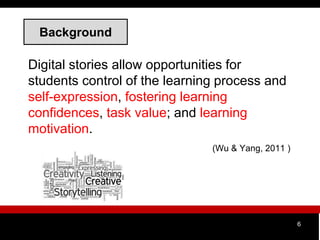
Background
Digital stories allow opportunities for
students control of the learning process and
self-expression, fostering learning
confidences, task value; and learning
motivation.
(Wu & Yang, 2011 )
6
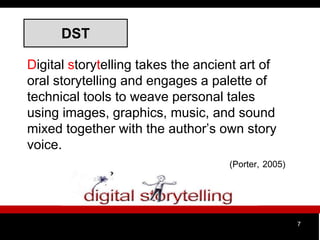
DST
Digital storytelling takes the ancient art of
oral storytelling and engages a palette of
technical tools to weave personal tales
using images, graphics, music, and sound
mixed together with the author’s own story
voice.
(Porter, 2005)
7
DST & academic
achievement
It has been demonstrated that an early
stage of learning acquisition, academic
achievement correlates positively with the
oral behaviors of repeating, chanting and
singing.
(Ellis, 1993; Gomez, Arai & Lowe, 1995; Schank, 1990; Tsou, 2003)
8
DST & critical
thinking
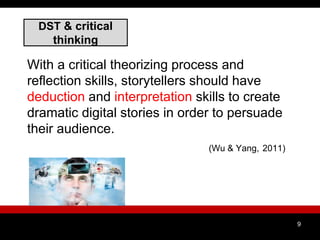
With a critical theorizing process and
reflection skills, storytellers should have
deduction and interpretation skills to create
dramatic digital stories in order to persuade
their audience.
(Wu & Yang, 2011)
9
DST & learning
motivation
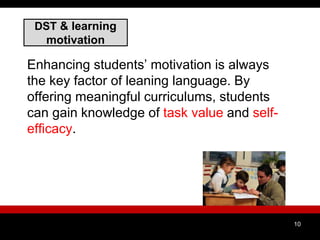
Enhancing students’ motivation is always
the key factor of leaning language. By
offering meaningful curriculums, students
can gain knowledge of task value and self-
efficacy.
10
Purpose of study
To examine the comparison between digital
storytelling(DST) and information
technology integrated instruction(ITII) with
innovative technology strategies
11
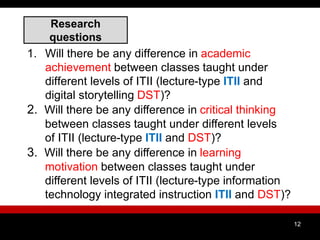
Research
questions
1. Will there be any difference in academic
achievement between classes taught under
different levels of ITII (lecture-type ITII and
digital storytelling DST)?
2. Will there be any difference in critical thinking
between classes taught under different levels
of ITII (lecture-type ITII and DST)?
3. Will there be any difference in learning
motivation between classes taught under
different levels of ITII (lecture-type information
technology integrated instruction ITII and DST)?
12
Method
• Participants
• Independent variable
• Dependent variable
• Research procedures
13
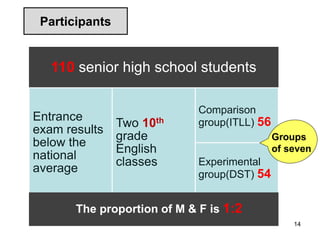
Participants
110 senior high school students
Entrance
exam results
below the
national
average
Two 10th
grade
English
classes
Comparison
group(ITLL) 56
Experimental
group(DST) 54
The proportion of M & F is 1:2
Groups
of seven
14
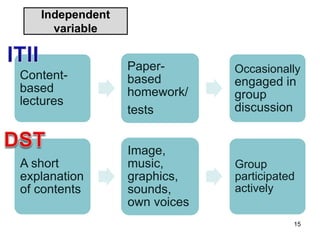
Independent
variable
Content-
based
lectures
Paper-
based
homework/
tests
Occasionally
engaged in
group
discussion
A short
explanation
of contents
Image,
music,
graphics,
sounds,
own voices
Group
participated
actively
15
Independent
variable
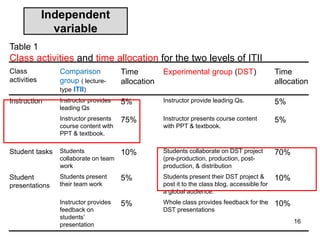
Table 1
Class activities and time allocation for the two levels of ITII
Class
activities
Comparison
group ( lecture-
type ITII)
Time
allocation
Experimental group (DST) Time
allocation
Instruction Instructor provides
leading Qs
5% Instructor provide leading Qs. 5%
Instructor presents
course content with
PPT & textbook.
75% Instructor presents course content
with PPT & textbook.
5%
Student tasks Students
collaborate on team
work
10% Students collaborate on DST project
(pre-production, production, post-
production, & distribution
70%
Student
presentations
Students present
their team work
5% Students present their DST project &
post it to the class blog, accessible for
a global audience.
10%
Instructor provides
feedback on
students’
presentation
5% Whole class provides feedback for the
DST presentations
10%
16
Dependent
variable
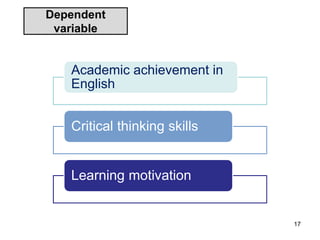
Academic achievement in
English
Critical thinking skills
Learning motivation
17
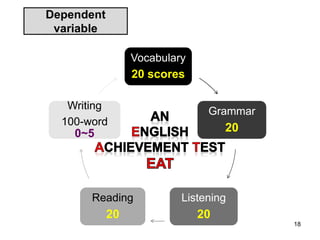
Dependent
variable
Vocabulary
20 scores
Grammar
20
Listening
20
Reading
20
Writing
100-word
0~5
18
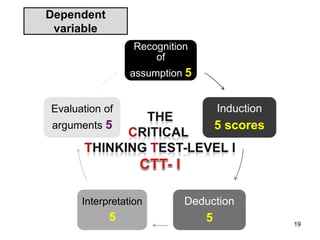
Dependent
variable
Recognition
of
assumption 5
Induction
5 scores
Deduction
5
Interpretation
5
Evaluation of
arguments 5
19
Dependent
variable
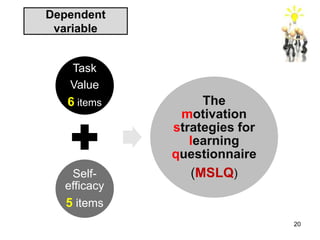
Task
Value
6 items
Self-
efficacy
5 items
The
motivation
strategies for
learning
questionnaire
(MSLQ)
20
Research
procedures
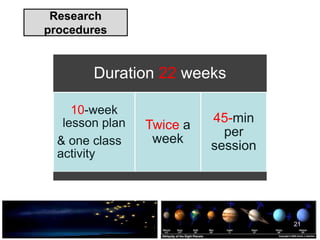
Duration 22 weeks
10-week
lesson plan
& one class
activity
Twice a
week
45-min
per
session
21
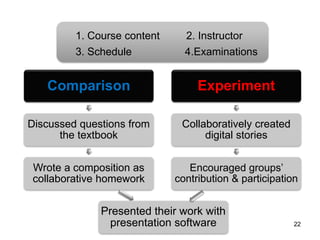
22
Comparison
Discussed questions from
the textbook
Wrote a composition as
collaborative homework
Presented their work with
presentation software
Experiment
Collaboratively created
digital stories
Encouraged groups’
contribution & participation
1. Course content 2. Instructor
3. Schedule 4.Examinations
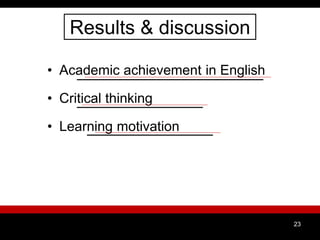
Results & discussion
• Academic achievement in English
• Critical thinking
• Learning motivation
23
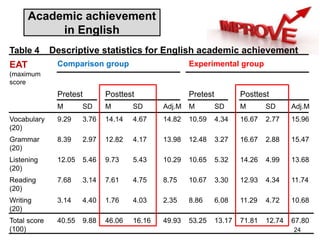
Academic achievement
in English
Table 4 Descriptive statistics for English academic achievement
EAT
(maximum
score
Comparison group Experimental group
Pretest Posttest Pretest Posttest
M SD M SD Adj.M M SD M SD Adj.M
Vocabulary
(20)
9.29 3.76 14.14 4.67 14.82 10.59 4.34 16.67 2.77 15.96
Grammar
(20)
8.39 2.97 12.82 4.17 13.98 12.48 3.27 16.67 2.88 15.47
Listening
(20)
12.05 5.46 9.73 5.43 10.29 10.65 5.32 14.26 4.99 13.68
Reading
(20)
7.68 3.14 7.61 4.75 8.75 10.67 3.30 12.93 4.34 11.74
Writing
(20)
3.14 4.40 1.76 4.03 2.35 8.86 6.08 11.29 4.72 10.68
Total score
(100)
40.55 9.88 46.06 16.16 49.93 53.25 13.17 71.81 12.74 67.80
24
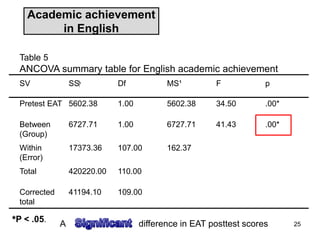
Academic achievement
in English
Table 5
ANCOVA summary table for English academic achievement
SV SS¹ Df MS¹ F p
Pretest EAT 5602.38 1.00 5602.38 34.50 .00*
Between
(Group)
6727.71 1.00 6727.71 41.43 .00*
Within
(Error)
17373.36 107.00 162.37
Total 420220.00 110.00
Corrected
total
41194.10 109.00
*P < .05.
25A difference in EAT posttest scores
Academic achievement
in English
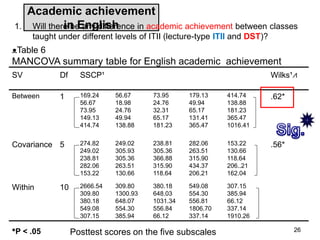
ᴥTable 6
MANCOVA summary table for English academic achievement
SV Df SSCP¹ Wilks¹⩘
Between 1 169.24
56.67
73.95
149.13
414.74
56.67
18.98
24.76
49.94
138.88
73.95
24.76
32.31
65.17
181.23
179.13
49.94
65.17
131.41
365.47
414.74
138.88
181.23
365.47
1016.41
.62*
Covariance 5 274.82
249.02
238.81
282.06
153.22
249.02
305.93
305.36
263.51
130.66
238.81
305.36
366.88
315.90
118.64
282.06
263.51
315.90
434.37
206.21
153.22
130.66
118.64
206..21
162.04
.56*
Within 10 2666.54
309.80
380.18
549.08
307.15
309.80
1300.93
648.07
554.30
385.94
380.18
648.03
1031.34
556.84
66.12
549.08
554.30
556.81
1806.70
337.14
307.15
385.94
66.12
337.14
1910.26
*P < .05 26Posttest scores on the five subscales
1. Will there be any difference in academic achievement between classes
taught under different levels of ITII (lecture-type ITII and DST)?
Academic achievement
in English
*P < .05
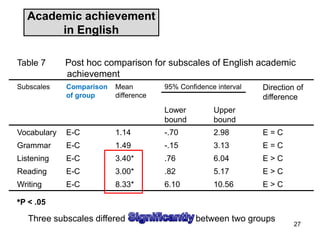
Table 7 Post hoc comparison for subscales of English academic
achievement
Subscales Comparison
of group
Mean
difference
95% Confidence interval Direction of
difference
Lower
bound
Upper
bound
Vocabulary E-C 1.14 -.70 2.98 E = C
Grammar E-C 1.49 -.15 3.13 E = C
Listening E-C 3.40* .76 6.04 E > C
Reading E-C 3.00* .82 5.17 E > C
Writing E-C 8.33* 6.10 10.56 E > C
27
Three subscales differed between two groups
Critical thinking
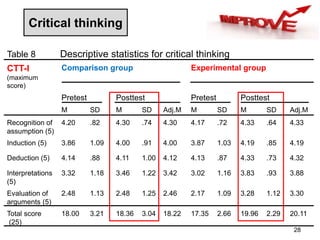
Table 8 Descriptive statistics for critical thinking
CTT-I
(maximum
score)
Comparison group Experimental group
Pretest Posttest Pretest Posttest
M SD M SD Adj.M M SD M SD Adj.M
Recognition of
assumption (5)
4.20 .82 4.30 .74 4.30 4.17 .72 4.33 .64 4.33
Induction (5) 3.86 1.09 4.00 .91 4.00 3.87 1.03 4.19 .85 4.19
Deduction (5) 4.14 .88 4.11 1.00 4.12 4.13 .87 4.33 .73 4.32
Interpretations
(5)
3.32 1.18 3.46 1.22 3.42 3.02 1.16 3.83 .93 3.88
Evaluation of
arguments (5)
2.48 1.13 2.48 1.25 2.46 2.17 1.09 3.28 1.12 3.30
Total score
(25)
18.00 3.21 18.36 3.04 18.22 17.35 2.66 19.96 2.29 20.11
28
Critical thinking
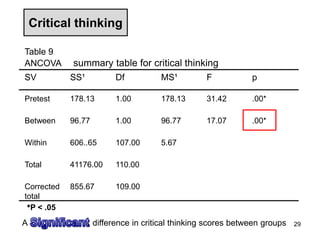
Table 9
ANCOVA summary table for critical thinking
SV SS¹ Df MS¹ F p
Pretest 178.13 1.00 178.13 31.42 .00*
Between 96.77 1.00 96.77 17.07 .00*
Within 606..65 107.00 5.67
Total 41176.00 110.00
Corrected
total
855.67 109.00
*P < .05
29A difference in critical thinking scores between groups
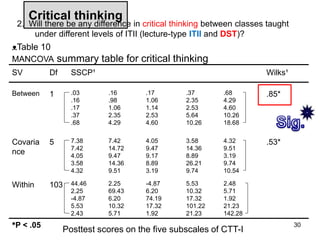
ᴥTable 10
MANCOVA summary table for critical thinking
SV Df SSCP¹ Wilks¹
Between 1 .03
.16
.17
.37
.68
.16
.98
1.06
2.35
4.29
.17
1.06
1.14
2.53
4.60
.37
2.35
2.53
5.64
10.26
.68
4.29
4.60
10.26
18.68
.85*
Covaria
nce
5 7.38
7.42
4.05
3.58
4.32
7.42
14.72
9.47
14.36
9.51
4.05
9.47
9.17
8.89
3.19
3.58
14.36
8.89
26.21
9.74
4.32
9.51
3.19
9.74
10.54
.53*
Within 103 44.46
2.25
-4.87
5.53
2.43
2.25
69.43
6.20
10.32
5.71
-4.87
6.20
74.19
17.32
1.92
5.53
10.32
17.32
101.22
21.23
2.48
5.71
1.92
21.23
142.28
Critical thinking
*P < .05 30
Posttest scores on the five subscales of CTT-I
2. Will there be any difference in critical thinking between classes taught
under different levels of ITII (lecture-type ITII and DST)?
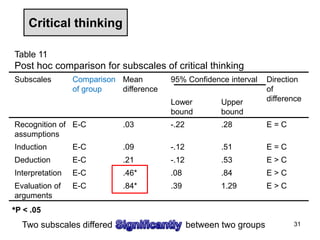
Critical thinking
*P < .05
Table 11
Post hoc comparison for subscales of critical thinking
Subscales Comparison
of group
Mean
difference
95% Confidence interval Direction
of
differenceLower
bound
Upper
bound
Recognition of
assumptions
E-C .03 -.22 .28 E = C
Induction E-C .09 -.12 .51 E = C
Deduction E-C .21 -.12 .53 E > C
Interpretation E-C .46* .08 .84 E > C
Evaluation of
arguments
E-C .84* .39 1.29 E > C
31Two subscales differed between two groups
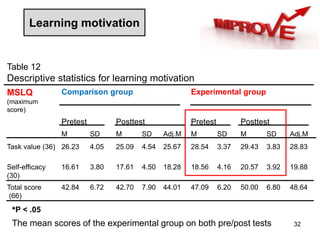
Learning motivation
*P < .05
Table 12
Descriptive statistics for learning motivation
MSLQ
(maximum
score)
Comparison group Experimental group
Pretest Posttest Pretest Posttest
M SD M SD Adj.M M SD M SD Adj.M
Task value (36) 26.23 4.05 25.09 4.54 25.67 28.54 3.37 29.43 3.83 28.83
Self-efficacy
(30)
16.61 3.80 17.61 4.50 18.28 18.56 4.16 20.57 3.92 19.88
Total score
(66)
42.84 6.72 42.70 7.90 44.01 47.09 6.20 50.00 6.80 48.64
32The mean scores of the experimental group on both pre/post tests
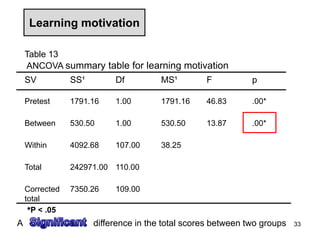
Learning motivation
*P < .05
Table 13
ANCOVA summary table for learning motivation
SV SS¹ Df MS¹ F p
Pretest 1791.16 1.00 1791.16 46.83 .00*
Between 530.50 1.00 530.50 13.87 .00*
Within 4092.68 107.00 38.25
Total 242971.00 110.00
Corrected
total
7350.26 109.00
33A difference in the total scores between two groups
Learning motivation
*P < .05
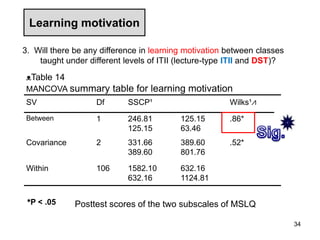
ᴥTable 14
MANCOVA summary table for learning motivation
SV Df SSCP¹ Wilks¹⩘
Between 1 246.81
125.15
125.15
63.46
.86*
Covariance 2 331.66
389.60
389.60
801.76
.52*
Within 106 1582.10
632.16
632.16
1124.81
34
Posttest scores of the two subscales of MSLQ
3. Will there be any difference in learning motivation between classes
taught under different levels of ITII (lecture-type ITII and DST)?
Learning motivation
*P < .05
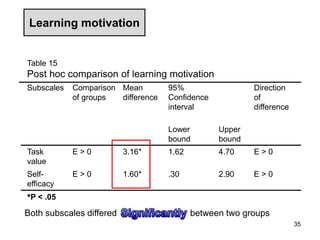
Table 15
Post hoc comparison of learning motivation
Subscales Comparison
of groups
Mean
difference
95%
Confidence
interval
Direction
of
difference
Lower
bound
Upper
bound
Task
value
E > 0 3.16* 1.62 4.70 E > 0
Self-
efficacy
E > 0 1.60* .30 2.90 E > 0
35
Both subscales differed between two groups
Conclusion
With such the interesting and challenging
digital storytelling curriculum, students can
be profoundly impressed on their potential
capacity for language learning talent and
higher order thinking skills.
36
Reflection
Technology and language learning can form
a combination to enhance one’s problem
solving skills and higher level thinking
abilities in order to survive the daily life.
37
Thank you
38
“ Have the courage to
follow your heart and
intuition. They somehow
know what you truly
want to become.”
39

Ellie presentation for digital story learning

  • 1.
    Digital storytelling forenhancing studnets academic achievement, critical thinking, and learning motivation: A year-long exerimental study Presenter: Ellie Lin Instructor: Teresa Hsu Date: Apr 27, 2015 1
  • 2.
    Citation Wu, W. C.,& Yang, Y. T. (2011). Digital storytelling for enhancing student academic achievement, critical thinking, and learning motivation: A year-long experimental study. Computer & Education, 59, 339-352. 2
  • 3.
    Contents • Introduction • Method •Results and discussion • Conclusion • Reflection 3
  • 4.
    Definition of terms DSTDigital storytelling  ITII Information technology integrated instruction 4
  • 5.
    Introduction • Background • Digitalstorytelling (DST) • DST & academic achievement • DST & critical thinking • DST & learning motivation • Purpose of study • Research questions 5
  • 6.
    Background Digital stories allowopportunities for students control of the learning process and self-expression, fostering learning confidences, task value; and learning motivation. (Wu & Yang, 2011 ) 6
  • 7.
    DST Digital storytelling takesthe ancient art of oral storytelling and engages a palette of technical tools to weave personal tales using images, graphics, music, and sound mixed together with the author’s own story voice. (Porter, 2005) 7
  • 8.
    DST & academic achievement Ithas been demonstrated that an early stage of learning acquisition, academic achievement correlates positively with the oral behaviors of repeating, chanting and singing. (Ellis, 1993; Gomez, Arai & Lowe, 1995; Schank, 1990; Tsou, 2003) 8
  • 9.
    DST & critical thinking Witha critical theorizing process and reflection skills, storytellers should have deduction and interpretation skills to create dramatic digital stories in order to persuade their audience. (Wu & Yang, 2011) 9
  • 10.
    DST & learning motivation Enhancingstudents’ motivation is always the key factor of leaning language. By offering meaningful curriculums, students can gain knowledge of task value and self- efficacy. 10
  • 11.
    Purpose of study Toexamine the comparison between digital storytelling(DST) and information technology integrated instruction(ITII) with innovative technology strategies 11
  • 12.
    Research questions 1. Will therebe any difference in academic achievement between classes taught under different levels of ITII (lecture-type ITII and digital storytelling DST)? 2. Will there be any difference in critical thinking between classes taught under different levels of ITII (lecture-type ITII and DST)? 3. Will there be any difference in learning motivation between classes taught under different levels of ITII (lecture-type information technology integrated instruction ITII and DST)? 12
  • 13.
    Method • Participants • Independentvariable • Dependent variable • Research procedures 13
  • 14.
    Participants 110 senior highschool students Entrance exam results below the national average Two 10th grade English classes Comparison group(ITLL) 56 Experimental group(DST) 54 The proportion of M & F is 1:2 Groups of seven 14
  • 15.
  • 16.
    Independent variable Table 1 Class activitiesand time allocation for the two levels of ITII Class activities Comparison group ( lecture- type ITII) Time allocation Experimental group (DST) Time allocation Instruction Instructor provides leading Qs 5% Instructor provide leading Qs. 5% Instructor presents course content with PPT & textbook. 75% Instructor presents course content with PPT & textbook. 5% Student tasks Students collaborate on team work 10% Students collaborate on DST project (pre-production, production, post- production, & distribution 70% Student presentations Students present their team work 5% Students present their DST project & post it to the class blog, accessible for a global audience. 10% Instructor provides feedback on students’ presentation 5% Whole class provides feedback for the DST presentations 10% 16
  • 17.
  • 18.
  • 19.
  • 20.
  • 21.
    Research procedures Duration 22 weeks 10-week lessonplan & one class activity Twice a week 45-min per session 21
  • 22.
    22 Comparison Discussed questions from thetextbook Wrote a composition as collaborative homework Presented their work with presentation software Experiment Collaboratively created digital stories Encouraged groups’ contribution & participation 1. Course content 2. Instructor 3. Schedule 4.Examinations
  • 23.
    Results & discussion •Academic achievement in English • Critical thinking • Learning motivation 23
  • 24.
    Academic achievement in English Table4 Descriptive statistics for English academic achievement EAT (maximum score Comparison group Experimental group Pretest Posttest Pretest Posttest M SD M SD Adj.M M SD M SD Adj.M Vocabulary (20) 9.29 3.76 14.14 4.67 14.82 10.59 4.34 16.67 2.77 15.96 Grammar (20) 8.39 2.97 12.82 4.17 13.98 12.48 3.27 16.67 2.88 15.47 Listening (20) 12.05 5.46 9.73 5.43 10.29 10.65 5.32 14.26 4.99 13.68 Reading (20) 7.68 3.14 7.61 4.75 8.75 10.67 3.30 12.93 4.34 11.74 Writing (20) 3.14 4.40 1.76 4.03 2.35 8.86 6.08 11.29 4.72 10.68 Total score (100) 40.55 9.88 46.06 16.16 49.93 53.25 13.17 71.81 12.74 67.80 24
  • 25.
    Academic achievement in English Table5 ANCOVA summary table for English academic achievement SV SS¹ Df MS¹ F p Pretest EAT 5602.38 1.00 5602.38 34.50 .00* Between (Group) 6727.71 1.00 6727.71 41.43 .00* Within (Error) 17373.36 107.00 162.37 Total 420220.00 110.00 Corrected total 41194.10 109.00 *P < .05. 25A difference in EAT posttest scores
  • 26.
    Academic achievement in English ᴥTable6 MANCOVA summary table for English academic achievement SV Df SSCP¹ Wilks¹⩘ Between 1 169.24 56.67 73.95 149.13 414.74 56.67 18.98 24.76 49.94 138.88 73.95 24.76 32.31 65.17 181.23 179.13 49.94 65.17 131.41 365.47 414.74 138.88 181.23 365.47 1016.41 .62* Covariance 5 274.82 249.02 238.81 282.06 153.22 249.02 305.93 305.36 263.51 130.66 238.81 305.36 366.88 315.90 118.64 282.06 263.51 315.90 434.37 206.21 153.22 130.66 118.64 206..21 162.04 .56* Within 10 2666.54 309.80 380.18 549.08 307.15 309.80 1300.93 648.07 554.30 385.94 380.18 648.03 1031.34 556.84 66.12 549.08 554.30 556.81 1806.70 337.14 307.15 385.94 66.12 337.14 1910.26 *P < .05 26Posttest scores on the five subscales 1. Will there be any difference in academic achievement between classes taught under different levels of ITII (lecture-type ITII and DST)?
  • 27.
    Academic achievement in English *P< .05 Table 7 Post hoc comparison for subscales of English academic achievement Subscales Comparison of group Mean difference 95% Confidence interval Direction of difference Lower bound Upper bound Vocabulary E-C 1.14 -.70 2.98 E = C Grammar E-C 1.49 -.15 3.13 E = C Listening E-C 3.40* .76 6.04 E > C Reading E-C 3.00* .82 5.17 E > C Writing E-C 8.33* 6.10 10.56 E > C 27 Three subscales differed between two groups
  • 28.
    Critical thinking Table 8Descriptive statistics for critical thinking CTT-I (maximum score) Comparison group Experimental group Pretest Posttest Pretest Posttest M SD M SD Adj.M M SD M SD Adj.M Recognition of assumption (5) 4.20 .82 4.30 .74 4.30 4.17 .72 4.33 .64 4.33 Induction (5) 3.86 1.09 4.00 .91 4.00 3.87 1.03 4.19 .85 4.19 Deduction (5) 4.14 .88 4.11 1.00 4.12 4.13 .87 4.33 .73 4.32 Interpretations (5) 3.32 1.18 3.46 1.22 3.42 3.02 1.16 3.83 .93 3.88 Evaluation of arguments (5) 2.48 1.13 2.48 1.25 2.46 2.17 1.09 3.28 1.12 3.30 Total score (25) 18.00 3.21 18.36 3.04 18.22 17.35 2.66 19.96 2.29 20.11 28
  • 29.
    Critical thinking Table 9 ANCOVAsummary table for critical thinking SV SS¹ Df MS¹ F p Pretest 178.13 1.00 178.13 31.42 .00* Between 96.77 1.00 96.77 17.07 .00* Within 606..65 107.00 5.67 Total 41176.00 110.00 Corrected total 855.67 109.00 *P < .05 29A difference in critical thinking scores between groups
  • 30.
    ᴥTable 10 MANCOVA summarytable for critical thinking SV Df SSCP¹ Wilks¹ Between 1 .03 .16 .17 .37 .68 .16 .98 1.06 2.35 4.29 .17 1.06 1.14 2.53 4.60 .37 2.35 2.53 5.64 10.26 .68 4.29 4.60 10.26 18.68 .85* Covaria nce 5 7.38 7.42 4.05 3.58 4.32 7.42 14.72 9.47 14.36 9.51 4.05 9.47 9.17 8.89 3.19 3.58 14.36 8.89 26.21 9.74 4.32 9.51 3.19 9.74 10.54 .53* Within 103 44.46 2.25 -4.87 5.53 2.43 2.25 69.43 6.20 10.32 5.71 -4.87 6.20 74.19 17.32 1.92 5.53 10.32 17.32 101.22 21.23 2.48 5.71 1.92 21.23 142.28 Critical thinking *P < .05 30 Posttest scores on the five subscales of CTT-I 2. Will there be any difference in critical thinking between classes taught under different levels of ITII (lecture-type ITII and DST)?
  • 31.
    Critical thinking *P <.05 Table 11 Post hoc comparison for subscales of critical thinking Subscales Comparison of group Mean difference 95% Confidence interval Direction of differenceLower bound Upper bound Recognition of assumptions E-C .03 -.22 .28 E = C Induction E-C .09 -.12 .51 E = C Deduction E-C .21 -.12 .53 E > C Interpretation E-C .46* .08 .84 E > C Evaluation of arguments E-C .84* .39 1.29 E > C 31Two subscales differed between two groups
  • 32.
    Learning motivation *P <.05 Table 12 Descriptive statistics for learning motivation MSLQ (maximum score) Comparison group Experimental group Pretest Posttest Pretest Posttest M SD M SD Adj.M M SD M SD Adj.M Task value (36) 26.23 4.05 25.09 4.54 25.67 28.54 3.37 29.43 3.83 28.83 Self-efficacy (30) 16.61 3.80 17.61 4.50 18.28 18.56 4.16 20.57 3.92 19.88 Total score (66) 42.84 6.72 42.70 7.90 44.01 47.09 6.20 50.00 6.80 48.64 32The mean scores of the experimental group on both pre/post tests
  • 33.
    Learning motivation *P <.05 Table 13 ANCOVA summary table for learning motivation SV SS¹ Df MS¹ F p Pretest 1791.16 1.00 1791.16 46.83 .00* Between 530.50 1.00 530.50 13.87 .00* Within 4092.68 107.00 38.25 Total 242971.00 110.00 Corrected total 7350.26 109.00 33A difference in the total scores between two groups
  • 34.
    Learning motivation *P <.05 ᴥTable 14 MANCOVA summary table for learning motivation SV Df SSCP¹ Wilks¹⩘ Between 1 246.81 125.15 125.15 63.46 .86* Covariance 2 331.66 389.60 389.60 801.76 .52* Within 106 1582.10 632.16 632.16 1124.81 34 Posttest scores of the two subscales of MSLQ 3. Will there be any difference in learning motivation between classes taught under different levels of ITII (lecture-type ITII and DST)?
  • 35.
    Learning motivation *P <.05 Table 15 Post hoc comparison of learning motivation Subscales Comparison of groups Mean difference 95% Confidence interval Direction of difference Lower bound Upper bound Task value E > 0 3.16* 1.62 4.70 E > 0 Self- efficacy E > 0 1.60* .30 2.90 E > 0 35 Both subscales differed between two groups
  • 36.
    Conclusion With such theinteresting and challenging digital storytelling curriculum, students can be profoundly impressed on their potential capacity for language learning talent and higher order thinking skills. 36
  • 37.
    Reflection Technology and languagelearning can form a combination to enhance one’s problem solving skills and higher level thinking abilities in order to survive the daily life. 37
  • 38.
  • 39.
    “ Have thecourage to follow your heart and intuition. They somehow know what you truly want to become.” 39