M-Learning
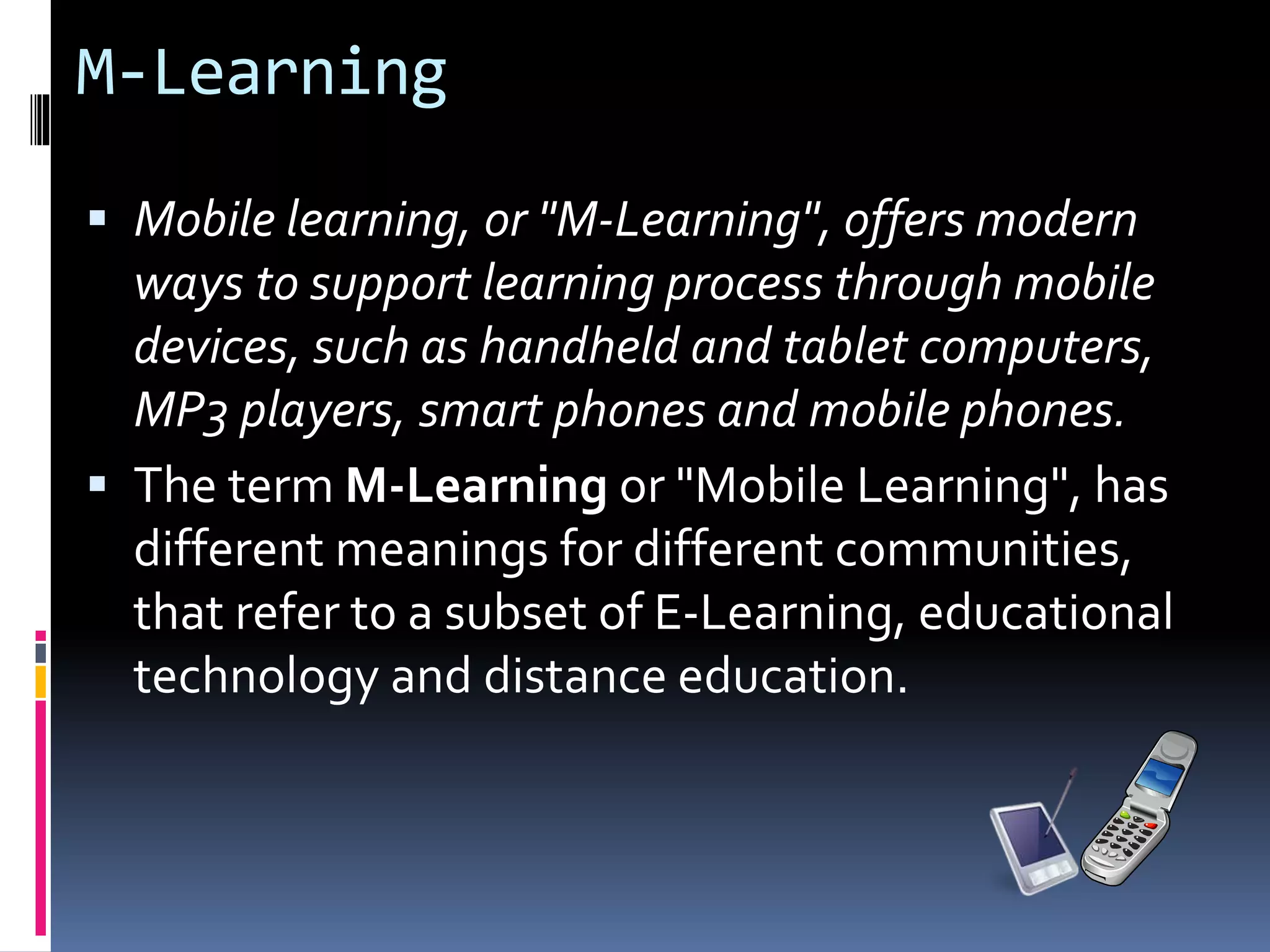
 Mobile learning, or "M-Learning", offers modern
ways to support learning process through mobile
devices, such as handheld and tablet computers,
MP3 players, smart phones and mobile phones.
 The term M-Learning or "Mobile Learning", has
different meanings for different communities,
that refer to a subset of E-Learning, educational
technology and distance education.
 ‘Mobile learning‘ is certainly not merely the
conjunction of ‘mobile‘ and ‘learning‘; it has always
implicitly meant ‘mobile E-Learning‘ .
 Its history and development have to be understood
as both a continuation of ‘conventional‘ E-Learning
and a reaction to this ‘conventional‘ E-Learning and
to its perceived inadequacies and limitations.
 It is the ‘mobile' aspect of mobile learning that
makes it stand apart from other types of learning,
specifically designing learning experiences that
exploit the opportunities that ‘mobility' can offer us.
 M-Learning focuses on the mobility of the learner,
interacting with portable technologies, and learning
that reflects a focus on how society and its
institutions can accommodate and support an
increasingly mobile population
Values of M-learning
 It is important to bring new technology into the
classroom.
 Devices used are more lightweight than books and
PCs.
 Mobile learning can be used to diversify the types of
learning activities students partake in (or a blended
learning approach).
 Mobile learning supports the learning process rather
than being integral to it.
 Mobile learning can be a useful add-on tool for
students with special needs.
 However, for SMS and MMS this might be dependent
on the students‘ specific disabilities or difficulties
involved.
 Mobile learning can be used as a ‘hook‘ to re-engage
disaffected youth.
Mobile devices and personal technologies
that can support mobile learning include:
 E-book
 Handheld game console, modern gaming consoles
such as Sony PSP or Nintendo DS
 Personal audio player, e.g. for listening to audio
recordings of lectures (podcasting)
 Personal Digital Assistant, in the classroom and
outdoors
 Tablet computer
 UMPC, mobile phone, camera phone and Smart Phone
Technical and delivery support for
mobile learning include:
 3GP For compression and delivery method of
audiovisual content associated with Mobile
Learning
 GPRS mobile data service, provides high speed
connection and data transfer rate
 Wi-Fi gives access to instructors and resources via
internet
 Cloud computing for storing and sharing files
These technologies should be
 Highly portable
The technology is available whenever the
user needs to learn.
 Individual
The technology can be personalized to suit
the individual learner‘s abilities, knowledge and
learning style, and is designed to support personal
learning rather than general office work.
 Unobtrusive
The learner can capture situations and
retrieve knowledge without the technology becoming
overly noticeable or imposing on the situation.
 Available
The learner can use the technology
anywhere, to enable communication with
teachers, experts and peers.
 Adaptable
The technology can be adapted to the
context for learning and the learner‘s evolving
skills and knowledge.
 Easy to use
The technology is easily comprehended
and navigated by people with no previous
experience using it.
 Persistent
The learner can use the technology to
manage learning throughout a lifetime, so that
the learner‘s personal accumulation of resources
and knowledge will be immediately accessible
despite changes in technology.
 Useful
The technology is suited to everyday needs
for communication, reference, work and
learning
BENEFITS OF M-LEARNING
 Relatively inexpensive opportunities, as the cost of
mobile devices are significantly less than PCs and
laptops .
 Continuous and situated learning support .
 Decrease in training costs .
 Potentially a more rewarding learning experience .
 Provides interactive learning
 Improving levels of literacy, numeracy and
participation in education amongst young adults.
 Using the communication features of a mobile
phone as part of a larger learning activity, e.g.:
sending media or texts into a central portfolio, or
exporting audio files from a learning platform to
your phone.
 Provides for global delivery of learning material.
BENEFITS OF M-LEARNING

M learning

  • 1.
    M-Learning  Mobile learning,or "M-Learning", offers modern ways to support learning process through mobile devices, such as handheld and tablet computers, MP3 players, smart phones and mobile phones.  The term M-Learning or "Mobile Learning", has different meanings for different communities, that refer to a subset of E-Learning, educational technology and distance education.
  • 2.
     ‘Mobile learning‘is certainly not merely the conjunction of ‘mobile‘ and ‘learning‘; it has always implicitly meant ‘mobile E-Learning‘ .  Its history and development have to be understood as both a continuation of ‘conventional‘ E-Learning and a reaction to this ‘conventional‘ E-Learning and to its perceived inadequacies and limitations.
  • 3.
     It isthe ‘mobile' aspect of mobile learning that makes it stand apart from other types of learning, specifically designing learning experiences that exploit the opportunities that ‘mobility' can offer us.  M-Learning focuses on the mobility of the learner, interacting with portable technologies, and learning that reflects a focus on how society and its institutions can accommodate and support an increasingly mobile population
  • 4.
    Values of M-learning It is important to bring new technology into the classroom.  Devices used are more lightweight than books and PCs.  Mobile learning can be used to diversify the types of learning activities students partake in (or a blended learning approach).  Mobile learning supports the learning process rather than being integral to it.
  • 5.
     Mobile learningcan be a useful add-on tool for students with special needs.  However, for SMS and MMS this might be dependent on the students‘ specific disabilities or difficulties involved.  Mobile learning can be used as a ‘hook‘ to re-engage disaffected youth.
  • 6.
    Mobile devices andpersonal technologies that can support mobile learning include:  E-book  Handheld game console, modern gaming consoles such as Sony PSP or Nintendo DS  Personal audio player, e.g. for listening to audio recordings of lectures (podcasting)  Personal Digital Assistant, in the classroom and outdoors  Tablet computer  UMPC, mobile phone, camera phone and Smart Phone
  • 7.
    Technical and deliverysupport for mobile learning include:  3GP For compression and delivery method of audiovisual content associated with Mobile Learning  GPRS mobile data service, provides high speed connection and data transfer rate  Wi-Fi gives access to instructors and resources via internet  Cloud computing for storing and sharing files
  • 8.
    These technologies shouldbe  Highly portable The technology is available whenever the user needs to learn.  Individual The technology can be personalized to suit the individual learner‘s abilities, knowledge and learning style, and is designed to support personal learning rather than general office work.  Unobtrusive The learner can capture situations and retrieve knowledge without the technology becoming overly noticeable or imposing on the situation.
  • 9.
     Available The learnercan use the technology anywhere, to enable communication with teachers, experts and peers.  Adaptable The technology can be adapted to the context for learning and the learner‘s evolving skills and knowledge.  Easy to use The technology is easily comprehended and navigated by people with no previous experience using it.
  • 10.
     Persistent The learnercan use the technology to manage learning throughout a lifetime, so that the learner‘s personal accumulation of resources and knowledge will be immediately accessible despite changes in technology.  Useful The technology is suited to everyday needs for communication, reference, work and learning
  • 11.
    BENEFITS OF M-LEARNING Relatively inexpensive opportunities, as the cost of mobile devices are significantly less than PCs and laptops .  Continuous and situated learning support .  Decrease in training costs .  Potentially a more rewarding learning experience .  Provides interactive learning
  • 12.
     Improving levelsof literacy, numeracy and participation in education amongst young adults.  Using the communication features of a mobile phone as part of a larger learning activity, e.g.: sending media or texts into a central portfolio, or exporting audio files from a learning platform to your phone.  Provides for global delivery of learning material. BENEFITS OF M-LEARNING