Enhancing EFL instruction through mobile learningMohammed NourEDUC605July 19, 2011
ContentsMobile learning (m-learning) explainedm-learning vs. e-learningFocus of studiesCommon themes (6)Questions
Mobile learning (m-learning) explained“learning mediated via handheld devices and available anytime, anywhere”*Video: Mobile learning (http://www.youtube.com/watch?v=neZYE9gBIuE)*(Kukulska-Hulme and Shield, 2008, p. 273)
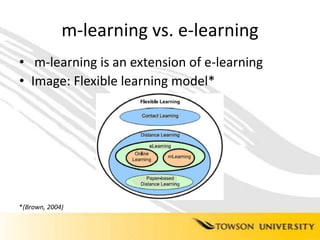
m-learning vs. e-learning m-learning is an extension of e-learningImage: Flexible learning model**(Brown, 2004)
Focus of studiesEFL (as opposed to ESL)where most research has been donewhere my experience is applicableMobile phones (as opposed to other devices)widespread use across the worldinclusive of numerous functions and features
Theme #1: Access to educationWhat?/Why?access to new learning opportunitiesprovide equal access for all learnersExample: Wireless access protocol (WAP) site in Korealistening materials provided via a WAP site
Theme #2: Active learningWhat?/Why?learning is a more active (rather than passive) experiencestudents are more engagedExample: Real-time learning in Chinalive polls during lectures
Theme #3: Constructive learningWhat?/Why?learning occurs by building upon previous knowledgereflection and transfer are encouraged Example: SMS texting research in Turkeyvocabulary words sent with increasing difficulty
Theme #4: Informal learningWhat?/Why?learning can happen “anytime and anywhere”*the classroom walls are extendedExample: MP3 device use in the UKstudents incorporate devices into personal activities*(Cavus et al., 2009, p. 81)
Theme #5: Student/Teacher attitudesCurrent scenariostudents find traditional EFL instruction boring teachers complain about lack of student interestExample: SMS texting study in Bangladeshstudents are motivated by m-learning opportunitiesteachers are interested, but apprehensive
Theme #6: Student achievementCurrent scenarioproblems with retention of conceptscannot apply instruction to real-life situationsExample:Mobile email and video site in Japanresults nearly double vs. paper/web-based instructionvideo samples aid on quiz scores
Questions???
ReferencesBegum, R. (2011). Prospect for Cell Phones as Instructional Tools in the EFL Classroom: A Case Study of Jahangirnagar University, Bangladesh. English Language Teaching, 4(1), 105-115. Retrieved from http://journal.ccsenet.org/index.php/elt/article/view/6958/6939Brown, T. (2004). The role of m-learning in the future of e-learning in Africa. In D. Murphy, R. Carr, J. Taylor & W. Tat-meng (Eds.), Distance education and technology: Issues and practice (pp. 197 - 216). Hong Kong: University of Hong Kong. Retrieved from http://matheasy.webstarts.com/uploads/The_role_of_m-learning_in_the_future_of_e-learning_in_Africa.pdfCavus, N., & Ibrahim, D. (2009). m-Learning: An experiment in using SMS to support learning new English language words. British Journal of Educational Technology, 40(1), 78-91. doi:10.1111/j.1467-8535.2007.00801Kukulska- Hulme, A. & Shield, L. (2008). An overview of mobile assisted language learning: From content delivery to supported collaboration and interaction: Recall 20(3), 271-289. doi: 10.1017/S0958344008000335Nah, K.C., White, P., & Sussex, R. (2008). The potential of using a mobile phone to Access the Internet for learning EFL listening skills within a Korean context. ReCALL, 20(3), 331-347. doi:10.1017/S0958344008000633 Ros I Solé, C., Calic, J., & Neijmann, D. (2010). A social and self-reflective approach to MALL. ReCALL, 22(1), 39-52. doi:10.1017/S0958344009990188Thornton, P., & Houser, C. (2005). Using mobile phones in English education in Japan. Journal of Computer Assisted Learning, 21(3), 217-228. doi:10.1111/j.1365-2729.2005.00129Wang, M., Shen, R., Novak, D., & Pan, X. (2009). The impact of mobile learning on students' learning behaviours and performance: Report from a large blended classroom. British Journal of Educational Technology, 40(4), 673-695. doi:10.1111/j.1467-8535.2008.00846

EDUC605 Lit Review-Presentation

  • 1.
    Enhancing EFL instructionthrough mobile learningMohammed NourEDUC605July 19, 2011
  • 2.
    ContentsMobile learning (m-learning)explainedm-learning vs. e-learningFocus of studiesCommon themes (6)Questions
  • 3.
    Mobile learning (m-learning)explained“learning mediated via handheld devices and available anytime, anywhere”*Video: Mobile learning (http://www.youtube.com/watch?v=neZYE9gBIuE)*(Kukulska-Hulme and Shield, 2008, p. 273)
  • 4.
    m-learning vs. e-learningm-learning is an extension of e-learningImage: Flexible learning model**(Brown, 2004)
  • 5.
    Focus of studiesEFL(as opposed to ESL)where most research has been donewhere my experience is applicableMobile phones (as opposed to other devices)widespread use across the worldinclusive of numerous functions and features
  • 6.
    Theme #1: Accessto educationWhat?/Why?access to new learning opportunitiesprovide equal access for all learnersExample: Wireless access protocol (WAP) site in Korealistening materials provided via a WAP site
  • 7.
    Theme #2: ActivelearningWhat?/Why?learning is a more active (rather than passive) experiencestudents are more engagedExample: Real-time learning in Chinalive polls during lectures
  • 8.
    Theme #3: ConstructivelearningWhat?/Why?learning occurs by building upon previous knowledgereflection and transfer are encouraged Example: SMS texting research in Turkeyvocabulary words sent with increasing difficulty
  • 9.
    Theme #4: InformallearningWhat?/Why?learning can happen “anytime and anywhere”*the classroom walls are extendedExample: MP3 device use in the UKstudents incorporate devices into personal activities*(Cavus et al., 2009, p. 81)
  • 10.
    Theme #5: Student/TeacherattitudesCurrent scenariostudents find traditional EFL instruction boring teachers complain about lack of student interestExample: SMS texting study in Bangladeshstudents are motivated by m-learning opportunitiesteachers are interested, but apprehensive
  • 11.
    Theme #6: StudentachievementCurrent scenarioproblems with retention of conceptscannot apply instruction to real-life situationsExample:Mobile email and video site in Japanresults nearly double vs. paper/web-based instructionvideo samples aid on quiz scores
  • 12.
  • 13.
    ReferencesBegum, R. (2011).Prospect for Cell Phones as Instructional Tools in the EFL Classroom: A Case Study of Jahangirnagar University, Bangladesh. English Language Teaching, 4(1), 105-115. Retrieved from http://journal.ccsenet.org/index.php/elt/article/view/6958/6939Brown, T. (2004). The role of m-learning in the future of e-learning in Africa. In D. Murphy, R. Carr, J. Taylor & W. Tat-meng (Eds.), Distance education and technology: Issues and practice (pp. 197 - 216). Hong Kong: University of Hong Kong. Retrieved from http://matheasy.webstarts.com/uploads/The_role_of_m-learning_in_the_future_of_e-learning_in_Africa.pdfCavus, N., & Ibrahim, D. (2009). m-Learning: An experiment in using SMS to support learning new English language words. British Journal of Educational Technology, 40(1), 78-91. doi:10.1111/j.1467-8535.2007.00801Kukulska- Hulme, A. & Shield, L. (2008). An overview of mobile assisted language learning: From content delivery to supported collaboration and interaction: Recall 20(3), 271-289. doi: 10.1017/S0958344008000335Nah, K.C., White, P., & Sussex, R. (2008). The potential of using a mobile phone to Access the Internet for learning EFL listening skills within a Korean context. ReCALL, 20(3), 331-347. doi:10.1017/S0958344008000633 Ros I Solé, C., Calic, J., & Neijmann, D. (2010). A social and self-reflective approach to MALL. ReCALL, 22(1), 39-52. doi:10.1017/S0958344009990188Thornton, P., & Houser, C. (2005). Using mobile phones in English education in Japan. Journal of Computer Assisted Learning, 21(3), 217-228. doi:10.1111/j.1365-2729.2005.00129Wang, M., Shen, R., Novak, D., & Pan, X. (2009). The impact of mobile learning on students' learning behaviours and performance: Report from a large blended classroom. British Journal of Educational Technology, 40(4), 673-695. doi:10.1111/j.1467-8535.2008.00846