Download to read offline
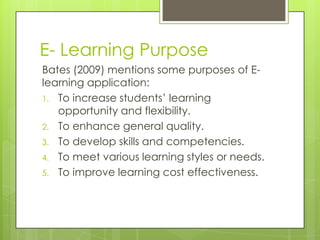

E-learning provides a means of education that incorporates self-motivation, communication, efficiency and technology. It eliminates distances and commutes by making learning content accessible through computers and internet technology. Nichols outlines ten e-learning concepts, including that it is grounded in behaviorism and constructivism, is a unique form of education, and will succeed through pedagogical innovation. Bates mentions that e-learning aims to increase learning opportunities and flexibility for students, enhance overall quality, develop skills and competencies, meet various learning styles and needs, and improve cost effectiveness.


