The impact of vocabulary
preparation on L2 listening
comprehension, confidence and
strategy use
Presenter: Ellie Lin
Instructor: Dr. Teresa Hsu
Date: Jan 05, 2015
1
Chang, A. C. (2007). The impact of
vocabulary preparation on L2
listening comprehension, confidence
and strategy use. System, 35, 534-
550.
2
1. Introduction
2. Literature review
3. Methodology
4. Results & discussion
5. Conclusion
6. Reflection
3
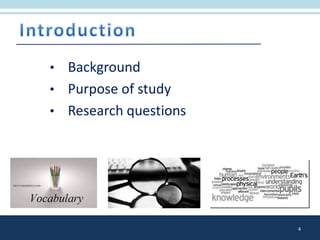
• Background
• Purpose of study
• Research questions
4
Background
Understanding spoken English and
lacking vocabulary knowledge may
trouble most EFL learners who are
limited exposure to outside of
English classroom.
5
Purpose of study
To provide learners pre-task activities,
relevant materials and the lengths of
preparation time in order to influence
learners’ fluency, complexity and
accuracy skills
6
Research questions
1. Do varying lengths of preparation time make a
difference to learners’ performance in vocabulary
knowledge or overall listening comprehension?
7
3. Do different lengths of preparation time make
a difference to learners’ strategy use?
2. Do different lengths of preparation time make
a difference to learners’ confidence? If yes,
which results in a higher level of confidence?
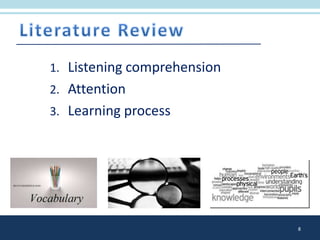
1. Listening comprehension
2. Attention
3. Learning process
8
1. Vocabulary supports in listening
comprehension only when it is
combined with multiple listening
2. L2 learners pay conscious
attention to think words and
take time slowly to use them.
(Berne, 1995; Elkhafaifi, 2005)
(Buck, 2001:7)
9
3. Even thought previewing
relevant vocabulary L2 learners’
listening ability has no
immediate effect, they need
more time to practice and
automatize processing
(Chang & Read, 2006)
10
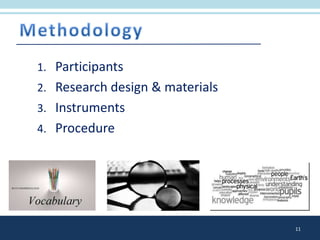
1. Participants
2. Research design & materials
3. Instruments
4. Procedure
11
Participants
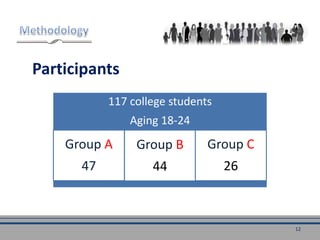
117 college students
Aging 18-24
Group A
47
Group B
44
Group C
26
12
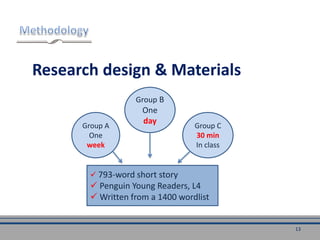
Research design & Materials
Group B
One
day
Group A
One
week
Group C
30 min
In class
 793-word short story
 Penguin Young Readers, L4
 Written from a 1400 wordlist
13
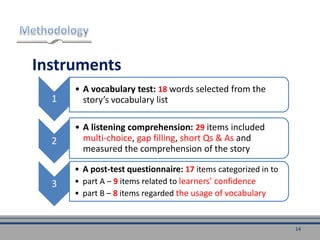
Instruments
1
• A vocabulary test: 18 words selected from the
story’s vocabulary list
2
• A listening comprehension: 29 items included
multi-choice, gap filling, short Qs & As and
measured the comprehension of the story
3
• A post-test questionnaire: 17 items categorized in to
• part A – 9 items related to learners’ confidence
• part B – 8 items regarded the usage of vocabulary
14
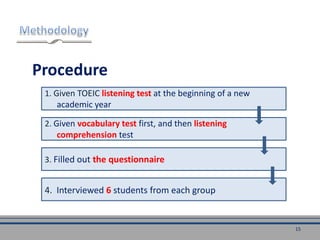
Procedure
1. Given TOEIC listening test at the beginning of a new
academic year
2. Given vocabulary test first, and then listening
comprehension test
3. Filled out the questionnaire
4. Interviewed 6 students from each group
15
1. Test results
2. Questionnaire results
3. Confidence level
4. Strategy use
16
Test results
Group A
One week
Group B
One day
Group C
30 min
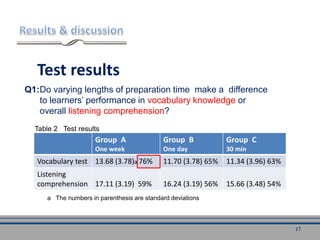
Vocabulary test 13.68 (3.78)a 76% 11.70 (3.78) 65% 11.34 (3.96) 63%
Listening
comprehension 17.11 (3.19) 59% 16.24 (3.19) 56% 15.66 (3.48) 54%
a The numbers in parenthesis are standard deviations
Do varying lengths of preparation time make a difference
to learners’ performance in vocabulary knowledge or
overall listening comprehension?
Q1:
Table 2 Test results
17
Test results
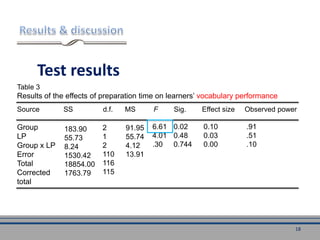
Source SS d.f. MS F Sig. Effect size Observed power
Group
LP
Group x LP
Error
Total
Corrected
total
183.90
55.73
8.24
1530.42
18854.00
1763.79
2
1
2
110
116
115
91.95
55.74
4.12
13.91
6.61
4.01
.30
0.02
0.48
0.744
0.10
0.03
0.00
.91
.51
.10
Table 3
Results of the effects of preparation time on learners’ vocabulary performance
18
Test results
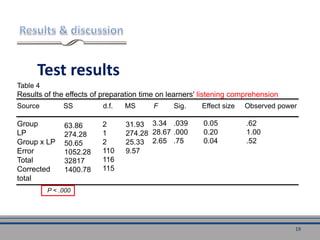
P < .000
Table 4
Results of the effects of preparation time on learners' listening comprehension
Source SS d.f. MS F Sig. Effect size Observed power
Group
LP
Group x LP
Error
Total
Corrected
total
63.86
274.28
50.65
1052.28
32817
1400.78
2
1
2
110
116
115
31.93
274.28
25.33
9.57
3.34
28.67
2.65
.039
.000
.75
0.05
0.20
0.04
.62
1.00
.52
19
Questionnaire results
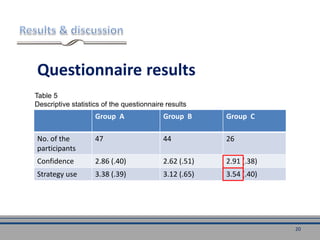
Group A Group B Group C
No. of the
participants
47 44 26
Confidence 2.86 (.40) 2.62 (.51) 2.91 (.38)
Strategy use 3.38 (.39) 3.12 (.65) 3.54 (.40)
Table 5
Descriptive statistics of the questionnaire results
20
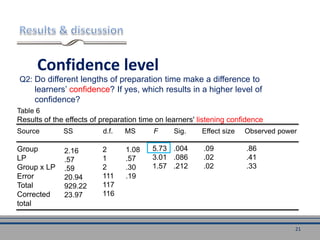
Confidence level
Table 6
Results of the effects of preparation time on learners' listening confidence
Source SS d.f. MS F Sig. Effect size Observed power
Group
LP
Group x LP
Error
Total
Corrected
total
2.16
.57
.59
20.94
929.22
23.97
2
1
2
111
117
116
1.08
.57
.30
.19
5.73
3.01
1.57
.004
.086
.212
.09
.02
.02
.86
.41
.33
Q2: Do different lengths of preparation time make a difference to
learners’ confidence? If yes, which results in a higher level of
confidence?
21
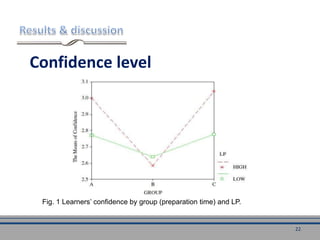
Confidence level
Fig. 1 Learners’ confidence by group (preparation time) and LP.
22
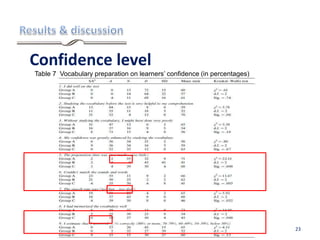
Confidence level
Table 7 Vocabulary preparation on learners’ confidence (in percentages)
z
z
23
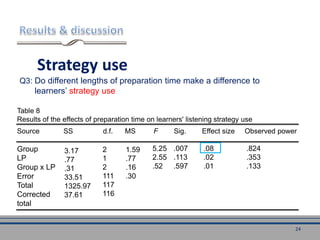
Strategy use
Table 8
Results of the effects of preparation time on learners' listening strategy use
Source SS d.f. MS F Sig. Effect size Observed power
Group
LP
Group x LP
Error
Total
Corrected
total
3.17
.77
.31
33.51
1325.97
37.61
2
1
2
111
117
116
1.59
.77
.16
.30
5.25
2.55
.52
.007
.113
.597
.08
.02
.01
.824
.353
.133
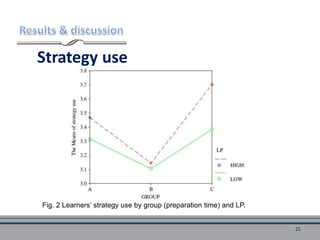
Q3: Do different lengths of preparation time make a difference to
learners’ strategy use
24
Strategy use
Fig. 2 Learners’ strategy use by group (preparation time) and LP.
25
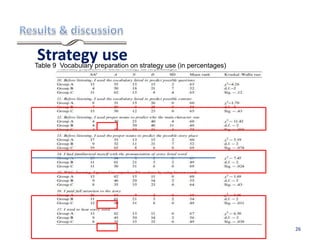
Strategy useTable 9 Vocabulary preparation on strategy use (in percentages)
26
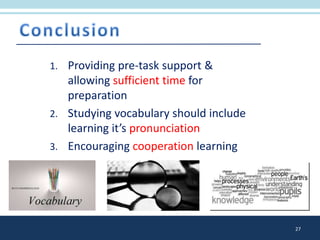
1. Providing pre-task support &
allowing sufficient time for
preparation
2. Studying vocabulary should include
learning it’s pronunciation
3. Encouraging cooperation learning
27
Providing pre-task support & allowing
sufficient time for preparation
Vocabulary preparation certainly impacts on learners’
confidence and strategy use
• Supporting visual & aural aids
• Enough time and familiar with pronunciation
28
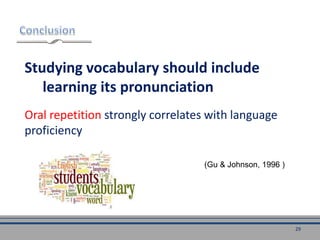
Studying vocabulary should include
learning its pronunciation
Oral repetition strongly correlates with language
proficiency
(Gu & Johnson, 1996 )
29
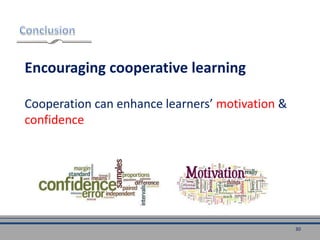
Encouraging cooperative learning
Cooperation can enhance learners’ motivation &
confidence
30
Relection
• How much parparation time will be
enough for students?
• Providing cooperative opportunities
for students
31
Thank you
Literature serves as a model and inspiration of
language awareness
32

Ellie second presentation

  • 1.
    The impact ofvocabulary preparation on L2 listening comprehension, confidence and strategy use Presenter: Ellie Lin Instructor: Dr. Teresa Hsu Date: Jan 05, 2015 1
  • 2.
    Chang, A. C.(2007). The impact of vocabulary preparation on L2 listening comprehension, confidence and strategy use. System, 35, 534- 550. 2
  • 3.
    1. Introduction 2. Literaturereview 3. Methodology 4. Results & discussion 5. Conclusion 6. Reflection 3
  • 4.
    • Background • Purposeof study • Research questions 4
  • 5.
    Background Understanding spoken Englishand lacking vocabulary knowledge may trouble most EFL learners who are limited exposure to outside of English classroom. 5
  • 6.
    Purpose of study Toprovide learners pre-task activities, relevant materials and the lengths of preparation time in order to influence learners’ fluency, complexity and accuracy skills 6
  • 7.
    Research questions 1. Dovarying lengths of preparation time make a difference to learners’ performance in vocabulary knowledge or overall listening comprehension? 7 3. Do different lengths of preparation time make a difference to learners’ strategy use? 2. Do different lengths of preparation time make a difference to learners’ confidence? If yes, which results in a higher level of confidence?
  • 8.
    1. Listening comprehension 2.Attention 3. Learning process 8
  • 9.
    1. Vocabulary supportsin listening comprehension only when it is combined with multiple listening 2. L2 learners pay conscious attention to think words and take time slowly to use them. (Berne, 1995; Elkhafaifi, 2005) (Buck, 2001:7) 9
  • 10.
    3. Even thoughtpreviewing relevant vocabulary L2 learners’ listening ability has no immediate effect, they need more time to practice and automatize processing (Chang & Read, 2006) 10
  • 11.
    1. Participants 2. Researchdesign & materials 3. Instruments 4. Procedure 11
  • 12.
    Participants 117 college students Aging18-24 Group A 47 Group B 44 Group C 26 12
  • 13.
    Research design &Materials Group B One day Group A One week Group C 30 min In class  793-word short story  Penguin Young Readers, L4  Written from a 1400 wordlist 13
  • 14.
    Instruments 1 • A vocabularytest: 18 words selected from the story’s vocabulary list 2 • A listening comprehension: 29 items included multi-choice, gap filling, short Qs & As and measured the comprehension of the story 3 • A post-test questionnaire: 17 items categorized in to • part A – 9 items related to learners’ confidence • part B – 8 items regarded the usage of vocabulary 14
  • 15.
    Procedure 1. Given TOEIClistening test at the beginning of a new academic year 2. Given vocabulary test first, and then listening comprehension test 3. Filled out the questionnaire 4. Interviewed 6 students from each group 15
  • 16.
    1. Test results 2.Questionnaire results 3. Confidence level 4. Strategy use 16
  • 17.
    Test results Group A Oneweek Group B One day Group C 30 min Vocabulary test 13.68 (3.78)a 76% 11.70 (3.78) 65% 11.34 (3.96) 63% Listening comprehension 17.11 (3.19) 59% 16.24 (3.19) 56% 15.66 (3.48) 54% a The numbers in parenthesis are standard deviations Do varying lengths of preparation time make a difference to learners’ performance in vocabulary knowledge or overall listening comprehension? Q1: Table 2 Test results 17
  • 18.
    Test results Source SSd.f. MS F Sig. Effect size Observed power Group LP Group x LP Error Total Corrected total 183.90 55.73 8.24 1530.42 18854.00 1763.79 2 1 2 110 116 115 91.95 55.74 4.12 13.91 6.61 4.01 .30 0.02 0.48 0.744 0.10 0.03 0.00 .91 .51 .10 Table 3 Results of the effects of preparation time on learners’ vocabulary performance 18
  • 19.
    Test results P <.000 Table 4 Results of the effects of preparation time on learners' listening comprehension Source SS d.f. MS F Sig. Effect size Observed power Group LP Group x LP Error Total Corrected total 63.86 274.28 50.65 1052.28 32817 1400.78 2 1 2 110 116 115 31.93 274.28 25.33 9.57 3.34 28.67 2.65 .039 .000 .75 0.05 0.20 0.04 .62 1.00 .52 19
  • 20.
    Questionnaire results Group AGroup B Group C No. of the participants 47 44 26 Confidence 2.86 (.40) 2.62 (.51) 2.91 (.38) Strategy use 3.38 (.39) 3.12 (.65) 3.54 (.40) Table 5 Descriptive statistics of the questionnaire results 20
  • 21.
    Confidence level Table 6 Resultsof the effects of preparation time on learners' listening confidence Source SS d.f. MS F Sig. Effect size Observed power Group LP Group x LP Error Total Corrected total 2.16 .57 .59 20.94 929.22 23.97 2 1 2 111 117 116 1.08 .57 .30 .19 5.73 3.01 1.57 .004 .086 .212 .09 .02 .02 .86 .41 .33 Q2: Do different lengths of preparation time make a difference to learners’ confidence? If yes, which results in a higher level of confidence? 21
  • 22.
    Confidence level Fig. 1Learners’ confidence by group (preparation time) and LP. 22
  • 23.
    Confidence level Table 7Vocabulary preparation on learners’ confidence (in percentages) z z 23
  • 24.
    Strategy use Table 8 Resultsof the effects of preparation time on learners' listening strategy use Source SS d.f. MS F Sig. Effect size Observed power Group LP Group x LP Error Total Corrected total 3.17 .77 .31 33.51 1325.97 37.61 2 1 2 111 117 116 1.59 .77 .16 .30 5.25 2.55 .52 .007 .113 .597 .08 .02 .01 .824 .353 .133 Q3: Do different lengths of preparation time make a difference to learners’ strategy use 24
  • 25.
    Strategy use Fig. 2Learners’ strategy use by group (preparation time) and LP. 25
  • 26.
    Strategy useTable 9Vocabulary preparation on strategy use (in percentages) 26
  • 27.
    1. Providing pre-tasksupport & allowing sufficient time for preparation 2. Studying vocabulary should include learning it’s pronunciation 3. Encouraging cooperation learning 27
  • 28.
    Providing pre-task support& allowing sufficient time for preparation Vocabulary preparation certainly impacts on learners’ confidence and strategy use • Supporting visual & aural aids • Enough time and familiar with pronunciation 28
  • 29.
    Studying vocabulary shouldinclude learning its pronunciation Oral repetition strongly correlates with language proficiency (Gu & Johnson, 1996 ) 29
  • 30.
    Encouraging cooperative learning Cooperationcan enhance learners’ motivation & confidence 30
  • 31.
    Relection • How muchparparation time will be enough for students? • Providing cooperative opportunities for students 31
  • 32.
    Thank you Literature servesas a model and inspiration of language awareness 32