PresenterPresenter :: Marina LoMarina Lo
InstructorInstructor :: Teresa HsuTeresa Hsu
DateDate :: June 8, 2015June 8, 2015
Research Writing and Publishing II
ContentsContents
2
Research Writing and Publishing II
Introduction
Research Writing and Publishing II
Research background
Statement of the problem
The purpose of the study
Research questions
4
Research backgroundResearch background
Learning English is becoming the trend in Taiwan. In
order to achieve teaching goals successfully and
promote student development and growth positively,
teachers should take more awareness on knowing
students individual differences.
5
Statement of the problemStatement of the problem
The focus of most studies was on differences in
strategy awareness, and learning attitudes, rather
than on differences in the use of specific strategies or
learning style preferences. Also, few data on the
relationship between strategies and language
proficiency.
6
The purpose of the studyThe purpose of the study
To figure out what are the relationships between
perceptual learning style preferences, language
learning strategies and learning efficiency on
grades 7 to 9 of junior high school in central Taiwan
7
Research questionsResearch questions
Are there any relationships between
perceptual learning style preferences and
language learning efficiency?
Are there any relationships between
language learning strategies and
language learning efficiency?
Literature Review
The influence of age on perceptual learning
style preferences
Definition and classification of Language
learning strategies
The effective language learner
Research Writing and Publishing II
9
The influence of age on perceptualThe influence of age on perceptual
learning style preferenceslearning style preferences
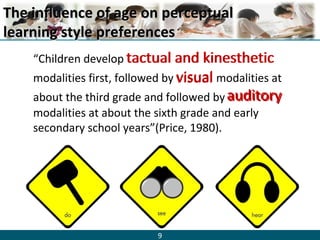
“Children develop tactual and kinesthetic
modalities first, followed by visual modalities at
about the third grade and followed by auditory
modalities at about the sixth grade and early
secondary school years”(Price, 1980).
visual
auditory
tactual and kinesthetic
10
The influence of age on perceptualThe influence of age on perceptual
learning style preferenceslearning style preferences
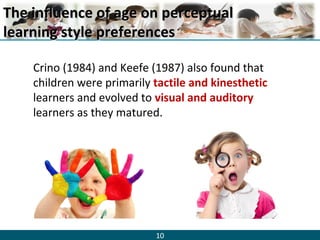
Crino (1984) and Keefe (1987) also found that
children were primarily tactile and kinesthetic
learners and evolved to visual and auditory
learners as they matured.
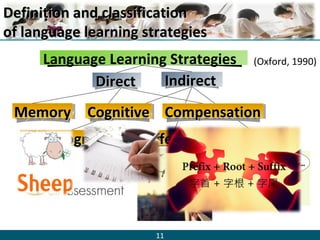
SocialSocialSocialSocialMetacognitiveMetacognitiveMetacognitiveMetacognitive AffectiveAffectiveAffectiveAffective
MemoryMemoryMemoryMemory CognitiveCognitiveCognitiveCognitive CompensationCompensationCompensationCompensation
11
Definition and classificationDefinition and classification
of language learning strategiesof language learning strategies
Language Learning Strategies
DirectDirect IndirectIndirect
(Oxford, 1990)
12
The effective language learnerThe effective language learner
Stern (1975) noted ten strategies of good language
learning and described successful language learners
in the aspects of personal characteristics, styles, and
strategies.
13
The effective language learnerThe effective language learner
Nunan (1991) found that effective language learners
displayed a high degree of autonomy, and were able
to reflect on and articulate the processes underlying
their own learning.
Methodology
Research Writing and Publishing II
Participants
Instrumentation
Research Procedures
15
ParticipantsParticipants
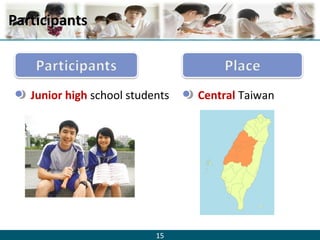
Junior high school students Central Taiwan
16
InstrumentationInstrumentation
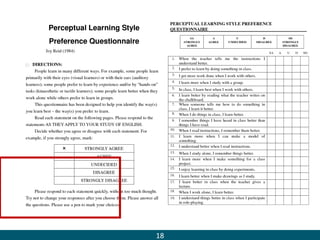
Perceptual Learning Style Preference Questionnaire
(PLSPQ)
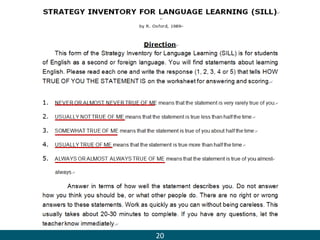
Strategy Inventory for Language Learning
(SILL)
5 points Likert-scale
17
InstrumentationInstrumentation
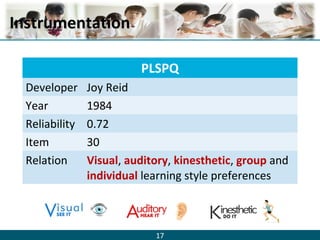
PLSPQ
Developer Joy Reid
Year 1984
Reliability 0.72
Item 30
Relation Visual, auditory, kinesthetic, group and
individual learning style preferences
18
19
InstrumentationInstrumentation
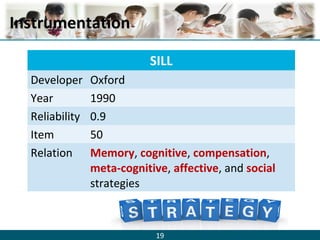
SILL
Developer Oxford
Year 1990
Reliability 0.9
Item 50
Relation Memory, cognitive, compensation,
meta-cognitive, affective, and social
strategies
20
21
Research procedureResearch procedure
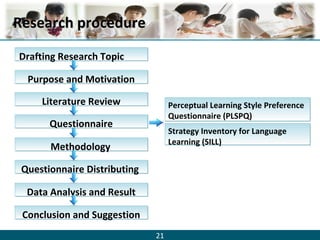
Drafting Research TopicDrafting Research Topic
Purpose and MotivationPurpose and Motivation
Literature ReviewLiterature Review
QuestionnaireQuestionnaire
MethodologyMethodology
Questionnaire DistributingQuestionnaire Distributing
Data Analysis and ResultData Analysis and Result
Conclusion and SuggestionConclusion and Suggestion
Perceptual Learning Style Preference
Questionnaire (PLSPQ)
Perceptual Learning Style Preference
Questionnaire (PLSPQ)
Strategy Inventory for Language
Learning (SILL)
Strategy Inventory for Language
Learning (SILL)
Thank youThank you

Marina proposal 0608

  • 1.
    PresenterPresenter :: MarinaLoMarina Lo InstructorInstructor :: Teresa HsuTeresa Hsu DateDate :: June 8, 2015June 8, 2015 Research Writing and Publishing II
  • 2.
  • 3.
    Introduction Research Writing andPublishing II Research background Statement of the problem The purpose of the study Research questions
  • 4.
    4 Research backgroundResearch background LearningEnglish is becoming the trend in Taiwan. In order to achieve teaching goals successfully and promote student development and growth positively, teachers should take more awareness on knowing students individual differences.
  • 5.
    5 Statement of theproblemStatement of the problem The focus of most studies was on differences in strategy awareness, and learning attitudes, rather than on differences in the use of specific strategies or learning style preferences. Also, few data on the relationship between strategies and language proficiency.
  • 6.
    6 The purpose ofthe studyThe purpose of the study To figure out what are the relationships between perceptual learning style preferences, language learning strategies and learning efficiency on grades 7 to 9 of junior high school in central Taiwan
  • 7.
    7 Research questionsResearch questions Arethere any relationships between perceptual learning style preferences and language learning efficiency? Are there any relationships between language learning strategies and language learning efficiency?
  • 8.
    Literature Review The influenceof age on perceptual learning style preferences Definition and classification of Language learning strategies The effective language learner Research Writing and Publishing II
  • 9.
    9 The influence ofage on perceptualThe influence of age on perceptual learning style preferenceslearning style preferences “Children develop tactual and kinesthetic modalities first, followed by visual modalities at about the third grade and followed by auditory modalities at about the sixth grade and early secondary school years”(Price, 1980). visual auditory tactual and kinesthetic
  • 10.
    10 The influence ofage on perceptualThe influence of age on perceptual learning style preferenceslearning style preferences Crino (1984) and Keefe (1987) also found that children were primarily tactile and kinesthetic learners and evolved to visual and auditory learners as they matured.
  • 11.
    SocialSocialSocialSocialMetacognitiveMetacognitiveMetacognitiveMetacognitive AffectiveAffectiveAffectiveAffective MemoryMemoryMemoryMemory CognitiveCognitiveCognitiveCognitiveCompensationCompensationCompensationCompensation 11 Definition and classificationDefinition and classification of language learning strategiesof language learning strategies Language Learning Strategies DirectDirect IndirectIndirect (Oxford, 1990)
  • 12.
    12 The effective languagelearnerThe effective language learner Stern (1975) noted ten strategies of good language learning and described successful language learners in the aspects of personal characteristics, styles, and strategies.
  • 13.
    13 The effective languagelearnerThe effective language learner Nunan (1991) found that effective language learners displayed a high degree of autonomy, and were able to reflect on and articulate the processes underlying their own learning.
  • 14.
    Methodology Research Writing andPublishing II Participants Instrumentation Research Procedures
  • 15.
  • 16.
    16 InstrumentationInstrumentation Perceptual Learning StylePreference Questionnaire (PLSPQ) Strategy Inventory for Language Learning (SILL) 5 points Likert-scale
  • 17.
    17 InstrumentationInstrumentation PLSPQ Developer Joy Reid Year1984 Reliability 0.72 Item 30 Relation Visual, auditory, kinesthetic, group and individual learning style preferences
  • 18.
  • 19.
    19 InstrumentationInstrumentation SILL Developer Oxford Year 1990 Reliability0.9 Item 50 Relation Memory, cognitive, compensation, meta-cognitive, affective, and social strategies
  • 20.
  • 21.
    21 Research procedureResearch procedure DraftingResearch TopicDrafting Research Topic Purpose and MotivationPurpose and Motivation Literature ReviewLiterature Review QuestionnaireQuestionnaire MethodologyMethodology Questionnaire DistributingQuestionnaire Distributing Data Analysis and ResultData Analysis and Result Conclusion and SuggestionConclusion and Suggestion Perceptual Learning Style Preference Questionnaire (PLSPQ) Perceptual Learning Style Preference Questionnaire (PLSPQ) Strategy Inventory for Language Learning (SILL) Strategy Inventory for Language Learning (SILL)
  • 22.