Teaching ‘Mobile Natives' in Russia:
   Challenges and Perspectives


                         Lomonosov
                        Moscow State
                           University

                            S. Titova
Your opinion….
 Why are mobile devices becoming
 more and more popular in
 education?
 What are the main reasons for
 that?
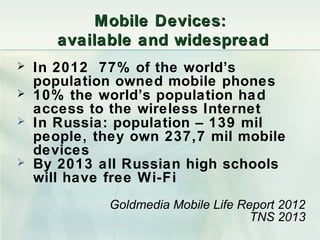
Mobile D evices:
       available and widespread
   In 2012 77% of the world’s
    population owned mobile phones
   10% the world’s population ha d
    access to the wireless Internet
   In Russia: population – 139 mil
    people, they own 237,7 mil mobile
    devices
   By 2013 all Russian high schools
    will have free Wi-Fi
             Goldmedia Mobile Life Report 2012
                                     TNS 2013
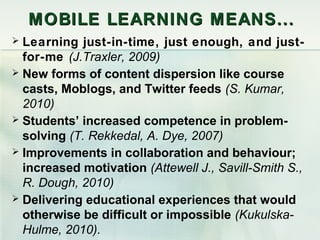
M OBILE LEARNING MEANS ...
 Learning just-in-time, just enough, and just-
  for-me (J.Traxler, 2009)
 New forms of content dispersion like course
  casts, Moblogs, and Twitter feeds (S. Kumar,
  2010)
 Students’ increased competence in problem-
  solving (T. Rekkedal, A. Dye, 2007)
 Improvements in collaboration and behaviour;
  increased motivation (Attewell J., Savill-Smith S.,
  R. Dough, 2010)
 Delivering educational experiences that would
  otherwise be difficult or impossible (Kukulska-
  Hulme, 2010).
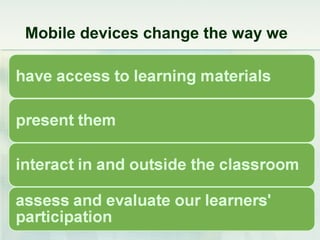
Mobile devices change the way we
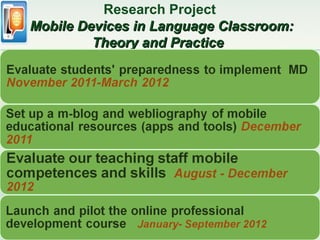
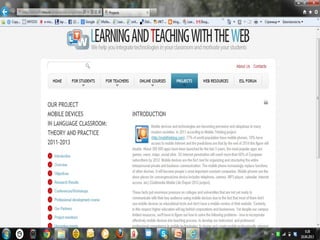
Research Project
Mobile Devices in Language Classroom:
         Theory and Practice
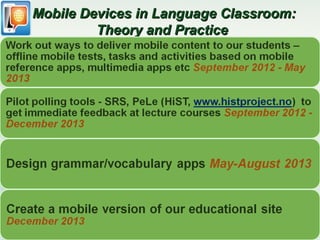
Mobile Devices in Language Classroom:
         Theory and Practice
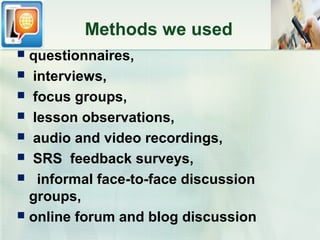
Methods we used
 questionnaires,
 interviews,
 focus groups,
 lesson observations,
 audio and video recordings,
 SRS feedback surveys,
 informal face-to-face discussion
  groups,
 online forum and blog discussion
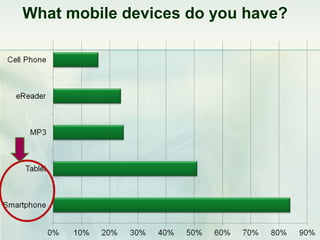
What mobile devices do you have?
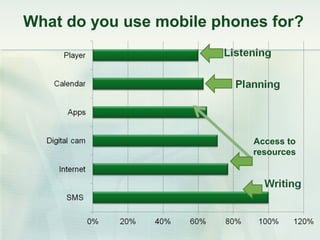
What do you use mobile phones for?


                           Access to
                           resources
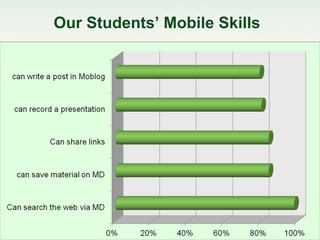
Our Students’ Mobile Skills
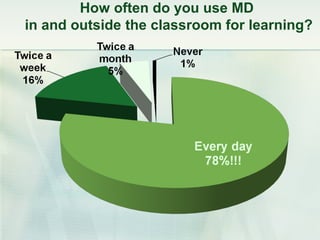
How often do you use MD
in and outside the classroom for learning?
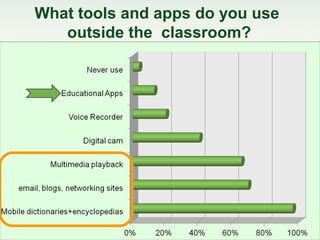
What tools and apps do you use
   outside the classroom?
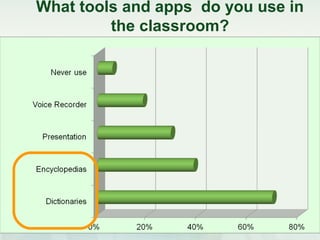
What tools and apps do you use in
         the classroom?
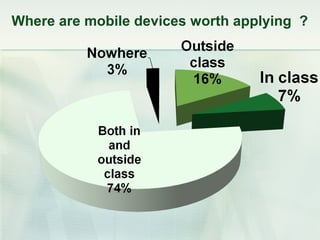
Where are mobile devices worth applying ?
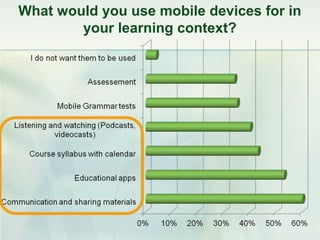
What would you use mobile devices for in
        your learning context?
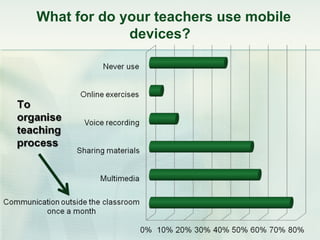
What for do your teachers use mobile
             devices?
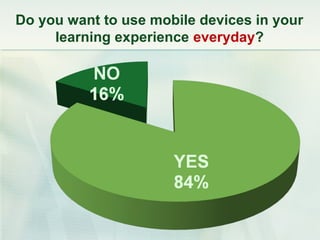
Do you want to use mobile devices in your
     learning experience everyday?
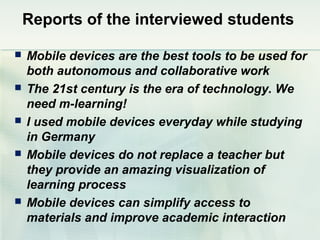
Reports of the interviewed students

   Mobile devices are the best tools to be used for
    both autonomous and collaborative work
   The 21st century is the era of technology. We
    need m-learning!
   I used mobile devices everyday while studying
    in Germany
   Mobile devices do not replace a teacher but
    they provide an amazing visualization of
    learning process
   Mobile devices can simplify access to
    materials and improve academic interaction
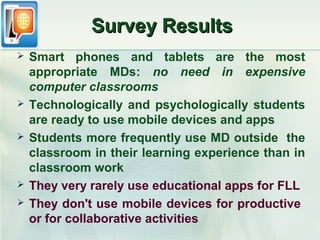
Survey Results
   Smart phones and tablets are the most
    appropriate MDs: no need in expensive
    computer classrooms
   Technologically and psychologically students
    are ready to use mobile devices and apps
   Students more frequently use MD outside the
    classroom in their learning experience than in
    classroom work
   They very rarely use educational apps for FLL
   They don't use mobile devices for productive
    or for collaborative activities
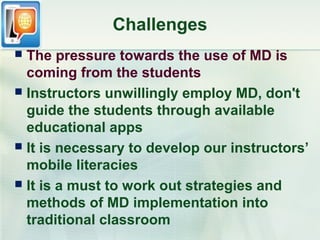
Challenges
 The pressure towards the use of MD is
  coming from the students
 Instructors unwillingly employ MD, don't
  guide the students through available
  educational apps
 It is necessary to develop our instructors’
  mobile literacies
 It is a must to work out strategies and
  methods of MD implementation into
  traditional classroom
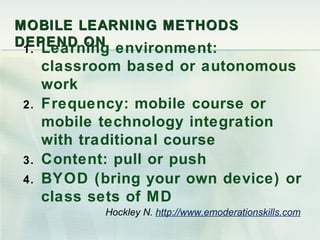
MOBILE LEARNING METHODS
DEPEND ON environment:
 1. Learning
     classroom based or autonomous
     work
2.   Frequency: mobile course or
     mobile technology integration
     with traditional course
3.   Content: pull or push
4.   BYOD (bring your own device) or
     class sets of MD
            Hockley N. http://www.emoderationskills.com
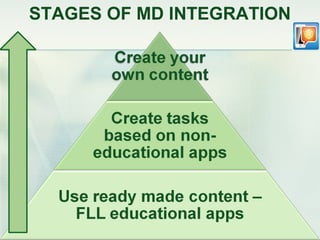
STAGES OF MD INTEGRATION
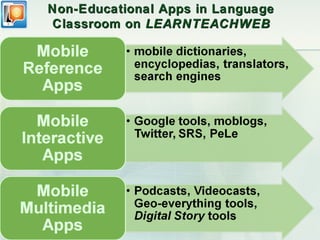
Non-Educational Apps in Language
Classroom on LEARNTEACHWEB
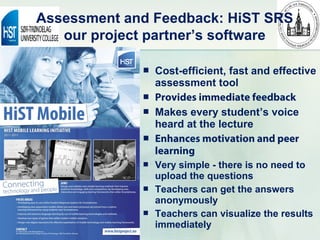
Assessment and Feedback: HiST SRS
   our project partner’s software

                Cost-efficient, fast and effective
                 assessment tool
                Provides immediate feedback
                Makes every student’s voice
                 heard at the lecture
                Enhances motivation and peer
                 learning
                Very simple - there is no need to
                 upload the questions
                Teachers can get the answers
                 anonymously
                Teachers can visualize the results
                 immediately
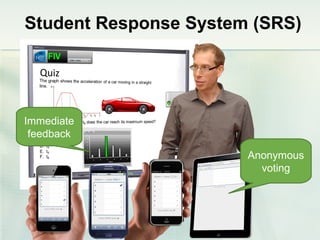
Student Response System (SRS)


Immediate
 feedback

                       Anonymous
                         voting
Prospects

 work out MLearning strategies and
  methods to enhance learner autonomy
  and to create interactive learning
  environment
 take advantages of MT in professional
  development courses
 create and pilot our own educational
  grammar/vocabulary apps
Contacts
  Learn&Teach with the WEB
     www.titova.ffl.msu.ru
Comments: stitova3@gmail.com
  learnteachweb@gmail.com

Iatefl 2013 titova

  • 1.
    Teaching ‘Mobile Natives'in Russia: Challenges and Perspectives Lomonosov Moscow State University S. Titova
  • 2.
    Your opinion….  Whyare mobile devices becoming more and more popular in education?  What are the main reasons for that?
  • 4.
    Mobile D evices: available and widespread  In 2012 77% of the world’s population owned mobile phones  10% the world’s population ha d access to the wireless Internet  In Russia: population – 139 mil people, they own 237,7 mil mobile devices  By 2013 all Russian high schools will have free Wi-Fi Goldmedia Mobile Life Report 2012 TNS 2013
  • 5.
    M OBILE LEARNINGMEANS ...  Learning just-in-time, just enough, and just- for-me (J.Traxler, 2009)  New forms of content dispersion like course casts, Moblogs, and Twitter feeds (S. Kumar, 2010)  Students’ increased competence in problem- solving (T. Rekkedal, A. Dye, 2007)  Improvements in collaboration and behaviour; increased motivation (Attewell J., Savill-Smith S., R. Dough, 2010)  Delivering educational experiences that would otherwise be difficult or impossible (Kukulska- Hulme, 2010).
  • 6.
  • 7.
    Research Project Mobile Devicesin Language Classroom: Theory and Practice
  • 8.
    Mobile Devices inLanguage Classroom: Theory and Practice
  • 10.
    Methods we used questionnaires,  interviews,  focus groups,  lesson observations,  audio and video recordings,  SRS feedback surveys,  informal face-to-face discussion groups,  online forum and blog discussion
  • 11.
    What mobile devicesdo you have?
  • 12.
    What do youuse mobile phones for? Access to resources
  • 13.
  • 14.
    How often doyou use MD in and outside the classroom for learning?
  • 15.
    What tools andapps do you use outside the classroom?
  • 16.
    What tools andapps do you use in the classroom?
  • 17.
    Where are mobiledevices worth applying ?
  • 18.
    What would youuse mobile devices for in your learning context?
  • 19.
    What for doyour teachers use mobile devices?
  • 20.
    Do you wantto use mobile devices in your learning experience everyday?
  • 21.
    Reports of theinterviewed students  Mobile devices are the best tools to be used for both autonomous and collaborative work  The 21st century is the era of technology. We need m-learning!  I used mobile devices everyday while studying in Germany  Mobile devices do not replace a teacher but they provide an amazing visualization of learning process  Mobile devices can simplify access to materials and improve academic interaction
  • 22.
    Survey Results  Smart phones and tablets are the most appropriate MDs: no need in expensive computer classrooms  Technologically and psychologically students are ready to use mobile devices and apps  Students more frequently use MD outside the classroom in their learning experience than in classroom work  They very rarely use educational apps for FLL  They don't use mobile devices for productive or for collaborative activities
  • 23.
    Challenges  The pressuretowards the use of MD is coming from the students  Instructors unwillingly employ MD, don't guide the students through available educational apps  It is necessary to develop our instructors’ mobile literacies  It is a must to work out strategies and methods of MD implementation into traditional classroom
  • 24.
    MOBILE LEARNING METHODS DEPENDON environment: 1. Learning classroom based or autonomous work 2. Frequency: mobile course or mobile technology integration with traditional course 3. Content: pull or push 4. BYOD (bring your own device) or class sets of MD Hockley N. http://www.emoderationskills.com
  • 25.
    STAGES OF MDINTEGRATION
  • 26.
    Non-Educational Apps inLanguage Classroom on LEARNTEACHWEB
  • 27.
    Assessment and Feedback:HiST SRS our project partner’s software  Cost-efficient, fast and effective assessment tool  Provides immediate feedback  Makes every student’s voice heard at the lecture  Enhances motivation and peer learning  Very simple - there is no need to upload the questions  Teachers can get the answers anonymously  Teachers can visualize the results immediately
  • 28.
    Student Response System(SRS) Immediate feedback Anonymous voting
  • 29.
    Prospects  work outMLearning strategies and methods to enhance learner autonomy and to create interactive learning environment  take advantages of MT in professional development courses  create and pilot our own educational grammar/vocabulary apps
  • 30.
    Contacts Learn&Teachwith the WEB www.titova.ffl.msu.ru Comments: stitova3@gmail.com learnteachweb@gmail.com