OPTIMIZATION OF BASIC
BLOCKS
ISHWARYA LAKSHMI.TK
BP150516
3/14/2017 1
OPTIMIZATION OF BASIC BLOCKS
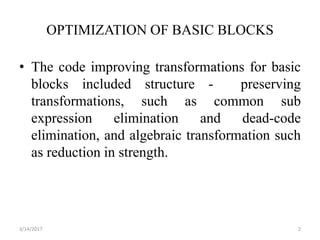
• The code improving transformations for basic
blocks included structure - preserving
transformations, such as common sub
expression elimination and dead-code
elimination, and algebraic transformation such
as reduction in strength.
3/14/2017 2
Cont …
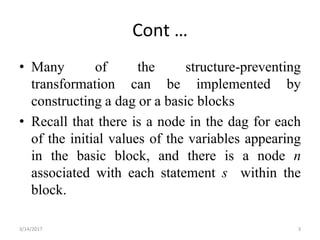
• Many of the structure-preventing
transformation can be implemented by
constructing a dag or a basic blocks
• Recall that there is a node in the dag for each
of the initial values of the variables appearing
in the basic block, and there is a node n
associated with each statement s within the
block.
3/14/2017 3
Cont …
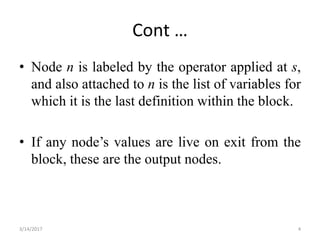
• Node n is labeled by the operator applied at s,
and also attached to n is the list of variables for
which it is the last definition within the block.
• If any node’s values are live on exit from the
block, these are the output nodes.
3/14/2017 4
Cont …
• Common sub expressions can be detected by
noticing, as a new node m is about to a added,
whether there is an existing node n with the
same children, in the same order, and with the
same operator. If so, n computes the same
value as m and may be used in its place.
3/14/2017 5
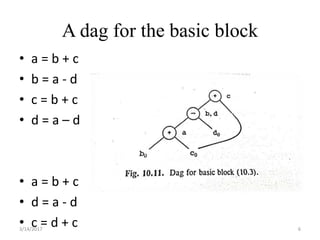
A dag for the basic block
• a = b + c
• b = a - d
• c = b + c
• d = a – d
• a = b + c
• d = a - d
• c = d + c3/14/2017 6
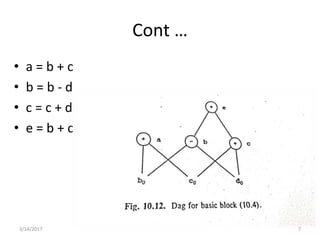
Cont …
• a = b + c
• b = b - d
• c = c + d
• e = b + c
3/14/2017 7
The Use of Algebraic Identities
• Algebraic identities another important class of
optimization on basic blocks.
• The simple algebraic transformations that one
might try during optimization.
• For examples apply arithmetic identities, such
as
• x + 0 = 0 + x = x
• x – 0 = x
• x * 1 = 1 * x = x
• x / 1 =x
3/14/2017 8
Cont …
• Another class of algebraic optimization
includes reduction in strength, that is,
replacing a more expensive operator by a
cheaper one as in
• x * * 2 = x * x
• 2.0 * x = x + x
• x / 2 = x * 0.5
3/14/2017 9
Cont …
• Evaluate constant expressions at compile time
and replace the constant expressions by their
values.
– 2*3.14 => 6.28
• The dag-construction process can help us
apply these and other more general algebraic
transformations such as commutative and
associative
3/14/2017 10
Cont …
• For example, suppose * is commutative ; that
is, x * y = y * x.
• Before create a new node labeled * with left
child m and right child n, check whether such
a node already exists, then check for a node
having operator *, let child n and right child m.
3/14/2017 11
Cont …
• The relational operators <=, >=, <, >, =, and !=
sometimes generate unexpected common sub
expressions.
• For example
• X – y and x > y
3/14/2017 12
Cont …
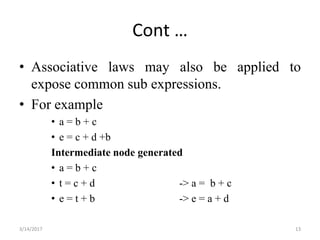
• Associative laws may also be applied to
expose common sub expressions.
• For example
• a = b + c
• e = c + d +b
Intermediate node generated
• a = b + c
• t = c + d -> a = b + c
• e = t + b -> e = a + d
3/14/2017 13
Cont …
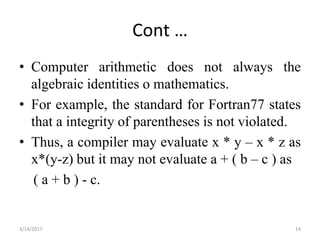
• Computer arithmetic does not always the
algebraic identities o mathematics.
• For example, the standard for Fortran77 states
that a integrity of parentheses is not violated.
• Thus, a compiler may evaluate x * y – x * z as
x*(y-z) but it may not evaluate a + ( b – c ) as
( a + b ) - c.
3/14/2017 14

Optimization of basic blocks

  • 1.
    OPTIMIZATION OF BASIC BLOCKS ISHWARYALAKSHMI.TK BP150516 3/14/2017 1
  • 2.
    OPTIMIZATION OF BASICBLOCKS • The code improving transformations for basic blocks included structure - preserving transformations, such as common sub expression elimination and dead-code elimination, and algebraic transformation such as reduction in strength. 3/14/2017 2
  • 3.
    Cont … • Manyof the structure-preventing transformation can be implemented by constructing a dag or a basic blocks • Recall that there is a node in the dag for each of the initial values of the variables appearing in the basic block, and there is a node n associated with each statement s within the block. 3/14/2017 3
  • 4.
    Cont … • Noden is labeled by the operator applied at s, and also attached to n is the list of variables for which it is the last definition within the block. • If any node’s values are live on exit from the block, these are the output nodes. 3/14/2017 4
  • 5.
    Cont … • Commonsub expressions can be detected by noticing, as a new node m is about to a added, whether there is an existing node n with the same children, in the same order, and with the same operator. If so, n computes the same value as m and may be used in its place. 3/14/2017 5
  • 6.
    A dag forthe basic block • a = b + c • b = a - d • c = b + c • d = a – d • a = b + c • d = a - d • c = d + c3/14/2017 6
  • 7.
    Cont … • a= b + c • b = b - d • c = c + d • e = b + c 3/14/2017 7
  • 8.
    The Use ofAlgebraic Identities • Algebraic identities another important class of optimization on basic blocks. • The simple algebraic transformations that one might try during optimization. • For examples apply arithmetic identities, such as • x + 0 = 0 + x = x • x – 0 = x • x * 1 = 1 * x = x • x / 1 =x 3/14/2017 8
  • 9.
    Cont … • Anotherclass of algebraic optimization includes reduction in strength, that is, replacing a more expensive operator by a cheaper one as in • x * * 2 = x * x • 2.0 * x = x + x • x / 2 = x * 0.5 3/14/2017 9
  • 10.
    Cont … • Evaluateconstant expressions at compile time and replace the constant expressions by their values. – 2*3.14 => 6.28 • The dag-construction process can help us apply these and other more general algebraic transformations such as commutative and associative 3/14/2017 10
  • 11.
    Cont … • Forexample, suppose * is commutative ; that is, x * y = y * x. • Before create a new node labeled * with left child m and right child n, check whether such a node already exists, then check for a node having operator *, let child n and right child m. 3/14/2017 11
  • 12.
    Cont … • Therelational operators <=, >=, <, >, =, and != sometimes generate unexpected common sub expressions. • For example • X – y and x > y 3/14/2017 12
  • 13.
    Cont … • Associativelaws may also be applied to expose common sub expressions. • For example • a = b + c • e = c + d +b Intermediate node generated • a = b + c • t = c + d -> a = b + c • e = t + b -> e = a + d 3/14/2017 13
  • 14.
    Cont … • Computerarithmetic does not always the algebraic identities o mathematics. • For example, the standard for Fortran77 states that a integrity of parentheses is not violated. • Thus, a compiler may evaluate x * y – x * z as x*(y-z) but it may not evaluate a + ( b – c ) as ( a + b ) - c. 3/14/2017 14