PSG COLLEGE OF TECHNOLOGY
Department of Electrical & Electronics Engineering
19E404- Induction and Synchronous Machine
Prepared by
Dr C.Maheswari,
AP/EEE, PSGCT
Syllabus – 19E404
 THREE PHASE INDUCTION MOTOR: Types - Construction –- MMF in Distributed
AC Windings – Rotating Magnetic Field - Principle of Operation – Torque equation -
Slip-Torque Characteristics – Equivalent Circuit – Phasor Diagram – Losses and
efficiency.
 PERFORMANCE AND CONTROL OF 3-PHASE INDUCTION MOTOR: No-Load
and Blocked Rotor Tests – Performance prediction by Circle Diagram - Starters –
Cogging and Crawling – Speed Control – Braking – Principle of Induction Generators.
(9)
 SINGLE PHASE INDUCTION MOTOR: Construction - Principle of Operation –
Double Revolving Field Theory – Equivalent Circuit – Methods of Starting – Types –
split phase, Capacitor type , Shaded pole and Universal Motor . (8)
 SYNCHRONOUS GENERATOR: Construction – types - Winding Factors – EMF
Equation – Armature Reaction - Voltage Regulation; EMF, MMF, and ZPF Methods –
Parallel Operations – Synchronization - Synchronizing power – Two reaction theory –
slip test - Phasor Diagrams – Voltage Regulation (10)
 SYNCHRONOUS MOTOR: Principle of Operation – Methods of Starting - Phasor
Diagrams – Power Flow Equations – Effect of Varying load angle and excitation – V
and Inverted V Curves – Synchronous Condenser - Hunting and Suppression
Techniques. (9)
Three Phase Induction Motor
 Working Principle:
Faraday’s Law of mutual induction.
In DC motor, the power is directly conducted to the armature
through brushes and commutator.
Hence DC motor is called as conduction motor.
In AC motor, the rotor does not receive any electric power by
conduction but by induction.
AC motor is called as Induction motor.
It is also called as rotating transformer.
Types
There are Two types of three phase Induction motor
 Squirrel Cage Induction Motor
 Slip ring Induction Motor
Three Phase Induction Motor
 The three-phase AC induction motor is a rotating electric machine
that is designed to operate on a three-phase supply.
 This 3 phase motor is also called as an asynchronous motor.
 The three phase induction motor is the most widely used
electrical motor. Almost 80% of the mechanical power used by
industries is provided by three phase induction motors because of
 Its simple construction,
 Low cost,
 Good operating characteristics,
 Absence of commutator and good speed regulation.
Contd…
 In three phase induction motor, the power is transferred from
stator to rotor winding through induction.
 The induction motor is also called a asynchronous motor as it
runs at a speed other than the synchronous speed.
Construction:
 A 3 phase induction motor is constructed from two main parts
namely the rotor and stator:
 Stator: As its name indicates stator is a stationary part of
induction motor. A stator winding is placed in the stator of
induction motor and the three phase supply is given to it.
 Rotor: The rotor is a rotating part of induction motor. The rotor is
connected to the mechanical load through the shaft.
The rotor of the three phase induction motor are further classified as
 Squirrel cage rotor
 Slip ring rotor or wound rotor or phase wound rotor.
The other parts of a 3 phase induction motor are:
 Shaft
 Bearing
 Fan
 Terminal box
Stator
The stator of the three-phase induction motor consists of three main
parts :
1. Stator frame,
2. Stator core,
3. Stator winding or field winding.
 Stator Frame
It is the outer part of the three phase induction motor. Its main
function is to support the stator core and the field winding. It acts as
a covering, and it provides protection and mechanical strength to all
the inner parts of the induction motor.
Contd…
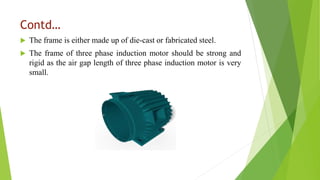
 The frame is either made up of die-cast or fabricated steel.
 The frame of three phase induction motor should be strong and
rigid as the air gap length of three phase induction motor is very
small.
Contd…
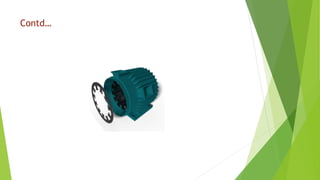
 Stator Core
 The main function of the stator core is to carry the alternating
flux.
 In order to reduce the eddy current loss, the stator core is
laminated.
 These laminated types of structure are made up of stamping
which is about 0.4 to 0.5 mm thick.
 All the stamping are stamped together to form stator core, which
is then housed in stator frame.
 The stamping is made up of silicon steel, which helps to reduce
the hysteresis loss occurring in the motor.
Contd…
Contd…
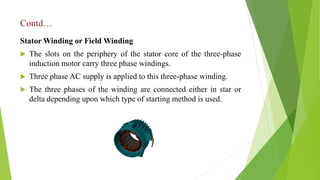
Stator Winding or Field Winding
 The slots on the periphery of the stator core of the three-phase
induction motor carry three phase windings.
 Three phase AC supply is applied to this three-phase winding.
 The three phases of the winding are connected either in star or
delta depending upon which type of starting method is used.
Rotor
Squirrel Cage Induction Motor
 The rotor of the squirrel cage three phase induction motor is
cylindrical and have slots on its periphery.
 The squirrel cage rotor consists of aluminum, brass or copper
bars.
 These aluminum, brass or copper bars are called rotor conductors
and are placed in the slots on the periphery of the rotor.
 The rotor conductors are permanently shorted by the copper, or
aluminum rings called the end rings.
Contd…
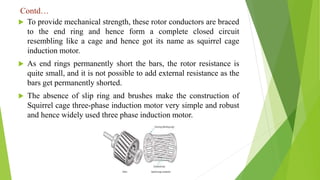
 To provide mechanical strength, these rotor conductors are braced
to the end ring and hence form a complete closed circuit
resembling like a cage and hence got its name as squirrel cage
induction motor.
 As end rings permanently short the bars, the rotor resistance is
quite small, and it is not possible to add external resistance as the
bars get permanently shorted.
 The absence of slip ring and brushes make the construction of
Squirrel cage three-phase induction motor very simple and robust
and hence widely used three phase induction motor.
Contd…
Advantages of Squirrel Cage Induction Rotor
 Its construction is very simple and rugged.
 As there are no brushes and slip ring, these motors requires less
maintenance.
Slip Ring or Wound Rotor Three Phase Induction Motor
 In this type of three phase induction motor the rotor is wound for
the same number of poles as that of the stator, but it has less
number of slots and has fewer turns per phase of a heavier
conductor.
 The rotor also carries star or delta winding similar to that of the
stator winding.
Contd…
 The rotor consists of numbers of slots and rotor winding are
placed inside these slots. The three end terminals are connected
together to form a star connection.
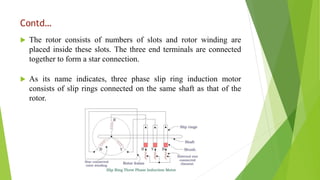
 As its name indicates, three phase slip ring induction motor
consists of slip rings connected on the same shaft as that of the
rotor.
Contd…
 The three ends of three-phase windings are permanently
connected to these slip rings.
 The external resistance can be easily connected through the
brushes and slip rings and hence used for speed controlling and
improving the starting torque of three phase induction motor.
 Due to the presence of slip rings and brushes the rotor
construction becomes somewhat complicated therefore it is less
used as compare to squirrel cage induction motor.
Advantages of Slip Ring Induction Motor
 It has high starting torque and low starting current.
 Possibility of adding additional resistance to control speed.
Working principle of three phase I/M:
 The stator of the motor consists of overlapping winding offset by
an electrical angle of 120 degree.
 If the three phase supply is given to the primary winding, or the
stator to a 3 phase AC source, it establishes rotating magnetic
field which rotates at the synchronous speed.
 According to Faraday’s law an emf induced in any circuit is due
to the rate of change of magnetic flux linkage through the circuit.
 As the rotor winding in an induction motor are either closed
through an external resistance or directly shorted by end ring, and
cut the stator rotating magnetic field.
 An emf is induced in the rotor copper bar and due to this emf a
current flows through the rotor conductor.
Contd…
 Here the relative speed between the rotating flux and static rotor
conductor is the cause of current generation; hence as per Lenz’s law,
the rotor will rotate in the same direction to reduce the cause, i.e., the
relative velocity.
 Thus from the working principle of three phase induction motor, it may
be observed that the rotor speed should not reach the synchronous
speed produced by the stator.
 If the speeds become equal, there would be no such relative speed, so
no emf induced in the rotor, and no current would be flowing, and
therefore no torque would be generated.
 Consequently, the rotor cannot reach the synchronous speed. The
difference between the stator (synchronous speed) and rotor speeds is
called the slip.
 The rotation of the magnetic field in an induction motor has the
advantage that no electrical connections need to be made to the rotor.
Slip
 In Induction Motor, a slip is a speed among the rotary magnetic
flux as well as rotor expressed in terms of for every unit
synchronous speed. It can be measured in dimensionless & the
value of this motor cannot be zero.
 The main disparity between the synchronous & actual speed is
known as the SLIP.
 The slip value is equal to ‘1’ as the rotor in the motor is at rest &
it will not equivalent to ‘0’. So while operating the motor, the
synchronous speed is not equivalent to ‘N’ i.e, actual speed in a
given time.
 If the revolving magnetic flux’s synchronous speed & the speed
of rotor are Ns & Nr in the motor, then the speed among them can
be equivalent to (Ns – Nr). So, slip can be determined as
S = (Ns – Nr) / Ns
 Here, both the rotor’s speed and synchronous speed are not
equivalent (Nr < Ns) and the slip value is constantly < 1. So for
this motor, it will be like (0<s<1).
Importance of Slip in an Induction Motor:
When the Value of Slip is ‘0’
 If the slip value is ‘0’ then the speed of the rotor is equivalent to
revolving magnetic flux.
 So there is no motion among the coils of the rotor as well as
revolving magnetic flux. So, there is no flux cutting act in the
rotor coils.
 Therefore, emf will not be generated within rotor coils for
generating rotor current. So this motor will not work. So, it
essential to have a positive slip value in this motor and due to this
reason, the slip will never become ‘0’ in an induction motor.
When the Value of Slip is ‘1’
If the slip value is ‘1’ then the rotor in the motor will be stationary
When the Value of Slip is ‘-1’
 If the slip value is ‘-1’ then the speed of the rotor in the motor is
more comparable with the synchronously revolving magnetic
flux.
 This is only possible when the rotor is turned in the direction of
revolving magnetic flux by some prime mover. In this condition,
the motor operates as an induction generator.
When the Value of Slip is >1
 If the slip value of the motor is greater than one then the rotor will
turn in the opposite direction to the revolution of magnetic flux.
So if the magnetic flux is revolving in the direction of clockwise,
then the rotor will turn rotating in the anti-clockwise direction.
 So, the speed among them will be like (Ns + Nr). In braking or
Plugging of this motor, the slip is greater than ‘1’ is attained to
rapidly bring the rotor of the motor at rest.
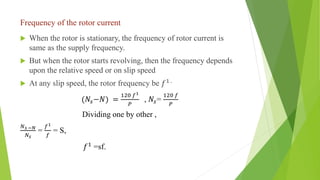
Frequency of the rotor current
 When the rotor is stationary, the frequency of rotor current is
same as the supply frequency.
 But when the rotor starts revolving, then the frequency depends
upon the relative speed or on slip speed
 At any slip speed, the rotor frequency be 𝑓1 .
(𝑁𝑠−𝑁) =
120 𝑓1
𝑃
, 𝑁𝑠=
120 𝑓
𝑃
Dividing one by other ,
𝑁𝑠 −𝑁
𝑁𝑠
=
𝑓1
𝑓
= S,
𝑓1 =sf.
Tutorial
1. If the synchronous speed of the motor is 1250 and the actual speed is
1300 then please find the slip in the motor?
2. A 4 pole 3 phase induction motor operates from a supply whose
frequency is 50 Hz, Calculate
a) The speed at which the magnetic field of the stator is rotating.
b) the speed of the rotor when the slip is 0.04.
c) the frequency of the rotor current when the slip is 0.03
d) frequency of the rotor current at standstill.
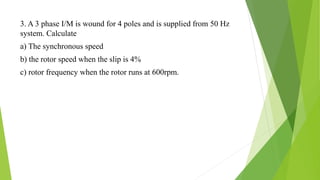
3. A 3 phase I/M is wound for 4 poles and is supplied from 50 Hz
system. Calculate
a) The synchronous speed
b) the rotor speed when the slip is 4%
c) rotor frequency when the rotor runs at 600rpm.
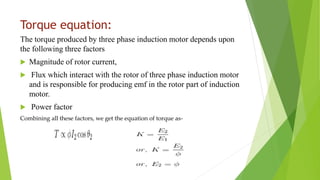
Torque equation:
The torque produced by three phase induction motor depends upon
the following three factors
 Magnitude of rotor current,
 Flux which interact with the rotor of three phase induction motor
and is responsible for producing emf in the rotor part of induction
motor.
 Power factor
Combining all these factors, we get the equation of torque as-
Contd..
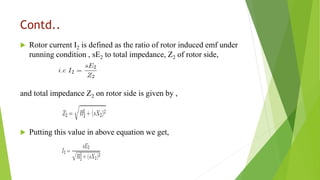
 Rotor current I2 is defined as the ratio of rotor induced emf under
running condition , sE2 to total impedance, Z2 of rotor side,
and total impedance Z2 on rotor side is given by ,
 Putting this value in above equation we get,
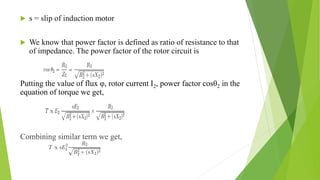
 s = slip of induction motor
 We know that power factor is defined as ratio of resistance to that
of impedance. The power factor of the rotor circuit is
Putting the value of flux φ, rotor current I2, power factor cosθ2 in the
equation of torque we get,
Combining similar term we get,
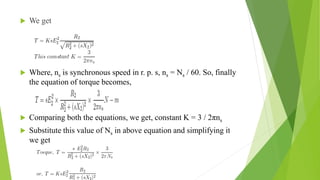
 We get
 Where, ns is synchronous speed in r. p. s, ns = Ns / 60. So, finally
the equation of torque becomes,
 Comparing both the equations, we get, constant K = 3 / 2πns
 Substitute this value of Ns in above equation and simplifying it
we get
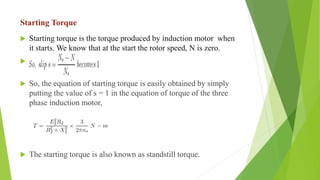
Starting Torque
 Starting torque is the torque produced by induction motor when
it starts. We know that at the start the rotor speed, N is zero.

 So, the equation of starting torque is easily obtained by simply
putting the value of s = 1 in the equation of torque of the three
phase induction motor,
 The starting torque is also known as standstill torque.
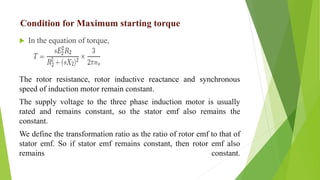
Condition for Maximum starting torque
 In the equation of torque,
The rotor resistance, rotor inductive reactance and synchronous
speed of induction motor remain constant.
The supply voltage to the three phase induction motor is usually
rated and remains constant, so the stator emf also remains the
constant.
We define the transformation ratio as the ratio of rotor emf to that of
stator emf. So if stator emf remains constant, then rotor emf also
remains constant.
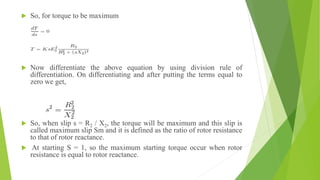
 So, for torque to be maximum
 Now differentiate the above equation by using division rule of
differentiation. On differentiating and after putting the terms equal to
zero we get,
 So, when slip s = R2 / X2, the torque will be maximum and this slip is
called maximum slip Sm and it is defined as the ratio of rotor resistance
to that of rotor reactance.
 At starting S = 1, so the maximum starting torque occur when rotor
resistance is equal to rotor reactance.
??????- 18.1.2021
 Peter's father has five sons. The names of four sons are Fefe, Fifi, Fafa and
Fufu respectively. What is the name of the fifth son?
Torque- Slip Characteristics
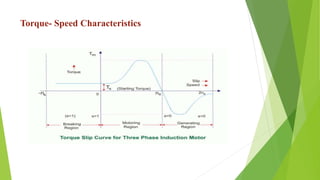
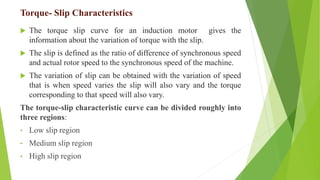
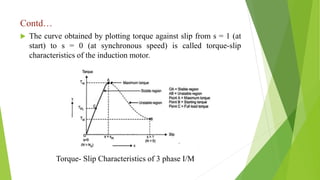
 The torque slip curve for an induction motor gives the
information about the variation of torque with the slip.
 The slip is defined as the ratio of difference of synchronous speed
and actual rotor speed to the synchronous speed of the machine.
 The variation of slip can be obtained with the variation of speed
that is when speed varies the slip will also vary and the torque
corresponding to that speed will also vary.
The torque-slip characteristic curve can be divided roughly into
three regions:
• Low slip region
• Medium slip region
• High slip region
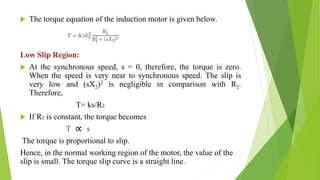
 The torque equation of the induction motor is given below.
Low Slip Region:
 At the synchronous speed, s = 0, therefore, the torque is zero.
When the speed is very near to synchronous speed. The slip is
very low and (sX2)2 is negligible in comparison with R2.
Therefore,
T= ks/R2
 If R2 is constant, the torque becomes
T s
The torque is proportional to slip.
Hence, in the normal working region of the motor, the value of the
slip is small. The torque slip curve is a straight line.
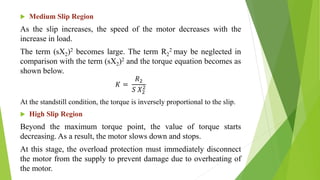
 Medium Slip Region
As the slip increases, the speed of the motor decreases with the
increase in load.
The term (sX2)2 becomes large. The term R2
2 may be neglected in
comparison with the term (sX2)2 and the torque equation becomes as
shown below.
𝐾 =
𝑅2
𝑆 𝑋2
2
At the standstill condition, the torque is inversely proportional to the slip.
 High Slip Region
Beyond the maximum torque point, the value of torque starts
decreasing. As a result, the motor slows down and stops.
At this stage, the overload protection must immediately disconnect
the motor from the supply to prevent damage due to overheating of
the motor.
Contd…
 The curve obtained by plotting torque against slip from s = 1 (at
start) to s = 0 (at synchronous speed) is called torque-slip
characteristics of the induction motor.
Torque- Slip Characteristics of 3 phase I/M
Torque- Speed Characteristics
Equivalent Circuit of three phase I/M
 The rotor phase current is given by,
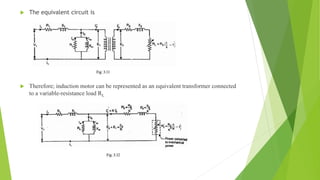
 The equivalent circuit of a transformer with secondary load equal
to R2.
 The rotor e.m.f. in the equivalent circuit now depends only on the
transformation ratio
K (= E2/E1).
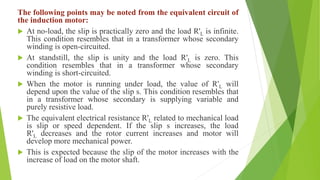
 The equivalent circuit is
 Therefore; induction motor can be represented as an equivalent transformer connected
to a variable-resistance load RL
The following points may be noted from the equivalent circuit of
the induction motor:
 At no-load, the slip is practically zero and the load R'L is infinite.
This condition resembles that in a transformer whose secondary
winding is open-circuited.
 At standstill, the slip is unity and the load R'L is zero. This
condition resembles that in a transformer whose secondary
winding is short-circuited.
 When the motor is running under load, the value of R'L will
depend upon the value of the slip s. This condition resembles that
in a transformer whose secondary is supplying variable and
purely resistive load.
 The equivalent electrical resistance R'L related to mechanical load
is slip or speed dependent. If the slip s increases, the load
R'L decreases and the rotor current increases and motor will
develop more mechanical power.
 This is expected because the slip of the motor increases with the
increase of load on the motor shaft.
Losses in a three phase Induction Motor
 There are two types of losses occur in three phase induction
motor These losses are,
1. Constant or fixed losses,
2. Variable losses.
Constant or Fixed Losses:
Constant losses are those losses which are considered to remain
constant over normal working range of induction motor.
The fixed losses can be easily obtained by performing no-load test
on the three phase induction motor. These losses are further
classified as-
1. Iron or core losses,
2. Mechanical losses,
3. Brush friction losses.
 Iron or Core Losses
Iron or core losses are further divided into
1. Hysteresis and
2. Eddy current losses
Eddy current losses are minimized by using lamination on core and
Hysteresis losses are minimized by using high grade silicon steel.
 Mechanical and Brush Friction Losses
Mechanical losses occur at the bearing and brush friction loss occurs
in wound rotor induction motor.
These losses are zero at start and with increase in speed these losses
increases.
In three phase induction motor the speed usually remains constant.
Hence these losses almost remains constant.
????
 1. A construction worker fell off a 100-foot ladder but didn't die. How is
that possible?
 2. What building has the most stories?
Variable Losses:
 These losses are also called copper losses.
 These losses occur due to current flowing in stator and rotor
windings.
 As the load changes, the current flowing in rotor and stator
winding also changes and hence these losses also changes.
Therefore these losses are called variable losses.
 The main function of induction motor is to convert an electrical
power into mechanical power.
 During this conversion of electrical energy into mechanical
energy the power flows through different stages.
 The input to the three phase induction motor is three phase
supply. So, the three phase supply is given to the stator of
three phase induction motor.
Let, Pin = electrical power supplied to the stator of three phase
induction motor,
VL = line voltage supplied to the stator of three phase induction
motor,
IL = line current,
Cosφ = power factor of the three phase induction motor.
A part of this power input is used to supply stator losses
which are stator iron loss and stator copper loss.
The remaining power i.e (input electrical power – stator
losses) are supplied to rotor as rotor input.
power input to the stator, Pin = √3VLILcosφ
So, rotor input P2 = Pin – stator losses (stator copper loss and
stator iron loss).
 Now, the rotor has to convert this rotor input into mechanical
energy but this complete input cannot be converted into
mechanical output as it has to supply rotor losses.
 The iron loss depends upon the rotor frequency, which is very
small when the rotor rotates, so it is usually neglected. So, the
rotor has only rotor copper loss.
 Therefore the rotor input has to supply these rotor copper losses.
After supplying the rotor copper losses, the remaining part of
Rotor input, P2 is converted into mechanical power, Pm.
 Let Pc be the rotor copper loss, I2 be the rotor current under
running condition, R2 is the rotor resistance, Pm is the gross
mechanical power developed.
 Pc=3I2
2R2
Pm = P2 – Pc
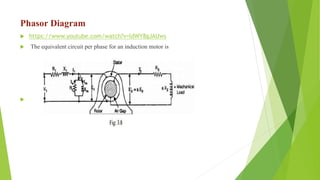
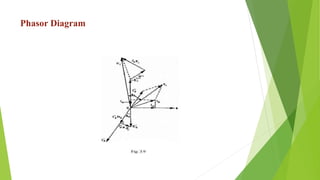
Phasor Diagram
 https://www.youtube.com/watch?v=ldWY8gJAUws
 The equivalent circuit per phase for an induction motor is

Phasor Diagram
PERFORMANCE AND CONTROL OF 3-PHASE
INDUCTION MOTOR
No load and Blocked Rotor Test:
 Indirect Method
 The efficiency of small motors can be determined by
directly loading them and by measuring the input and output
powers.
 The power loss will be large if we directly test the load.
 Therefore indirect methods are used to determine the efficiency
of 3-phase induction motors.
The following test on the motor is used to find the efficiency:
 No-Load test.
 Blocked-rotor test.
No load test:
 The no-load test of an induction motor is similar to the open-
circuit test of a transformer.
 The motor is not connected from its load, and the rated voltage at
the rated frequency is applied to the stator to run the motor
without a load.
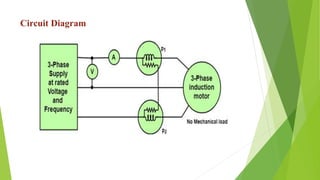
 The 2-wattmeter method measures the input power of the system.
 The voltmeter measures the standard-rated supply voltage and an
ammeter measures the no-load current.
 Since the motor is running at no-load, total power is equal to the
constant iron loss, friction and winding losses of the motor.
 Pconstant = Pi = P1 + P2 = Sum of the two wattmeter readings.
Circuit Diagram
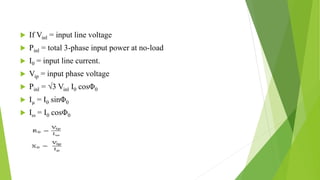
 If Vinl = input line voltage
 Pinl = total 3-phase input power at no-load
 I0 = input line current.
 Vip = input phase voltage
 Pinl = √3 Vinl I0 cosΦ0
 Iµ = I0 sinΦ0
 Iω = I0 cosΦ0
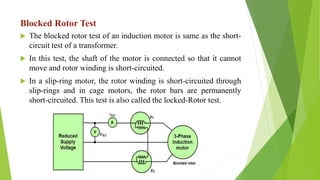
Blocked Rotor Test
 The blocked rotor test of an induction motor is same as the short-
circuit test of a transformer.
 In this test, the shaft of the motor is connected so that it cannot
move and rotor winding is short-circuited.
 In a slip-ring motor, the rotor winding is short-circuited through
slip-rings and in cage motors, the rotor bars are permanently
short-circuited. This test is also called the locked-Rotor test.
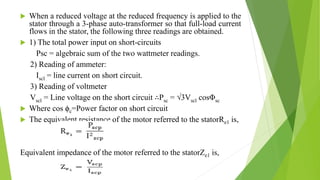
 When a reduced voltage at the reduced frequency is applied to the
stator through a 3-phase auto-transformer so that full-load current
flows in the stator, the following three readings are obtained.
 1) The total power input on short-circuits
Psc = algebraic sum of the two wattmeter readings.
2) Reading of ammeter:
Iscl = line current on short circuit.
3) Reading of voltmeter
Vscl = Line voltage on the short circuit ∴Psc = √3Vscl cosΦsc
 Where cos ϕc=Power factor on short circuit
 The equivalent resistance of the motor referred to the statorRe1 is,
Equivalent impedance of the motor referred to the statorZe1 is,
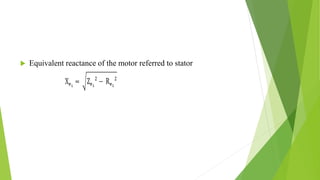
 Equivalent reactance of the motor referred to stator
Starting Methods– 27.01.2021
 A three phase Induction Motor is Self Starting.
 When the supply is connected to the stator of a three-phase
induction motor, a rotating magnetic field is produced, and the
rotor starts rotating and the induction motor starts.
 At the time of starting, the motor slip is unity, and the starting
current is very large.
 The purpose of a starter is not to just start the motor, but it
performs the two main functions. They are as follows.
• To reduce the heavy starting current
• To provide overload and under voltage protection.
 The three phase induction motor may be started by connecting the
motor directly to the full voltage of the supply. The motor can also be
started by applying a reduced voltage to the motor when the motor is
started.
 The torque of the induction motor is proportional to the square of the
applied voltage. Thus, a greater torque is exerted by a motor when it
is started on full voltage than when it is started on the reduced
voltage.
Various starting methods of induction motors are
1. Direct-On-Line (DOL) Starter- (for both squirrel cage and slip ring
induction motor
2. By using primary resistors
3.Autotransformer
4. Star-delta switches
5. Rotor Resistance starter
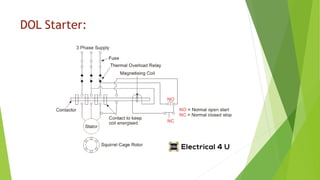
DOL Starter:
 Small three phase induction motors can be started direct-on-line, which means
that the rated supply is directly applied to the motor.
 Induction motors can be started directly on-line using a DOL starter which
generally consists of a contactor and a motor protection equipment such as a
circuit breaker.
 A DOL starter consists of a coil operated contactor which can be controlled by
start and stop push buttons.
 When the start push button is pressed, the contactor gets energized and it closes
all the three phases of the motor to the supply phases at a time.
 The stop push button de-energizes the contactor and disconnects all the three
phases to stop the motor.
 In order to avoid excessive voltage drop in the supply line due to large starting
current, a DOL starter is generally used for motors that are rated below 5kW.
DOL Starter:
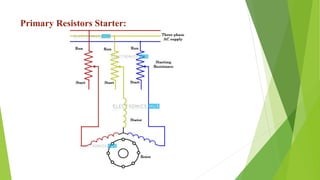
Primary Resistors Starter:
 Used for starting the Squirrel cage Induction Motor
 The purpose of primary resistors is to drop some voltage and
apply a reduced voltage to the stator
 Consider, the starting voltage is reduced by 50%. the starting
current will also be reduced by the same percentage.
 From the torque equation of a three phase induction motor, the
starting torque is approximately proportional to the square of the
applied voltage.
 That means, if the applied voltage is 50% of the rated value, the
starting torque will be only 25% of its normal voltage value.
 This method is generally used for a smooth starting of small
induction motors.
 When the motor reaches an appropriate speed, the resistances are
disconnected from the circuit and the stator phases are directly
connected to the supply lines.
Auto-Transformers:
 Auto-transformers are also known as auto-starters.
 They can be used for both star connected or delta
connected squirrel cage motors.
 It is basically a three phase step down transformer with different
taps provided that permit the user to start the motor at, say, 50%,
65% or 80% of line voltage.
 With auto-transformer starting, the current drawn from supply
line is always less than the motor current by an amount equal to
the transformation ratio.
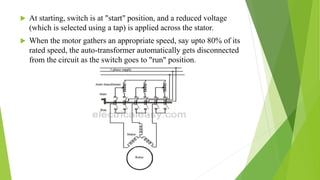
 At starting, switch is at "start" position, and a reduced voltage
(which is selected using a tap) is applied across the stator.
 When the motor gathers an appropriate speed, say upto 80% of its
rated speed, the auto-transformer automatically gets disconnected
from the circuit as the switch goes to "run" position.
Star- Delta Starter
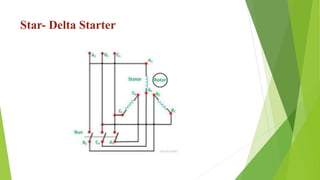
Star-Delta Starter:
 This method is used in the motors, which are designed to run on
delta connected stator.
 A two way switch is used to connect the stator winding in star
while starting and in delta while running at normal speed.
 When the stator winding is star connected, voltage over each
phase in motor will be reduced by a factor 1/(sqrt. 3) of that
would be for delta connected winding. The starting torque will
1/3 times that it will be for delta connected winding.
 Hence a star-delta starter is equivalent to an auto-transformer of
ratio 1/(sqrt. 3) or 58% reduced voltage.
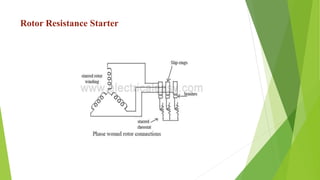
Rotor Resistance Starter
 Slip-ring motors are started with full line voltage, as external
resistance can be easily added in the rotor circuit with the help of
slip-rings.
 A star connected rheostat is connected in series with the rotor via
slip-rings as shown in the fig. Introducing resistance in rotor
current will decrease the starting current in rotor (and, hence, in
stator).
 Also, it improves power factor and the torque is increased. The
connected rheostat may be hand-operated or automatic.
 As, introduction of additional resistance in rotor improves the
starting torque, slip-ring motors can be started on load.
 The external resistance introduced is only for starting purposes,
and is gradually cut out as the motor gathers the speed.
Rotor Resistance Starter
Cogging and Crawling
Cogging:
 The phenomenon of Magnetic Locking between the stator and the
rotor teeth is called Cogging or Teeth Locking.
 Even after applying full voltage to the stator winding, the rotor of
a 3 phase induction motor fails to start.
 This condition arises when the number of stator and rotor slots
are either equal or have an integral ratio, strong alignment forces
is produced between the stator and the rotor.
 As a result of these forces an alignment torque greater than the
accelerating torque with consequent failure of the motor to start.
 Thus, a locking is created between the stator and rotor teeth. This
condition is known as Cogging or Magnetic locking.
 When the stator and the rotor teeth faces each other, the
reluctance of the magnetic path is minimum.
 Under this minimum reluctance path condition, magnetic locking
takes place between the stator and the rotor teeth.
 In order to reduce or eliminate the process of Cogging, the
number of stator slots are never made equal to the rotor or have
an integral ratio.
 It can also be reduced by using the skewed rotor.
 Cogging and Crawling are less eminent in wound rotor motors
because of the higher starting torques.
Crawling
 Sometimes, squirrel cage induction motors exhibits a tendency to
run at very slow speeds (as low as one-seventh of their
synchronous speed).
 This phenomenon is called as crawling of an induction motor.
 This action is due to the fact that, flux wave produced by a stator
winding is not purely sine wave.
 Instead, it is a complex wave consisting a fundamental wave and
odd harmonics like 3rd, 5th, 7th etc.
 The fundamental wave revolves synchronously at synchronous
speed Ns whereas 3rd, 5th, 7th harmonics may rotate in forward
or backward direction at Ns/3, Ns/5, Ns/7 speeds respectively.
 Hence, harmonic torques are also developed in addition with
fundamental torque.
 3rd harmonics are absent in a balanced 3-phase system. Hence
3rd harmonics do not produce rotating field and torque.
The total motor torque now consist three components as:
(i) the fundamental torque with synchronous speed Ns,
(ii) 5th harmonic torque with synchronous speed Ns/5,
(iv) 7th harmonic torque with synchronous speed Ns/7 (provided
that higher harmonics are neglected).
Now, 5th harmonic currents will have phase difference of 5 X 120 =
600° =2 X 360 - 120 = -120°.
Hence the revolving speed set up will be in reverse direction with
speed Ns/5.
The small amount of 5th harmonic torque produces breaking action
and can be neglected.
 The 7th harmonic currents will have phase difference of 7 X 120
= 840° = 2 X 360 +120 = + 120°. Hence they will set up rotating
field in forward direction with synchronous speed equal to Ns/7.
 If we neglect all the higher harmonics, the resultant torque will
be equal to sum of fundamental torque and 7th harmonic torque.
 7th harmonic torque reaches its maximum positive value just
before1/7th of Ns. If the mechanical load on the shaft involves
constant load torque, the torque developed by the motor may fall
below this load torque.
 In this case, motor will not accelerate upto its normal speed, but it
will run at a speed which is nearly 1/7th of its normal speed. This
phenomenon is called as crawling in induction motor.
Speed Control of 3 phase Induction motor
A three phase induction motor is basically a constant speed motor so
it’s somewhat difficult to control its speed.
The speed control of induction motor is done at the cost of decrease
in efficiency and low electrical power factor.
The Speed of Induction Motor is changed from Both Stator and
Rotor Side. The speed control of three phase induction motor from
stator side are further classified as :
1. V / f control or frequency control.
2. Changing the number of stator poles.
3. Controlling supply voltage.
4. Adding rheostat in the stator circuit.
1. V / f Control or Frequency Control
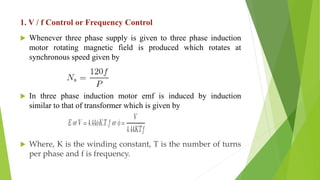
 Whenever three phase supply is given to three phase induction
motor rotating magnetic field is produced which rotates at
synchronous speed given by
 In three phase induction motor emf is induced by induction
similar to that of transformer which is given by
 Where, K is the winding constant, T is the number of turns
per phase and f is frequency.
 Now if we change frequency, synchronous speed changes but
with decrease in frequency flux will increase and this change in
value of flux causes saturation of rotor and stator cores which will
further cause increase in no load current of the motor.
 So, it is important to maintain flux , φ constant and it is only
possible if we change voltage.
 i.e if we decrease frequency, flux increases but at the same time
if we decrease voltage flux will also decease causing no change in
flux and hence it remains constant.
 So, here we are keeping the ratio of V/f as constant.
 Hence its name is V/ f method. For controlling the speed of three
phase induction motor by V/f method we have to supply variable
voltage and frequency which is easily obtained by using converter
and inverter set.
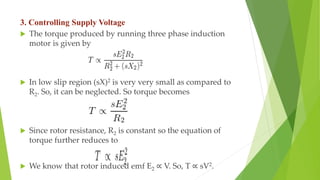
3. Controlling Supply Voltage
 The torque produced by running three phase induction
motor is given by
 In low slip region (sX)2 is very very small as compared to
R2. So, it can be neglected. So torque becomes
 Since rotor resistance, R2 is constant so the equation of
torque further reduces to
 We know that rotor induced emf E2 ∝ V. So, T ∝ sV2.
• The equation above clears that if we decrease supply voltage
torque will also decrease.
• But for supplying the same load, the torque must remain the
same, and it is only possible if we increase the slip and if the slip
increases the motor will run at a reduced speed.
This method is the easiest and cheapest, still rarely used, because
 Large change in supply voltage is required for relatively small
change in speed.
 Large change in supply voltage will result in a large change in
flux density, hence, this will disturb the magnetic conditions of
the motor.
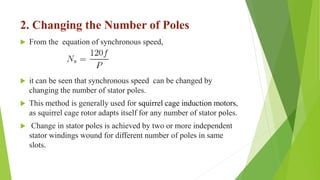
2. Changing the Number of Poles
 From the equation of synchronous speed,
 it can be seen that synchronous speed can be changed by
changing the number of stator poles.
 This method is generally used for squirrel cage induction motors,
as squirrel cage rotor adapts itself for any number of stator poles.
 Change in stator poles is achieved by two or more independent
stator windings wound for different number of poles in same
slots.
 For example, a stator is wound with two 3phase windings, one for
4 poles and other for 6 poles.
for supply frequency of 50 Hz
i) synchronous speed when 4 pole winding is connected,
Ns = 120*50/4 = 1500 RPM
ii) synchronous speed when 6 pole winding is connected,
Ns = 120*50/6 = 1000 RPM
4.Adding external resistance in the
stator side
 In this method of speed control of three phase induction motor
rheostat is added in the stator circuit due to this voltage gets
dropped .
 In case of three phase induction motor torque produced is given
by T ∝ sV2
2.
 If the supply voltage is decreased, torque will also decrease. But
for supplying the same load, the torque must remains the same
and it is only possible if slip is to be increased and if the slip
increases motor will run at reduced speed.
Speed Control From Rotor Side:
1.Rotor Rheostat Control:
 This method is similar to that of armature rheostat control of DC
shunt motor.
 But this method is only applicable to slip ring motors, as addition
of external resistance in the rotor of squirrel cage motors is not
possible.
Disadvantages
 The speed above the normal value is not possible.
 Large speed change requires a large value of resistance, and if
such large value of resistance is added in the circuit, it will cause
large copper loss and hence reduction in efficiency.
 Presence of resistance causes more losses.
 This method cannot be used for squirrel cage induction motor.
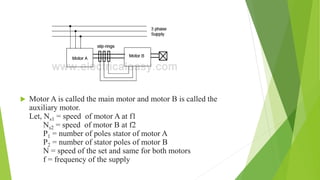
2. Cascade Operation:
 In this method of speed control, two motors are used. Both are
mounted on a same shaft so that both run at same speed.
 One motor is fed from a 3phase supply and the other motor is fed
from the induced emf in first motor via slip-rings.

 Motor A is called the main motor and motor B is called the
auxiliary motor.

Let, Ns1 = speed of motor A at f1
Ns2 = speed of motor B at f2
P1 = number of poles stator of motor A
P2 = number of stator poles of motor B
N = speed of the set and same for both motors
f = frequency of the supply
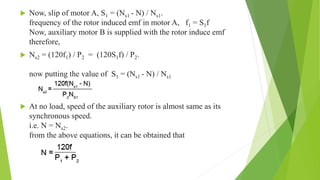
 Now, slip of motor A, S1 = (Ns1 - N) / Ns1.
frequency of the rotor induced emf in motor A, f1 = S1f
Now, auxiliary motor B is supplied with the rotor induce emf
therefore,
 Ns2 = (120f1) / P2 = (120S1f) / P2.
now putting the value of S1 = (Ns1 - N) / Ns1
 At no load, speed of the auxiliary rotor is almost same as its
synchronous speed.
i.e. N = Ns2.
from the above equations, it can be obtained that
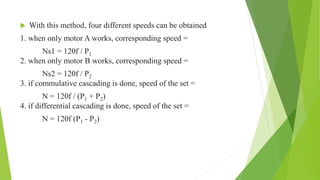
 With this method, four different speeds can be obtained
1. when only motor A works, corresponding speed =
Ns1 = 120f / P1
2. when only motor B works, corresponding speed =
Ns2 = 120f / P2
3. if commulative cascading is done, speed of the set =
N = 120f / (P1 + P2)
4. if differential cascading is done, speed of the set =
N = 120f (P1 - P2)
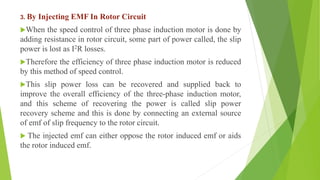
3. By Injecting EMF In Rotor Circuit
When the speed control of three phase induction motor is done by
adding resistance in rotor circuit, some part of power called, the slip
power is lost as I2R losses.
Therefore the efficiency of three phase induction motor is reduced
by this method of speed control.
This slip power loss can be recovered and supplied back to
improve the overall efficiency of the three-phase induction motor,
and this scheme of recovering the power is called slip power
recovery scheme and this is done by connecting an external source
of emf of slip frequency to the rotor circuit.
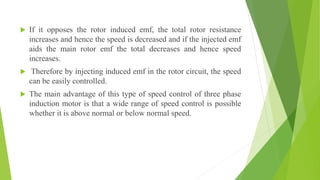
 The injected emf can either oppose the rotor induced emf or aids
the rotor induced emf.
 If it opposes the rotor induced emf, the total rotor resistance
increases and hence the speed is decreased and if the injected emf
aids the main rotor emf the total decreases and hence speed
increases.
 Therefore by injecting induced emf in the rotor circuit, the speed
can be easily controlled.
 The main advantage of this type of speed control of three phase
induction motor is that a wide range of speed control is possible
whether it is above normal or below normal speed.
Single phase Induction motor
 Single phase induction motors generally have a construction
similar to that of a three phase motor: an ac windings is placed on
the stator, short-circuited conductors are placed in a cylindrical
rotor.
 The significant difference is, of-course, that there is only a single
phase supply to the stator.
 The single-phase power system is used more widely than
three phase system for domestic purposes, commercial
purposes and some extent in industrial uses.
 Because, the single-phase system is more economical than
a three-phase system and the power requirement in most of
the houses, shops, offices are small, which can be easily met
by a single phase system.
 The single phase motors are simple in construction, cheap in cost,
reliable and easy to repair and maintain.
 Due to all these advantages, the single phase motor finds its
application in vacuum cleaners, fans, washing machines,
centrifugal pumps, blowers, washing machines, etc.
Construction of Single Phase Induction Motor
 Like any other electrical motor asynchronous motor also have
two main parts namely rotor and stator.
 Stator:
As its name indicates stator is a stationary part of induction
motor. A single phase AC supply is given to the stator of single
phase induction motor.
 Rotor:
The rotor is a rotating part of an induction motor. The rotor
connects the mechanical load through the shaft. The rotor in the
single-phase induction motor is of squirrel cage rotor type.
 The construction of single phase induction motor is almost
similar to the squirrel cage three-phase induction motor. But in
case of a single phase induction motor, the stator has two
windings instead of one three-phase winding in three phase
induction motor.
Working principle of single phase induction motor
 According to the Faraday’s law of electromagnetic induction, emf
gets induced in the rotor. As the rotor circuit is closed one so, the
current starts flowing in the rotor. This current is called the rotor
current.
 This rotor current produces its flux called rotor flux. Since this
flux is produced due to the induction principle so, the motor
working on this principle got its name as an induction motor.
 Now there are two fluxes one is main flux, and another is called
rotor flux.
 These two fluxes produce the desired torque which is required by
the motor to rotate.
Why Single Phase Induction Motor is not Self
Starting?
 According to double field revolving theory, we can resolve any
alternating quantity into two components.
 Each component has a magnitude equal to the half of the
maximum magnitude of the alternating quantity, and both these
components rotate in the opposite direction to each other.
 For example – a flux, φ can be resolved into two components
 Each of these components rotates in the opposite direction
i. e if one φm/2 is rotating in a clockwise direction then the
other φm / 2 rotates in an anticlockwise direction.
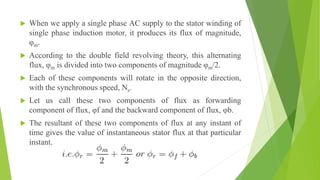
 When we apply a single phase AC supply to the stator winding of
single phase induction motor, it produces its flux of magnitude,
φm.
 According to the double field revolving theory, this alternating
flux, φm is divided into two components of magnitude φm/2.
 Each of these components will rotate in the opposite direction,
with the synchronous speed, Ns.
 Let us call these two components of flux as forwarding
component of flux, φf and the backward component of flux, φb.
 The resultant of these two components of flux at any instant of
time gives the value of instantaneous stator flux at that particular
instant.
 Now at starting condition, both the forward and backward
components of flux are exactly opposite to each other.
 Also, both of these components of flux are equal in magnitude.
So, they cancel each other and hence the net torque experienced
by the rotor at the starting condition is zero.
 So, the single phase induction motors are not self-starting
motors.
 https://www.electrical4u.com/single-phase-induction-motor/
 1. Who is the inventor of the ball-point pen?
 a) Laszlo Biro
b) Steve Jobs
c) Waterman Brothers
d) Wright Brothers
2. Which scientist discovered that some molecules have mirror images?
 a) Henry Moseley
b) Lord Kelvin
c) Robert Hooke
d) Louis Pasteur
Who is this?

Electrical machines I,DC Generator motor

  • 1.
    PSG COLLEGE OFTECHNOLOGY Department of Electrical & Electronics Engineering 19E404- Induction and Synchronous Machine Prepared by Dr C.Maheswari, AP/EEE, PSGCT
  • 2.
    Syllabus – 19E404 THREE PHASE INDUCTION MOTOR: Types - Construction –- MMF in Distributed AC Windings – Rotating Magnetic Field - Principle of Operation – Torque equation - Slip-Torque Characteristics – Equivalent Circuit – Phasor Diagram – Losses and efficiency.  PERFORMANCE AND CONTROL OF 3-PHASE INDUCTION MOTOR: No-Load and Blocked Rotor Tests – Performance prediction by Circle Diagram - Starters – Cogging and Crawling – Speed Control – Braking – Principle of Induction Generators. (9)  SINGLE PHASE INDUCTION MOTOR: Construction - Principle of Operation – Double Revolving Field Theory – Equivalent Circuit – Methods of Starting – Types – split phase, Capacitor type , Shaded pole and Universal Motor . (8)  SYNCHRONOUS GENERATOR: Construction – types - Winding Factors – EMF Equation – Armature Reaction - Voltage Regulation; EMF, MMF, and ZPF Methods – Parallel Operations – Synchronization - Synchronizing power – Two reaction theory – slip test - Phasor Diagrams – Voltage Regulation (10)  SYNCHRONOUS MOTOR: Principle of Operation – Methods of Starting - Phasor Diagrams – Power Flow Equations – Effect of Varying load angle and excitation – V and Inverted V Curves – Synchronous Condenser - Hunting and Suppression Techniques. (9)
  • 3.
    Three Phase InductionMotor  Working Principle: Faraday’s Law of mutual induction. In DC motor, the power is directly conducted to the armature through brushes and commutator. Hence DC motor is called as conduction motor. In AC motor, the rotor does not receive any electric power by conduction but by induction. AC motor is called as Induction motor. It is also called as rotating transformer.
  • 4.
    Types There are Twotypes of three phase Induction motor  Squirrel Cage Induction Motor  Slip ring Induction Motor
  • 5.
    Three Phase InductionMotor  The three-phase AC induction motor is a rotating electric machine that is designed to operate on a three-phase supply.  This 3 phase motor is also called as an asynchronous motor.  The three phase induction motor is the most widely used electrical motor. Almost 80% of the mechanical power used by industries is provided by three phase induction motors because of  Its simple construction,  Low cost,  Good operating characteristics,  Absence of commutator and good speed regulation.
  • 6.
    Contd…  In threephase induction motor, the power is transferred from stator to rotor winding through induction.  The induction motor is also called a asynchronous motor as it runs at a speed other than the synchronous speed.
  • 7.
    Construction:  A 3phase induction motor is constructed from two main parts namely the rotor and stator:  Stator: As its name indicates stator is a stationary part of induction motor. A stator winding is placed in the stator of induction motor and the three phase supply is given to it.  Rotor: The rotor is a rotating part of induction motor. The rotor is connected to the mechanical load through the shaft. The rotor of the three phase induction motor are further classified as  Squirrel cage rotor  Slip ring rotor or wound rotor or phase wound rotor.
  • 8.
    The other partsof a 3 phase induction motor are:  Shaft  Bearing  Fan  Terminal box
  • 9.
    Stator The stator ofthe three-phase induction motor consists of three main parts : 1. Stator frame, 2. Stator core, 3. Stator winding or field winding.  Stator Frame It is the outer part of the three phase induction motor. Its main function is to support the stator core and the field winding. It acts as a covering, and it provides protection and mechanical strength to all the inner parts of the induction motor.
  • 10.
    Contd…  The frameis either made up of die-cast or fabricated steel.  The frame of three phase induction motor should be strong and rigid as the air gap length of three phase induction motor is very small.
  • 11.
    Contd…  Stator Core The main function of the stator core is to carry the alternating flux.  In order to reduce the eddy current loss, the stator core is laminated.  These laminated types of structure are made up of stamping which is about 0.4 to 0.5 mm thick.  All the stamping are stamped together to form stator core, which is then housed in stator frame.  The stamping is made up of silicon steel, which helps to reduce the hysteresis loss occurring in the motor.
  • 12.
  • 13.
    Contd… Stator Winding orField Winding  The slots on the periphery of the stator core of the three-phase induction motor carry three phase windings.  Three phase AC supply is applied to this three-phase winding.  The three phases of the winding are connected either in star or delta depending upon which type of starting method is used.
  • 14.
    Rotor Squirrel Cage InductionMotor  The rotor of the squirrel cage three phase induction motor is cylindrical and have slots on its periphery.  The squirrel cage rotor consists of aluminum, brass or copper bars.  These aluminum, brass or copper bars are called rotor conductors and are placed in the slots on the periphery of the rotor.  The rotor conductors are permanently shorted by the copper, or aluminum rings called the end rings.
  • 15.
    Contd…  To providemechanical strength, these rotor conductors are braced to the end ring and hence form a complete closed circuit resembling like a cage and hence got its name as squirrel cage induction motor.  As end rings permanently short the bars, the rotor resistance is quite small, and it is not possible to add external resistance as the bars get permanently shorted.  The absence of slip ring and brushes make the construction of Squirrel cage three-phase induction motor very simple and robust and hence widely used three phase induction motor.
  • 16.
    Contd… Advantages of SquirrelCage Induction Rotor  Its construction is very simple and rugged.  As there are no brushes and slip ring, these motors requires less maintenance. Slip Ring or Wound Rotor Three Phase Induction Motor  In this type of three phase induction motor the rotor is wound for the same number of poles as that of the stator, but it has less number of slots and has fewer turns per phase of a heavier conductor.  The rotor also carries star or delta winding similar to that of the stator winding.
  • 17.
    Contd…  The rotorconsists of numbers of slots and rotor winding are placed inside these slots. The three end terminals are connected together to form a star connection.  As its name indicates, three phase slip ring induction motor consists of slip rings connected on the same shaft as that of the rotor.
  • 18.
    Contd…  The threeends of three-phase windings are permanently connected to these slip rings.  The external resistance can be easily connected through the brushes and slip rings and hence used for speed controlling and improving the starting torque of three phase induction motor.  Due to the presence of slip rings and brushes the rotor construction becomes somewhat complicated therefore it is less used as compare to squirrel cage induction motor. Advantages of Slip Ring Induction Motor  It has high starting torque and low starting current.  Possibility of adding additional resistance to control speed.
  • 19.
    Working principle ofthree phase I/M:  The stator of the motor consists of overlapping winding offset by an electrical angle of 120 degree.  If the three phase supply is given to the primary winding, or the stator to a 3 phase AC source, it establishes rotating magnetic field which rotates at the synchronous speed.  According to Faraday’s law an emf induced in any circuit is due to the rate of change of magnetic flux linkage through the circuit.  As the rotor winding in an induction motor are either closed through an external resistance or directly shorted by end ring, and cut the stator rotating magnetic field.  An emf is induced in the rotor copper bar and due to this emf a current flows through the rotor conductor.
  • 20.
    Contd…  Here therelative speed between the rotating flux and static rotor conductor is the cause of current generation; hence as per Lenz’s law, the rotor will rotate in the same direction to reduce the cause, i.e., the relative velocity.  Thus from the working principle of three phase induction motor, it may be observed that the rotor speed should not reach the synchronous speed produced by the stator.  If the speeds become equal, there would be no such relative speed, so no emf induced in the rotor, and no current would be flowing, and therefore no torque would be generated.  Consequently, the rotor cannot reach the synchronous speed. The difference between the stator (synchronous speed) and rotor speeds is called the slip.  The rotation of the magnetic field in an induction motor has the advantage that no electrical connections need to be made to the rotor.
  • 21.
    Slip  In InductionMotor, a slip is a speed among the rotary magnetic flux as well as rotor expressed in terms of for every unit synchronous speed. It can be measured in dimensionless & the value of this motor cannot be zero.  The main disparity between the synchronous & actual speed is known as the SLIP.  The slip value is equal to ‘1’ as the rotor in the motor is at rest & it will not equivalent to ‘0’. So while operating the motor, the synchronous speed is not equivalent to ‘N’ i.e, actual speed in a given time.  If the revolving magnetic flux’s synchronous speed & the speed of rotor are Ns & Nr in the motor, then the speed among them can be equivalent to (Ns – Nr). So, slip can be determined as S = (Ns – Nr) / Ns
  • 22.
     Here, boththe rotor’s speed and synchronous speed are not equivalent (Nr < Ns) and the slip value is constantly < 1. So for this motor, it will be like (0<s<1). Importance of Slip in an Induction Motor: When the Value of Slip is ‘0’  If the slip value is ‘0’ then the speed of the rotor is equivalent to revolving magnetic flux.  So there is no motion among the coils of the rotor as well as revolving magnetic flux. So, there is no flux cutting act in the rotor coils.  Therefore, emf will not be generated within rotor coils for generating rotor current. So this motor will not work. So, it essential to have a positive slip value in this motor and due to this reason, the slip will never become ‘0’ in an induction motor.
  • 23.
    When the Valueof Slip is ‘1’ If the slip value is ‘1’ then the rotor in the motor will be stationary When the Value of Slip is ‘-1’  If the slip value is ‘-1’ then the speed of the rotor in the motor is more comparable with the synchronously revolving magnetic flux.  This is only possible when the rotor is turned in the direction of revolving magnetic flux by some prime mover. In this condition, the motor operates as an induction generator. When the Value of Slip is >1  If the slip value of the motor is greater than one then the rotor will turn in the opposite direction to the revolution of magnetic flux. So if the magnetic flux is revolving in the direction of clockwise, then the rotor will turn rotating in the anti-clockwise direction.  So, the speed among them will be like (Ns + Nr). In braking or Plugging of this motor, the slip is greater than ‘1’ is attained to rapidly bring the rotor of the motor at rest.
  • 24.
    Frequency of therotor current  When the rotor is stationary, the frequency of rotor current is same as the supply frequency.  But when the rotor starts revolving, then the frequency depends upon the relative speed or on slip speed  At any slip speed, the rotor frequency be 𝑓1 . (𝑁𝑠−𝑁) = 120 𝑓1 𝑃 , 𝑁𝑠= 120 𝑓 𝑃 Dividing one by other , 𝑁𝑠 −𝑁 𝑁𝑠 = 𝑓1 𝑓 = S, 𝑓1 =sf.
  • 25.
    Tutorial 1. If thesynchronous speed of the motor is 1250 and the actual speed is 1300 then please find the slip in the motor? 2. A 4 pole 3 phase induction motor operates from a supply whose frequency is 50 Hz, Calculate a) The speed at which the magnetic field of the stator is rotating. b) the speed of the rotor when the slip is 0.04. c) the frequency of the rotor current when the slip is 0.03 d) frequency of the rotor current at standstill.
  • 26.
    3. A 3phase I/M is wound for 4 poles and is supplied from 50 Hz system. Calculate a) The synchronous speed b) the rotor speed when the slip is 4% c) rotor frequency when the rotor runs at 600rpm.
  • 27.
    Torque equation: The torqueproduced by three phase induction motor depends upon the following three factors  Magnitude of rotor current,  Flux which interact with the rotor of three phase induction motor and is responsible for producing emf in the rotor part of induction motor.  Power factor Combining all these factors, we get the equation of torque as-
  • 28.
    Contd..  Rotor currentI2 is defined as the ratio of rotor induced emf under running condition , sE2 to total impedance, Z2 of rotor side, and total impedance Z2 on rotor side is given by ,  Putting this value in above equation we get,
  • 29.
     s =slip of induction motor  We know that power factor is defined as ratio of resistance to that of impedance. The power factor of the rotor circuit is Putting the value of flux φ, rotor current I2, power factor cosθ2 in the equation of torque we get, Combining similar term we get,
  • 30.
     We get Where, ns is synchronous speed in r. p. s, ns = Ns / 60. So, finally the equation of torque becomes,  Comparing both the equations, we get, constant K = 3 / 2πns  Substitute this value of Ns in above equation and simplifying it we get
  • 31.
    Starting Torque  Startingtorque is the torque produced by induction motor when it starts. We know that at the start the rotor speed, N is zero.   So, the equation of starting torque is easily obtained by simply putting the value of s = 1 in the equation of torque of the three phase induction motor,  The starting torque is also known as standstill torque.
  • 32.
    Condition for Maximumstarting torque  In the equation of torque, The rotor resistance, rotor inductive reactance and synchronous speed of induction motor remain constant. The supply voltage to the three phase induction motor is usually rated and remains constant, so the stator emf also remains the constant. We define the transformation ratio as the ratio of rotor emf to that of stator emf. So if stator emf remains constant, then rotor emf also remains constant.
  • 33.
     So, fortorque to be maximum  Now differentiate the above equation by using division rule of differentiation. On differentiating and after putting the terms equal to zero we get,  So, when slip s = R2 / X2, the torque will be maximum and this slip is called maximum slip Sm and it is defined as the ratio of rotor resistance to that of rotor reactance.  At starting S = 1, so the maximum starting torque occur when rotor resistance is equal to rotor reactance.
  • 34.
    ??????- 18.1.2021  Peter'sfather has five sons. The names of four sons are Fefe, Fifi, Fafa and Fufu respectively. What is the name of the fifth son?
  • 36.
    Torque- Slip Characteristics The torque slip curve for an induction motor gives the information about the variation of torque with the slip.  The slip is defined as the ratio of difference of synchronous speed and actual rotor speed to the synchronous speed of the machine.  The variation of slip can be obtained with the variation of speed that is when speed varies the slip will also vary and the torque corresponding to that speed will also vary. The torque-slip characteristic curve can be divided roughly into three regions: • Low slip region • Medium slip region • High slip region
  • 37.
     The torqueequation of the induction motor is given below. Low Slip Region:  At the synchronous speed, s = 0, therefore, the torque is zero. When the speed is very near to synchronous speed. The slip is very low and (sX2)2 is negligible in comparison with R2. Therefore, T= ks/R2  If R2 is constant, the torque becomes T s The torque is proportional to slip. Hence, in the normal working region of the motor, the value of the slip is small. The torque slip curve is a straight line.
  • 38.
     Medium SlipRegion As the slip increases, the speed of the motor decreases with the increase in load. The term (sX2)2 becomes large. The term R2 2 may be neglected in comparison with the term (sX2)2 and the torque equation becomes as shown below. 𝐾 = 𝑅2 𝑆 𝑋2 2 At the standstill condition, the torque is inversely proportional to the slip.  High Slip Region Beyond the maximum torque point, the value of torque starts decreasing. As a result, the motor slows down and stops. At this stage, the overload protection must immediately disconnect the motor from the supply to prevent damage due to overheating of the motor.
  • 39.
    Contd…  The curveobtained by plotting torque against slip from s = 1 (at start) to s = 0 (at synchronous speed) is called torque-slip characteristics of the induction motor. Torque- Slip Characteristics of 3 phase I/M
  • 40.
  • 41.
    Equivalent Circuit ofthree phase I/M  The rotor phase current is given by,  The equivalent circuit of a transformer with secondary load equal to R2.  The rotor e.m.f. in the equivalent circuit now depends only on the transformation ratio K (= E2/E1).
  • 42.
     The equivalentcircuit is  Therefore; induction motor can be represented as an equivalent transformer connected to a variable-resistance load RL
  • 43.
    The following pointsmay be noted from the equivalent circuit of the induction motor:  At no-load, the slip is practically zero and the load R'L is infinite. This condition resembles that in a transformer whose secondary winding is open-circuited.  At standstill, the slip is unity and the load R'L is zero. This condition resembles that in a transformer whose secondary winding is short-circuited.  When the motor is running under load, the value of R'L will depend upon the value of the slip s. This condition resembles that in a transformer whose secondary is supplying variable and purely resistive load.  The equivalent electrical resistance R'L related to mechanical load is slip or speed dependent. If the slip s increases, the load R'L decreases and the rotor current increases and motor will develop more mechanical power.  This is expected because the slip of the motor increases with the increase of load on the motor shaft.
  • 44.
    Losses in athree phase Induction Motor  There are two types of losses occur in three phase induction motor These losses are, 1. Constant or fixed losses, 2. Variable losses. Constant or Fixed Losses: Constant losses are those losses which are considered to remain constant over normal working range of induction motor. The fixed losses can be easily obtained by performing no-load test on the three phase induction motor. These losses are further classified as- 1. Iron or core losses, 2. Mechanical losses, 3. Brush friction losses.
  • 45.
     Iron orCore Losses Iron or core losses are further divided into 1. Hysteresis and 2. Eddy current losses Eddy current losses are minimized by using lamination on core and Hysteresis losses are minimized by using high grade silicon steel.  Mechanical and Brush Friction Losses Mechanical losses occur at the bearing and brush friction loss occurs in wound rotor induction motor. These losses are zero at start and with increase in speed these losses increases. In three phase induction motor the speed usually remains constant. Hence these losses almost remains constant.
  • 46.
    ????  1. Aconstruction worker fell off a 100-foot ladder but didn't die. How is that possible?  2. What building has the most stories?
  • 47.
    Variable Losses:  Theselosses are also called copper losses.  These losses occur due to current flowing in stator and rotor windings.  As the load changes, the current flowing in rotor and stator winding also changes and hence these losses also changes. Therefore these losses are called variable losses.  The main function of induction motor is to convert an electrical power into mechanical power.  During this conversion of electrical energy into mechanical energy the power flows through different stages.  The input to the three phase induction motor is three phase supply. So, the three phase supply is given to the stator of three phase induction motor.
  • 48.
    Let, Pin =electrical power supplied to the stator of three phase induction motor, VL = line voltage supplied to the stator of three phase induction motor, IL = line current, Cosφ = power factor of the three phase induction motor. A part of this power input is used to supply stator losses which are stator iron loss and stator copper loss. The remaining power i.e (input electrical power – stator losses) are supplied to rotor as rotor input. power input to the stator, Pin = √3VLILcosφ So, rotor input P2 = Pin – stator losses (stator copper loss and stator iron loss).
  • 49.
     Now, therotor has to convert this rotor input into mechanical energy but this complete input cannot be converted into mechanical output as it has to supply rotor losses.  The iron loss depends upon the rotor frequency, which is very small when the rotor rotates, so it is usually neglected. So, the rotor has only rotor copper loss.  Therefore the rotor input has to supply these rotor copper losses. After supplying the rotor copper losses, the remaining part of Rotor input, P2 is converted into mechanical power, Pm.  Let Pc be the rotor copper loss, I2 be the rotor current under running condition, R2 is the rotor resistance, Pm is the gross mechanical power developed.  Pc=3I2 2R2 Pm = P2 – Pc
  • 50.
    Phasor Diagram  https://www.youtube.com/watch?v=ldWY8gJAUws The equivalent circuit per phase for an induction motor is 
  • 51.
  • 52.
    PERFORMANCE AND CONTROLOF 3-PHASE INDUCTION MOTOR No load and Blocked Rotor Test:  Indirect Method  The efficiency of small motors can be determined by directly loading them and by measuring the input and output powers.  The power loss will be large if we directly test the load.  Therefore indirect methods are used to determine the efficiency of 3-phase induction motors. The following test on the motor is used to find the efficiency:  No-Load test.  Blocked-rotor test.
  • 53.
    No load test: The no-load test of an induction motor is similar to the open- circuit test of a transformer.  The motor is not connected from its load, and the rated voltage at the rated frequency is applied to the stator to run the motor without a load.  The 2-wattmeter method measures the input power of the system.  The voltmeter measures the standard-rated supply voltage and an ammeter measures the no-load current.  Since the motor is running at no-load, total power is equal to the constant iron loss, friction and winding losses of the motor.  Pconstant = Pi = P1 + P2 = Sum of the two wattmeter readings.
  • 54.
  • 55.
     If Vinl= input line voltage  Pinl = total 3-phase input power at no-load  I0 = input line current.  Vip = input phase voltage  Pinl = √3 Vinl I0 cosΦ0  Iµ = I0 sinΦ0  Iω = I0 cosΦ0
  • 56.
    Blocked Rotor Test The blocked rotor test of an induction motor is same as the short- circuit test of a transformer.  In this test, the shaft of the motor is connected so that it cannot move and rotor winding is short-circuited.  In a slip-ring motor, the rotor winding is short-circuited through slip-rings and in cage motors, the rotor bars are permanently short-circuited. This test is also called the locked-Rotor test.
  • 57.
     When areduced voltage at the reduced frequency is applied to the stator through a 3-phase auto-transformer so that full-load current flows in the stator, the following three readings are obtained.  1) The total power input on short-circuits Psc = algebraic sum of the two wattmeter readings. 2) Reading of ammeter: Iscl = line current on short circuit. 3) Reading of voltmeter Vscl = Line voltage on the short circuit ∴Psc = √3Vscl cosΦsc  Where cos ϕc=Power factor on short circuit  The equivalent resistance of the motor referred to the statorRe1 is, Equivalent impedance of the motor referred to the statorZe1 is,
  • 58.
     Equivalent reactanceof the motor referred to stator
  • 59.
    Starting Methods– 27.01.2021 A three phase Induction Motor is Self Starting.  When the supply is connected to the stator of a three-phase induction motor, a rotating magnetic field is produced, and the rotor starts rotating and the induction motor starts.  At the time of starting, the motor slip is unity, and the starting current is very large.  The purpose of a starter is not to just start the motor, but it performs the two main functions. They are as follows. • To reduce the heavy starting current • To provide overload and under voltage protection.
  • 60.
     The threephase induction motor may be started by connecting the motor directly to the full voltage of the supply. The motor can also be started by applying a reduced voltage to the motor when the motor is started.  The torque of the induction motor is proportional to the square of the applied voltage. Thus, a greater torque is exerted by a motor when it is started on full voltage than when it is started on the reduced voltage. Various starting methods of induction motors are 1. Direct-On-Line (DOL) Starter- (for both squirrel cage and slip ring induction motor 2. By using primary resistors 3.Autotransformer 4. Star-delta switches 5. Rotor Resistance starter
  • 61.
    DOL Starter:  Smallthree phase induction motors can be started direct-on-line, which means that the rated supply is directly applied to the motor.  Induction motors can be started directly on-line using a DOL starter which generally consists of a contactor and a motor protection equipment such as a circuit breaker.  A DOL starter consists of a coil operated contactor which can be controlled by start and stop push buttons.  When the start push button is pressed, the contactor gets energized and it closes all the three phases of the motor to the supply phases at a time.  The stop push button de-energizes the contactor and disconnects all the three phases to stop the motor.  In order to avoid excessive voltage drop in the supply line due to large starting current, a DOL starter is generally used for motors that are rated below 5kW.
  • 62.
  • 63.
  • 64.
     Used forstarting the Squirrel cage Induction Motor  The purpose of primary resistors is to drop some voltage and apply a reduced voltage to the stator  Consider, the starting voltage is reduced by 50%. the starting current will also be reduced by the same percentage.  From the torque equation of a three phase induction motor, the starting torque is approximately proportional to the square of the applied voltage.  That means, if the applied voltage is 50% of the rated value, the starting torque will be only 25% of its normal voltage value.  This method is generally used for a smooth starting of small induction motors.  When the motor reaches an appropriate speed, the resistances are disconnected from the circuit and the stator phases are directly connected to the supply lines.
  • 65.
    Auto-Transformers:  Auto-transformers arealso known as auto-starters.  They can be used for both star connected or delta connected squirrel cage motors.  It is basically a three phase step down transformer with different taps provided that permit the user to start the motor at, say, 50%, 65% or 80% of line voltage.  With auto-transformer starting, the current drawn from supply line is always less than the motor current by an amount equal to the transformation ratio.
  • 66.
     At starting,switch is at "start" position, and a reduced voltage (which is selected using a tap) is applied across the stator.  When the motor gathers an appropriate speed, say upto 80% of its rated speed, the auto-transformer automatically gets disconnected from the circuit as the switch goes to "run" position.
  • 67.
  • 68.
    Star-Delta Starter:  Thismethod is used in the motors, which are designed to run on delta connected stator.  A two way switch is used to connect the stator winding in star while starting and in delta while running at normal speed.  When the stator winding is star connected, voltage over each phase in motor will be reduced by a factor 1/(sqrt. 3) of that would be for delta connected winding. The starting torque will 1/3 times that it will be for delta connected winding.  Hence a star-delta starter is equivalent to an auto-transformer of ratio 1/(sqrt. 3) or 58% reduced voltage.
  • 69.
    Rotor Resistance Starter Slip-ring motors are started with full line voltage, as external resistance can be easily added in the rotor circuit with the help of slip-rings.  A star connected rheostat is connected in series with the rotor via slip-rings as shown in the fig. Introducing resistance in rotor current will decrease the starting current in rotor (and, hence, in stator).  Also, it improves power factor and the torque is increased. The connected rheostat may be hand-operated or automatic.  As, introduction of additional resistance in rotor improves the starting torque, slip-ring motors can be started on load.  The external resistance introduced is only for starting purposes, and is gradually cut out as the motor gathers the speed.
  • 70.
  • 71.
    Cogging and Crawling Cogging: The phenomenon of Magnetic Locking between the stator and the rotor teeth is called Cogging or Teeth Locking.  Even after applying full voltage to the stator winding, the rotor of a 3 phase induction motor fails to start.  This condition arises when the number of stator and rotor slots are either equal or have an integral ratio, strong alignment forces is produced between the stator and the rotor.  As a result of these forces an alignment torque greater than the accelerating torque with consequent failure of the motor to start.  Thus, a locking is created between the stator and rotor teeth. This condition is known as Cogging or Magnetic locking.
  • 72.
     When thestator and the rotor teeth faces each other, the reluctance of the magnetic path is minimum.  Under this minimum reluctance path condition, magnetic locking takes place between the stator and the rotor teeth.  In order to reduce or eliminate the process of Cogging, the number of stator slots are never made equal to the rotor or have an integral ratio.  It can also be reduced by using the skewed rotor.  Cogging and Crawling are less eminent in wound rotor motors because of the higher starting torques.
  • 73.
    Crawling  Sometimes, squirrelcage induction motors exhibits a tendency to run at very slow speeds (as low as one-seventh of their synchronous speed).  This phenomenon is called as crawling of an induction motor.  This action is due to the fact that, flux wave produced by a stator winding is not purely sine wave.  Instead, it is a complex wave consisting a fundamental wave and odd harmonics like 3rd, 5th, 7th etc.  The fundamental wave revolves synchronously at synchronous speed Ns whereas 3rd, 5th, 7th harmonics may rotate in forward or backward direction at Ns/3, Ns/5, Ns/7 speeds respectively.  Hence, harmonic torques are also developed in addition with fundamental torque.
  • 74.
     3rd harmonicsare absent in a balanced 3-phase system. Hence 3rd harmonics do not produce rotating field and torque. The total motor torque now consist three components as: (i) the fundamental torque with synchronous speed Ns, (ii) 5th harmonic torque with synchronous speed Ns/5, (iv) 7th harmonic torque with synchronous speed Ns/7 (provided that higher harmonics are neglected). Now, 5th harmonic currents will have phase difference of 5 X 120 = 600° =2 X 360 - 120 = -120°. Hence the revolving speed set up will be in reverse direction with speed Ns/5. The small amount of 5th harmonic torque produces breaking action and can be neglected.
  • 75.
     The 7thharmonic currents will have phase difference of 7 X 120 = 840° = 2 X 360 +120 = + 120°. Hence they will set up rotating field in forward direction with synchronous speed equal to Ns/7.  If we neglect all the higher harmonics, the resultant torque will be equal to sum of fundamental torque and 7th harmonic torque.  7th harmonic torque reaches its maximum positive value just before1/7th of Ns. If the mechanical load on the shaft involves constant load torque, the torque developed by the motor may fall below this load torque.  In this case, motor will not accelerate upto its normal speed, but it will run at a speed which is nearly 1/7th of its normal speed. This phenomenon is called as crawling in induction motor.
  • 76.
    Speed Control of3 phase Induction motor A three phase induction motor is basically a constant speed motor so it’s somewhat difficult to control its speed. The speed control of induction motor is done at the cost of decrease in efficiency and low electrical power factor. The Speed of Induction Motor is changed from Both Stator and Rotor Side. The speed control of three phase induction motor from stator side are further classified as : 1. V / f control or frequency control. 2. Changing the number of stator poles. 3. Controlling supply voltage. 4. Adding rheostat in the stator circuit.
  • 77.
    1. V /f Control or Frequency Control  Whenever three phase supply is given to three phase induction motor rotating magnetic field is produced which rotates at synchronous speed given by  In three phase induction motor emf is induced by induction similar to that of transformer which is given by  Where, K is the winding constant, T is the number of turns per phase and f is frequency.
  • 78.
     Now ifwe change frequency, synchronous speed changes but with decrease in frequency flux will increase and this change in value of flux causes saturation of rotor and stator cores which will further cause increase in no load current of the motor.  So, it is important to maintain flux , φ constant and it is only possible if we change voltage.  i.e if we decrease frequency, flux increases but at the same time if we decrease voltage flux will also decease causing no change in flux and hence it remains constant.  So, here we are keeping the ratio of V/f as constant.  Hence its name is V/ f method. For controlling the speed of three phase induction motor by V/f method we have to supply variable voltage and frequency which is easily obtained by using converter and inverter set.
  • 79.
    3. Controlling SupplyVoltage  The torque produced by running three phase induction motor is given by  In low slip region (sX)2 is very very small as compared to R2. So, it can be neglected. So torque becomes  Since rotor resistance, R2 is constant so the equation of torque further reduces to  We know that rotor induced emf E2 ∝ V. So, T ∝ sV2.
  • 80.
    • The equationabove clears that if we decrease supply voltage torque will also decrease. • But for supplying the same load, the torque must remain the same, and it is only possible if we increase the slip and if the slip increases the motor will run at a reduced speed. This method is the easiest and cheapest, still rarely used, because  Large change in supply voltage is required for relatively small change in speed.  Large change in supply voltage will result in a large change in flux density, hence, this will disturb the magnetic conditions of the motor.
  • 81.
    2. Changing theNumber of Poles  From the equation of synchronous speed,  it can be seen that synchronous speed can be changed by changing the number of stator poles.  This method is generally used for squirrel cage induction motors, as squirrel cage rotor adapts itself for any number of stator poles.  Change in stator poles is achieved by two or more independent stator windings wound for different number of poles in same slots.
  • 82.
     For example,a stator is wound with two 3phase windings, one for 4 poles and other for 6 poles. for supply frequency of 50 Hz i) synchronous speed when 4 pole winding is connected, Ns = 120*50/4 = 1500 RPM ii) synchronous speed when 6 pole winding is connected, Ns = 120*50/6 = 1000 RPM
  • 83.
    4.Adding external resistancein the stator side  In this method of speed control of three phase induction motor rheostat is added in the stator circuit due to this voltage gets dropped .  In case of three phase induction motor torque produced is given by T ∝ sV2 2.  If the supply voltage is decreased, torque will also decrease. But for supplying the same load, the torque must remains the same and it is only possible if slip is to be increased and if the slip increases motor will run at reduced speed.
  • 84.
    Speed Control FromRotor Side: 1.Rotor Rheostat Control:  This method is similar to that of armature rheostat control of DC shunt motor.  But this method is only applicable to slip ring motors, as addition of external resistance in the rotor of squirrel cage motors is not possible. Disadvantages  The speed above the normal value is not possible.  Large speed change requires a large value of resistance, and if such large value of resistance is added in the circuit, it will cause large copper loss and hence reduction in efficiency.  Presence of resistance causes more losses.  This method cannot be used for squirrel cage induction motor.
  • 85.
    2. Cascade Operation: In this method of speed control, two motors are used. Both are mounted on a same shaft so that both run at same speed.  One motor is fed from a 3phase supply and the other motor is fed from the induced emf in first motor via slip-rings.
  • 86.
     Motor Ais called the main motor and motor B is called the auxiliary motor. Let, Ns1 = speed of motor A at f1 Ns2 = speed of motor B at f2 P1 = number of poles stator of motor A P2 = number of stator poles of motor B N = speed of the set and same for both motors f = frequency of the supply
  • 87.
     Now, slipof motor A, S1 = (Ns1 - N) / Ns1. frequency of the rotor induced emf in motor A, f1 = S1f Now, auxiliary motor B is supplied with the rotor induce emf therefore,  Ns2 = (120f1) / P2 = (120S1f) / P2. now putting the value of S1 = (Ns1 - N) / Ns1  At no load, speed of the auxiliary rotor is almost same as its synchronous speed. i.e. N = Ns2. from the above equations, it can be obtained that
  • 88.
     With thismethod, four different speeds can be obtained 1. when only motor A works, corresponding speed = Ns1 = 120f / P1 2. when only motor B works, corresponding speed = Ns2 = 120f / P2 3. if commulative cascading is done, speed of the set = N = 120f / (P1 + P2) 4. if differential cascading is done, speed of the set = N = 120f (P1 - P2)
  • 89.
    3. By InjectingEMF In Rotor Circuit When the speed control of three phase induction motor is done by adding resistance in rotor circuit, some part of power called, the slip power is lost as I2R losses. Therefore the efficiency of three phase induction motor is reduced by this method of speed control. This slip power loss can be recovered and supplied back to improve the overall efficiency of the three-phase induction motor, and this scheme of recovering the power is called slip power recovery scheme and this is done by connecting an external source of emf of slip frequency to the rotor circuit.  The injected emf can either oppose the rotor induced emf or aids the rotor induced emf.
  • 90.
     If itopposes the rotor induced emf, the total rotor resistance increases and hence the speed is decreased and if the injected emf aids the main rotor emf the total decreases and hence speed increases.  Therefore by injecting induced emf in the rotor circuit, the speed can be easily controlled.  The main advantage of this type of speed control of three phase induction motor is that a wide range of speed control is possible whether it is above normal or below normal speed.
  • 91.
    Single phase Inductionmotor  Single phase induction motors generally have a construction similar to that of a three phase motor: an ac windings is placed on the stator, short-circuited conductors are placed in a cylindrical rotor.  The significant difference is, of-course, that there is only a single phase supply to the stator.  The single-phase power system is used more widely than three phase system for domestic purposes, commercial purposes and some extent in industrial uses.  Because, the single-phase system is more economical than a three-phase system and the power requirement in most of the houses, shops, offices are small, which can be easily met by a single phase system.
  • 92.
     The singlephase motors are simple in construction, cheap in cost, reliable and easy to repair and maintain.  Due to all these advantages, the single phase motor finds its application in vacuum cleaners, fans, washing machines, centrifugal pumps, blowers, washing machines, etc.
  • 93.
    Construction of SinglePhase Induction Motor  Like any other electrical motor asynchronous motor also have two main parts namely rotor and stator.  Stator: As its name indicates stator is a stationary part of induction motor. A single phase AC supply is given to the stator of single phase induction motor.  Rotor: The rotor is a rotating part of an induction motor. The rotor connects the mechanical load through the shaft. The rotor in the single-phase induction motor is of squirrel cage rotor type.  The construction of single phase induction motor is almost similar to the squirrel cage three-phase induction motor. But in case of a single phase induction motor, the stator has two windings instead of one three-phase winding in three phase induction motor.
  • 94.
    Working principle ofsingle phase induction motor  According to the Faraday’s law of electromagnetic induction, emf gets induced in the rotor. As the rotor circuit is closed one so, the current starts flowing in the rotor. This current is called the rotor current.  This rotor current produces its flux called rotor flux. Since this flux is produced due to the induction principle so, the motor working on this principle got its name as an induction motor.  Now there are two fluxes one is main flux, and another is called rotor flux.  These two fluxes produce the desired torque which is required by the motor to rotate.
  • 95.
    Why Single PhaseInduction Motor is not Self Starting?  According to double field revolving theory, we can resolve any alternating quantity into two components.  Each component has a magnitude equal to the half of the maximum magnitude of the alternating quantity, and both these components rotate in the opposite direction to each other.  For example – a flux, φ can be resolved into two components  Each of these components rotates in the opposite direction i. e if one φm/2 is rotating in a clockwise direction then the other φm / 2 rotates in an anticlockwise direction.
  • 96.
     When weapply a single phase AC supply to the stator winding of single phase induction motor, it produces its flux of magnitude, φm.  According to the double field revolving theory, this alternating flux, φm is divided into two components of magnitude φm/2.  Each of these components will rotate in the opposite direction, with the synchronous speed, Ns.  Let us call these two components of flux as forwarding component of flux, φf and the backward component of flux, φb.  The resultant of these two components of flux at any instant of time gives the value of instantaneous stator flux at that particular instant.
  • 97.
     Now atstarting condition, both the forward and backward components of flux are exactly opposite to each other.  Also, both of these components of flux are equal in magnitude. So, they cancel each other and hence the net torque experienced by the rotor at the starting condition is zero.  So, the single phase induction motors are not self-starting motors.  https://www.electrical4u.com/single-phase-induction-motor/
  • 98.
     1. Whois the inventor of the ball-point pen?  a) Laszlo Biro b) Steve Jobs c) Waterman Brothers d) Wright Brothers 2. Which scientist discovered that some molecules have mirror images?  a) Henry Moseley b) Lord Kelvin c) Robert Hooke d) Louis Pasteur
  • 99.