DEPARTMENT OF CIVIL ENGINEERING
BAYERO UNIVERSITY, KANO
NIGERIA
PRESENTATION
BY
DAUDU ALEX TASHILANI
SPS/15/MCE/00017
email - lexylinks@yahoo.com
M.ENG – CIVIL ENGINEERING (HIGHWAY AND
TRANSPORTATION)
ON
REVIEW ON ROAD NETWORK
COURSE LECTURER: DR. HASHIM M. ALHASSAN
INTRODUCTION
Roads are the lifeblood of Nigeria trade and social utility.
Despite the increasing focus on the use of other
modalities like railway, shipping and all kinds of public
transport, roads carry’s the majority of land freight
(bulk) transport and passenger traffic. Keeping this traffic
rolling is the main concern for road authorities. Building
new roads or expanding square meters of asphalt might
seem to be the obvious way to do this.
Transportation and property are important in physical
and economic development of towns and cities all over
the world. Property and land values tend to increase in
areas with expanding transportation networks, and
increase less rapidly in areas without such
improvements. Rapid and continued rise in housing and
land prices are expected in cities with transportation
improvements and rapid economic and population
growth (Goldberg, 1970).
Road networks are observed in terms of its components
of accessibility, connectivity, traffic density, level of
service, compactness, and density of particular roads.
Level of service is a measure by which the quality of
service on transportation devices or infrastructure is
determined. Developments of various transportation
modes have become pivotal to physical and economic
developments. Such modes include railways, ropeways
and cableways, pipelines, inland waterways, sea, air, and
roads (Said and Shah, 2008).
As rivers and mountains naturally reclaim the
geographical composition of the continents, so ground
transportation systems dominate the physical planning of
landscapes and cities. These man-made systems/barriers
offer freedom of movement to people and goods in the
society .
ROAD NETWORK
Road network literarily refers to the framework of routes within
a system of location. According to Rodrique et al (2006)
transportation network are of various types of links between
points along which movement can take place. Rao and Jayasree
(2010) expressed that a proper skeleton of road network creates
a promotional impact of land use activity in the urban centers.
Rodrique et al (2006) categorized road network structure into
two, based on the accessibility they provide. The centripetal
network favors a limited number of locations. The centrifugal
network on the other hand does not convey any specific
network connection advantages. The arrangement and
connectivity of transport network is known as its typology. Road
network can also be classified based on their typological
attributes. Rodrique identified several criteria for such
classification among which are; orientation and extent, mode
and terminals, type of traffic, volume and direction or pattern of
network.
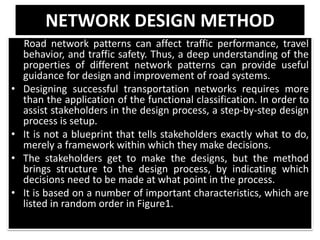
NETWORK DESIGN METHOD
Road network patterns can affect traffic performance, travel
behavior, and traffic safety. Thus, a deep understanding of the
properties of different network patterns can provide useful
guidance for design and improvement of road systems.
• Designing successful transportation networks requires more
than the application of the functional classification. In order to
assist stakeholders in the design process, a step-by-step design
process is setup.
• It is not a blueprint that tells stakeholders exactly what to do,
merely a framework within which they make decisions.
• The stakeholders get to make the designs, but the method
brings structure to the design process, by indicating which
decisions need to be made at what point in the process.
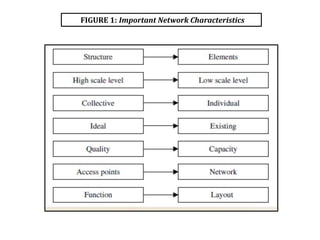
• It is based on a number of important characteristics, which are
listed in random order in Figure1.
FIGURE 1: Important Network Characteristics
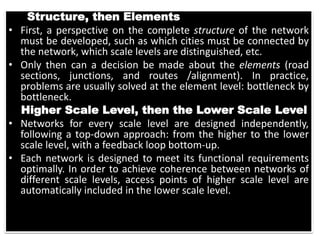
Structure, then Elements
• First, a perspective on the complete structure of the network
must be developed, such as which cities must be connected by
the network, which scale levels are distinguished, etc.
• Only then can a decision be made about the elements (road
sections, junctions, and routes /alignment). In practice,
problems are usually solved at the element level: bottleneck by
bottleneck.
Higher Scale Level, then the Lower Scale Level
• Networks for every scale level are designed independently,
following a top-down approach: from the higher to the lower
scale level, with a feedback loop bottom-up.
• Each network is designed to meet its functional requirements
optimally. In order to achieve coherence between networks of
different scale levels, access points of higher scale level are
automatically included in the lower scale level.
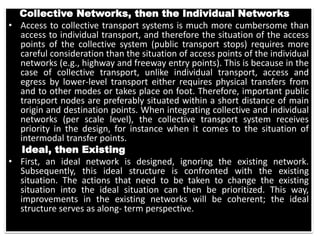
Collective Networks, then the Individual Networks
• Access to collective transport systems is much more cumbersome than
access to individual transport, and therefore the situation of the access
points of the collective system (public transport stops) requires more
careful consideration than the situation of access points of the individual
networks (e.g., highway and freeway entry points). This is because in the
case of collective transport, unlike individual transport, access and
egress by lower-level transport either requires physical transfers from
and to other modes or takes place on foot. Therefore, important public
transport nodes are preferably situated within a short distance of main
origin and destination points. When integrating collective and individual
networks (per scale level), the collective transport system receives
priority in the design, for instance when it comes to the situation of
intermodal transfer points.
Ideal, then Existing
• First, an ideal network is designed, ignoring the existing network.
Subsequently, this ideal structure is confronted with the existing
situation. The actions that need to be taken to change the existing
situation into the ideal situation can then be prioritized. This way,
improvements in the existing networks will be coherent; the ideal
structure serves as along- term perspective.
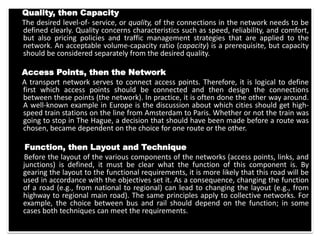
Quality, then Capacity
The desired level-of- service, or quality, of the connections in the network needs to be
defined clearly. Quality concerns characteristics such as speed, reliability, and comfort,
but also pricing policies and traffic management strategies that are applied to the
network. An acceptable volume-capacity ratio (capacity) is a prerequisite, but capacity
should be considered separately from the desired quality.
Access Points, then the Network
A transport network serves to connect access points. Therefore, it is logical to define
first which access points should be connected and then design the connections
between these points (the network). In practice, it is often done the other way around.
A well-known example in Europe is the discussion about which cities should get high-
speed train stations on the line from Amsterdam to Paris. Whether or not the train was
going to stop in The Hague, a decision that should have been made before a route was
chosen, became dependent on the choice for one route or the other.
Function, then Layout and Technique
Before the layout of the various components of the networks (access points, links, and
junctions) is defined, it must be clear what the function of this component is. By
gearing the layout to the functional requirements, it is more likely that this road will be
used in accordance with the objectives set it. As a consequence, changing the function
of a road (e.g., from national to regional) can lead to changing the layout (e.g., from
highway to regional main road). The same principles apply to collective networks. For
example, the choice between bus and rail should depend on the function; in some
cases both techniques can meet the requirements.
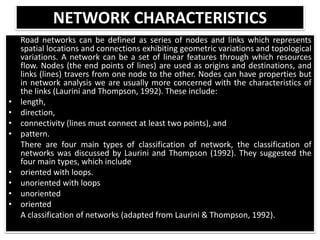
NETWORK CHARACTERISTICS
Road networks can be defined as series of nodes and links which represents
spatial locations and connections exhibiting geometric variations and topological
variations. A network can be a set of linear features through which resources
flow. Nodes (the end points of lines) are used as origins and destinations, and
links (lines) travers from one node to the other. Nodes can have properties but
in network analysis we are usually more concerned with the characteristics of
the links (Laurini and Thompson, 1992). These include:
• length,
• direction,
• connectivity (lines must connect at least two points), and
• pattern.
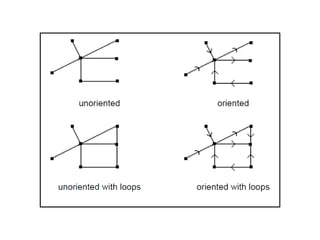
There are four main types of classification of network, the classification of
networks was discussed by Laurini and Thompson (1992). They suggested the
four main types, which include
• oriented with loops.
• unoriented with loops
• unoriented
• oriented
A classification of networks (adapted from Laurini & Thompson, 1992).
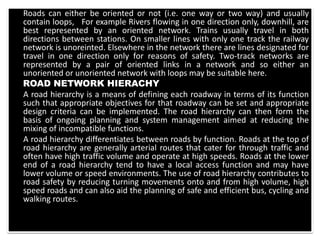
Roads can either be oriented or not (i.e. one way or two way) and usually
contain loops, For example Rivers flowing in one direction only, downhill, are
best represented by an oriented network. Trains usually travel in both
directions between stations. On smaller lines with only one track the railway
network is unoreinted. Elsewhere in the network there are lines designated for
travel in one direction only for reasons of safety. Two-track networks are
represented by a pair of oriented links in a network and so either an
unoriented or unoriented network with loops may be suitable here.
ROAD NETWORK HIERACHY
A road hierarchy is a means of defining each roadway in terms of its function
such that appropriate objectives for that roadway can be set and appropriate
design criteria can be implemented. The road hierarchy can then form the
basis of ongoing planning and system management aimed at reducing the
mixing of incompatible functions.
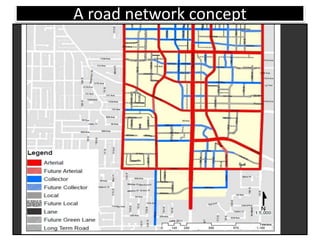
A road hierarchy differentiates between roads by function. Roads at the top of
road hierarchy are generally arterial routes that cater for through traffic and
often have high traffic volume and operate at high speeds. Roads at the lower
end of a road hierarchy tend to have a local access function and may have
lower volume or speed environments. The use of road hierarchy contributes to
road safety by reducing turning movements onto and from high volume, high
speed roads and can also aid the planning of safe and efficient bus, cycling and
walking routes.
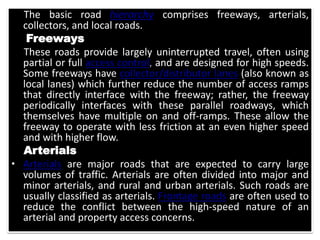
The basic road comprises freeways, arterials,
collectors, and local roads.
Freeways
These roads provide largely uninterrupted travel, often using
partial or full and are designed for high speeds.
Some freeways have (also known as
local lanes) which further reduce the number of access ramps
that directly interface with the freeway; rather, the freeway
periodically interfaces with these parallel roadways, which
themselves have multiple on and off-ramps. These allow the
freeway to operate with less friction at an even higher speed
and with higher flow.
Arterials
are major roads that are expected to carry large
volumes of traffic. Arterials are often divided into major and
minor arterials, and rural and urban arterials. Such roads are
usually classified as arterials. are often used to
reduce the conflict between the high-speed nature of an
arterial and property access concerns.
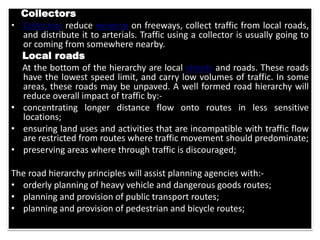
Collectors
reduce on freeways, collect traffic from local roads,
and distribute it to arterials. Traffic using a collector is usually going to
or coming from somewhere nearby.
Local roads
At the bottom of the hierarchy are local and roads. These roads
have the lowest speed limit, and carry low volumes of traffic. In some
areas, these roads may be unpaved. A well formed road hierarchy will
reduce overall impact of traffic by:-
• concentrating longer distance flow onto routes in less sensitive
locations;
• ensuring land uses and activities that are incompatible with traffic flow
are restricted from routes where traffic movement should predominate;
• preserving areas where through traffic is discouraged;
The road hierarchy principles will assist planning agencies with:-
• orderly planning of heavy vehicle and dangerous goods routes;
• planning and provision of public transport routes;
• planning and provision of pedestrian and bicycle routes;
A road network concept
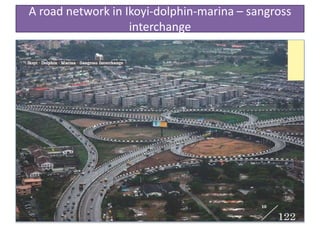
A road network in Ikoyi-dolphin-marina – sangross
interchange
ASSESSMENT AND ANALYSIS
Network analysis enables us to solve problems, such as finding the most
efficient travel route, generating travel directions, finding the closest
facility, defining service areas based on travel time. Networks are all
around us. Roads, railways, cables, pipelines, streams and even glaciers
are phenomena that frequently need to be represented and analysed as
a network. Networks are used to move people, transport goods,
communicate information and control the flow of matter and energy. It
is not surprising then that techniques have been developed to analyse
these most geographical phenomena.
Algorithms for network operations
At the heart of a network analysis is the search procedure. One can, for
example, select
• links that take you as far away from the start node as possible, never
turning back. Alternatively one can search all the links that propagate
from a node, moving out one link at a time and gradually accumulating
a cost of travel in all directions from a start node. Or one can seek to
find a route that passes through the fewest number of nodes, even if it
is not necessarily the route of lowest cost.
Applications of network analysis
• Routing: Finding shortest routes is probably the commonest routing
problem to GIS users. Finding the shortest route from A to B through a
road network is crucial for emergency services, business journeys, or
simply planning routes for holiday makers touring a region. In order to
carry out such operations it is important to construct an appropriate
network. Details of connectivity, one way streets, possible turns and
speed limits will be required.
• Resource allocation: Another application of network analysis is resource
allocation. The objective is to create service areas around a service
centre and if implemented successfully, allows an organization to
optimize the distribution of the resources based on the capacity of each
facility. For example, centres may be schools with a maximum capacity
for children, health centres with a capacity for patients, or warehouses
with a capacity for goods. Allocation algorithms use these centres as
destinations then model how people or goods will travel through the
network to get there. The result is a map that shows the areas served
by each service facility e.g. a school or health centre catchment area, or
the warehouse’s distribution area. The algorithms usually work by
allocating links in the network to the nearest centre, taking into
account, of course, the attributes such as one way streets, barriers to
movement and so on.
CONTROL AND OPERATIONS
Traffic Control Measures
Traffic control aims to manage and control the movement of traffic on roads to
optimize the use of existing road capacity. Traffic control covers all measures
aimed at distributing and controlling road traffic flows in time and space in
order to avoid the onset of incidents or to reduce their impacts. Traffic control
is carried out by network operators and controllers with reference to
predetermined traffic management policies and plans. In most countries it is
an activity done in coordination with the authorities in charge of traffic
policing, often under their direct control. Traffic control also includes the use
of CCTV and other means of monitoring traffic by local or State roadways
authorities to manage traffic flows and providing advice concerning traffic
congestion
• It is possible to distinguish between:
• direct control measures – using traffic lights, “smart” barriers and Variable
Message Signs (VMS) to allocate traffic priorities in time and space
• enforcement measures against violations of control measures and traffic laws –
for example speed enforcement cameras and red-light running detection
linked to ANPR cameras.
• indirect control measures – mainly information and recommendations to
drivers that will affect the behaviour of individual vehicles, for example radio
broadcasts, pre-trip information (via internet and mobile devices), in-vehicle
routing and on-board navigation systems.
CONCLUSION
The socio-economic development and subsequent economic growth of
any nation is strongly linked to its transport infrastructure. The level
and quality of transportation systems in any area are of crucial
significance in influencing political, economic and social progress, and
these must be considered at every stage of local, national and regional
development planning. Without good roads, it is difficult to have
socially inclusive development interventions. Improved road networks
bring many benefits these include improved accessibility to social
infrastructure (schools, churches and health centres), increased access
to education and health facilities and improved social interaction and
mobility. Direct benefits of improved road networks include reduced
vehicle operating costs, savings in travel time, reduced accident costs
resulting from the upgrade of the proposed roads, possible savings in
road maintenance costs (because roads are bound to withstand harsh
weather if they are well-maintained). A high quality road network is
essential not only for connecting key urban centres, but for improving
connectivity of more isolated local communities to whom public
transport options are limited.
REFERENCES
• Coops, N.C and Waring, R.H. (2001)the use of multi scale remote sensing
imagery to derive regional estimates of forest growth capacity using 3-PGS
• Rodrigue et al (2006) The Geography of transport system. New york
Routledge.
• Verma, R.K et al (2008)Application of remote sensing and GIS technique for
efficient urban planning. GIS@development.Net/application/urban.
• Rao,K,M and Jayasreo, K. (2010)Rural infrastructural planning with emphasis
on road network connectivity by coplanar concurrent theory:
http://.www.gisdevelopment.net/application/utility/transport/mi03151.htm.
• Abosede, A. J. (2000) Sampling and Sampling Techniques in Research
Methods in the Social and Management Science. Centre for Sandwich
Programmes (CESAP), Ogun State University, Ago-Iwoye, 175-192.
• Aderamo, A. J. (2003). A Graph Theoretic Analysis of Intra-Urban Road
Network in Ilorin, Nigeria. Research for Development. 17, 1 & 2; 18, 1 & 2
(December 2003), 221 – 240.
THANK
YOU
FOR
LISTENING

Road network presentation

  • 1.
    DEPARTMENT OF CIVILENGINEERING BAYERO UNIVERSITY, KANO NIGERIA PRESENTATION BY DAUDU ALEX TASHILANI SPS/15/MCE/00017 email - lexylinks@yahoo.com M.ENG – CIVIL ENGINEERING (HIGHWAY AND TRANSPORTATION) ON REVIEW ON ROAD NETWORK COURSE LECTURER: DR. HASHIM M. ALHASSAN
  • 2.
    INTRODUCTION Roads are thelifeblood of Nigeria trade and social utility. Despite the increasing focus on the use of other modalities like railway, shipping and all kinds of public transport, roads carry’s the majority of land freight (bulk) transport and passenger traffic. Keeping this traffic rolling is the main concern for road authorities. Building new roads or expanding square meters of asphalt might seem to be the obvious way to do this. Transportation and property are important in physical and economic development of towns and cities all over the world. Property and land values tend to increase in areas with expanding transportation networks, and increase less rapidly in areas without such improvements. Rapid and continued rise in housing and land prices are expected in cities with transportation improvements and rapid economic and population growth (Goldberg, 1970).
  • 3.
    Road networks areobserved in terms of its components of accessibility, connectivity, traffic density, level of service, compactness, and density of particular roads. Level of service is a measure by which the quality of service on transportation devices or infrastructure is determined. Developments of various transportation modes have become pivotal to physical and economic developments. Such modes include railways, ropeways and cableways, pipelines, inland waterways, sea, air, and roads (Said and Shah, 2008). As rivers and mountains naturally reclaim the geographical composition of the continents, so ground transportation systems dominate the physical planning of landscapes and cities. These man-made systems/barriers offer freedom of movement to people and goods in the society .
  • 4.
    ROAD NETWORK Road networkliterarily refers to the framework of routes within a system of location. According to Rodrique et al (2006) transportation network are of various types of links between points along which movement can take place. Rao and Jayasree (2010) expressed that a proper skeleton of road network creates a promotional impact of land use activity in the urban centers. Rodrique et al (2006) categorized road network structure into two, based on the accessibility they provide. The centripetal network favors a limited number of locations. The centrifugal network on the other hand does not convey any specific network connection advantages. The arrangement and connectivity of transport network is known as its typology. Road network can also be classified based on their typological attributes. Rodrique identified several criteria for such classification among which are; orientation and extent, mode and terminals, type of traffic, volume and direction or pattern of network.
  • 5.
    NETWORK DESIGN METHOD Roadnetwork patterns can affect traffic performance, travel behavior, and traffic safety. Thus, a deep understanding of the properties of different network patterns can provide useful guidance for design and improvement of road systems. • Designing successful transportation networks requires more than the application of the functional classification. In order to assist stakeholders in the design process, a step-by-step design process is setup. • It is not a blueprint that tells stakeholders exactly what to do, merely a framework within which they make decisions. • The stakeholders get to make the designs, but the method brings structure to the design process, by indicating which decisions need to be made at what point in the process. • It is based on a number of important characteristics, which are listed in random order in Figure1.
  • 6.
    FIGURE 1: ImportantNetwork Characteristics
  • 7.
    Structure, then Elements •First, a perspective on the complete structure of the network must be developed, such as which cities must be connected by the network, which scale levels are distinguished, etc. • Only then can a decision be made about the elements (road sections, junctions, and routes /alignment). In practice, problems are usually solved at the element level: bottleneck by bottleneck. Higher Scale Level, then the Lower Scale Level • Networks for every scale level are designed independently, following a top-down approach: from the higher to the lower scale level, with a feedback loop bottom-up. • Each network is designed to meet its functional requirements optimally. In order to achieve coherence between networks of different scale levels, access points of higher scale level are automatically included in the lower scale level.
  • 8.
    Collective Networks, thenthe Individual Networks • Access to collective transport systems is much more cumbersome than access to individual transport, and therefore the situation of the access points of the collective system (public transport stops) requires more careful consideration than the situation of access points of the individual networks (e.g., highway and freeway entry points). This is because in the case of collective transport, unlike individual transport, access and egress by lower-level transport either requires physical transfers from and to other modes or takes place on foot. Therefore, important public transport nodes are preferably situated within a short distance of main origin and destination points. When integrating collective and individual networks (per scale level), the collective transport system receives priority in the design, for instance when it comes to the situation of intermodal transfer points. Ideal, then Existing • First, an ideal network is designed, ignoring the existing network. Subsequently, this ideal structure is confronted with the existing situation. The actions that need to be taken to change the existing situation into the ideal situation can then be prioritized. This way, improvements in the existing networks will be coherent; the ideal structure serves as along- term perspective.
  • 9.
    Quality, then Capacity Thedesired level-of- service, or quality, of the connections in the network needs to be defined clearly. Quality concerns characteristics such as speed, reliability, and comfort, but also pricing policies and traffic management strategies that are applied to the network. An acceptable volume-capacity ratio (capacity) is a prerequisite, but capacity should be considered separately from the desired quality. Access Points, then the Network A transport network serves to connect access points. Therefore, it is logical to define first which access points should be connected and then design the connections between these points (the network). In practice, it is often done the other way around. A well-known example in Europe is the discussion about which cities should get high- speed train stations on the line from Amsterdam to Paris. Whether or not the train was going to stop in The Hague, a decision that should have been made before a route was chosen, became dependent on the choice for one route or the other. Function, then Layout and Technique Before the layout of the various components of the networks (access points, links, and junctions) is defined, it must be clear what the function of this component is. By gearing the layout to the functional requirements, it is more likely that this road will be used in accordance with the objectives set it. As a consequence, changing the function of a road (e.g., from national to regional) can lead to changing the layout (e.g., from highway to regional main road). The same principles apply to collective networks. For example, the choice between bus and rail should depend on the function; in some cases both techniques can meet the requirements.
  • 10.
    NETWORK CHARACTERISTICS Road networkscan be defined as series of nodes and links which represents spatial locations and connections exhibiting geometric variations and topological variations. A network can be a set of linear features through which resources flow. Nodes (the end points of lines) are used as origins and destinations, and links (lines) travers from one node to the other. Nodes can have properties but in network analysis we are usually more concerned with the characteristics of the links (Laurini and Thompson, 1992). These include: • length, • direction, • connectivity (lines must connect at least two points), and • pattern. There are four main types of classification of network, the classification of networks was discussed by Laurini and Thompson (1992). They suggested the four main types, which include • oriented with loops. • unoriented with loops • unoriented • oriented A classification of networks (adapted from Laurini & Thompson, 1992).
  • 12.
    Roads can eitherbe oriented or not (i.e. one way or two way) and usually contain loops, For example Rivers flowing in one direction only, downhill, are best represented by an oriented network. Trains usually travel in both directions between stations. On smaller lines with only one track the railway network is unoreinted. Elsewhere in the network there are lines designated for travel in one direction only for reasons of safety. Two-track networks are represented by a pair of oriented links in a network and so either an unoriented or unoriented network with loops may be suitable here. ROAD NETWORK HIERACHY A road hierarchy is a means of defining each roadway in terms of its function such that appropriate objectives for that roadway can be set and appropriate design criteria can be implemented. The road hierarchy can then form the basis of ongoing planning and system management aimed at reducing the mixing of incompatible functions. A road hierarchy differentiates between roads by function. Roads at the top of road hierarchy are generally arterial routes that cater for through traffic and often have high traffic volume and operate at high speeds. Roads at the lower end of a road hierarchy tend to have a local access function and may have lower volume or speed environments. The use of road hierarchy contributes to road safety by reducing turning movements onto and from high volume, high speed roads and can also aid the planning of safe and efficient bus, cycling and walking routes.
  • 13.
    The basic roadcomprises freeways, arterials, collectors, and local roads. Freeways These roads provide largely uninterrupted travel, often using partial or full and are designed for high speeds. Some freeways have (also known as local lanes) which further reduce the number of access ramps that directly interface with the freeway; rather, the freeway periodically interfaces with these parallel roadways, which themselves have multiple on and off-ramps. These allow the freeway to operate with less friction at an even higher speed and with higher flow. Arterials are major roads that are expected to carry large volumes of traffic. Arterials are often divided into major and minor arterials, and rural and urban arterials. Such roads are usually classified as arterials. are often used to reduce the conflict between the high-speed nature of an arterial and property access concerns.
  • 14.
    Collectors reduce on freeways,collect traffic from local roads, and distribute it to arterials. Traffic using a collector is usually going to or coming from somewhere nearby. Local roads At the bottom of the hierarchy are local and roads. These roads have the lowest speed limit, and carry low volumes of traffic. In some areas, these roads may be unpaved. A well formed road hierarchy will reduce overall impact of traffic by:- • concentrating longer distance flow onto routes in less sensitive locations; • ensuring land uses and activities that are incompatible with traffic flow are restricted from routes where traffic movement should predominate; • preserving areas where through traffic is discouraged; The road hierarchy principles will assist planning agencies with:- • orderly planning of heavy vehicle and dangerous goods routes; • planning and provision of public transport routes; • planning and provision of pedestrian and bicycle routes;
  • 15.
  • 16.
    A road networkin Ikoyi-dolphin-marina – sangross interchange
  • 17.
    ASSESSMENT AND ANALYSIS Networkanalysis enables us to solve problems, such as finding the most efficient travel route, generating travel directions, finding the closest facility, defining service areas based on travel time. Networks are all around us. Roads, railways, cables, pipelines, streams and even glaciers are phenomena that frequently need to be represented and analysed as a network. Networks are used to move people, transport goods, communicate information and control the flow of matter and energy. It is not surprising then that techniques have been developed to analyse these most geographical phenomena. Algorithms for network operations At the heart of a network analysis is the search procedure. One can, for example, select • links that take you as far away from the start node as possible, never turning back. Alternatively one can search all the links that propagate from a node, moving out one link at a time and gradually accumulating a cost of travel in all directions from a start node. Or one can seek to find a route that passes through the fewest number of nodes, even if it is not necessarily the route of lowest cost.
  • 18.
    Applications of networkanalysis • Routing: Finding shortest routes is probably the commonest routing problem to GIS users. Finding the shortest route from A to B through a road network is crucial for emergency services, business journeys, or simply planning routes for holiday makers touring a region. In order to carry out such operations it is important to construct an appropriate network. Details of connectivity, one way streets, possible turns and speed limits will be required. • Resource allocation: Another application of network analysis is resource allocation. The objective is to create service areas around a service centre and if implemented successfully, allows an organization to optimize the distribution of the resources based on the capacity of each facility. For example, centres may be schools with a maximum capacity for children, health centres with a capacity for patients, or warehouses with a capacity for goods. Allocation algorithms use these centres as destinations then model how people or goods will travel through the network to get there. The result is a map that shows the areas served by each service facility e.g. a school or health centre catchment area, or the warehouse’s distribution area. The algorithms usually work by allocating links in the network to the nearest centre, taking into account, of course, the attributes such as one way streets, barriers to movement and so on.
  • 19.
    CONTROL AND OPERATIONS TrafficControl Measures Traffic control aims to manage and control the movement of traffic on roads to optimize the use of existing road capacity. Traffic control covers all measures aimed at distributing and controlling road traffic flows in time and space in order to avoid the onset of incidents or to reduce their impacts. Traffic control is carried out by network operators and controllers with reference to predetermined traffic management policies and plans. In most countries it is an activity done in coordination with the authorities in charge of traffic policing, often under their direct control. Traffic control also includes the use of CCTV and other means of monitoring traffic by local or State roadways authorities to manage traffic flows and providing advice concerning traffic congestion • It is possible to distinguish between: • direct control measures – using traffic lights, “smart” barriers and Variable Message Signs (VMS) to allocate traffic priorities in time and space • enforcement measures against violations of control measures and traffic laws – for example speed enforcement cameras and red-light running detection linked to ANPR cameras. • indirect control measures – mainly information and recommendations to drivers that will affect the behaviour of individual vehicles, for example radio broadcasts, pre-trip information (via internet and mobile devices), in-vehicle routing and on-board navigation systems.
  • 20.
    CONCLUSION The socio-economic developmentand subsequent economic growth of any nation is strongly linked to its transport infrastructure. The level and quality of transportation systems in any area are of crucial significance in influencing political, economic and social progress, and these must be considered at every stage of local, national and regional development planning. Without good roads, it is difficult to have socially inclusive development interventions. Improved road networks bring many benefits these include improved accessibility to social infrastructure (schools, churches and health centres), increased access to education and health facilities and improved social interaction and mobility. Direct benefits of improved road networks include reduced vehicle operating costs, savings in travel time, reduced accident costs resulting from the upgrade of the proposed roads, possible savings in road maintenance costs (because roads are bound to withstand harsh weather if they are well-maintained). A high quality road network is essential not only for connecting key urban centres, but for improving connectivity of more isolated local communities to whom public transport options are limited.
  • 21.
    REFERENCES • Coops, N.Cand Waring, R.H. (2001)the use of multi scale remote sensing imagery to derive regional estimates of forest growth capacity using 3-PGS • Rodrigue et al (2006) The Geography of transport system. New york Routledge. • Verma, R.K et al (2008)Application of remote sensing and GIS technique for efficient urban planning. GIS@development.Net/application/urban. • Rao,K,M and Jayasreo, K. (2010)Rural infrastructural planning with emphasis on road network connectivity by coplanar concurrent theory: http://.www.gisdevelopment.net/application/utility/transport/mi03151.htm. • Abosede, A. J. (2000) Sampling and Sampling Techniques in Research Methods in the Social and Management Science. Centre for Sandwich Programmes (CESAP), Ogun State University, Ago-Iwoye, 175-192. • Aderamo, A. J. (2003). A Graph Theoretic Analysis of Intra-Urban Road Network in Ilorin, Nigeria. Research for Development. 17, 1 & 2; 18, 1 & 2 (December 2003), 221 – 240.
  • 22.