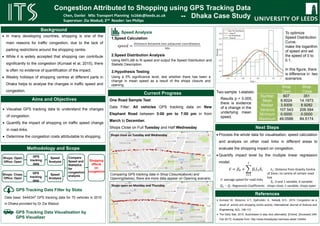
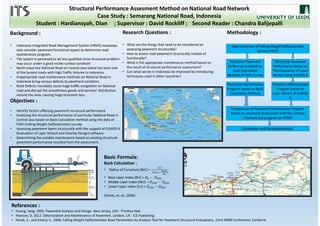
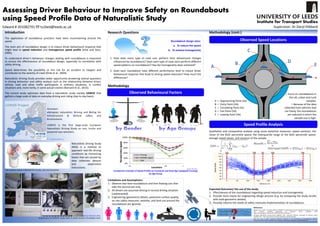
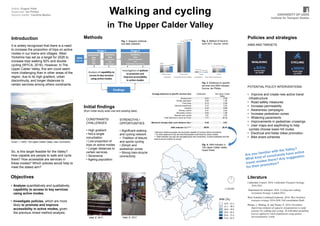
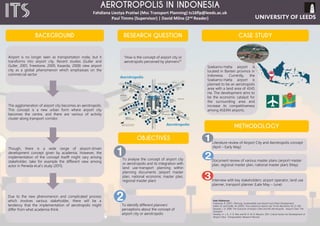
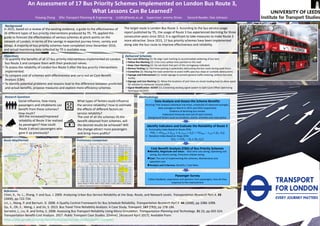
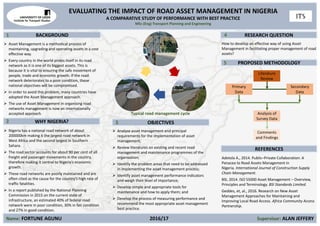
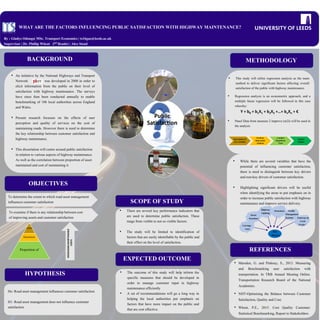
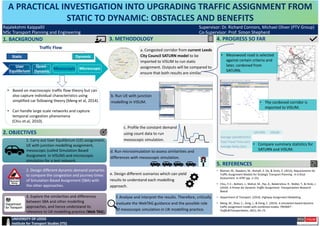
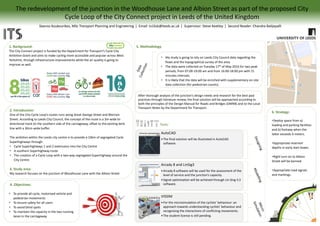
1985 1986 1987 1988 1989 1990 1991 1992 1993 1994 1995 1996 1997 1998 1999 2000 2001 2002 2003 2004 2005 2006 2007 2008 2009 2010 2011 2012 2013 2014 2015 … 2030
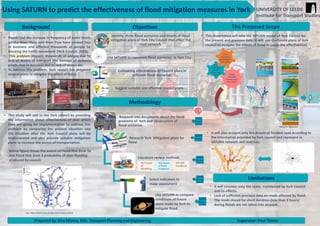
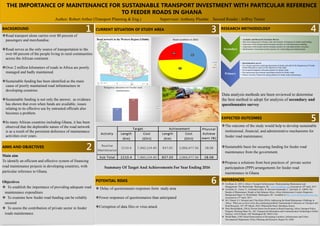
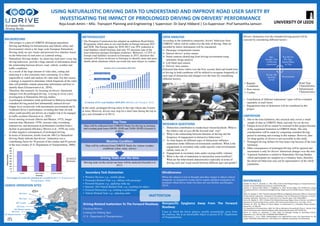
Background
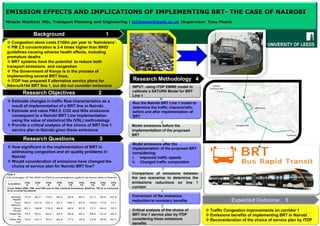
• China’s first car was made in 1956 and the
first private car was made in early 1980;
• In 1994, the government started to
encourage people to buy private cars;
• Nowadays the car ownership in China has
reached 290 million With the growth of
27.5 million cars and 33.1 million drivers in
2016 (Xinhua news agency 2017);
• Traffic congestion and environment
problems have been more serious;
• More traffic policies are carried out to
restrict the amount of cars since 2008;
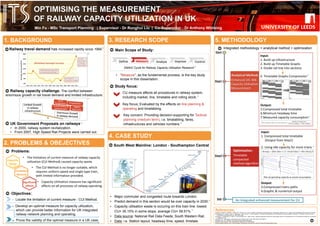
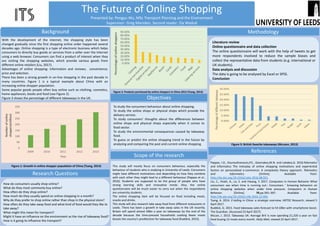
Private Car ownership analysis in several cities in China
Shijun Cheng, M.Sc. Transport Planning & Engineering Supervisor: Zia Wadud Institute of Transport Study
(Traffic congestion in Beijing)
Source: http://chuansong.me/n/981272952969
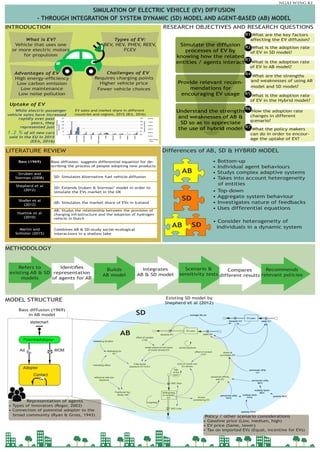
The proposed scope
• Taking Beijing ,Shanghai ,Tianjin,
Guangzhou and Hangzhou as the examples;
• The time series are divided into three parts:
“1985 - 2008”, “2008 - 2015”, “2015 -
2030”;
• Choose GDP per capita (RMB), population
data (1,000 people) and fuel price (RMB)
as the main valuable factors.
The proposed methodology
• Econometric model:
ln 𝐶𝑡 = 𝐾 +
𝑖=1
𝑚
𝛼𝑖 ln 𝐶𝑡−𝑖 +
𝑗=0
𝑛
𝛽𝑗 ln 𝐺𝐷𝑃𝑡−𝑗
+ 𝑘=0
𝑜
𝛾 𝑘 ln 𝑃𝑡−𝑘 𝑙=0
𝑝
δ𝑙 ln 𝐹𝑡−𝑙 + 𝜀𝑡;
• For the eq., C is the number of vehicles,
GDP is real GDP per capita ,P is population
and F is fuel price, 𝜀𝑡 is the error of the
econometric model, m n o p will be
chosen to fit the error 𝜀𝑡 and α, β, γ, δ, k
are the estimated parameters;
• Intervention analysis will be used in time
series econometrics to estimate the impact
of traffic polices.
Expected conclusions
• GDP per capita and population could be the
main variables of the car ownership model;
• After carrying out traffic policies,
comparing with the actual data, the growth
of the car ownership starts to slow down;
• The growth of the predictive results should
be more slowly.
Aims and Objectives
• By analysing the previous car ownership
data from to get estimated results;
• To find the differences between the actual
data and estimated results;
• Whether the traffic policies have positive
impacts on the restraint of car numbers?
• What is the predicted value of car ownership
in the future (2030)?
Private car ownership in China (per 1000)
GDP
(Population)
(Grass Domestic
Product) per capita
References
Bhat, C.R. and Sen, S. 2006. Transportation Research Part B: Methodological. Household Vehicle Type Holdings and Usage: An Application of the Multiple Discrete-
Continuous Extreme Value (MDCEV) Model. [Online]. 40(1).pp 35-53. [Available from]:
http://www.sciencedirect.com/science/article/pii/S0191261505000093
Dargay, J. et al. 2007. Science Direct: Transportation Research Part A. The effect of prices and income on car travel in the UK. [Online]. 2017(4).pp 949-960. [Available
from]:
http://www.sciencedirect.com/science/article/pii/S0965856407000419
Deng, X. 2007. Private Car Ownership in China: How Important is the effect of Income? [Online]. [Available from]:
https://www.researchgate.net/publication/241654202_Private_Car_Ownership_in_China_How_Important_is_the_effect_of_Income
Huang, X. 2011. Michigan Tech: Dissertations, Master's Theses and Master's Reports. Car ownership modeling and forecasts for China. [Online]. [Available from]:
http://digitalcommons.mtu.edu/etds/444/
Li, J. et al. 2010. Modelling Private Car Ownership in China: Investigation of Urban Form Impact across Megacities. [Online]. [Available from]:
https://trid.trb.org/view.aspx?id=909830
Wadud, Z. 2012. Transportation Research Part A. Transport impacts of an energy-environment policy: The case of CNG conversion of vehicles in Dhaka. [Online].
[Available from]:
www.sciencedirect.com/science/article/pii/S0965856414001128
Wu, T. 2014. Sustainability. Vehicle Ownership Analysis Based on GDP per Capita in China: 1963–2050. [Online]. 2014(6).pp 4877-4899. [Available from]:
https://www.researchgate.net/publication/277673929_Vehicle_Ownership_Analysis_Based_on_GDP_per_Capita_in_China_1963-2050
Xinhua News Agency. 2017. The car ownership in China.[Online].[Accessed 17 April]. Available from : http://www.gov.cn/shuju/2017-01/11/content_5158647.htm
Traffic policies have been taken in 2008
Where will it go in the future?
Fuel price per liter
(¥)
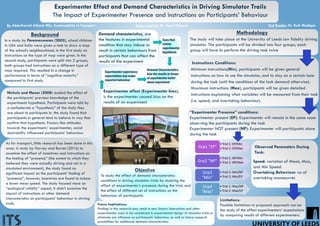
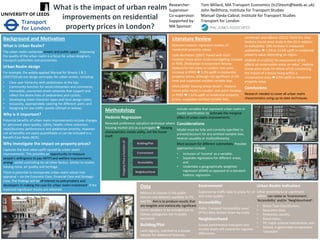
Experimenter Effect and Demand Characteristics in Driving Simulator Trails
The Impact of Experimenter Presence and instructions on Participants’ Behaviour
By Abdulhamid Alfalah MSc. Sustainability in Transport Supervised by: Dr. Daryl Hibberd 2nd Reader: Dr. Ruth Madigan
In a study by Parameswaran (2003), school children
in USA and India were given a task to draw a map
of the school’s neighbourhood, in the first study no
instructions on the type of map were given. In the
second study, participants were split into 2 groups,
both groups had instructions on a different type of
map required. This resulted in a change in
performance in terms of “cognitive maturity”
compared to first study.
Background
Experimenter effect (Experimenter bias),
is the experimenter caused bias on the
results of an experiment
Demand characteristics, are
the features in experimental
condition that may induce or
result in certain behaviours from
participants that can affect the
results of the experiment
To study the effect of demand characteristics
conditions in driving simulator trials by studying the
effect of experimenter’s presence during the trial, and
the effect of different set of instructions on the
behaviour of participants.
Objective
Methodology
The study will take place at the University of Leeds low fidelity driving
simulator. The participants will be divided into four groups, each
group will have to perform the driving task twice
•Trial 1: EP/Min
•Trial 2: EP/MaxGrp1 "EP"
•Trial 1: NP/Min
•Trial 2: NP/MaxGrp2 "NP"
•Trial 1: Min/NP
•Trial 2: Min/EP
Grp3
"Min"
•Trial 1: Max/NP
•Trial 2: Max/EP
Grp4
"Max"
Instructions Conditions:
Minimum instructions(Min), participants will be given general
instructions on how to use the simulator, and to stay on a certain lane
during the task (until the conditions of the task demand otherwise).
Maximum instructions (Max), participants will be given detailed
instructions explaining what variables will be measured from their task
(i.e. speed, and overtaking behaviour).
“Experimenter Presence” conditions:
Experimenter present (EP): Experimenter will remain in the same room
observing the participants during the task
Experimenter NOT present (NP): Experimenter will participants alone
during the task
Observed Parameters During
Task:
Speed: variation of Mean, Max,
and Min Speed.
Overtaking Behaviour: no of
overtaking manoeuvres
Nichols and Maner (2008) studied the effect of
the participants’ previous knowledge of the
experiments hypothesis. Participants were told by
a confederate a “hypothesis” of the study they
are about to participate in. the study found that
participants in general tend to behave in way that
confirm that hypothesis. Factors like attitudes
towards the experiment/ experimenter, social
desirability influenced participants’ behaviour.
As for transport, little research has been done in this
area. A study by Harvey and Burnet (2016) to
examine the effect of incentives and instructions on
the feeling of “presence” (the extent to which they
believed they were actually driving and not in a
simulated environment), the study found no
significant impact on the participants’ feeling of
“presence”, however, incentives are found to induce
a lower mean speed. The study focused more on
“ecological validity” aspect, it didn’t examine the
impact of instructions or other demand
characteristics on participants’ behaviour in driving
trails.
Cues that
convey
experimental
hypothesis
Experimenter expectancy
expectations may evoke
expected behaviour
Demand Characteristics
bias the results in favour
of experimenter belief
about experiment
Limitations:
Possible limitations to proposed approach can be
the study of the effect experimenters’ expectations
by comparing results of different experimenters.
Future Implications:
Findings in this research may result in new factors (instructions and other
experimenter cues) to be considered in experimental design of simulator trials to
eliminate any influence on participants’ behaviour, as well as future research
possibilities for additional demand characteristics
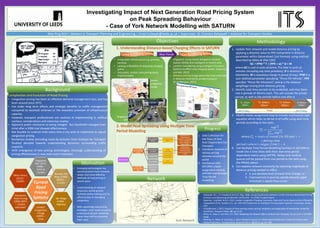
LOW-COST DRIVING SIMULATION, UNDERSTANDING TRANSITION OUT OF AUTOMATED DRIVING BY
USING DESKTOP SIMULATOR
Author: Agung Adri Laksono – MSc Transport Planning Supervisor: Gustav Markkula
BACKGROUND STUDY
60%
Human behaviour is the
most factor that causes road
accident (Rosolino et al.
(2013)
Autonomous vehicles can
generate the reduction on road
traffic accident - prevent and
reduce failure on human factor
(Bertoncello and Wee, 2015).
However, during the automation, the driver’s attention
may shift away and potentially impairs driver’s ability
Running desktop simulator
can be useful to address
these problems by studying
several aspect such as the
Reaction Time and
Visual Angle.
Therefore, this research will investigate the reaction
time and visual angle during the automation. Also this
research will refer to Louw et al., (2017) that has used
driving simulator to generate comparative result.
To what extent the generated result
of experimental reseach on
transition out such as reaction time
and visual angle in desktop
simulator compared to the driving
simulator ?
RESEARCH QUESTION
Aim :
Obtain the comparative result between desktop simulator
and previous study which used driving simulator in term of
investigating the reaction time and visual angle during the
transition out.
Objectives:
AIM & OBJECTIVES
Andersen, G. and Sauer, C. (2007). Optical Information for Car Following: The Driving by Visual Angle (DVA)
Model. Human Factors, 49(5), pp.878-896.
Louw, T., Markkula, G., Boer, E., Madigan, R., Carsten, O. and Merat, N. (2017). Coming Back into the Loop: Driver's
Perceptual-Motor Performance in Critical Events after Automated Driving. Transport Research.
Louw TL; Merat N (2017) Are you in the loop? Using gaze dispersion to understand driver visual attention during vehicle
automation, Transportation Research Part C: Emerging Technologies, 76, pp.35-50.
KEY REFERENCES
Second Reader: Natasha Merat200985420 - ts16aal@leeds.ac.uk
To compare the generated result from low-cost driving
simulator (desktop simulator) with the previous result
that generated by driving simulator in term of
investigating the reaction time and visual angle during
the transition out of automated driving.
To analyse and identify the important aspects which
affect the different result generated by desktop
simulator.
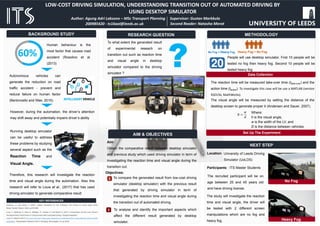
No Fog + Heavy Fog Heavy Fog + No Fog
People will use desktop simulator. First 10 people will be
tested no fog then heavy fog. Second 10 people will be
tested heavy fog
Data Collection
Set Up The Experiment
The reaction time will be measured take-over time (ttake-over) and the
action time (taction). To investigate this case will be use a MATLAB (version
R2015b, MathWorks).
The visual angle will be measured by setting the distance of the
desktop screen to generate proper θ (Andersen and Sauer, 2007).
θ =
𝑤
𝑑
Where:
θ is the visual angle,
w is the width of the LV, and
D is the distance between vehicles.
Set Up The Experiment
METHODOLOGY
The recruited participant will be on
age between 25 and 45 years old
and have driving license.
NEXT STEP
The study will investigate the reaction
time and visual angle, the driver will
be tested with 2 different screen
manipulations which are no fog and
heavy fog.
No Fog
Heavy Fog
University of Leeds Driving
Simulator (UoLDS)
Location:
Participants : ITS Master Students
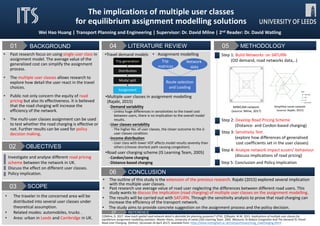
Assessing Diverging Diamond Interchange against
Traditional Signalized Roundabout
MSc (Eng) Transport Planning and Engineering
BACKGROUND
NAME: AHMED ABDELBAKI 2016/17 SUPERVISOR: JEREMY THOMPSON
• Roundabout is one of the most effective junction
types as it “minimize delay for vehicles whilst
maintaining the safe passage of all road users
through the junction”, especially when arm flows
are reasonably balanced.
• When demand exceeds the roundabout capacity,
critical queues, unbalanced delays and lower safety
level will result. The problem becomes more
critical when queues built up and reach the main
road on the interchange, even when converting to
signal control .
• In order to avoid problems on roundabouts and
conventional diamond interchanges, an alternative
has been introduced in the USA. Diverging
Diamond Interchange (DDI) have become a popular
choice since 2009.
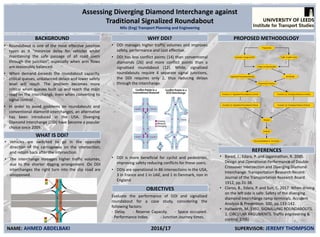
• DDI manages higher traffic volumes and improves
safety, performance and cost effective.
• DDI has less conflict points (14) than conventional
diamonds (26) and more conflict points than a
signalised roundabout (12). While, signalized
roundabouts require 4 separate signal junctions,
the DDI requires only 2, thus reducing delays
through the interchange.
• DDI is more beneficial for cyclist and pedestrian,
improving safety reducing conflicts for these users.
• DDIs are operational in 86 intersections in the USA,
3 in France and 1 in UAE, and 1 in Denmark, non in
England
REFERENCES
Evaluate the performance of DDI and signalized
roundabout for a case study, considering the
following factors:
- Delay. - Reserve Capacity. - Space occupied.
- Performance Index. - Junction Journey times.
• Bared, J., Edara, P. and Jagannathan, R. 2005.
Design and Operational Performance of Double
Crossover Intersection and Diverging Diamond
Interchange. Transportation Research Record:
Journal of the Transportation Research Board.
1912, pp.31-38.
• Claros, B., Edara, P. and Sun, C. 2017. When driving
on the left side is safe: Safety of the diverging
diamond interchange ramp terminals. Accident
Analysis & Prevention. 100, pp.133-142.
• Hallworth, M. 1992. SIGNALLING ROUNDABOUTS.
1. CIRCULAR ARGUMENTS. Traffic engineering &
control. 33(6).
WHY DDI?
OBJECTIVES
PROPOSED METHODOLOGY
WHAT IS DDI?
• Vehicles are switched to go in the opposite
direction of the carriageway on the intersection,
and return back after the intersection.
• The interchange manages higher traffic volumes,
due to the shorter staging arrangement. On DDI
interchanges the right turn into the slip road are
unopposed.
Impact of transport investments on health in Ghana
Alba Rodríguez Fernández
cn14arf@leeds.ac.uk
MSc (Eng) Transport Planning and Engineering
1. Context 2. Objective
3. Methodology
4. Scope
Supervisor: Jeffrey Turner
Second reader: Tony Plumbe
The main objective of the study is to analyze the optimal
places and type of infrastructure (roads mainly) to invest in
trying to improve the connectivity in rural areas of Ghana
to make health facilities more accessible for citizens.
There will be two ranges to take into account:
- The national infrastructure
- The rural roads available (focusing on these ones)
Connect both of them without creating isolated networks
not integrated into the bigger picture scheme is essential in
order to be able to keep expanding the system in the future.
With the literature studied and the data obtained online
through different organisations, plot and study the information
using the software QGIS.
Steps to follow:
− Literature and background study: Infrastructure and health
problems.
− Critical analysis of the existing network
Consider: Topography and climate, Politics and economy,
Social situation, Health system, Road sector in Ghana,
Transport policies in Ghana, Future plans and strategic
programmes, Road maintenance, Prioritise interventions,
Possible funding sources, Propose changes in the network
and plot them.
Using as the main reference the Ghana Living Standards
Survey Round 6 (GLSS 6).
− Study the service area of the new roads and infrastructure.
− Adaptation and mitigation of climate changes.
− Technical characteristics of the new network.
− Impacts (positives and negatives).
− Constrains.
− Possible cost of the implementation.
− Recommendations.
Ghana:
- Projected Population:
28,308,301 hab. (2016)
- Density: 102 hab./km²
- GPD: $120.786 billion
- Capital: Accra
- Constitutional Republic
- Area: 238,535 km2
- Water: 4,61% of the area
Characteristics of rural communities:
− Well stablished communities: 92.4% have been existing
for more than 50 years
− Main economic activity: farming (93.5% of rural
communities)
− 48.9% of rural communities consider that their living
conditions have improved in the last 10 years thanks to
the provision of electricity and water and improvement
in amenities such as roads
Facilities
− 79.7% of rural communities have access to a mobile
phone network
− 5.2% have access to a post office
− 7.6% have access to banking services
Health facilities in rural communities:
− 24.9% have a clinic
− 10.2% have a maternity home
− 3% have a hospital
− 9.7% have nurses
− 1.0% have doctors
− 1.8% have pharmacists
− 50.4% consider the lack of health
facilities as the major problem
and for 14.8% the distance to them
is the problem
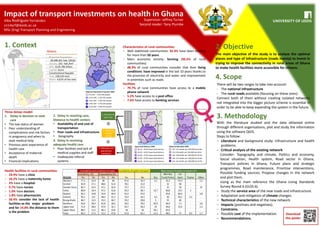
Availability and condition of roads Availability of public transport Main means of public transport (%)
Availability (%) Impassability (%) Mini Bus Car
REGION Yes No Yes No Yes No Bus Truck/Trotro (taxi) Tractor Other
Western 77,1 22,9 40 60 67,6 32,4 2,2 41,3 54,3 - 2,2
Central 82,9 17,1 48,6 51,4 78,1 21,9 - 32 68 - -
Greater Accra 85,7 14,3 57,1 42,9 72,7 27,3 - 25 50 - 25
Volta 80,9 19,4 47,2 52,8 63,3 36,7 13,7 60,8 23,5 2 -
Eastern 85,2 14,8 55,6 44,4 62,4 37,6 - 35,8 60,4 - 3,8
Ashanti 93,1 6,9 48,3 51,7 75,9 24,1 4,5 50 43,2 2,3 -
Brong Ahafo 86,7 13,3 53,3 46,7 70,2 29,8 5 55 40 - -
Northern 63,6 36,4 81,8 18,2 29,5 70,5 42,9 46,4 7,1 - 3,6
Upper East 71,4 28,6 67,9 32,1 43,7 56,3 25 56,8 15,9 - 2,3
Upper West 88,5 11,5 46,2 53,8 50 50 34,1 65,9 - - -
Total 82,5 17,5 52,2 47,8 57,9 42,1 12,3 48,5 37 0,5 1,7
Three delays model:
1. Delay in decision to seek
care
• The low status of women
• Poor understanding of
complications and risk factors
in pregnancy and when to
seek medical help
• Previous poor experience of
health care
• Acceptance of maternal
death
• Financial implications
3. Delay in receiving
adequate health care
• Poor facilities and lack of
medical supplies and staff
• Inadequate referral
systems
2. Delay in reaching care,
Distance to health centers
• Availability of and cost of
transportation
• Poor roads and infrastructure
• Geography
Socioeconomic/
CulturalFactors
Accesibility
offacilities
Qualityofcare
1. Decision to
seek Care
2. Reaching
medical
facility
3. Adequate and
appropriate
treatment
Download
this poster
36,1% - 39,4% Supervised delivery
39,4% - 42,6% Supervised delivery
42,6% - 47,9% Supervised delivery
47,9% - 52,6% Supervised delivery
52,6% - 53,7% Supervised delivery
129 -131 deaths per 100,000 live births
131-136 deaths per 100,000 live births
136 -148 deaths per 100,000 live births
148 -215 deaths per 100,000 live births
215 -267 deaths per 100,000 live births
671,043 – 1,015,290 people
1,015,290 – 1,937,301 people
1,937,301 – 2,387,502 people
2,387,502 – 2,555,362 people
2,555,362 – 4,881,427 people
Regional Population Projection 2009
Supervised Delivery 2009 Maternal Mortality 2009
•For almost over 30 years in Hong Kong, bus networks have
not seen major changes nor innovations. However during
this time, 1) people and activities could have changed, 2)
roads have become more congested and 3)new MTR
railways have ‘caught-up’ and an efficient and reliable
substitute has been available.
•These changes imply bus amendments are necessary but
to date, they have been difficult to conduct - This is
because there is a part or section of each bus route which
is still more point-to-point and direct compared to using
MTR. Also, the Public housing estates which are usually not
well-served by the railways but requires affordable
transport means that buses are also important for meeting
equity needs. All in all, with lots of objections to proposed
amendments, oversupply of services is resulted.
•It is thus important to ‘rationalize’ transport services by
removing wasteful competition to maintain economic
efficiency. This study looks, from the basis of passenger
and operator welfare-maximization, the extent that rail
‘substituting’ buses is desirable.
Background – The ‘problem’
•To conduct bus patronage counts, generalized cost
calculations and interviews with passengers on the
existing bus services
•To form a theoretical model to explain the factors that
affect the travel mode choices at different times of day
and at different sections of the same corridor
•To find out if efficiency can be achieved with equity
•To inform and recommend to the policy over the most
economic welfare-maximizing competition and/or
coordination levels based on the results
Aims and Objectives
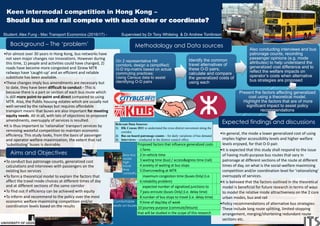
Keen intermodal competition in Hong Kong –
Should bus and rail compete with each other or coordinate?
Student: Alex Fung - Msc Transport Economics (2016/17) - Supervised by Dr Tony Whiteing & Dr Andrew Tomlinson
On 2 representative HK
corridors, design a (simplified)
O-D trip-matrix based on actual
commuting practices;
Using Census data to assist
identifying O-D pairs
Identify the common
travel alternatives of
these O-D pairs,
calculate and compare
the generalized costs of
using each
Also conducting interviews and bus
patronage counts, recording
passenger opinions (e.g. mode
attributes) to help understand the
generalized cost difference and to
reflect the welfare impacts on
operator’s costs when alternative
bus strategies are proposed
Present the factors affecting generalized
cost using a theoretical model,
Highlight the factors that are of more
significant impact to assist policy
recommendations
MTR overcrowding
Comfortable
seats on buses
Methodology and Data sources
•In general, the mode a lower generalized cost of using
implies higher accessibility levels and higher welfare
levels enjoyed, for that O-D pair.
•It is expected that this study shall respond to the issue
of having multi-purpose bus routes that vary in
patronage at different sections of the route at different
times of day, on what is the social-welfare maximizing
competition and/or coordination level for ‘rationalizing’
oversupply of services.
•It is believed that the factors outlined in the theoretical
model is beneficial for future research in terms of ways
to model the relative mode attractiveness on the 2 core
urban modes, bus and rail
•Policy recommendations of alternative bus strategies:
These include long route splitting, limited-stopping
arrangement, merging/shortening redundant route
sections etc.
Expected findings and discussions
Slow bus
routes
high
travel
time
variability
Proposed factors that influence generalized costs
1
2
3
4
5
6
7
8 number of bus stops to travel (i.e. delay time)
9 time of day/day of week
10
that will be studied in the scope of this research
journey purpose (commute/leisure)
anxiety of waiting at bus stops
fares
Overcrowding at MTR
maximum congestion time (buses Only) (i.e.
reliability problem)
expected number of signalized junctions to
pass enroute (buses Only) (i.e. delay time)
in-vehicle time
waiting time (bus) / access&egress time (rail)
Relevant Data Sources:
1) HK Census 2011 to understand the cross district movement along the
corridor.
2) Bus on board patronage counts – for daily variations of bus demand
3) Interviews – conducted in the district council office
Understanding Pedestrian Interactions with Automated Vehicles
OBJECTIVES
To achieve this aim, the following objectives have been
set:
 Understanding pedestrian interactions with the
non-automated vehicles
 Studying different aspects of this understanding,
such as the cultural differences that have a crucial
role in this interrelationship
 Finally, understanding of the factors that affect
pedestrian interactions with AVs
METHODOLOGY & DATA
COLLECTION
Literature Review of studies
regarding the driver-pedestrian
interactions, as well as some
recent studies regarding the
interaction between pedestrians
and AVs.
Data Collection by focus groups
interviews (2-3 with 5-8 people
each). The groups consist of
participants of different genders and
nationalities, with cultural differences
who are asked to state their preferred
choices across a set of different
scenarios.
Data collection by
questionnaires. They include
questions regarding the pedestrians-
drivers interactions and some others
regarding some important aspects of
the pedestrians – AVs interactions,
based on the outcomes of the focus
groups discussions.
Analysis of the results. Qualitative
analysis of the focus groups outputs by
recording them and taking notes, and
statistical analysis of the
questionnaires’ results by using the
statistical software SPSS.
AIM
The aim of this project is to understand the
interactions between the pedestrians and
the drivers of the non - automated vehicles
and identify how these interactions may
change when introducing automated driving
(SAE Level 4 AVs).
INTRODUCTION - BACKGROUND
 Even though there is some understanding of how pedestrians
interpret the actions of vehicles with drivers, there are great
challenges for interpreting these communication strategies in the
case that the driver is absent or is not maneuvering the vehicle
(Merat et al., 2016).
 People of different gender, nationalities and with cultural
differences perceive the pedestrian - vehicle interactions in a
different way.
 Pedestrians’ safety might decrease when driver’s role changes
from active to passive (Lagstrom and Lundgren, 2015).
 Pedestrians perceive this new driver behavior as hazardous when
they are unaware that the vehicle is driving in the automated
mode (Lagstrom and Lundgren, 2015).
 Hence, pedestrians need to be provided with additional feedback
in the interaction with the automated vehicles (AVs) due to the
inadequate information.
KEY REFERENCES
• Anderson, J., Kalra, N., Stanley, K., Sorensen, P., Samaras, C. & Oluwatola,
O. 2014. Autonomous vehicle technology: a guide for policymakers in
Rand Corporation, Arlington, Virginia, USA, pp. 185.
• Lagstrom, T. and Lundgren, V.M., 2015. AVIP-Autonomous vehicles
interaction with pedestrians (Doctoral dissertation, Thesis).
• Merat, N., Madigan, R. and Nordhoff, S., 2016. Human Factors, User
Requirements, and User Acceptance of Ride-Sharing in Automated
Vehicles. Paper prepared for the ITF Roundtable on Cooperative Mobility
Systems and Automated Driving, 6th-7th December, 2016, OECD.
• Šucha, M. 2014. Fit to drive: 8th International Traffic Expert Congress. 8-9
May, 2014, Warsaw.
Alexandra Kotopouli MSc Transport Economics
Supervisor: Ruth Madigan Second Reader: Natasha Merat
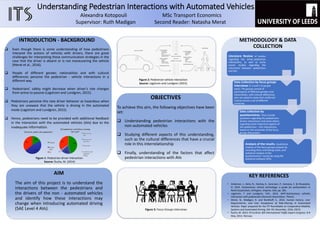
Figure 2: Pedestrian-vehicle interaction
Source: Lagstrom and Lundgren (2015)
Figure 1: Pedestrian-driver interaction.
Source: Šucha, M. (2014)
Figure 3: Focus Groups Interviews
Sebayang, Aliset – MSc (Eng) Transport Planning and Engineering
Institute for Transport Studies
Email: ts16as@leeds.ac.uk
Supervisor: Alan Jeffery, BSc(hons) CEng MICE FCIHT FCMI
Utilization	of	Aircraft	Classification	Number	and	Pavement	Classification	Number
(ACN-PCN)	as	part	of	Airport	Pavement	Management	System	(APMS)
Study	Case:	Soekarno-Hatta	International	Airport	(SHIA),	Jakarta,	Indonesia
Background
ACN-PCN	is	a	method	to	describe	the	relationship	
between	the	airfield	pavement	strength	and	the	
aircraft.	ACN	is	published	by	aircraft	manufacturers	
and	PCN	is	issued	by	the	airport's	operator.	The	
purpose	is	to	determine	whether	an	aircraft	can	use	
an	airfield	pavement.
Four	methods	of	ACN-PCN	recognized	by	
International	Civil	Aviation	Organization	(ICAO):	
1. Classic	method	(CBR	method)	
2. Graphical	method	(by	UK	Dept.	of	Defence)
3. Federal	Aviation	Administration	(FAA)	standard	
method
4. Field	test	by	Heavy-Weight-Deflectometer
Expected	Findings
1. The	method(s)	that	is	preferred	to	use	in	
evaluating	the	airport’s	PCN	value	in	Indonesia	
and the	reasons
2. The	residual	life	of	the	existing	pavement	
Objectives
1. To	assess	which	method	is	preferred	by	the	
operator(s)	as	part	of	the	APMS.	
2. To	discuss	the	advantages	and	the	drawbacks	in	
implementing	the	methods.
3. To	evaluate	the	ACN-PCN	of	SHIA,	Jakarta
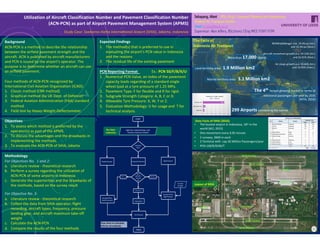
PCN Reporting Format Ex.: PCN 50/F/B/X/U
1. Numerical	PCN	Value,	an	index	of	the	pavement	
capacity	loads	regarding	of	a	standard	single	
wheel	load	at	a	tyre	pressure	of	1.25	MPa.
2. Pavement	Type:	F	for	flexible	and	R	for	rigid.
3. Subgrade	Strength	Category:	A,	B,	C	or	D.
4. Allowable	Tyre	Pressure:	X,	W,	Y	or	Z.
5. Evaluation	Methodology:	U	for	usage	and		T	for	
technical	analysis.
Airline	passenger	rise		19.3%	pa	(Int.)
and	13.4%	pa	(Dom.)
Aircraft	movement	growth	p.a:	19.12%	(Int.)	
and	16.01%	(Dom.)
Air	cargo	growth	p.a:	19.46%	(Int.)	
and	14.95%	(Dom.).
More	than	17,000	islands
Land	territory	area: 1.9	Million	km2
Marine	territory	area: 3.1	Million	km2
The	4th fastest	growing	market	in	terms	of	
additional	passengers	per	year	by	2035	
(IATA,	2016)
299	Airports connecting	the	islands
The	Facts	of	
Indonesia	Air	Transport
Source:	google.map
The	Data	
Collection
Flow	chart	to	Calculate	
PCN	for	all	methods
Data	Facts	of	SHIA	(2016):
• The	busiest	airport	in	Indonesia,	18th in	the	
world	(ACI,	2015)
• One	movement	every	0.95	minute
• 2	runway,	3600	m	each
• 3	Terminal	with		cap	26	Million	Passengers/year
• PCN	120/R/D/W/T
Source:	google.map
Layout	of	SHIA	
North	Runway
South	Runway
North	Taxiway
South	Taxiway
Terminal	1
Terminal	2
Terminal	3
MRO
Methodology
For Objectives No. 1 and 2:
a. Literature	review	- theoretical	research	
b. Perform	a	survey	regarding	the	utilization	of	
ACN-PCN	of	some	airports	in	Indonesia
c. Generate	the	superiorities	and	the	drawbacks	of	
the	methods,	based	on	the	survey	result
For Objective No. 3:
a. Literature	review	- theoretical	research
b. Collect	the	data	from	SHIA	operator;	flight	
recording,	aircraft	types,	frequency,	pressure	
landing	gear,	and	aircraft	maximum	take-off	
weight	
c. Calculate	the	ACN-PCN
d. Compare	the	results	of	the	four	methods
Introduction
Connectivity throughout road networks is an issue of major interest for local and national
governments, it is considered as an index of productivity and development. For that
reason, studies have been developed to provide a solid framework that helps poli-
cymakers to achieve the highest benefit of their decisions. Regardless the deci-
sions made, networks may occasionally undergo reductions of their designed
capacity due to unexpected and undesirable events such as accidents or nat-
ural disasters like earthquakes and flooding. Then, with limited resources
for reconstruction and enhancement, policymakers must decide how to
distribute the official budget to minimize the impact of possible disrup-
tions.
Objectives
 Formulate the Network Investment Allocation Problem as Mathe-
matical Problem with Equilibrium Constrain.
 Propose a solution using a Simulating Annealing Approach.
 Test different scenarios and evaluate the solution using at least two net-
work examples.
 Evaluate the performance of the methodology in real scale networks.
Theoretical Framework
Network Investment Allocation Problem
The Network Design Problem (NDP) is formulated to identify the combination of links (i.e. road, streets), whose availability
(construction) or capacity expansion, maximize the network benefit (or minimize costs) in order to meet the growing trip demand and
prevent congestion (Wang, et al., 2014). Authors subdivide NDP into three categories: Continues Network Design Problems (CNDP),
Discrete Network Design Problem (DNDP) and the mixed version (MNDP) (Wang, et al., 2014). The first category suggests to add new
links to the network, while the second one aims to increase the existing capacity and the third one is a combination of the first two. In
this dissertation it will be formulated the Network Investment Allocation Problem (NIAP). This problem consists on identifying what
is the best invest, to recover capacity after disruption or to increase capacity on other non-disrupted links.
Simulated Annealing
In condensed matter physics, the simulation of the annealing of solids is a process which objective is to minimize the energy between
particles by arranging them aleatory. To achieve the minimal energy the solid is exposed to heat until it melts (maximum heat), then it
is cooled up slowly until it turns into solid state again (cooling scheme). As analogy of this process, Kirkpatrick (1983) developed an
algorithm to solve combinatorial problems, that consists of four elements: a representation of the system, a random generator of per-
turbances, an objective function and the annealing schedule (maximum temperature and cooling scheme).
Methodology
It will be proposed an algorithm to solve the NIAP, which will be first tested using an small network. Once the solution is proved to
work, the performance of the algorithm will be evaluated using a real scale network.
Algorithm
Represent the network as graph.
Code and run Method of Successive Average (MSA) to model traffic assignment.
Code and run Simulated Annealing.
Define objective function: Total travel cost.
Create perturbance function: Select randomly the set of links where the investment
will be allocated.
Set annealing schedule: Trial and error, different tempera-
tures and cooling schemes will be logged.
Tools
 Excel: To store input (coordinates, capacity, demands,
paths, etc.) and outputs (flow, new capacities, system cost).
 Wolfram Language: To code algorithms and visualise
networks.
Outputs
Network performance: New capacities, flows and travel time.
Algorithm performance: Runtimes and convergence.
Evaluation of the applicability of the solution to solve the
problem of the budged distribution.
Discussion of further researches.Institute for Transport Studies (ITS)
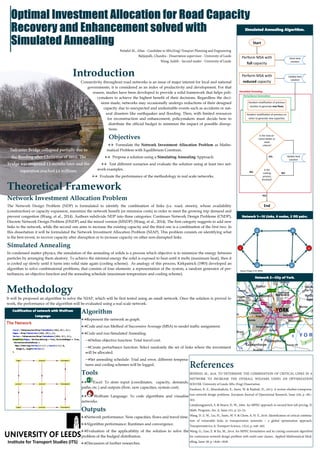
Start
Perform MSA with
full capacity
Perform MSA with
reduced capacity
Random modification of previous
solution to generate new flows.
Random modification of previous so-
lution to generate new capacities.
Update best
solution
Store best
solution
Simulated Annealing
Perturbance Generation
Is the new so-
lution better or
meet
criteria?
Update best
solution
Is the
cooling
process
finished?
YES
YES
NONO
End
2 4
5
1 6
3
Source: Wang, G.M. (2014)
Andrew Robbins
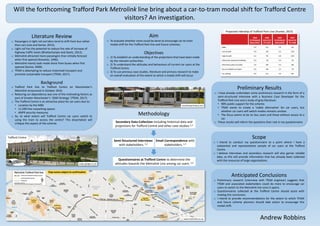
Will the forthcoming Trafford Park Metrolink line bring about a car-to-tram modal shift for Trafford Centre
visitors? An investigation.
Literature Review
o Passengers in light rail corridors tend to shift from bus rather
than cars (Lee and Senior, 2013).
o Light rail has the potential to reduce the rate of increase of
highway traffic levels (Bhattachanjee and Goetz, 2012).
o Metrolink attracted more passengers than initially forecast
when first opened (Knowles, 1996).
o Metrolink mainly took mode share from buses when first
opened (Senior, 2009).
o TfGM is attempting to reduce motorised transport and
promote sustainable transport (TfGM, 2017).
Background
o Trafford Park line to Trafford Centre on Manchester’s
Metrolink announced in October 2016.
o Reducing car dependency was one of the motivating factors as
part of Greater Manchester’s ‘2040 Strategy’ (TfGM, 2017).
o The Trafford Centre is an attractive place for car users due to:
• Location by the M60
• 11,500 free carparking spaces
• ANPR security measures
o So, to what extent will Trafford Centre car users switch to
using the tram to access the centre? This dissertation will
critique this aspect of the scheme.
Aim
o To evaluate whether more could be done to encourage car-to-tram
modal shift for the Trafford Park line and future schemes.
Objectives
o 1) To establish an understanding of the projections that have been made
by the relevant authorities.
o 2) To understand the attitudes and behaviours of current car users at the
Trafford Centre.
o 3) To use previous case studies, literature and primary research to make
an overall evaluation of the extent to which a modal shift will occur.
Scope
o I intend to conduct my questionnaire to a point where I have a
substantial and representative sample of car users at the Trafford
Centre.
o I believe interviews and secondary research will also garner reliable
data, as this will provide information that has already been collected
with the resources of large organisations.
Anticipated Conclusions
o Preliminary research (interview with TfGM engineer) suggests that
TfGM and associated stakeholders could do more to encourage car
users to switch to the Metrolink line once it opens.
o Questionnaires collected at the Trafford Centre should assist with
making this conclusion.
o I intend to provide recommendations for the extent to which TFGM
and future scheme planners should take action to encourage this
modal shift.
Methodology
maps.google.co.uk
www.metrolink.co.uk
Projected ridership of Trafford Park Line (Hunter, 2015)
Secondary Data Collection including historical data and
projections for Trafford Centre and other case studies.1,3
Semi-Structured Interviews
with stakeholders.1,3
Questionnaires at Trafford Centre to determine the
attitudes towards the Metrolink Line among car users.2,3
Email Correspondence with
stakeholders.1,3
Trafford Centre
Preliminary Results
o I have already undertaken some preliminary research in the form of a
semi-structured interview with a Business Case Developer for the
Trafford Park Line and a study of grey literature:
• 90% public support for the scheme.
• TfGM wants to create a ‘viable alternative’ for car users, but
whether car users will switch modes remains unclear.
• The focus seems to be on bus users and those without access to a
car.
o These results will inform the questions that I ask in my questionnaire.
manchesterhistory.net
Evaluating transport governance structures for Metro
Manila using cases on mass transit programmes
Anne Patricia E. Mariano, ts16apem@leeds.ac.uk Supervisor: Dr. Katharine Pangbourne
Second Reader: Professor Greg MarsdenMSc Sustainability in Transport
Potential Cases: Mass Transit Programmes
1.  Limited-stop	bus	services	were	introduced	in	2015	to	encourage	bus	ridership.	
These	services	successfully	reduced	travel	?me	but	do	not	replace	exis?ng	routes.	
2.  Studies	were	conducted	in	2014	and	2016	to	(a)	iden?fy	required	mass	transit	
routes	by	reviewing	demand	and	exis?ng	services,	and	(b)	present	op?misa?on	
plans	for	3	routes.	These	are	yet	to	be	implemented	in	favour	of	further	studies.	
3.  Infrastructure	projects	such	as	a	bus	rapid	transit	system	between	2	ci?es	and	a	
commuter	rail	to	connect	4	regions	were	posi?vely	received	by	stakeholders	albeit	
with	concerns	on	the	poli?cal	costs	of	land	acquisi?on.	
Mode Share of Metro Manila Trips
Based	on	household	interview	surveys	and	a	total	of	35.5	million	trips	(JICA,	2014)	
Transportation Issues
•  Total	metro	rail	lines	of	only	50km	(DOTr,	2015)	
•  Transit	primarily	informal,	lacking	organised	
stops,	schedules,	and	services	(DOTr,	2015)	
•  18%	increase	in	travel	9me	on	buses	from	
1996	to	2014	(JICA,	2015)	
•  Over	2M	registered	vehicles	and	some	of	the	
worst	conges?on	in	the	world	(DOTr,	2015;	Waze,	
2015)	
Es?mates	put	Metro	Manila	conges9on	costs	
at	GBP	37.5M	every	day.	(JICA,	2014)	
Selected References
• Aberbach,	J.	and	Rockman,	B.	2002.	Conduc?ng	and	coding	elite	interviews.	PoliDcal	
Science	&	PoliDcs,	35(04),	pp.673-676.	
• Creswell,	J.	2007.	QualitaDve	inquiry	and	research	design:	Choosing	among	five	
approaches.	2nd	edi?on.	California:	Sage	Publica?ons.	
• DOTr.	2015.	Metro	Manila	2015-2030:	Approaches	to	Current	Transporta?on	Issues	for	
the	Future.	
• Japan	Interna?onal	Coopera?on	Agency	[JICA].	2014.	Final	Report	-	Main	Text.	Roadmap	
for	Transport	Infrastructure	Development	for	Metro	Manila	and	Its	Surrounding	Areas.		
• JICA.	2015.	MUCEP	Progress.	The	Project	for	Capacity	Development	on	TransportaDon	
Planning	and	Database	Management	in	the	Republic	of	the	Philippines	(MUCEP).	
• Philippine	Sta?s?cs	Authority.	2016.	Regional	Accounts	of	the	Philippines.	[Online].	
[Accessed	21	April	2017].	Available	from	h`ps://psa.gov.ph/regional-accounts/grdp/
data-and-charts	
• Waze.	2015.	Global	Driver	Sa?sfac?on	Index.	[Online].	[Accessed	20	April	2017].	
Available	from	h`ps://blog.waze.com/2015/09/global-driver-sa?sfac?on-index.html	
The	study	will	focus	on	the	following:	
1.  What	are	the	formal	and	informal	boundaries	of	Metro	Manila	in	
terms	of	transporta?on?	
2.  Who	are	the	decision-makers	for	the	planning	and	implementa?on	
of	transporta?on	programmes	in	Metro	Manila?	
3.  What	organisa?onal	or	mandate	issues	do	these	decision-makers	
face	in	planning	or	implementa?on,	in	light	of	a	specific	programme	
to	improve	mass	transit?	
4.  What	policy	or	organisa?onal	changes	can	address	these	issues?	
Research Questions
Regional	Development	Council	
–	Na?onal	Capital	Region	
Metropolitan	Manila	
Development	Authority	
Department	of	
Transporta?on	
Department	of	Public	
Works	and	Highways	
Na?onal	Economic	and	
Development	Authority	
Proposed Methodology
This	study	will	employ	qualita?ve	research	methods	(Creswell,	2007).	To	gain	a	
deeper	understanding	of	the	issues,	semi-structured	interviews	with	open-ended	
ques?ons	will	be	conducted	with	stakeholder	representa?ves	(Aberbach	and	
Rockman,	2002).	These	may	include	the	DOTr,	the	MMDA,	2-3	LGUs	depending	on	
the	case	study,	and,	if	relevant,	public	individuals.	All	data	will	be	anonymised.	
Legisla?on,	historical	and	current	events,	and	similar	cases	will	be	reviewed	prior	
to	fieldwork.	This	will	aid	in	formula?ng	ques?ons	and	iden?fying	relevant	
stakeholders.	Due	to	?me	constraints,	all	interviews	will	be	scheduled	over	one	
week	in	June	2017.	Coordina?ng	with	officials	will	be	crucial	to	data	quality.	
Collected	data	will	be	transcribed	and	coded	to	enable	analysis.		


Review	of	
literature	
On	Metro	Manila;	
metro	regions;	
qualita?ve	research;	
and	elite	interviews	
Formula?on	of	
ques?ons	
and	
iden?fica?on	
of	interviewees	
Conduct	of	
face-to-face	
interviews	
Data	analysis	
and	
formula?on	of	
conclusions	
*Coloured	areas	on	map	depict	potenDal	study	areas.	
Jeepney,	19%	
Tricycle,	16%	
Bus,	7%	
Train,	4%	
Other	Public	
Modes,	3%	
Motorcycle,	
8%	
Car,	8%	
Taxi,	1%	
Other	Private	
Modes,	3%	
Walking,	31%	
Public		
17,335		
Private		
7,253		Walking		
10,913		
Overview: Metro Manila Transportation
Area:	 	 	 		
636km2,	0.21%	of	country	
Popula?on	(2015): 		
12.88M,	12.75%	of	country	
Economic	Output	(20151):	
GBP	43.3B,	36.5%	of	country	
Public	transit	op?ons:	
3	metro	rail	lines	
82	bus	routes	
124	u?lity	vehicle	routes	
677	jeepney	routes	
1Constant	2000	prices	
Local	Government	Units	(LGUs):		
16	ci9es	
1	municipality	
Regional	Agencies: 		
MMDA	–		Metropolitan	Manila	Development	Authority	
Na?onal	Agencies:	
DOTr	–	Department	of	Transporta?on	
DPWH	–	Department	of	Public	Works	and	Highways		
NEDA	–	Na?onal	Economic	and	Development	Authority	
LGUs	are	led	by	elected	mayors,	while	regional	and	
na?onal	agencies	are	typically	led	by	presiden?al	
appointees.
Data Fusion: A Simulation Approach
Aseem Awad
Institute for Transport Studies, Leeds
Objectives
We explore ways of addressing the issue of Verac-
ity and Value in Big Data.
• Apply techniques of Data Fusion to create a
Origin-Destination with high fitness-for-use, to
provide benchmark for the performance of our
models.
• Create Geospatial Microsimulation to visualize
results of the transport model based on our
datasets. Focus on one system.
• Use the hybrid Geospatial Microsimulation to
iteratively improve a simulation model of the
urban system. Compare the results with
analytical approaches.
Introduction
Transport modelling can be conceptualised as mod-
elling of transport demand, transport supply and the
evolving interaction of these two factors. In this dis-
sertation we set out to create and exhibit a demand
model with high fitness-for-use by utilising Data Fu-
sion and an innovative hybrid of Spatial Microsimu-
lation and Agent-Based simulation.
Figure 1: Agent-Based model to simulate changes in the built
environment of East Anglia
Materials
The following materials are required to complete the
research:
• A social media dataset coming from active
individuals. (STRAVA)
• Data of Automatic Traffic Detection readings.
• Data regarding Land-Use and demographics.
• A software suitable for Agent-Based Simulation.
Previous attempts in this direction have been
made using MATsim-T and NetLogo. We intend
to use R and NetLogo.
Methodology
• We apply the ITS Data Fusion techniques
described in [1] to STRAVA and other
demographic datasets.
• We use Geospatial Microsimulation for a separate
process of Data Fusion.
• We iteratively calibrate the simulation model and
the analytical model used for Data Fusion.
• We conclude by an analysis of the relation
between Active Travel, Public Transport and
Land Use/demographic variables.
The Central Research Question
How to fuse data from social media with traditional datasets to create high quality data? What role can
Geospatial Microsimulation and Agent-Based Modelling serve in this process?
Underlying Architecture of Data
Fusion
Figure 2: The typical Architecture of Data Fusion techniques.
[2]
[3] is the first paper that uses Geospatial Microsim-
ulation for the purpose of Data Fusion. The simula-
tion can display the efficacy of a given algorithm.
Application of the Technique
Figure 3: A link existing?
The relation between active travel, public transit
and Land-Use characteristics provides a rich area
for research. We aim to get a detailed picture of the
active travel occurring in our area of choice. We can
use the dataset to infer the relation of active travel
with Land-Use and Public Transit. As a conclusion
we hope to demonstrate the relation between these
elements.
Additional Information
Figure 4: City of Glasgow in motion. Projection of a dataset
acquired by UBDC
This project has established relationships with orga-
nizations that specialize in collecting and curating
data. CDRC in Leeds and Urban Big Data Center
(UBDC) will be involved in the acquisition of data.
References
[1] Nour-Eddin El Faouzi, Henry Leung, and Ajeesh Kurian.
Data fusion in intelligent transportation systems: Progress
and challenges–a survey. Information Fusion, 12(1):4–10,
2011.
[2] David Lee Hall and Sonya AH McMullen. Mathematical
techniques in multisensor data fusion. Artech House,
2004.
[3] Chris Bachmann, Baher Abdulhai, Matthew J Roorda, and
Behzad Moshiri. A comparative assessment of multi-sensor
data fusion techniques for freeway traffic speed estimation
using microsimulation modeling. Transportation Research
Part C: Emerging Technologies, 26:33–48, 2013.
Contact Information
• Email: ts16ara@leeds.ac.uk
• Phone: +44 7435703778
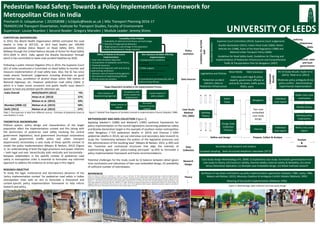
1. Introduction
India ranks high in road traffic fatalities. India has the 2nd largest road network in the World[1]
but lags qualitatively[2]. A report[3] based on in-depth crash data highlights that all fatal crashes
in urban Kolkata (Nov’14 to Nov’15) had at least one infrastructure factor contributing to its
incidence. My research study aims to identify and address such factors in a junction in the city
of Kolkata, India.
4. Location identification
o Identify one location from 516 crashes with GPS locations
• Should have high accident incidence
• Be a typical junction to develop a template for transferability
8. References
[1] www.telegraphtravelteam.carto.com
[2] www.web.worldbank.org
[3]Kolkata City Fatal Accident Study 2016, JP Research India Pvt. Ltd.
6. Intervention development
o Literature review for possible solutions to identified problems
o Develop relevant interventions based on local conditions
• CAD will be used for design, if required
• ARCADY/LinSig to be used for intervention assessment
5. Problem identification
o Registered accidents considered as “case studies” and analysed
for following crash parameters:
• Crash configuration
• Kind of accident
o Additional data to be collected on traffic volume and counts
2. Objectives
o Identify a junction with high crash incidence
o Study crashes to understand the interactions leading to crash occurrence
o Literature review to list possible solutions and develop relevant changes
o Assess the proposed changes using relevant software
o Transferability of changes to other locations
3. Data Source and basic statistics
Fatal crashes data from JP Research India Private Limited (JPRI)
o 719 crashes registered between Nov’14 to Nov’16 (24months)
• 53% of 719 crashes involved pedestrians
• 54% of 706 fatalities were pedestrians
• 20% of accidents involved vehicles moving in the same direction
0% 0%
0%
81%
19%
Human
VehicleInfrastructure
Pedestrian,
384Same
direction
traffic,
140
Pedestrian
Same direction traffic
Leaving carriageway
Opposing traffic
Turning/crossing
Obstacles in carriageway
Other kind
Unknown
DEVELOPMENT OF INFRASTRUCTURE IMPROVEMENTS FOR REDUCING
FATAL ACCIDENTS IN KOLKATA, INDIA
QGIS plot of 516 crashes
516 accidents
Evenly spread
throughout city
QGIS filtering to
locations > 2 crashes
within 100m2 area
12 Locations: 45 accidents
Max: 6 accidents
Includes:
Junctions
Roundabouts
Grade separated junc.
Parking bay entry
2 Locations: 12 accidents
1. Typical 4-arm junction,
lower traffic density
2. Most vulnerable,
includes tram line, grade
separated overhead
bridge, high traffic
density
7. Transferability
o Improved junction design will to be used as base template
• Most locations have ensuing crash configurations in common
(Front-rear, front-side, pedestrian, object)
o Numerical extrapolation of number of accidents prevented
with proposed changes
Kind of Accident
Contributory factors [3]
Bhuvanesh Bharath Alwar M, MSc (Eng) Transport Planning and Engineering
Junction Ped. Acci. Veh. Acci. Fatalities
Raja Dinendra street -
Shri Aurobindo Sarani
2 2 4
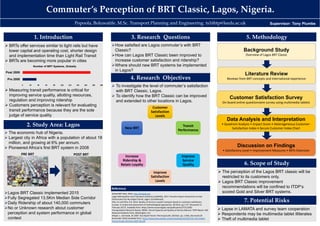
Commuter’s Perception of BRT Classic, Lagos, Nigeria.
Popoola, Boluwatife. M.Sc. Transport Planning and Engineering. ts16btp@leeds.ac.uk 
 The economic hub of Nigeria.
 Largest city in Africa with a population of about 18
million, and growing at 6% per annum.
 Pioneered Africa’s first BRT system in 2008
Lagos BRT Classic implemented 2015
Fully Segregated 13.5Km Median Side Corridor
Daily Ridership of about 140,000 commuters
No or Unknown research about customer
perception and system performance in global
context
 To investigate the level of commuter’s satisfaction
with BRT Classic, Lagos.
 To identify how the BRT Classic can be improved
and extended to other locations in Lagos.
1. Introduction 3. Research  Questions 5. Methodology
 The perception of the Lagos BRT classic will be
restricted to its customers only.
 Lagos BRT Classic improvement
recommendations will be confined to ITDP‘s
scored Gold and Silver BRT systems.
 BRTs offer services similar to light rails but have
lower capital and operating cost, shorter design
and implementation time than Light Rail Transit
 BRTs are becoming more popular in cities
0 20 40 60 80 100 120 140 160 180 200
Pre 2000
Post 2000
Number of BRT Systems, Globally
 Measuring transit performance is critical for
improving service quality, allotting resources,
regulation and improving ridership
 Customers perception is relevant for evaluating
transit performance because they are the sole
judge of service quality
How satisfied are Lagos commuter’s with BRT
Classic?
How can Lagos BRT Classic been improved to
increase customer satisfaction and ridership?
Where should new BRT systems be implemented
in Lagos?
4. Research  Objectives
6. Scope of Study
7. Potential Risks
2. Study Area: Lagos
PRE BRT POST BRT
 Lapse in LAMATA and survey team cooperation
 Respondents may be multimedia tablet illiterates
 Theft of multimedia tablet
Supervisor: Tony Plumbe
Background Study
Overview of Lagos BRT Classic 
Discussion on Findings
• Satisfactory Level • Improvement Measures • BRTs Extension
Data Analysis and Interpretation
• Quadrant Analysis • Impact Score • Heterogeneous Customer‐
Satisfaction Index • Secure Customer Index Chart
Customer Satisfaction Survey
On‐board online questionnaire survey using multimedia tablets
Literature Review
Reviews from BRT concepts and international experience
Customer 
Satisfaction
Levels
Transit 
Performance
Improve
Service 
Quality
Improve 
Satisfaction 
Levels
Increase 
Ridership & 
Retain Loyalty
New BRT
Reference
Global BRT Data. 2016. http://brtdata.org
Lagos Metropolitan Area Transport Authority (LAMATA). 2017. Periodic Impact Assessment on Key 
Performance for Bus Rapid Transit. Lagos. (Confidential)
Oña, D.J and Oña, D.R. 2014. Quality of service in public transport based on customer satisfaction 
surveys: A review and assessment of methodological approaches. [Online]. pp.1‐47. [Accessed 12 
February 2017]. Available from: https://www.researchgate.net/publication/271512605
Transportation Research Board, 2003b. Transit Capacity and Quality of Service Manual. TCRP Report 100. 
National Academy Press, Washington, D.C. 
Wright, L. and Hook, W. 2007. Bus Rapid Transit: Planning Guide. [Online]. pp. 1‐836. [Accessed 20 
November 2016] Available from: https://www.itdp.org/wp‐content/uploads/2014/07/52.‐Bus‐Rapid‐
Transit‐Guide‐PartIntro‐2007‐09.pdf
1
2
3
4
12
34
Datacollection
By:BowenZhang (Email:ts16bz@leeds.ac.uk) Supervisor:Dr.AndrewTomlinson
Farescrossingdifferent
classonsamefights
farescrossingdifferent
spaceinsameroutes/class
Publicdatasource
Dataexample
PitchandWidthDataiscollectedfrom www.seatguru.com
LowestPriceiscollectedfrom www.britishairways.com,therouteisfrom LHRtoPEK,thetraveldateis3rdMay2017
Mainreference
Kremser,F.,Guenzkofer,F.,Sedlmeier,C.,Sabbah,O.andBengler,K.2012.
Aircraftseatingcomfort:Theinfluenceofspaceonboardonpassengers’
well-being.Work.41(Supplement1),pp.4936–4942.
Lee,D.andLuengo-Prado,M.J.2004.Arepassengerswillingtopaymore
foradditionallegroom?JournalofAirTransportManagement.10(6),
pp.377–383.
Pels,E.2008.Airlinenetworkcompetition:Full-serviceairlines,low-costairPels,E.2008.Airlinenetworkcompetition:Full-serviceairlines,low-costair-
linesandlong-haulmarkets.ResearchinTransportationEconomics.24(1),
pp.68–74.
.wechoosetocollectdatafrom differentfull-serviceair-
lineswhichhavemorethan3classesofserviceorpersonal
space.
Theresearchwillfocusonlong-haulflight(8hoursor
more),becausepersonalspacebecomesmoreimportantin
whichalong-distancetrip.
Scopeoftheresearch
IsPassengerpersonalspaceakeyfactoraffectingflight
ticketfare?
Whatistherelationshipbetweenairlineticketpriceand
passengerpersonalspace?
Canwedrawthecurvetoindicatetherelationshipbetween
valueforperincreasinginch2ofpersonalspace?
Researchquestions
Personalspaceisanimportantfactoraffectingthecomfort
andtravelexperience.Therefore,thereareaaseriesof
questionsaboutthepersonalspaceandpossibleeffectfor
ticketfaresacrossfullserviceairline.Thepurposeofthis
researchisrevealingthepotentialrelationship.
Background
Methodology
Isitakeyfactoraffectingflightticketfare?
PASSENGERPERSONALSPACE
`
Carlos Caro Martin MSc Transport Economics
Supervisor: Dr Andrew Smith Second Reader: Dr Manuel Ojeda Cabral
Background
1. Is the length of the contract a determinant factor of
efficiency?
2. Is any different behaviour depending of the years
remaining in the contract?
Aim, objectives and data
a) Create a framework for all rail franchises to be able
to evaluate an optimum length of the franchise
b) Evaluation of each franchise to provide justifications
or expected level performance for each company
c) Provide recommendation for future actions
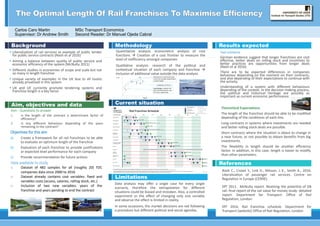
Quantitative analysis: econometric analysis of cost
functions  Creation of a cost frontier to measure the
level of inefficiency amongst companies
Qualitative analysis: research of the political and
contextual situation of each company and franchise 
Inclusion of additional value outside the data analysis
Methodology
Data analysis may offer a single case for every single
scenario, therefore the extrapolation for different
situations could be biased and mistaken. Also, a controlled
experiment or the effect of changing only one variable
and observe the effect is limited in reality.
In some occasions, the market decisions are not following
a procedure but different political and social agendas.
 Liberalization of rail services as example of public tender
for public service contracts (Nash et al 2016)
 Aiming a balance between quality of public service and
economic efficiency of the system (McNulty 2011)
 Different studies in economies of scope and scale but not
so many in length franchise
 Unique variety of examples in the UK due to all routes
already privatised in this system
 UK and UE currently promote tendering systems and
franchise length is a key factor
Limitations
German evidence suggest that longer franchises are cost
effective, better deals on rolling stock and incentives to
better practices are opportunities from longer deals
(Nash et al 2016).
There are to be expected differences in companies
behaviour depending on the moment on their contracts,
and also depending of their expectations to continue with
the activity.
Understanding of a system with different behaviours
depending of the context. In the decision making process,
the political and historical heritage are possibly as
important as current economic performance.
Results expected
The length of the franchise should be able to be modified
depending of the conditions of each line.
Long contracts in systems where investments are needed
and better rolling stock deals are possible.
Short contracts where the situation is about to change in
a near future, or not possible to obtain benefits from big
investments.
The flexibility in length should be another efficiency
factor. In addition, in this case, length is easier to modify
than other parameters.
Nash C., Crozet Y., Link H., Nilsson, J.-E., Smith A., 2016.
Liberalisation of passenger rail services. Centre on
Regulation in Europe (CERRE).
DfT 2011. McNulty report. Realising the potential of GB
rail: final report of the rail value for money study: detailed
report. Department for Transport: Office of Rail
Regulation, London.
DfT 2016. Rail franchise schedule. Department for
Transport [website] Office of Rail Regulation, London
References
Current situation
Cost frontier: establish the
level of inefficiency for each
firm at an output level
A’
Inefficiency of firm A
o Dataset of 482 samples for all (roughly 20) TOC
companies data since 2000 to 2016
o Dataset already contains cost variables: fixed and
variables costs (access, salaries, rolling stock, etc.)
o Inclusion of two new variables: years of the
franchise and years pending to end the contract
Movements in cost frontier due
to dummy variables depending of
contract length
1. BACKGROUND
• China’s "One Belt, One Road" initiative
prompted the construction and operation of
China-Europe 'Silk Road' Rail Network.
• China is one of the largest manufacturing
centre. Trade between EU and China keeps
increasing in recent years, while about 10.1%
of the imports and 6.3% of exports in 2016
were electronic products.
• Air pollution is responsible for tens of
thousands of early deaths every year. And in
EU 51% of NOx and 20% of PM2.5 emissions
were from transport in 2015.
2. SCOPE
Key Words
Eurasian Landbridge, Logistics, Emission
Area
China: Focus on 5 electronic industrial bases
European Cities:
London
Rotterdam
Hamburg
Oslo
Mode
3. METHODOLOGY
• Rail and road freight transport- García-
Álvarez et al (2013)
• Shipping- Jalkanen et al (2012) STEAM2
• Airline- Moniruzzaman et al (2011)
4. KEY REFERENCES
Data Source
• China Statistical Yearbook
• Ministry of Commerce PRC Statistic
• UN Comtrade Database
• IMF Data
Geography
• The Geography of Transport Systems
• Geographic Information System
Routes between China and Europe
Energy Consumption and
Pollutant Emission Evaluation
for Each OD Pair by Each Mode
Research Target Origins and
Destination Choosing
Comparison Analysis on
Emission Volumes from Each
Mode in Each Route
Pollutant
Impact on:
Human Vegetation Climate
Carbon
dioxide
Major greenhouse gas
Nitrogen
dioxide
Respiratory
irritation
Acidification of
soil and water,
over-fertilizing
Has high greenhouse
potential, lead to ozone
formation
Particulates
Respiratory
damage, various
toxic content
Reduced
assimilation
0
50
100
150
200
250
300
350
400
2006 2007 2008 2009 2010 2011 2012 2013 2014 2015 2016
EU Trand flows with China (Billion €)
Exports Imports
Emission Evaluation of Freight Transport Between Europe and China
in Electronic Trade
CHUCHU XIE ts16cx@leeds.ac.uk Supervisor: Anthony Whiteing MSc Transport Planning and the Environment
Data collection: The study incorporates the collection of both primary and
secondary data for an in-depth investigation.
Primary data will be collected though a structured self-administer
questionnaire. A draft questionnaire has been developed and will be pilot
tested on 30 respondents and modifications will be made based on pilot
testing.
Secondary data will be collected from academic journals, company reports and
books which will be used to define the research objectives and to explore
various facts.
Data analysis and interpretation of surveys: The questionnaire data
composed of closed rating scale questions will be compare against existing
literature and a descriptive analysis with bar charts and pie charts will be used.
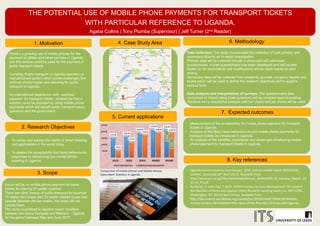
THE POTENTIAL USE OF MOBILE PHONE PAYMENTS FOR TRANSPORT TICKETS
WITH PARTICULAR REFERENCE TO UGANDA.
Agaba Collins | Tony Plumbe (Supervisor) | Jeff Turner (2nd Reader)
1. Motivation
There’s a growing use of mobile phones for the
payment of utilities and other services in Uganda
and this service could be used for the payment of
public transport tickets.
Currently, Public transport in Uganda operates on
manual based system which poses challenges like
retrieval of information and planning for public
transport in Uganda.
My international experience with cashless
payment for transport tickets showed me that a
solution could be provided by using mobile phone
payments which will benefit public transport users,
operators and the government.
2. Research Objectives
• To review and access the merits of smart ticketing
and applications in the world today.
• To assess the acceptability and likely behavioural
responses to introducing bus mobile phone
ticketing in Uganda.
4. Case Study Area
3. Scope
6. Methodology
Focus will be on mobile phone payment for travel
tickets for intercity 67 seater coaches.
There are other means of public transport for example
14 seater mini buses and 32 seater coaster buses that
operate between the two towns, this study will not
include them.
The study is confined to daytime coach travellers
between two towns Kampala and Mbarara – Uganda
for the period between May and June 2017.
5. Current applications
7. Expected outcomes
• Measurement of the acceptability for mobile phone payment for transport
tickets in Uganda.
• Analysis of the likely travel behaviour should mobile phone payments for
transport tickets be introduced in Uganda.
• An analysis of the benefits, importance and challenges of adopting mobile
phone payment for transport tickets in Uganda.
8. Key references
• Uganda	communications	commission.	2016.	Annual	market	report	2015/2016.	
[online].	[Accessed	26th April	2017].	Available	from:	
http://www.ucc.co.ug/files/downloads/Annual_Market%20_&_Industry_Report_20
15-16_FY.pdf
• Gutierrez,	E.	and	Choi,	T.	2014.	Mobile	money	services	development:	the	cases	of	
the	Republic	of	Korea	and	Uganda.	Policy	Research	working	paper;	no.	WPS	6786.	
Washington,	DC:	World	Bank	Group.	Available	from:	
http://documents.worldbank.org/curated/en/503961468174904206/Mobile-
money-services-development-the-cases-of-the-Republic-of-Korea-and-Uganda
Comparison	of	mobile	phones	and	Mobile	Money	
Subscribers’	Statistics	in	Uganda.
(CityConnect,2017)
1. Research Context
Despite a raised profile in recent years the modal share for cycling in
West Yorkshire is 0.8% of all commuting trips, half the national average
(Rogers, 2013).
 CityConnect is a £6m cycling infrastructure/promotion programme
managed by West Yorkshire Combined Authority and funded by the
Department for Transport
 It aims to make cycling “the natural choice for short journeys”
 The first physical leg, CS1, opened in June 2016 from west Leeds to
Bradford
By February 2017, 100,000 trips had been made on CS1, but limited
work has taken place so far to gauge usage by local residents.
2. Transport and identity theory
Traditionally, predictions of transport mode choice have been based on cost,
time and effort (Van Acker et al, 2013). However, these theories don’t ex-
plain differences in transport choices by “individuals in similar situations
and with similar socio-economic circumstances” (Heinen, et al 2011; Hei-
nen, 2016).
Now, a burgeoning body of work “suggests that decisions to cycle are af-
fected by perceptions of ‘bicyclists’ in the community, and whether or not an
individual wants to be identified with that group” (Sherwin, 2014).
“Transport identities, social-role identities, self-identities and place identi-
ties are important predictors of mode choice and change” (Heinen, 2016).
Identity theory in transport can be largely ascribed to :
 cultural identity (e.g. ethnicity)
 social identity, indicating identification with a group or social category
(Tajfel and Turner, 1986), i.e. a link between the self and social structure
(Stryker, 1987).
 Self identity, or the meaning that individuals attach to themselves
(Heinen, 2016). A value set rather than a role.
 The identities that local residents assume and/or subscribe to may there-
fore have an influence on their transport choices and use of CS1.
Increasing cycling could:
 Enhance air quality
 Reduce congestion
 Increase access to services
 Improve physical and mental
health
CityConnect - Cycling and Identity in Leeds
Daniel Gillett, MSc Sustainability in Transport, pt08djg@leeds.ac.uk Supervisors – Eva Heinen and Caroline Mullen
5. Application of findings
West Yorkshire Combined Authority’s Transport Strategy and the Leeds City
Council Interim Transport Strategy both support the goals of the Strategic
Economic Plan for West Yorkshire, which aims to achieve “good”, or sustaina-
ble, growth for the region.
As both transport documents pledge to increase cycling levels, a deeper un-
derstanding of why people do or do not cycle will be desirable when encourag-
ing behaviour change, even where segregated infrastructure is provided.
Work done to understand the role that identity can play in making the decision
whether to cycle, not cycle, or opt for a different transport mode could there-
fore potentially be used to inform promotional campaigns or individual inter-
ventions designed to encourage cycling and address identity roles or values
which might obstruct positive decisions on travelling by bike.
3. Research Goals
This dissertation uses identity theory to explore the extent to which identity
can influence the decision to cycle and might influence the patronage of CS1.
As a comparatively risky area to cycle (Lovelace, 2016), many people in West
Yorkshire cite danger as a barrier to cycling. CityConnect aims to challenge
this be providing dedicated, segregated infrastructure.
Therefore, it will be worthwhile to investigate whether identity remains an in-
fluential factor in the decision making process even when cycling provision is
promoted as “safe”. Considering that the scheme also attempts to normalise
cycling through promotional or “soft” measures, the data may also provide
some insight into potential promotional measures specific to the area.
Key Research Questions
 Who do residents living along CS1 perceive as cyclists? Who is cycling for?
Who cycles?
 Do residents’ social identities (i.e. their societal roles) or self identity (i.e.
their personal values) influence their decision to cycle?
 Would it be acceptable within a resident’s direct, less-direct and wider so-
cial circles to identify, or be identified, as a cyclist?
4. Methodology
(IndicesofDeprivationexplorer2015)
As CS1 passes through a diverse range of communities, there
is likely to be a valuable assortment of social identities and
identity values among residents.
i. Overview
This research will follow a qualitative approach based on a grounded theory meth-
odology, and comprise of interviews with residents living close to CS1. As notions
of identity involve emotional elements, the aim is to collect lived experiences of the
social world, so a qualitative approach is justified (Liamputtong and Ezzy, 2005; Bei-
rão and Cabral, 2007; Grosvenor, 2000).
ii. Literature review
Literature will be reviewed in further detail to inform questioning and establish an a
priori knowledge base for use in inductive data analysis.
iii. Sample design and selection
The research sample will comprise residents living close to CS1. 10 regular cyclists
and 10 non-cyclists make up the target sample, but a saturation strategy may be
used to gain more data. Non-cyclists will be useful for exploring the identity deter-
minates that might inform transport decisions, while existing cyclists will provide
value by illuminating the identity roles and values held by cyclists. This will allow
comparison of similarities or differences between the two groups.
iv. Recruitment
The recruitment strategy will focus on attracting participants primarily through: so-
cial media; leafleting; announcements at community groups; contacting cycling
clubs/campaigns, and; comms with the CityConnect team.
Some demographics may be difficult to recruit, with any limitations noted and dis-
cussed in the analysis.
Participants will be interviewed using a semi-structured script informed by the litera-
ture review and research questions. Semi-structuring will allow participants to convey
authentic feelings that might not be touched upon using a rigid question structure.
Interviews will take place in a location where the participant feels comfortable talk-
ing, which may be a public space such as a café or community centre.
vi. Analysis
Analysis will follow an inductive Grounded Theory methodology (process taken from
Strauss and Corbin, 1998).
v. Interview procedure
(CityConnect,2017)
(ibikeLondon,2017)
Background
Aims and Objectives
GPS Tracking Data Filter by Stata
GPS Tracking Data Visualisation by
GPS Visualizer
Methodology and Scope
5 Current Progress
Next Steps
 Process the whole data for visualisation, speed calculation
and analysis on other road links in different areas to
evaluate the shopping impact on congestion.
 Quantify impact level by the multiple linear regression
model.
𝑣 = 𝛽0 +
𝑖=1
7
𝛽𝑖 𝐿𝑖 𝛿𝑖 𝐿𝑖: Distance from Gravity Centre
of Zone i to centre of certain road-
link
𝛿𝑖: 0 and 1 variable, 0 variable:
shops close; 1 variable: shops open
Congestion Attributed to Shopping using GPS Tracking Data
-- Dhaka Case StudyChen, Danlei MSc Transport Planning ts16dc@leeds.ac.uk
Supervisor: Zia Wadud; 2nd Reader: Ian Philips
𝑣: average speed for road-links
𝛽0 ⋯ 𝛽𝑖: Regression Coefficients
References
One Road Sample Test
Data Filter: All vehicles GPS tracking data on New
Elephant Road between 3:00 pm to 7:00 pm in from
March to December.
Shops Close on Full Tuesday and Half Wednesday
Data base: 5444347 GPS tracking data for 70 vehicles in 2010
in Dhaka provided by Dr Zia Wadud.
 In many developing countries, shopping is one of the
main reasons for traffic congestion, due to the lack of
parking restrictions around the shopping centre.
 While it is widely accepted that shopping can contribute
significantly to the congestion (Kumaat et al, 2015), there
is often no evidence of quantification of the impact.
 Weekly holidays of shopping centres at different parts in
Dhaka helps to analyse the changes in traffic speed and
congestion.
 Visualise GPS tracking data to understand the changes
of congestion.
 Quantify the impact of shopping on traffic speed change
in road-links.
 Determine the congestion costs attributable to shopping.
Results p < 0.005,
there is evidence
of a change in the
underlying mean
speed.
Shop
Open
Shop
Close
Number 607 351
Mean 8.6024 14.1973
Median 3.9309 8.9282
Variance 107.543 206.584
Minimum 0.0000 0.0000
Maximum 49.0586 84.5174
To optimize
Speed Distribution
Curve,
make the logarithm
of speed and set
the speed of 0 to
0.1.
In this figure, there
is difference in two
scenarios.
Speed Analysis
3.Hypothesis Testing
Using a 5% significance level, test whether there has been a
change in mean speed as a result of the shops closure and
opening.
2.Speed Distribution Analysis
Using MATLAB to fit speed and output the Speed Distribution and
Statistic Description.
Comparing GPS tracking data in Shop Closure(above) and
Opening(below), there are more data appear on Opening scenario.
1.Speed Calculation
𝑠𝑝𝑒𝑒𝑑 =
𝐷𝑖𝑠𝑡𝑎𝑛𝑐𝑒 𝑏𝑒𝑡𝑤𝑒𝑒𝑛 𝑡𝑤𝑜 𝑎𝑑𝑗𝑎𝑐𝑒𝑛𝑡 𝑐𝑜𝑜𝑟𝑑𝑖𝑛𝑎𝑡𝑒𝑠
30𝑠
Shops close on Tuesday and Wednesday
Shops open on Monday and Thursday
Two-sample t-statistic
Shops: Open;
Office: Open
Speed
Analysis
GPS
tracking
data
Compare
Speed and
Statistics
for
congestion
analysis
Shopping
effects
on
congestion
 Kumaat, M., Mulyono, A.T., Sjafruddin, A., Setiadji, B.H., 2015. Congestion as a
result of school and shopping centre activity, International Journal of Science and
Engineering, 9(2), 106-112.
 The Daily Star, 2010. Businesses to stay shut alternately. [Online]. [Accessed 24th
Feb 2017]. Available from: http://www.thedailystar.net/news-detail-124484
Speed
Analysis
GPS
tracking
data
Shops: Close;
Office: Open
Structural Performance Assesment Method on National Road Network
Case Study : Semarang National Road, Indonesia
Student : Hardiansyah, Dian ; Supervisor : David Rockliff ; Second Reader : Chandra Balijepalli
Background :
• Indonesia Integrated Road Management System (IIRMS) nowadays
only consider pavement functional aspect to determine road
maintenance program.
• The system is perceived to be less qualified since structural problem
may occur under a good visible surface condition
• North coast line National Road on Central Java Island has been one
of the busiest roads with High Traffic Volume in Indonesia.
• Inappropriate road maintenance methods on National Road in
Indonesia bring various defects to pavement condition.
• Road Defects inevitably cause huge traffic congestion on National
road and disrupt the smoothness goods and services’ distribution
around the area, causing huge economic loss.
Objectives :
• Identify factors affecting pavement structural performance
• Analysing the structural performance of particular National Road in
Central Java based on Back Calculation method using the data of
FWD (Falling Weight Deflectometer) survey
• Assessing pavement layers structurally with the support of ELMOD 6
(Evaluation of Layer Moduli and Overlay Design) software.
• Determining the suitable maintenance based on existing structural
pavement performance resulted from the assessment.
Research Questions :
• What are the things that need to be considered on
assessing pavement structurally?
• How to assess road pavement structurally instead of
functionally?
• What is the appropriate maintenance method based on
the result of structural performance assessment?
• Can what we do in Indonesia be improved by introducing
techniques used in other countries?
Data Collection of Falling Weight Deflectometer
Survey (FWD)
Structural Pavement
Performance based on
Back Calculation
Method of FWD Survey
Structural Pavement
Performance based on
The Evaluation of Layer
Moduli using ELMOD 6
Pavement Maintenance
Program based on Back
Calculation Method
Pavement Maintenance
Program based on
Layer Moduli of ELMOD
6
Comparison of Pavement Maintenance Program
based on structural assessment with the existing
maintenance program on IIRMS
Conclusion and Recommendation
Methodology :
Basic Formula:
Back Calculation :
• Radius of Curvature (RoC) =
( )
( )
• Base Layer Index (BLI) = −
• Middle Layer Index (MLI) = −
• Lower Layer Index (LLI) = −
(Horak, et, al ; 2006)
References :
• Huang, Yang, 1993. Pavement Analysis and Design. New Jersey, USA : Prentice Hall.
• Pearson, D. 2012. Deterioration and Maintenance of Pavement. London, UK : ICE Publishing.
• Horak, E., and Emery, S., 2006, Falling Weight Deflectometer Bowl Parameters As Analysis Tool for Pavement Structural Evaluations, 22nd ARRB Conference, Canberra
Quantifying journey time variability and understanding its
impact on passenger decision making, for bus travel
Diego I. Silva López – Msc Transport Planning Student
ts16disl@leeds.ac.uk
Supervisor: Manuel Ojeda Cabral | Co-supervisor: John Nellthorp
Third marker:Thijs Dekker
Durán-Hormazábal, E., andTirachini,A. 2016. Estimation of travel time variability for
cars, buses, metro and door-to-door public transport trips in Santiago, Chile. Research
inTransportation Economics. 59, pp. 26-39.
Hollander,Y. 2006. Direct versus indirect models for the effects of unreliability.
Transportation Research Part A: Policy and Practice, 40(9), 699-711
Kouwenhoven M., and Peer, S. 2016. ForecastingTravelTimeVariability in Public
Transport.
.
Kouwenhoven, M. 2016. ForecastingTravelTime Reliability in RoadTransport A new
Model forThe Netherlands.
Van Oort, N. 2016. Incorporating enhanced service reliability of public transport in
cost-benefit analyses. PublicTransport
Transport for London (TfL) is looking for
a method to quantify bus journey time
variability and its impacts on passengers.
Bus system Reliability is important due to
benefits for users and operators (Van Oort, 2016)
This methodology is necessary to asses
projects where buses are involved
Recent literature useful for study formulation, as
Hollander (2006), and its incorporation in Cost
Benefit Analysis (Van Oort, 2016)
Kouwenhoven and Peer (2016) proposed a
methodology which could be applied in this work
Test different methodologies of quantifying bus
journey time variability which consider the data
available from TfL for all the formulated variables.
To predict passengers’ behavior based in
different types of changes in the bus system.
The method must be capable to be translated
into the metric used in appraisal.
2. Objectives and Scope
Relevant corridors
and bus routes
identification
With significant
demand changes
Before
During
After
R
O
A
D
W
O
R
K
S
Calculations
of different
variables
1. Introduction and Background
3. Data Available
BODS survey
data
RTV Real Time
Vehicle
iBus journey time
Example from Kouwenhoven and Peer (2016) of variables
calculation for a bus route:
4. Data Collection Process
References
5. Methodology and Expected Findings
Comparing and relating reliability metrics and
variables for each scenario through econometric methods
(e.g. Std Dev vs Average lateness)
Understanding link between reliability metrics and
users’ response analysing demand in each scenario
Mean Delay
Std Dev
Average time
spent at stop
Definition of what reliability metrics are more directly
linked with passengers’ behavior
Formulation of the final input for the appraisal of
projects and policies affecting bus reliability
Va Vb Vd VeVc
Assessing Driver Behaviour to Improve Safety on Roundabouts
using Speed Profile Data of Naturalistic Study
Introduction
The application of roundabout junctions have been mushrooming around the
world.
The main aim of roundabout design is to induce driver behavioural response that
might lead to speed reduction and homogenous speed profile (Silva and Seco,
2005).
To understand driver’s behaviour changes dealing with roundabouts is important
to ensure the effectiveness of roundabout design, especially its correlation with
safety driving.
Speed determines the possibility or the risk for an accident to happen and
contributes to the severity of crash (Elvik et al., 2004).
Naturalistic Driving Study provides wider opportunity answering several questions
in driving behaviour and safety analysis such as the relationship between driver,
vehicle, road and other traffic participants in ordinary situations, in conflict
situations and, more rarely, in some actual crashes (Barnard et al., 2015).
The current study optimises data from a naturalistic study namely UDRIVE that
gathers a large scale of data on everyday driving and riding (day-to-day basis).
Edward # 201082791 ✉ ts16ed@leeds.ac.uk Supervisor: Dr Daryl Hibberd
Institute for Transport Studies
Research Questions
UDRIVE Project
Acronym:
eUropean naturalistic Driving and Riding for
Infrastructure & Vehicle safety and
Environment.
Source: Barnard, 2015.
Source: http://www.udrive.eu
UDRIVE is the first large-scale European
Naturalistic Driving Study on cars, trucks and
powered two-wheelers.
Impression of UDRIVE video data in draft version of analysis tool.
The camera views collected for trucks, cars and scooters
Observed Behavioural Factors
Observed Speed Locations
𝑆𝐷85 =
1
𝑛 − 1
(𝑣85,𝑖 − 𝑣85)2
𝑛
𝑖=1
𝑀𝑒𝑎𝑛85 =
𝑣85,𝑖
𝑛
𝑖=1
𝑛
𝐼𝑛𝑡𝑒𝑟𝑞𝑢𝑎𝑟𝑡𝑖𝑙𝑒85 = 𝑄3 𝑣85 − 𝑄1(𝑣85)
Naturalistic Driving Study
(NDS) is a method to
approach real-life driving
conditions by minimising
biases that are caused by
data collection devices
and experiment
instructions.
References:
Barnard, et al., 2015. The study design of UDRIVE: the naturalistic driving study across Europe for cars, trucks
and scooters. [Online]. [Accessed 24 February 2017]. Available from:
https://link.springer.com/article/10.1007%2Fs12544-016-0202-z
European Naturalistic Driving Study (UDRIVE). 2017. Overview. [Online]. [Accessed 24 February 2017].
Available from: http://www.udrive.eu/index.php/about-udrive/overview
Silva, B.A., Seco, A. 2005. Trajectory Deflection Influence on The Performance Of Roundabouts. [Online].
[Accessed 20 April 2017]. Available from: abstracts.aetransport.org/paper /download/id/2247
Roundabout design aims:
a. To reduce the speed
b. To achieve homogeneity
Methodology (cont.)
Methodology
Comparison Example of Speed Profiles at Crossbuck and Stop Sign Equipped Crossings
by Age Group
Source: FRA, 2014.
A = Approaching Point (Va)
B = Entry Point (Vb)
C = Circulating Point (Vc)
D = Exit Point (Vd)
E = Leaving Point (Ve)
Speed Profile Analysis
Qualitative and comparative analysis using some statistical measures: speed variation, the
mean of the 85th percentile speed, the interquartile range of the 85th percentile speed,
average speed values, and variance of the sample.
Limitations and Assumptions:
1. Observe two-lane roundabouts and free flowing cars that
take the second exit only.
2. All drivers are assumed driving in normal driving situation
(undistracted).
3. Engineering (geometric) details, pavement surface quality,
on-site safety measures, weather, and land use around the
roundabouts are ignored.
• Focus on roundabouts in
the UK, urban and rural
samples.
• Because of the data
collected from vehicles that
ran freely, the roundabouts
are selected in which the
sample size is high.
Expected Outcomes/ the use of the study:
1. Effectiveness of the roundabouts regarding speed reduction and homogeneity.
2. Provide more inputs for engineering design process (e.g. by comparing the study results
with built-geometric details).
3. Possibly informs the needs of safety measures implementation at roundabouts.
1. How does every type of road user perform their behavioural changes
influenced by roundabouts? Does each type of road users perform different
speed patterns on roundabouts? Has the homogeneity been achieved?
2. Does each roundabout have different performance level to induce driver
behavioural response that leads to driving speed reduction? How much the
differences?
Module: TRAN5911, ID Number: 201078336
2
Introduction
It is widely recognized that there is a need
to increase the proportion of trips on active
modes in our towns and villages. West
Yorkshire has set as a target for 2026 to
increase trips walking 50% and double
cycling (WYCA, 2016). However, in The
Upper Calder Valley, this aim could seem
more challenging than in other areas of the
region, due to its high gradient, urban
discontinuity, and longer distances to
certain services among others constraints.
Objectives
• Analyse quantitatively and qualitatively
capability to access to key services
using active modes.
• Investigate policies, which are more
likely to promote and improve
accessibility in active modes, given
the previous mixed method analysis.
Methods
Walking and cycling
in The Upper Calder Valley
Literature
Calderdale Council. 2016. Calderdale Transport Strategy
2016-2031.
Department for transport. 2016. Cycling and walking
investment Strategy. London OLG.
West Yorkshire Combined Authority. 2016. West Yorkshire
transport strategy 2016-2036. Full consultation Draft.
Philips, I., Watling, D. and Timms, P., 2014, November.
Improving estimates of capacity of populations to make
journeys by walking and cycling: An individual modelling
process applied to whole populations using spatial
microsimulation. Leeds
Fig. 1. Diagram methods
and data collection
CONSTRAINTS/
CHALLENGES
• High gradient
• Not a single
conurbation
• Low proportion of
trips on active modes
• Longer distances to
certain services
• Severance
• Ageing population
Green, T. 2009. The Upper Calder Valley, near Cornholme.
STRENGTHS /
OPPORTUNITIES
• Significant walking
and cycling network
• Tradition of leisure
and sports cycling
• 20mph and
pedestrian zones
• Strong train-bicycle
connectivity
Policies and strategies
AIMS AND TARGETS
POTENTIAL POLICY INTERVENTIONS
• Improve and create new active travel
infrastructure
• Road safety measures
• Increase permeability
• Awareness campaigns
• Increase pedestrian zones
• Widening pavements
• Improvements in pedestrian crossings
• User maps and wayfinding to help
cyclists choose lower-hill routes
• Electrical and folder bikes promotion
• Bike share schemes
Fig. 4. AMA indicator in
The Upper Calder Valley
Ouput Areas
Fig. 2. Method of travel to
work 2011. Source: nomis
Author: Eugeni Vidal
Supervisor: Ian Philips
Second marker: Caroline Mullen
Vidal, E. 2017. Vidal, E. 2017.
So, is this target feasible for the Valley?
How capable are people to walk and cycle
there? How accessible are services in
these modes? Which policies would help to
meet the stated aim?
Initial findings
(from initial study area visit and existing data)
Fig. 3. Distances to specific
services and AMA indicator.
Source: Ian Philips
* Maximum distance people are physically capable of cycling without constraints
** % of the distance to key services that people could travel by active modes
*** AMA indicator can also be calculated given the constraints: no bike availability and the
need to escort children to school
Understanding Passengers’ Effective Use of Travel Time
Evelio Robles Alejo | MSc(Eng) Transport Planning and Engineering | ts16era@leeds.ac.uk
Supervisor | Manuel Ojeda Cabral Second Reader | Thijs Dekker
Background
1
Objectives
2
Scope
3
Methodology
4
Data collection
5
References
6
There is not much evidence on showing how travellers perceive the time
as effective when travelling. The effective use of travel time may also vary
upon the travel mode, as different stages arise at each mode.
Previous research: based on the productivity of travel time (studies
frrom Hensher, Batley).
- Mostly centred on the trade-offs on time savings, rather than in the
effective use of travel time due to particular trip conditions.
- ‘Journey time savings in rail trips led to increased productive time for
business travellers, but also to a reallocation of time use’ (DfT, 2009)
Further elements such as saved time, as well as access and egress times,
among others, may influence the effective use of time across all modes. As
the mentioned elements have not been directly assessed before, these will
be included in this study.
The aim of this project will be based on a cross model comparison, in order
to gain a better understanding of travellers’ modal choice decisions on
medium and long range trips within the UK.
(I)
(II)
Determine which mode provides the most
effective use of travel time in the different bands
Identify what elements influence the time
effectiveness for each of the modes under study.
Centred on trips made within mainland UK
(Great Britain), where air, car and rail modes
can directly compete.
Edinburgh
Leeds
London
Two scenarios: medium and
long range trips
‘Medium’: e.g. London-Leeds
‘Long’: e.g. London-Edinburgh
Medium range scenario
Travel time bands for each mode
1h30min - 2h30min
2h30min - 4h30min
Long range scenario
Travel time bands for each mode
>2h30min
1h - 1h30min
SURVEYS
(I). How travellers used their time during the trip	
- Categories covering potential answers
(II). How useful time was, as perceived by travellers
- In competing modes, compared to not travelling, 		
		 then determining a common reference level.
(III). How useful each trip stage was
Based on interactive surveys, obtained through the interception of intercity
travellers at the targeted corridors.
Due to the reduced number of commuters at the chosen corridors, only
business (dark grey) and non-work (light grey) trips will be considered.
Medium range Long range
100
100
100
100
100
100
100
100
Comfort Reliability Speed
Connectivity
Schedule
flexibility
Access and
egress time
Abrantes, P.A.L. and Wardman, M.R. 2011. Meta-analysis of UK values of travel time: An
update. Transportation Research Part A. 45, pp.1-17
Batley, R. 2015. The Hensher equation: derivation, interpretation and implications for
practical implementation. Transportation. 42 (2), pp.257-275
Department for Transport. 2009. Productive use of rail travel time and the valuation of
travel time savings for rail business travellers. [Online]. [Accessed 24 February 2017].
Accessible from: 																					
https://www.gov.uk/government/publications/productive-use-of-rail-travel-time-and-the-
valuation-of-travel-time-savings-for-business-travellers-final-report
Kirby, H., Carreno, M. and Smyth, A. 2006. Exploring the relative costs of travelling by train
and car. Final report to Virgin Trains and Fishburn Hedges.
The input values will be the passengers perception of the use of travel time,being
this split into time blocks (different stages of the trip,varying across all modes) and
assessing to what extent each of these time blocks would be useful, in reference
to a common established level (not travelling scenario).
The output values will be how effective the travel time would be for the whole
trip in both scenarios under comparison, as compared to not travelling case. As
well, how passengers used their time will be cleared with the data collection.
(III)
Contrast how much time is perceived as useful
time across the different modes.
BACKGROUND
Airport is no longer seen as transportation node, but it
transforms into airport city. Recent studies (Guller and
Guller, 2001, Freestone, 2009, Kasarda, 2008) view airport
city as a global phenomenon which emphasises on the
commercial sector
The agglomeration of airport city becomes an aerotropolis.
This concept is a new urban form where airport city
becomes the centre, and there are various of activity
cluster along transport corridor.
Though, there is a wide range of airport-driven
development concept given by academia. However, the
implementation of the concept itselft might vary among
stakeholder, take for example the different view among
actor in Peneda et.al’s study (2011).
Due to the new phenomenon and complicated process
which involves various stakeholder, there will be a
tendency that the implementation of aerotropolis might
differ from what academia think.
RESEARCH QUESTION
“How is the concept of airport city or
aerotropolis perceived by planners?”
OBJECTIVES
To identify different planners’
perceptions about the concept of
airport city or aerotropolis
CASE STUDY
Soekarno-Hatta airport is
located in Banten province in
Indonesia. Currently, the
Soekarno-Hatta airport is
planned to be an aerotropolis
area with a land area of 4345
Ha. The development aims to
be the economic catalyst for
the surrounding area and
increase its competitiveness
among ASEAN airports.
AEROTROPOLIS IN INDONESIA
Fahdiana Liestya Pratiwi (Msc Transport Planning) ts16flp@leeds.ac.uk
Paul Timms (Supervisor) | David Milne (2nd Reader)
METHODOLOGY
Main References
Freestone, R. (2017). Planning, Sustainability and Airport-Led Urban Development.
Güller, M. and Güller, M. (2003). From airport to airport city. 1st ed. Barcelona: Ed. G. Gilli.
Kasarda, J. D. 2008. The Evolution of Airport Cities and the Aerotropolis . Airport Cities: The
Evolution
Peneda, m. J. A., V. D. Reis and M. D. M. R. Macario. 2011. Critical Factors for Development of
Airport Cities. Transportation Research Record,
To analyse the concept of airport city
or aerotropolis and its integration with
land use-transport planning within
planning documents (airport master
plan, national economic master plan,
regional master plan)
Document review of various master plans (airport master
plan, regional master plan, national master plan) (May)
Literature review of Airport City and Aerotropolis concept
(April – Early May)
Interview with key stakeholders: airport operator, land use
planner, transport planner (Late May – June)
C
Background
Research Questions
Route Map(Partial)
Methodology
Objectives
References
Preliminary Comparison
Delivered Schemes
(Note: Boxes in white: data in 2015; Boxes in blue: data in 2016; Boxes
in yellow: Downward trend in running time)
➢Bus Lane Widening (5): Re-align road marking to accommodate widening of bus lane
➢Yellow Box Marking (3): Criss-cross yellow lines painted on the road
➢Keep Clear Marking (2): Do not block that part of the carriageway indicated.
➢Review Parking (1): Part-time parking is potentially obstructing the bus route during peak hours
➢Centerline (3): Moving the road centerline to assist traffic pass bus stops or curbside obstructions.
➢Signage and Enforcement (1): Install signage to prevent general traffic entering, enforce bus lane
facility.
➢Signage and Line Marking (1): Move the locations of part-time on-street loading bays to allow space
for vehicles to maneuver around safely.
➢Signal Modification- SCOOT (1): Converting existing signal system to Split Cycle Offset Optimizing
Technique (SCOOT).
• To quantify the benefits of all 17 bus priority interventions implemented on London
bus Route 3 and compare them with their predicted values.
• To assess the reliability of London bus Route 3 after the bus priority interventions
implemented.
• To compare cost of schemes with effectiveness and carry out an Cost-Benefit
Analysis (CBA).
• To identify potential problems and reasons lead to the difference between predicted
and actual benefits, propose measures and explore more efficiency schemes.
In 2015, based on a review of the existing evidence, a guide to the effectiveness of
26 different types of bus priority interventions produced by TfL. TfL applied this
guide to forecast the effectiveness of various schemes at pinch-points on the
network of London, in terms of the savings in expected journey times, variety and
delays. A majority of bus priority schemes have completed since December 2016,
and actual monitoring data collected by Tfl is available now.
The target route is London Bus Route 3. According to the bus service usage
report published by TfL, the usage of Route 3 has experienced declining for three
consecutive years since 2013, it is significant to take measures to make Route 3
more attractive. Since 2015, 17 bus priority schemes have been implemented
along side the bus route to improve effectiveness and reliability.
Social influence, how many
passengers and inhabitants can
benefit from these schemes?
How much?
Will the increased/improved
reliability of Route 3 be realized
by passengers? How could
Route 3 attract passengers who
gave it up previously?
What types of factors could influence
the service reliability? How to estimate
the effects of different factors on
service reliability?
Data Analysis and Assess the Scheme Benefits
Running Time Analysis-Individual trip times, scheduled VS observed averages,
daily averages in March in 2015 and 2016 respectively
Evidence of declining bus market
Implement timescale and cost of each scheme
Background factors (such as accidents, events, activities and road works)
Identify Indicators and Evaluate the Reliability of Route 3
➢ Punctuality Index Based on Route (PIR):
𝑃𝐼𝑅 𝐿 = 𝑃 𝑡 𝑅𝑢𝑛 ∈ [𝑡 𝑠𝑐ℎ + 𝛿1, 𝑡 𝑠𝑐ℎ + 𝛿2] = 𝑃{𝑡 𝑅𝑢𝑛 − 𝑡 𝑠𝑐ℎ ∈ [𝛿1, 𝛿2]}
➢ Deviation Index Based on Stops (DIS):
𝐷𝐼𝑆𝑠 = 𝑃 𝐻𝑠 − 𝐻0 ∈ 𝜃1, 𝜃2
Cost-Benefit Analysis (CBA) of Bus Priority Schemes
An Assessment of 17 Bus Priority Schemes Implemented on London Bus Route 3,
What Lessons Can Be Learned?
Feiyang Zhang MSc-Transport Planning & Engineering ts16fz@leeds.ac.uk Supervisor: Jeremy Shires Second Reader: Dan Johnson
The cost of all the schemes VS the
benefit obtained from schemes, will
the desired results be achieved? Will
the change attract more passengers
and bring more profits?
Chen, X., Yu. L., Zhang, Y. and Guo, J. 2009. Analyzing Urban Bus Service Reliability at the Stop, Route, and Network Levels. Transportation Research Part A. 43
(2009), pp.722-734.
Lin, J., Wang, P. and Barnum. D. 2008. A Quality Control Framework for Bus Schedule Reliability. Transportation Research Part E. 44 (2008), pp.1086-1098.
Qu, X., Oh, E., Weng, J. and Jin, S. 2013. Bus Travel Time Reliability Analysis: A Case Study. Transport. 167 (TR3), pp.178-184.
Sorratini, J., Liu, R. and Sinha, S. 2008. Assessing Bus Transport Reliability Using Micro-Simulation. Transportation Planning and Technology. 31 (3), pp.303-324.
Transportation Benefit-Cost Analysis. 2017. Public Transport Case Studies. [Online]. [Accessed April 2017]. Available from:
https://sites.google.com/site/benefitcostanalysis/case-studies/public-transport
Benefits, Magnitude and Value:Total time cost saving, Operating cost
saving, Bus device saving, Emissions-related saving
Cost: The cost of implementing the schemes, Maintenance and
operation cost
Analysis and Criterions: Benefits / Cost Ratio
Passenger Survey
Collect feedback, experience and opinions from passengers, how do they
response to the improvement
EVALUATING	THE	IMPACT	OF	ROAD	ASSET	MANAGEMENT	IN	NIGERIA
A	COMPARATIVE	STUDY	OF	PERFORMANCE	WITH	BEST	PRACTICE
MSc	(Eng)	Transport	Planning	and	Engineering
BACKGROUND
Name: FORTUNE	AGUNU 2016/17 Supervisor: ALAN	JEFFERY
Ø Asset	Management	is	a	methodical	process	of	
maintaining,	upgrading	and	operating	assets	in	a	cost	
effective	way.
Ø Every	country	in	the	world	prides	itself	in	its	road	
network	as	it	is	one	of	its	biggest	assets.	This	is	
because	it	is	vital	to	ensuring	the	safe	movement	of	
people,	trade	and	economic	growth.	If	the	road	
network	deteriorates	to	a	poor	condition,	these	
national	objectives	will	be	compromised.
Ø In	order	to	avoid	this	problem,	many	countries	have	
adopted	the	Asset	Management	approach.
Ø The	use	of	Asset	Management	in	organising	road	
networks	management	is	now	an	internationally	
accepted	approach.
Ø Nigeria	has	a	national	road	network	of	about	
200000km	making	it	the	largest	road	network	in	
West	Africa	and	the	second	largest	in	Southern	
Sahara.
Ø The	road	sector	accounts	for	about	90	per	cent	of	all	
freight	and	passenger	movements	in	the	country,	
therefore	making	it	central	to	Nigeria’s	economic	
growth.
Ø These	road	networks	are	poorly	maintained	and	are	
often	cited	as	the	cause	for	the	country’s	high	rate	of	
traffic	fatalities.
Ø In	a	report	published	by	the	National	Planning	
Commission	in	2015	on	the	current	state	of	
infrastructure,	an	estimated	40%	of	federal	road	
network	were	in	poor	condition,	30%	in	fair	condition	
and	27%	in	good	condition.
PROPOSED	METHODOLOGY
REFERENCES
Ø Analyse	asset	management	and	principal	
requirements	for	the	implementation	of	asset	
management;
Ø Review	literatures	on	existing	and	recent	road	
management	and	maintenance	programmes	of	the	
organisation;
Ø Identify	the	problem	areas	that	need	to	be	addressed	
in	implementing	the	asset	management	process;
Ø Identify	asset	management	performance	indicators	
and	weigh	their	level	of	importance;
Ø Develop	simple	and	appropriate	tools	for	
maintenance	and	how	to	apply	them;	and
Ø Develop	the	process	of	measuring	performance	and	
recommend	the	most	appropriate	asset	management	
best	practice.
Adetola A.,	2014.	Public–Private	Collaboration:	A	
Panacea	to	Road	Assets	Management	in	
Nigeria. International	Journal	of	Construction	Supply	
Chain	Management.
BSI,	2014.	ISO	55000	Asset	Management	– Overview,	
Principles	and	Terminology.	BSI	Standards	Limited.
Geddes,	et,	al.,	2016.	Research	on	New	Asset	
Management	Approaches	for	Maintaining	and	
Improving	Local	Road	Access. Africa	Community	Access	
Partnership.
Typical	road	management	cycle	
WHY	NIGERIA? OBJECTIVES
Literature
Review
Comments	
and	Findings
Analysis	of
Survey	Data
Secondary
Data
Primary
Data
RESEARCH	QUESTION
How	to	develop	an	effective	way	of	using	Asset	
Management	in	facilitating	proper	management	of	road	
assets?
1
2 3
4
5
WHAT ARE THE FACTORS INFLUENCING PUBLIC SATISFACTION WITH HIGHWAY MAINTENANCE?
By : Gladys Odongo| MSc. Transport Economics | ts16gao@leeds.ac.uk
Supervisor | Dr. Phillip Wheat 2nd Reader | Alex Stead
• An initiative by the National Highways and Transport
Network was developed in 2008 in order to
elicit information from the public on their level of
satisfaction with highway maintenance. The surveys
have since then been conducted annually to enable
benchmarking of 106 local authorities across England
and Wales.
• Present research focusses on the effects of user
perception and quality of services on the cost of
maintaining roads. However there is need to determine
the key relationship between customer satisfaction and
highway maintenance.
• This dissertation will centre around public satisfaction
in relation to various aspects of highway maintenance.
As well as the correlation between proportion of asset
maintained and cost of maintaining it.
BACKGROUND METHODOLOGY
OBJECTIVES
SCOPE OF STUDY
• There are several key performance indicators that
are used to determine public satisfaction. These
range from visible to not so visible factors.
• The study will be limited to identification of
factors that are easily identifiable by the public and
their effect on the level of satisfaction.
HYPOTHESIS
Ho: Road asset management influences customer satisfaction
H1: Road asset management does not influence customer
satisfaction
• The outcome of this study will help inform the
specific measures that should be developed in
order to manage customer input in highway
maintenance efficiently
• A set of recommendations will go a long way in
helping the local authorities put emphasis on
factors that have more impact on the public and
that are cost effective.
EXPECTED OUTCOME
REFERENCES
• Marsden, G. and Pinkney, S., 2013. Measuring
and Benchmarking user satisfaction with
transportation. In TRB Annual Meeting Online.
Transportation Research Board of the National
Academies.
• NHT-Optimising the Balance between Customer
Satisfaction, Quality and Cost.
• Wheat, P.E., 2015. Cost Quality Customer:
Statistical Benchmarking, Report to Stakeholders.
To determine the extent to which road asset management
influences customer satisfaction
To examine if there is any relationship between cost
of improving assets and customer satisfaction
Public
Satisfaction
• This study will utilise regression analysis as the main
method to deliver significant factors affecting overall
satisfaction of the public with highway maintenance.
• Regression analysis is an econometric approach, and a
multiple linear regression will be followed in this case
whereby:
Y = b0 + b1X1 + b2X2 +…+ bnXn + €
• Panel Data from measure 2 improve (m2i) will be used in
the analysis
• While there are several variables that have the
potential of influencing customer satisfaction,
there is need to distinguish between key drivers
and non-key drivers of customer satisfaction.
• Highlighting significant drivers will be useful
when identifying the areas to put emphasis on in
order to increase public satisfaction with highway
maintenance and improve service delivery.
Asset
Maintained
Proportion of
INCREASINGMAINTENANCE
COSTS
Carriage
ways
Street
Furniture
Highway
Lighting
Structures Traffic
Management
Systems Footways &
Cycle
Tracks
Key
Drivers
Description of
key variables
Perform
Regression
Analysis
Conduct
Hypothesis
Tests
Analyse
Output
Evaluation of railway liberalisation
efforts in Türkiye in comparison
with UK and Japan experiences
Harun Eroglu - MSc Sustainability in Transport | Philip Wheat - Supervisor | Andrew Smith - Second Reader
OBJECTIVES
METHODOLOGY
HISTORY OF LIBERALISATION
IN JAPAN, UK &TURKEY
The main aim of the study is to understand whether EU experience was a good
example for Turkey in the liberalisation of railways and establishment of the
relevant institutional and regulatory structure. This aim would be achieved
through the following:
• Discuss the implementation of railway liberalisation in Turkey in terms of
policy transfer
• Compare and contrast the liberalisation and privatization of railways in UK
and Japan with Turkey
• Evaluate if the EU example is a good fit for Turkey, state lessons learned, and
derive recommendations for future implementation
Methodology would include documentary analysis and literature review to
understand the railway market transformations in UK, Japan and Turkey. Since
the railway reforms had been done with the help of EU funded projects, study
about Turkey would also include the reports of those past EU projects and
issued legislation up to now. The discussions on Turkey will be mainly based on
the concepts, definitions and explanations of policy transfer literature.
Additionally, interviews with the main actors in Turkey would be conducted to
understand and discuss the opinions of different sides regarding the lessons
learned, recent status of the railway sector in Turkey and their future
perspectives.
SCOPE
REFERENCES
The scope will involve the process of railway market reforms in Turkey, UK and
Japan for a comparison and focus on the main strategies, institutions, policies
and primary legislation of the railway sectors in three countries. Interviews
would be conducted with the main actors/experts that were involved in the
Turkish reform process and/or currently in a decision making position (if
available). Turkish reform discussions will focus mainly on liberalisation of the
market, but also the separation of tasks regarding the infrastructure management
and train operations in the Turkish State Railways will also be detailed when
relevant.
-HOKKAIDO
-EAST
-CENTRAL
-WEST
-SHIKOKU
-KYUSHU
-FREIGHT
1985 1987 1988 1989 1990 1991 1993 1994 1997 1999 2000
JNR annual
loss before
subsidies: $18B
Privatization of
National Bus
Company
JNR divided into
new 7 firms
Report of Adam Smith Institute
"Infrastructure Manager" (IM) idea
Roads for Prosperity
"The Great Car Economy”
First operating loss in 5 years
EC Directive 91/440
Separation of
infrastructure management
and operations
Shinkansen lines
bought by 3 JRs
British Railways divided into:
Train Operating Units,
Freight Operating Companies,
Railtrack, Rail Regulator,
Dir.of Passenger Rail Franchising,
Rolling Stock Leasing Companies,
British Rail Infrastructure Services
Hatfield Accident
Metal fatigue - derailment
Helsinki Summit
Candidateship for
EU Accession
Railways
Act 1993
2001 2002 2004 2005 2006 2010 2011 2013 2014 2016
JR East
All shares listed
JR West
All shares listed
First EU Project
on railway sector
restructuring
JR South
All shares listed
Second EU funded Project
on restructuring
Turkish State Railways (TSR)
DG Railway Regulation
(DGRR) established
Law for separation
of resp. of TSR on
IM and operations
Mention of alignment
with Directive 91/440
in strategic documents
Establishment of Network
Rail (replacing Railtrack)
TSR Transport established
TSR restructured as IM
Network statement for 2017 issued
First PSO agreements have signed
with TSR-T
Decision of ONS:
Debt of NR to
be treated as public
3rd EU Project
on strengthening
DGRR & secondary
legislation
TSR financial status (billion TRL in 2015 prices)
JR Kyushu
All shares listed
-1B
-2B
-3B
4B
3B
2B
1B
0 2007 2008 2009 2010 2011 2012 2013 20142015
Expenditures
Net Revenues (W/O Subsidies)
Net Profit/Loss
Policy transfer:
Benson, D. and Jordan, A. 2011. What Have We Learned from Policy Transfer Research? Dolowitz and Marsh Revisited. Political Studies Review.
9(3), pp.366-378.
Dolowitz, D. and Marsh, D. 2000. Learning from abroad: the role of policy transfer in contemporary policy-making. Governance: An International
Journal of Policy and Administration. 13(1), pp. 5-24.
Evans, M. and Davies, J. 1999. Understanding Policy Transfer: A Multi-Level, Multi-Disciplinary Perspective. Public Administration. 77(2), pp.361-385.
Gonzalez, S. 2011. Bilbao and Barcelona ‘in Motion’. How Urban Regeneration ‘Models’ Travel and Mutate in the Global Flows of Policy Tourism.
Urban Studies. 48(7), pp.1397-1418.
James, O. and Lodge, M. 2003. The Limitations of ‘Policy Transfer’ and ‘Lesson Drawing’ for Public Policy Research. Political Studies Review. 1(2),
pp.179-193.
McCann, E. and Ward, K. 2012. Policy Assemblages, Mobilities and Mutations: Toward a Multidisciplinary Conversation. Political Studies Review.
10(3), pp. 325-332.
Stone, D. 2004. Transfer agents and global networks in the ‘transnationalization’ of policy. Journal of European Public Policy. 11(3), pp.545-566.
Railway Reforms in UK:
Dudley, G. and Richardson, J. 2000. Why does Policy Change? Lessons from British transport policy 1945-1999. London: Routledge
Lodge, M. 2003. Institutional Choice and Policy Transfer: Reforming British and German Railway Regulation. Governance: An International Journal of
Policy, Administration and Institutions. 16(2). pp.159-178
Nash, C. 2016. European Rail Policy–British Experience. Network Industries Quarterly. 18(4), pp. 3-7
Railway Reforms in Japan:
Fukui, K. 1992. Japanese National Railways Privatization Study, The Experience of Japan and Lessons for Developing Countries. Washington: World Bank.
Kopicki R. and Thompson L. 1995. Best Methods of Railway Restructuring and Privatization. Washington: World Bank
Kurosaki, F. 2016. Reform of Japanese Railways (JNR). Network Industries Quarterly. 18(4), pp. 8-11
Mizutani, F. 1999. An assessment of the Japan Railway companiessince privatization: Performance, local rail service and debts. Transport Reviews.
19(2), pp.117-139
Obermauer, A. 2001. National Railway Reform in Japan and the EU: Evaluation of Institutional Changes. Japan Railway and Transport Review.
29(12), pp. 24-31.
Liberalisation of railways in Turkey:
Council Decision 2001/235/EC of 8 March 2001 on the principles, priorities, intermediate objectives and conditions contained in the Accession
Partnership with the Republic of Turkey
ECORYS, 2012. Technical Assistance for Reform of the Turkish Railways - Final Report, Ankara: ECORYS.
Image and icon sources:
www.freepik.com
Rob Welham
EXPECTED RESULTS
• Identify the dynamics behind the liberalisation efforts in Turkey and confirm if
the overall process could be counted as a policy transfer or not.
• Derive conclusions, recommendations and lessons learned from the UK and
Japanese experience on railway reforms that might be relevant for Turkey.
• Determine whether EU example was a good fit for Turkey in railway reform.
Justification
Reason for study
 Past sport transport studies undertaken
focus on tourism, long distance travel,
high profile sport and mega events
 Past Studies have lacked depth (e.g. small
sample sizes
 Lower league football travel can impose
significant local externalities in the form
of traffic, parking and emissions
Why GTFC?
 Moving to a new stadium which allows
people to re-assess current travel behavior
 Similar average attendance to average for
League 1 and League 2 2015/16 . (5,240
compared to 6,022)
 GTFC have only recently returned to
League 2 so therefore are not accounted
for in recent studies
Literature Review
Car has a larger model share for lower
league football travel than top level
football travel
Traffic is the largest externality imposed
by football matches
Walking is more popular in lower
league football
Travel related issues the largest barrier
to watching high level football (is this
similar in the lower leagues)
Moving stadiums represents a significant
external shock which can help to break
habitual travel behaviour
Studies have found that this shock can be
exploited to expose people to new modes
if the correct initiatives are put in place
Methodology
Data will be collected by online
questionnaires which will include
questions on the following topics:
How people currently travel to lower
league football matches
The reasons and motivations behind how
people travel and their willingness to
change the way they travel
What people perceive as the potential
barriers to traveling by different modes
Peoples current arrival time to a football
match and their desired arrival time
Activities undertaken at the football
stadium and what effect this has on
arrival time and mode choice
The survey will appear on the unofficial
supporters online forum. Online surveys
have been used to collect as many
responses as possible in comparison to
focus groups / interviews. Questions will
be relatively simple and will not need
detailed responses to minimise bias.
Next Steps
Creating and trialing an online
questionnaire
Contacting the relevant organisations (the
club, supporters trust) to gain population
data and help distributing the survey
Grimsby’s New Stadium
 Capacity to increase by 5,000 from
around 9,000 to 14,000
 Development to include Ice Rink,
housing, transport hub, community
facilities, restaurants and car park
 More central location which could
affect the way people travel
Key References
The Campaign for Better Transport . 2013. Door
to turnstile - improving travel choices for football
fans.
Ajzen, I 1991. The Theory of Planned Behaviour.
Organizational Behavoir and Human Decision
Proccesses 50 pp 179-211.
Jack Waller, MSC Transport Planning (ts16jlw@leeds.ac.uk) Supervisor – Bryan Matthews
17
20
41
31
0 10 20 30 40 50 60 70
League 1
League 2
Lower league car usage
Single occupant % Car sharing %
Aims
Discover how people are travelling to
lower league Football
Discern whether lower league football
travel needs to be made more sustainable
and if people are willing and able to
change their transportation mode and
behaviour
Use results to suggest how interventions
that could make football more sustainable
Study if location of a stadium affects
transport mode
Competition of Bus Operators in Student Market
in Manchester Oxford Road Corridor
Jacky Sham
Supervisors: Dr. JeremyToner
Mr. Daniel Johnson
Background
Oxford Road Corridor is one of the very rare transport
corridor with inter-company competition on similar
routing in UK and not be covered by tram services.
It is a cluster of tertiary education and major
connection of universities to student residences in
south of the city, the major travel flow of the corridor,
for purpose of school attending.
Bus priority package in Oxford Road corridor has
been completed in April 2017 to increase the
attractiveness of bus travel and cycling. It is expected
that bus travel and cycling would be more favourable.
Literature review
Khattak (2011, p.137) “university students, and their
behavior is neither well understood nor well represented
in travel demand models …
sociodemographic and travel behavior of university
students were different from those of the general
population”
Whalen (2013, p.132) (qv Ben-Akiva and Lerman, 1985)
“It is possible to quantify how variables combine to
predict variations in logit model”
𝑃𝑛,𝑖 = 𝑃(𝑉𝑛,𝑖+ 𝜀 𝑛,𝑖 ≥ 𝑉𝑛,𝑗+ 𝜀 𝑛,𝑗) while 𝑈 𝑛,𝑖 = 𝑉𝑛,𝑖 + 𝜀 𝑛,𝑖
𝑖, 𝑗 = 𝑂𝑝𝑡𝑖𝑜𝑛 𝑖 𝑜𝑟 𝑗
𝑉𝑛,𝑖 = 𝛽1 𝑥1 + 𝛽2 𝑥2 + 𝛽3 𝑥3 + ⋯
Methodology
Scope
Target: University Student –Term time travel
Competition factor:
Fare, Reliability, Crowdedness, Expected Frequency
Objective
• Finding of the magnitude of each factors on
preference of transport option
• Explain the difference in preference of student
market and commuting / leisure travel market
• Explain the reason of Oxford Road corridor is
capable for inter-company competition
Oxford Road
Source:
www.manchesterstudenthome.com
Literature
Review
•Studies on characteristics of student market
•Application of choice modelling theories
Data
Collection
•Stated Preference survey simulating difference bus
operators (Generated by NGene)
•Online survey, shared on-street or online
Data
analysis
•Generate parameter of each factor affecting
preference in MNL model through iteration by
statistical programme (R-Studio)
Sample of survey questions
Student of MSc in Transport Planning in 2016/2017
Email: jackysham@live.hk / ts16lyjs@leeds.ac.uk
Ticket A Ticket B
Fare for ticket (per day) [£]
X 3.5 for week ticket, X 18 for month ticket
3 3.5
Expected time for next arrival 4.5 3
Longer than expected waiting per 100 trips 8 10
Level of crowdedness
1: Nearly empty
2: Free to choose seats
3: Need to sit next to someone
4: Need to stand
5: Full standing, can just board on the bus
4 2
Choice O O
Informal Public Transport Operations
• Low service levels - services are generally viewed as disorderly and
unreliable. Vehicles are old, badly maintained and of low capacity.
• Long waiting time. Unscheduled services. Vehicles board and alight
anywhere which cause increased traffic.
• Poor quality terminals and bus stops.
• Limited Government Regulation. Market Controlled by Unions.
• High rates of collision and accidents: 1,800 deaths and 14,500 injuries
annually in Ghana.
Jedd Carlo F. Ugay | Dr. Jeffrey Turner (Supervisor)
Institute for Transport Studies, Leeds
References
Cervero, R., 2000. Informal transport in the developing world. UN-HABITAT.
Cervero, R. and Golub, A., 2007. Informal transport: A global perspective. Transport policy,
14(6), pp.445-457.
Dimitriou, H.T. and Gakenheimer, R. eds., 2011. Urban transport in the developing world: A
handbook of policy and practice. Edward Elgar Publishing.
Fox, H., 2000. World Bank urban transport strategy review–Mass rapid transit in developing
countries. Final Report, World Bank, Washington, DC.
Japan International Cooperation Agency, 2014. Roadmap for Transport Infrastructure
Development for Metro Manila and its Surrounding Areas. National Economic
Development Authority, Republic of the Philippines.
Kumar, A. and Barrett, F., 2008. Stuck in traffic: Urban transport in Africa. Africa
Infrastructure Country Diagnostic, 44980.
Kwakye, E.A. and Fouracre, P.R., 1998. Urban transport policy reform in Ghana. In CODATU
VIII Conference, Cape Town (pp. 21-25).
Pirie, G., 2014. Transport pressures in urban Africa: Practices, policies, perspectives. Africa’s
urban revolution, p.133.
Poku-Boansi, M. and Adarkwa, K.K., 2011. An analysis of the supply of urban public transport
services in Kumasi, Ghana. Journal of Sustainable Development in Africa, 13(2), pp.28-40.
Takyi, I.K., 1990. An evaluation of jitney systems in developing countries. Transportation
Quarterly.
Introduction
In developing countries, the informal transport
sector arises when the government fails to
provide the infrastructure/capacity needed to
meet transport demand. The informal sector
finds business opportunity in the underserved
transport demand, and attempts to bridge the gap
between what the government failed to provide
and what society actually needs. These informal
service providers often operate outside
government regulation, but still continue to exist
because they fill a society's needs.
Current
Transport
Network/
Infrastruct
ure
Informal
Sector
Desired
Transport
Network/
Infrastruct
ure
Objectives
1. Study current literature about how
developing countries tried to include the
informal transport sector as part of long-term
transport solutions. Compare the difference
in effectiveness of various solutions.
2. Find a socially sustainable role for the
informal transport sector in the Philippines
within an urban development framework.
Methodology and Research Questions
This paper will mainly gather secondary information regarding the informal
transportation sector in developing countries and will try to find out the key
points that are common/shared among various literatures. This paper will
investigate the reasons for the difference in effectiveness of various
solutions/projects implemented. Based on the gathered literature and data (from
the Philippines and from other countries), this paper will try to find the best
practices and try to apply them locally to the Philippine context.
1. Review of informal transport sector in developing countries—What is the state
of (inadequacy of) transport infrastructure? Why and how does the informal
transport arise and grow?
2. What is the status of Operations and Livelihood/Market of Informal Transport
Sector in different developing countries?
3. What are the differences in service levels between the formal and informal
sector?
4. What are the challenges faced?
5. What are the different “solutions” done regarding the informal sector? Which
are successful and not successful?
6. What is the Philippine informal transport history and context? How can best
practices be applied locally in the Philippine context?
Literature
Review
Gathering
and
Analysis of
Secondary
Data
Collection
of
Philippine
Literature
and Data
Results
and
Findings
Conclusion
/Recomme
ndations
Metro Manila at a Glance
• Area: 620 km2
• Population: 11.9 million
• Density: 191 persons/ha
Population Density of Asian
Cities
• Seoul: 170 person/ha
• Tokyo: 131 person/ha
• Jakarta: 131 person/ha
• Shanghai: 124 person/ha
Trotro (Ghana)
Jeepney (Philippines)Tricycle (Philippines)
UV Express (Philippines)
Quick Overview
• The government views the informal sector negatively because they are
band-aid solutions and not long-term optimal solutions, unlike mass
public transport such as rail and BRTs.
• Commuters view them as convenient and necessary because they often
provide faster, flexible, reliable, and more convenient services than the
current public transport system.
• Around 80% of total passenger trips in cities in developing countries are
served by informal transport. It is the transport mode of the poor.
• Livelihood in this sector is significant; it employs many of the
uneducated/unskilled as drivers, conductors, & barkers/station masters.
A Comparative Study To Assess Re-Design Options And Bus Priority
Measures For The Lawnswood Roundabout (A660/A6120 Junction)
Author: Joel Flatts (ts16jsbf@leeds.ac.uk) Supervisor: Adrian Bateman 2nd Reader: Jeremy Shires
BACKGROUND RESEARCH SCOPE DATA COLLECTION
METHODOLOGY DESIGN ALTERNATIVESOBJECTIVES
1
2 4
3 5
6
 A660 (Otley Road) – Major radial and bus route
heading north-west from Leeds City Centre;
 A6120 (Outer Ring Road) – Strategic Main Road
around perimeter of Leeds;
 Junction is unsignalised and suffers from
localised peak period congestion. Identified as
hazardous and a significant source of delay by
Leeds City Council since 2008;
 No priority for buses at junction;
 No formal provision for pedestrians and cyclists.
 Improve Functional Capacity – Reduce delays
and queues for a re-design period of 15 years;
 Assess feasibility of providing bus priority
measures;
 Improve Safety – Minimize traffic conflicts and
provide dedicated crossings for pedestrians and
cyclists;
 Environmental Improvement – Reduce site
specific pollution;
 Evaluation Assessment – Determine the ideal
solution through a comparative cost-benefit
analysis;
 Design and analyse improvements using
ARCADY, PICADY and LINSIG Softwares;
 Assess impact on commuters using the junction
with special focus on those using sustainable
modes of transport;
 Evaluate impact on air quality if trees within the
vicinity of the junction were to be removed to
facilitate improved traffic flow.
 Layout Mapping – geometric parameters and
relative positioning of road furniture, utilities,
trees, etc;
 2008 Leeds City Council Classified Turning
Counts - 7:00HRS to 19:00HRS. Determine
current peak flows using Regional Traffic Growth
Forecasts;
 Lane Queue Lengths – Site Visit Observations.
Data Collection;
Create and calibrate base models;
Design Future Alternatives;
Assess air quality due to emissions;
Accident Analysis – using Crashmap data;
Evaluation Assessment – using guidance from
sources such as HM Treasury’s Green Book.
The following re-designs will be considered - both
with and without bus priority measures:
Geometric Improvements – provision
of additional lanes;
Implementing Signalisation – along
with possible geometric improvements;
Signalised Intersection;
Grade Separated Junction.
King Yu Leung – MSc. in Transport Planning
Railway incident management focusing on efficient operation
recovery: the case of East Rail Line, MTR, Hong Kong
Aims & Objectives
The research will look into two incident handling case studies:
1. Flooding under unexpected pipe burst
2. Dealing with stray animals within track areas
The research will analyse the sequence of events, the
procedures, what went wrong and hopes to establish good
practices from other railway countries (Australia, Ireland, UK) so
that similar incidents could be prevented to escalate into major
incidents and speeding up recovery time for efficient train services.
Supervisor – Kate Pangbourne
Methodology
• Understanding the root cause of the failure
• Data sets collected from the railway company on rules,
regulations, procedures & event logs
• Semi-structured interviews from railway staff
Literature Review
Fatalities due to railway accidents occur rarely and some
railways identify risks from potential accident precursors.
According to Kyriakidis et al, (2011), by lowering precursor
frequency, the probability of more serious incidents and
accidents may be reduced, following the idea of a reverse
pyramid between precursors, top events, injuries and deaths
(above).
Background of incident handling
Operation recovery during incident handling is important and Mass
Transit Railway (MTR) in Hong Kong proud herself for as the leading
railway operator for its safety and maintaining a high level of reliability.
East Rail Line, the oldest railway line in Hong Kong, came under
scrutiny from various stakeholders due to recent major incidents that led
to serious train delays in recent years.
Incidents in railway are rare but such incidents do occur when there
is a collision causing injury or loss of life, collision obstructing a running
track immobile under their own power and defect or failure considered by
railway officials and is likely to curtail train services for more than 20
minutes (According to Hong Kong gov’t standards).
References
• Kyriakidis, M., Hirsch, R. and Majumdar, A. 2012. Metro railway safety: An analysis of accident precursors. Safety Science.
[Online]. 50(7),pp.1535-1548. [Accessed 27 April 2017]. Available from: https://www.researchgate.net/profile/
Miltos_Kyriakidis/publication/257356112_Metro_railway_safety_An_analysis_of_accident_precursors/links/
55b12d7208ae092e964fe461/Metro-railway-safety-An-analysis-of-accident-precursors.pdf.
• MacDonald, I. 2014. East Rail Line [Online]. [Accessed 27 April 2017]. Available from: https://i0.wp.com/ijmacd.com/blog/
wp-content/uploads/2014/11/East-Rail-Line.png?w=770&ssl=1.
• MTR 2017. Glance of incident handling. Hong Kong: Sheung Shui Station.
• MTR 2017. MTR System Map [Online]. [Accessed 27 April 2017]. Available from: http://www.mtr.com.hk/en/customer/
images/services/MTR_routemap_510.jpg.
• ON.CC 2014. Dealing with stray animals within track areas [Online]. [Accessed 27 April 2017]. Available from: http://
hk.on.cc/hk/bkn/cnt/news/20140823/photo/bkn-20140823190746701-0823_00822_001_06p.jpg?212210.
• ON.CC 2016. Flooding under Pipe Burst [Online]. [Accessed 27 April 2017]. Available from: http://hk.on.cc/hk/bkn/cnt/news/
20160825/photo/bkn-20160825112225464-0825_00822_001_01b.jpg?20160826060051.
Map of MTR in Hong Kong (Above)
(Source: MTR)
Glance of Incident Handling (Above)
(Source: MTR)
Map of East Rail Line (Above)
(Source: Iain MacDonald)
Flooding under unexpected pipe burst (Above) (Source: ON.CC)
Dealing with stray animals within track areas (Below) (Source: ON.CC)
LEEDS
Establish Objectives
Leeds Network Modelling
(SATURN)
Traffic Analysis of base
case scenario
Current pollutant
emissions
Re-assignment of trips in
the network after
modelling the CAZ user
charges (SATURN)
Do Something pollutant
emissions
Traffic Analysis of Do
Something scenario
Analysis of findings
(overall change of
emission levels)
Health Impact Assessment
on school trips
Calculation of pollutant uptake
during school trips on car
routes for both scenarios Calculation of uptake on green
school routes under different
scenarios (e.g. Walking school
bus scheme)
Conclusion
Literature review
Clean Air Zone (CAZ)
✓ Class C action category: buses/coaches /HGVs to meet a Euro 6 standard, taxis/LGVs a Euro 6 (diesel) or Euro 4 (petrol)
standard. Private vehicles excluded from the congestion charge.
✓ Supplemental measures (park ’n’ ride schemes, road improvements, provisions for alternative transportation etc.) also needed.
✓ Leeds and Joint Air Quality Unit (DEFRA and Department for Transport) to form the final action plan by April 2017.
✓ Leeds Air Quality Action Plan currently in progress (6 designated AQMAs under the Environmental Act 1995, 10 real time
monitoring stations and 70 NO2 diffusion tubes to ascertain DEFRA’s predictions for 2020).
1. Background & Introduction
2015: DEFRA’s National Air Quality Assessment
• Six UK cities (London Leeds, Birmingham, Derby,
Nottingham, Southampton) at risk of not achieving
NO2 emission targets by 2020.
• ‘Clean Air Zone’ (CAZ) strategy to be adopted by
2020 or sooner in the form of a congestion charge
on pre-Euro 6 diesel vehicles.
2. Aims and Objectives
References
• DEFRA (2015). Air quality plan for reducing nitrogen dioxide (NO2) in West Yorkshire urban area (UK0004). Air quality plan for nitrogen dioxide (NO2) in UK (2015) Environmental quality. [online] pp.1-51
• Hickford, A. and Tubby, J. (2016). AIR QUALITY AND AIR QUALITY UPDATE. Report of the Director of Environment and Housing. [online] Leeds: Leeds City Council, pp.1-14
• Wang JYT; Ehrgott M; Dirks KN; Gupta A (2014) A bilevel multi-objective road pricing model for economic, environmental and health sustainability Transportation Research Procedia
• West Yorkshire Combined Authority (WYCA) and Public Health England (PHE) (2016). West Yorkshire Low Emissions Strategy 2016 to 2021, Delivering Cleaner Air for All in West Yorkshire [online] pp.1-71.
‘Clean Air Zone’ strategy as an instrument towards emission reduction and its
health impact on school trips: A case study of Leeds.
By: Konstantina Athanasia Kouroupi MSc Transport Planning and Engineering e-mail: ts16kak@leeds.ac.uk
Supervised by Dr. Judith Wang Year 2016/17
3. The case study of Leeds
Air pollution reduces life expectancy of every person in
the UK by an average of six months, with an estimated
annual cost to society of up to £16 billion per year
(DEFRA, 2015).
40.000/yr
Premature
deaths in the
UKSO2
NO2
PMn
O3
West Yorkshire Local Authority Fleet – vehicles by Euro Standard
(WYCA and PHE, 2016)
Relative Air Quality Damage Costs (PM and NOx) by Sector
(WYCA and PHE, 2016)
Maps of modelled roadside annual mean NO2 concentrations 2013 and 2020 (WYCA and PHE, 2016)
5. Expected Results
• The potential impact of the ‘polluter pays’ principle in the form of ‘Clean Air Zones’ on the environment and on the health of
children commuting to school in the city of Leeds.
• The development of a new methodology to assess the health impact of a road pricing policy through traffic modelling assignment.
Air Pollution Targets
• UK Air Quality Strategy
• European Air Quality Directives
LEEDS LEEDS
O-D studies to model the
Base case scenario
using Wardrop’s User
Equilibrium assignment
(SATURN)
Base case
emission levels
from SATURN
Do Something scenario: User
charging modelling and new
traffic assignment in SATURN
Do Something
emission levels
from SATURN
Health Impact Assessment
Environmental assessment
School routes
identification and modal
split (between trips by
car and walking trips)
Calculation of air
pollutant
dispersion on each
used link
Calculation of air
pollutant
concentrations
on each used link
Uptake = Breathing Rate x
Pollutant Concentration x
Time spent on path/linkAssess the environmental impact of ‘Clean Air
Zone’ strategy in the city of Leeds, with a main
focus on N02.
Assess the health impact on the daily school
commutes through the estimation of pollutants
uptake (e.g. UFP, BC, CO, etc).
#1
#2
With a population of approximately 774,000, Leeds is the 3rd worst UK hotspot for air quality.
1 in 20 deaths are attributable to air pollution for the over 30s.
4. Methodology
In the Transport Integrated Project I have been assigned a role of a
transport planner focusing on understanding the nature of the
realm and travel patterns
Costs & Route Choice Proportions For Choice Sets Satisfying RSUE(min); q = 100
RSUE(min) choice sets must satisfy:
min 𝑡𝑖|𝑖∈𝐶 ≤ 𝑡𝑗, ∀ 𝑗 ∉ 𝐶
e.g. for 𝐶 = {2,3},
min 𝑡𝑖|𝑖∈{2,3} = 𝑡2 = 15.125
𝑡𝑗|𝑗∉{2,3}; 𝑡1 = 23, 𝑡4 = 17
15.125 ≤ 23, 17 ∴ {2,3} ∈ 𝐶 𝑅𝑆𝑈𝐸(𝑚𝑖𝑛)
Rasmussen et al (2015) and Watling et al (2015) have developed a
theoretical foundation for SUE-style approaches which do not suffer
from such scalability problems.
A new Restricted Stochastic User Equilibrium (RSUE) model is
formulated.
Here, in equilibrium, traffic is assigned only to the routes with travel
costs that are within a ‘threshold’ (φ) of the cost on the cheapest route.
No route considered attractive to drivers is left unused.
An issue remains, however, in how to specify the threshold function,
which is critical to the success of the approach.
Watling et al (2015) specify three important threshold functions RSUE(φ);
RSUE(min), RSUE(avg), and RSUE(max).
Choice sets for utilised paths satisfy these three threshold conditions if;
 An SUE solution exists for the utilised paths, and;
 The travel costs of the paths not in the choice set are greater than or equal to;
 The travel cost on the shortest utilised path RSUE(min)
 The average travel cost of the utilised paths RSUE(avg)
 The travel cost on the longest utilised path RSUE(max)
Example
OD Demand = 𝑞 = 0 up to 600
Given 𝑥𝑖 flow on path 𝑖, the average generalised costs (𝑡𝑖) of paths
𝑖 = 1,2,3,4 are:
𝑡1 𝑥1 = 23 +
𝑥1
21
𝑡3 𝑥3 = 24 +
𝑥3
12
𝑡2 𝑥2 = 12 +
𝑥2
32
𝑡4 𝑥4 = 17 +
𝑥4
17
Logit Traveller Route Choice Model:
𝑓𝑜𝑟 𝑐ℎ𝑜𝑖𝑐𝑒 𝑠𝑒𝑡 𝐶 ⊆ {1,2,3,4}
𝑝𝑟𝑜𝑝𝑜𝑟𝑡𝑖𝑜𝑛 𝑐ℎ𝑜𝑜𝑠𝑖𝑛𝑔 𝑝𝑎𝑡ℎ 𝑖 = 𝑝𝑖
=
𝑒−𝜃𝑡𝑖(𝑥 𝑖)
∀𝑗∈𝐶 𝑒−𝜃𝑡 𝑗(𝑥 𝑗)
𝑖𝑓 𝑖 ∈ 𝐶
0 𝑖𝑓 𝑖 ∉ 𝐶
Model parameter 𝜃 is assumed in this example to be equal to 1.
Plotting Route Choice Proportions Against Demand For All RSUE(min) Solutions
Every route in a road network connecting an origin and a destination has a
generalised travel cost related to some observable attributes of the route, for
example, time, distance, and toll.
The Stochastic User Equilibrium (SUE) Model
 Every route in the network is considered during traffic assignment; vehicle flows
are assigned to routes using Random Utility Models (RUMs).
 In equilibrium, route flows are randomly distributed but directly proportional to
the travel cost for that route; routes with high travel costs will probabilistically
receive small amounts of flow etc.
For large scale networks (e.g. international scale), solving for SUE results in
unfeasibly high computational requirements.
Choice Set (𝑪) 𝒕 𝟏 𝒕 𝟐 𝒕 𝟑 𝒕 𝟒 min 𝑡𝑖|𝑖∈𝐶 𝒑 𝟏 𝒑 𝟐 𝒑 𝟑 𝒑 𝟒
{2} 23.00000 15.12500 24.00000 17.00000 15.12500 0.00000 1.00000 0.00000 0.00000
{1,2} 23.00180 15.12382 24.00000 17.00000 15.12382 0.00038 0.99962 0.00000 0.00000
{2,3} 23.00000 15.12456 24.00116 17.00000 15.12456 0.00000 0.99986 0.00014 0.00000
{2,4} 23.00000 14.89570 24.00000 17.43163 14.89570 0.00000 0.92662 0.00000 0.07338
{1,2,3} 23.00180 15.12338 24.00116 17.00000 15.12338 0.00038 0.99948 0.00014 0.00000
{1,2,4} 23.00133 14.89498 24.00000 17.43134 14.89498 0.00028 0.92639 0.00000 0.07333
{2,3,4} 23.00000 14.89543 24.00086 17.43152 14.89543 0.00000 0.92654 0.00010 0.07336
A Problem
The example case studied here highlights a potentially significant weakness
with evaluating RSUE(min) solutions; an issue remains whether there could be
a rationale for favouring a particular solution, and if so, what is the rationale?
If we disregard the problem from a modelling perspective, and instead consider
the issue as a Network Design Problem, we can suggest desirable equilibrium
solutions that transport planners can then try to achieve, i.e. through policy
change.
A possible incentive could be to try and reduce the total network travel cost, and
hence choice sets could be selected to adhere to this.
In the case of our example, if we select the choice sets that result in the lowest
total network travel cost for that demand level, the route proportions would now
be:
For each choice set satisfying RSUE(min) conditions, the route choice proportions on the
utilised paths are plotted.
The number of choice sets satisfying RSUE(min) decreases as demand increases.
At low levels of demand, the proportion of travellers choosing path 2 (for all RSUE(min)
solutions) is high.
However, as demand increases, the proportion of travellers choosing paths 1,3,4
increases.
For demand greater than 580, there are no RSUE(min) solutions.
RED : Path 1
GREEN : Path 2
BLUE : Path 3
PINK: Path 4
Dissertation
The nature of my dissertation is investigative; my aim is to reach a
level of understanding that will set me up for further research in
this field, i.e. PhD.
The research areas I aim to cover in this dissertation are;
 Evaluating different specifications of the threshold function;
 Test whether solutions are always guaranteed to exist and be
unique;
 Devise and test several potential solution algorithms, in terms of
convergence speed and scalability to larger scale problems.
Objectives
Define and compare a set of reliability indicators
that can be used to measure operations
performance in the Underground service.
Understand to what extent disruptions and
reliability improvements on the Underground
system influence the amount of user’s and their
actual travel times.
Background 2
Transport for London (TfL) is interested in establishing a
reliability metric to understand the impact of
disruptions on the Underground service and how this
affects users’ behaviour. This interest stems from the need
to quantify changes in users’ travel times for operational
purposes and the construction of Cost-Benefit Analyses.
1
Selection of relevant travel time variability measures (e.g.
Average Additional Time fromVan Oort, 2016).
Methodology
Quantifying Journey Time Variability and Understanding its
Impact on Passenger Decision Making for the Underground
Expected	Results
A selection of reliability indicators that clearly represents the
impact of disruptions or improvements in the Underground
network.
Main	references
Luis Ross ● Transport Planning and the Environment MSc ● ts16larp@leeds.ac.uk
Dr.Thijs Dekker (Supervisor)
Dr. John Nellthorp (2nd reader)
3
4
ScheduledTravelTime
ActualTravelTime A
ActualTravelTime B
Travel	Time	Variability	Example
Additional	Time
Adapted	from	Van	Oort,	2016.
Hollander,	Y.	2006.	Direct	versus	indirect	models	for	the	effects	of	
unreliability.	Transportation	Research	Part	A.	40(9) pp.699-711.
Karathodorou,	N.	and	Condry,	B.	2016.	Choosing	Optimal	Reliability	
Measures	for	Passenger	Railways:	Different	Measures	for	Different	
Purposes.Transportation Research	Record:	Journal	of	the	Transportation	
Research	Board.	No.	2596,	pp.1-9.
Van	Oort,	N.	2016.	Incorporating	enhanced	service	reliability	of	public	
transport	in	cost-benefit	analyses.	Public	Transport.	Volume	8,	pp.143-160.
Data for actual train travel timesː
Used to obtain in-vehicle times, headways and to
calculate travel time variability.
Oyster data from users:
This will reveal passenger flows and the use of
alternative stations
The Picadilly line is selected as a case study for this
research since it went through a major disruption from
November 2016 to early January 2017.
Case	Study
The selected measures are
intended to fit with the Business
Case Development Manual
appraisal methods, currently
considering standard deviation as
a reliability indicator.
Data	Collection
Access Time
Waiting Time
In-Vehicle Time
Exit Time
Variability
6
75
Selection OD station pair in the Picadilly Line
Setting reliability indicators
Measuring performance before and after
disruption
Understanding the link between reliability
metrics and users’ response.
Assessing whether an improvement on
reliability has been achieved after solving the
issues on the line.
By analysing the amount of user’s between the
selected OD pairs, the use of alternative
routes (e.g. other lines or modes) and the
change in passenger flows.
1
3
4
2
One or two pairs will be selected.
Does Traffic Noise have a Negative Impact
upon Satisfaction with Public Spaces?
Background
• Previous literature has mainly focused on
residential satisfaction with noise, with relatively
little focus given to similar comparisons
between noise and satisfaction with public
space.
Research Aim
• To investigate to what extent traffic noise
impacts upon satisfaction with public spaces by
combining questionnaires with noise
measurements.
Methodology
• Initial noise measurements (Table 1).
• A combination of questionnaires of public space
users and objective noise measurements from a
fully calibrated, industry-standard noise meter
(Figure 1; Norsonic, 2017) set up on a tripod.
• Questionnaires will be conducted near-
simultaneously with noise measurements,
ensuring data is as reliable as possible.
• Data collection will take place over 9 days, with 3
locations at each site (Table 1).
• Data will be analysed to investigate to what
extent there exists an association between noise
and satisfaction with public spaces.Key Literature
• Residential satisfaction/quality of life are
negatively affected by traffic noise (Botteldooren
et al., 2011; Urban & Máca, 2013).
• Green space can offset dissatisfaction with noisy
residential areas (Reidel et al. 2013, Lakes et al.,
2013). This suggests if green spaces are also
noisy, annoyance could be exacerbated.
• Pervasive background noise negatively affects
the overall soundscape of a public square (Yang
& Kang, 2005a)
• Perceptions of noise in public squares differ
depending on the type of noise being heard
(birds singing is seen as positive, traffic noise
negative (Yang & Kang, 2005b).
Student: Luke Summers (200900221)
Supervisor: Dr Eva Heinen
Second Marker: Dr John Nellthorp
INITIAL SCOPING NOISE MEASUREMENTS (3MINS)
Location Average
(Min, Max)
Woodhouse Moor Queen Victoria Statue
(Fig 2)
60 (40, 74)
Woodhouse Moor West (Hyde Park Rd.) 56 (29, 72)
Woodhouse Moor Centre (Fig 3) 52 (44, 72)
Park Square NE Corner (Fig 4) 58 (40, 68)
Park Square Centre 56 (41, 70)
Park Square SW Corner 55 (32, 66)
Roundhay Park Path nr. Car Park (Fig 5) 66 (39, 84)
Roundhay Park Bowling Green 61 (30, 75)
Roundhay Park Steps nr. Cricket Pitch
(Fig 6)
48 (35, 67)
References
Botteldooren, D., Dekoninck, L. & Gillis, D. 2011. The Influence of Traffic Noise on Appreciation of the Living Quality of a Neighbourhood. International Journal of Environmental Research and Public Health. 8(1), pp. 777-798.
Howley, P., Scott, M. & Redmond, D. 2009. Sustainability Versus Liveability: An Investigation of Neighbourhood Satisfaction. Journal of Environmental Planning and Management. 52(6), pp. 847-864.
Norsonic. 2017. Sound Analyser Nor140 – New Version 4.0. [Online] [Accessed 24/02/2017]. Available from: http://www.norsonic.com/en/products/sound_level_meters/sound_analyser_nor140/Sound+Analyser+Nor140+-+New+version+4.0.9UFRjQYk.ips
Riedel, N., Scheiner, J., Müller, G. & Köckler, H. 2013b. Assessing the Relationship between Objective and Subjective Indicators of Residential Exposure to Road Traffic Noise in the Context of Environmental Justice. Journal of Environmental Planning and Management. 57(8), pp. 1398-1421.
Urban, J. & Máca, V. 2013. Linking Traffic Noise, Noise Annoyance and Life Satisfaction: A Case Study. International Journal of Environmental Research and Public Health. 10(5), pp. 1895-1915.
Yang, W. & Kang, J. 2005a. Acoustic Comfort Evaluation in Urban Open Public Spaces. Applied Acoustics. 66(2), pp. 211-229.
Yang, W. & Kang, J. 2005b. Soundscape and Sound Preferences in Urban Squares: A Case Study in Sheffield. Journal of Urban Design. 10(1), pp. 61-80.
Figure 1 (Norsonic, 2017) Figure 2: WM Statue Path Figure 3: WM Centre
Figure 4: PS NE Corner Figure 5: RP Car Park Path Figure 6: RP Steps
Table 1: Noise measurement locations and results from smartphone
measurements. Methodological Risks
• Weather: Wind and heavy rain can negatively
impact the study due to their high noise level, and
lead to fewer public space users. Weather
forecasts will be consulted for suitability prior to
data collection days.
• Other noise sources: e.g. roadworks, loud music
etc. can influence noise measurements. An
element of flexibility will be applied to location
should this be an issue.
• Noise Meter: Participants may recognise the noise
meter which could influence responses.
Equipment will be hidden to prevent this.
Factors and Formulation of Optimal Fares of an Airport Rail
Link in Thailand: A case Study of Airport Rail Link Extension
Don Mueang-Bang Sue Project
Mananya Srisaeng, MSc Transport Economics
Supervisor: Daniel Johnson
Background
•	 Airport Rail Link (ARL) system has started to run the service since August 23rd 2010. The system includ-
ed the service of Airport City Line and Airport Express Line system. However, the express line system
was stopped in 2014 due to low numbers of ridership (State Railway of Thailand, 2015).
•	 Suvarnabhumi Airport Rail Link with City Air Terminal Project (Phaya Thai-Bang Sue-DonMueang) is an
extended project from the existing ARL network (Phaya Thai-MakKa San- Suvarnabhumi), undertak-
en by State Railway of Thailand (SRT). The project will be a double track rail network from Phaya Thai to
Don Mueang with total distances of 22 km including 14 km of Bangsue-Don Mueang route in order to
enhance the rail network in bangkok and metropolis areas connecting to two main airports of Thailand
(State Railway of Thailand, 2015).	
•	 Congestion problem
•	 	Don Mueang airport – Suvarnabhumi airport (47.5 km): Taxi/car (1 - 2 hrs) with approximate price
of £10, bus/van (1 - 2 hrs) with approximate price of £2, free shuttle provided by the airport (1 - 2
hrs)
•	 Don Mueang airport – Central Bangkok (23 km): Taxi/car (1-2 hrs) with approximate price of £6,
bus/van (1-2 hrs) with approximate price of £2, Taxi+Metro train (45 mins - 1 hr) with approximate
price of £3 - £4
Objectives
•	 To define what factors do influence rail transport fares and how those factors might be reflected in
the fares of travel to indicate the optimal fares for ARL in order to increase demand of ARL.
•	 To recommend measures to determine the optimal fares for rail system in Thailand.
•	 To maximise social welfare by an aforementioned project of the case study.
KeyQuestions
•	 How do fares of ARL impact demand function?
•	 How to develop the rail fare model to apply the pricing methods (First-best pricing/ Second –best
pricing) in the case study?
Methodology
•	 Aggregate Model: The aggregate models represent dependent variables correlated with independent
variables which are applied to rail demand studies (Warman, 2005);
•	 	Exogenous variables (GDP, demographic, car ownership, employment status)
•	 	Fare
•	 	Rail service quality (travel time, frequency, number of interchange)
•	 	Substitutive services (taxi, bus)
•	 Generating demand function to consider how correlative variables impact the demand of ARL.
•	 Initial Demand Model:
Note that F, T and C are fare of rail, travel time by car and cost of car between station i and j respectively.
GJT is generalised journey time. G, P and H denote GDP, population and an proportion of households that
have cars. μ is constant variable. The other parameters are elasticities (Wardman, 2006).
Appraisal
•	 To consider a range of scenarios and linking the demand model results to define the net benefits be-
tween those scenarios for the best outcome.
•	 Total social costs: marginal infrastructure usage, air pollution, noise, climate change, congestion,
accident cost
•	 Total Revenue
•	 To find diversion factors to estimate the new share of transport modes for the new ARL project for cal-
culating a number of impacts outlined in the appraisal framework.
DataRequirements
•	 Regarding the demand model above, all data of those variables should be required. This poster pro-
vides some data generally.
•	 Socio-Economic data in Bangkok
References
•	 National Statistical Office (NSO), 2015. NI, QGDP, GPP . [Online]. [Accessed 8 April 2017]. Available from: http://service.nso.go.th/nso/web/statseries/statseries15.html
•	 Office of the National Economic and Social Development Board (NESDB), 2015. Gross Regional and Provincial Product (GPP). [Online]. [Accessed 8 April 2017]. Available from: http://www.nesdb.go.th/nesdb_en/more_news.
php?cid=156filename=index
•	 State Railway of Thailand. 2015. Draft Final Report Airport Rail Link Extension Don Mueang-Bang Sue. Unpublished.
•	 Wardman, M. 2006. Demand for rail travel and the effects of external factors. Transportation Research Part E: Logistics and Transportation Review, 42(3), pp.129-148.
•	 Warman, E. 2005. Development of Rail Fare Model. Dissertation. University of Leeds.
(NESDB,2015;NSO,2015)
•	 PreviousstudyofdailydemandforecastofARL(passenger/year)
Year GDP (£million)
Number of
Population
Income Per Capita
(£)
2014 94,453.14 8,581,548.85 8,796.27
2015 100,850.11 8,643,230.14 N/A
2016 N/A N/A N/A
Route 2022 2032 2042
Suvarnabhumi Airport-Phaya Thai 321,500 589,400 651,000
Bangsue-Don Mueang Airport
(City Line)
420,300 725,600 801,300
Bangsue-Don Mueang Airport
(Express Line)
43,800 69,500 76,700
(StateRailwayofThailand,2015)
Figure 1: Map of the case study project (State Railway of Thailand, 2015)
Figure2:DemandforecastsforDonMueangairportandSuvarnabhumiairport(AirportofThailand2015,citedinStateRailwayofThailand,2015)
THE EFFECT OF SKID RESISTANCE ON ROAD SAFETY AT
INTERSECTIONS
BY MARIE-ROSE BENJAMIN MSC TRANSPORTATION PLANNING AND ENGINEERING ts16mrmc@leeds.ac.uk
2. OBJECTIVES
• To establish a relationship between skid
resistance and crash rates .
• Establish whether the current skid
resistance requirements have been met.
1. INTRODUCTION 3. CASE STUDY
4. METHODOLOGY
5. EXPECTED FINDINGS
6. SIGNIFICANCE OF RESULTS
A lack of sufficient skid resistance is a
contributory factor to accident rates. The
European Commission (2017) highlights
that 40%-60% of accidents in most
countries happen at junctions.
• An inverse relationship between skid
resistance on junction arms and crash
rates.
• A need to increase skid resistance
• Regression line can be used to make
future predictions
• To improve pavement design and
safety at junctions
Accident Data Road Data
Traffic Data Friction Coefficient data
Literature Review
Crash Rates, SCRIM Previous relationships
established and
methodology.
Data Collection
Data Analysis
AADT, %HGV Histogram Quantile and bar plots
Z-test and K-
test
Chi-
Squared
Test
Box and whisker plots
Skewness
Classifying
Samples
Binomial logistic
Regression
The Headrow
• What makes pedestrian zone BENEFICIAL?
• WHO benefits from pedestrian zones?
• What are conventional methods of pedestrian
zones projects ASSESSMENT (e.g. cost-
benefit analysis, multi-criteria analysis)?
• How local authorities make DECISIONS on
pedestrian zones development?
• What are potential DISBENEFITS and
TRADE-OFFS of pedestrian zones?
• Are there any international standards for
MEASUREMENT of walking?
• LITERATURE review
• SECONDARY DATA analysis
• MULTI-CRITERIA analysis
• SEMI- STRUCTURED INTERVIEW with
City of York Council representatives
Where and when is pedestrianization beneficial?
• York has one of the largest
pedestrian zones in Europe.
• According to the York Central
redevelopment plan (2016) there’s a
potential for redesign of footstreets.
BACKGROUND
OBJECTIVES
RESEARCH QUESTIONS PRELIMINARY RESULTS
METHODOLOGY
SCOPE
SOCIAL
SAFETY AND
PUBLIC HEALTH
ECONOMIC
ENVIRONMENTAL
URBAN
BENEFITS
WHO benefits from pedestrian zones?
URBAN
RESIDENTS
BUSINESSES
LOCAL
AUTHORITIES
TRADE-OFFS of pedestrian zones
TRAFFIC
PLANNING
UNAFFORDABLE
RENT FOR
RETAILERS
LIMITED ACCESSIBILITY
FOR MEDICAL/ FIRE
SERVICES, ETC.
Student: Mariia Melenteva
ID: 201074696
Programme: MSc Transport Planning
Supervisor: Dr Caroline Mullen
Second Reader:
Senior Research Fellow Bryan Matthews
DEFINE
economic benefits and
non-monetized values of
pedestrian zones
DEFINE
IDENTIFY
OUTLINE
disbenefits, trade-offs and
negative impacts of
pedestrian zones
parties which benefit from
pedestrian zones
key features of pedestrian
zones that bring benefits
“Walking is not only a natural right. Walking
is a legitimate use of public space and people
should be supported and encouraged to
choose to walk. Being an essential part of
sustainable mobility, walking improves health
and liveability of communities.”
International Federation of Pedestrians, 2016
Research Questions
• How much do pedestrians rely on technology?
• Technology over instinct?
• What matters most?
Assessing the impacts of GPS applications on pedestrian
route choice in terms of comfort, efficiency and safety.
Collecting Data through Q Methodology
- Q studies explore correlations between persons or whole aspects
of persons.
- Q methodology combines qualitative and quantitative methods
to investigate the subjective views of those directly involved in a
particular topic.
(Coogan, J., Herrington, N. 2011)
Establish a
research
question
1 Statements that
represent
various points
of view
2
Sort into categories
and sub-categories
to identify duplicates
3
Run pilot study
to ensure that
the statements are
clear enough
4
Each user sorts
statements
according to the
Q-grid
5
AgreeDisagree
Neutral
0-1-2-3 +1 +2 +3
6
Run factor analysis
to identify similarities
between participants.
Sample Q-Sort that reflects the
most common responses of
participants
Part A
Understanding how pedestrians act?
Part C
200980017 - Miguel Plata Carreon
MSc Transport Planning and the Environment
Supervisor: Professor Samantha Jamson
Second Reader: Dr. Oliver Carsten
Interviews
Existing research
The analysis will focus on young adult pedestrians and the
importance that they give to the selected factors:
Comfort, Efficiency, Safety
Users will be selected when meeting the following criteria:
- They are currently students
- The majority of their trips are made by walking
- They have used an existing GPS app previously
Scope
Using the sample Q-sort, suggestions will be made on
how to improve the availability of routes on GPS
applications.
Typically GPS apps show available routes based on
distance and time of arrival
Research Objectives
• Understanding route choice based on importance
given to three factors:
Comfort – Is the route enjoyable?
Efficiency – Is the route fast and accessible enough?
Safety – Is the route safe enough?
• Find out how GPS apps can improve route selection
based on user experience in the three mentioned areas.
Interpreting and Suggesting
Part B
Steps for Q Methodology
Comfort
Incorporating user experience can be help develop a
better way of presenting routes for users, taking into
account other factors such as the ones studied.
Safety
Time
Distance
Time
Distance
At night, I’d rather take
a better lit route, even
if it takes longer.
If in a hurry, I don’t really
mind the route that gets
me there in time
I walk as little as
possible, I don’t
mind the route
I would rather go
through the park than
through a busy road
Statement Examples
References:
Coogan, J. Herrington, N. 2011. Q methodology: an overview. University of East London. Research in secondary education. Vol 1. 2 pp. 22-48
Watts, S. Stenner, P. 2005. Doing Q methodology: theory,method and interpretation. Qualitative Research in Psychology. 2. pp. 67-91
Google Maps 2016. City of Leeds. [Accessed 22 April 2017]. Available from: https://www.google.co.uk/maps/@53.8077453,-1.5584167,15.75z?hl=es
Institute for Transport Studies
Define Measure Analyse Improve Control
DMAIC Cycle for Railway Capacity Utilisation Research
• “Measure”, as the fundemental process, is the key study
scope in this dissertation.
Railway travel demand has increased rapidly since 1994.
Railway capacity challenge. The conflict between
enormous growth in rail travel demand and limited infrastructure.
• The limitation of current measure of railway capacity
utilization (CUI Method) caused capacity waste.
• Capacity Utilisation measure has significant
effects on all processes of railway operating.
• The CUI Method is no longer suitable, which
requires uniform speed and single type train,
with limited information provided.
Capacity
Waste
Outdated
Method
Significant
effects
● Locate the limitation of current measure - CUI Method.
3. RESEARCH SCOPE
Study focus:
4. CASE STUDY
South West Mainline: London - Southampton Central
• Major commuter and congested route towards London.
• Predict demand in this section would be over capacity in 2030.
• Capacity utilisation waste is occuring on this train line: lowest
CU= 30.10% in some stops, average CU= 59.51%.
• Data source: National Rail Data Feeds; South Western Rail.
• Data: i.e. Station layout, headway time, speed, timetale.
5. METHODOLOGY
2. PROBLEMS  OBEJECTIVES
Problems:
Ø Objectives:
Main Scope of Study:
1. BACKGROUND
UK Government Proposals on railways
• In 2000, railway system revitalization.
• From 2007, High Speed Rail Projects were carried out.
Integrated methodology = analytical method + optimization
Start
Input:
1. Build up Infrastructure
2. Build up Timetable Graphs
3. Divide rail line into sections
4. Timetable Graphs Compression
Optimisation:
Timetable
compacted
method algorithm
Output:
3.Compressed trains paths
4.Graphic  numerical output
2. Using idle capacity for more trians
Step1
Step2
End
Input:
1. Compressed total timetable
(Output from Step1)
Plan of operating capacity as actual consumption
An integrated enhanced measurement for CU
References:
[1] Abril, M., Barber, F., Ingolotti, L., Salido, M.A., Tormos, P. and Lova, A., 2008. An assessment of railway capacity. Transportation Research Part E: Logistics and Transportation Review, 44(5), pp.774-806.
[2] Confessore, G., Liotta, G., Cicini, P., Rondinone, F. and De Luca, P., 2009, December. A simulation-based approach for estimating the commercial capacity of railways. In Simulation Conference (WSC),
Proceedings of the 2009 Winter (pp. 2542-2552). IEEE.
[3] Landex, A., Schittenhelm, B., Kaas, A.H. and Schneider-Tilli, J., 2008, January. Capacity measurement with the UIC 406 capacity method. In Proceedings of the 11th International Conference on Computers
in Railways (p. 55).
[4] Leaflet, U.I.C., 406-Capacity. International Union of Railways (UIC). Paris, 2004. ISBN 2-7461-0802-X.
[5] Sameni, M.K., 2012. Railway Track Capacity: Measuring and Managing.
[6] Office of Rail and Road, 2016, Passenger Rail Usage 2015-16 Annual Report.
[7] South Western Mainline, 2016, London Waterloo, Southampton, Bournemouth, Poole and Weymouth Railway Network Map.
Min Fu - MSc Transport Planning | Supervisor - Dr Ronghui Liu | Co-Supervisor - Dr Anthony Whiteing
Sustainability 
environment
Higher
fuel costs
Privatisation
Road
Congestion
CU measure affects all procedures in railway system,
including market, line, timetable and rolling stock.
Key focus: Evaluated by the effects on line planning 
operating and timetabling.
Key concern: Providing decision-supporting for Tactical
planning (meduim term), i.e. timatabling, fares,
infrastructures and vehicles numbers.
Output:
5.Compressed total timetable
6.Minimum headway time
7.Measured capacity consumption
[6]
[5]
[7]
[6]
[5]
[5]
[1]
[5]
[7]
[2]
[2]
[3]
[4]
[3]
 Estimate changes in traffic flow characteristics as a
result of implementation of a BRT line in Nairobi.
 Estimate and value PM2.5, CO2 and NOx emissions
consequent to a Nairobi BRT Line implementation
using the value of statistical life (VSL) methodology
 Provide a critical analysis of the choice of BRT line 1
service plan in Nairobi given these emissions
 Congestion alone costs £100m per year to ‘Nairobians’.
 PM 2.5 concentration is 2-4 times higher than WHO
guidelines causing adverse health effects, including
premature deaths
 BRT systems have the potential to reduce both
transport emissions and congestion
 The Government of Kenya is in the process of
implementing several BRT lines,
 ITDP has prepared 5 alternative service plans for
Ndovu/A104 BRT line 1, but did not consider emissions
Background 1
Research Objectives 2
Research Methodology 4
Expected Outcome 5
Run the Nairobi BRT Line 1 model to
determine the traffic characteristic
before and after implementation of
BRT
Model emissions before the
implementation of the proposed
BRT
Model emissions after the
implementation of the proposed BRT
considering:
i. Improved traffic speeds
ii. Changed traffic composition
Conversion of the emissions
reduction to monetary benefits
Critical analysis of the choice of
BRT line 1 service plan by ITDP
considering these emissions
benefits
Comparison of emissions between
the two scenarios to determine the
emissions reductions on line 1
corridor
 Traffic Congestion improvements on corridor 1
 Emissions benefits of implementing BRT in Nairobi
 Reconsideration of the choice of service plan by ITDP
INPUT: using ITDP EMME model to
calibrate a SATURN Model for BRT
Line 1
 How significant is the implementation of BRT in
addressing congestion and air quality problems in
Nairobi
 Would consideration of emissions have changed the
choice of service plan for Nairobi BRT line?
Research Questions 3
RELIEVING TRAFFIC GRIDLOCKS IN A TWO WHEELERS DOMINANT
CITY
1
REFERENCES:
Mizandaru Wicaksono – MSc (Eng) Transport Planning and Engineering – ts16mw@leeds.ac.uk
Supervisor: Dr. Chandra Balijepalli
• Traffic congestion is common in cities worldwide.
• Gridlock is a type of congestion where traffic does
not move at all.
The aim of this study is to reduce traffic congestions by
relieving traffic gridlocks. The objective of this study is
to analyse the effect of some different measures in
relieving traffic gridlocks.
The research question to be answered in this study is as
following:
How do we relieve traffic gridlocks?
a. By changing traffic lights
b. By implementing two wheelers only road
c. By doing both (changing traffic lights and
implementing two wheelers only road)
In this study, we will use network modelling method
using SATURN software. This study will use study
location of Jakarta, Indonesia.
The trip matrix and network model of Jakarta is already
available, but some works need to be done before it can
be used.
There are 3 different scenarios beside the do-nothing
scenario to be tested, which are as following:
1. Modification on traffic lights
2. Implementation of two wheelers only road
3. Combination of 1 and 2
Daganzo, C.F. 2007. Urban Gridlock: Macroscopic Modelling and Mitigation Approaches. Transportation Research Part B: Methodological. 41(1), pp.49-62
Mahmassani, H.S., Saberi, M. and Zockaie, A. 2013. Urban Network Gridlock: Theory, Characteristics, and Dynamics. Procedia - Social and Behavioral Sciences. 80, pp.79-98
Yperman, I. 2011. Commuting By Motorcycle: Impact Analysis. Brussels: Transport  Mobility Leuven.
• Smaller vehicles escape gridlocks/queues with more
ease. Two wheelers is one example of them.
• There are many cities where two wheelers dominate
the traffic.
Sao Paulo, Brazil
New York, USA Miami, USA Xi’an, China
Delhi, India Jakarta, Indonesia
https://en.wikipedia.org/wiki/File:New_York_City_
Gridlock.jpg
https://en.wikipedia.org/wiki/File:7th_Street_gridl
ock_afternoon.jpg
http://uk.businessinsider.com/how-to-solve-the-
gridlock-in-chinese-cities-2016-7?r=USIR=T
http://www.newshub.co.nz/home/world/2017/02/t
raffic-jam-nightmare-in-brazil.html
http://pikipiki2.co.za/thats-our-spot/ http://jakchat.com/public/macet/100_5414.JPG
Result Interpretation and Evaluation
Simulation of Modified Network Scenarios
Simulation of Do-Nothing Scenario
SATURN Simulation Network Model Development
Literature Review Source: Google Maps
Real Jakarta Network SATURN Jakarta Network
• Define the exact links to be tested and change the
surrounding nodes into simulation nodes.
• Check the traffic flow result on the model with the
actual traffic flow on some links. Calibrate the model
if necessary.
• Run the 4 scenarios and record the results.
Jakarta, IndonesiaBangkok, ThailandPune, India
Ho Chi Minh City, Vietnam Taipei, Taiwan
http://www.awonderfulplanet.com/ho-chi-
minh-traffic-spirits-and-trust/
http://www.businessinsider.co.id/worst-
traffic-jams-around-the-world-2015-
12/5/#pe62HyKrqqHqwE7V.97
https://d26bwjyd9l0e3m.cloudfront.net/wp
-content/uploads/2016/10/macet-1.jpg
http://www.texaschlforum.com/viewtopic.p
hp?t=87543start=60
http://images.indianexpress.com/2016/02/
helmetpune759.jpg
BACKGROUND AIM AND OBJECTIVE2
RESEARCH QUESTION3
METHODOLOGY4
NEXT STEPS5
1. BACKGROUND
6. POTENTIAL RISKS
Parents’ Attitudes to Transport Sustainability in Brunei-Muara District
Especially in Relation to the National School Bus System
Mohammad Fahmi Abu Bakar (200815127) | MSc in Transport Planning and the Environment
E-mail: ee13mfab@leeds.ac.uk | Supervisor: Antony Plumbe
3. OBJECTIVES
Main: To encourage the use of sustainable modes of transport to
travel to school.
Intermediate:
1. To transfer lessons from other cities regarding car dependency
reduction,
2. To establish why car-dependency is high in Brunei-Muara District,
3. To assess the applicability of National School Bus System
internationally to Brunei-Muara District,
4. To identify how school bus use might reduce car-dependency in
Brunei-Muara District.
5. METHODOLOGY
2. SCOPE
• Brunei-Muara District
1. Highest population
2. Severe traffic problem
• Parents (primary/secondary students)
4. RESEARCH QUESTIONS
1. How can National School Bus System be made sure to be
useful and favourable to the students and to ensure it is
capable of catering to all students in Brunei-Muara District?
2. How effective would a National School Bus System be in
reducing car dependency in Brunei-Muara District
1. Formulating a research
problem
2. Choosing an instrument
for data collection
4. Sample selection and
pilot testing questionnaire
3. Developing online
questionnaire
5. Remote questionnaire
administration
6. Processing and
analysing data
Brunei
Vision
2035
Land Transport
White Paper
(2014)
Tackling Car-
Dependency
National
School
Bus
System
1. School-
Related Traffic
2. High Energy
Consumption
3. Working
Hours Issues
4. Pollution
Sustainable
Modes of
Travel to
School
• Potential computer crime • Computer/devices/communicating
lines breaking down
• The timing of Ramadhan • Complacency/respondents not
taking this survey seriously
Potential to
solve:I always arrive late at the
office, but I make up for it
by leaving early
Source: Karl Ropkins, supervisor
Contact: MOHD YASAR AHMAD
Email: ts16mya@leeds.ac.uk
Supervisor: Dr. Karl Ropkins; 2nd Marker : Dr Ann Jopson
References
Ropkins K., DeFries T. H., Pope F., Kemper J., Kishan S., Fuller G. W., Li H., Sidebottom J. (2017). SOME OBSERVATIONS BASED ON COMPLEMENTARY
INTERNATIONAL EVALUATIONS OF EDAR VEHICLE EMISSIONS REMOTE SENSING TECHNOLOGY Riverside, Californina.
Available from:http://www.cert.ucr.edu/events/pems/presentations/KRopkins_EDAR_PEMSPaper2017_v2.pdf
Analysis and Visualization of Vehicle Emission Data
Project by: MOHD YASAR AHMAD, MSc. Transport Planning
Figure-1 Figure-2
On-going Data Analysis
The London Blackheath EDAR data will be analysed in detail within this study.
One of the approaches which was also used in previous EDAR studies is Pareto analysis, which will be used to analyse the ‘high
emitters’. The above example of a Pareto analysis, taken from the earlier study, illustrates one of the methods that is being used in
on-going work. In this case the accumulative Pareto curve for NO emissions (calculated using EDAR data and fuel consumption
estimates from the merged data sources) shows that 80% of all emissions were caused by 33% of the vehicles (Figure-1) and also
that in this case buses and taxis were significant contributors to total passing fleet emissions (Figure-2).
The NEXT STEPS of the project in line with the objectives will be the analysis of the fleet data subsets based on Euro class, age
etc. In addition, analysis and visualization will focus on the vehicles that are emitting most in these sub-sets to investigate ‘hit
emitters’ contribution.
Background
Road vehicle emissions are a major source of air pollutants.
Historically dynamometer was used as a laboratory testing
measure to provide emission rates for regulatory purposes.
In-situ approaches such as tunnel, remote sensing methods
like VERSS, probe vehicle and car chaser studies have been
used to provide more “real-world” measures of vehicle
emissions. Methodology
Statistical programming language “R” will be used
along with associated statistical packages.
• The package boot will be used for bootstrapping to
handle uncertainties when calculating vehicle fleet
statistics
• The packages lattice and ggplot2 are plotting packages
and one or both will be used for visualization of
statistical results.
• Code recently written as part the EDAR evaluation
study will be used to investigate the contributions of
different emissions sources including potential ‘high-
emitter’ contributions
Source: Ropkins et al 2017
Introduction
EDAR (Emissions Detecting and Reporting) is a new Vehicle
Emissions Remote Sensing Systems (VERSSs) system which
can accurately measure CO, CO, NO, and PM etc.
EDAR has been recently been evaluated and used to collect
vehicle data at three sites in the UK.
This study analyses data collected at one of those sites:
London Blackheath. Source: Karl Ropkins, supervisor
Source: Karl Ropkins, supervisor
Source: google maps
Vehicle Data
Most of the vehicles seen at
the Blackheath Hill site were
cars and vans. Most of these
were only seen once.
Smaller numbers of buses and
HGVs were also seen, as it is a
residential area.
Objectives
A large number of factors effect vehicle emissions, e.g. the vehicle type, age and
EURO category, maintenance level and driver behavior etc.
This study will focus on the analysis, visualization and reporting of emissions trends
of vehicle fleet and the relationship between emissions and these factors.
Location
Blackheath Hill is a major arterial route at a junction with a
minor road in a residential area.
VERSS data collected there was merged with vehicle
registration data (e.g. DVLA records) for this analysis.
.
Previous Evaluation
Attitudes and preferences of 16-19 year old students on bus travel
Narinder Singh Lali MSC Transport Economics
Supervisors Mr J Shires  Mr D Johnson
Introduction
The number of driving
licences held by young
people has been
declining over the past
decade (EU report 2016)
and there has been a
reduction in distances
travelled by young
people in the UK, for
example 17-20 are
travelling 1400 mile less
than in 2003 (Dft 2014).
Background
While in 1995, some 43%
of 17- to 20-year-olds
held a full driving
licence, that has plunged
to just 31%. The fall is
sharpest among young
men, where it has
dropped from 51% to
30%, while the
percentage of young
women with a full
driving licence has
slipped from 36% to 31%
0%
10%
20%
30%
40%
50%
60%
70%
80%
90%
100%
17-
20
21-
29
30-
39
40-
49
50-
59
60-
69
70+ 17-
20
21-
29
30-
39
40-
49
50-
59
60-
69
70+
Full car drivinglicence holders by age and gender:
England, 1975/76 to 2015
1975/76 1985/86 1995/97
2005 2015
M F
Objective
•To establish the attitudes and preferences of 16-19
on bus travel in West Yorkshire
Objective
•To analyse why there has been a decline in driving
license applications and young person attitude
towards driving
•What are the reasons for the change in attitudes of
young people to this decline
Objective
•To establish young peoples preferences and attitudes
in how they use technology to inform decision
making in their use of bus travel
To conduct research at
RoundhaySchool, Old Park
Road, LS8 1ND
Focus on 16-19 6th form
pupils
Conduct assembliesat
school and carry out survey
Scope of the
research
Objectives Methodology
Literature
review
•Review of literature on young people
preferences and attitudes to bus travel
•Review of literature on peak travel
•Identificationof trends and causal factors
Survey
•Conduct assemblies at RoundhaySchool
•Distribution of specifically designed
questionnaire to obtain gender, ethnic and
socio-economic mix to obtain quantitative
data
•Undertake focus groups at Roundhay
School to obtain qualitative data
NTS data
analysis
• Statistical analysis of NTS data and compare
patternsbetween young people and othergroups
• If there is a difference what is the difference and
the reasons for the difference
• Identification of any gaps in the NTS data
Possible outcomes
16-19 attitudes to driving may be due to
increasing costs of lesson and insurance
16-19 may prefer to obtain a lift from parents
rather than use public transport
16-19 preferences and attitudes may be
impacted by technology in particular UBER
16-19 attitudes and preferences may be
determined by socio-economic factors
• Heath, Yuko, Gifford, Robert, 2002,Extending the Theory of Planned Behaviour: Predicting the Use of Public Transportation
• Beirão, Gabriela, Sarsfield Cabral, JA, 2007, Understanding attitudes towards public transport and private car: A qualitative
study
• López-Sáez, Mercedes, Lois, David, Fernández, Itziar, Martínez-Rubio, José-Luis. 2014, Influential factors in the choice of
public transportation or cars as the mode of transportation in habitual commutes
• Peak, Phil 2012, Peak Travel, Peak Car and the future of mobility: Evidence, Unresolved Issues, Policy Implications and a
Research Agenda
References
My dissertation will present the results of a qualitative
and quantitative study of young people’s attitudes and
preferences on bus travel. My key research will focus
on, in order to increase public transport usage for young
people the service should be designedin a way that
accommodates the levels of service required by young
people.
Furthermore, the choice of transport is influenced by
several factors, such as individual characteristics and
lifestyle, the type of journey, the perceived service
performance bus travel and situational variables
including technology.
Policies which aim to discourage car usage should be
targeted at the youngpeople that are most motivated
to change and willing to adapt travel behaviour
Methodology
-
Secondary analysis
of Better Points
data from the
‘Better Travel’
programme funded by
‘Transition Cities’.
Users downloaded the app
and tracked all sustainable
travel activities.
• Majority of gamification research has involved meta-
analysis of multiple apps.
• Lack of detailed analysis into individual apps.
• Samples skewed towards younger people who are
less likely to drive or make independent travel
decisions.
Gamification
‘The use of game design elements in non-game
contexts’ (Deterding et al., 2011, p.2)
Objective
To examine the potential of gamification, through
_ the app ‘Better Points’, in inducing modal shift to
walking.
The efficacy of gamification to encourage walking: a study of Better Points
Olivia Hockney, MSc Transport Planning Supervisor: Frances Hodgson 2nd Reader: Susan Grant-Muller
Research Questions
• To what extent does gamification combat the cost
of walking?
• How long does the impact of gamification last?
• For which groups of people does gamification work best
(age, gender, accommodation type, ethnicity, family,
occupation)?
• How does incentivising walking with gamification compare
with other modes?
• How do the impacts of gamification on known car users
compare with other groups?
Theory of Planned behaviourIntroduction
• It is asserted that people today are generally
more sedentary due to an aging population,
unplanned urbanisation and globalisation
(WHO, 2010).
Gamification
Elements
Leader
Boards
Levels
Digital
Rewards
Real-world
Prizes
Competitions
Social/Peer
Pressure
• In England, between 1975-2003 total walking distance per
person reduced by approximately 25% resulting in health
and environmental implications (Butland et al., 2007)
• It is becoming increasingly important for authorities to
encourage modal shift to active travel.
Literature Review
• Little research so far specifically examining
gamification, especially in regard to apps
• Existing literature has not provided a definitive
conclusion as to whether this method is
successful.
Subjective norm
e.g. Leaderboards, tracking
friends or social media link
Attitude toward the behaviour
e.g. Financial reward
Perceived Behavioural Control
e.g. Route advice
Intention Behaviour
Gamification apps have the potential to influence at several
stages of this model.
The Incentive
The Better Points app allows
users to track sustainable
travel journeys: walking,
cycling, public transport and
car sharing.
Earn two points per
minute for up to 150
minutes per week
These points can be spent on
shopping vouchers or donated
to national charities and
community causes.
The Study
• Data was collected from
May-September 2016.
• Users were split into two
groups:
• Transition Cities
(regular car
drivers)
• Better Travel
(control group)
Lister et al. (2014)
Azjen (1991: p. 182)
Better Points Interface (Better Points, 2017)
Better Points (2017)
References
Ajzen, I. 1991. The Theory of Planned Behaviour. Organisational Behaviour
and Human Decision Processes. [Online]. 50, pp. 179-211. [Accessed 23
October 2016]. Available from: https://tinyurl.com/nx895nr
Better Points. 2017. Better Points Resource Space. [Accessed 25 April
2017]. Available from: https://tinyurl.com/nxztxpx
Butland, B., Jebb, S., Kopelman, P., McPherson, K., Thomas, S., Mardell, J.
and Parry, V. 2007. FORESIGHT: Tackling Obesities: Future Choices – Project
Report 2nd Edition. [Online]. London: Government Office for Science.
[Accessed 30 October 2016]. Available from: https://tinyurl.com/o9bq9fu
Deterding, S., Khaled, R., Nacke, L.E. and Dixon, D. 2011. Gamification:
Toward a Definition. https://tinyurl.com/ly6xwbo
Lister, C., West, J., Cannon, B., Sax, T. and Brodegard, D. 2014. Just a Fad?
Gamification in Health and Fitness Apps. Journal of Medical Internet
Research. [Online]. 2(2), pp. [Accessed 20 October 2016]. Available from:
http://games.jmir.org/2014/2/e9/
World Health Organisation. 2010. Global Recommendations on Physical
Activity for Health. [Online]. Geneva: World Health Organisation. [Accessed
22 October 2016]. Available from:
https://tinyurl.com/mkaln8n
Participants Female Male Average Age
Transition Cities 61 22 18 36.03
Better Travel 63 18 12 38.15
The	
  Future	
  of	
  Online	
  Shopping
Presented	
  by:	
  Pengyu	
  Wu,	
  MSc	
  Transport	
  Planning	
  and	
  the	
  Environment
Supervisor:	
  Greg	
  Marsden,	
  Second	
  reader:	
  Zia	
  Wadud
Objectives
Research	
  Questions
Scope	
  of	
  the	
  research
Methodology
References
With the development of the internet, the shopping style has been
changed gradually since the first shopping online order happened several
decades ago. Online shopping is a type of electronic business which helps
consumers to directly buy goods or services from a seller over the Internet
using a web browser. Consumers can find a product of interest when they
are visiting the shopping websites, which provide various goods from
different online retailers (Liu, 2017).
Advantages of online shopping: information and reviews; convenience;
price and selection.
There has been a strong growth in on-­‐line shopping in the past decade in
many countries. Figure 1 is a typical example about China with an
increasing online shopper population.
Some popular goods people often buy online such as clothing, cosmetics,
home appliances, books and food (see Figure 2).
Figure 3 shows the percentage of different takeaways in the UK.
How	
  do	
  consumers	
  usually	
  shop	
  online?
What	
  do	
  they	
  most	
  commonly	
  buy	
  online?
How	
  often	
  do	
  they	
  shop	
  online?
How	
  much	
  do	
  they	
  usually	
  spend	
  on	
  online	
  shopping	
  in	
  a	
  month?
Why	
  do	
  they	
  prefer	
  to	
  shop	
  online	
  rather	
  than	
  shop	
  in	
  the	
  physical	
  store?
How	
  often	
  do	
  they	
  take	
  away	
  food	
  and	
  what	
  kind	
  of	
  food	
  would	
  they	
  like	
  to	
  
take	
  away?
What	
  might	
  this	
  mean	
  for	
  transport?
Might	
  it	
  have	
  an	
  influence	
  on	
  the	
  environment	
  as	
  the	
  rise	
  of	
  takeaway	
  food?
How	
  is	
  it	
  going	
  to	
  influence	
  the	
  transport?
This study will mostly focus on consumers behaviour, especially the
behaviour of students who is studying in University of Leeds. Consumers
might have different motivations and depending on how they combine
with each other they might lead to a different behaviour (Pappas et al.,
2016). Students are supposed to be the group of people who have
strong learning skills and innovative minds. Also, the online
questionnaire will be much easier to carry out when the respondents
are university students.
The online shopping item will be focused on food including meals,
snacks and drinks.
This study will also research take away food from different restaurants in
Leeds. There has been a growth in take away sales in the UK recently.
Britain will spend almost £8bn a year on takeaways by the end of the
decade because the time-­‐pressed households cooking fewer meals
boosts the country’s predilection for takeaway food (Ruddick, 2015).
Literature	
  review
Online	
  questionnaire	
  and	
  data	
  collection
The online questionnaire will work with the help of tweets to get
more respondents involved to reduce the sample biases and
collect the representative data from students (e.g. international or
UK students).
Data	
  analysis	
  and	
  discussion
The	
  data	
  is	
  going	
  to	
  be	
  analysed	
  by	
  Excel	
  or	
  SPSS.
Conclusion
To study the consumers behaviour about online shopping.
To study the online shops or physical shops which provide the
delivery service.
To study consumers’ thoughts about the differences between
online shops and physical shops especially when it comes to
food sector.
To study the environmental consequences caused by takeaway
food.
To guess or predict the online shopping trend in the future by
analysing and comparing the past and current online shopping.
Background
Pappas, I.O., Kourouthanassis,P.E., Giannakos,M.N. and Lekakos,G. 2016.Telematics
and Informatics The interplay of online shopping motivations and experiential
factors on personalized e-­‐commerce: A complexity theory approach. Telematics
and Informatics. [Online]. Available from:
http://dx.doi.org/10.1016/j.tele.2016.08.021.
Liu, C., Hsieh, A., Lo, S. and Hwang, Y. 2017. Computers in Human Behavior What
consumers see when time is running out  : Consumers ’ browsing behaviors on
online shopping websites when under time pressure. Computers in Human
Behavior. [Online]. 70,pp.391–397. Available from:
http://dx.doi.org/10.1016/j.chb.2016.12.065.
Tsang, A. 2014. E-­‐tailing in China: a strategic overview, HKTDC Research, viewed 5
April 2017.
Ruddick, G. 2015. Food takeaway sales forecast to hit £8bn with smartphone boost.
The Guardian. [Accessed 23 April 2017].
Mccan, J. 2013. Takeaway UK: Average Brit is now spending £1,320 a year on fast
food buying 12 meals every month. Daily Mail, viewed 23 April 2017.
Figure	
  1:	
  Growth	
  in	
  online	
  shopper	
  population	
  of	
  China	
  (Tsang,	
  2014)
Figure	
  2:	
  Products	
  purchased	
  by	
  online	
  shoppers	
  in	
  China	
  2012	
  (Tsang,	
  2014)
Figure	
  3:	
  British	
  favorite	
  takeaways	
  (Mccann,	
  2013)
CONTEXTUAL BACKGROUND
In 2015, the World Health Organisation (WHO) estimated the road
deaths in India at 207,531, at 16.6 road deaths per 100,000
population (Global Status Report on Road Safety 2015, 2015).
Midway through the United Nations Decade of Action for Road Safety
2011-2020 in 2015, India signed the Brasilia Declaration through
which it has committed to halve road accident fatalities by 2020.
Following a public interest litigation (PIL) in 2014, the Supreme Court
(SC) of India constituted a Committee on Road Safety to monitor and
measure implementation of road safety laws. Also, the SC has since
made several ‘landmark’ judgements including directives on good
Samaritan laws, prohibition of alcohol shops within 500 metres of
National Highways, etc. However, pedestrian road safety (Table 1)
which is a major social, economic and public health issue doesn’t
appear to have any elicited specific attention yet.
Table 1: Discrepancies in data from different sources - Estimates of pedestrian share of
road fatalities in India
THEORETICAL BACKGROUND
Political system, policy design and characteristics of the target
population affect the implementation context and this (along with
the distinctness of pedestrian road safety involving the central
government (legislation), local government (municipal corporation)
and state government (traffic police and urban transport
department)) necessitates a case study of these specific context to
model the policy implementation (Meyers  Nielsen, 2012) (Figure
1). An understanding of both the legal provisions and power relations
– both legal and real, hierarchically both vertically and horizontally -
between stakeholders in the specific context of pedestrian road
safety in metropolitan cities is essential to formulate any informed
approach to address the evidence-to-action gap in this regard.
RESEARCH OBJECTIVE
To study the legal, institutional and discretionary dynamics of the
‘policy implementation context’ for pedestrian road safety in Indian
metropolitan cities with an aim to formulate a theoretical and
context-specific policy implementation framework to help inform
research and policy.
Prashanth D. Udayakumar | 201058088 | ts16pdu@leeds.ac.uk | MSc Transport Planning 2016-17
TRAN5911M Transport Dissertation, Institute for Transport Studies, Faculty of Environment
Supervisor: Louise Reardon | Second Reader: Gregory Marsden | Module Leader: Jeremy Shires
Pedestrian Road Safety: Towards a Policy Implementation Framework for
Metropolitan Cities in India
India Overall WHO/MoRTH (2015) ~9%
Hsiao et al. (2013) 37%
Mohan et al. (2015) 33%
Mumbai [2008-12] Mohan et al. (2015) 58%
Delhi [2013] Mohan et al. (2015) 47%
Figure 1: Skeletal Flow Diagram of Variables involved in Implementation Process (Sabatier, 1986)
METHODOLOGY AND DATA COLLECTION (Figure 2)
Applying Sabatier’s (1986) and Matland’s (1995) synthesis frameworks for
policy implementation on the central legislations concerning pedestrian safety
and Brasilia Declaration target in the example of southern Indian metropolitan
cities Bengaluru (~725 pedestrian deaths in 2014) and Chennai (~1050
pedestrian deaths in 2014), we use interviews and secondary data research to
study the “relationship between the politics of the legislative processes and
the administration of the resulting laws” (Meyers  Nielsen, 2012, p.305) and
the “incentive and contractual structures that align the interests of
implementing agents with policy-making principals” (p.305) to formulate a
policy implementation framework and frame recommendations.
Potential challenges for the study could be (i) balance between detail (given
time constraints) and robustness of two-case embedded design, (ii) availability
of sufficient number of interviewees.
REFERENCES
Hyder, A.A., Allen, K.A., Pietro, G.D., Adriazola, C.A., Sobel, R., Larson, K. and Peden, M. 2012. Addressing the Implementation Gap in Global Road Safety: Exploring
Features of an Effective Response and Introducing a 10-Country Program. American Journal of Public Health. 102(6), pp.1061-1067. | Lipsky, M., 1983. Street-Level
Bureaucracy: The Dilemmas of the Individual in Public Service. New York: Russell Sage Foundation. https://muse.jhu.edu/ (accessed April 5, 2017) | Meyers, M. K. 
Nielsen, V. L., 2012. Street-Level Bureaucrats and the Implementation of Public Policy. In: B. G. Peters  J. Pierre, eds. The SAGE Handbook of Public Adminisration. New
Delhi: SAGE Publications Limited, pp. 305-318. | Sabatier, P. A., 1986. Top-Down and Bottom-Up Approaches to Implementation Research: A Critical Analysis and
Suggested Synthesis. Journal of Public Policy, 6(1), pp. 21-48. | Tetali, S. et al., 2013. Qualitative study to explore stakeholder perceptions related to road safety in
Hyderabad, India. Injury: International Journal of the Care of the Injured, 44(4), p. S17–S23.
Stages (Dependent Variables) in the Implementation Process
Tractability of the Problem
1. Availability of valid technical theory and technology
2. Diversity of target-group behaviour
3. Target group as a percentage of the population
4. Extent of behavioural change required
Ability of Statute to Structure
Implementation
1. Clear and consistent objectives
2. Incorporation of adequate causal theory
3. Financial resources
4. Hierarchical integration with and among
implementing institutions
5. Decision-rules of implementing agencies
6. Recruitment of implementing officials
7. Formal access by outsiders
Non-statutory Variables affecting
Implementation
1. Socioeconomic conditions and
technology
2. Media attention to the problem
3. Public support
4. Attitudes and resources of
constituency groups
5. Support from sovereigns
6. Commitment and leadership skill of
implementing officials.
Policy Outputs of
Implementing Agencies
Compliance with
policy outputs by
target groups
Actual impacts of
policy outputs
Perceived
impacts of policy
outputs
Major revision in
statute
Figure 2: Methodology, Data Collection and Case Study Design
Expected
Results
Develop
Theory
Select
Cases
Design Data
Collection
Protocol
Bengaluru
Chennai
Individual
case report
Individual
case report
Write cross-case
report
Develop policy
implications
Modify theory
Make cross-case
conclusions
Case Study Design Methodology (Yin, 2009): (i) Exploratory case study; (ii) Analytic generalisation from
case study to theory; (iii) Construct validity, Internal validity, External validity  Reliability; (iv) Literal
versus theoretical replication; (v) Multiple-case embedded design, (vi) Mixed methods research
Syntheses of top-down and bottom-up policy implementation approaches (Sabatier, 1986; Lipsky, 1980;
Meyers and Nielsen, 2012); Advocacy-Coalition  Ambiguity-Conflict Models (Matland, 1995)
EVIDENCE-TO-ACTION
GAP
Semi-structured telephonic interviews (10*2)
Secondary data research and analysis
Snowball sampling
Supreme Court Committee (2014); Supreme Court Judgements
Brasilia Declaration (2015); Indian Penal Code (1860), Motor
Vehicles Act (1988), Rules of the Road Regulation (1989) and
National Urban Transport Policy (2006)
Guidelines for Road Safety Audit, Guidelines for Planning and
Implementation of Pedestrian Infrastructure and Comprehensive
Traffic  Transportation Plan for Bengaluru (2007)
Define and Design Prepare, Collect  Analyse
Analyse

Conclude
Research
Design
Data
Collection
Data Sources
News Media NGO Literature
Interviews with legal  policy
experts, government officials at
central  city levels, traffic police,
NGOs, users
Legislations and Policies
Pedestrian accident
statistics; Data on
Pedestrian Infrastructure
NGOs
Central, state
and local
governments
Judiciary
Pedestrians
Meaning of Successful Implementation (Matland, 1995)
Theory
RS-10 Study Results: Hyder et al.
(2012), Tetali et al. (2013)
Moderate policy ambiguity  low
policy conflict: Administrative/
Experimental implementation
Policy
evolution
AccidentStatistics
Two-case
embedded
case study
design
Case Study
Method
(Yin, 2003)
Biswarup Ganguly [GFDL (http://www.gnu.org/copyleft/fdl.html) or CC BY 3.0 (http://creativecommons.org/licenses/by/3.0)], via Wikimedia CommonsBy Ville Miettinen from Helsinki, Finland (Laxmi street) [CC BY 2.0 (http://creativecommons.org/licenses/by/2.0)], via Wikimedia Commons© vbel71 / Adobe Stock© Philophoto / Adobe Stock© Игор Чусь / Adobe Stock © TheFinalMiracle / Adobe Stock © suman / Adobe Stock
BACKGROUND
 Pavement evaluation is generally divided into structural and
functional properties. Functional aspect covers pavement quality to
provide good riding (Evdorides, 2013)
 Road surface smoothness can be judged subjectively depending on
visual inspection or evaluator experience (Ibrahim, 1997) or be judged
objectively through empirical measurement.
 Indonesia Integrated Road Management System (IIRMS) merely cover
Road Network Inventory, Road Condition Survey, Traffic Survey and
IRI (International Roughness Index)
 There is a gap on assessing complete functional properties, i.e Skid
Resistance aspect
 North Coast Line (Jalur Pantai Utara-Pantura) in Java Island Indonesia
has significant role in land transport since it accommodates 20,000-
70,000 vehicles per day.
OBJECTIVES
 Objectively assess road functional performance with the support
of IRI and Surface Distress Index (SDI)
 Determine appropriate action in preserving road condition
 Assessing the absence of Skid Resistance aspect and its
implication on road user’s safety
REFERENCES
 Andriejauskas, et. al, 2014. Evaluation of Skid Resistance Characteristics and Measurement Methods. [Online]. Vilnius, Lithuania. [Accessed 01 March 2017]. Available from:
http://leidykla.vgtu.lt/conferences/ENVIRO_2014/Articles/4/141_Andriejauskas.pdf
 Departement for Transport. 2002. Design Manual for Roads and Bridges (DMRB) Volume 7 Pavement Design and Maintenance. [Online]. London, UK. [Accessed 22 February 2017]. Available from:
http://www.standardsforhighways.co.uk/ha/standards/dmrb/vol-7/index.htm
 Highways Agency. 2009. Network Management Manual. [Online]. Manchester, UK. [Accessed 22 February 2017]. Available from: http://www.standardsforhighways.co.uk/ha/standards/nmm_rwsc/index.htm
 Pearson, D. 2012. Deterioration and Maintenance of Pavement. London, UK : ICE Publishing.
 UK Road Liaison Group. 2016. Well-managed Highway Infrastructure: A Code of Practice. [Online]. London, UK. [Accessed 22 February 2017]. Available from: http://www.ukroadsliaisongroup.org/en/codes/
METHODOLOGY
FUNCTIONAL PERFORMANCE ASSESSMENT ON NATIONAL ROAD NETWORK IN INDONESIA
Case for Change of Practice
Hapsari, PW • 201079327• MSc (Eng)Transport Planning and Engineering
Supervisor : David Rockliff • 2nd Reader : Chandra Balijepalli
LITERATURE REVIEW
 Functional performance include roughness and skid resistance
(Pavement Design Guide, 2011)
 Pavement roughness affects driving comfort, vehicle operating cost,
and safety (Smith AndTighe, 2004)
 Skid resistance determines friction between road surface and vehicle
tire (Andriejauskas et. al, 2014) and affect its safety
 Pavement Roughness in Indonesia is mostly conducted by NAASRA
method (SNI 03-3426-1994). Alternative methods are Rolling Straight
Edge, Slope Profilometer, CHLOE Profilometer, and Roughometer
(Yoder andWitczak, 1975)
STUDY AREA
 National Road segment in North Coast Line of Central Java
Province, Indonesia starting from Semarang until Brebes for
approximately 180 kms length segmented per 10 kms with
mostly roads are constructed with flexible pavement.
 Muson, Tropical and Sea Climate are three climates affecting
Indonesia’s seasons become dry and rain only which more or less
affecting pavement surface quality.
Assess pavement performance based on IRI
Determine appropriate action
Discuss Skid Resistance aspect and its implication
Data Collection
RESEARCH QUESTIONS
 How is the functional performance of national road in Indonesia
assessed?
 What can be evaluated from current practice on functional
performance assessment ?
 How to improve existing practice to gain maximum result in an
effective way?
PROGRESS MADE
 Some supporting data available recently are IRI, SDI and AADT
FURTHER PLAN
 Obtain friction data from similar assessed location.
 Comprehend European countries assessment on Skid Resistance
as a literature and comparison
TRANSFERABILITY FROM UK TO BANGLADESH OF POLICY 
PRACTICE CONCERNING MULTI MODAL PUBLIC
TRANSPORT INTEGRATION Qazi Jawwad Ahmed
• Public Transport in Bangladesh-
Current Scenario
• UK`s Public Transport  Its
Multimodal Transport
Integration Concept ---
Interchanges
Aims
• Transforming Fragmented Public
Transport System of Bangladesh Into
Multimodal Transport system ---
Transferability of UK Model Based On
Efficiency, Usability , Understanding 
Quality
• Possibility of Integration of Major
Railway Stations Through
Interchanges with BRT`s, Buses, Taxi`s
and Rickshaws
Multimodal
Transport
Integration
Interchanges
Railway
Stations
BRT
Buses
Cycle
Rickshaw
Motor
Rickshaw
Taxi
Methodology , Impediments 
Way Forward
•Multi Modal Planning and
Connection Among Modes
•Separation of Interchanges?
•Interviews of Policy Makers: SKYPE,
Email  Calls
•Questions: Public Transport`s
Integration Concept?
Regularization of Non Motorized
Transport To Be Made Part of
Transport Integration?
•Impediments: Resources  Space
•Way Forward: Local Solutions
References
• Rahaman, M.  Hasan, K. R. (2015).
Potential Multimodal Transport in
Bangladesh and Relative Obstacles.
Journal of Traffic and Transportation
Engineering, 3, 241-246
• Transport for London (2016). Urban
Planning  Construction:
Interchanges.
Proposed Scope
• Bangladesh : A Developing Country
• Needs Efficient Mobility,
Accessibility, and Welfare of Masses
• Population
157 Million
• Motorized 
Non Motor
Integration 
Interchanges
Introduction
A PRACTICAL INVESTIGATION INTO UPGRADING TRAFFIC ASSIGNMENT FROM
STATIC TO DYNAMIC: OBSTACLES AND BENEFITS
Rajalekshmi Kaippallil Supervisor: Dr. Richard Connors, Michael Oliver (PTV Group)
MSc Transport Planning and Engineering Co-Supervisor: Prof. Simon Shepherd
1. BACKGROUND 3. METHODOLOGY 4. PROGRESS SO FAR
5. REFERENCES
2. OBJECTIVES
1. Carry out User Equilibrium (UE) assignment,
UE with junction modelling assignment,
mesoscopic (called Simulation Based
Assignment in VISUM) and microscopic
simulation for a test network.
2. Design different dynamic demand scenarios
to compare the congestion and journey times
of Simulation Based Assignment (SBA) with
the other approaches.
3. Explore the similarities and differences
between SBA and other modelling
approaches, and hence understand its
relevance to UK modelling practice (Web TAG).
UNIVERSITY OF LEEDS
Institute for Transport Studies (ITS)
a. Congested corridor from current Leeds
City Council SATURN model to be
imported to VISUM to run static
assignment. Outputs will be compared to
ensure that both results are similar.
b. Run UE with junction
modelling in VISUM.
c. Profile the constant demand
using count data to run
mesoscopic simulation.
f. Analyse and interpret the results. Therefore, critically
evaluate the WebTAG guidance and the possible role
of mesoscopic simulation in UK modelling practice.
e. Design different scenarios which can yield
results to understand each modelling
approach.
• Based on macroscopic traffic flow theory but can
also capture individual characteristics using
simplified car following theory (Meng et al, 2014).
• Can handle large scale networks and capture
temporal congestion phenomena
(Chiu et.al, 2010).
• Meanwood road is selected
against certain criteria and
later, cordoned from
SATURN.
• The cordoned corridor is
imported to VISUM.
SATURN VISUM
Average speed(km/hr)
Total Travel Time (sec)
Average Delay (sec)
• Bliemer, M., Raadsen, M., Romph, E. De,  Smits, E. (2013). Requirements for
Traffic Assignment Models for Strategic Transport Planning : A Critical
Assessment. In ATRF (pp. 1–25).
• Chiu, Y.-C., Bottom, J., Mahut, M., Paz, A., Balakrishna, R., Waller, T.,  Hicks, J.
(2010). A Primer for Dynamic Traffic Assignment. Transportation Research
Board.
• Department of Transport. (2014). Highway Assignment Modelling.
• Meng, M., Shao, C., Zeng, J.,  Dong, C. (2014). A simulation-based dynamic
traffic assignment model with combined modes. PROMET -
TrafficTransportation, 26(1), 65–73.
d. Run microsimulation to assess similarities and
differences with mesoscopic simulation.
• Compare summary statistics for
SATURN and VISUM.
The taxi market in the UK and its regulation did not
change dramatically since the 1980s when the market
was deregulated. However, since e-hailing services and
ridesharing have become more popular, the taxi market
and its regulation are being forced to change.
The general purpose of this work is to analyse the
structure of the taxi market in Leeds, through a
characterization of its demand and operators.
MethodologyBackground
Objectives
• Find the factors that determine the demand for Uber
and stablish if the users must be differentiated from the
taxi market.
• Analyse the impact or the Uber model on taxi industry
regulation and make recommendations on further
measures.
Taxi market outline
Taxi and private hire in Leeds
Source Leeds City Council, data as 1st January 2017
Rita Tinajera Fuentes
MSc Transport Economics Student
ml14rtf@leeds.ac.uk
Jeremy Toner
Supervisor
Anthony Whiteing
Second Reader
Current situation
Main competitors
Year
Amber
vehicles
Uber
vehicles
2015 786 584
2016 920 563
IMPACT OF UBER IN LEEDS TAXI MARKET: DETERMINING THE DEMAND DRIVERS AND
IMPLICATIONS FOR FUTURE REGULATION
Taxi deregulation in England 30 years on
Main References
• Beesley, M.E. and Glaister, S., 1983. Information for
regulating: the case of taxis. The economic
journal, 93(371), pp.594-615.
• Douglas, G.W., 1972. Price regulation and optimal
service standards: The taxicab industry. Journal of
Transport Economics and Policy, pp.116-127.
• Toner, JP, “The welfare effects of taxicab regulation in
English towns”, Economic Analysis and Policy, 40(3),
pp299-312, 2010
Demand(trips)=
𝑓(𝑃𝑟𝑖𝑐𝑒,
𝑄𝑢𝑎𝑙𝑖𝑡𝑦)
Quality includes
waiting time
Supply(hours) =
Engaged trips
+ empty trips
The price should
cover total time
Total cost=
f(demand,
time)
6. Conclusions
5. Discussion
4. Model
3. Data Analysis
2. Data collection
1. Literature review
Scope and limitations
• The study is focused on the Private Hire Services of
Leeds.
• There is no information available about taxi usage.
• No detailed information about taxi frequencies, hours
worked by driver.
• The results of the survey possible cannot be
representative for all the population.
• Primary data for demand
will be obtained by
electronic surveys about
taxi user preferences.
• 951 Hackney carriage drivers
• 537 Hackney carriage vehicles
• 5150 Private hire drivers
• 4284 private hire vehicles
• 78 Private hire operators
Download
this poster Contact me
402 537 537 537 536 537
2,649
3,698
4,281 4,281
3,723 3,877
0
1,000
2,000
3,000
4,000
5,000
6,000
2005 2007 2009 2011 2013 2015
NUMBER OF TAXI VEHICLES IN LEEDS
Taxi cabs Private hire
• Floods and the increase in frequency of water levels
on the River Ouse and River Foss have created loss
in business and affected thousands of people by
blocking the traffic movement (York Council, 2016).
• This problem impacts thousands of people due to
lack of access of transport like damage of delivery
goods, loss in business due to lack of access etc.
• To address this problem, York council has prepared
several plans to mitigate the effect of flood.
• This study will add to the York council by providing
the information about effectiveness of plan which
they are going for implementation to address this
problem by comparing the present situation and
the situation after the York Council plans will be
implemented and also provide suitable mitigation
plans to increase the access of transportation.
Background
• This dissertation will take the SATURN model of York Council for
the present and previous data. It will use the future plans of York
council to mitigate the effects of flood to judge the effectiveness.
York Flood Map
Glass Walls
Embankment
Fully demountable wall
Metal Temporary Defence
Raising the coping stone
UNIVERSITY OF LEEDS
Institute for Transport Studies
Identify three flood scenarios and details of flood
mitigation plans of York City Council that effect the
road network.
Use SATURN to represent flood scenarios in York City.
Comparing effectiveness of Council plans in
different flood scenarios.
Suggest suitable and effective council plans.
Methodology
The Proposed Scope
Prepared By: Ritu Mishra, MSc. Transport Planning and Engineering Supervisor: Paul Timms
Using SATURN to predict the effectiveness of flood mitigation measures in York
Limitations
Objectives
Flood
scenario
based upon
Year 2012
Flood
scenario
based
upon Year
2015
Fig : Map of flood zone of York (York Council, 2014)
• It will consider only the roads maintained by York Council
and its effects.
• Lack of sufficient previous data on roads affected by flood.
• The roads closed for short duration (less than 3 hours)
during floods are not taken into account.
Below figure shows the extent of Flood Risk Zone 3a
and Flood Risk Zone 3 probability of river flooding
produced by council.
• It will also account only the details of flooded road according to
the information provided by York council and represent in
SATURN network and matrices.
.
.
Research into documents about the flood
problems of York and construction of
flood scenarios.
Research York Mitigation plans for
flood.
Literature review methods
Use SATURN to compare
conditions of future
plans made by York to
mitigate flood.
30 April
15 May
15 June
17 June
20 July
Select indicators to
make assessment
.
Text books
of
Modelling
.
Text books
of flood
mitigation.
.
SATURN
Handbook
BACKGROUND
Road transport alone carries over 80 percent of
passengers and merchandise.
Road serves as the only source of transportation to the
over 60 percent of the people living in rural communities
across the African continent
Over 2 million kilometers of roads in Africa are poorly
managed and badly maintained.
Sustainable funding has been identified as the main
cause of poorly maintained road infrastructure in
developing countries.
Sustainable funding is not only the answer, as evidence
has shown that even when funds are available, issues
relating to its effective use by entrusted officials also
becomes a problem.
In many African countries including Ghana, it has been
observed that the deplorable nature of the road network
is as a result of the persistent deference of maintenance
activities over years.
THE IMPORTANCE OF MAINTENANCE FOR SUSTAINABLE TRANSPORT INVESTMENT WITH PARTICULAR REFERENCE
TO FEEDER ROADS IN GHANA
RESEARCH METHODOLOGY
POTENTIAL RISKS
 Delay of questionnaire responses form study area
Fewer responses of questionnaires than anticipated
Corruption of data files or virus attack
Author: Robert Arthur (Transport Planning  Eng.) Supervisor: Anthony Plumbe Second Reader : Jeffrey Turner
EXPECTED OUTCOMES
The outcome of the study would help to develop sustainable
institutional, financial, and administrative mechanisms for
feeder road maintenance.
Sustainable basis for securing funding for feeder road
maintenance from the government.
Propose a solutions from best practices of private sector
participation (PPP) arrangements for feeder road
maintenance in Ghana
REFERENCES
 Gwilliam, K. (2011). Africa’s Transport Infrastructure: Mainstreaming Maintenance and
Management. The World bank, Washington, DC. www.worldbank.org, Accessed on 10th April, 2017
 Gwilliam, K., Foster, V., Archondo-Callao, R. Briceno-Garmendia, C. and Sethi, K. (2009), The
Burden of Maintenance: Roads in Sub-Saharan Africa. Africa Infrastructure Country Diagnostic
Background Paper 14, World Bank, Washington, DC. Available at http://www.infrastructurearica.org,
Accessed on 15th April, 2017.
 M.I. Pinard, S.J. Newport and J.Van Rijin (2016), Addressing the Road Maintenance Challenge in
Africa: What can we do to solve this continuing problem? International Conference on Transport and
Road Research, 16th-18th March, 2016, Whitesands Hotel, Mombasa, Kenya
 Peter BrockleBank, (2014), Private Sector Involvement in Road Financing, Africa Transport Policy
Program, Working Paper No. 102, Transport  Information and Communication Technologies Global
Practice, 1818 H Street, NW Washington DC 20433 USA
 World Bank, (1987) Road Deterioration in Developing Countries, Infrastructure and Urban
Development Department, Policy Planning and Research, Report No. 6968.
CURRENT SITUATION OF STUDY AREA
Data analysis methods are been reviewed to determine
the best method to adopt for analysis of secondary and
questionnaire survey
33%
41%
26%
Road condition in 2015
GOOD
FAIR
POOR
0.57
0.98
Budgetary allocation for Feeder road
maintenance
2015
2016
Road network in the Western Region (Ghana)
Length Cost Length Cost
(Km) (Gh¢) (Km) (Gh¢)
Routine
Maintenance
2210.4 7,360,124.40 837.05 2,066,477.36 28.08
Sub Total 2210.4 7,360,124.40 837.05 2,066,477.36 28.08
Physical
Achieve
ment (%)
Activity
Target Achievement
Summary Of Target And Achievements For Year Ending 2016
AIMS AND OBJECTIVES
Main aim
To identify an efficient and effective system of financing
road maintenance projects in developing countries, with
particular reference to Ghana.
Objectives
 To establish the importance of providing adequate road
maintenance expenditure
 To examine how feeder road funding can be reliably
secured
 To assess the contribution of private sector in feeder
roads maintenance.
Primary
• Questionnaires survey
• Use of open and close ended questionnaires to heads and staff of the Department of Feeder
Road (Takoradi) to opine on the objectives of the study
• Government budgetary allocation pattern for feeder roads
• Past and present government expenditure profile for feeder roads
• History of policy framework and guidelines for feeder roads maintenance
Secondary
• Academic and Research Literature Review
• Data from department of feeder roads and ministry of transport on feeder road funding
• Experience of developed and developing countries on road maintenance funding
• Experience of developed and developing countries on road administrative structure
• Identification of international best practice for road funding and administration
1
2
3 4
5
6
USING	NATURALISTIC	DRIVING	DATA	TO	UNDERSTAND	AND	IMPROVE	ROAD	USER	SAFETY	BY	
INVESTIGATING	THE	IMPACT	OF	PRROLONGED	DRIVING	ON	DRIVERS’	PERFORMANCE
Roja	Ezzati	Amini	– MSc.	Transport	Planning	and	Engineering	|	Supervisor:	Dr	Daryl	Hibberd	|	Co-Supervisor:	Prof	Samantha	Jamson
BACKGROUND
• This project is a part of UDRIVE (European naturalistic
Driving and Riding for Infrastructure and Vehicle safety and
Environment) which is the large-scale European Naturalistic
Driving study on cars, trucks and powered-two wheelers based
on the behaviour of road users in a natural setting.
• Naturalistic Driving studies- by observing road users’ every day
driving behaviour- provide a huge amount of information about
the relationship between drivers, road, vehicle, weather and
traffic conditions.
• As a result of the large amount of video data, coding and
analysing it is also extremely time-consuming. It is often
impossible to watch and analyse all video data. For this reason,
a strategy is required to determine which fragments of the video
data will probably contain interesting information and how to
identify them (Groenewoud et al., 2010).
• Therefore, this research -by focusing on drivers’ distraction
changes over the prolonged driving- is trying to cover a new
investigation in Naturalistic Driving studies.
• A prolonged simulation study performed in Malaysia found that
extended driving period had substantially induced drivers’
fatigue level exclusively with monotonous environment and It
weakened driver’s performance, revealing that time-on-task
effect could possibly put drivers on a higher risk to be engaged
in traffic accident (Szeseen et al., 2010).
• Fewer steering reversals (Harris and Mackie, 1972), longer
reaction time (Heimstra, 1970), increase risky overtaking
manoeuvres, and decrement in performance resulted from a
decline in perceptual efficiency (Brown et al., 1970) are some
of other negative consequences of prolonged driving.
• In terms of distraction, results from the 100-Car Naturalistic
Driving Study indicate that drivers’ inattention was a
contributing factor for 78 percent of the crashes and 65 percent
of the near-crashes (U.S. Department of Transportation, 2006).
UDRIVE	OPERATION	SITES
METHODOLOGY
• The European Commission has adopted an ambitious Road Safety
Programme which aims to cut road deaths in Europe between 2011
and 2020. The Europe target for 2010-2015 was 29% reduction in
road fatalities which Germany had only 5% decrease (one of the
least reduction amongst European countries). Moreover, 13.25% of
Europe road fatalities occurred in Germany in 2015, therefore this
research will focus on drivers in Germany to identify more and more
details about situations which can result into near-misses or crashes.
In this study, prolonged driving refers to the trips which take 4 hours
or more. However, drivers may stop for a short time during the trip to
get a rest (Gastaldi et al 2013).
DATA	ANALYSIS
According to the inattention categories, drivers’ behaviour from
UDRIVE videos will be coded over the time of driving. Data set
recorded by below instruments will be considered;
Ø Passenger compartment camera
Ø Interior drivers’ action camera
Ø Smart cameras identifying front driving environment using
automatic image analysis
Ø Left blind spot camera
Ø Drivers’ face camera
Extracted data from videos over the first, second, third and fourth hour
of driving in both conditions will be utilised to recognise frequently of
each type of distraction and changes over the time (by considering
different factors).
RESEARCH	QUESTIONS
1. Distraction contribution to crashes/near-misses/incidents. What is
the relative risk of eyes off the forward road- way?
2. What is the relationship between duration of driving and the
frequency of engagement in distractive behaviours ?
3. To what degree do different types of distractions influence
inattention under different environmental conditions. What is the
engagement in secondary tasks under specific road environments
(urban, rural, etc.)?
4. Engagement in secondary tasks under varying traffic volumes.
5. What is the role of inattention in intersection errors/conflicts?
What are the behavioural characteristics especially in terms of
driving style and visual search between different ages and gender?
Drivers’ distraction over the extended driving period will be
assessed by considering different factors:
• Contribution of different inattentions’ types will be evaluated
separately in each factor.
• Engagement time of distraction will be considered in this
project.
LIMITATION
1. Due to the time limitation, this research only covers a small
sample of data in UDRIVE Study and only for car drivers.
2. Fatigue level of driver cannot be assessed in this project because
of the equipment limitation in UDRIVE Study. The only
consideration will be made by comparing extended driving
period in morning and evening in this manner. However, data
for sleep quality of drivers is not accessible in this study.
3. Prolonged driving defines for four hours trip because of the time
limitation.
4. Other consequences of prolonged driving will be ignored and
assessment is only for drivers’ distraction changes over the time.
5. A general limitation is related to Naturalistic Driving Studies
which participants are sampled on a voluntary basis, therefore
the observed behaviour may not be representative of the whole
population.
• Regular
Conditions
• Near-misses
• Crashes
• Road Type
Characteristics
• Infrastructure
Characteristics
Age ,
Gender, Year
of Driving
experience
Km Driven
Per Trip,
Speed Mean
in Trip
Environment
Events By
Severity
Level
Driving	Tasks	over	the	time
Driving tasks on the circuit one hour will be analysed (Gastaldi et al
2013).
Weather	Condition
Data will be collected from UDRIVE Study for various weather
conditions (clear, rainy, snowy)
Day	Time
Data will be collected from UDRIVE Study for driving in morning
and evening peak hours (06:00–10:00 and 16:00–20:00) (Gastaldi et
al 2013).
REFERENCES
Gastaldi, M., Rossi, R., Gecchele, G., 2013. Effect of Driver Task-Related Fatigue on Driving Performance.
Procedia- Social and Behavioural Sciences 111(2014) 955-964.
Szeseen, K., Shamsul Bahri Mohd, T., YongMeng, G., 2010. Driving Fatigue and Performance among
Occupational Drivers in Simulated Prolonged Driving. Global Journal of Health Science; Toronto 2.1:167-
177.
Köber, M., Bengler, K. 2014. Potential Individual Differences Regarding Automation Effects in Automated
Driving Institute Ergonomics. Interaction14 Proceedings of the XV International Conference on Human
Computer Interaction. Article No. 22. Puerto de la Cruz, Tenerife, Spain: 978-1-4503-2880-7.
Harris, W., Mackie, R., 1972. A Study of the Relationship among Fatigue, Hours of Service, and safety of
Operations of Trucks and Bus Drivers. Goleta, Calif: Human Factors Research Inc. Tech. Rep. 1727-2.
Heimstra, W. 1970. The Effects of ‘Stress Fatigue’ on Performance in a Simulated Driving Situation.
Ergonomics, 13, 209-218.
U.S. Department of Transportation. 2006. The 100-car Naturalistic Driving Study. Phase ll – Results of the
100-Car Field Experiment. National Highway Traffic Safety Administration. DOT HD 810 593.
Brown, D., Tickner, A., Simmonds, V. 1970. Effect of Prolonged Driving on Overtaking Criteria.
Ergonomics, 13:2, 230-242, DOI: 10.1080/00140137008931137.
Groenewoud, C., et al. (2010). Methodological and organizational issues and requirements for ND
studies. PROLOGUE Deliverable D2.2. TNO Defensie en Veiligheid, Soesterberg, The Netherlands.
Secondary	Task	Distraction
• Wireless Devices: e.g., mobile phone
• Passenger-Related Task: e.g., talking with passenger
• Personal Hygiene: e.g., applying make up
• Internal –Not Vehicle Related Task: e.g., reaching for object
• External Distraction: e.g., looking at pedestrians
• Vehicle-Related Task: e.g., adjusting radio
Mindlessness
When the subject is lost in thought and takes longer to detect critical
situations, to respond to events and to regain situation awareness for
incidents which driver looks but does not see( Korber and Bengler,
2014).
Driving-Related	Inattention	To	The	Forward	Roadway
Checking Mirrors
Looking For Parking Spot
(U.S. Department of Transportation)
Nonspecific Eyeglance Away From The Forward
Roadway
Cases in which the driver glances, usually momentarily, away from
the roadway, but at no discernable object or person (U.S. Department
of Transportation).
INATTENTION
Evolution of EU road fatalities 2010-2015 (Mobility and Transport. 2016)
Percentage of events for attention by severity level (U.S. Department of
Transportation, 2006).
EU	2016	Target	(-29%)
EU	average	(-17%)
-5%
Prior
Evidence
Posterior
MODELLING
CONDITIONAL
FARE ELASTICITIES
OF RAIL DEMAND
The wide range of fares is present
along all history of UK rails. This
complex and sophisticated fare
structure benefits passengers
allowing more flexible trips, To
the industry, however, is left the
challenge of understand the
consumer behavior in this
context when forecasting
demand and stablishing fares.
Previous studies in price effects
on the demand have failed to
provide consistent and
convincing estimates of fare
elasticities causing significant
changes in their recommended
values over time. Later studies
have tried to improve the
estimates with aid of the surveys
data.
This work aims to study
alternative approaches to
estimate conditional fare
elasticities to improve the
forecast framework in the rail
industry.
S a m i r a M a r x
M S c T r a n s p o r t E c o n o m i c s
D r . J e r e m y T o n e r
S u p e r v i s o r
PASSENGER DEMAND FORECAST IN THE RAIL INDUSTRY
Conditional
Fare Elasticities
I. Quadratic Programming
B. Bayesian Hierachical Modelling
In place of a traditional demand forecast method, i.e. the four step model, rail demand models are based on the
relationship between changes in the volume of passengers and changes in the factors known as drivers of demand.
MOIRA
(specification of rail
services and capacity)
SUPPLY DEMAND
LENNON
(ticket sale database), adjusted by
changes in the drivers of demand
EDGE
(Exogenous
Demand Growth
Estimator)
Drivers of
Demand
Elasticities
Rail Forecast Framework
Main References:
ITS and Systra (2016), ‘Conditional elasticity of demand to fares - Final Report’.
Liu, Q., Otter, T. and Allenby, G.M., 2009. Measurement of own-and cross-price effects. Handbook of Pricing Research in
Marketing, p.61.
Worsley, T., 2012. Rail Demand Forecasting. Using the Passenger Demand Forecasting Handbook. On the Move – Supporting
Paper 2. RAC Foundation. URL:http://www.racfoundation.org/assets/rac_foundation/content/downloadables/pdfh-worsley-
dec2012.pdf. Accessed in 03.04.2017
DATA 39.680
observations
1.983
OD pairs
1995 ~ 2014
annual series
This study will be based in the Rail Usage and Drivers Dataset (RUDD), for Non-London Long
Distance. That contains a LENNON data extract as well as a large number of exogenous variables
that are matched to the individual observations.
They are factors that affect the rail patronage. The PDFH
(Passenger Demand Forecast Handbook - PDFH) identifies all
of the known drivers, broadly classified as:
WHAT ARE THE DRIVERS OF DEMAND?
We are here!
External Factors
GDP; employment;
population etc.
Quality of services
Fares
including interaction betwe-
en different types of tickets.
Conditional fare elasticities are given
by:
𝑐 = 𝑓 +  𝑓'
'
, where:
ESTIMATION OF CONDITIONAL FARE ELASTICTIES
CURRENT APPROACHES ALTERNATIVE APPROACHESx
Inequalities
Constraints
Estimation of elasticities based on
SP data (market research) scaled by
RP data (RUDD).
Generic form of the regression model (single or system of
equations):
Consists in applying inequality constraints to
the estimates.
ln 𝑉 =	 𝑓 ln 𝑃 +  𝑓' ln 𝑃' +  𝛽/ ln 𝐷𝐷 , where:
Joint RP-SP
modelling
Best
Approach
Free estimation
Slutsky
Symmetry
Constraint
Diversion Factors
Constraint
Own elasticities estimates
constraining cross elasticities
by ”best evidence”
Direct estimation of
conditional elasticities
Other Trials
WEAKNESS:
STRENGH: assure their algebraic sign will be
consistent
own-elasticties / cross-elasticities+-
𝑉 is the demand of ticket ;
is the fare own-elasticity of ticket ;
are the fare cross-elasticties for
other tickets.
𝑓
𝑓'
𝑃 and are the prices of tickets .
and ;
are the elasticities of others
drivers of demand ( );
𝛽/
𝑃'𝑖
𝑖
𝑘
𝑘
𝑖
𝐷𝐷
𝑐 is the conditional elasticity of ticket ;
is the fare own-elasticity of ticket ;
are the fare cross-elasticties for other tickets.
𝑓
𝑓'
𝑖
𝑖
𝑘
for some markets the resul-
ts were not satisfactory.
STRENGH: pooling techinque with
good results in price
effects analysis.
Departure from the traditional approach.
Analyse the evidence to formulate posterior
distributions for the estimates.
AutoCAD
•The final solution will be illustrated in AutoCAD
software.
Arcady 8 and LinSig3
•Arcady 8 software will be used for the assessment of the
level of service and the junction’s capacity.
•Signal optimisation will be achieved through Lin Sing V.3
software.
VISSIM
•For the microsimulation of the cyclists’ behaviour: an
approach towards understanding cyclists’ behaviour and
recognising the interactions of conflicting movements.
•The student license is still pending.
Stavros Koukourikos, MSc Transport Planning and Engineering | Email: ts16sk@leeds.ac.uk | Supervisor: Steve Keetley | Second Reader: Chandra Balijepalli
1. Background:
The City Connect project is funded by the Department for Transport’s Cycle City
Ambition Grant and aims to make cycling more accessible and popular across West
Yorkshire, through infrastructure improvements while the air quality is going to
improve as well.
2. Introduction:
One of the City Cycle Loop’s routes runs along Great George Street and Merrion
Street. According to Leeds City Council, the concept of the route is a 3m-wide bi-
directional track on the southern side of the carriageway, offset to the existing kerb
line with a 30cm-wide buffer.
The ambition within the Leeds city centre is to provide a 10km of segregated Cycle
Superhighways through:
• Cycle Superhighways 1 and 2 extensions into the City Centre
• A southern Superhighway route
• The creation of a Cycle Loop with a two-way segregated Superhighway around the
City Centre
3. Study area:
My research focuses on the junction of Woodhouse Lane with the Albion Street
4. Objectives:
• To provide all cycle, motorised vehicle and
pedestrian movements
• To ensure safety for all users
• To avoid blind spots
• To maintain the capacity in the two running
lanes in the carriageway
5. Methodology
• My study is going to rely on Leeds City Council data regarding the
flows and the topographical survey of the area.
• The data were collected on Tuesday 17th of May 2016 for two peak
periods, from 07:00-10:00 am and from 16:00-18:00 pm with 15
minutes intervals.
• It is likely that the data will be enriched with supplementary on-site
data collection (for pedestrian counts).
Tools:
6. Strategy:
•Deploy space from a)
loading and parking facilities
and b) footway when the
latter exceeds 4 meters.
•Appropriate reservoir
depths in early start boxes.
•Right turn on to Albion
Street will be banned
•Appropriate road signals
and markings.
The redevelopment of the junction in the Woodhouse Lane and Albion Street as part of the proposed City
Cycle Loop of the City Connect project in Leeds of the United Kingdom
After thorough analysis of the junction’s design needs and research for the best past
practices through literature review, the final solution will be approached according to
both the principles of the Design Manual for Roads and Bridges (DMRB) and to the Local
Transport Notes by the Department for Transport.
MODELLING CITY EVOLUTION
Student: Stefano Masci
ts16sm@leeds.ac.uk
MSc Transport Planning and Engineering, ITS
1. BACKGROUND
The urban economics field analyses issues that
can affect the spatial distribution of population
within an urban area. (e.g. income, rent,
transportation, employment, etc …)
The Monocentric City (MC) models a city as
circularly distributed around its central
business district (CBD), namely the main
attractive business pole of the city
The so called Linear Monocentric City (LMC) is
used for transport purposes to represents “a
traffic corridor problem with two congested
modes, a continuum of entry points and a
single exit point” (Jehiel 1993, p.17)
Supervisor: Richard Connors
Second Reader: Judith Wang
The main aim of the project is to examine the
potential for the LMC to model location choice. The
objectives are:
• Determine urban density profiles from real city
data and scientific literature
• Examine how non-uniform distribution of
population affect the system performance of the
LMC
• Extend the LMC model formulation to include
location choice
• Devise a solution algorithm to compute the
equilibrium flows and population distribution for
the extended LMC model, and verify and validate
the algorithm
• Use the extended LMC model to test different
scenarios under the hypothesis of population
growth
2. OBJECTIVES 4. METHODOLOGY: Two Different Approaches
Investigation of Different Density
Profiles: The city density profile will be
derived from real cities through review
of cases of study and from
Governmental websites
Identification of New Parameters: A
sensible set of parameters will be
selected to make the model better
representative of reality
Population Density Comparisons:
Density profiles will be compared to
investigate the impact of different
distributions on congestion, air quality
and health impact.
CALIBRATION
• Fixed length of the city
• Continuous and uniform density
distribution of commuters
• Common destination (CBD)
• Two congested modes, a continuum of
access points for car and a discrete
distribution of stations for train
Novel characteristics:
• Modal split is achieved through a bi-modal
three-objective user equilibrium (TUE)
problem
• Stochasticity of road travel times is
congestion-dependent
• It is implemented to assess land use and air
quality of the system, and the health
impact by individual
• It explicitly models active access modes to
the station
3. FEATURES OF THE MODEL
Transport Supply
+ Monetary Budget
Level of Emissions
NEW INPUTS
EXTENSION
Individual’s satisfaction: To know whether
individuals are satisfied about their current
location or if they wish to move somewhere else
to maximise their happiness/benefits. Three
criteria have been identified so far:
1. Travel Cost
2. Rent Unit [£/sqm]
3. Level of Pollution
The new algorithm: Location choice will be
modelled as a three objective user equilibrium
(TUE). The algorithm will lead to a condition of
equilibrium by simulating the individuals’ trade
off when choosing their location.
Exploratory Tests: Various test and scenarios will
be designed and deployed to test the correctness
and robustness of the new code
TO DEVELOP AN ALMOST
SELF-CONSISTENT MODEL
Realistic population density
distribution based on
location choice
NEW OUTPUT
References:
Jehiel, P. 1993. Equilibrium on a Traffic Corridor with Several
Congested Modes. Transportation Science. 27,pp.16–24.
Wang, J.Y.T. and Connors, R.D. 2015. An integrated land use,
transport planning , air quality and health impact assessment model
for a linear monocentric city. Transportation Research Procedia. 0.
COMPONENTS OF THE MODEL
EXAMPLE OF POPULATION DENSITY DISTRIBUTIONS
BIMODAL vs NON-UNIFORM DISTRIBUTION
Which one will maximise individual satisfaction?
1 Source of the picture (left) and of the chart (above): Wang and Connors, 2015
1
1
Knowing how people would spread across the city can be helpful to policy makers and urban planners to
rethink land use, in order to select the more suitable typology and location of residential areas, to
incentivate the use of greener modes of transport and to improve accessibility to transport infrastructures.
What is the impact of urban realm
improvements on residential
property prices in London?
Researcher: Tom Millard, MA Transport Economics (ts15tesm@leeds.ac.uk)
Supervisor: John Nellthorp, Institute for Transport Studies
Co-supervisor: Manuel Ojeda-Cabral, Institute for Transport Studies
Supported by: Transport for London
MA Sponsor:
Literature Review
Relevant hedonic regression studies of
residential property values.
Colin Buchanan (2007) ‘Paved with Gold’.
Hedonic house price study investigating increase
in PERS (Pedestrian Environment Review
System) for ten areas in London: one point
increase in PERS  5.2% uplift in residential
property prices, although not significant at 5%
level and suspected omitted variable bias.
MVA (2008) ‘Valuing Urban Realm’. Hedonic
house price study in London: one point increase
in PERS  1.62% uplift in residential property
prices, suspected omitted variable bias.
Leinberger and Alfonzo (2012) ‘Walk this Way’.
Hedonic house price study in the US in relation
to walkability: 10% increase in measured
walkability  1.2% to 13.6% uplift in residential
property value depending on region.
Ahlfeldt et al (2012) ‘An assessment of the
effects of conservation areas on value’. Hedonic
house price study for whole of UK considering
the impact of a house being within a
conservation area  8.5% uplift in residential
property value.
Conclusions
Research needed to cover all urban realm
characteristics using up-to-date techniques.
Methodology
Hedonic Regression
Revealed preference valuation technique where
housing market acts as a surrogate  housing
characteristics create utility, not the house
itself.
Include variables that represent urban realm in
model specification to estimate the marginal
effect of urban realm improvements.
Considerations
Model must be fully and correctly specified to
prevent/account for any omitted variable bias,
reverse causality or multicollinearity.
Must account for different submarkets. Possible
approaches include:
• Inclusion of ‘Income’ as a variable;
• Separate regressions for different areas;
and
• Undertake a geographically weighted
regression (GWR) as opposed to a standard
hedonic regression.
Data
Mixture of sources in the public
domain and datasets available to ITS
and TfL. Aim is to produce results that
are tangible and statistically significant.
Some variables to be included are as
follows (categories not mutually
exclusive).
Building/Plot
Land registry, matched to a Zoopla
dataset for additional features.
Environment
Captured by traffic data to proxy for air
and noise quality.
Accessibility
Public Transport Accessibility Level
(PTAL) data, broken down by mode.
Neighbourhood
School performance indicators and
income levels will control for regional
differences.
Urban Realm Indicators
Either proximity to or catchment
within; can relate to ‘Environment’,
‘Accessibility’ and/or ‘Neighbourhood’:
• Street Type Classification;
• Severance data;
• Pedestrian density;
• Street trees;
• TfL major scheme intervention; and
• Historic England data to represent
‘character’.
Crossrail
Crossrail
PropertyPriceafunctionof:
Building/Plot
Environment
Accessibility
Neighbourhood
Background and Motivation
What is Urban Realm?
The urban realm comprises streets and public space. Improving
the quality of the urban realm is a focus for urban designers,
transport authorities and economists.
Urban Realm design
For example, the widely-applied Manual for Streets 1  2
(2007/10) set out design principles for urban streets, including:
• Clear user hierarchy with pedestrians at the top;
• Community function for social interaction and commerce;
• Permeable, connected street networks that support and
reflect the desire lines of pedestrians and cyclists;
• Developing street character types and local design codes;
• Inclusivity, appropriately catering for different users; and
• Designing for low traffic speeds (20mph or below).
Why is it important?
Potential benefits of urban realm improvements include changes
in: perceived place quality; safety; health; crime reduction;
retail/business performance; and pedestrian amenity. However
not all benefits are easily quantifiable or can be included in a
Benefit-Cost-Ratio (BCR).
Why investigate the impact on property prices?
Captures the land value uplift caused by urban realm
improvements. This provides an opportunity to measure
people’s willingness to pay (WTP) and welfare improvements
arising, whilst controlling for all other factors. Similar to studies
valuing noise, air quality and heritage.
There is potential to incorporate urban realm values into
appraisal – via the Economic Case, Financial Case and Strategic
Case. The findings will be of interest to policymakers and
developers in making the case for urban realm investment, if the
expected significant results are obtained.
Crossrail
Module: TRAN5911M IDNUMBER: 201002567
`
Sustainability Assessment of the Proposed Bus Rapid
Transit Project in Mongolia
Udval Oyunsaikhan, MSc Sustainability in Transport, Institute for Transport Studies (ts16uo@leeds.ac.uk)
Supervisor: Jeffrey Turner (j.m.turner@its.leeds.ac.uk)
Background
Mongolia is the most sparsely populated fully sovereign country with a
territory of 1.5m sq.km and a population around 3 million. Ulaanbaatar,
the capital of Mongolia, is a home to half of the country’s total population.
Bus is the only means of urban public transport while 60% of commuters
travel through public transport. However, the level of services does not
meet the public demand. Air pollution is another major social issue.
Concentration of PM10 has exceeded WHO standard by 12 times.
Objectives
Identify most
suitable
sustainable
transport
indicators
Define
sustainability
in the
Mongolian
context
Evaluate the
current
sustainability
approach of
the project
Identify trade-
offs between
the indicators
Define future
challenges
Draw
recommend-
ation based on
evaluation
result
Goal
Methods
Identify
issues
Literature
review
Project
document
review
Define
indicators
Develop
framework
Collect
secondary
data
Policy
review
• Both quantitative and qualitative assessment are expected to be used where
applicable.
• Some bias in the data are expected. Interviews with relevant authority is can
be undertaken in order to clarify data bias and collect supporting information.
• CBA is not available due to lack of data from local government. Multi-criteria
Decision Making Analysis is to be used as a main evaluation tool.
Preliminary Studies
Next Steps
New BRT Project
ADB financed BRT project has been set to
open its first corridor in 2018 by the
Municipality of Ulaanbaatar (MUB). TA for the
project is completed by Far East BRT in
cooperation with ADB and MUB in 2017.
Before After
Source: (Far East BRT, 2017)
48.8 kms – 4
corridors
58 stations
with multiple
sub-stops
Median bus
lanes
ITS for
operators and
passengers
200 vehicles
Develop a
proposal for a
sustainability
assessment
framework for the
project
List of Draft Indicators
Economic Environment Social
• Rate of use of urban land for
transport
• Relative cost of urban
transport
• Daily average time budget
• Share of income devoted to
transport
• Modal share
• Level of services of public
transport and slow modes
• Motor vehicle ownership
• Cost of congestion
• GHG and air
pollutants emissions
• Resource
consumption from
transport
• Road transport injury
and fatality
• Access to key
destination
• Incidence of crime in
public transport
MCDM
assessment
Draw
recommendation
0
5000
10000
15000
20000
25000
30000
35000
0
5
10
15
20
25
30
35
6 7 8 9 10 11 12 13 14 15 16 17 18 19 20 21 22
BUSSPEEDKM/HR
HOURS
Table 1. Current bus speed and boardings
Bus speed (km/hr)
Bus boardings (pax)
• Preliminary study is drawn based on the data from on-going Technical Assistance.
TA is subject to change in the future and all data may not be comprehensive.
• Tab.1 shows the average speed of bus is very low around 10 kilometres during peak
hours whereas the number of passengers boarding during this time is very high.
• There are currently no government strategy or policy focused on sustainable
transport. In order to develop the assessment framework, international best
practices can be taken into account and recommended in the result.
• The project is taking environmental impact assessment during construction phase.
However, social and economic impact assessments are not yet planned to be taken
in the TA. Particularly, impacts on the user groups, affordability and inclusivity are
not addressed.
Source: (Far East BRT, 2017)
BRT Features planned
Source: (Far East BRT, 2017)
Current diesel bus used in Ulaanbaatar Hybrid diesel-electric bus used in Hino Blue Ribbon City Electric bus charging the station in Stockton, California
 Analyse current conditions
 Collect secondary data
 Interview key stakeholders in order to take their view on
sustainability approach to the project
 Analyse data
 Develop framework
 Evaluate using MCDM analysis
 Draw conclusion and recommendation
 Introduce the recommendations to key stakeholders
Research question:
How sustainability
approach has been
taken in the proposed
BRT project?
 Above table represents the draft sustainability indicators list that is
identified based on relevant literature at this stage.
Analyzing regional variation in accident risk:
A spatial and statistical analysis of
road traffic accidents
Source: Department for Transport, 2016
Introduction and Background
Objectives of the study
Methodology
References
VASILIKI AGATHANGELOU, MSc Mathematical Modelling for Transport
email: ts16va@leeds.ac.uk
Institute for Transport Studies
FACULTY OF ENVIRONMENT
 Anon, 2010, Met police has twelve traffic accidents EVERY DAY - killing five
pedestrians and a cyclist in last three years, Daily Mail, [Online], 30 September.
 Anon, 2014, Casualties on London’s roads at lowest level ever, Transport for
London, [Online], 11 June.
 Anon, 2015, Road deaths up by 16% in Scotland, BBC, [Online], 17 June.
 Anon, 2014, Shocking accident rate near Leeds schools, Yorkshire Evening
Post, [Online], 28 November.
 B. Hurst, 2015, Revealed: Birmingham's most dangerous roads for cyclists,
Birmingham Mail, [Online], 24 June.
 Department for Transport, Reported road casualties Great Britain: 2015 annual
report (2016), Factors affecting reported road casualties.
 Smeed, R. J. (1949). Some statistical aspects of road safety research. Journal
of the Royal Statistical Society. Series A (General), 112(1), 1-34.
 World Health Organization. Violence, Injury Prevention,  World Health
Organization. (2013). Global status report on road safety 2013: supporting a
decade of action.
Road deaths up by
16% in Scotland
Source: BBC,2015
Casualties on London’s
roads at lowest level
ever
Source: TfL, 2014
MET police has twelve traffic
accidents EVERY DAY
Source: Dailymail, 2010
London
Shocking accident rate near
Leeds schools
Source: Yorkshire evening post,
2014
Revealed: Birmingham’s
most dangerous roads for
cyclists
Source: Birmingham MAIL, 2015
Leeds
Birmingham
Where is it safer to drive in the UK??
Investigate the application of Smeed’s law at a regional or city
level, while the parameters of the model are changing with the
spatial scale and with geographical location.
 Apply Smeed’s model for different cities or regions in the UK in order to create
comparable results.
 Expand Smeed’s formula in order to allow its implementation for different road
types and/or junction types.
 Plot the road accidents for different cities in the UK by different road and/or
junction type in a year by year basis.
 Identify the accident rate per city
 Inform policy makers about road safety
Road safety constitutes a major problem in
many countries all over the world.
1.25 million road traffic deaths were
registered globally in 2013 (WHO,2013).
Factors like population, driving licenses,
motor vehicles affect indirectly the road
accidents.
Great Britain’s population has shown an
increase of 15%, while the road fatalities
have decreased by 68%, over the last 30
years
Deaths from road traffic
collisions increased by 7 to
62 in West Yorkshire
Source: UK government, Annual
Report 2014
𝑫
𝑵
= 𝟎. 𝟎𝟎𝟎𝟑 ∗
𝑵
𝑷
−𝟎.𝟔𝟕
In 1948 R. J. Smeed came up with a formula
which is worldwide used and estimates the
annual traffic fatalities according the
population and the registered vehicles.
D: number of deaths
N: motor vehicles
P: population
1
• Collection of the required data
(STATS19) and the necessary analysis.
2
• Fit the Smeed model to the data (for a
selection of different regions/cities) and
compare parameters and model fit for
different subsets of data.
3
• Investigation of extensions of the
Smeed model to account for other
potentially influential factors, like traffic
volume (number of vehicle kilometres).
4
• Use of statistics tests for the improved
models in order to determine the relative
goodness of fit of Smeed’s law/model at
different levels of spatial aggregation.
5
• Writing code to extract and analyse the
necessary data for the different
regions/cities
6
• Import of the traffic accident data to
QGIS through PSQL
7
• Make comparison of accident rates in
cities/regions and comment on the
applicability of Smeed’s formula
Supervisor : Dr Richard Connors
Second supervisor : Professor Simon Shepherd
Investigating Impact of Next Generation Road Pricing System
on Peak Spreading Behaviour
- Case of York Network Modelling with SATURN
Wee Ping KOH | Masters in Transport Planning and Engineering | Email ts16wpk@leeds.ac.uk | Supervisor: Dr Chandra Balijepalli | Institute for Transport Studies
York Network
Complexities and Evolution of Road Pricing
• Congestion pricing has been an effective demand management tool, and has
been around since 1975.
• Has wider long term effects and strategic benefits to traffic management
compared to localised schemes or the ceaseless provision of infrastructure
capacity.
• However, transport professionals are cautious in implementing it, without
cautious considerations and extensive studies.
• Apparent public resistance to being charged. But Stockholm changed their
mind after a 2006 trial showed effectiveness
• Not feasible to conduct trials every time a city wish to implement or adjust
congestion pricing
• Numerous studies (including many by lecturers from Institute for Transport
Studies) devoted towards understanding dynamics surrounding traffic
response
• With emergence of new pricing technologies, thorough understanding of
pricing effectiveness is now even more important
Current
Road
Pricing
Systems
Singapore
ERP (1975,
1998) –
Point 
Cordon
Norway Toll
Rings (1986/
90/91) -
Cordon
San Diego
(1996) -
Highway
London
Congestion
Charge
(2003) –
Zone
Stockholm
Road Pricing
(2006,2007)
– Cordon
entry/exit
Milan Area C
(2012) -
Cordon
• Emerging technologies has
caused gradual move towards
newer and more effective
methods of road pricing in
recent years
• Understanding of network
responses would greatly
facilitate policy making and its
effectiveness in managing
congestion
• With upcoming new pricing
strategies, even more crucial to
understand drivers’ potential
travel time shift to minimise
their costs
Motivation
1. Update York network and model distance pricing by
applying a distance value to PPK component in distance
parameter within Generalised Cost Formula ,using method
described by Milne  Vliet 1993
GC = PPM * T + (PPK + α) * D + M
where GC is cost in units of pence, T is time in units of
minutes (including any time penalties), D is distance in
kilometres, M is monetary charge in pence (if any), PPM is a
user-defined parameter specifying “Pence Per Minute”, PPK
specifies “Pence Per Kilometre”, and α is the distance
weightage arising from distance pricing.
2. Identify total time periods to be modelled, and slice them
into 4 periods of 30mins each. This will include the priced
period, as well as the periods before and after it
3. Modify elastic assignment loop to include multinomial logit
equation which helps to derive % of traffic using each time
periods according to the costs.
𝑇𝑖𝑗
𝑡
=
𝑒𝑥𝑝 𝐶𝑖𝑗
𝑡
𝑠=1
4
𝑒𝑥𝑝 𝐶𝑖𝑗
𝑠
where 𝐶𝑖𝑗
𝑡
= 𝑐𝑜𝑠𝑡𝑠 𝑜𝑓 𝑡𝑟𝑎𝑣𝑒𝑙 𝑓𝑜𝑟 𝑂𝐷 𝑝𝑎𝑖𝑟 𝑖 →
𝑗 𝑑𝑢𝑟𝑖𝑛𝑔 𝑡𝑖𝑚𝑒
𝑝𝑒𝑟𝑖𝑜𝑑 𝑡 𝑤ℎ𝑒𝑟𝑒 𝑡 𝑟𝑎𝑛𝑔𝑒𝑠 𝑓𝑟𝑜𝑚 1 − 4
4. Use Multiple Time Period Modelling function in SATURN to
model the 4 time slices with their own time period
dependent matrix using SATTPX. Delays and residual
queues will be passed from one period to the next using
the PASSQ option.
5. Can explore network sensitivity by adjusting magnitude of
distance pricing needed to effect
 a pre-decided level of travel time change; or
 Improvement in journey speeds beyond upper
threshold in speed flow curves
• Using static infrastructure e.g. gantries,
cameras
• Lacking in flexibility of relocating charging
points
• Only point, cordon, area pricing easily
implementable
• Singapore: Using Global Navigation Satellite
System (GNSS) and intelligent on-board units
• London: Considering using Intelligent Transport
Systems to effect new charging system (Kaparias
and Bell, 2012)
• Distance pricing brings about the most reduction
in distance travelled by private transport
(Kristoffersson, 2013)
• Balijepalli, N.C., S.P. Shepherd and A.D. May. 2008. Comparing Benefits Between Cordon and Area-Based Road Pricing
Schemes and Optimising the Benefits. DISTILLATE - An EPSRC Funded Project.
• Kaparias, I. and Bell, M.G.H. 2012. London Congestion Charging: Successes, Gaps and Future Opportunities Offered by
Cooperative ITS In: London, C.U., ed. 15th IEEE Conference on Intelligent Transportation Systems, Anchorage, Alaska,
USA.
• Kristoffersson, I. 2013. Impacts of time-varying cordon pricing: Validation and application of mesoscopic model for
Stockholm. Transport Policy. 28, pp.51-60.
• Milne, D., May, A. and Vliet, D.V. 1993. Modelling the Network Effects of Road User Charging: Results from A SATURN
Study.
• Waitling, D., Milne, D. and Clark, S. 2012. Network Impacts of a Road Capacity Reduction: Empirical Analysis And
Model Predictions. Transportation Research Part A. 46(2012), pp.167-189.
References
London
Congestion
Charge
Singapore
ERP
Background
Network
Objectives
1. Understanding Distance-based Charging Effects in SATURN
2. Model Peak Spreading Using Multiple Time
Period Modelling
New Trends
1. Data Collection for
link flows of York
from Department For
Transport
2. Literature research of
various pricing
schemes around the
world
3. Familiarise with
SATURN’s elastic
assignment module
SATEASY and Multiple
Time Period
modelling
Progress
Methodology
• Past research focus on using single user class in
assignment model. The average value of the
generalized cost can simplify the assignment
process.
• The multiple user classes allows research to
explore how detail the user react in the travel
choices.
• Public not only concern the equity of road
pricing but also its effectiveness. It is believed
that the road charging will increase the
efficiency of the network.
• The multi-user classes assignment can be used
to test whether the road charging is effective or
not. Further results can be used for policy
decision making.
The implications of multiple user classes
for equilibrium assignment modelling solutions
Wei Hao Huang | Transport Planning and Engineering | Supervisor: Dr. David Milne | 2nd Reader: Dr. David Watling
01 BACKGROUND
02 OBJECTIVES
Investigate and analyse different road pricing
scheme between the network in UK.
Discuss the effect on different user classes.
Policy implication.
03 SCOPE
• The traveler in the concerned area will be
distributed into several user classes under
theoretical assumption.
• Related modes: automobiles, trucks .
• Area: urban in Leeds and Cambridge in UK.
Step 1: Build Networks on SATURN
(OD demand, road networks data,..)
Step 2: Develop Road Pricing Scheme
(Distance- and Cordon-based charging)
Step 3: Sensitivity Test
(explore how differences of generalised
cost coefficients set in the user classes)
Step 4: Analyze network impact users’ behaviour
(discuss implications of road pricing)
Step 5: Conclusion and Policy Implication
•Travel demand models
Trip generation
Distribution
Modal split
Assignment
Network
data
Trip
matrices
Route selection
and Loading
[1]Milne, D. 2017. How much spatial road network detail is desirable for planning purposes? UTSG. [2]Rajabi, M.M. 2015. Implications of multiple user classes for
equilibrium assignment modelling solutions. Master thesis, University of Leeds.[3]IS Learning Team. 2005. Measures To Reduce Congestion And The Demand To Travel:
Road-User Charging. [Online]. [Accessed 24 April 2017]. Available from: https://www.nottingham.ac.uk/transportissues/cong_roadcharging.shtml
MINICAM network
(source: Milne, 2017)
Simplified Leeds network
(source: Rajabi, 2015)
04 LITERATURE REVIEW
• Assignment modelling
•Multiple user classes in assignment modelling
(Rajabi, 2015)
-Demand variability
-Unless huge differences in sensitivities to the travel cost
between users, there is no implication to the overall model
results.
-User classes variability
-The higher No. of user classes, the closer outcome to the 2-
user classes condition.
-Income distribution
-User class with lower VOT affects model results severely than
others (choose shortest path causing congestion).
•Road user charging scheme (IS Learning Team, 2005)
-Cordon/zone charging
-Distance-based charging
05 METHODOLOGY
06 CONCLUSION
• The study aims to provide concrete suggestion on the assignment process and the policy decision.
• The outline of this study is the extension of the previous research. Rajabi (2015) explored several implication
with the multiple user classes.
• Past research use average value of road user neglecting the differences between different road users. This
study wants to discuss the implication (road charging) of multiple user classes on the assignment modelling.
• The results will be carried out with SATURN. Through the sensitivity analysis to prove that road charging can
increase the efficiency of the transport network.
07 REFERENCE
Simulate the diffusion
processes of EV by
knowing how the related
entities / agents interact
NGAI WING KI
SIMULATION OF ELECTRIC VEHICLE (EV) DIFFUSION
- THROUGH INTEGRATION OF SYSTEM DYNAMIC (SD) MODEL AND AGENT-BASED (AB) MODEL
INTRODUCTION
What is EV?
Vehicle that uses one
or more electric motors
for propulsion
Types of EV:
BEV, HEV, PHEV, REEV,
FCEV
	 Advantages of EV
High energy-efficiency
Low carbon emission
Low maintenance
Low noise pollution
	 Challenges of EV
Requires charging points
Higher vehicle price
Fewer vehicle choices
RESEARCH OBJECTIVES AND RESEARCH QUESTIONS
What are the key factors
affecting the EV diffusion?
What is the adoption rate
of EV in SD model?
What is the adoption rate
of EV in AB model?
What are the strengths
and weaknesses of using AB
model and SD model?
What is the adoption rate
of EV in the Hybrid model?
How the adoption rate
changes in different
scenario?
What the policy makers
can do in order to encour-
age the uptake of EV?
Provide relevant recom-
mendations for
encouraging EV usage
Understand the strengths
and weaknesses of AB 
SD so as to appreciate
the use of hybrid model
R1
R2
R3
R4
R5
R6
R7
LITERATURE REVIEW
Refers to
existing AB  SD
models
Identifies
representation
of agents for AB
Builds
AB model
Integrates
AB  SD model
Scenario 
sensitivity tests
Compares
different results
Recommends
relevant policies
METHODOLOGY
MODEL STRUCTURE
Struben and
Sterman (2008)
Shepherd et al
(2012)
Shafiei et al
(2012)
Huetink et al
(2010)
Differences of AB, SD  HYBRID MODEL
•	Bottom-up
•	Individual agent behaviours
•	Studys complex adaptive systems
•	Takes into account heterogeneity
of entities
•	Top-down
•	Aggregate system behaviour
•	Investigates nature of feedbacks
•	Uses differential equations
AB
SD
AB SD
Bass diffusion (1969)
in AB model
Existing SD model by
Shepherd et al (2012)
Representation of agents
• Types of innovators (Roger, 2003)
• Connection of potential adopter to the
broad community (Ryan  Gross, 1943) Policy / other scenario considerations
• Gasoline price (Low, medium, high)
• EV price (Same, lower)
• Tax on imported EVs (Equal, incentive for EVs)
AB
SD
Bass (1969) Bass diffusion: suggests differential equation for de-
scribing the process of people adopting new products
SD: Simulates Alternative fuel vehicle diffusion
SD: Extends Stuben  Sterman’ model in order to
simulate the EVs market in the UK
AB: Simulates the market share of EVs in Iceland
AB: Studys the relationship between the provision of
charging infrastructure and the adoption of hydrogen
vehicle in Dutch
While electric passenger
vehicle sales have increased
•	Consider heterogeneity of
individuals in a dynamic system
Uptake of EV
rapidly over past
years, they
represented just
1.2 % of all new cars
sold in the EU in 2015
(EEA, 2016)
EV sales and market share in different
countries and regions, 2015 (IEA, 2016)
Martin and
Schlüter (2015)
Combines AB  SD:study social-ecological
interactions in a shallow lake
Initial assessment of ‘lively’impact of a PR scheme
using SATURN and logit model
1. Background
Park and Ride (PR)
the system of leaving the private car in a park and ride
area and taking public transport to the city center.
The binary Logit model
Predicts the proportion of a population
choosing one of two mutually exclusive option.
Model split
describes the proportion of people use
alternative forms of transportation.
4. Methodology
Where
South of Beverley town
Why
Looking to encourage mode shift
from private cars to buses.
3. Structure
CONCLUSION
ANALYSIS
ASSUMPTION
REVIEW
2. Objectives
How is the demand of PR varying ?
To investigate the effectiveness
of a PR scheme variation in its
certain features for reducing car
traffic from the city centre
5. Potential risk
Logit model
Impedance function
SATURNJourney
time
Different
Wi,Ci
Variables
Town center parking fare
PR cost (ticket fare)
PR journey time/ frequency
PR
assumption
 Operation time
 frequency
 Value of time
▪ Specific different
pair of O-D
• Only using AM period
• Not considering the different of time period
• Not considering the different travel purpose
• No analysis of the BCR( benefit cost ratio)
6. Next step
• Analysis the journey time of car base
on SATURN network modelling
• Some basic PR assumption of
operating time, frequency and fare
Yang Yang (ts16yy@leeds.ac.uk) MSc Transport Planning  Engineering
Supervisor : Chris Wiles
Second reader: Jeremy Shires
Reference
ITS;, Van Vliet, D. and atkins;. 2015. simulation and assignment of traffic in urban road networks. [Manuscript]. At: http://www.saturnsoftware.co.uk/saturnmanual/index.html
Hensher, D.A. and Button, K.J. 2000. Handbook of transport modelling. Oxford: Pergamon.
. Great Britain. Department of the Environment for Northern, I., Great Britain. Department of, T., Great Britain. Scottish Office.Industry, D. and Great Britain. Welsh, O. 1996. Design manual for roads
and bridges: Vol.12,Section 1,Part 1, Traffic appraisal of roads schemes.Traffic appraisal manual.Application of traffic appraisal to trunk road schemes. London: Dept. of Transport; Scottish Office
Industry Dept.; Welsh Office; Dept. of the Environment for Northern Ireland.
Po
- B B : B B D B CA
E AA CA B : B AEAB
GL TYR HSLZ B3 PYR C]LY [Z]_ WLYYTYR LYO 5YRTYPP]TYR B [P]aT Z]0 2]dLY L__SPb (YO ]PLOP]0 4] 4L]dW 8TMMP]O
INTRODUCTION
Ø
• B L]_ _TNVP_TYR T LY LW_P]YL_TaP _Z _SP NZYaPY_TZYLW
[L[P] Z] NL]OMZL]O _TNVP_ TYNW OTYR _SP P Z
L]_ NL]O NZY_LN_WP OPMT_ LYO N]POT_ NL]O LYO
ZMTWP OPaTNP
Ø
• CSP]P L]P N ]]PY_Wd -  L]_NL]O TY P TY
B L]_ 3T_TP L]_YP] ST[ B3 NT_TP 4 C LYO :ZYP
( ,
• CSP D f MTR + M Z[P]L_Z] SLaP LYYZ YNPO
_SPd bTWW M]TYR NZY_LN_WP _]LaPW _Z PaP]d M TY
2]T_LTY Md ((( 4 C LYO :ZYP ( ,
Ø -
• B L]_ _TNVP_TYR NLY PYNZ ]LRP Z]P _]LaPW Md
[ MWTN _]LY [Z]_ bT_S L ZNTL_PO MPYP T_ M _ _SP]P
L]P _TWW Z P [Z_PY_TLW ]T V _SL_ NLYYZ_ MP
TRYZ]PO
n AT V Z NL]O NWL S
n AT V Z d _P LTW ]P
n AT V Z []TaLNd LYO PN ]T_d
n 3Z _ Z d _P T [WP PY_L_TZY LYO LTY_PYLYNP
Ø _Z OPaPWZ[ L MP__P] P]# ]TPYOWd LYO LNNP TMWP
M _TNVP_TYR d _P T_LMWP Z] PPO LYO
_]LY P]LMWP _Z Z_SP] NT_TP
Ø B D A
• CZ TYO VPd LN_Z] TY W PYNTYR _SP d _P
• CZ OP_P] TYP _SP P_SZO _Z PaLW L_P _SP d _P
• CZ RTaP RRP _TZY Z] PYSLYNTYR _SP d _P
AIM AND OBJECTIVES
PREVIOUS RESEARH
METHODOLOGY
NEXT STAGES
REFERENCE
Ø 4P[L]_ PY_ Z] C]LY [Z]_ (/ B L]_ LYO 9Y_PR]L_PO CTNVP_TYR B_]L_PRd I YWTYPJ I1 P PO .
1[]TW ( -J 1aLTWLMWP ]Z 0
S__[0%%bPML]NSTaP YL_TZYLWL]NSTaP RZa V% %S__[0%bbb O _ RZa V%[R]%]PRTZYLW% L]_#
TY_PR]L_PO#_TNVP_TYR%
Ø SP 5OPW LYY LYO APTNSPYMLNS AP_]TPaPO ( 9Y_PR]L_PO ]MLY P#_TNVP_TYR Z]
[ MWTN _]LY [Z]_ LYO _Z ]T _TN T_P I YWTYPJ BNTPYNP LYO CPNSYZWZRd [_TZY 1 P PY_
BC 1 I1 P PO + 6PM] L]d ( -J 1aLTWLMWP ]Z 0
S__[0%%bbb P ]Z[L]W P ]Z[L P %APR4L_L%P_ OP %P_ OP %UZTY%( %+ )++ %9 #
: 9 K5C ( + )++ K5 [O (% %( ,
Ø b3 ( + B L]_P] ZaP 0 7]Zb_S TY [ MWTN _]LY [Z]_ TY L OTRT_LW P]L I YWTYPJ I1NNP PO .
1[]TW ( -J 1aLTWLMWP ]Z 0 S__[0%%bbb [bN NZ V%TYO _]TP %RZaP]Y PY_#[ MWTN#
PN_Z]%_]LY [Z]_%TY TRS_ % L]_P]# ZaP #R]Zb_S#TY#[ MWTN#_]LY [Z]_#TY#L#OTRT_LW#P]L S_ W
Ø FPWOP (  B L]_ NL]O _TNVP_TYR TY C]ZYOSPT OPWTaP] M _LY_TLW MPYP T_ _Z ZNTP_d
I YWTYPJ I1 P PO . 1[]TW ( -J 1aLTWLMWP ]Z 0
S__[0%%LM _]LN_ LP_]LY [Z]_ Z]R%NZY P]PYNP%TYOPc%TO% ,
Ø d _P] NL]O LYO
3ZY_LN_WP NL]O
Ø ZYOZY D
Ø 961A5 _PNSYZWZRd
Ø ) TWWTZY P] TY ( (
Ø9Y_PR]L_PO0 GP
ØBLaPO (#) PNZYO [P]
MZL]OTYR
Ø N_Z[ NL]O
Ø8ZYR ZYR 3STYL
Ø6PWT3L _PNSYZWZRd
Ø  TWWTZY P] TY (-
Ø9Y_PR]L_PO0 GP
ØBL_T LN_TZY WPaPW Z /-
ØCZ NS C]LaPW
Ø7P] LYd
Ø 63 _PNSYZWZRd
ØWP _SLY   P]
Ø9Y_PR]L_PO0 GP
Ø5YOPO ZY ) _S 4PN ( ,
Ø 7P_ OL_L ]Z 6T] _ 7]Z [ LYO ]Z ZM P]aL_TZY
]aPd _Z OZ _SP NZ _#MPYP T_ LYLWd T 321 0
• CSP P_ ]P PY_ ELW P E
!# =	' +	)
*+ − -+
(1 + 0)+
2
+3'
• CSP MPYP T_ NZ _ ]L_TZ 23A
*-4 =	
*
-
Ø3ZYO N_ ]aPd LMZ _ _SP []P P]PYNP LYO
[P]NP[_TZY L ZYR
• _SP PcT _TYR LYO [Z_PY_TLW P]
• _SP O]TaP] LYO Z[P]L_Z]
❇ B B A
• BZ P LN_Z] NLYYZ_ MP ZYP_TePO Z] 321
• CSP L [WP TeP LYO YT_ Ld L PN_ _SP ]P W_
AP Z ]NP0 S__[0%%T[[] Z]R%]PLO%_]LY [Z]_# Z]#_SP#YZ]_S#L#MW P[]TY_# Z]#OPaZWaTYR#LYO#TY_PR]L_TYR#_]LY [Z]_#
[ZbP] #TY#PYRWLYO TY_]ZO N_TZY
AP Z ]NP0 S__[0%%bbb ]LTWbLd[]Z NZ %b[%TY_PR]L_PO#_TNVP_TYR# Z]# L]_#NT_TP %
AP Z ]NP0 S__[0%%bbb ZN_Z[ NZ SV%RP_#dZ ]#ZN_Z[ %PY%TYOPc S_ W
AP Z ]NP0 S__[ 0%%bbb SPT P OP%YPb _TNVP]% PWO YR%CTNVP_OTPY _#CZ NS#C]LaPW# _T]M_#TY#bPYTRPY#
FZNSPY#)) ,, S_ W
•4P TRY P _TZYYLT]P ML PO ZY _SP Pc[PN_PO ]P W_
•3ZYO N_ _SP ]aPd
•1YLWd P _SP OL_L ]Z ]aPd LYO 6T] _ 7]Z [
•5aLW L_P _SP M _TNVP_TYR d _P
•1 M _TNVP_TYR d _P bTWW MP T []ZaPO bT_S _SP
SPW[ Z _SP ]P W_ ]Z PaLW L_TZY
ThispapermainlyinviewoftripgenerationofAMweekdaymorningpeak
(08:00-09:00)incurrentstatusofBeverley,toconductatargetedresearch,and
planning.Comparedwithwholedaysituation,itwasuncomprehensiveandmay
impacttheresearchresult.
Reference:
Beverly,2017.VisitBeverly.[Online].[Accessed20thApril2017].Avail-
ablefrom:http://www.visithullandeastyorkshire.com/beverley/
PlanningServiceandDepartmentofRegionalDevelopment,2006.Guide-
linesforDevelopmentProposalsinNorthernIreland.[Online].[accessed
18March2017].Availablefrom:http://www.planningni.gov.uk/index/poli-
cy/supplementary_guid-
ance/spg_other/transport/transport_preparing/transport_stage1/transport_t
ravel/transport_triprate.htm
SATURNSoftware.2015.ManualUserGuide.Version11.3.12.[Online].
[Accessed09February2017].Availablefrom:http://www.saturnsoftware.-
co.uk/saturnmanual/pdfs/SATURN%20v11.3.12%20Manual%20(Main).pdf
TRICSConsortiumLimited.2017.TRICSWebsite.[Online].[Accessed16
March2017].Availablefrom:http://www.trics.org/
VanVliet,D.1982.SATURN-amodernassignmentmodel.TrafficEngi-
neering+Control.23(12),pp.578-581.
Optimization	of	Manchester	Metrolink Timetable
By: Yifan Huang ml15y4h@leeds.ac.uk Supervisor:	Dr.	Ronghui LiuMSc	Transport	Planning
Background
Ø Manchester	light	rail	system, Metrolink, opened	in	1992. It	
connected	Bury	and	Altrincham	and	expanded	to	Eccles	in	
2002(Knowles,	1996).	
Ø The	Department	for	Transport	(DfT)	planned	to	improve	more	
trams	in	the	fleet	and	increased	capacity	in	the	centre	of	city	
(West	and	Cushing,	2015).	
Ø Now,	11	Metrolink lines	are in use.	Containing both street	
running	and	underground	running.	
Ø The	aim	of	this	research	is	to coordinate energy	consumption
and	improve the service in different times of	the	day.
Objectives
Ø To	improve	the	timetable	and	considering the	whole	driving
cycle and including traction and brake.
Ø To	reduce	run	time	 unreliability	between	the	tram	stations,
considering	the	influence	of	other	surface	traffic.
Methodology
Introduction
Problem
1. Excessive	energy	consumption
2. Highly unreliable	run	time	between	the	tram	stations	
in	the	whole	network
Expected	Outcome
1.The	optimized	frequency and headway	can	be	calculated.
2.Minimize	Energy	can	be	calculated	and	will	be	compared	
with	the energy data before.
References:
1.Knowles,	R.D.,	1996.	Transport	impacts	of	Greater	
Manchester's	Metrolink light	rail	system.	Journal	of	Transport	
Geography,	4(1),	pp.1-14.
2. West,	L.	and	Cushing,	P.,	2015.	Expanding	and	Enhancing	
Manchester	Metrolink.	In European	Transport	Conference	2015.
Step2
Step2
Ø Use	suitable algorithm	to	solve this optimal	
problem
•Eg.	Genetic	algorithm(GA)
•Particle	Swarm	Optimization	and	Simulated	
Annealing	(PSO-SA)
Step3
Ø Data analysis
•Traffic	OD	data
•Traffic	flow	of	peak	hours	and	off-peak hours	
in	Metrolink system
•Energy	consumption	data	for	the	network
Ø Objective	function-minimize	energy	consumption
Energy	of	acceleration	time	one	tram	in	whole	stations	
𝐸 = 2%M(a * 𝑡
,
,

)2 ∗ N
Energy	of	deceleration	time	one	tram	in	whole	stations	
𝐸0 = 2%M(a * 𝑡0
,
,

)2 ∗ N
Energy	of	the	time	to	travel	at	maximum	speed	one	tram	in	
whole	stations-
𝐸1 = {𝑇4546 − [(* 𝑡
,
,

+ * 𝑡0
,
,

) : 𝑁 + 𝑡 : 𝑁 − 2 ]} : 𝐹 : 𝑉A1
So	𝑬 = ∑ ∑ 𝒇 𝒒
𝒒
𝟏 (𝑬 𝒂 + 𝑬 𝒃 + 𝑬 𝒙)𝒎
𝟏
Ø Constraints
• Train	operation	constraints
• Safety	headway	constraints
• Dwelling	time	constraints	--(𝑡
KL
)AK,≤ 𝑡
KL
≤ (𝑡
KL
)A1
• Integer	Constraints		-- 𝑞, 𝑥 ∈ 𝑍S
Step 1
Ø Assumptions
• Uniform headways
• No accident	
• Fixed	time	at	each	station
Second	Marker:Hongbo Ye
t
v
𝑡

𝑡0

𝑉A1
𝑡1

𝑡

𝑡1
T
𝑡
T
𝑡0
T
The	accelerating	and	braking	time	diagram
𝑡
,-The	acceleration	time	from	the	nth station
𝑡0
,
-The	deceleration	time	of	the	nth station
𝑡1
,-The	time	to	travel	at	maximum	speed	of	the	nth station
𝑡-Dwelling	time	of	train	i at	station	n	in	line	l
𝑉A1- Maximum	speed	of	the	tram
the discomfort of crowding in public transport - a case study in china
ITS Zhang Yiming
Supervisor Dr Thijs Dekker
background
1.	Background
There is a massive amount of real-time mobility
data being generated in cities nowadays using
mobile phones, GPS devices, Bluetooth sensors,
etc. These so-called 'big data' are being used to
make transportation system smarter and more
efficient.
The research gap of the application of GPS data
in transportation is to identify trip mode of each
GPS trip and develop urban route choice models
in different days and different trip destinations.
2.	Aims	and	Objectives
4.	Methodology
GPS Trajectory Division: Divide the GPS trajectory into different
trips and segments, according to the trip origination and trip
destination identified through the GIS map matching and the
trip travel time.
Trip Mode Identification: Identify the trip modes of each trip,
such as walk, bicycle, bus, car and rail in one trip according to
the trip travel speed and relevant GIS map information of the
transportation system.
Trip Destination Identification: Identify the function of the
destination for each trip segment according to the GIS map
information, such as airport, university, residential area and
shopping centres, add destination attribute to each trip,.
6.	Expect	Outcomes
• Approaches to transform the GPS trajectory data into trip
segments with trip modes and destinations
• Better route choice models based on different trip destination
and trip occur time
5.	Route	Choice	Model
Choose Nested Logit model as the route choice model in traffic
assignment to seek for the improvement of route choice model
with GPS data.
The utility that individual n associates with alternative i in the
choice set Cn is
The probability for individual n to choose alternative i within
nest Cmn is
Parameters μ and μm reflect the correlation among alternatives
within the nest Cmn.
	5km
36%
5km	~	20km
36%
20km	~	100km
23%
	100km
5%
Distribution	of	trajectories	by	disrance
	5km 5km	~	20km 20km	~	100km 	100km
3.	GPS	Trajectory	Data
The GPS trajectory dataset was collected in
(Microsoft Research Asia) Geolife project by 182
users in a period of over four years in Beijing,
contains the information of time, latitude,
longitude and altitude.
	1week
24%
1week	~	1	
month
34%
1month	~	
1year
40%
	1year
2%
Distribution	of	users	by	data	collection	period
	1week 1week	~	1	month 1month	~	1year 	1year
References
• Jan, O., Horowitz, A. and Peng, Z.R., 2000. Using global positioning system data to understand variations in
path choice. Transportation Research Record: Journal of the Transportation Research Board, (1725), pp.37-
44.
• Forrest, T. and Pearson, D., 2005. Comparison of trip determination methods in household travel surveys
enhanced by a Global Positioning System. Transportation Research Record: Journal of the Transportation
Research Board, (1917), pp.63-71.
• Duncan, M.J. and Mummery, W.K., 2007. GIS or GPS? A comparison of two methods for assessing route
taken during active transport. American journal of preventive medicine, 33(1), pp.51-53.
28%
34%
15%
23%
0
5
10
15
20
25
30
35
40
	10 10	~	50 50	~	100 	100
Distribution	of	users	by	number	of	trajectories
Yu	Zhang			Msc Transport	Planning	and	Engineering				Supervisor:	Dr.	Charisma	Choudhury			Second	Reader:	Dr.	Ronghui Liu
Institute	for	Transport	Studies	(ITS)
Ø Find the existing problems in
Tianjin subway system.
Define Car Dependence
Background
Reducing Car Dependence-- A case study in China
MSc(Eng)Transport Planning and Engineering Supervisor: Ann Jopson University of Leeds- April 2017 Presenter:Lu yumeng
Objectives and Methodology
Case Study
Expected results
Ø ‘Car dependence’--automobile dependence
Ø Three different understandings:
-Macro, e.g. Physical/environmental(Gorham, 2002)
-Meso, e.g. A car reliant trips(Lucas and Jones, 2009)
-Micro, e.g. Car dependent people(Stradling, 2003; Jeekel, 2013)
pic. 1
Ø Vehicle population of China is increasing, see Table
Ø Current situation is serious
-Heavy traffic congestion (pic 1)
-Economic effects, e.g. Value of fuel and wasted time
-Environmental effects: high pressure to the resource and
environment(World Bank 2007), the data between 2001 and 2005
is shown in table.
Ø Use of petroleum will reach 47% in 2030 (Word Bank 2007).
Ø Main reasons for driving a car(Cullinane, 2003):
-Poor accessibility,
-Helpful for carrying things,
-Take children to school and other activities.
Ø Find the main problems of Tianjin subway system.
Ø Propose some useful methods to increase the attraction of
public transport system.
-Perfect subway network,
-Combination of all kinds of transportation,
-Cycling and walking to station.
Ø Coordinated public transportation can enhance the
efficiency of PT then reduce the use of private car.
Objectives Methodology
Ø Put forward a useful scheme
about optimizing subway system
Ø Reducing the use of private
vehicles/ car dependence
Ø Literature review
-To study car dependence in both general and detail levels.
Ø Desk Study
-Find problems in Tianjin subway system.
-Base on experiences, relevant cases and latest reports
Ø Questionnaire Survey
• Sample: Online questionnaire and face-to-face interviews
Random sample, 3000 over 10-year-old citizen in Tianjin
• Three parts: 1. Car dependence
-Travel habit(e.g. private car or public transport),
-What causes car dependence.
2. Existing problems(three level)
-Direct at second objective
e.g. Meso: When will you travel by private car not Public Transport?
3. Suggestion about 'how to optimize subway system'
-Three levels(Macro, Meso and Micro)
-Increasing attraction of subway
Ø Data Analysis(data base)
-T-test
Ø General operational situation about
public transport, focusing on subway
and the cooperation between subway
and other public transports.
Ø Tianjin-- the city is chosen as the case
study in this project, which got 5
operated lines(pic 2) and other 4 under
construction lines.
No. Private
vehicle
Grew by 23% annually
Use of
petroleum
From 24.6% to 29.8%
CO2
emissions
Cars accounted is 7%
pic. 2 Tianjin Subway network
Ø Current car dependence,
Ø Main reasons (focus on public
transport--subway)
Author: Zayyad Kabir, Msc. Transport Planning and Engineering
BUILDING INFORMATION MODELING (BIM) FOR SUSTAINABLE ROAD TRANSPORT SYSTEM
AN INVESTIGATION INTO GOVERNANCE AND ROAD INFRASTRUCTURE CHALLENGES IN NIGERIA
BACKGROUND
According to the Africa Development Bank (AFDB) 2007,
there is well over 200,000km roads in Nigeria, 65.5% belonging
to local governments, 16% to the state governments and 15.5%
to the federal government. About 80% of those roads are in a
bad shape (AFDB, 2007). Some reasons include faulty design
mechanisms and guidelines, poor drainage, limited funding,
inefficient monitoring and maintenance culture (CBN, 2003).
The Federal Ministry of Power Works and Housing (FMPWH)
and The Federal Road Maintenance Agency (FERMA) have
struggled in providing efficient road transport system in
Nigeria. This has slowed down economic growth and
realization of potential of the country. These clusters of
challenges are to be investigated under two main categories,
namely;
Ø Governance  leadership
Ø Physical state of road infrastructures.
Ø What are the governance and leadership challenges in the
road sector and to what extent is the influence of governance
decisions decisive?
Ø What is the current state of physical road infrastructure; a
question of design, quality control and materials?
Ø Awareness of BIM as a sustainable framework for adoption;
especially in coordinating and incorporation of designers,
builders and product users at an instance?
Ø In what way is BIM compatible and a sustainable solution to
the Nigerian problem?
Map of Africa (Left) and Nigeria (Right) (Source: nationsonline.org)
Kaduna to Abuja Expressway (Source: tnmlimited.com)
BIM benefits;
Ø All project Information can be incorporated into a 3D
model which can benefit different stakeholders involved.
Ø Decision making, accountability and transparency.
Ø Cost estimating, conflict and clash detection.
Ø Improved project delivery, monitoring and performance.
Ø Whole life cycle management.
BIM lets you build the project, before you build the project.
Data Sources
Interviews using
Questionnaires
Secondary Data
Governance (Heads
and Staff of MDA’s)
State of Road
Infrastructure
Data Analysis and BIM
viability as a sustainable
framework for adoption in
Nigeria
Key findings, Conclusion and
Recommendations.
Supervisor: Jeffrey Turner
Ø To identify issues behind road sector challenges in Nigeria with
respect to governance and road infrastructure.
Ø To study and understand the role of Building Information
Modeling (BIM) in Architectural, Engineering and
Construction (AEC) industry growth and sustainability through
critical review of literature and knowledge of best practices.
Ø To determine the viability of BIM to the Nigerian road sector
and recommend or otherwise its incorporation for better
decision making, improved productivity, effective
communication and efficiency in terms of accountability and
transparency.
In an effort to increase productivity, efficiency and additional
value to infrastructure, countries like U.S, U.K, Finland, France
and Germany have all adopted BIM and Integrated Design and
Delivery Systems (IDDS) in their Architectural, Engineering and
Construction (AEC) Owen et al., (2009) stressed.
BIM Interface (Source: bimontherocks.com)
PROBLEM STATEMENT
RESEARCH QUESTIONS
OBJECTIVES
BIM AS A SUSTAINABLE FRAMEWORK
BIM APPLICATION IN ROAD TRANSPORT
PROPOSED METHODOLOGY
Whole Life Cycle Approach on BIM (Source: Badinlo et al, 2015)
References
1. BIM Application on Asset Management: Amir Badinglo et al., 2015.
2. Highway Maintenance in Nigeria: Central Bank of Nigeria, 2003.
3. Road Infrastructure and Related Development in Nigeria: Federal Ministry of Works, Nigeria. 2013.
4. Challenges for Integrated Design and Delivery solutions: Robert Owen et al., 2009.
City Health and Active Travel: Health Data and Transport Strategy
A case study of Leeds Bradford Super Highway
Background
How does transport affect health and how transport related
health inequalities?
Car Accidents
186209 casualties and 1732 fatalities
The main reason of death for 15-29.
Half of all road traffic deaths are among pedestrians, cyclists and motorcyclists.
Deprived areas face inequalities
Air pollution
In 2012 air pollution lead to 6.5 million premature deaths, more than 1/9 of
the whole deaths, transport is now considered the main source of urban air
pollution
Active Travel and Physical activities
Reduce obesity, diabetes the risk of all-cause mortality
Benefit to mental health.
WHO recommend 150 minutes physical activities at least
In developed countries, cycling is dominated by the rich, the poor face inequalities in active travel.
The relationship between the risk of
all-cause mortality and non-vigorous
physical activities
1
What can active travel achieve
Improve physical and mental health
Solve congestion and air pollution problems(more efficiency than promotion public transport and improving
technologies)
2
Scope
Leeds-BradfordCycle
Superhighway
3 Objectives
Collect and analyze health related data and assess the health impact of
Leeds-Bradford Superhighway.
Provide improvement proposal based on the health impact assessment.
4 Methodology
Evidence Collection
Accident data: Leeds Road Traffic Accident Data: 2009-2016.
Deprived distribution: Deprived map UK
Superhighway report: Cityconnect website
Leeds cycle policy in Leeds City Council :Cycle in Leeds
Cyclists’ satisfaction and behaviour: Questionnaire
Cycle flow: Traffic survey
Data analysis
 GIS: QGIS can help in determining the
location of traffic accidents.
Health Economic Assessment Tool (HEAT): For
determining the benefit of physical activities.
Other data analysis software: Excel and R.
Health Impact Assessment (HIA) Process
Use check list to make sure is this scheme related to
public health, health inequalities to determine the
necessity of HIA.
Determine the scheme description, objectives and
context, spatial and temporal scope, the involved
population, possible health impact and related
policies. The purpose of this stage is to identify the
indicators for appraisal stage.
Multi-criteria decision analysis is commonly used in
this stage, first development a multi-criteria framework
and give weight to each indicator. Then evaluate each
indicator. Finally calculate the final marks (P.C. Bueno
et al, 2015)
Make conclusion of the health impact of the scheme
Critically review and discuss about the process of HIA
Improvement proposal
Based on the problems found in the evaluation process, the opinion of
cyclists and the review the effeteness of existing scheme
Supervisor: Ann Jopson Second Reader: Charlotte Kelly Student: Zhishen Xu Email:ts16zx@leeds.ac.uk
Screening
Scoping
Appraisal
Decision
Mornitor
Length 23km(the longest cycleway in the north of England) Cost £29.26m (package cost)
Location from east Leeds to Bradford Time June 2013-September 2015

Masters Dissertation Posters 2017

  • 1.
    1985 1986 19871988 1989 1990 1991 1992 1993 1994 1995 1996 1997 1998 1999 2000 2001 2002 2003 2004 2005 2006 2007 2008 2009 2010 2011 2012 2013 2014 2015 … 2030 Background • China’s first car was made in 1956 and the first private car was made in early 1980; • In 1994, the government started to encourage people to buy private cars; • Nowadays the car ownership in China has reached 290 million With the growth of 27.5 million cars and 33.1 million drivers in 2016 (Xinhua news agency 2017); • Traffic congestion and environment problems have been more serious; • More traffic policies are carried out to restrict the amount of cars since 2008; Private Car ownership analysis in several cities in China Shijun Cheng, M.Sc. Transport Planning & Engineering Supervisor: Zia Wadud Institute of Transport Study (Traffic congestion in Beijing) Source: http://chuansong.me/n/981272952969 The proposed scope • Taking Beijing ,Shanghai ,Tianjin, Guangzhou and Hangzhou as the examples; • The time series are divided into three parts: “1985 - 2008”, “2008 - 2015”, “2015 - 2030”; • Choose GDP per capita (RMB), population data (1,000 people) and fuel price (RMB) as the main valuable factors. The proposed methodology • Econometric model: ln 𝐶𝑡 = 𝐾 + 𝑖=1 𝑚 𝛼𝑖 ln 𝐶𝑡−𝑖 + 𝑗=0 𝑛 𝛽𝑗 ln 𝐺𝐷𝑃𝑡−𝑗 + 𝑘=0 𝑜 𝛾 𝑘 ln 𝑃𝑡−𝑘 𝑙=0 𝑝 δ𝑙 ln 𝐹𝑡−𝑙 + 𝜀𝑡; • For the eq., C is the number of vehicles, GDP is real GDP per capita ,P is population and F is fuel price, 𝜀𝑡 is the error of the econometric model, m n o p will be chosen to fit the error 𝜀𝑡 and α, β, γ, δ, k are the estimated parameters; • Intervention analysis will be used in time series econometrics to estimate the impact of traffic polices. Expected conclusions • GDP per capita and population could be the main variables of the car ownership model; • After carrying out traffic policies, comparing with the actual data, the growth of the car ownership starts to slow down; • The growth of the predictive results should be more slowly. Aims and Objectives • By analysing the previous car ownership data from to get estimated results; • To find the differences between the actual data and estimated results; • Whether the traffic policies have positive impacts on the restraint of car numbers? • What is the predicted value of car ownership in the future (2030)? Private car ownership in China (per 1000) GDP (Population) (Grass Domestic Product) per capita References Bhat, C.R. and Sen, S. 2006. Transportation Research Part B: Methodological. Household Vehicle Type Holdings and Usage: An Application of the Multiple Discrete- Continuous Extreme Value (MDCEV) Model. [Online]. 40(1).pp 35-53. [Available from]: http://www.sciencedirect.com/science/article/pii/S0191261505000093 Dargay, J. et al. 2007. Science Direct: Transportation Research Part A. The effect of prices and income on car travel in the UK. [Online]. 2017(4).pp 949-960. [Available from]: http://www.sciencedirect.com/science/article/pii/S0965856407000419 Deng, X. 2007. Private Car Ownership in China: How Important is the effect of Income? [Online]. [Available from]: https://www.researchgate.net/publication/241654202_Private_Car_Ownership_in_China_How_Important_is_the_effect_of_Income Huang, X. 2011. Michigan Tech: Dissertations, Master's Theses and Master's Reports. Car ownership modeling and forecasts for China. [Online]. [Available from]: http://digitalcommons.mtu.edu/etds/444/ Li, J. et al. 2010. Modelling Private Car Ownership in China: Investigation of Urban Form Impact across Megacities. [Online]. [Available from]: https://trid.trb.org/view.aspx?id=909830 Wadud, Z. 2012. Transportation Research Part A. Transport impacts of an energy-environment policy: The case of CNG conversion of vehicles in Dhaka. [Online]. [Available from]: www.sciencedirect.com/science/article/pii/S0965856414001128 Wu, T. 2014. Sustainability. Vehicle Ownership Analysis Based on GDP per Capita in China: 1963–2050. [Online]. 2014(6).pp 4877-4899. [Available from]: https://www.researchgate.net/publication/277673929_Vehicle_Ownership_Analysis_Based_on_GDP_per_Capita_in_China_1963-2050 Xinhua News Agency. 2017. The car ownership in China.[Online].[Accessed 17 April]. Available from : http://www.gov.cn/shuju/2017-01/11/content_5158647.htm Traffic policies have been taken in 2008 Where will it go in the future? Fuel price per liter (¥)
  • 2.
    Experimenter Effect andDemand Characteristics in Driving Simulator Trails The Impact of Experimenter Presence and instructions on Participants’ Behaviour By Abdulhamid Alfalah MSc. Sustainability in Transport Supervised by: Dr. Daryl Hibberd 2nd Reader: Dr. Ruth Madigan In a study by Parameswaran (2003), school children in USA and India were given a task to draw a map of the school’s neighbourhood, in the first study no instructions on the type of map were given. In the second study, participants were split into 2 groups, both groups had instructions on a different type of map required. This resulted in a change in performance in terms of “cognitive maturity” compared to first study. Background Experimenter effect (Experimenter bias), is the experimenter caused bias on the results of an experiment Demand characteristics, are the features in experimental condition that may induce or result in certain behaviours from participants that can affect the results of the experiment To study the effect of demand characteristics conditions in driving simulator trials by studying the effect of experimenter’s presence during the trial, and the effect of different set of instructions on the behaviour of participants. Objective Methodology The study will take place at the University of Leeds low fidelity driving simulator. The participants will be divided into four groups, each group will have to perform the driving task twice •Trial 1: EP/Min •Trial 2: EP/MaxGrp1 "EP" •Trial 1: NP/Min •Trial 2: NP/MaxGrp2 "NP" •Trial 1: Min/NP •Trial 2: Min/EP Grp3 "Min" •Trial 1: Max/NP •Trial 2: Max/EP Grp4 "Max" Instructions Conditions: Minimum instructions(Min), participants will be given general instructions on how to use the simulator, and to stay on a certain lane during the task (until the conditions of the task demand otherwise). Maximum instructions (Max), participants will be given detailed instructions explaining what variables will be measured from their task (i.e. speed, and overtaking behaviour). “Experimenter Presence” conditions: Experimenter present (EP): Experimenter will remain in the same room observing the participants during the task Experimenter NOT present (NP): Experimenter will participants alone during the task Observed Parameters During Task: Speed: variation of Mean, Max, and Min Speed. Overtaking Behaviour: no of overtaking manoeuvres Nichols and Maner (2008) studied the effect of the participants’ previous knowledge of the experiments hypothesis. Participants were told by a confederate a “hypothesis” of the study they are about to participate in. the study found that participants in general tend to behave in way that confirm that hypothesis. Factors like attitudes towards the experiment/ experimenter, social desirability influenced participants’ behaviour. As for transport, little research has been done in this area. A study by Harvey and Burnet (2016) to examine the effect of incentives and instructions on the feeling of “presence” (the extent to which they believed they were actually driving and not in a simulated environment), the study found no significant impact on the participants’ feeling of “presence”, however, incentives are found to induce a lower mean speed. The study focused more on “ecological validity” aspect, it didn’t examine the impact of instructions or other demand characteristics on participants’ behaviour in driving trails. Cues that convey experimental hypothesis Experimenter expectancy expectations may evoke expected behaviour Demand Characteristics bias the results in favour of experimenter belief about experiment Limitations: Possible limitations to proposed approach can be the study of the effect experimenters’ expectations by comparing results of different experimenters. Future Implications: Findings in this research may result in new factors (instructions and other experimenter cues) to be considered in experimental design of simulator trials to eliminate any influence on participants’ behaviour, as well as future research possibilities for additional demand characteristics
  • 3.
    LOW-COST DRIVING SIMULATION,UNDERSTANDING TRANSITION OUT OF AUTOMATED DRIVING BY USING DESKTOP SIMULATOR Author: Agung Adri Laksono – MSc Transport Planning Supervisor: Gustav Markkula BACKGROUND STUDY 60% Human behaviour is the most factor that causes road accident (Rosolino et al. (2013) Autonomous vehicles can generate the reduction on road traffic accident - prevent and reduce failure on human factor (Bertoncello and Wee, 2015). However, during the automation, the driver’s attention may shift away and potentially impairs driver’s ability Running desktop simulator can be useful to address these problems by studying several aspect such as the Reaction Time and Visual Angle. Therefore, this research will investigate the reaction time and visual angle during the automation. Also this research will refer to Louw et al., (2017) that has used driving simulator to generate comparative result. To what extent the generated result of experimental reseach on transition out such as reaction time and visual angle in desktop simulator compared to the driving simulator ? RESEARCH QUESTION Aim : Obtain the comparative result between desktop simulator and previous study which used driving simulator in term of investigating the reaction time and visual angle during the transition out. Objectives: AIM & OBJECTIVES Andersen, G. and Sauer, C. (2007). Optical Information for Car Following: The Driving by Visual Angle (DVA) Model. Human Factors, 49(5), pp.878-896. Louw, T., Markkula, G., Boer, E., Madigan, R., Carsten, O. and Merat, N. (2017). Coming Back into the Loop: Driver's Perceptual-Motor Performance in Critical Events after Automated Driving. Transport Research. Louw TL; Merat N (2017) Are you in the loop? Using gaze dispersion to understand driver visual attention during vehicle automation, Transportation Research Part C: Emerging Technologies, 76, pp.35-50. KEY REFERENCES Second Reader: Natasha Merat200985420 - ts16aal@leeds.ac.uk To compare the generated result from low-cost driving simulator (desktop simulator) with the previous result that generated by driving simulator in term of investigating the reaction time and visual angle during the transition out of automated driving. To analyse and identify the important aspects which affect the different result generated by desktop simulator. No Fog + Heavy Fog Heavy Fog + No Fog People will use desktop simulator. First 10 people will be tested no fog then heavy fog. Second 10 people will be tested heavy fog Data Collection Set Up The Experiment The reaction time will be measured take-over time (ttake-over) and the action time (taction). To investigate this case will be use a MATLAB (version R2015b, MathWorks). The visual angle will be measured by setting the distance of the desktop screen to generate proper θ (Andersen and Sauer, 2007). θ = 𝑤 𝑑 Where: θ is the visual angle, w is the width of the LV, and D is the distance between vehicles. Set Up The Experiment METHODOLOGY The recruited participant will be on age between 25 and 45 years old and have driving license. NEXT STEP The study will investigate the reaction time and visual angle, the driver will be tested with 2 different screen manipulations which are no fog and heavy fog. No Fog Heavy Fog University of Leeds Driving Simulator (UoLDS) Location: Participants : ITS Master Students
  • 4.
    Assessing Diverging DiamondInterchange against Traditional Signalized Roundabout MSc (Eng) Transport Planning and Engineering BACKGROUND NAME: AHMED ABDELBAKI 2016/17 SUPERVISOR: JEREMY THOMPSON • Roundabout is one of the most effective junction types as it “minimize delay for vehicles whilst maintaining the safe passage of all road users through the junction”, especially when arm flows are reasonably balanced. • When demand exceeds the roundabout capacity, critical queues, unbalanced delays and lower safety level will result. The problem becomes more critical when queues built up and reach the main road on the interchange, even when converting to signal control . • In order to avoid problems on roundabouts and conventional diamond interchanges, an alternative has been introduced in the USA. Diverging Diamond Interchange (DDI) have become a popular choice since 2009. • DDI manages higher traffic volumes and improves safety, performance and cost effective. • DDI has less conflict points (14) than conventional diamonds (26) and more conflict points than a signalised roundabout (12). While, signalized roundabouts require 4 separate signal junctions, the DDI requires only 2, thus reducing delays through the interchange. • DDI is more beneficial for cyclist and pedestrian, improving safety reducing conflicts for these users. • DDIs are operational in 86 intersections in the USA, 3 in France and 1 in UAE, and 1 in Denmark, non in England REFERENCES Evaluate the performance of DDI and signalized roundabout for a case study, considering the following factors: - Delay. - Reserve Capacity. - Space occupied. - Performance Index. - Junction Journey times. • Bared, J., Edara, P. and Jagannathan, R. 2005. Design and Operational Performance of Double Crossover Intersection and Diverging Diamond Interchange. Transportation Research Record: Journal of the Transportation Research Board. 1912, pp.31-38. • Claros, B., Edara, P. and Sun, C. 2017. When driving on the left side is safe: Safety of the diverging diamond interchange ramp terminals. Accident Analysis & Prevention. 100, pp.133-142. • Hallworth, M. 1992. SIGNALLING ROUNDABOUTS. 1. CIRCULAR ARGUMENTS. Traffic engineering & control. 33(6). WHY DDI? OBJECTIVES PROPOSED METHODOLOGY WHAT IS DDI? • Vehicles are switched to go in the opposite direction of the carriageway on the intersection, and return back after the intersection. • The interchange manages higher traffic volumes, due to the shorter staging arrangement. On DDI interchanges the right turn into the slip road are unopposed.
  • 5.
    Impact of transportinvestments on health in Ghana Alba Rodríguez Fernández cn14arf@leeds.ac.uk MSc (Eng) Transport Planning and Engineering 1. Context 2. Objective 3. Methodology 4. Scope Supervisor: Jeffrey Turner Second reader: Tony Plumbe The main objective of the study is to analyze the optimal places and type of infrastructure (roads mainly) to invest in trying to improve the connectivity in rural areas of Ghana to make health facilities more accessible for citizens. There will be two ranges to take into account: - The national infrastructure - The rural roads available (focusing on these ones) Connect both of them without creating isolated networks not integrated into the bigger picture scheme is essential in order to be able to keep expanding the system in the future. With the literature studied and the data obtained online through different organisations, plot and study the information using the software QGIS. Steps to follow: − Literature and background study: Infrastructure and health problems. − Critical analysis of the existing network Consider: Topography and climate, Politics and economy, Social situation, Health system, Road sector in Ghana, Transport policies in Ghana, Future plans and strategic programmes, Road maintenance, Prioritise interventions, Possible funding sources, Propose changes in the network and plot them. Using as the main reference the Ghana Living Standards Survey Round 6 (GLSS 6). − Study the service area of the new roads and infrastructure. − Adaptation and mitigation of climate changes. − Technical characteristics of the new network. − Impacts (positives and negatives). − Constrains. − Possible cost of the implementation. − Recommendations. Ghana: - Projected Population: 28,308,301 hab. (2016) - Density: 102 hab./km² - GPD: $120.786 billion - Capital: Accra - Constitutional Republic - Area: 238,535 km2 - Water: 4,61% of the area Characteristics of rural communities: − Well stablished communities: 92.4% have been existing for more than 50 years − Main economic activity: farming (93.5% of rural communities) − 48.9% of rural communities consider that their living conditions have improved in the last 10 years thanks to the provision of electricity and water and improvement in amenities such as roads Facilities − 79.7% of rural communities have access to a mobile phone network − 5.2% have access to a post office − 7.6% have access to banking services Health facilities in rural communities: − 24.9% have a clinic − 10.2% have a maternity home − 3% have a hospital − 9.7% have nurses − 1.0% have doctors − 1.8% have pharmacists − 50.4% consider the lack of health facilities as the major problem and for 14.8% the distance to them is the problem Availability and condition of roads Availability of public transport Main means of public transport (%) Availability (%) Impassability (%) Mini Bus Car REGION Yes No Yes No Yes No Bus Truck/Trotro (taxi) Tractor Other Western 77,1 22,9 40 60 67,6 32,4 2,2 41,3 54,3 - 2,2 Central 82,9 17,1 48,6 51,4 78,1 21,9 - 32 68 - - Greater Accra 85,7 14,3 57,1 42,9 72,7 27,3 - 25 50 - 25 Volta 80,9 19,4 47,2 52,8 63,3 36,7 13,7 60,8 23,5 2 - Eastern 85,2 14,8 55,6 44,4 62,4 37,6 - 35,8 60,4 - 3,8 Ashanti 93,1 6,9 48,3 51,7 75,9 24,1 4,5 50 43,2 2,3 - Brong Ahafo 86,7 13,3 53,3 46,7 70,2 29,8 5 55 40 - - Northern 63,6 36,4 81,8 18,2 29,5 70,5 42,9 46,4 7,1 - 3,6 Upper East 71,4 28,6 67,9 32,1 43,7 56,3 25 56,8 15,9 - 2,3 Upper West 88,5 11,5 46,2 53,8 50 50 34,1 65,9 - - - Total 82,5 17,5 52,2 47,8 57,9 42,1 12,3 48,5 37 0,5 1,7 Three delays model: 1. Delay in decision to seek care • The low status of women • Poor understanding of complications and risk factors in pregnancy and when to seek medical help • Previous poor experience of health care • Acceptance of maternal death • Financial implications 3. Delay in receiving adequate health care • Poor facilities and lack of medical supplies and staff • Inadequate referral systems 2. Delay in reaching care, Distance to health centers • Availability of and cost of transportation • Poor roads and infrastructure • Geography Socioeconomic/ CulturalFactors Accesibility offacilities Qualityofcare 1. Decision to seek Care 2. Reaching medical facility 3. Adequate and appropriate treatment Download this poster 36,1% - 39,4% Supervised delivery 39,4% - 42,6% Supervised delivery 42,6% - 47,9% Supervised delivery 47,9% - 52,6% Supervised delivery 52,6% - 53,7% Supervised delivery 129 -131 deaths per 100,000 live births 131-136 deaths per 100,000 live births 136 -148 deaths per 100,000 live births 148 -215 deaths per 100,000 live births 215 -267 deaths per 100,000 live births 671,043 – 1,015,290 people 1,015,290 – 1,937,301 people 1,937,301 – 2,387,502 people 2,387,502 – 2,555,362 people 2,555,362 – 4,881,427 people Regional Population Projection 2009 Supervised Delivery 2009 Maternal Mortality 2009
  • 6.
    •For almost over30 years in Hong Kong, bus networks have not seen major changes nor innovations. However during this time, 1) people and activities could have changed, 2) roads have become more congested and 3)new MTR railways have ‘caught-up’ and an efficient and reliable substitute has been available. •These changes imply bus amendments are necessary but to date, they have been difficult to conduct - This is because there is a part or section of each bus route which is still more point-to-point and direct compared to using MTR. Also, the Public housing estates which are usually not well-served by the railways but requires affordable transport means that buses are also important for meeting equity needs. All in all, with lots of objections to proposed amendments, oversupply of services is resulted. •It is thus important to ‘rationalize’ transport services by removing wasteful competition to maintain economic efficiency. This study looks, from the basis of passenger and operator welfare-maximization, the extent that rail ‘substituting’ buses is desirable. Background – The ‘problem’ •To conduct bus patronage counts, generalized cost calculations and interviews with passengers on the existing bus services •To form a theoretical model to explain the factors that affect the travel mode choices at different times of day and at different sections of the same corridor •To find out if efficiency can be achieved with equity •To inform and recommend to the policy over the most economic welfare-maximizing competition and/or coordination levels based on the results Aims and Objectives Keen intermodal competition in Hong Kong – Should bus and rail compete with each other or coordinate? Student: Alex Fung - Msc Transport Economics (2016/17) - Supervised by Dr Tony Whiteing & Dr Andrew Tomlinson On 2 representative HK corridors, design a (simplified) O-D trip-matrix based on actual commuting practices; Using Census data to assist identifying O-D pairs Identify the common travel alternatives of these O-D pairs, calculate and compare the generalized costs of using each Also conducting interviews and bus patronage counts, recording passenger opinions (e.g. mode attributes) to help understand the generalized cost difference and to reflect the welfare impacts on operator’s costs when alternative bus strategies are proposed Present the factors affecting generalized cost using a theoretical model, Highlight the factors that are of more significant impact to assist policy recommendations MTR overcrowding Comfortable seats on buses Methodology and Data sources •In general, the mode a lower generalized cost of using implies higher accessibility levels and higher welfare levels enjoyed, for that O-D pair. •It is expected that this study shall respond to the issue of having multi-purpose bus routes that vary in patronage at different sections of the route at different times of day, on what is the social-welfare maximizing competition and/or coordination level for ‘rationalizing’ oversupply of services. •It is believed that the factors outlined in the theoretical model is beneficial for future research in terms of ways to model the relative mode attractiveness on the 2 core urban modes, bus and rail •Policy recommendations of alternative bus strategies: These include long route splitting, limited-stopping arrangement, merging/shortening redundant route sections etc. Expected findings and discussions Slow bus routes high travel time variability Proposed factors that influence generalized costs 1 2 3 4 5 6 7 8 number of bus stops to travel (i.e. delay time) 9 time of day/day of week 10 that will be studied in the scope of this research journey purpose (commute/leisure) anxiety of waiting at bus stops fares Overcrowding at MTR maximum congestion time (buses Only) (i.e. reliability problem) expected number of signalized junctions to pass enroute (buses Only) (i.e. delay time) in-vehicle time waiting time (bus) / access&egress time (rail) Relevant Data Sources: 1) HK Census 2011 to understand the cross district movement along the corridor. 2) Bus on board patronage counts – for daily variations of bus demand 3) Interviews – conducted in the district council office
  • 7.
    Understanding Pedestrian Interactionswith Automated Vehicles OBJECTIVES To achieve this aim, the following objectives have been set:  Understanding pedestrian interactions with the non-automated vehicles  Studying different aspects of this understanding, such as the cultural differences that have a crucial role in this interrelationship  Finally, understanding of the factors that affect pedestrian interactions with AVs METHODOLOGY & DATA COLLECTION Literature Review of studies regarding the driver-pedestrian interactions, as well as some recent studies regarding the interaction between pedestrians and AVs. Data Collection by focus groups interviews (2-3 with 5-8 people each). The groups consist of participants of different genders and nationalities, with cultural differences who are asked to state their preferred choices across a set of different scenarios. Data collection by questionnaires. They include questions regarding the pedestrians- drivers interactions and some others regarding some important aspects of the pedestrians – AVs interactions, based on the outcomes of the focus groups discussions. Analysis of the results. Qualitative analysis of the focus groups outputs by recording them and taking notes, and statistical analysis of the questionnaires’ results by using the statistical software SPSS. AIM The aim of this project is to understand the interactions between the pedestrians and the drivers of the non - automated vehicles and identify how these interactions may change when introducing automated driving (SAE Level 4 AVs). INTRODUCTION - BACKGROUND  Even though there is some understanding of how pedestrians interpret the actions of vehicles with drivers, there are great challenges for interpreting these communication strategies in the case that the driver is absent or is not maneuvering the vehicle (Merat et al., 2016).  People of different gender, nationalities and with cultural differences perceive the pedestrian - vehicle interactions in a different way.  Pedestrians’ safety might decrease when driver’s role changes from active to passive (Lagstrom and Lundgren, 2015).  Pedestrians perceive this new driver behavior as hazardous when they are unaware that the vehicle is driving in the automated mode (Lagstrom and Lundgren, 2015).  Hence, pedestrians need to be provided with additional feedback in the interaction with the automated vehicles (AVs) due to the inadequate information. KEY REFERENCES • Anderson, J., Kalra, N., Stanley, K., Sorensen, P., Samaras, C. & Oluwatola, O. 2014. Autonomous vehicle technology: a guide for policymakers in Rand Corporation, Arlington, Virginia, USA, pp. 185. • Lagstrom, T. and Lundgren, V.M., 2015. AVIP-Autonomous vehicles interaction with pedestrians (Doctoral dissertation, Thesis). • Merat, N., Madigan, R. and Nordhoff, S., 2016. Human Factors, User Requirements, and User Acceptance of Ride-Sharing in Automated Vehicles. Paper prepared for the ITF Roundtable on Cooperative Mobility Systems and Automated Driving, 6th-7th December, 2016, OECD. • Šucha, M. 2014. Fit to drive: 8th International Traffic Expert Congress. 8-9 May, 2014, Warsaw. Alexandra Kotopouli MSc Transport Economics Supervisor: Ruth Madigan Second Reader: Natasha Merat Figure 2: Pedestrian-vehicle interaction Source: Lagstrom and Lundgren (2015) Figure 1: Pedestrian-driver interaction. Source: Šucha, M. (2014) Figure 3: Focus Groups Interviews
  • 8.
    Sebayang, Aliset –MSc (Eng) Transport Planning and Engineering Institute for Transport Studies Email: ts16as@leeds.ac.uk Supervisor: Alan Jeffery, BSc(hons) CEng MICE FCIHT FCMI Utilization of Aircraft Classification Number and Pavement Classification Number (ACN-PCN) as part of Airport Pavement Management System (APMS) Study Case: Soekarno-Hatta International Airport (SHIA), Jakarta, Indonesia Background ACN-PCN is a method to describe the relationship between the airfield pavement strength and the aircraft. ACN is published by aircraft manufacturers and PCN is issued by the airport's operator. The purpose is to determine whether an aircraft can use an airfield pavement. Four methods of ACN-PCN recognized by International Civil Aviation Organization (ICAO): 1. Classic method (CBR method) 2. Graphical method (by UK Dept. of Defence) 3. Federal Aviation Administration (FAA) standard method 4. Field test by Heavy-Weight-Deflectometer Expected Findings 1. The method(s) that is preferred to use in evaluating the airport’s PCN value in Indonesia and the reasons 2. The residual life of the existing pavement Objectives 1. To assess which method is preferred by the operator(s) as part of the APMS. 2. To discuss the advantages and the drawbacks in implementing the methods. 3. To evaluate the ACN-PCN of SHIA, Jakarta PCN Reporting Format Ex.: PCN 50/F/B/X/U 1. Numerical PCN Value, an index of the pavement capacity loads regarding of a standard single wheel load at a tyre pressure of 1.25 MPa. 2. Pavement Type: F for flexible and R for rigid. 3. Subgrade Strength Category: A, B, C or D. 4. Allowable Tyre Pressure: X, W, Y or Z. 5. Evaluation Methodology: U for usage and T for technical analysis. Airline passenger rise 19.3% pa (Int.) and 13.4% pa (Dom.) Aircraft movement growth p.a: 19.12% (Int.) and 16.01% (Dom.) Air cargo growth p.a: 19.46% (Int.) and 14.95% (Dom.). More than 17,000 islands Land territory area: 1.9 Million km2 Marine territory area: 3.1 Million km2 The 4th fastest growing market in terms of additional passengers per year by 2035 (IATA, 2016) 299 Airports connecting the islands The Facts of Indonesia Air Transport Source: google.map The Data Collection Flow chart to Calculate PCN for all methods Data Facts of SHIA (2016): • The busiest airport in Indonesia, 18th in the world (ACI, 2015) • One movement every 0.95 minute • 2 runway, 3600 m each • 3 Terminal with cap 26 Million Passengers/year • PCN 120/R/D/W/T Source: google.map Layout of SHIA North Runway South Runway North Taxiway South Taxiway Terminal 1 Terminal 2 Terminal 3 MRO Methodology For Objectives No. 1 and 2: a. Literature review - theoretical research b. Perform a survey regarding the utilization of ACN-PCN of some airports in Indonesia c. Generate the superiorities and the drawbacks of the methods, based on the survey result For Objective No. 3: a. Literature review - theoretical research b. Collect the data from SHIA operator; flight recording, aircraft types, frequency, pressure landing gear, and aircraft maximum take-off weight c. Calculate the ACN-PCN d. Compare the results of the four methods
  • 9.
    Introduction Connectivity throughout roadnetworks is an issue of major interest for local and national governments, it is considered as an index of productivity and development. For that reason, studies have been developed to provide a solid framework that helps poli- cymakers to achieve the highest benefit of their decisions. Regardless the deci- sions made, networks may occasionally undergo reductions of their designed capacity due to unexpected and undesirable events such as accidents or nat- ural disasters like earthquakes and flooding. Then, with limited resources for reconstruction and enhancement, policymakers must decide how to distribute the official budget to minimize the impact of possible disrup- tions. Objectives  Formulate the Network Investment Allocation Problem as Mathe- matical Problem with Equilibrium Constrain.  Propose a solution using a Simulating Annealing Approach.  Test different scenarios and evaluate the solution using at least two net- work examples.  Evaluate the performance of the methodology in real scale networks. Theoretical Framework Network Investment Allocation Problem The Network Design Problem (NDP) is formulated to identify the combination of links (i.e. road, streets), whose availability (construction) or capacity expansion, maximize the network benefit (or minimize costs) in order to meet the growing trip demand and prevent congestion (Wang, et al., 2014). Authors subdivide NDP into three categories: Continues Network Design Problems (CNDP), Discrete Network Design Problem (DNDP) and the mixed version (MNDP) (Wang, et al., 2014). The first category suggests to add new links to the network, while the second one aims to increase the existing capacity and the third one is a combination of the first two. In this dissertation it will be formulated the Network Investment Allocation Problem (NIAP). This problem consists on identifying what is the best invest, to recover capacity after disruption or to increase capacity on other non-disrupted links. Simulated Annealing In condensed matter physics, the simulation of the annealing of solids is a process which objective is to minimize the energy between particles by arranging them aleatory. To achieve the minimal energy the solid is exposed to heat until it melts (maximum heat), then it is cooled up slowly until it turns into solid state again (cooling scheme). As analogy of this process, Kirkpatrick (1983) developed an algorithm to solve combinatorial problems, that consists of four elements: a representation of the system, a random generator of per- turbances, an objective function and the annealing schedule (maximum temperature and cooling scheme). Methodology It will be proposed an algorithm to solve the NIAP, which will be first tested using an small network. Once the solution is proved to work, the performance of the algorithm will be evaluated using a real scale network. Algorithm Represent the network as graph. Code and run Method of Successive Average (MSA) to model traffic assignment. Code and run Simulated Annealing. Define objective function: Total travel cost. Create perturbance function: Select randomly the set of links where the investment will be allocated. Set annealing schedule: Trial and error, different tempera- tures and cooling schemes will be logged. Tools  Excel: To store input (coordinates, capacity, demands, paths, etc.) and outputs (flow, new capacities, system cost).  Wolfram Language: To code algorithms and visualise networks. Outputs Network performance: New capacities, flows and travel time. Algorithm performance: Runtimes and convergence. Evaluation of the applicability of the solution to solve the problem of the budged distribution. Discussion of further researches.Institute for Transport Studies (ITS) Start Perform MSA with full capacity Perform MSA with reduced capacity Random modification of previous solution to generate new flows. Random modification of previous so- lution to generate new capacities. Update best solution Store best solution Simulated Annealing Perturbance Generation Is the new so- lution better or meet criteria? Update best solution Is the cooling process finished? YES YES NONO End 2 4 5 1 6 3 Source: Wang, G.M. (2014)
  • 10.
    Andrew Robbins Will theforthcoming Trafford Park Metrolink line bring about a car-to-tram modal shift for Trafford Centre visitors? An investigation. Literature Review o Passengers in light rail corridors tend to shift from bus rather than cars (Lee and Senior, 2013). o Light rail has the potential to reduce the rate of increase of highway traffic levels (Bhattachanjee and Goetz, 2012). o Metrolink attracted more passengers than initially forecast when first opened (Knowles, 1996). o Metrolink mainly took mode share from buses when first opened (Senior, 2009). o TfGM is attempting to reduce motorised transport and promote sustainable transport (TfGM, 2017). Background o Trafford Park line to Trafford Centre on Manchester’s Metrolink announced in October 2016. o Reducing car dependency was one of the motivating factors as part of Greater Manchester’s ‘2040 Strategy’ (TfGM, 2017). o The Trafford Centre is an attractive place for car users due to: • Location by the M60 • 11,500 free carparking spaces • ANPR security measures o So, to what extent will Trafford Centre car users switch to using the tram to access the centre? This dissertation will critique this aspect of the scheme. Aim o To evaluate whether more could be done to encourage car-to-tram modal shift for the Trafford Park line and future schemes. Objectives o 1) To establish an understanding of the projections that have been made by the relevant authorities. o 2) To understand the attitudes and behaviours of current car users at the Trafford Centre. o 3) To use previous case studies, literature and primary research to make an overall evaluation of the extent to which a modal shift will occur. Scope o I intend to conduct my questionnaire to a point where I have a substantial and representative sample of car users at the Trafford Centre. o I believe interviews and secondary research will also garner reliable data, as this will provide information that has already been collected with the resources of large organisations. Anticipated Conclusions o Preliminary research (interview with TfGM engineer) suggests that TfGM and associated stakeholders could do more to encourage car users to switch to the Metrolink line once it opens. o Questionnaires collected at the Trafford Centre should assist with making this conclusion. o I intend to provide recommendations for the extent to which TFGM and future scheme planners should take action to encourage this modal shift. Methodology maps.google.co.uk www.metrolink.co.uk Projected ridership of Trafford Park Line (Hunter, 2015) Secondary Data Collection including historical data and projections for Trafford Centre and other case studies.1,3 Semi-Structured Interviews with stakeholders.1,3 Questionnaires at Trafford Centre to determine the attitudes towards the Metrolink Line among car users.2,3 Email Correspondence with stakeholders.1,3 Trafford Centre Preliminary Results o I have already undertaken some preliminary research in the form of a semi-structured interview with a Business Case Developer for the Trafford Park Line and a study of grey literature: • 90% public support for the scheme. • TfGM wants to create a ‘viable alternative’ for car users, but whether car users will switch modes remains unclear. • The focus seems to be on bus users and those without access to a car. o These results will inform the questions that I ask in my questionnaire. manchesterhistory.net
  • 11.
    Evaluating transport governancestructures for Metro Manila using cases on mass transit programmes Anne Patricia E. Mariano, ts16apem@leeds.ac.uk Supervisor: Dr. Katharine Pangbourne Second Reader: Professor Greg MarsdenMSc Sustainability in Transport Potential Cases: Mass Transit Programmes 1.  Limited-stop bus services were introduced in 2015 to encourage bus ridership. These services successfully reduced travel ?me but do not replace exis?ng routes. 2.  Studies were conducted in 2014 and 2016 to (a) iden?fy required mass transit routes by reviewing demand and exis?ng services, and (b) present op?misa?on plans for 3 routes. These are yet to be implemented in favour of further studies. 3.  Infrastructure projects such as a bus rapid transit system between 2 ci?es and a commuter rail to connect 4 regions were posi?vely received by stakeholders albeit with concerns on the poli?cal costs of land acquisi?on. Mode Share of Metro Manila Trips Based on household interview surveys and a total of 35.5 million trips (JICA, 2014) Transportation Issues •  Total metro rail lines of only 50km (DOTr, 2015) •  Transit primarily informal, lacking organised stops, schedules, and services (DOTr, 2015) •  18% increase in travel 9me on buses from 1996 to 2014 (JICA, 2015) •  Over 2M registered vehicles and some of the worst conges?on in the world (DOTr, 2015; Waze, 2015) Es?mates put Metro Manila conges9on costs at GBP 37.5M every day. (JICA, 2014) Selected References • Aberbach, J. and Rockman, B. 2002. Conduc?ng and coding elite interviews. PoliDcal Science & PoliDcs, 35(04), pp.673-676. • Creswell, J. 2007. QualitaDve inquiry and research design: Choosing among five approaches. 2nd edi?on. California: Sage Publica?ons. • DOTr. 2015. Metro Manila 2015-2030: Approaches to Current Transporta?on Issues for the Future. • Japan Interna?onal Coopera?on Agency [JICA]. 2014. Final Report - Main Text. Roadmap for Transport Infrastructure Development for Metro Manila and Its Surrounding Areas. • JICA. 2015. MUCEP Progress. The Project for Capacity Development on TransportaDon Planning and Database Management in the Republic of the Philippines (MUCEP). • Philippine Sta?s?cs Authority. 2016. Regional Accounts of the Philippines. [Online]. [Accessed 21 April 2017]. Available from h`ps://psa.gov.ph/regional-accounts/grdp/ data-and-charts • Waze. 2015. Global Driver Sa?sfac?on Index. [Online]. [Accessed 20 April 2017]. Available from h`ps://blog.waze.com/2015/09/global-driver-sa?sfac?on-index.html The study will focus on the following: 1.  What are the formal and informal boundaries of Metro Manila in terms of transporta?on? 2.  Who are the decision-makers for the planning and implementa?on of transporta?on programmes in Metro Manila? 3.  What organisa?onal or mandate issues do these decision-makers face in planning or implementa?on, in light of a specific programme to improve mass transit? 4.  What policy or organisa?onal changes can address these issues? Research Questions Regional Development Council – Na?onal Capital Region Metropolitan Manila Development Authority Department of Transporta?on Department of Public Works and Highways Na?onal Economic and Development Authority Proposed Methodology This study will employ qualita?ve research methods (Creswell, 2007). To gain a deeper understanding of the issues, semi-structured interviews with open-ended ques?ons will be conducted with stakeholder representa?ves (Aberbach and Rockman, 2002). These may include the DOTr, the MMDA, 2-3 LGUs depending on the case study, and, if relevant, public individuals. All data will be anonymised. Legisla?on, historical and current events, and similar cases will be reviewed prior to fieldwork. This will aid in formula?ng ques?ons and iden?fying relevant stakeholders. Due to ?me constraints, all interviews will be scheduled over one week in June 2017. Coordina?ng with officials will be crucial to data quality. Collected data will be transcribed and coded to enable analysis. Review of literature On Metro Manila; metro regions; qualita?ve research; and elite interviews Formula?on of ques?ons and iden?fica?on of interviewees Conduct of face-to-face interviews Data analysis and formula?on of conclusions *Coloured areas on map depict potenDal study areas. Jeepney, 19% Tricycle, 16% Bus, 7% Train, 4% Other Public Modes, 3% Motorcycle, 8% Car, 8% Taxi, 1% Other Private Modes, 3% Walking, 31% Public 17,335 Private 7,253 Walking 10,913 Overview: Metro Manila Transportation Area: 636km2, 0.21% of country Popula?on (2015): 12.88M, 12.75% of country Economic Output (20151): GBP 43.3B, 36.5% of country Public transit op?ons: 3 metro rail lines 82 bus routes 124 u?lity vehicle routes 677 jeepney routes 1Constant 2000 prices Local Government Units (LGUs): 16 ci9es 1 municipality Regional Agencies: MMDA – Metropolitan Manila Development Authority Na?onal Agencies: DOTr – Department of Transporta?on DPWH – Department of Public Works and Highways NEDA – Na?onal Economic and Development Authority LGUs are led by elected mayors, while regional and na?onal agencies are typically led by presiden?al appointees.
  • 12.
    Data Fusion: ASimulation Approach Aseem Awad Institute for Transport Studies, Leeds Objectives We explore ways of addressing the issue of Verac- ity and Value in Big Data. • Apply techniques of Data Fusion to create a Origin-Destination with high fitness-for-use, to provide benchmark for the performance of our models. • Create Geospatial Microsimulation to visualize results of the transport model based on our datasets. Focus on one system. • Use the hybrid Geospatial Microsimulation to iteratively improve a simulation model of the urban system. Compare the results with analytical approaches. Introduction Transport modelling can be conceptualised as mod- elling of transport demand, transport supply and the evolving interaction of these two factors. In this dis- sertation we set out to create and exhibit a demand model with high fitness-for-use by utilising Data Fu- sion and an innovative hybrid of Spatial Microsimu- lation and Agent-Based simulation. Figure 1: Agent-Based model to simulate changes in the built environment of East Anglia Materials The following materials are required to complete the research: • A social media dataset coming from active individuals. (STRAVA) • Data of Automatic Traffic Detection readings. • Data regarding Land-Use and demographics. • A software suitable for Agent-Based Simulation. Previous attempts in this direction have been made using MATsim-T and NetLogo. We intend to use R and NetLogo. Methodology • We apply the ITS Data Fusion techniques described in [1] to STRAVA and other demographic datasets. • We use Geospatial Microsimulation for a separate process of Data Fusion. • We iteratively calibrate the simulation model and the analytical model used for Data Fusion. • We conclude by an analysis of the relation between Active Travel, Public Transport and Land Use/demographic variables. The Central Research Question How to fuse data from social media with traditional datasets to create high quality data? What role can Geospatial Microsimulation and Agent-Based Modelling serve in this process? Underlying Architecture of Data Fusion Figure 2: The typical Architecture of Data Fusion techniques. [2] [3] is the first paper that uses Geospatial Microsim- ulation for the purpose of Data Fusion. The simula- tion can display the efficacy of a given algorithm. Application of the Technique Figure 3: A link existing? The relation between active travel, public transit and Land-Use characteristics provides a rich area for research. We aim to get a detailed picture of the active travel occurring in our area of choice. We can use the dataset to infer the relation of active travel with Land-Use and Public Transit. As a conclusion we hope to demonstrate the relation between these elements. Additional Information Figure 4: City of Glasgow in motion. Projection of a dataset acquired by UBDC This project has established relationships with orga- nizations that specialize in collecting and curating data. CDRC in Leeds and Urban Big Data Center (UBDC) will be involved in the acquisition of data. References [1] Nour-Eddin El Faouzi, Henry Leung, and Ajeesh Kurian. Data fusion in intelligent transportation systems: Progress and challenges–a survey. Information Fusion, 12(1):4–10, 2011. [2] David Lee Hall and Sonya AH McMullen. Mathematical techniques in multisensor data fusion. Artech House, 2004. [3] Chris Bachmann, Baher Abdulhai, Matthew J Roorda, and Behzad Moshiri. A comparative assessment of multi-sensor data fusion techniques for freeway traffic speed estimation using microsimulation modeling. Transportation Research Part C: Emerging Technologies, 26:33–48, 2013. Contact Information • Email: ts16ara@leeds.ac.uk • Phone: +44 7435703778
  • 13.
    1. Introduction India rankshigh in road traffic fatalities. India has the 2nd largest road network in the World[1] but lags qualitatively[2]. A report[3] based on in-depth crash data highlights that all fatal crashes in urban Kolkata (Nov’14 to Nov’15) had at least one infrastructure factor contributing to its incidence. My research study aims to identify and address such factors in a junction in the city of Kolkata, India. 4. Location identification o Identify one location from 516 crashes with GPS locations • Should have high accident incidence • Be a typical junction to develop a template for transferability 8. References [1] www.telegraphtravelteam.carto.com [2] www.web.worldbank.org [3]Kolkata City Fatal Accident Study 2016, JP Research India Pvt. Ltd. 6. Intervention development o Literature review for possible solutions to identified problems o Develop relevant interventions based on local conditions • CAD will be used for design, if required • ARCADY/LinSig to be used for intervention assessment 5. Problem identification o Registered accidents considered as “case studies” and analysed for following crash parameters: • Crash configuration • Kind of accident o Additional data to be collected on traffic volume and counts 2. Objectives o Identify a junction with high crash incidence o Study crashes to understand the interactions leading to crash occurrence o Literature review to list possible solutions and develop relevant changes o Assess the proposed changes using relevant software o Transferability of changes to other locations 3. Data Source and basic statistics Fatal crashes data from JP Research India Private Limited (JPRI) o 719 crashes registered between Nov’14 to Nov’16 (24months) • 53% of 719 crashes involved pedestrians • 54% of 706 fatalities were pedestrians • 20% of accidents involved vehicles moving in the same direction 0% 0% 0% 81% 19% Human VehicleInfrastructure Pedestrian, 384Same direction traffic, 140 Pedestrian Same direction traffic Leaving carriageway Opposing traffic Turning/crossing Obstacles in carriageway Other kind Unknown DEVELOPMENT OF INFRASTRUCTURE IMPROVEMENTS FOR REDUCING FATAL ACCIDENTS IN KOLKATA, INDIA QGIS plot of 516 crashes 516 accidents Evenly spread throughout city QGIS filtering to locations > 2 crashes within 100m2 area 12 Locations: 45 accidents Max: 6 accidents Includes: Junctions Roundabouts Grade separated junc. Parking bay entry 2 Locations: 12 accidents 1. Typical 4-arm junction, lower traffic density 2. Most vulnerable, includes tram line, grade separated overhead bridge, high traffic density 7. Transferability o Improved junction design will to be used as base template • Most locations have ensuing crash configurations in common (Front-rear, front-side, pedestrian, object) o Numerical extrapolation of number of accidents prevented with proposed changes Kind of Accident Contributory factors [3] Bhuvanesh Bharath Alwar M, MSc (Eng) Transport Planning and Engineering Junction Ped. Acci. Veh. Acci. Fatalities Raja Dinendra street - Shri Aurobindo Sarani 2 2 4
  • 14.
    Commuter’s Perception of BRT Classic, Lagos, Nigeria. Popoola, Boluwatife. M.Sc. Transport Planning and Engineering. ts16btp@leeds.ac.uk   The economichub of Nigeria.  Largest city in Africa with a population of about 18 million, and growing at 6% per annum.  Pioneered Africa’s first BRT system in 2008 Lagos BRT Classic implemented 2015 Fully Segregated 13.5Km Median Side Corridor Daily Ridership of about 140,000 commuters No or Unknown research about customer perception and system performance in global context  To investigate the level of commuter’s satisfaction with BRT Classic, Lagos.  To identify how the BRT Classic can be improved and extended to other locations in Lagos. 1. Introduction 3. Research  Questions 5. Methodology  The perception of the Lagos BRT classic will be restricted to its customers only.  Lagos BRT Classic improvement recommendations will be confined to ITDP‘s scored Gold and Silver BRT systems.  BRTs offer services similar to light rails but have lower capital and operating cost, shorter design and implementation time than Light Rail Transit  BRTs are becoming more popular in cities 0 20 40 60 80 100 120 140 160 180 200 Pre 2000 Post 2000 Number of BRT Systems, Globally  Measuring transit performance is critical for improving service quality, allotting resources, regulation and improving ridership  Customers perception is relevant for evaluating transit performance because they are the sole judge of service quality How satisfied are Lagos commuter’s with BRT Classic? How can Lagos BRT Classic been improved to increase customer satisfaction and ridership? Where should new BRT systems be implemented in Lagos? 4. Research  Objectives 6. Scope of Study 7. Potential Risks 2. Study Area: Lagos PRE BRT POST BRT  Lapse in LAMATA and survey team cooperation  Respondents may be multimedia tablet illiterates  Theft of multimedia tablet Supervisor: Tony Plumbe Background Study Overview of Lagos BRT Classic  Discussion on Findings • Satisfactory Level • Improvement Measures • BRTs Extension Data Analysis and Interpretation • Quadrant Analysis • Impact Score • Heterogeneous Customer‐ Satisfaction Index • Secure Customer Index Chart Customer Satisfaction Survey On‐board online questionnaire survey using multimedia tablets Literature Review Reviews from BRT concepts and international experience Customer  Satisfaction Levels Transit  Performance Improve Service  Quality Improve  Satisfaction  Levels Increase  Ridership &  Retain Loyalty New BRT Reference Global BRT Data. 2016. http://brtdata.org Lagos Metropolitan Area Transport Authority (LAMATA). 2017. Periodic Impact Assessment on Key  Performance for Bus Rapid Transit. Lagos. (Confidential) Oña, D.J and Oña, D.R. 2014. Quality of service in public transport based on customer satisfaction  surveys: A review and assessment of methodological approaches. [Online]. pp.1‐47. [Accessed 12  February 2017]. Available from: https://www.researchgate.net/publication/271512605 Transportation Research Board, 2003b. Transit Capacity and Quality of Service Manual. TCRP Report 100.  National Academy Press, Washington, D.C.  Wright, L. and Hook, W. 2007. Bus Rapid Transit: Planning Guide. [Online]. pp. 1‐836. [Accessed 20  November 2016] Available from: https://www.itdp.org/wp‐content/uploads/2014/07/52.‐Bus‐Rapid‐ Transit‐Guide‐PartIntro‐2007‐09.pdf
  • 15.
    1 2 3 4 12 34 Datacollection By:BowenZhang (Email:ts16bz@leeds.ac.uk) Supervisor:Dr.AndrewTomlinson Farescrossingdifferent classonsamefights farescrossingdifferent spaceinsameroutes/class Publicdatasource Dataexample PitchandWidthDataiscollectedfromwww.seatguru.com LowestPriceiscollectedfrom www.britishairways.com,therouteisfrom LHRtoPEK,thetraveldateis3rdMay2017 Mainreference Kremser,F.,Guenzkofer,F.,Sedlmeier,C.,Sabbah,O.andBengler,K.2012. Aircraftseatingcomfort:Theinfluenceofspaceonboardonpassengers’ well-being.Work.41(Supplement1),pp.4936–4942. Lee,D.andLuengo-Prado,M.J.2004.Arepassengerswillingtopaymore foradditionallegroom?JournalofAirTransportManagement.10(6), pp.377–383. Pels,E.2008.Airlinenetworkcompetition:Full-serviceairlines,low-costairPels,E.2008.Airlinenetworkcompetition:Full-serviceairlines,low-costair- linesandlong-haulmarkets.ResearchinTransportationEconomics.24(1), pp.68–74. .wechoosetocollectdatafrom differentfull-serviceair- lineswhichhavemorethan3classesofserviceorpersonal space. Theresearchwillfocusonlong-haulflight(8hoursor more),becausepersonalspacebecomesmoreimportantin whichalong-distancetrip. Scopeoftheresearch IsPassengerpersonalspaceakeyfactoraffectingflight ticketfare? Whatistherelationshipbetweenairlineticketpriceand passengerpersonalspace? Canwedrawthecurvetoindicatetherelationshipbetween valueforperincreasinginch2ofpersonalspace? Researchquestions Personalspaceisanimportantfactoraffectingthecomfort andtravelexperience.Therefore,thereareaaseriesof questionsaboutthepersonalspaceandpossibleeffectfor ticketfaresacrossfullserviceairline.Thepurposeofthis researchisrevealingthepotentialrelationship. Background Methodology Isitakeyfactoraffectingflightticketfare? PASSENGERPERSONALSPACE
  • 16.
    ` Carlos Caro MartinMSc Transport Economics Supervisor: Dr Andrew Smith Second Reader: Dr Manuel Ojeda Cabral Background 1. Is the length of the contract a determinant factor of efficiency? 2. Is any different behaviour depending of the years remaining in the contract? Aim, objectives and data a) Create a framework for all rail franchises to be able to evaluate an optimum length of the franchise b) Evaluation of each franchise to provide justifications or expected level performance for each company c) Provide recommendation for future actions Quantitative analysis: econometric analysis of cost functions  Creation of a cost frontier to measure the level of inefficiency amongst companies Qualitative analysis: research of the political and contextual situation of each company and franchise  Inclusion of additional value outside the data analysis Methodology Data analysis may offer a single case for every single scenario, therefore the extrapolation for different situations could be biased and mistaken. Also, a controlled experiment or the effect of changing only one variable and observe the effect is limited in reality. In some occasions, the market decisions are not following a procedure but different political and social agendas.  Liberalization of rail services as example of public tender for public service contracts (Nash et al 2016)  Aiming a balance between quality of public service and economic efficiency of the system (McNulty 2011)  Different studies in economies of scope and scale but not so many in length franchise  Unique variety of examples in the UK due to all routes already privatised in this system  UK and UE currently promote tendering systems and franchise length is a key factor Limitations German evidence suggest that longer franchises are cost effective, better deals on rolling stock and incentives to better practices are opportunities from longer deals (Nash et al 2016). There are to be expected differences in companies behaviour depending on the moment on their contracts, and also depending of their expectations to continue with the activity. Understanding of a system with different behaviours depending of the context. In the decision making process, the political and historical heritage are possibly as important as current economic performance. Results expected The length of the franchise should be able to be modified depending of the conditions of each line. Long contracts in systems where investments are needed and better rolling stock deals are possible. Short contracts where the situation is about to change in a near future, or not possible to obtain benefits from big investments. The flexibility in length should be another efficiency factor. In addition, in this case, length is easier to modify than other parameters. Nash C., Crozet Y., Link H., Nilsson, J.-E., Smith A., 2016. Liberalisation of passenger rail services. Centre on Regulation in Europe (CERRE). DfT 2011. McNulty report. Realising the potential of GB rail: final report of the rail value for money study: detailed report. Department for Transport: Office of Rail Regulation, London. DfT 2016. Rail franchise schedule. Department for Transport [website] Office of Rail Regulation, London References Current situation Cost frontier: establish the level of inefficiency for each firm at an output level A’ Inefficiency of firm A o Dataset of 482 samples for all (roughly 20) TOC companies data since 2000 to 2016 o Dataset already contains cost variables: fixed and variables costs (access, salaries, rolling stock, etc.) o Inclusion of two new variables: years of the franchise and years pending to end the contract Movements in cost frontier due to dummy variables depending of contract length
  • 17.
    1. BACKGROUND • China’s"One Belt, One Road" initiative prompted the construction and operation of China-Europe 'Silk Road' Rail Network. • China is one of the largest manufacturing centre. Trade between EU and China keeps increasing in recent years, while about 10.1% of the imports and 6.3% of exports in 2016 were electronic products. • Air pollution is responsible for tens of thousands of early deaths every year. And in EU 51% of NOx and 20% of PM2.5 emissions were from transport in 2015. 2. SCOPE Key Words Eurasian Landbridge, Logistics, Emission Area China: Focus on 5 electronic industrial bases European Cities: London Rotterdam Hamburg Oslo Mode 3. METHODOLOGY • Rail and road freight transport- García- Álvarez et al (2013) • Shipping- Jalkanen et al (2012) STEAM2 • Airline- Moniruzzaman et al (2011) 4. KEY REFERENCES Data Source • China Statistical Yearbook • Ministry of Commerce PRC Statistic • UN Comtrade Database • IMF Data Geography • The Geography of Transport Systems • Geographic Information System Routes between China and Europe Energy Consumption and Pollutant Emission Evaluation for Each OD Pair by Each Mode Research Target Origins and Destination Choosing Comparison Analysis on Emission Volumes from Each Mode in Each Route Pollutant Impact on: Human Vegetation Climate Carbon dioxide Major greenhouse gas Nitrogen dioxide Respiratory irritation Acidification of soil and water, over-fertilizing Has high greenhouse potential, lead to ozone formation Particulates Respiratory damage, various toxic content Reduced assimilation 0 50 100 150 200 250 300 350 400 2006 2007 2008 2009 2010 2011 2012 2013 2014 2015 2016 EU Trand flows with China (Billion €) Exports Imports Emission Evaluation of Freight Transport Between Europe and China in Electronic Trade CHUCHU XIE ts16cx@leeds.ac.uk Supervisor: Anthony Whiteing MSc Transport Planning and the Environment
  • 18.
    Data collection: Thestudy incorporates the collection of both primary and secondary data for an in-depth investigation. Primary data will be collected though a structured self-administer questionnaire. A draft questionnaire has been developed and will be pilot tested on 30 respondents and modifications will be made based on pilot testing. Secondary data will be collected from academic journals, company reports and books which will be used to define the research objectives and to explore various facts. Data analysis and interpretation of surveys: The questionnaire data composed of closed rating scale questions will be compare against existing literature and a descriptive analysis with bar charts and pie charts will be used. THE POTENTIAL USE OF MOBILE PHONE PAYMENTS FOR TRANSPORT TICKETS WITH PARTICULAR REFERENCE TO UGANDA. Agaba Collins | Tony Plumbe (Supervisor) | Jeff Turner (2nd Reader) 1. Motivation There’s a growing use of mobile phones for the payment of utilities and other services in Uganda and this service could be used for the payment of public transport tickets. Currently, Public transport in Uganda operates on manual based system which poses challenges like retrieval of information and planning for public transport in Uganda. My international experience with cashless payment for transport tickets showed me that a solution could be provided by using mobile phone payments which will benefit public transport users, operators and the government. 2. Research Objectives • To review and access the merits of smart ticketing and applications in the world today. • To assess the acceptability and likely behavioural responses to introducing bus mobile phone ticketing in Uganda. 4. Case Study Area 3. Scope 6. Methodology Focus will be on mobile phone payment for travel tickets for intercity 67 seater coaches. There are other means of public transport for example 14 seater mini buses and 32 seater coaster buses that operate between the two towns, this study will not include them. The study is confined to daytime coach travellers between two towns Kampala and Mbarara – Uganda for the period between May and June 2017. 5. Current applications 7. Expected outcomes • Measurement of the acceptability for mobile phone payment for transport tickets in Uganda. • Analysis of the likely travel behaviour should mobile phone payments for transport tickets be introduced in Uganda. • An analysis of the benefits, importance and challenges of adopting mobile phone payment for transport tickets in Uganda. 8. Key references • Uganda communications commission. 2016. Annual market report 2015/2016. [online]. [Accessed 26th April 2017]. Available from: http://www.ucc.co.ug/files/downloads/Annual_Market%20_&_Industry_Report_20 15-16_FY.pdf • Gutierrez, E. and Choi, T. 2014. Mobile money services development: the cases of the Republic of Korea and Uganda. Policy Research working paper; no. WPS 6786. Washington, DC: World Bank Group. Available from: http://documents.worldbank.org/curated/en/503961468174904206/Mobile- money-services-development-the-cases-of-the-Republic-of-Korea-and-Uganda Comparison of mobile phones and Mobile Money Subscribers’ Statistics in Uganda.
  • 19.
    (CityConnect,2017) 1. Research Context Despitea raised profile in recent years the modal share for cycling in West Yorkshire is 0.8% of all commuting trips, half the national average (Rogers, 2013).  CityConnect is a £6m cycling infrastructure/promotion programme managed by West Yorkshire Combined Authority and funded by the Department for Transport  It aims to make cycling “the natural choice for short journeys”  The first physical leg, CS1, opened in June 2016 from west Leeds to Bradford By February 2017, 100,000 trips had been made on CS1, but limited work has taken place so far to gauge usage by local residents. 2. Transport and identity theory Traditionally, predictions of transport mode choice have been based on cost, time and effort (Van Acker et al, 2013). However, these theories don’t ex- plain differences in transport choices by “individuals in similar situations and with similar socio-economic circumstances” (Heinen, et al 2011; Hei- nen, 2016). Now, a burgeoning body of work “suggests that decisions to cycle are af- fected by perceptions of ‘bicyclists’ in the community, and whether or not an individual wants to be identified with that group” (Sherwin, 2014). “Transport identities, social-role identities, self-identities and place identi- ties are important predictors of mode choice and change” (Heinen, 2016). Identity theory in transport can be largely ascribed to :  cultural identity (e.g. ethnicity)  social identity, indicating identification with a group or social category (Tajfel and Turner, 1986), i.e. a link between the self and social structure (Stryker, 1987).  Self identity, or the meaning that individuals attach to themselves (Heinen, 2016). A value set rather than a role.  The identities that local residents assume and/or subscribe to may there- fore have an influence on their transport choices and use of CS1. Increasing cycling could:  Enhance air quality  Reduce congestion  Increase access to services  Improve physical and mental health CityConnect - Cycling and Identity in Leeds Daniel Gillett, MSc Sustainability in Transport, pt08djg@leeds.ac.uk Supervisors – Eva Heinen and Caroline Mullen 5. Application of findings West Yorkshire Combined Authority’s Transport Strategy and the Leeds City Council Interim Transport Strategy both support the goals of the Strategic Economic Plan for West Yorkshire, which aims to achieve “good”, or sustaina- ble, growth for the region. As both transport documents pledge to increase cycling levels, a deeper un- derstanding of why people do or do not cycle will be desirable when encourag- ing behaviour change, even where segregated infrastructure is provided. Work done to understand the role that identity can play in making the decision whether to cycle, not cycle, or opt for a different transport mode could there- fore potentially be used to inform promotional campaigns or individual inter- ventions designed to encourage cycling and address identity roles or values which might obstruct positive decisions on travelling by bike. 3. Research Goals This dissertation uses identity theory to explore the extent to which identity can influence the decision to cycle and might influence the patronage of CS1. As a comparatively risky area to cycle (Lovelace, 2016), many people in West Yorkshire cite danger as a barrier to cycling. CityConnect aims to challenge this be providing dedicated, segregated infrastructure. Therefore, it will be worthwhile to investigate whether identity remains an in- fluential factor in the decision making process even when cycling provision is promoted as “safe”. Considering that the scheme also attempts to normalise cycling through promotional or “soft” measures, the data may also provide some insight into potential promotional measures specific to the area. Key Research Questions  Who do residents living along CS1 perceive as cyclists? Who is cycling for? Who cycles?  Do residents’ social identities (i.e. their societal roles) or self identity (i.e. their personal values) influence their decision to cycle?  Would it be acceptable within a resident’s direct, less-direct and wider so- cial circles to identify, or be identified, as a cyclist? 4. Methodology (IndicesofDeprivationexplorer2015) As CS1 passes through a diverse range of communities, there is likely to be a valuable assortment of social identities and identity values among residents. i. Overview This research will follow a qualitative approach based on a grounded theory meth- odology, and comprise of interviews with residents living close to CS1. As notions of identity involve emotional elements, the aim is to collect lived experiences of the social world, so a qualitative approach is justified (Liamputtong and Ezzy, 2005; Bei- rão and Cabral, 2007; Grosvenor, 2000). ii. Literature review Literature will be reviewed in further detail to inform questioning and establish an a priori knowledge base for use in inductive data analysis. iii. Sample design and selection The research sample will comprise residents living close to CS1. 10 regular cyclists and 10 non-cyclists make up the target sample, but a saturation strategy may be used to gain more data. Non-cyclists will be useful for exploring the identity deter- minates that might inform transport decisions, while existing cyclists will provide value by illuminating the identity roles and values held by cyclists. This will allow comparison of similarities or differences between the two groups. iv. Recruitment The recruitment strategy will focus on attracting participants primarily through: so- cial media; leafleting; announcements at community groups; contacting cycling clubs/campaigns, and; comms with the CityConnect team. Some demographics may be difficult to recruit, with any limitations noted and dis- cussed in the analysis. Participants will be interviewed using a semi-structured script informed by the litera- ture review and research questions. Semi-structuring will allow participants to convey authentic feelings that might not be touched upon using a rigid question structure. Interviews will take place in a location where the participant feels comfortable talk- ing, which may be a public space such as a café or community centre. vi. Analysis Analysis will follow an inductive Grounded Theory methodology (process taken from Strauss and Corbin, 1998). v. Interview procedure (CityConnect,2017) (ibikeLondon,2017)
  • 20.
    Background Aims and Objectives GPSTracking Data Filter by Stata GPS Tracking Data Visualisation by GPS Visualizer Methodology and Scope 5 Current Progress Next Steps  Process the whole data for visualisation, speed calculation and analysis on other road links in different areas to evaluate the shopping impact on congestion.  Quantify impact level by the multiple linear regression model. 𝑣 = 𝛽0 + 𝑖=1 7 𝛽𝑖 𝐿𝑖 𝛿𝑖 𝐿𝑖: Distance from Gravity Centre of Zone i to centre of certain road- link 𝛿𝑖: 0 and 1 variable, 0 variable: shops close; 1 variable: shops open Congestion Attributed to Shopping using GPS Tracking Data -- Dhaka Case StudyChen, Danlei MSc Transport Planning ts16dc@leeds.ac.uk Supervisor: Zia Wadud; 2nd Reader: Ian Philips 𝑣: average speed for road-links 𝛽0 ⋯ 𝛽𝑖: Regression Coefficients References One Road Sample Test Data Filter: All vehicles GPS tracking data on New Elephant Road between 3:00 pm to 7:00 pm in from March to December. Shops Close on Full Tuesday and Half Wednesday Data base: 5444347 GPS tracking data for 70 vehicles in 2010 in Dhaka provided by Dr Zia Wadud.  In many developing countries, shopping is one of the main reasons for traffic congestion, due to the lack of parking restrictions around the shopping centre.  While it is widely accepted that shopping can contribute significantly to the congestion (Kumaat et al, 2015), there is often no evidence of quantification of the impact.  Weekly holidays of shopping centres at different parts in Dhaka helps to analyse the changes in traffic speed and congestion.  Visualise GPS tracking data to understand the changes of congestion.  Quantify the impact of shopping on traffic speed change in road-links.  Determine the congestion costs attributable to shopping. Results p < 0.005, there is evidence of a change in the underlying mean speed. Shop Open Shop Close Number 607 351 Mean 8.6024 14.1973 Median 3.9309 8.9282 Variance 107.543 206.584 Minimum 0.0000 0.0000 Maximum 49.0586 84.5174 To optimize Speed Distribution Curve, make the logarithm of speed and set the speed of 0 to 0.1. In this figure, there is difference in two scenarios. Speed Analysis 3.Hypothesis Testing Using a 5% significance level, test whether there has been a change in mean speed as a result of the shops closure and opening. 2.Speed Distribution Analysis Using MATLAB to fit speed and output the Speed Distribution and Statistic Description. Comparing GPS tracking data in Shop Closure(above) and Opening(below), there are more data appear on Opening scenario. 1.Speed Calculation 𝑠𝑝𝑒𝑒𝑑 = 𝐷𝑖𝑠𝑡𝑎𝑛𝑐𝑒 𝑏𝑒𝑡𝑤𝑒𝑒𝑛 𝑡𝑤𝑜 𝑎𝑑𝑗𝑎𝑐𝑒𝑛𝑡 𝑐𝑜𝑜𝑟𝑑𝑖𝑛𝑎𝑡𝑒𝑠 30𝑠 Shops close on Tuesday and Wednesday Shops open on Monday and Thursday Two-sample t-statistic Shops: Open; Office: Open Speed Analysis GPS tracking data Compare Speed and Statistics for congestion analysis Shopping effects on congestion  Kumaat, M., Mulyono, A.T., Sjafruddin, A., Setiadji, B.H., 2015. Congestion as a result of school and shopping centre activity, International Journal of Science and Engineering, 9(2), 106-112.  The Daily Star, 2010. Businesses to stay shut alternately. [Online]. [Accessed 24th Feb 2017]. Available from: http://www.thedailystar.net/news-detail-124484 Speed Analysis GPS tracking data Shops: Close; Office: Open
  • 21.
    Structural Performance AssesmentMethod on National Road Network Case Study : Semarang National Road, Indonesia Student : Hardiansyah, Dian ; Supervisor : David Rockliff ; Second Reader : Chandra Balijepalli Background : • Indonesia Integrated Road Management System (IIRMS) nowadays only consider pavement functional aspect to determine road maintenance program. • The system is perceived to be less qualified since structural problem may occur under a good visible surface condition • North coast line National Road on Central Java Island has been one of the busiest roads with High Traffic Volume in Indonesia. • Inappropriate road maintenance methods on National Road in Indonesia bring various defects to pavement condition. • Road Defects inevitably cause huge traffic congestion on National road and disrupt the smoothness goods and services’ distribution around the area, causing huge economic loss. Objectives : • Identify factors affecting pavement structural performance • Analysing the structural performance of particular National Road in Central Java based on Back Calculation method using the data of FWD (Falling Weight Deflectometer) survey • Assessing pavement layers structurally with the support of ELMOD 6 (Evaluation of Layer Moduli and Overlay Design) software. • Determining the suitable maintenance based on existing structural pavement performance resulted from the assessment. Research Questions : • What are the things that need to be considered on assessing pavement structurally? • How to assess road pavement structurally instead of functionally? • What is the appropriate maintenance method based on the result of structural performance assessment? • Can what we do in Indonesia be improved by introducing techniques used in other countries? Data Collection of Falling Weight Deflectometer Survey (FWD) Structural Pavement Performance based on Back Calculation Method of FWD Survey Structural Pavement Performance based on The Evaluation of Layer Moduli using ELMOD 6 Pavement Maintenance Program based on Back Calculation Method Pavement Maintenance Program based on Layer Moduli of ELMOD 6 Comparison of Pavement Maintenance Program based on structural assessment with the existing maintenance program on IIRMS Conclusion and Recommendation Methodology : Basic Formula: Back Calculation : • Radius of Curvature (RoC) = ( ) ( ) • Base Layer Index (BLI) = − • Middle Layer Index (MLI) = − • Lower Layer Index (LLI) = − (Horak, et, al ; 2006) References : • Huang, Yang, 1993. Pavement Analysis and Design. New Jersey, USA : Prentice Hall. • Pearson, D. 2012. Deterioration and Maintenance of Pavement. London, UK : ICE Publishing. • Horak, E., and Emery, S., 2006, Falling Weight Deflectometer Bowl Parameters As Analysis Tool for Pavement Structural Evaluations, 22nd ARRB Conference, Canberra
  • 22.
    Quantifying journey timevariability and understanding its impact on passenger decision making, for bus travel Diego I. Silva López – Msc Transport Planning Student ts16disl@leeds.ac.uk Supervisor: Manuel Ojeda Cabral | Co-supervisor: John Nellthorp Third marker:Thijs Dekker Durán-Hormazábal, E., andTirachini,A. 2016. Estimation of travel time variability for cars, buses, metro and door-to-door public transport trips in Santiago, Chile. Research inTransportation Economics. 59, pp. 26-39. Hollander,Y. 2006. Direct versus indirect models for the effects of unreliability. Transportation Research Part A: Policy and Practice, 40(9), 699-711 Kouwenhoven M., and Peer, S. 2016. ForecastingTravelTimeVariability in Public Transport. . Kouwenhoven, M. 2016. ForecastingTravelTime Reliability in RoadTransport A new Model forThe Netherlands. Van Oort, N. 2016. Incorporating enhanced service reliability of public transport in cost-benefit analyses. PublicTransport Transport for London (TfL) is looking for a method to quantify bus journey time variability and its impacts on passengers. Bus system Reliability is important due to benefits for users and operators (Van Oort, 2016) This methodology is necessary to asses projects where buses are involved Recent literature useful for study formulation, as Hollander (2006), and its incorporation in Cost Benefit Analysis (Van Oort, 2016) Kouwenhoven and Peer (2016) proposed a methodology which could be applied in this work Test different methodologies of quantifying bus journey time variability which consider the data available from TfL for all the formulated variables. To predict passengers’ behavior based in different types of changes in the bus system. The method must be capable to be translated into the metric used in appraisal. 2. Objectives and Scope Relevant corridors and bus routes identification With significant demand changes Before During After R O A D W O R K S Calculations of different variables 1. Introduction and Background 3. Data Available BODS survey data RTV Real Time Vehicle iBus journey time Example from Kouwenhoven and Peer (2016) of variables calculation for a bus route: 4. Data Collection Process References 5. Methodology and Expected Findings Comparing and relating reliability metrics and variables for each scenario through econometric methods (e.g. Std Dev vs Average lateness) Understanding link between reliability metrics and users’ response analysing demand in each scenario Mean Delay Std Dev Average time spent at stop Definition of what reliability metrics are more directly linked with passengers’ behavior Formulation of the final input for the appraisal of projects and policies affecting bus reliability
  • 23.
    Va Vb VdVeVc Assessing Driver Behaviour to Improve Safety on Roundabouts using Speed Profile Data of Naturalistic Study Introduction The application of roundabout junctions have been mushrooming around the world. The main aim of roundabout design is to induce driver behavioural response that might lead to speed reduction and homogenous speed profile (Silva and Seco, 2005). To understand driver’s behaviour changes dealing with roundabouts is important to ensure the effectiveness of roundabout design, especially its correlation with safety driving. Speed determines the possibility or the risk for an accident to happen and contributes to the severity of crash (Elvik et al., 2004). Naturalistic Driving Study provides wider opportunity answering several questions in driving behaviour and safety analysis such as the relationship between driver, vehicle, road and other traffic participants in ordinary situations, in conflict situations and, more rarely, in some actual crashes (Barnard et al., 2015). The current study optimises data from a naturalistic study namely UDRIVE that gathers a large scale of data on everyday driving and riding (day-to-day basis). Edward # 201082791 ✉ ts16ed@leeds.ac.uk Supervisor: Dr Daryl Hibberd Institute for Transport Studies Research Questions UDRIVE Project Acronym: eUropean naturalistic Driving and Riding for Infrastructure & Vehicle safety and Environment. Source: Barnard, 2015. Source: http://www.udrive.eu UDRIVE is the first large-scale European Naturalistic Driving Study on cars, trucks and powered two-wheelers. Impression of UDRIVE video data in draft version of analysis tool. The camera views collected for trucks, cars and scooters Observed Behavioural Factors Observed Speed Locations 𝑆𝐷85 = 1 𝑛 − 1 (𝑣85,𝑖 − 𝑣85)2 𝑛 𝑖=1 𝑀𝑒𝑎𝑛85 = 𝑣85,𝑖 𝑛 𝑖=1 𝑛 𝐼𝑛𝑡𝑒𝑟𝑞𝑢𝑎𝑟𝑡𝑖𝑙𝑒85 = 𝑄3 𝑣85 − 𝑄1(𝑣85) Naturalistic Driving Study (NDS) is a method to approach real-life driving conditions by minimising biases that are caused by data collection devices and experiment instructions. References: Barnard, et al., 2015. The study design of UDRIVE: the naturalistic driving study across Europe for cars, trucks and scooters. [Online]. [Accessed 24 February 2017]. Available from: https://link.springer.com/article/10.1007%2Fs12544-016-0202-z European Naturalistic Driving Study (UDRIVE). 2017. Overview. [Online]. [Accessed 24 February 2017]. Available from: http://www.udrive.eu/index.php/about-udrive/overview Silva, B.A., Seco, A. 2005. Trajectory Deflection Influence on The Performance Of Roundabouts. [Online]. [Accessed 20 April 2017]. Available from: abstracts.aetransport.org/paper /download/id/2247 Roundabout design aims: a. To reduce the speed b. To achieve homogeneity Methodology (cont.) Methodology Comparison Example of Speed Profiles at Crossbuck and Stop Sign Equipped Crossings by Age Group Source: FRA, 2014. A = Approaching Point (Va) B = Entry Point (Vb) C = Circulating Point (Vc) D = Exit Point (Vd) E = Leaving Point (Ve) Speed Profile Analysis Qualitative and comparative analysis using some statistical measures: speed variation, the mean of the 85th percentile speed, the interquartile range of the 85th percentile speed, average speed values, and variance of the sample. Limitations and Assumptions: 1. Observe two-lane roundabouts and free flowing cars that take the second exit only. 2. All drivers are assumed driving in normal driving situation (undistracted). 3. Engineering (geometric) details, pavement surface quality, on-site safety measures, weather, and land use around the roundabouts are ignored. • Focus on roundabouts in the UK, urban and rural samples. • Because of the data collected from vehicles that ran freely, the roundabouts are selected in which the sample size is high. Expected Outcomes/ the use of the study: 1. Effectiveness of the roundabouts regarding speed reduction and homogeneity. 2. Provide more inputs for engineering design process (e.g. by comparing the study results with built-geometric details). 3. Possibly informs the needs of safety measures implementation at roundabouts. 1. How does every type of road user perform their behavioural changes influenced by roundabouts? Does each type of road users perform different speed patterns on roundabouts? Has the homogeneity been achieved? 2. Does each roundabout have different performance level to induce driver behavioural response that leads to driving speed reduction? How much the differences?
  • 24.
    Module: TRAN5911, IDNumber: 201078336 2
  • 25.
    Introduction It is widelyrecognized that there is a need to increase the proportion of trips on active modes in our towns and villages. West Yorkshire has set as a target for 2026 to increase trips walking 50% and double cycling (WYCA, 2016). However, in The Upper Calder Valley, this aim could seem more challenging than in other areas of the region, due to its high gradient, urban discontinuity, and longer distances to certain services among others constraints. Objectives • Analyse quantitatively and qualitatively capability to access to key services using active modes. • Investigate policies, which are more likely to promote and improve accessibility in active modes, given the previous mixed method analysis. Methods Walking and cycling in The Upper Calder Valley Literature Calderdale Council. 2016. Calderdale Transport Strategy 2016-2031. Department for transport. 2016. Cycling and walking investment Strategy. London OLG. West Yorkshire Combined Authority. 2016. West Yorkshire transport strategy 2016-2036. Full consultation Draft. Philips, I., Watling, D. and Timms, P., 2014, November. Improving estimates of capacity of populations to make journeys by walking and cycling: An individual modelling process applied to whole populations using spatial microsimulation. Leeds Fig. 1. Diagram methods and data collection CONSTRAINTS/ CHALLENGES • High gradient • Not a single conurbation • Low proportion of trips on active modes • Longer distances to certain services • Severance • Ageing population Green, T. 2009. The Upper Calder Valley, near Cornholme. STRENGTHS / OPPORTUNITIES • Significant walking and cycling network • Tradition of leisure and sports cycling • 20mph and pedestrian zones • Strong train-bicycle connectivity Policies and strategies AIMS AND TARGETS POTENTIAL POLICY INTERVENTIONS • Improve and create new active travel infrastructure • Road safety measures • Increase permeability • Awareness campaigns • Increase pedestrian zones • Widening pavements • Improvements in pedestrian crossings • User maps and wayfinding to help cyclists choose lower-hill routes • Electrical and folder bikes promotion • Bike share schemes Fig. 4. AMA indicator in The Upper Calder Valley Ouput Areas Fig. 2. Method of travel to work 2011. Source: nomis Author: Eugeni Vidal Supervisor: Ian Philips Second marker: Caroline Mullen Vidal, E. 2017. Vidal, E. 2017. So, is this target feasible for the Valley? How capable are people to walk and cycle there? How accessible are services in these modes? Which policies would help to meet the stated aim? Initial findings (from initial study area visit and existing data) Fig. 3. Distances to specific services and AMA indicator. Source: Ian Philips * Maximum distance people are physically capable of cycling without constraints ** % of the distance to key services that people could travel by active modes *** AMA indicator can also be calculated given the constraints: no bike availability and the need to escort children to school
  • 26.
    Understanding Passengers’ EffectiveUse of Travel Time Evelio Robles Alejo | MSc(Eng) Transport Planning and Engineering | ts16era@leeds.ac.uk Supervisor | Manuel Ojeda Cabral Second Reader | Thijs Dekker Background 1 Objectives 2 Scope 3 Methodology 4 Data collection 5 References 6 There is not much evidence on showing how travellers perceive the time as effective when travelling. The effective use of travel time may also vary upon the travel mode, as different stages arise at each mode. Previous research: based on the productivity of travel time (studies frrom Hensher, Batley). - Mostly centred on the trade-offs on time savings, rather than in the effective use of travel time due to particular trip conditions. - ‘Journey time savings in rail trips led to increased productive time for business travellers, but also to a reallocation of time use’ (DfT, 2009) Further elements such as saved time, as well as access and egress times, among others, may influence the effective use of time across all modes. As the mentioned elements have not been directly assessed before, these will be included in this study. The aim of this project will be based on a cross model comparison, in order to gain a better understanding of travellers’ modal choice decisions on medium and long range trips within the UK. (I) (II) Determine which mode provides the most effective use of travel time in the different bands Identify what elements influence the time effectiveness for each of the modes under study. Centred on trips made within mainland UK (Great Britain), where air, car and rail modes can directly compete. Edinburgh Leeds London Two scenarios: medium and long range trips ‘Medium’: e.g. London-Leeds ‘Long’: e.g. London-Edinburgh Medium range scenario Travel time bands for each mode 1h30min - 2h30min 2h30min - 4h30min Long range scenario Travel time bands for each mode >2h30min 1h - 1h30min SURVEYS (I). How travellers used their time during the trip - Categories covering potential answers (II). How useful time was, as perceived by travellers - In competing modes, compared to not travelling, then determining a common reference level. (III). How useful each trip stage was Based on interactive surveys, obtained through the interception of intercity travellers at the targeted corridors. Due to the reduced number of commuters at the chosen corridors, only business (dark grey) and non-work (light grey) trips will be considered. Medium range Long range 100 100 100 100 100 100 100 100 Comfort Reliability Speed Connectivity Schedule flexibility Access and egress time Abrantes, P.A.L. and Wardman, M.R. 2011. Meta-analysis of UK values of travel time: An update. Transportation Research Part A. 45, pp.1-17 Batley, R. 2015. The Hensher equation: derivation, interpretation and implications for practical implementation. Transportation. 42 (2), pp.257-275 Department for Transport. 2009. Productive use of rail travel time and the valuation of travel time savings for rail business travellers. [Online]. [Accessed 24 February 2017]. Accessible from: https://www.gov.uk/government/publications/productive-use-of-rail-travel-time-and-the- valuation-of-travel-time-savings-for-business-travellers-final-report Kirby, H., Carreno, M. and Smyth, A. 2006. Exploring the relative costs of travelling by train and car. Final report to Virgin Trains and Fishburn Hedges. The input values will be the passengers perception of the use of travel time,being this split into time blocks (different stages of the trip,varying across all modes) and assessing to what extent each of these time blocks would be useful, in reference to a common established level (not travelling scenario). The output values will be how effective the travel time would be for the whole trip in both scenarios under comparison, as compared to not travelling case. As well, how passengers used their time will be cleared with the data collection. (III) Contrast how much time is perceived as useful time across the different modes.
  • 27.
    BACKGROUND Airport is nolonger seen as transportation node, but it transforms into airport city. Recent studies (Guller and Guller, 2001, Freestone, 2009, Kasarda, 2008) view airport city as a global phenomenon which emphasises on the commercial sector The agglomeration of airport city becomes an aerotropolis. This concept is a new urban form where airport city becomes the centre, and there are various of activity cluster along transport corridor. Though, there is a wide range of airport-driven development concept given by academia. However, the implementation of the concept itselft might vary among stakeholder, take for example the different view among actor in Peneda et.al’s study (2011). Due to the new phenomenon and complicated process which involves various stakeholder, there will be a tendency that the implementation of aerotropolis might differ from what academia think. RESEARCH QUESTION “How is the concept of airport city or aerotropolis perceived by planners?” OBJECTIVES To identify different planners’ perceptions about the concept of airport city or aerotropolis CASE STUDY Soekarno-Hatta airport is located in Banten province in Indonesia. Currently, the Soekarno-Hatta airport is planned to be an aerotropolis area with a land area of 4345 Ha. The development aims to be the economic catalyst for the surrounding area and increase its competitiveness among ASEAN airports. AEROTROPOLIS IN INDONESIA Fahdiana Liestya Pratiwi (Msc Transport Planning) ts16flp@leeds.ac.uk Paul Timms (Supervisor) | David Milne (2nd Reader) METHODOLOGY Main References Freestone, R. (2017). Planning, Sustainability and Airport-Led Urban Development. Güller, M. and Güller, M. (2003). From airport to airport city. 1st ed. Barcelona: Ed. G. Gilli. Kasarda, J. D. 2008. The Evolution of Airport Cities and the Aerotropolis . Airport Cities: The Evolution Peneda, m. J. A., V. D. Reis and M. D. M. R. Macario. 2011. Critical Factors for Development of Airport Cities. Transportation Research Record, To analyse the concept of airport city or aerotropolis and its integration with land use-transport planning within planning documents (airport master plan, national economic master plan, regional master plan) Document review of various master plans (airport master plan, regional master plan, national master plan) (May) Literature review of Airport City and Aerotropolis concept (April – Early May) Interview with key stakeholders: airport operator, land use planner, transport planner (Late May – June)
  • 28.
    C Background Research Questions Route Map(Partial) Methodology Objectives References PreliminaryComparison Delivered Schemes (Note: Boxes in white: data in 2015; Boxes in blue: data in 2016; Boxes in yellow: Downward trend in running time) ➢Bus Lane Widening (5): Re-align road marking to accommodate widening of bus lane ➢Yellow Box Marking (3): Criss-cross yellow lines painted on the road ➢Keep Clear Marking (2): Do not block that part of the carriageway indicated. ➢Review Parking (1): Part-time parking is potentially obstructing the bus route during peak hours ➢Centerline (3): Moving the road centerline to assist traffic pass bus stops or curbside obstructions. ➢Signage and Enforcement (1): Install signage to prevent general traffic entering, enforce bus lane facility. ➢Signage and Line Marking (1): Move the locations of part-time on-street loading bays to allow space for vehicles to maneuver around safely. ➢Signal Modification- SCOOT (1): Converting existing signal system to Split Cycle Offset Optimizing Technique (SCOOT). • To quantify the benefits of all 17 bus priority interventions implemented on London bus Route 3 and compare them with their predicted values. • To assess the reliability of London bus Route 3 after the bus priority interventions implemented. • To compare cost of schemes with effectiveness and carry out an Cost-Benefit Analysis (CBA). • To identify potential problems and reasons lead to the difference between predicted and actual benefits, propose measures and explore more efficiency schemes. In 2015, based on a review of the existing evidence, a guide to the effectiveness of 26 different types of bus priority interventions produced by TfL. TfL applied this guide to forecast the effectiveness of various schemes at pinch-points on the network of London, in terms of the savings in expected journey times, variety and delays. A majority of bus priority schemes have completed since December 2016, and actual monitoring data collected by Tfl is available now. The target route is London Bus Route 3. According to the bus service usage report published by TfL, the usage of Route 3 has experienced declining for three consecutive years since 2013, it is significant to take measures to make Route 3 more attractive. Since 2015, 17 bus priority schemes have been implemented along side the bus route to improve effectiveness and reliability. Social influence, how many passengers and inhabitants can benefit from these schemes? How much? Will the increased/improved reliability of Route 3 be realized by passengers? How could Route 3 attract passengers who gave it up previously? What types of factors could influence the service reliability? How to estimate the effects of different factors on service reliability? Data Analysis and Assess the Scheme Benefits Running Time Analysis-Individual trip times, scheduled VS observed averages, daily averages in March in 2015 and 2016 respectively Evidence of declining bus market Implement timescale and cost of each scheme Background factors (such as accidents, events, activities and road works) Identify Indicators and Evaluate the Reliability of Route 3 ➢ Punctuality Index Based on Route (PIR): 𝑃𝐼𝑅 𝐿 = 𝑃 𝑡 𝑅𝑢𝑛 ∈ [𝑡 𝑠𝑐ℎ + 𝛿1, 𝑡 𝑠𝑐ℎ + 𝛿2] = 𝑃{𝑡 𝑅𝑢𝑛 − 𝑡 𝑠𝑐ℎ ∈ [𝛿1, 𝛿2]} ➢ Deviation Index Based on Stops (DIS): 𝐷𝐼𝑆𝑠 = 𝑃 𝐻𝑠 − 𝐻0 ∈ 𝜃1, 𝜃2 Cost-Benefit Analysis (CBA) of Bus Priority Schemes An Assessment of 17 Bus Priority Schemes Implemented on London Bus Route 3, What Lessons Can Be Learned? Feiyang Zhang MSc-Transport Planning & Engineering ts16fz@leeds.ac.uk Supervisor: Jeremy Shires Second Reader: Dan Johnson The cost of all the schemes VS the benefit obtained from schemes, will the desired results be achieved? Will the change attract more passengers and bring more profits? Chen, X., Yu. L., Zhang, Y. and Guo, J. 2009. Analyzing Urban Bus Service Reliability at the Stop, Route, and Network Levels. Transportation Research Part A. 43 (2009), pp.722-734. Lin, J., Wang, P. and Barnum. D. 2008. A Quality Control Framework for Bus Schedule Reliability. Transportation Research Part E. 44 (2008), pp.1086-1098. Qu, X., Oh, E., Weng, J. and Jin, S. 2013. Bus Travel Time Reliability Analysis: A Case Study. Transport. 167 (TR3), pp.178-184. Sorratini, J., Liu, R. and Sinha, S. 2008. Assessing Bus Transport Reliability Using Micro-Simulation. Transportation Planning and Technology. 31 (3), pp.303-324. Transportation Benefit-Cost Analysis. 2017. Public Transport Case Studies. [Online]. [Accessed April 2017]. Available from: https://sites.google.com/site/benefitcostanalysis/case-studies/public-transport Benefits, Magnitude and Value:Total time cost saving, Operating cost saving, Bus device saving, Emissions-related saving Cost: The cost of implementing the schemes, Maintenance and operation cost Analysis and Criterions: Benefits / Cost Ratio Passenger Survey Collect feedback, experience and opinions from passengers, how do they response to the improvement
  • 29.
    EVALUATING THE IMPACT OF ROAD ASSET MANAGEMENT IN NIGERIA A COMPARATIVE STUDY OF PERFORMANCE WITH BEST PRACTICE MSc (Eng) Transport Planning and Engineering BACKGROUND Name: FORTUNE AGUNU 2016/17Supervisor: ALAN JEFFERY Ø Asset Management is a methodical process of maintaining, upgrading and operating assets in a cost effective way. Ø Every country in the world prides itself in its road network as it is one of its biggest assets. This is because it is vital to ensuring the safe movement of people, trade and economic growth. If the road network deteriorates to a poor condition, these national objectives will be compromised. Ø In order to avoid this problem, many countries have adopted the Asset Management approach. Ø The use of Asset Management in organising road networks management is now an internationally accepted approach. Ø Nigeria has a national road network of about 200000km making it the largest road network in West Africa and the second largest in Southern Sahara. Ø The road sector accounts for about 90 per cent of all freight and passenger movements in the country, therefore making it central to Nigeria’s economic growth. Ø These road networks are poorly maintained and are often cited as the cause for the country’s high rate of traffic fatalities. Ø In a report published by the National Planning Commission in 2015 on the current state of infrastructure, an estimated 40% of federal road network were in poor condition, 30% in fair condition and 27% in good condition. PROPOSED METHODOLOGY REFERENCES Ø Analyse asset management and principal requirements for the implementation of asset management; Ø Review literatures on existing and recent road management and maintenance programmes of the organisation; Ø Identify the problem areas that need to be addressed in implementing the asset management process; Ø Identify asset management performance indicators and weigh their level of importance; Ø Develop simple and appropriate tools for maintenance and how to apply them; and Ø Develop the process of measuring performance and recommend the most appropriate asset management best practice. Adetola A., 2014. Public–Private Collaboration: A Panacea to Road Assets Management in Nigeria. International Journal of Construction Supply Chain Management. BSI, 2014. ISO 55000 Asset Management – Overview, Principles and Terminology. BSI Standards Limited. Geddes, et, al., 2016. Research on New Asset Management Approaches for Maintaining and Improving Local Road Access. Africa Community Access Partnership. Typical road management cycle WHY NIGERIA? OBJECTIVES Literature Review Comments and Findings Analysis of Survey Data Secondary Data Primary Data RESEARCH QUESTION How to develop an effective way of using Asset Management in facilitating proper management of road assets? 1 2 3 4 5
  • 30.
    WHAT ARE THEFACTORS INFLUENCING PUBLIC SATISFACTION WITH HIGHWAY MAINTENANCE? By : Gladys Odongo| MSc. Transport Economics | ts16gao@leeds.ac.uk Supervisor | Dr. Phillip Wheat 2nd Reader | Alex Stead • An initiative by the National Highways and Transport Network was developed in 2008 in order to elicit information from the public on their level of satisfaction with highway maintenance. The surveys have since then been conducted annually to enable benchmarking of 106 local authorities across England and Wales. • Present research focusses on the effects of user perception and quality of services on the cost of maintaining roads. However there is need to determine the key relationship between customer satisfaction and highway maintenance. • This dissertation will centre around public satisfaction in relation to various aspects of highway maintenance. As well as the correlation between proportion of asset maintained and cost of maintaining it. BACKGROUND METHODOLOGY OBJECTIVES SCOPE OF STUDY • There are several key performance indicators that are used to determine public satisfaction. These range from visible to not so visible factors. • The study will be limited to identification of factors that are easily identifiable by the public and their effect on the level of satisfaction. HYPOTHESIS Ho: Road asset management influences customer satisfaction H1: Road asset management does not influence customer satisfaction • The outcome of this study will help inform the specific measures that should be developed in order to manage customer input in highway maintenance efficiently • A set of recommendations will go a long way in helping the local authorities put emphasis on factors that have more impact on the public and that are cost effective. EXPECTED OUTCOME REFERENCES • Marsden, G. and Pinkney, S., 2013. Measuring and Benchmarking user satisfaction with transportation. In TRB Annual Meeting Online. Transportation Research Board of the National Academies. • NHT-Optimising the Balance between Customer Satisfaction, Quality and Cost. • Wheat, P.E., 2015. Cost Quality Customer: Statistical Benchmarking, Report to Stakeholders. To determine the extent to which road asset management influences customer satisfaction To examine if there is any relationship between cost of improving assets and customer satisfaction Public Satisfaction • This study will utilise regression analysis as the main method to deliver significant factors affecting overall satisfaction of the public with highway maintenance. • Regression analysis is an econometric approach, and a multiple linear regression will be followed in this case whereby: Y = b0 + b1X1 + b2X2 +…+ bnXn + € • Panel Data from measure 2 improve (m2i) will be used in the analysis • While there are several variables that have the potential of influencing customer satisfaction, there is need to distinguish between key drivers and non-key drivers of customer satisfaction. • Highlighting significant drivers will be useful when identifying the areas to put emphasis on in order to increase public satisfaction with highway maintenance and improve service delivery. Asset Maintained Proportion of INCREASINGMAINTENANCE COSTS Carriage ways Street Furniture Highway Lighting Structures Traffic Management Systems Footways & Cycle Tracks Key Drivers Description of key variables Perform Regression Analysis Conduct Hypothesis Tests Analyse Output
  • 31.
    Evaluation of railwayliberalisation efforts in Türkiye in comparison with UK and Japan experiences Harun Eroglu - MSc Sustainability in Transport | Philip Wheat - Supervisor | Andrew Smith - Second Reader OBJECTIVES METHODOLOGY HISTORY OF LIBERALISATION IN JAPAN, UK &TURKEY The main aim of the study is to understand whether EU experience was a good example for Turkey in the liberalisation of railways and establishment of the relevant institutional and regulatory structure. This aim would be achieved through the following: • Discuss the implementation of railway liberalisation in Turkey in terms of policy transfer • Compare and contrast the liberalisation and privatization of railways in UK and Japan with Turkey • Evaluate if the EU example is a good fit for Turkey, state lessons learned, and derive recommendations for future implementation Methodology would include documentary analysis and literature review to understand the railway market transformations in UK, Japan and Turkey. Since the railway reforms had been done with the help of EU funded projects, study about Turkey would also include the reports of those past EU projects and issued legislation up to now. The discussions on Turkey will be mainly based on the concepts, definitions and explanations of policy transfer literature. Additionally, interviews with the main actors in Turkey would be conducted to understand and discuss the opinions of different sides regarding the lessons learned, recent status of the railway sector in Turkey and their future perspectives. SCOPE REFERENCES The scope will involve the process of railway market reforms in Turkey, UK and Japan for a comparison and focus on the main strategies, institutions, policies and primary legislation of the railway sectors in three countries. Interviews would be conducted with the main actors/experts that were involved in the Turkish reform process and/or currently in a decision making position (if available). Turkish reform discussions will focus mainly on liberalisation of the market, but also the separation of tasks regarding the infrastructure management and train operations in the Turkish State Railways will also be detailed when relevant. -HOKKAIDO -EAST -CENTRAL -WEST -SHIKOKU -KYUSHU -FREIGHT 1985 1987 1988 1989 1990 1991 1993 1994 1997 1999 2000 JNR annual loss before subsidies: $18B Privatization of National Bus Company JNR divided into new 7 firms Report of Adam Smith Institute "Infrastructure Manager" (IM) idea Roads for Prosperity "The Great Car Economy” First operating loss in 5 years EC Directive 91/440 Separation of infrastructure management and operations Shinkansen lines bought by 3 JRs British Railways divided into: Train Operating Units, Freight Operating Companies, Railtrack, Rail Regulator, Dir.of Passenger Rail Franchising, Rolling Stock Leasing Companies, British Rail Infrastructure Services Hatfield Accident Metal fatigue - derailment Helsinki Summit Candidateship for EU Accession Railways Act 1993 2001 2002 2004 2005 2006 2010 2011 2013 2014 2016 JR East All shares listed JR West All shares listed First EU Project on railway sector restructuring JR South All shares listed Second EU funded Project on restructuring Turkish State Railways (TSR) DG Railway Regulation (DGRR) established Law for separation of resp. of TSR on IM and operations Mention of alignment with Directive 91/440 in strategic documents Establishment of Network Rail (replacing Railtrack) TSR Transport established TSR restructured as IM Network statement for 2017 issued First PSO agreements have signed with TSR-T Decision of ONS: Debt of NR to be treated as public 3rd EU Project on strengthening DGRR & secondary legislation TSR financial status (billion TRL in 2015 prices) JR Kyushu All shares listed -1B -2B -3B 4B 3B 2B 1B 0 2007 2008 2009 2010 2011 2012 2013 20142015 Expenditures Net Revenues (W/O Subsidies) Net Profit/Loss Policy transfer: Benson, D. and Jordan, A. 2011. What Have We Learned from Policy Transfer Research? Dolowitz and Marsh Revisited. Political Studies Review. 9(3), pp.366-378. Dolowitz, D. and Marsh, D. 2000. Learning from abroad: the role of policy transfer in contemporary policy-making. Governance: An International Journal of Policy and Administration. 13(1), pp. 5-24. Evans, M. and Davies, J. 1999. Understanding Policy Transfer: A Multi-Level, Multi-Disciplinary Perspective. Public Administration. 77(2), pp.361-385. Gonzalez, S. 2011. Bilbao and Barcelona ‘in Motion’. How Urban Regeneration ‘Models’ Travel and Mutate in the Global Flows of Policy Tourism. Urban Studies. 48(7), pp.1397-1418. James, O. and Lodge, M. 2003. The Limitations of ‘Policy Transfer’ and ‘Lesson Drawing’ for Public Policy Research. Political Studies Review. 1(2), pp.179-193. McCann, E. and Ward, K. 2012. Policy Assemblages, Mobilities and Mutations: Toward a Multidisciplinary Conversation. Political Studies Review. 10(3), pp. 325-332. Stone, D. 2004. Transfer agents and global networks in the ‘transnationalization’ of policy. Journal of European Public Policy. 11(3), pp.545-566. Railway Reforms in UK: Dudley, G. and Richardson, J. 2000. Why does Policy Change? Lessons from British transport policy 1945-1999. London: Routledge Lodge, M. 2003. Institutional Choice and Policy Transfer: Reforming British and German Railway Regulation. Governance: An International Journal of Policy, Administration and Institutions. 16(2). pp.159-178 Nash, C. 2016. European Rail Policy–British Experience. Network Industries Quarterly. 18(4), pp. 3-7 Railway Reforms in Japan: Fukui, K. 1992. Japanese National Railways Privatization Study, The Experience of Japan and Lessons for Developing Countries. Washington: World Bank. Kopicki R. and Thompson L. 1995. Best Methods of Railway Restructuring and Privatization. Washington: World Bank Kurosaki, F. 2016. Reform of Japanese Railways (JNR). Network Industries Quarterly. 18(4), pp. 8-11 Mizutani, F. 1999. An assessment of the Japan Railway companiessince privatization: Performance, local rail service and debts. Transport Reviews. 19(2), pp.117-139 Obermauer, A. 2001. National Railway Reform in Japan and the EU: Evaluation of Institutional Changes. Japan Railway and Transport Review. 29(12), pp. 24-31. Liberalisation of railways in Turkey: Council Decision 2001/235/EC of 8 March 2001 on the principles, priorities, intermediate objectives and conditions contained in the Accession Partnership with the Republic of Turkey ECORYS, 2012. Technical Assistance for Reform of the Turkish Railways - Final Report, Ankara: ECORYS. Image and icon sources: www.freepik.com Rob Welham EXPECTED RESULTS • Identify the dynamics behind the liberalisation efforts in Turkey and confirm if the overall process could be counted as a policy transfer or not. • Derive conclusions, recommendations and lessons learned from the UK and Japanese experience on railway reforms that might be relevant for Turkey. • Determine whether EU example was a good fit for Turkey in railway reform.
  • 32.
    Justification Reason for study Past sport transport studies undertaken focus on tourism, long distance travel, high profile sport and mega events  Past Studies have lacked depth (e.g. small sample sizes  Lower league football travel can impose significant local externalities in the form of traffic, parking and emissions Why GTFC?  Moving to a new stadium which allows people to re-assess current travel behavior  Similar average attendance to average for League 1 and League 2 2015/16 . (5,240 compared to 6,022)  GTFC have only recently returned to League 2 so therefore are not accounted for in recent studies Literature Review Car has a larger model share for lower league football travel than top level football travel Traffic is the largest externality imposed by football matches Walking is more popular in lower league football Travel related issues the largest barrier to watching high level football (is this similar in the lower leagues) Moving stadiums represents a significant external shock which can help to break habitual travel behaviour Studies have found that this shock can be exploited to expose people to new modes if the correct initiatives are put in place Methodology Data will be collected by online questionnaires which will include questions on the following topics: How people currently travel to lower league football matches The reasons and motivations behind how people travel and their willingness to change the way they travel What people perceive as the potential barriers to traveling by different modes Peoples current arrival time to a football match and their desired arrival time Activities undertaken at the football stadium and what effect this has on arrival time and mode choice The survey will appear on the unofficial supporters online forum. Online surveys have been used to collect as many responses as possible in comparison to focus groups / interviews. Questions will be relatively simple and will not need detailed responses to minimise bias. Next Steps Creating and trialing an online questionnaire Contacting the relevant organisations (the club, supporters trust) to gain population data and help distributing the survey Grimsby’s New Stadium  Capacity to increase by 5,000 from around 9,000 to 14,000  Development to include Ice Rink, housing, transport hub, community facilities, restaurants and car park  More central location which could affect the way people travel Key References The Campaign for Better Transport . 2013. Door to turnstile - improving travel choices for football fans. Ajzen, I 1991. The Theory of Planned Behaviour. Organizational Behavoir and Human Decision Proccesses 50 pp 179-211. Jack Waller, MSC Transport Planning (ts16jlw@leeds.ac.uk) Supervisor – Bryan Matthews 17 20 41 31 0 10 20 30 40 50 60 70 League 1 League 2 Lower league car usage Single occupant % Car sharing % Aims Discover how people are travelling to lower league Football Discern whether lower league football travel needs to be made more sustainable and if people are willing and able to change their transportation mode and behaviour Use results to suggest how interventions that could make football more sustainable Study if location of a stadium affects transport mode
  • 33.
    Competition of BusOperators in Student Market in Manchester Oxford Road Corridor Jacky Sham Supervisors: Dr. JeremyToner Mr. Daniel Johnson Background Oxford Road Corridor is one of the very rare transport corridor with inter-company competition on similar routing in UK and not be covered by tram services. It is a cluster of tertiary education and major connection of universities to student residences in south of the city, the major travel flow of the corridor, for purpose of school attending. Bus priority package in Oxford Road corridor has been completed in April 2017 to increase the attractiveness of bus travel and cycling. It is expected that bus travel and cycling would be more favourable. Literature review Khattak (2011, p.137) “university students, and their behavior is neither well understood nor well represented in travel demand models … sociodemographic and travel behavior of university students were different from those of the general population” Whalen (2013, p.132) (qv Ben-Akiva and Lerman, 1985) “It is possible to quantify how variables combine to predict variations in logit model” 𝑃𝑛,𝑖 = 𝑃(𝑉𝑛,𝑖+ 𝜀 𝑛,𝑖 ≥ 𝑉𝑛,𝑗+ 𝜀 𝑛,𝑗) while 𝑈 𝑛,𝑖 = 𝑉𝑛,𝑖 + 𝜀 𝑛,𝑖 𝑖, 𝑗 = 𝑂𝑝𝑡𝑖𝑜𝑛 𝑖 𝑜𝑟 𝑗 𝑉𝑛,𝑖 = 𝛽1 𝑥1 + 𝛽2 𝑥2 + 𝛽3 𝑥3 + ⋯ Methodology Scope Target: University Student –Term time travel Competition factor: Fare, Reliability, Crowdedness, Expected Frequency Objective • Finding of the magnitude of each factors on preference of transport option • Explain the difference in preference of student market and commuting / leisure travel market • Explain the reason of Oxford Road corridor is capable for inter-company competition Oxford Road Source: www.manchesterstudenthome.com Literature Review •Studies on characteristics of student market •Application of choice modelling theories Data Collection •Stated Preference survey simulating difference bus operators (Generated by NGene) •Online survey, shared on-street or online Data analysis •Generate parameter of each factor affecting preference in MNL model through iteration by statistical programme (R-Studio) Sample of survey questions Student of MSc in Transport Planning in 2016/2017 Email: jackysham@live.hk / ts16lyjs@leeds.ac.uk Ticket A Ticket B Fare for ticket (per day) [£] X 3.5 for week ticket, X 18 for month ticket 3 3.5 Expected time for next arrival 4.5 3 Longer than expected waiting per 100 trips 8 10 Level of crowdedness 1: Nearly empty 2: Free to choose seats 3: Need to sit next to someone 4: Need to stand 5: Full standing, can just board on the bus 4 2 Choice O O
  • 34.
    Informal Public TransportOperations • Low service levels - services are generally viewed as disorderly and unreliable. Vehicles are old, badly maintained and of low capacity. • Long waiting time. Unscheduled services. Vehicles board and alight anywhere which cause increased traffic. • Poor quality terminals and bus stops. • Limited Government Regulation. Market Controlled by Unions. • High rates of collision and accidents: 1,800 deaths and 14,500 injuries annually in Ghana. Jedd Carlo F. Ugay | Dr. Jeffrey Turner (Supervisor) Institute for Transport Studies, Leeds References Cervero, R., 2000. Informal transport in the developing world. UN-HABITAT. Cervero, R. and Golub, A., 2007. Informal transport: A global perspective. Transport policy, 14(6), pp.445-457. Dimitriou, H.T. and Gakenheimer, R. eds., 2011. Urban transport in the developing world: A handbook of policy and practice. Edward Elgar Publishing. Fox, H., 2000. World Bank urban transport strategy review–Mass rapid transit in developing countries. Final Report, World Bank, Washington, DC. Japan International Cooperation Agency, 2014. Roadmap for Transport Infrastructure Development for Metro Manila and its Surrounding Areas. National Economic Development Authority, Republic of the Philippines. Kumar, A. and Barrett, F., 2008. Stuck in traffic: Urban transport in Africa. Africa Infrastructure Country Diagnostic, 44980. Kwakye, E.A. and Fouracre, P.R., 1998. Urban transport policy reform in Ghana. In CODATU VIII Conference, Cape Town (pp. 21-25). Pirie, G., 2014. Transport pressures in urban Africa: Practices, policies, perspectives. Africa’s urban revolution, p.133. Poku-Boansi, M. and Adarkwa, K.K., 2011. An analysis of the supply of urban public transport services in Kumasi, Ghana. Journal of Sustainable Development in Africa, 13(2), pp.28-40. Takyi, I.K., 1990. An evaluation of jitney systems in developing countries. Transportation Quarterly. Introduction In developing countries, the informal transport sector arises when the government fails to provide the infrastructure/capacity needed to meet transport demand. The informal sector finds business opportunity in the underserved transport demand, and attempts to bridge the gap between what the government failed to provide and what society actually needs. These informal service providers often operate outside government regulation, but still continue to exist because they fill a society's needs. Current Transport Network/ Infrastruct ure Informal Sector Desired Transport Network/ Infrastruct ure Objectives 1. Study current literature about how developing countries tried to include the informal transport sector as part of long-term transport solutions. Compare the difference in effectiveness of various solutions. 2. Find a socially sustainable role for the informal transport sector in the Philippines within an urban development framework. Methodology and Research Questions This paper will mainly gather secondary information regarding the informal transportation sector in developing countries and will try to find out the key points that are common/shared among various literatures. This paper will investigate the reasons for the difference in effectiveness of various solutions/projects implemented. Based on the gathered literature and data (from the Philippines and from other countries), this paper will try to find the best practices and try to apply them locally to the Philippine context. 1. Review of informal transport sector in developing countries—What is the state of (inadequacy of) transport infrastructure? Why and how does the informal transport arise and grow? 2. What is the status of Operations and Livelihood/Market of Informal Transport Sector in different developing countries? 3. What are the differences in service levels between the formal and informal sector? 4. What are the challenges faced? 5. What are the different “solutions” done regarding the informal sector? Which are successful and not successful? 6. What is the Philippine informal transport history and context? How can best practices be applied locally in the Philippine context? Literature Review Gathering and Analysis of Secondary Data Collection of Philippine Literature and Data Results and Findings Conclusion /Recomme ndations Metro Manila at a Glance • Area: 620 km2 • Population: 11.9 million • Density: 191 persons/ha Population Density of Asian Cities • Seoul: 170 person/ha • Tokyo: 131 person/ha • Jakarta: 131 person/ha • Shanghai: 124 person/ha Trotro (Ghana) Jeepney (Philippines)Tricycle (Philippines) UV Express (Philippines) Quick Overview • The government views the informal sector negatively because they are band-aid solutions and not long-term optimal solutions, unlike mass public transport such as rail and BRTs. • Commuters view them as convenient and necessary because they often provide faster, flexible, reliable, and more convenient services than the current public transport system. • Around 80% of total passenger trips in cities in developing countries are served by informal transport. It is the transport mode of the poor. • Livelihood in this sector is significant; it employs many of the uneducated/unskilled as drivers, conductors, & barkers/station masters.
  • 35.
    A Comparative StudyTo Assess Re-Design Options And Bus Priority Measures For The Lawnswood Roundabout (A660/A6120 Junction) Author: Joel Flatts (ts16jsbf@leeds.ac.uk) Supervisor: Adrian Bateman 2nd Reader: Jeremy Shires BACKGROUND RESEARCH SCOPE DATA COLLECTION METHODOLOGY DESIGN ALTERNATIVESOBJECTIVES 1 2 4 3 5 6  A660 (Otley Road) – Major radial and bus route heading north-west from Leeds City Centre;  A6120 (Outer Ring Road) – Strategic Main Road around perimeter of Leeds;  Junction is unsignalised and suffers from localised peak period congestion. Identified as hazardous and a significant source of delay by Leeds City Council since 2008;  No priority for buses at junction;  No formal provision for pedestrians and cyclists.  Improve Functional Capacity – Reduce delays and queues for a re-design period of 15 years;  Assess feasibility of providing bus priority measures;  Improve Safety – Minimize traffic conflicts and provide dedicated crossings for pedestrians and cyclists;  Environmental Improvement – Reduce site specific pollution;  Evaluation Assessment – Determine the ideal solution through a comparative cost-benefit analysis;  Design and analyse improvements using ARCADY, PICADY and LINSIG Softwares;  Assess impact on commuters using the junction with special focus on those using sustainable modes of transport;  Evaluate impact on air quality if trees within the vicinity of the junction were to be removed to facilitate improved traffic flow.  Layout Mapping – geometric parameters and relative positioning of road furniture, utilities, trees, etc;  2008 Leeds City Council Classified Turning Counts - 7:00HRS to 19:00HRS. Determine current peak flows using Regional Traffic Growth Forecasts;  Lane Queue Lengths – Site Visit Observations. Data Collection; Create and calibrate base models; Design Future Alternatives; Assess air quality due to emissions; Accident Analysis – using Crashmap data; Evaluation Assessment – using guidance from sources such as HM Treasury’s Green Book. The following re-designs will be considered - both with and without bus priority measures: Geometric Improvements – provision of additional lanes; Implementing Signalisation – along with possible geometric improvements; Signalised Intersection; Grade Separated Junction.
  • 36.
    King Yu Leung– MSc. in Transport Planning Railway incident management focusing on efficient operation recovery: the case of East Rail Line, MTR, Hong Kong Aims & Objectives The research will look into two incident handling case studies: 1. Flooding under unexpected pipe burst 2. Dealing with stray animals within track areas The research will analyse the sequence of events, the procedures, what went wrong and hopes to establish good practices from other railway countries (Australia, Ireland, UK) so that similar incidents could be prevented to escalate into major incidents and speeding up recovery time for efficient train services. Supervisor – Kate Pangbourne Methodology • Understanding the root cause of the failure • Data sets collected from the railway company on rules, regulations, procedures & event logs • Semi-structured interviews from railway staff Literature Review Fatalities due to railway accidents occur rarely and some railways identify risks from potential accident precursors. According to Kyriakidis et al, (2011), by lowering precursor frequency, the probability of more serious incidents and accidents may be reduced, following the idea of a reverse pyramid between precursors, top events, injuries and deaths (above). Background of incident handling Operation recovery during incident handling is important and Mass Transit Railway (MTR) in Hong Kong proud herself for as the leading railway operator for its safety and maintaining a high level of reliability. East Rail Line, the oldest railway line in Hong Kong, came under scrutiny from various stakeholders due to recent major incidents that led to serious train delays in recent years. Incidents in railway are rare but such incidents do occur when there is a collision causing injury or loss of life, collision obstructing a running track immobile under their own power and defect or failure considered by railway officials and is likely to curtail train services for more than 20 minutes (According to Hong Kong gov’t standards). References • Kyriakidis, M., Hirsch, R. and Majumdar, A. 2012. Metro railway safety: An analysis of accident precursors. Safety Science. [Online]. 50(7),pp.1535-1548. [Accessed 27 April 2017]. Available from: https://www.researchgate.net/profile/ Miltos_Kyriakidis/publication/257356112_Metro_railway_safety_An_analysis_of_accident_precursors/links/ 55b12d7208ae092e964fe461/Metro-railway-safety-An-analysis-of-accident-precursors.pdf. • MacDonald, I. 2014. East Rail Line [Online]. [Accessed 27 April 2017]. Available from: https://i0.wp.com/ijmacd.com/blog/ wp-content/uploads/2014/11/East-Rail-Line.png?w=770&ssl=1. • MTR 2017. Glance of incident handling. Hong Kong: Sheung Shui Station. • MTR 2017. MTR System Map [Online]. [Accessed 27 April 2017]. Available from: http://www.mtr.com.hk/en/customer/ images/services/MTR_routemap_510.jpg. • ON.CC 2014. Dealing with stray animals within track areas [Online]. [Accessed 27 April 2017]. Available from: http:// hk.on.cc/hk/bkn/cnt/news/20140823/photo/bkn-20140823190746701-0823_00822_001_06p.jpg?212210. • ON.CC 2016. Flooding under Pipe Burst [Online]. [Accessed 27 April 2017]. Available from: http://hk.on.cc/hk/bkn/cnt/news/ 20160825/photo/bkn-20160825112225464-0825_00822_001_01b.jpg?20160826060051. Map of MTR in Hong Kong (Above) (Source: MTR) Glance of Incident Handling (Above) (Source: MTR) Map of East Rail Line (Above) (Source: Iain MacDonald) Flooding under unexpected pipe burst (Above) (Source: ON.CC) Dealing with stray animals within track areas (Below) (Source: ON.CC)
  • 37.
    LEEDS Establish Objectives Leeds NetworkModelling (SATURN) Traffic Analysis of base case scenario Current pollutant emissions Re-assignment of trips in the network after modelling the CAZ user charges (SATURN) Do Something pollutant emissions Traffic Analysis of Do Something scenario Analysis of findings (overall change of emission levels) Health Impact Assessment on school trips Calculation of pollutant uptake during school trips on car routes for both scenarios Calculation of uptake on green school routes under different scenarios (e.g. Walking school bus scheme) Conclusion Literature review Clean Air Zone (CAZ) ✓ Class C action category: buses/coaches /HGVs to meet a Euro 6 standard, taxis/LGVs a Euro 6 (diesel) or Euro 4 (petrol) standard. Private vehicles excluded from the congestion charge. ✓ Supplemental measures (park ’n’ ride schemes, road improvements, provisions for alternative transportation etc.) also needed. ✓ Leeds and Joint Air Quality Unit (DEFRA and Department for Transport) to form the final action plan by April 2017. ✓ Leeds Air Quality Action Plan currently in progress (6 designated AQMAs under the Environmental Act 1995, 10 real time monitoring stations and 70 NO2 diffusion tubes to ascertain DEFRA’s predictions for 2020). 1. Background & Introduction 2015: DEFRA’s National Air Quality Assessment • Six UK cities (London Leeds, Birmingham, Derby, Nottingham, Southampton) at risk of not achieving NO2 emission targets by 2020. • ‘Clean Air Zone’ (CAZ) strategy to be adopted by 2020 or sooner in the form of a congestion charge on pre-Euro 6 diesel vehicles. 2. Aims and Objectives References • DEFRA (2015). Air quality plan for reducing nitrogen dioxide (NO2) in West Yorkshire urban area (UK0004). Air quality plan for nitrogen dioxide (NO2) in UK (2015) Environmental quality. [online] pp.1-51 • Hickford, A. and Tubby, J. (2016). AIR QUALITY AND AIR QUALITY UPDATE. Report of the Director of Environment and Housing. [online] Leeds: Leeds City Council, pp.1-14 • Wang JYT; Ehrgott M; Dirks KN; Gupta A (2014) A bilevel multi-objective road pricing model for economic, environmental and health sustainability Transportation Research Procedia • West Yorkshire Combined Authority (WYCA) and Public Health England (PHE) (2016). West Yorkshire Low Emissions Strategy 2016 to 2021, Delivering Cleaner Air for All in West Yorkshire [online] pp.1-71. ‘Clean Air Zone’ strategy as an instrument towards emission reduction and its health impact on school trips: A case study of Leeds. By: Konstantina Athanasia Kouroupi MSc Transport Planning and Engineering e-mail: ts16kak@leeds.ac.uk Supervised by Dr. Judith Wang Year 2016/17 3. The case study of Leeds Air pollution reduces life expectancy of every person in the UK by an average of six months, with an estimated annual cost to society of up to £16 billion per year (DEFRA, 2015). 40.000/yr Premature deaths in the UKSO2 NO2 PMn O3 West Yorkshire Local Authority Fleet – vehicles by Euro Standard (WYCA and PHE, 2016) Relative Air Quality Damage Costs (PM and NOx) by Sector (WYCA and PHE, 2016) Maps of modelled roadside annual mean NO2 concentrations 2013 and 2020 (WYCA and PHE, 2016) 5. Expected Results • The potential impact of the ‘polluter pays’ principle in the form of ‘Clean Air Zones’ on the environment and on the health of children commuting to school in the city of Leeds. • The development of a new methodology to assess the health impact of a road pricing policy through traffic modelling assignment. Air Pollution Targets • UK Air Quality Strategy • European Air Quality Directives LEEDS LEEDS O-D studies to model the Base case scenario using Wardrop’s User Equilibrium assignment (SATURN) Base case emission levels from SATURN Do Something scenario: User charging modelling and new traffic assignment in SATURN Do Something emission levels from SATURN Health Impact Assessment Environmental assessment School routes identification and modal split (between trips by car and walking trips) Calculation of air pollutant dispersion on each used link Calculation of air pollutant concentrations on each used link Uptake = Breathing Rate x Pollutant Concentration x Time spent on path/linkAssess the environmental impact of ‘Clean Air Zone’ strategy in the city of Leeds, with a main focus on N02. Assess the health impact on the daily school commutes through the estimation of pollutants uptake (e.g. UFP, BC, CO, etc). #1 #2 With a population of approximately 774,000, Leeds is the 3rd worst UK hotspot for air quality. 1 in 20 deaths are attributable to air pollution for the over 30s. 4. Methodology
  • 38.
    In the TransportIntegrated Project I have been assigned a role of a transport planner focusing on understanding the nature of the realm and travel patterns
  • 39.
    Costs & RouteChoice Proportions For Choice Sets Satisfying RSUE(min); q = 100 RSUE(min) choice sets must satisfy: min 𝑡𝑖|𝑖∈𝐶 ≤ 𝑡𝑗, ∀ 𝑗 ∉ 𝐶 e.g. for 𝐶 = {2,3}, min 𝑡𝑖|𝑖∈{2,3} = 𝑡2 = 15.125 𝑡𝑗|𝑗∉{2,3}; 𝑡1 = 23, 𝑡4 = 17 15.125 ≤ 23, 17 ∴ {2,3} ∈ 𝐶 𝑅𝑆𝑈𝐸(𝑚𝑖𝑛) Rasmussen et al (2015) and Watling et al (2015) have developed a theoretical foundation for SUE-style approaches which do not suffer from such scalability problems. A new Restricted Stochastic User Equilibrium (RSUE) model is formulated. Here, in equilibrium, traffic is assigned only to the routes with travel costs that are within a ‘threshold’ (φ) of the cost on the cheapest route. No route considered attractive to drivers is left unused. An issue remains, however, in how to specify the threshold function, which is critical to the success of the approach. Watling et al (2015) specify three important threshold functions RSUE(φ); RSUE(min), RSUE(avg), and RSUE(max). Choice sets for utilised paths satisfy these three threshold conditions if;  An SUE solution exists for the utilised paths, and;  The travel costs of the paths not in the choice set are greater than or equal to;  The travel cost on the shortest utilised path RSUE(min)  The average travel cost of the utilised paths RSUE(avg)  The travel cost on the longest utilised path RSUE(max) Example OD Demand = 𝑞 = 0 up to 600 Given 𝑥𝑖 flow on path 𝑖, the average generalised costs (𝑡𝑖) of paths 𝑖 = 1,2,3,4 are: 𝑡1 𝑥1 = 23 + 𝑥1 21 𝑡3 𝑥3 = 24 + 𝑥3 12 𝑡2 𝑥2 = 12 + 𝑥2 32 𝑡4 𝑥4 = 17 + 𝑥4 17 Logit Traveller Route Choice Model: 𝑓𝑜𝑟 𝑐ℎ𝑜𝑖𝑐𝑒 𝑠𝑒𝑡 𝐶 ⊆ {1,2,3,4} 𝑝𝑟𝑜𝑝𝑜𝑟𝑡𝑖𝑜𝑛 𝑐ℎ𝑜𝑜𝑠𝑖𝑛𝑔 𝑝𝑎𝑡ℎ 𝑖 = 𝑝𝑖 = 𝑒−𝜃𝑡𝑖(𝑥 𝑖) ∀𝑗∈𝐶 𝑒−𝜃𝑡 𝑗(𝑥 𝑗) 𝑖𝑓 𝑖 ∈ 𝐶 0 𝑖𝑓 𝑖 ∉ 𝐶 Model parameter 𝜃 is assumed in this example to be equal to 1. Plotting Route Choice Proportions Against Demand For All RSUE(min) Solutions Every route in a road network connecting an origin and a destination has a generalised travel cost related to some observable attributes of the route, for example, time, distance, and toll. The Stochastic User Equilibrium (SUE) Model  Every route in the network is considered during traffic assignment; vehicle flows are assigned to routes using Random Utility Models (RUMs).  In equilibrium, route flows are randomly distributed but directly proportional to the travel cost for that route; routes with high travel costs will probabilistically receive small amounts of flow etc. For large scale networks (e.g. international scale), solving for SUE results in unfeasibly high computational requirements. Choice Set (𝑪) 𝒕 𝟏 𝒕 𝟐 𝒕 𝟑 𝒕 𝟒 min 𝑡𝑖|𝑖∈𝐶 𝒑 𝟏 𝒑 𝟐 𝒑 𝟑 𝒑 𝟒 {2} 23.00000 15.12500 24.00000 17.00000 15.12500 0.00000 1.00000 0.00000 0.00000 {1,2} 23.00180 15.12382 24.00000 17.00000 15.12382 0.00038 0.99962 0.00000 0.00000 {2,3} 23.00000 15.12456 24.00116 17.00000 15.12456 0.00000 0.99986 0.00014 0.00000 {2,4} 23.00000 14.89570 24.00000 17.43163 14.89570 0.00000 0.92662 0.00000 0.07338 {1,2,3} 23.00180 15.12338 24.00116 17.00000 15.12338 0.00038 0.99948 0.00014 0.00000 {1,2,4} 23.00133 14.89498 24.00000 17.43134 14.89498 0.00028 0.92639 0.00000 0.07333 {2,3,4} 23.00000 14.89543 24.00086 17.43152 14.89543 0.00000 0.92654 0.00010 0.07336 A Problem The example case studied here highlights a potentially significant weakness with evaluating RSUE(min) solutions; an issue remains whether there could be a rationale for favouring a particular solution, and if so, what is the rationale? If we disregard the problem from a modelling perspective, and instead consider the issue as a Network Design Problem, we can suggest desirable equilibrium solutions that transport planners can then try to achieve, i.e. through policy change. A possible incentive could be to try and reduce the total network travel cost, and hence choice sets could be selected to adhere to this. In the case of our example, if we select the choice sets that result in the lowest total network travel cost for that demand level, the route proportions would now be: For each choice set satisfying RSUE(min) conditions, the route choice proportions on the utilised paths are plotted. The number of choice sets satisfying RSUE(min) decreases as demand increases. At low levels of demand, the proportion of travellers choosing path 2 (for all RSUE(min) solutions) is high. However, as demand increases, the proportion of travellers choosing paths 1,3,4 increases. For demand greater than 580, there are no RSUE(min) solutions. RED : Path 1 GREEN : Path 2 BLUE : Path 3 PINK: Path 4 Dissertation The nature of my dissertation is investigative; my aim is to reach a level of understanding that will set me up for further research in this field, i.e. PhD. The research areas I aim to cover in this dissertation are;  Evaluating different specifications of the threshold function;  Test whether solutions are always guaranteed to exist and be unique;  Devise and test several potential solution algorithms, in terms of convergence speed and scalability to larger scale problems.
  • 40.
    Objectives Define and comparea set of reliability indicators that can be used to measure operations performance in the Underground service. Understand to what extent disruptions and reliability improvements on the Underground system influence the amount of user’s and their actual travel times. Background 2 Transport for London (TfL) is interested in establishing a reliability metric to understand the impact of disruptions on the Underground service and how this affects users’ behaviour. This interest stems from the need to quantify changes in users’ travel times for operational purposes and the construction of Cost-Benefit Analyses. 1 Selection of relevant travel time variability measures (e.g. Average Additional Time fromVan Oort, 2016). Methodology Quantifying Journey Time Variability and Understanding its Impact on Passenger Decision Making for the Underground Expected Results A selection of reliability indicators that clearly represents the impact of disruptions or improvements in the Underground network. Main references Luis Ross ● Transport Planning and the Environment MSc ● ts16larp@leeds.ac.uk Dr.Thijs Dekker (Supervisor) Dr. John Nellthorp (2nd reader) 3 4 ScheduledTravelTime ActualTravelTime A ActualTravelTime B Travel Time Variability Example Additional Time Adapted from Van Oort, 2016. Hollander, Y. 2006. Direct versus indirect models for the effects of unreliability. Transportation Research Part A. 40(9) pp.699-711. Karathodorou, N. and Condry, B. 2016. Choosing Optimal Reliability Measures for Passenger Railways: Different Measures for Different Purposes.Transportation Research Record: Journal of the Transportation Research Board. No. 2596, pp.1-9. Van Oort, N. 2016. Incorporating enhanced service reliability of public transport in cost-benefit analyses. Public Transport. Volume 8, pp.143-160. Data for actual train travel timesː Used to obtain in-vehicle times, headways and to calculate travel time variability. Oyster data from users: This will reveal passenger flows and the use of alternative stations The Picadilly line is selected as a case study for this research since it went through a major disruption from November 2016 to early January 2017. Case Study The selected measures are intended to fit with the Business Case Development Manual appraisal methods, currently considering standard deviation as a reliability indicator. Data Collection Access Time Waiting Time In-Vehicle Time Exit Time Variability 6 75 Selection OD station pair in the Picadilly Line Setting reliability indicators Measuring performance before and after disruption Understanding the link between reliability metrics and users’ response. Assessing whether an improvement on reliability has been achieved after solving the issues on the line. By analysing the amount of user’s between the selected OD pairs, the use of alternative routes (e.g. other lines or modes) and the change in passenger flows. 1 3 4 2 One or two pairs will be selected.
  • 41.
    Does Traffic Noisehave a Negative Impact upon Satisfaction with Public Spaces? Background • Previous literature has mainly focused on residential satisfaction with noise, with relatively little focus given to similar comparisons between noise and satisfaction with public space. Research Aim • To investigate to what extent traffic noise impacts upon satisfaction with public spaces by combining questionnaires with noise measurements. Methodology • Initial noise measurements (Table 1). • A combination of questionnaires of public space users and objective noise measurements from a fully calibrated, industry-standard noise meter (Figure 1; Norsonic, 2017) set up on a tripod. • Questionnaires will be conducted near- simultaneously with noise measurements, ensuring data is as reliable as possible. • Data collection will take place over 9 days, with 3 locations at each site (Table 1). • Data will be analysed to investigate to what extent there exists an association between noise and satisfaction with public spaces.Key Literature • Residential satisfaction/quality of life are negatively affected by traffic noise (Botteldooren et al., 2011; Urban & Máca, 2013). • Green space can offset dissatisfaction with noisy residential areas (Reidel et al. 2013, Lakes et al., 2013). This suggests if green spaces are also noisy, annoyance could be exacerbated. • Pervasive background noise negatively affects the overall soundscape of a public square (Yang & Kang, 2005a) • Perceptions of noise in public squares differ depending on the type of noise being heard (birds singing is seen as positive, traffic noise negative (Yang & Kang, 2005b). Student: Luke Summers (200900221) Supervisor: Dr Eva Heinen Second Marker: Dr John Nellthorp INITIAL SCOPING NOISE MEASUREMENTS (3MINS) Location Average (Min, Max) Woodhouse Moor Queen Victoria Statue (Fig 2) 60 (40, 74) Woodhouse Moor West (Hyde Park Rd.) 56 (29, 72) Woodhouse Moor Centre (Fig 3) 52 (44, 72) Park Square NE Corner (Fig 4) 58 (40, 68) Park Square Centre 56 (41, 70) Park Square SW Corner 55 (32, 66) Roundhay Park Path nr. Car Park (Fig 5) 66 (39, 84) Roundhay Park Bowling Green 61 (30, 75) Roundhay Park Steps nr. Cricket Pitch (Fig 6) 48 (35, 67) References Botteldooren, D., Dekoninck, L. & Gillis, D. 2011. The Influence of Traffic Noise on Appreciation of the Living Quality of a Neighbourhood. International Journal of Environmental Research and Public Health. 8(1), pp. 777-798. Howley, P., Scott, M. & Redmond, D. 2009. Sustainability Versus Liveability: An Investigation of Neighbourhood Satisfaction. Journal of Environmental Planning and Management. 52(6), pp. 847-864. Norsonic. 2017. Sound Analyser Nor140 – New Version 4.0. [Online] [Accessed 24/02/2017]. Available from: http://www.norsonic.com/en/products/sound_level_meters/sound_analyser_nor140/Sound+Analyser+Nor140+-+New+version+4.0.9UFRjQYk.ips Riedel, N., Scheiner, J., Müller, G. & Köckler, H. 2013b. Assessing the Relationship between Objective and Subjective Indicators of Residential Exposure to Road Traffic Noise in the Context of Environmental Justice. Journal of Environmental Planning and Management. 57(8), pp. 1398-1421. Urban, J. & Máca, V. 2013. Linking Traffic Noise, Noise Annoyance and Life Satisfaction: A Case Study. International Journal of Environmental Research and Public Health. 10(5), pp. 1895-1915. Yang, W. & Kang, J. 2005a. Acoustic Comfort Evaluation in Urban Open Public Spaces. Applied Acoustics. 66(2), pp. 211-229. Yang, W. & Kang, J. 2005b. Soundscape and Sound Preferences in Urban Squares: A Case Study in Sheffield. Journal of Urban Design. 10(1), pp. 61-80. Figure 1 (Norsonic, 2017) Figure 2: WM Statue Path Figure 3: WM Centre Figure 4: PS NE Corner Figure 5: RP Car Park Path Figure 6: RP Steps Table 1: Noise measurement locations and results from smartphone measurements. Methodological Risks • Weather: Wind and heavy rain can negatively impact the study due to their high noise level, and lead to fewer public space users. Weather forecasts will be consulted for suitability prior to data collection days. • Other noise sources: e.g. roadworks, loud music etc. can influence noise measurements. An element of flexibility will be applied to location should this be an issue. • Noise Meter: Participants may recognise the noise meter which could influence responses. Equipment will be hidden to prevent this.
  • 42.
    Factors and Formulationof Optimal Fares of an Airport Rail Link in Thailand: A case Study of Airport Rail Link Extension Don Mueang-Bang Sue Project Mananya Srisaeng, MSc Transport Economics Supervisor: Daniel Johnson Background • Airport Rail Link (ARL) system has started to run the service since August 23rd 2010. The system includ- ed the service of Airport City Line and Airport Express Line system. However, the express line system was stopped in 2014 due to low numbers of ridership (State Railway of Thailand, 2015). • Suvarnabhumi Airport Rail Link with City Air Terminal Project (Phaya Thai-Bang Sue-DonMueang) is an extended project from the existing ARL network (Phaya Thai-MakKa San- Suvarnabhumi), undertak- en by State Railway of Thailand (SRT). The project will be a double track rail network from Phaya Thai to Don Mueang with total distances of 22 km including 14 km of Bangsue-Don Mueang route in order to enhance the rail network in bangkok and metropolis areas connecting to two main airports of Thailand (State Railway of Thailand, 2015). • Congestion problem • Don Mueang airport – Suvarnabhumi airport (47.5 km): Taxi/car (1 - 2 hrs) with approximate price of £10, bus/van (1 - 2 hrs) with approximate price of £2, free shuttle provided by the airport (1 - 2 hrs) • Don Mueang airport – Central Bangkok (23 km): Taxi/car (1-2 hrs) with approximate price of £6, bus/van (1-2 hrs) with approximate price of £2, Taxi+Metro train (45 mins - 1 hr) with approximate price of £3 - £4 Objectives • To define what factors do influence rail transport fares and how those factors might be reflected in the fares of travel to indicate the optimal fares for ARL in order to increase demand of ARL. • To recommend measures to determine the optimal fares for rail system in Thailand. • To maximise social welfare by an aforementioned project of the case study. KeyQuestions • How do fares of ARL impact demand function? • How to develop the rail fare model to apply the pricing methods (First-best pricing/ Second –best pricing) in the case study? Methodology • Aggregate Model: The aggregate models represent dependent variables correlated with independent variables which are applied to rail demand studies (Warman, 2005); • Exogenous variables (GDP, demographic, car ownership, employment status) • Fare • Rail service quality (travel time, frequency, number of interchange) • Substitutive services (taxi, bus) • Generating demand function to consider how correlative variables impact the demand of ARL. • Initial Demand Model: Note that F, T and C are fare of rail, travel time by car and cost of car between station i and j respectively. GJT is generalised journey time. G, P and H denote GDP, population and an proportion of households that have cars. μ is constant variable. The other parameters are elasticities (Wardman, 2006). Appraisal • To consider a range of scenarios and linking the demand model results to define the net benefits be- tween those scenarios for the best outcome. • Total social costs: marginal infrastructure usage, air pollution, noise, climate change, congestion, accident cost • Total Revenue • To find diversion factors to estimate the new share of transport modes for the new ARL project for cal- culating a number of impacts outlined in the appraisal framework. DataRequirements • Regarding the demand model above, all data of those variables should be required. This poster pro- vides some data generally. • Socio-Economic data in Bangkok References • National Statistical Office (NSO), 2015. NI, QGDP, GPP . [Online]. [Accessed 8 April 2017]. Available from: http://service.nso.go.th/nso/web/statseries/statseries15.html • Office of the National Economic and Social Development Board (NESDB), 2015. Gross Regional and Provincial Product (GPP). [Online]. [Accessed 8 April 2017]. Available from: http://www.nesdb.go.th/nesdb_en/more_news. php?cid=156filename=index • State Railway of Thailand. 2015. Draft Final Report Airport Rail Link Extension Don Mueang-Bang Sue. Unpublished. • Wardman, M. 2006. Demand for rail travel and the effects of external factors. Transportation Research Part E: Logistics and Transportation Review, 42(3), pp.129-148. • Warman, E. 2005. Development of Rail Fare Model. Dissertation. University of Leeds. (NESDB,2015;NSO,2015) • PreviousstudyofdailydemandforecastofARL(passenger/year) Year GDP (£million) Number of Population Income Per Capita (£) 2014 94,453.14 8,581,548.85 8,796.27 2015 100,850.11 8,643,230.14 N/A 2016 N/A N/A N/A Route 2022 2032 2042 Suvarnabhumi Airport-Phaya Thai 321,500 589,400 651,000 Bangsue-Don Mueang Airport (City Line) 420,300 725,600 801,300 Bangsue-Don Mueang Airport (Express Line) 43,800 69,500 76,700 (StateRailwayofThailand,2015) Figure 1: Map of the case study project (State Railway of Thailand, 2015) Figure2:DemandforecastsforDonMueangairportandSuvarnabhumiairport(AirportofThailand2015,citedinStateRailwayofThailand,2015)
  • 43.
    THE EFFECT OFSKID RESISTANCE ON ROAD SAFETY AT INTERSECTIONS BY MARIE-ROSE BENJAMIN MSC TRANSPORTATION PLANNING AND ENGINEERING ts16mrmc@leeds.ac.uk 2. OBJECTIVES • To establish a relationship between skid resistance and crash rates . • Establish whether the current skid resistance requirements have been met. 1. INTRODUCTION 3. CASE STUDY 4. METHODOLOGY 5. EXPECTED FINDINGS 6. SIGNIFICANCE OF RESULTS A lack of sufficient skid resistance is a contributory factor to accident rates. The European Commission (2017) highlights that 40%-60% of accidents in most countries happen at junctions. • An inverse relationship between skid resistance on junction arms and crash rates. • A need to increase skid resistance • Regression line can be used to make future predictions • To improve pavement design and safety at junctions Accident Data Road Data Traffic Data Friction Coefficient data Literature Review Crash Rates, SCRIM Previous relationships established and methodology. Data Collection Data Analysis AADT, %HGV Histogram Quantile and bar plots Z-test and K- test Chi- Squared Test Box and whisker plots Skewness Classifying Samples Binomial logistic Regression The Headrow
  • 44.
    • What makespedestrian zone BENEFICIAL? • WHO benefits from pedestrian zones? • What are conventional methods of pedestrian zones projects ASSESSMENT (e.g. cost- benefit analysis, multi-criteria analysis)? • How local authorities make DECISIONS on pedestrian zones development? • What are potential DISBENEFITS and TRADE-OFFS of pedestrian zones? • Are there any international standards for MEASUREMENT of walking? • LITERATURE review • SECONDARY DATA analysis • MULTI-CRITERIA analysis • SEMI- STRUCTURED INTERVIEW with City of York Council representatives Where and when is pedestrianization beneficial? • York has one of the largest pedestrian zones in Europe. • According to the York Central redevelopment plan (2016) there’s a potential for redesign of footstreets. BACKGROUND OBJECTIVES RESEARCH QUESTIONS PRELIMINARY RESULTS METHODOLOGY SCOPE SOCIAL SAFETY AND PUBLIC HEALTH ECONOMIC ENVIRONMENTAL URBAN BENEFITS WHO benefits from pedestrian zones? URBAN RESIDENTS BUSINESSES LOCAL AUTHORITIES TRADE-OFFS of pedestrian zones TRAFFIC PLANNING UNAFFORDABLE RENT FOR RETAILERS LIMITED ACCESSIBILITY FOR MEDICAL/ FIRE SERVICES, ETC. Student: Mariia Melenteva ID: 201074696 Programme: MSc Transport Planning Supervisor: Dr Caroline Mullen Second Reader: Senior Research Fellow Bryan Matthews DEFINE economic benefits and non-monetized values of pedestrian zones DEFINE IDENTIFY OUTLINE disbenefits, trade-offs and negative impacts of pedestrian zones parties which benefit from pedestrian zones key features of pedestrian zones that bring benefits “Walking is not only a natural right. Walking is a legitimate use of public space and people should be supported and encouraged to choose to walk. Being an essential part of sustainable mobility, walking improves health and liveability of communities.” International Federation of Pedestrians, 2016
  • 45.
    Research Questions • Howmuch do pedestrians rely on technology? • Technology over instinct? • What matters most? Assessing the impacts of GPS applications on pedestrian route choice in terms of comfort, efficiency and safety. Collecting Data through Q Methodology - Q studies explore correlations between persons or whole aspects of persons. - Q methodology combines qualitative and quantitative methods to investigate the subjective views of those directly involved in a particular topic. (Coogan, J., Herrington, N. 2011) Establish a research question 1 Statements that represent various points of view 2 Sort into categories and sub-categories to identify duplicates 3 Run pilot study to ensure that the statements are clear enough 4 Each user sorts statements according to the Q-grid 5 AgreeDisagree Neutral 0-1-2-3 +1 +2 +3 6 Run factor analysis to identify similarities between participants. Sample Q-Sort that reflects the most common responses of participants Part A Understanding how pedestrians act? Part C 200980017 - Miguel Plata Carreon MSc Transport Planning and the Environment Supervisor: Professor Samantha Jamson Second Reader: Dr. Oliver Carsten Interviews Existing research The analysis will focus on young adult pedestrians and the importance that they give to the selected factors: Comfort, Efficiency, Safety Users will be selected when meeting the following criteria: - They are currently students - The majority of their trips are made by walking - They have used an existing GPS app previously Scope Using the sample Q-sort, suggestions will be made on how to improve the availability of routes on GPS applications. Typically GPS apps show available routes based on distance and time of arrival Research Objectives • Understanding route choice based on importance given to three factors: Comfort – Is the route enjoyable? Efficiency – Is the route fast and accessible enough? Safety – Is the route safe enough? • Find out how GPS apps can improve route selection based on user experience in the three mentioned areas. Interpreting and Suggesting Part B Steps for Q Methodology Comfort Incorporating user experience can be help develop a better way of presenting routes for users, taking into account other factors such as the ones studied. Safety Time Distance Time Distance At night, I’d rather take a better lit route, even if it takes longer. If in a hurry, I don’t really mind the route that gets me there in time I walk as little as possible, I don’t mind the route I would rather go through the park than through a busy road Statement Examples References: Coogan, J. Herrington, N. 2011. Q methodology: an overview. University of East London. Research in secondary education. Vol 1. 2 pp. 22-48 Watts, S. Stenner, P. 2005. Doing Q methodology: theory,method and interpretation. Qualitative Research in Psychology. 2. pp. 67-91 Google Maps 2016. City of Leeds. [Accessed 22 April 2017]. Available from: https://www.google.co.uk/maps/@53.8077453,-1.5584167,15.75z?hl=es Institute for Transport Studies
  • 46.
    Define Measure AnalyseImprove Control DMAIC Cycle for Railway Capacity Utilisation Research • “Measure”, as the fundemental process, is the key study scope in this dissertation. Railway travel demand has increased rapidly since 1994. Railway capacity challenge. The conflict between enormous growth in rail travel demand and limited infrastructure. • The limitation of current measure of railway capacity utilization (CUI Method) caused capacity waste. • Capacity Utilisation measure has significant effects on all processes of railway operating. • The CUI Method is no longer suitable, which requires uniform speed and single type train, with limited information provided. Capacity Waste Outdated Method Significant effects ● Locate the limitation of current measure - CUI Method. 3. RESEARCH SCOPE Study focus: 4. CASE STUDY South West Mainline: London - Southampton Central • Major commuter and congested route towards London. • Predict demand in this section would be over capacity in 2030. • Capacity utilisation waste is occuring on this train line: lowest CU= 30.10% in some stops, average CU= 59.51%. • Data source: National Rail Data Feeds; South Western Rail. • Data: i.e. Station layout, headway time, speed, timetale. 5. METHODOLOGY 2. PROBLEMS OBEJECTIVES Problems: Ø Objectives: Main Scope of Study: 1. BACKGROUND UK Government Proposals on railways • In 2000, railway system revitalization. • From 2007, High Speed Rail Projects were carried out. Integrated methodology = analytical method + optimization Start Input: 1. Build up Infrastructure 2. Build up Timetable Graphs 3. Divide rail line into sections 4. Timetable Graphs Compression Optimisation: Timetable compacted method algorithm Output: 3.Compressed trains paths 4.Graphic numerical output 2. Using idle capacity for more trians Step1 Step2 End Input: 1. Compressed total timetable (Output from Step1) Plan of operating capacity as actual consumption An integrated enhanced measurement for CU References: [1] Abril, M., Barber, F., Ingolotti, L., Salido, M.A., Tormos, P. and Lova, A., 2008. An assessment of railway capacity. Transportation Research Part E: Logistics and Transportation Review, 44(5), pp.774-806. [2] Confessore, G., Liotta, G., Cicini, P., Rondinone, F. and De Luca, P., 2009, December. A simulation-based approach for estimating the commercial capacity of railways. In Simulation Conference (WSC), Proceedings of the 2009 Winter (pp. 2542-2552). IEEE. [3] Landex, A., Schittenhelm, B., Kaas, A.H. and Schneider-Tilli, J., 2008, January. Capacity measurement with the UIC 406 capacity method. In Proceedings of the 11th International Conference on Computers in Railways (p. 55). [4] Leaflet, U.I.C., 406-Capacity. International Union of Railways (UIC). Paris, 2004. ISBN 2-7461-0802-X. [5] Sameni, M.K., 2012. Railway Track Capacity: Measuring and Managing. [6] Office of Rail and Road, 2016, Passenger Rail Usage 2015-16 Annual Report. [7] South Western Mainline, 2016, London Waterloo, Southampton, Bournemouth, Poole and Weymouth Railway Network Map. Min Fu - MSc Transport Planning | Supervisor - Dr Ronghui Liu | Co-Supervisor - Dr Anthony Whiteing Sustainability environment Higher fuel costs Privatisation Road Congestion CU measure affects all procedures in railway system, including market, line, timetable and rolling stock. Key focus: Evaluated by the effects on line planning operating and timetabling. Key concern: Providing decision-supporting for Tactical planning (meduim term), i.e. timatabling, fares, infrastructures and vehicles numbers. Output: 5.Compressed total timetable 6.Minimum headway time 7.Measured capacity consumption [6] [5] [7] [6] [5] [5] [1] [5] [7] [2] [2] [3] [4] [3]
  • 47.
     Estimate changesin traffic flow characteristics as a result of implementation of a BRT line in Nairobi.  Estimate and value PM2.5, CO2 and NOx emissions consequent to a Nairobi BRT Line implementation using the value of statistical life (VSL) methodology  Provide a critical analysis of the choice of BRT line 1 service plan in Nairobi given these emissions  Congestion alone costs £100m per year to ‘Nairobians’.  PM 2.5 concentration is 2-4 times higher than WHO guidelines causing adverse health effects, including premature deaths  BRT systems have the potential to reduce both transport emissions and congestion  The Government of Kenya is in the process of implementing several BRT lines,  ITDP has prepared 5 alternative service plans for Ndovu/A104 BRT line 1, but did not consider emissions Background 1 Research Objectives 2 Research Methodology 4 Expected Outcome 5 Run the Nairobi BRT Line 1 model to determine the traffic characteristic before and after implementation of BRT Model emissions before the implementation of the proposed BRT Model emissions after the implementation of the proposed BRT considering: i. Improved traffic speeds ii. Changed traffic composition Conversion of the emissions reduction to monetary benefits Critical analysis of the choice of BRT line 1 service plan by ITDP considering these emissions benefits Comparison of emissions between the two scenarios to determine the emissions reductions on line 1 corridor  Traffic Congestion improvements on corridor 1  Emissions benefits of implementing BRT in Nairobi  Reconsideration of the choice of service plan by ITDP INPUT: using ITDP EMME model to calibrate a SATURN Model for BRT Line 1  How significant is the implementation of BRT in addressing congestion and air quality problems in Nairobi  Would consideration of emissions have changed the choice of service plan for Nairobi BRT line? Research Questions 3
  • 48.
    RELIEVING TRAFFIC GRIDLOCKSIN A TWO WHEELERS DOMINANT CITY 1 REFERENCES: Mizandaru Wicaksono – MSc (Eng) Transport Planning and Engineering – ts16mw@leeds.ac.uk Supervisor: Dr. Chandra Balijepalli • Traffic congestion is common in cities worldwide. • Gridlock is a type of congestion where traffic does not move at all. The aim of this study is to reduce traffic congestions by relieving traffic gridlocks. The objective of this study is to analyse the effect of some different measures in relieving traffic gridlocks. The research question to be answered in this study is as following: How do we relieve traffic gridlocks? a. By changing traffic lights b. By implementing two wheelers only road c. By doing both (changing traffic lights and implementing two wheelers only road) In this study, we will use network modelling method using SATURN software. This study will use study location of Jakarta, Indonesia. The trip matrix and network model of Jakarta is already available, but some works need to be done before it can be used. There are 3 different scenarios beside the do-nothing scenario to be tested, which are as following: 1. Modification on traffic lights 2. Implementation of two wheelers only road 3. Combination of 1 and 2 Daganzo, C.F. 2007. Urban Gridlock: Macroscopic Modelling and Mitigation Approaches. Transportation Research Part B: Methodological. 41(1), pp.49-62 Mahmassani, H.S., Saberi, M. and Zockaie, A. 2013. Urban Network Gridlock: Theory, Characteristics, and Dynamics. Procedia - Social and Behavioral Sciences. 80, pp.79-98 Yperman, I. 2011. Commuting By Motorcycle: Impact Analysis. Brussels: Transport Mobility Leuven. • Smaller vehicles escape gridlocks/queues with more ease. Two wheelers is one example of them. • There are many cities where two wheelers dominate the traffic. Sao Paulo, Brazil New York, USA Miami, USA Xi’an, China Delhi, India Jakarta, Indonesia https://en.wikipedia.org/wiki/File:New_York_City_ Gridlock.jpg https://en.wikipedia.org/wiki/File:7th_Street_gridl ock_afternoon.jpg http://uk.businessinsider.com/how-to-solve-the- gridlock-in-chinese-cities-2016-7?r=USIR=T http://www.newshub.co.nz/home/world/2017/02/t raffic-jam-nightmare-in-brazil.html http://pikipiki2.co.za/thats-our-spot/ http://jakchat.com/public/macet/100_5414.JPG Result Interpretation and Evaluation Simulation of Modified Network Scenarios Simulation of Do-Nothing Scenario SATURN Simulation Network Model Development Literature Review Source: Google Maps Real Jakarta Network SATURN Jakarta Network • Define the exact links to be tested and change the surrounding nodes into simulation nodes. • Check the traffic flow result on the model with the actual traffic flow on some links. Calibrate the model if necessary. • Run the 4 scenarios and record the results. Jakarta, IndonesiaBangkok, ThailandPune, India Ho Chi Minh City, Vietnam Taipei, Taiwan http://www.awonderfulplanet.com/ho-chi- minh-traffic-spirits-and-trust/ http://www.businessinsider.co.id/worst- traffic-jams-around-the-world-2015- 12/5/#pe62HyKrqqHqwE7V.97 https://d26bwjyd9l0e3m.cloudfront.net/wp -content/uploads/2016/10/macet-1.jpg http://www.texaschlforum.com/viewtopic.p hp?t=87543start=60 http://images.indianexpress.com/2016/02/ helmetpune759.jpg BACKGROUND AIM AND OBJECTIVE2 RESEARCH QUESTION3 METHODOLOGY4 NEXT STEPS5
  • 49.
    1. BACKGROUND 6. POTENTIALRISKS Parents’ Attitudes to Transport Sustainability in Brunei-Muara District Especially in Relation to the National School Bus System Mohammad Fahmi Abu Bakar (200815127) | MSc in Transport Planning and the Environment E-mail: ee13mfab@leeds.ac.uk | Supervisor: Antony Plumbe 3. OBJECTIVES Main: To encourage the use of sustainable modes of transport to travel to school. Intermediate: 1. To transfer lessons from other cities regarding car dependency reduction, 2. To establish why car-dependency is high in Brunei-Muara District, 3. To assess the applicability of National School Bus System internationally to Brunei-Muara District, 4. To identify how school bus use might reduce car-dependency in Brunei-Muara District. 5. METHODOLOGY 2. SCOPE • Brunei-Muara District 1. Highest population 2. Severe traffic problem • Parents (primary/secondary students) 4. RESEARCH QUESTIONS 1. How can National School Bus System be made sure to be useful and favourable to the students and to ensure it is capable of catering to all students in Brunei-Muara District? 2. How effective would a National School Bus System be in reducing car dependency in Brunei-Muara District 1. Formulating a research problem 2. Choosing an instrument for data collection 4. Sample selection and pilot testing questionnaire 3. Developing online questionnaire 5. Remote questionnaire administration 6. Processing and analysing data Brunei Vision 2035 Land Transport White Paper (2014) Tackling Car- Dependency National School Bus System 1. School- Related Traffic 2. High Energy Consumption 3. Working Hours Issues 4. Pollution Sustainable Modes of Travel to School • Potential computer crime • Computer/devices/communicating lines breaking down • The timing of Ramadhan • Complacency/respondents not taking this survey seriously Potential to solve:I always arrive late at the office, but I make up for it by leaving early
  • 50.
    Source: Karl Ropkins,supervisor Contact: MOHD YASAR AHMAD Email: ts16mya@leeds.ac.uk Supervisor: Dr. Karl Ropkins; 2nd Marker : Dr Ann Jopson References Ropkins K., DeFries T. H., Pope F., Kemper J., Kishan S., Fuller G. W., Li H., Sidebottom J. (2017). SOME OBSERVATIONS BASED ON COMPLEMENTARY INTERNATIONAL EVALUATIONS OF EDAR VEHICLE EMISSIONS REMOTE SENSING TECHNOLOGY Riverside, Californina. Available from:http://www.cert.ucr.edu/events/pems/presentations/KRopkins_EDAR_PEMSPaper2017_v2.pdf Analysis and Visualization of Vehicle Emission Data Project by: MOHD YASAR AHMAD, MSc. Transport Planning Figure-1 Figure-2 On-going Data Analysis The London Blackheath EDAR data will be analysed in detail within this study. One of the approaches which was also used in previous EDAR studies is Pareto analysis, which will be used to analyse the ‘high emitters’. The above example of a Pareto analysis, taken from the earlier study, illustrates one of the methods that is being used in on-going work. In this case the accumulative Pareto curve for NO emissions (calculated using EDAR data and fuel consumption estimates from the merged data sources) shows that 80% of all emissions were caused by 33% of the vehicles (Figure-1) and also that in this case buses and taxis were significant contributors to total passing fleet emissions (Figure-2). The NEXT STEPS of the project in line with the objectives will be the analysis of the fleet data subsets based on Euro class, age etc. In addition, analysis and visualization will focus on the vehicles that are emitting most in these sub-sets to investigate ‘hit emitters’ contribution. Background Road vehicle emissions are a major source of air pollutants. Historically dynamometer was used as a laboratory testing measure to provide emission rates for regulatory purposes. In-situ approaches such as tunnel, remote sensing methods like VERSS, probe vehicle and car chaser studies have been used to provide more “real-world” measures of vehicle emissions. Methodology Statistical programming language “R” will be used along with associated statistical packages. • The package boot will be used for bootstrapping to handle uncertainties when calculating vehicle fleet statistics • The packages lattice and ggplot2 are plotting packages and one or both will be used for visualization of statistical results. • Code recently written as part the EDAR evaluation study will be used to investigate the contributions of different emissions sources including potential ‘high- emitter’ contributions Source: Ropkins et al 2017 Introduction EDAR (Emissions Detecting and Reporting) is a new Vehicle Emissions Remote Sensing Systems (VERSSs) system which can accurately measure CO, CO, NO, and PM etc. EDAR has been recently been evaluated and used to collect vehicle data at three sites in the UK. This study analyses data collected at one of those sites: London Blackheath. Source: Karl Ropkins, supervisor Source: Karl Ropkins, supervisor Source: google maps Vehicle Data Most of the vehicles seen at the Blackheath Hill site were cars and vans. Most of these were only seen once. Smaller numbers of buses and HGVs were also seen, as it is a residential area. Objectives A large number of factors effect vehicle emissions, e.g. the vehicle type, age and EURO category, maintenance level and driver behavior etc. This study will focus on the analysis, visualization and reporting of emissions trends of vehicle fleet and the relationship between emissions and these factors. Location Blackheath Hill is a major arterial route at a junction with a minor road in a residential area. VERSS data collected there was merged with vehicle registration data (e.g. DVLA records) for this analysis. . Previous Evaluation
  • 51.
    Attitudes and preferencesof 16-19 year old students on bus travel Narinder Singh Lali MSC Transport Economics Supervisors Mr J Shires Mr D Johnson Introduction The number of driving licences held by young people has been declining over the past decade (EU report 2016) and there has been a reduction in distances travelled by young people in the UK, for example 17-20 are travelling 1400 mile less than in 2003 (Dft 2014). Background While in 1995, some 43% of 17- to 20-year-olds held a full driving licence, that has plunged to just 31%. The fall is sharpest among young men, where it has dropped from 51% to 30%, while the percentage of young women with a full driving licence has slipped from 36% to 31% 0% 10% 20% 30% 40% 50% 60% 70% 80% 90% 100% 17- 20 21- 29 30- 39 40- 49 50- 59 60- 69 70+ 17- 20 21- 29 30- 39 40- 49 50- 59 60- 69 70+ Full car drivinglicence holders by age and gender: England, 1975/76 to 2015 1975/76 1985/86 1995/97 2005 2015 M F Objective •To establish the attitudes and preferences of 16-19 on bus travel in West Yorkshire Objective •To analyse why there has been a decline in driving license applications and young person attitude towards driving •What are the reasons for the change in attitudes of young people to this decline Objective •To establish young peoples preferences and attitudes in how they use technology to inform decision making in their use of bus travel To conduct research at RoundhaySchool, Old Park Road, LS8 1ND Focus on 16-19 6th form pupils Conduct assembliesat school and carry out survey Scope of the research Objectives Methodology Literature review •Review of literature on young people preferences and attitudes to bus travel •Review of literature on peak travel •Identificationof trends and causal factors Survey •Conduct assemblies at RoundhaySchool •Distribution of specifically designed questionnaire to obtain gender, ethnic and socio-economic mix to obtain quantitative data •Undertake focus groups at Roundhay School to obtain qualitative data NTS data analysis • Statistical analysis of NTS data and compare patternsbetween young people and othergroups • If there is a difference what is the difference and the reasons for the difference • Identification of any gaps in the NTS data Possible outcomes 16-19 attitudes to driving may be due to increasing costs of lesson and insurance 16-19 may prefer to obtain a lift from parents rather than use public transport 16-19 preferences and attitudes may be impacted by technology in particular UBER 16-19 attitudes and preferences may be determined by socio-economic factors • Heath, Yuko, Gifford, Robert, 2002,Extending the Theory of Planned Behaviour: Predicting the Use of Public Transportation • Beirão, Gabriela, Sarsfield Cabral, JA, 2007, Understanding attitudes towards public transport and private car: A qualitative study • López-Sáez, Mercedes, Lois, David, Fernández, Itziar, Martínez-Rubio, José-Luis. 2014, Influential factors in the choice of public transportation or cars as the mode of transportation in habitual commutes • Peak, Phil 2012, Peak Travel, Peak Car and the future of mobility: Evidence, Unresolved Issues, Policy Implications and a Research Agenda References My dissertation will present the results of a qualitative and quantitative study of young people’s attitudes and preferences on bus travel. My key research will focus on, in order to increase public transport usage for young people the service should be designedin a way that accommodates the levels of service required by young people. Furthermore, the choice of transport is influenced by several factors, such as individual characteristics and lifestyle, the type of journey, the perceived service performance bus travel and situational variables including technology. Policies which aim to discourage car usage should be targeted at the youngpeople that are most motivated to change and willing to adapt travel behaviour
  • 52.
    Methodology - Secondary analysis of BetterPoints data from the ‘Better Travel’ programme funded by ‘Transition Cities’. Users downloaded the app and tracked all sustainable travel activities. • Majority of gamification research has involved meta- analysis of multiple apps. • Lack of detailed analysis into individual apps. • Samples skewed towards younger people who are less likely to drive or make independent travel decisions. Gamification ‘The use of game design elements in non-game contexts’ (Deterding et al., 2011, p.2) Objective To examine the potential of gamification, through _ the app ‘Better Points’, in inducing modal shift to walking. The efficacy of gamification to encourage walking: a study of Better Points Olivia Hockney, MSc Transport Planning Supervisor: Frances Hodgson 2nd Reader: Susan Grant-Muller Research Questions • To what extent does gamification combat the cost of walking? • How long does the impact of gamification last? • For which groups of people does gamification work best (age, gender, accommodation type, ethnicity, family, occupation)? • How does incentivising walking with gamification compare with other modes? • How do the impacts of gamification on known car users compare with other groups? Theory of Planned behaviourIntroduction • It is asserted that people today are generally more sedentary due to an aging population, unplanned urbanisation and globalisation (WHO, 2010). Gamification Elements Leader Boards Levels Digital Rewards Real-world Prizes Competitions Social/Peer Pressure • In England, between 1975-2003 total walking distance per person reduced by approximately 25% resulting in health and environmental implications (Butland et al., 2007) • It is becoming increasingly important for authorities to encourage modal shift to active travel. Literature Review • Little research so far specifically examining gamification, especially in regard to apps • Existing literature has not provided a definitive conclusion as to whether this method is successful. Subjective norm e.g. Leaderboards, tracking friends or social media link Attitude toward the behaviour e.g. Financial reward Perceived Behavioural Control e.g. Route advice Intention Behaviour Gamification apps have the potential to influence at several stages of this model. The Incentive The Better Points app allows users to track sustainable travel journeys: walking, cycling, public transport and car sharing. Earn two points per minute for up to 150 minutes per week These points can be spent on shopping vouchers or donated to national charities and community causes. The Study • Data was collected from May-September 2016. • Users were split into two groups: • Transition Cities (regular car drivers) • Better Travel (control group) Lister et al. (2014) Azjen (1991: p. 182) Better Points Interface (Better Points, 2017) Better Points (2017) References Ajzen, I. 1991. The Theory of Planned Behaviour. Organisational Behaviour and Human Decision Processes. [Online]. 50, pp. 179-211. [Accessed 23 October 2016]. Available from: https://tinyurl.com/nx895nr Better Points. 2017. Better Points Resource Space. [Accessed 25 April 2017]. Available from: https://tinyurl.com/nxztxpx Butland, B., Jebb, S., Kopelman, P., McPherson, K., Thomas, S., Mardell, J. and Parry, V. 2007. FORESIGHT: Tackling Obesities: Future Choices – Project Report 2nd Edition. [Online]. London: Government Office for Science. [Accessed 30 October 2016]. Available from: https://tinyurl.com/o9bq9fu Deterding, S., Khaled, R., Nacke, L.E. and Dixon, D. 2011. Gamification: Toward a Definition. https://tinyurl.com/ly6xwbo Lister, C., West, J., Cannon, B., Sax, T. and Brodegard, D. 2014. Just a Fad? Gamification in Health and Fitness Apps. Journal of Medical Internet Research. [Online]. 2(2), pp. [Accessed 20 October 2016]. Available from: http://games.jmir.org/2014/2/e9/ World Health Organisation. 2010. Global Recommendations on Physical Activity for Health. [Online]. Geneva: World Health Organisation. [Accessed 22 October 2016]. Available from: https://tinyurl.com/mkaln8n Participants Female Male Average Age Transition Cities 61 22 18 36.03 Better Travel 63 18 12 38.15
  • 53.
    The  Future  of  Online  Shopping Presented  by:  Pengyu  Wu,  MSc  Transport  Planning  and  the  Environment Supervisor:  Greg  Marsden,  Second  reader:  Zia  Wadud Objectives Research  Questions Scope  of  the  research Methodology References With the development of the internet, the shopping style has been changed gradually since the first shopping online order happened several decades ago. Online shopping is a type of electronic business which helps consumers to directly buy goods or services from a seller over the Internet using a web browser. Consumers can find a product of interest when they are visiting the shopping websites, which provide various goods from different online retailers (Liu, 2017). Advantages of online shopping: information and reviews; convenience; price and selection. There has been a strong growth in on-­‐line shopping in the past decade in many countries. Figure 1 is a typical example about China with an increasing online shopper population. Some popular goods people often buy online such as clothing, cosmetics, home appliances, books and food (see Figure 2). Figure 3 shows the percentage of different takeaways in the UK. How  do  consumers  usually  shop  online? What  do  they  most  commonly  buy  online? How  often  do  they  shop  online? How  much  do  they  usually  spend  on  online  shopping  in  a  month? Why  do  they  prefer  to  shop  online  rather  than  shop  in  the  physical  store? How  often  do  they  take  away  food  and  what  kind  of  food  would  they  like  to   take  away? What  might  this  mean  for  transport? Might  it  have  an  influence  on  the  environment  as  the  rise  of  takeaway  food? How  is  it  going  to  influence  the  transport? This study will mostly focus on consumers behaviour, especially the behaviour of students who is studying in University of Leeds. Consumers might have different motivations and depending on how they combine with each other they might lead to a different behaviour (Pappas et al., 2016). Students are supposed to be the group of people who have strong learning skills and innovative minds. Also, the online questionnaire will be much easier to carry out when the respondents are university students. The online shopping item will be focused on food including meals, snacks and drinks. This study will also research take away food from different restaurants in Leeds. There has been a growth in take away sales in the UK recently. Britain will spend almost £8bn a year on takeaways by the end of the decade because the time-­‐pressed households cooking fewer meals boosts the country’s predilection for takeaway food (Ruddick, 2015). Literature  review Online  questionnaire  and  data  collection The online questionnaire will work with the help of tweets to get more respondents involved to reduce the sample biases and collect the representative data from students (e.g. international or UK students). Data  analysis  and  discussion The  data  is  going  to  be  analysed  by  Excel  or  SPSS. Conclusion To study the consumers behaviour about online shopping. To study the online shops or physical shops which provide the delivery service. To study consumers’ thoughts about the differences between online shops and physical shops especially when it comes to food sector. To study the environmental consequences caused by takeaway food. To guess or predict the online shopping trend in the future by analysing and comparing the past and current online shopping. Background Pappas, I.O., Kourouthanassis,P.E., Giannakos,M.N. and Lekakos,G. 2016.Telematics and Informatics The interplay of online shopping motivations and experiential factors on personalized e-­‐commerce: A complexity theory approach. Telematics and Informatics. [Online]. Available from: http://dx.doi.org/10.1016/j.tele.2016.08.021. Liu, C., Hsieh, A., Lo, S. and Hwang, Y. 2017. Computers in Human Behavior What consumers see when time is running out  : Consumers ’ browsing behaviors on online shopping websites when under time pressure. Computers in Human Behavior. [Online]. 70,pp.391–397. Available from: http://dx.doi.org/10.1016/j.chb.2016.12.065. Tsang, A. 2014. E-­‐tailing in China: a strategic overview, HKTDC Research, viewed 5 April 2017. Ruddick, G. 2015. Food takeaway sales forecast to hit £8bn with smartphone boost. The Guardian. [Accessed 23 April 2017]. Mccan, J. 2013. Takeaway UK: Average Brit is now spending £1,320 a year on fast food buying 12 meals every month. Daily Mail, viewed 23 April 2017. Figure  1:  Growth  in  online  shopper  population  of  China  (Tsang,  2014) Figure  2:  Products  purchased  by  online  shoppers  in  China  2012  (Tsang,  2014) Figure  3:  British  favorite  takeaways  (Mccann,  2013)
  • 54.
    CONTEXTUAL BACKGROUND In 2015,the World Health Organisation (WHO) estimated the road deaths in India at 207,531, at 16.6 road deaths per 100,000 population (Global Status Report on Road Safety 2015, 2015). Midway through the United Nations Decade of Action for Road Safety 2011-2020 in 2015, India signed the Brasilia Declaration through which it has committed to halve road accident fatalities by 2020. Following a public interest litigation (PIL) in 2014, the Supreme Court (SC) of India constituted a Committee on Road Safety to monitor and measure implementation of road safety laws. Also, the SC has since made several ‘landmark’ judgements including directives on good Samaritan laws, prohibition of alcohol shops within 500 metres of National Highways, etc. However, pedestrian road safety (Table 1) which is a major social, economic and public health issue doesn’t appear to have any elicited specific attention yet. Table 1: Discrepancies in data from different sources - Estimates of pedestrian share of road fatalities in India THEORETICAL BACKGROUND Political system, policy design and characteristics of the target population affect the implementation context and this (along with the distinctness of pedestrian road safety involving the central government (legislation), local government (municipal corporation) and state government (traffic police and urban transport department)) necessitates a case study of these specific context to model the policy implementation (Meyers Nielsen, 2012) (Figure 1). An understanding of both the legal provisions and power relations – both legal and real, hierarchically both vertically and horizontally - between stakeholders in the specific context of pedestrian road safety in metropolitan cities is essential to formulate any informed approach to address the evidence-to-action gap in this regard. RESEARCH OBJECTIVE To study the legal, institutional and discretionary dynamics of the ‘policy implementation context’ for pedestrian road safety in Indian metropolitan cities with an aim to formulate a theoretical and context-specific policy implementation framework to help inform research and policy. Prashanth D. Udayakumar | 201058088 | ts16pdu@leeds.ac.uk | MSc Transport Planning 2016-17 TRAN5911M Transport Dissertation, Institute for Transport Studies, Faculty of Environment Supervisor: Louise Reardon | Second Reader: Gregory Marsden | Module Leader: Jeremy Shires Pedestrian Road Safety: Towards a Policy Implementation Framework for Metropolitan Cities in India India Overall WHO/MoRTH (2015) ~9% Hsiao et al. (2013) 37% Mohan et al. (2015) 33% Mumbai [2008-12] Mohan et al. (2015) 58% Delhi [2013] Mohan et al. (2015) 47% Figure 1: Skeletal Flow Diagram of Variables involved in Implementation Process (Sabatier, 1986) METHODOLOGY AND DATA COLLECTION (Figure 2) Applying Sabatier’s (1986) and Matland’s (1995) synthesis frameworks for policy implementation on the central legislations concerning pedestrian safety and Brasilia Declaration target in the example of southern Indian metropolitan cities Bengaluru (~725 pedestrian deaths in 2014) and Chennai (~1050 pedestrian deaths in 2014), we use interviews and secondary data research to study the “relationship between the politics of the legislative processes and the administration of the resulting laws” (Meyers Nielsen, 2012, p.305) and the “incentive and contractual structures that align the interests of implementing agents with policy-making principals” (p.305) to formulate a policy implementation framework and frame recommendations. Potential challenges for the study could be (i) balance between detail (given time constraints) and robustness of two-case embedded design, (ii) availability of sufficient number of interviewees. REFERENCES Hyder, A.A., Allen, K.A., Pietro, G.D., Adriazola, C.A., Sobel, R., Larson, K. and Peden, M. 2012. Addressing the Implementation Gap in Global Road Safety: Exploring Features of an Effective Response and Introducing a 10-Country Program. American Journal of Public Health. 102(6), pp.1061-1067. | Lipsky, M., 1983. Street-Level Bureaucracy: The Dilemmas of the Individual in Public Service. New York: Russell Sage Foundation. https://muse.jhu.edu/ (accessed April 5, 2017) | Meyers, M. K. Nielsen, V. L., 2012. Street-Level Bureaucrats and the Implementation of Public Policy. In: B. G. Peters J. Pierre, eds. The SAGE Handbook of Public Adminisration. New Delhi: SAGE Publications Limited, pp. 305-318. | Sabatier, P. A., 1986. Top-Down and Bottom-Up Approaches to Implementation Research: A Critical Analysis and Suggested Synthesis. Journal of Public Policy, 6(1), pp. 21-48. | Tetali, S. et al., 2013. Qualitative study to explore stakeholder perceptions related to road safety in Hyderabad, India. Injury: International Journal of the Care of the Injured, 44(4), p. S17–S23. Stages (Dependent Variables) in the Implementation Process Tractability of the Problem 1. Availability of valid technical theory and technology 2. Diversity of target-group behaviour 3. Target group as a percentage of the population 4. Extent of behavioural change required Ability of Statute to Structure Implementation 1. Clear and consistent objectives 2. Incorporation of adequate causal theory 3. Financial resources 4. Hierarchical integration with and among implementing institutions 5. Decision-rules of implementing agencies 6. Recruitment of implementing officials 7. Formal access by outsiders Non-statutory Variables affecting Implementation 1. Socioeconomic conditions and technology 2. Media attention to the problem 3. Public support 4. Attitudes and resources of constituency groups 5. Support from sovereigns 6. Commitment and leadership skill of implementing officials. Policy Outputs of Implementing Agencies Compliance with policy outputs by target groups Actual impacts of policy outputs Perceived impacts of policy outputs Major revision in statute Figure 2: Methodology, Data Collection and Case Study Design Expected Results Develop Theory Select Cases Design Data Collection Protocol Bengaluru Chennai Individual case report Individual case report Write cross-case report Develop policy implications Modify theory Make cross-case conclusions Case Study Design Methodology (Yin, 2009): (i) Exploratory case study; (ii) Analytic generalisation from case study to theory; (iii) Construct validity, Internal validity, External validity Reliability; (iv) Literal versus theoretical replication; (v) Multiple-case embedded design, (vi) Mixed methods research Syntheses of top-down and bottom-up policy implementation approaches (Sabatier, 1986; Lipsky, 1980; Meyers and Nielsen, 2012); Advocacy-Coalition Ambiguity-Conflict Models (Matland, 1995) EVIDENCE-TO-ACTION GAP Semi-structured telephonic interviews (10*2) Secondary data research and analysis Snowball sampling Supreme Court Committee (2014); Supreme Court Judgements Brasilia Declaration (2015); Indian Penal Code (1860), Motor Vehicles Act (1988), Rules of the Road Regulation (1989) and National Urban Transport Policy (2006) Guidelines for Road Safety Audit, Guidelines for Planning and Implementation of Pedestrian Infrastructure and Comprehensive Traffic Transportation Plan for Bengaluru (2007) Define and Design Prepare, Collect Analyse Analyse Conclude Research Design Data Collection Data Sources News Media NGO Literature Interviews with legal policy experts, government officials at central city levels, traffic police, NGOs, users Legislations and Policies Pedestrian accident statistics; Data on Pedestrian Infrastructure NGOs Central, state and local governments Judiciary Pedestrians Meaning of Successful Implementation (Matland, 1995) Theory RS-10 Study Results: Hyder et al. (2012), Tetali et al. (2013) Moderate policy ambiguity low policy conflict: Administrative/ Experimental implementation Policy evolution AccidentStatistics Two-case embedded case study design Case Study Method (Yin, 2003) Biswarup Ganguly [GFDL (http://www.gnu.org/copyleft/fdl.html) or CC BY 3.0 (http://creativecommons.org/licenses/by/3.0)], via Wikimedia CommonsBy Ville Miettinen from Helsinki, Finland (Laxmi street) [CC BY 2.0 (http://creativecommons.org/licenses/by/2.0)], via Wikimedia Commons© vbel71 / Adobe Stock© Philophoto / Adobe Stock© Игор Чусь / Adobe Stock © TheFinalMiracle / Adobe Stock © suman / Adobe Stock
  • 55.
    BACKGROUND  Pavement evaluationis generally divided into structural and functional properties. Functional aspect covers pavement quality to provide good riding (Evdorides, 2013)  Road surface smoothness can be judged subjectively depending on visual inspection or evaluator experience (Ibrahim, 1997) or be judged objectively through empirical measurement.  Indonesia Integrated Road Management System (IIRMS) merely cover Road Network Inventory, Road Condition Survey, Traffic Survey and IRI (International Roughness Index)  There is a gap on assessing complete functional properties, i.e Skid Resistance aspect  North Coast Line (Jalur Pantai Utara-Pantura) in Java Island Indonesia has significant role in land transport since it accommodates 20,000- 70,000 vehicles per day. OBJECTIVES  Objectively assess road functional performance with the support of IRI and Surface Distress Index (SDI)  Determine appropriate action in preserving road condition  Assessing the absence of Skid Resistance aspect and its implication on road user’s safety REFERENCES  Andriejauskas, et. al, 2014. Evaluation of Skid Resistance Characteristics and Measurement Methods. [Online]. Vilnius, Lithuania. [Accessed 01 March 2017]. Available from: http://leidykla.vgtu.lt/conferences/ENVIRO_2014/Articles/4/141_Andriejauskas.pdf  Departement for Transport. 2002. Design Manual for Roads and Bridges (DMRB) Volume 7 Pavement Design and Maintenance. [Online]. London, UK. [Accessed 22 February 2017]. Available from: http://www.standardsforhighways.co.uk/ha/standards/dmrb/vol-7/index.htm  Highways Agency. 2009. Network Management Manual. [Online]. Manchester, UK. [Accessed 22 February 2017]. Available from: http://www.standardsforhighways.co.uk/ha/standards/nmm_rwsc/index.htm  Pearson, D. 2012. Deterioration and Maintenance of Pavement. London, UK : ICE Publishing.  UK Road Liaison Group. 2016. Well-managed Highway Infrastructure: A Code of Practice. [Online]. London, UK. [Accessed 22 February 2017]. Available from: http://www.ukroadsliaisongroup.org/en/codes/ METHODOLOGY FUNCTIONAL PERFORMANCE ASSESSMENT ON NATIONAL ROAD NETWORK IN INDONESIA Case for Change of Practice Hapsari, PW • 201079327• MSc (Eng)Transport Planning and Engineering Supervisor : David Rockliff • 2nd Reader : Chandra Balijepalli LITERATURE REVIEW  Functional performance include roughness and skid resistance (Pavement Design Guide, 2011)  Pavement roughness affects driving comfort, vehicle operating cost, and safety (Smith AndTighe, 2004)  Skid resistance determines friction between road surface and vehicle tire (Andriejauskas et. al, 2014) and affect its safety  Pavement Roughness in Indonesia is mostly conducted by NAASRA method (SNI 03-3426-1994). Alternative methods are Rolling Straight Edge, Slope Profilometer, CHLOE Profilometer, and Roughometer (Yoder andWitczak, 1975) STUDY AREA  National Road segment in North Coast Line of Central Java Province, Indonesia starting from Semarang until Brebes for approximately 180 kms length segmented per 10 kms with mostly roads are constructed with flexible pavement.  Muson, Tropical and Sea Climate are three climates affecting Indonesia’s seasons become dry and rain only which more or less affecting pavement surface quality. Assess pavement performance based on IRI Determine appropriate action Discuss Skid Resistance aspect and its implication Data Collection RESEARCH QUESTIONS  How is the functional performance of national road in Indonesia assessed?  What can be evaluated from current practice on functional performance assessment ?  How to improve existing practice to gain maximum result in an effective way? PROGRESS MADE  Some supporting data available recently are IRI, SDI and AADT FURTHER PLAN  Obtain friction data from similar assessed location.  Comprehend European countries assessment on Skid Resistance as a literature and comparison
  • 56.
    TRANSFERABILITY FROM UKTO BANGLADESH OF POLICY PRACTICE CONCERNING MULTI MODAL PUBLIC TRANSPORT INTEGRATION Qazi Jawwad Ahmed • Public Transport in Bangladesh- Current Scenario • UK`s Public Transport Its Multimodal Transport Integration Concept --- Interchanges Aims • Transforming Fragmented Public Transport System of Bangladesh Into Multimodal Transport system --- Transferability of UK Model Based On Efficiency, Usability , Understanding Quality • Possibility of Integration of Major Railway Stations Through Interchanges with BRT`s, Buses, Taxi`s and Rickshaws Multimodal Transport Integration Interchanges Railway Stations BRT Buses Cycle Rickshaw Motor Rickshaw Taxi Methodology , Impediments Way Forward •Multi Modal Planning and Connection Among Modes •Separation of Interchanges? •Interviews of Policy Makers: SKYPE, Email Calls •Questions: Public Transport`s Integration Concept? Regularization of Non Motorized Transport To Be Made Part of Transport Integration? •Impediments: Resources Space •Way Forward: Local Solutions References • Rahaman, M. Hasan, K. R. (2015). Potential Multimodal Transport in Bangladesh and Relative Obstacles. Journal of Traffic and Transportation Engineering, 3, 241-246 • Transport for London (2016). Urban Planning Construction: Interchanges. Proposed Scope • Bangladesh : A Developing Country • Needs Efficient Mobility, Accessibility, and Welfare of Masses • Population 157 Million • Motorized Non Motor Integration Interchanges Introduction
  • 57.
    A PRACTICAL INVESTIGATIONINTO UPGRADING TRAFFIC ASSIGNMENT FROM STATIC TO DYNAMIC: OBSTACLES AND BENEFITS Rajalekshmi Kaippallil Supervisor: Dr. Richard Connors, Michael Oliver (PTV Group) MSc Transport Planning and Engineering Co-Supervisor: Prof. Simon Shepherd 1. BACKGROUND 3. METHODOLOGY 4. PROGRESS SO FAR 5. REFERENCES 2. OBJECTIVES 1. Carry out User Equilibrium (UE) assignment, UE with junction modelling assignment, mesoscopic (called Simulation Based Assignment in VISUM) and microscopic simulation for a test network. 2. Design different dynamic demand scenarios to compare the congestion and journey times of Simulation Based Assignment (SBA) with the other approaches. 3. Explore the similarities and differences between SBA and other modelling approaches, and hence understand its relevance to UK modelling practice (Web TAG). UNIVERSITY OF LEEDS Institute for Transport Studies (ITS) a. Congested corridor from current Leeds City Council SATURN model to be imported to VISUM to run static assignment. Outputs will be compared to ensure that both results are similar. b. Run UE with junction modelling in VISUM. c. Profile the constant demand using count data to run mesoscopic simulation. f. Analyse and interpret the results. Therefore, critically evaluate the WebTAG guidance and the possible role of mesoscopic simulation in UK modelling practice. e. Design different scenarios which can yield results to understand each modelling approach. • Based on macroscopic traffic flow theory but can also capture individual characteristics using simplified car following theory (Meng et al, 2014). • Can handle large scale networks and capture temporal congestion phenomena (Chiu et.al, 2010). • Meanwood road is selected against certain criteria and later, cordoned from SATURN. • The cordoned corridor is imported to VISUM. SATURN VISUM Average speed(km/hr) Total Travel Time (sec) Average Delay (sec) • Bliemer, M., Raadsen, M., Romph, E. De, Smits, E. (2013). Requirements for Traffic Assignment Models for Strategic Transport Planning : A Critical Assessment. In ATRF (pp. 1–25). • Chiu, Y.-C., Bottom, J., Mahut, M., Paz, A., Balakrishna, R., Waller, T., Hicks, J. (2010). A Primer for Dynamic Traffic Assignment. Transportation Research Board. • Department of Transport. (2014). Highway Assignment Modelling. • Meng, M., Shao, C., Zeng, J., Dong, C. (2014). A simulation-based dynamic traffic assignment model with combined modes. PROMET - TrafficTransportation, 26(1), 65–73. d. Run microsimulation to assess similarities and differences with mesoscopic simulation. • Compare summary statistics for SATURN and VISUM.
  • 58.
    The taxi marketin the UK and its regulation did not change dramatically since the 1980s when the market was deregulated. However, since e-hailing services and ridesharing have become more popular, the taxi market and its regulation are being forced to change. The general purpose of this work is to analyse the structure of the taxi market in Leeds, through a characterization of its demand and operators. MethodologyBackground Objectives • Find the factors that determine the demand for Uber and stablish if the users must be differentiated from the taxi market. • Analyse the impact or the Uber model on taxi industry regulation and make recommendations on further measures. Taxi market outline Taxi and private hire in Leeds Source Leeds City Council, data as 1st January 2017 Rita Tinajera Fuentes MSc Transport Economics Student ml14rtf@leeds.ac.uk Jeremy Toner Supervisor Anthony Whiteing Second Reader Current situation Main competitors Year Amber vehicles Uber vehicles 2015 786 584 2016 920 563 IMPACT OF UBER IN LEEDS TAXI MARKET: DETERMINING THE DEMAND DRIVERS AND IMPLICATIONS FOR FUTURE REGULATION Taxi deregulation in England 30 years on Main References • Beesley, M.E. and Glaister, S., 1983. Information for regulating: the case of taxis. The economic journal, 93(371), pp.594-615. • Douglas, G.W., 1972. Price regulation and optimal service standards: The taxicab industry. Journal of Transport Economics and Policy, pp.116-127. • Toner, JP, “The welfare effects of taxicab regulation in English towns”, Economic Analysis and Policy, 40(3), pp299-312, 2010 Demand(trips)= 𝑓(𝑃𝑟𝑖𝑐𝑒, 𝑄𝑢𝑎𝑙𝑖𝑡𝑦) Quality includes waiting time Supply(hours) = Engaged trips + empty trips The price should cover total time Total cost= f(demand, time) 6. Conclusions 5. Discussion 4. Model 3. Data Analysis 2. Data collection 1. Literature review Scope and limitations • The study is focused on the Private Hire Services of Leeds. • There is no information available about taxi usage. • No detailed information about taxi frequencies, hours worked by driver. • The results of the survey possible cannot be representative for all the population. • Primary data for demand will be obtained by electronic surveys about taxi user preferences. • 951 Hackney carriage drivers • 537 Hackney carriage vehicles • 5150 Private hire drivers • 4284 private hire vehicles • 78 Private hire operators Download this poster Contact me 402 537 537 537 536 537 2,649 3,698 4,281 4,281 3,723 3,877 0 1,000 2,000 3,000 4,000 5,000 6,000 2005 2007 2009 2011 2013 2015 NUMBER OF TAXI VEHICLES IN LEEDS Taxi cabs Private hire
  • 59.
    • Floods andthe increase in frequency of water levels on the River Ouse and River Foss have created loss in business and affected thousands of people by blocking the traffic movement (York Council, 2016). • This problem impacts thousands of people due to lack of access of transport like damage of delivery goods, loss in business due to lack of access etc. • To address this problem, York council has prepared several plans to mitigate the effect of flood. • This study will add to the York council by providing the information about effectiveness of plan which they are going for implementation to address this problem by comparing the present situation and the situation after the York Council plans will be implemented and also provide suitable mitigation plans to increase the access of transportation. Background • This dissertation will take the SATURN model of York Council for the present and previous data. It will use the future plans of York council to mitigate the effects of flood to judge the effectiveness. York Flood Map Glass Walls Embankment Fully demountable wall Metal Temporary Defence Raising the coping stone UNIVERSITY OF LEEDS Institute for Transport Studies Identify three flood scenarios and details of flood mitigation plans of York City Council that effect the road network. Use SATURN to represent flood scenarios in York City. Comparing effectiveness of Council plans in different flood scenarios. Suggest suitable and effective council plans. Methodology The Proposed Scope Prepared By: Ritu Mishra, MSc. Transport Planning and Engineering Supervisor: Paul Timms Using SATURN to predict the effectiveness of flood mitigation measures in York Limitations Objectives Flood scenario based upon Year 2012 Flood scenario based upon Year 2015 Fig : Map of flood zone of York (York Council, 2014) • It will consider only the roads maintained by York Council and its effects. • Lack of sufficient previous data on roads affected by flood. • The roads closed for short duration (less than 3 hours) during floods are not taken into account. Below figure shows the extent of Flood Risk Zone 3a and Flood Risk Zone 3 probability of river flooding produced by council. • It will also account only the details of flooded road according to the information provided by York council and represent in SATURN network and matrices. . . Research into documents about the flood problems of York and construction of flood scenarios. Research York Mitigation plans for flood. Literature review methods Use SATURN to compare conditions of future plans made by York to mitigate flood. 30 April 15 May 15 June 17 June 20 July Select indicators to make assessment . Text books of Modelling . Text books of flood mitigation. . SATURN Handbook
  • 60.
    BACKGROUND Road transport alonecarries over 80 percent of passengers and merchandise. Road serves as the only source of transportation to the over 60 percent of the people living in rural communities across the African continent Over 2 million kilometers of roads in Africa are poorly managed and badly maintained. Sustainable funding has been identified as the main cause of poorly maintained road infrastructure in developing countries. Sustainable funding is not only the answer, as evidence has shown that even when funds are available, issues relating to its effective use by entrusted officials also becomes a problem. In many African countries including Ghana, it has been observed that the deplorable nature of the road network is as a result of the persistent deference of maintenance activities over years. THE IMPORTANCE OF MAINTENANCE FOR SUSTAINABLE TRANSPORT INVESTMENT WITH PARTICULAR REFERENCE TO FEEDER ROADS IN GHANA RESEARCH METHODOLOGY POTENTIAL RISKS  Delay of questionnaire responses form study area Fewer responses of questionnaires than anticipated Corruption of data files or virus attack Author: Robert Arthur (Transport Planning Eng.) Supervisor: Anthony Plumbe Second Reader : Jeffrey Turner EXPECTED OUTCOMES The outcome of the study would help to develop sustainable institutional, financial, and administrative mechanisms for feeder road maintenance. Sustainable basis for securing funding for feeder road maintenance from the government. Propose a solutions from best practices of private sector participation (PPP) arrangements for feeder road maintenance in Ghana REFERENCES  Gwilliam, K. (2011). Africa’s Transport Infrastructure: Mainstreaming Maintenance and Management. The World bank, Washington, DC. www.worldbank.org, Accessed on 10th April, 2017  Gwilliam, K., Foster, V., Archondo-Callao, R. Briceno-Garmendia, C. and Sethi, K. (2009), The Burden of Maintenance: Roads in Sub-Saharan Africa. Africa Infrastructure Country Diagnostic Background Paper 14, World Bank, Washington, DC. Available at http://www.infrastructurearica.org, Accessed on 15th April, 2017.  M.I. Pinard, S.J. Newport and J.Van Rijin (2016), Addressing the Road Maintenance Challenge in Africa: What can we do to solve this continuing problem? International Conference on Transport and Road Research, 16th-18th March, 2016, Whitesands Hotel, Mombasa, Kenya  Peter BrockleBank, (2014), Private Sector Involvement in Road Financing, Africa Transport Policy Program, Working Paper No. 102, Transport Information and Communication Technologies Global Practice, 1818 H Street, NW Washington DC 20433 USA  World Bank, (1987) Road Deterioration in Developing Countries, Infrastructure and Urban Development Department, Policy Planning and Research, Report No. 6968. CURRENT SITUATION OF STUDY AREA Data analysis methods are been reviewed to determine the best method to adopt for analysis of secondary and questionnaire survey 33% 41% 26% Road condition in 2015 GOOD FAIR POOR 0.57 0.98 Budgetary allocation for Feeder road maintenance 2015 2016 Road network in the Western Region (Ghana) Length Cost Length Cost (Km) (Gh¢) (Km) (Gh¢) Routine Maintenance 2210.4 7,360,124.40 837.05 2,066,477.36 28.08 Sub Total 2210.4 7,360,124.40 837.05 2,066,477.36 28.08 Physical Achieve ment (%) Activity Target Achievement Summary Of Target And Achievements For Year Ending 2016 AIMS AND OBJECTIVES Main aim To identify an efficient and effective system of financing road maintenance projects in developing countries, with particular reference to Ghana. Objectives  To establish the importance of providing adequate road maintenance expenditure  To examine how feeder road funding can be reliably secured  To assess the contribution of private sector in feeder roads maintenance. Primary • Questionnaires survey • Use of open and close ended questionnaires to heads and staff of the Department of Feeder Road (Takoradi) to opine on the objectives of the study • Government budgetary allocation pattern for feeder roads • Past and present government expenditure profile for feeder roads • History of policy framework and guidelines for feeder roads maintenance Secondary • Academic and Research Literature Review • Data from department of feeder roads and ministry of transport on feeder road funding • Experience of developed and developing countries on road maintenance funding • Experience of developed and developing countries on road administrative structure • Identification of international best practice for road funding and administration 1 2 3 4 5 6
  • 61.
    USING NATURALISTIC DRIVING DATA TO UNDERSTAND AND IMPROVE ROAD USER SAFETY BY INVESTIGATING THE IMPACT OF PRROLONGED DRIVING ON DRIVERS’ PERFORMANCE Roja Ezzati Amini – MSc. Transport Planning and Engineering | Supervisor: Dr Daryl Hibberd | Co-Supervisor: Prof Samantha Jamson BACKGROUND • Thisproject is a part of UDRIVE (European naturalistic Driving and Riding for Infrastructure and Vehicle safety and Environment) which is the large-scale European Naturalistic Driving study on cars, trucks and powered-two wheelers based on the behaviour of road users in a natural setting. • Naturalistic Driving studies- by observing road users’ every day driving behaviour- provide a huge amount of information about the relationship between drivers, road, vehicle, weather and traffic conditions. • As a result of the large amount of video data, coding and analysing it is also extremely time-consuming. It is often impossible to watch and analyse all video data. For this reason, a strategy is required to determine which fragments of the video data will probably contain interesting information and how to identify them (Groenewoud et al., 2010). • Therefore, this research -by focusing on drivers’ distraction changes over the prolonged driving- is trying to cover a new investigation in Naturalistic Driving studies. • A prolonged simulation study performed in Malaysia found that extended driving period had substantially induced drivers’ fatigue level exclusively with monotonous environment and It weakened driver’s performance, revealing that time-on-task effect could possibly put drivers on a higher risk to be engaged in traffic accident (Szeseen et al., 2010). • Fewer steering reversals (Harris and Mackie, 1972), longer reaction time (Heimstra, 1970), increase risky overtaking manoeuvres, and decrement in performance resulted from a decline in perceptual efficiency (Brown et al., 1970) are some of other negative consequences of prolonged driving. • In terms of distraction, results from the 100-Car Naturalistic Driving Study indicate that drivers’ inattention was a contributing factor for 78 percent of the crashes and 65 percent of the near-crashes (U.S. Department of Transportation, 2006). UDRIVE OPERATION SITES METHODOLOGY • The European Commission has adopted an ambitious Road Safety Programme which aims to cut road deaths in Europe between 2011 and 2020. The Europe target for 2010-2015 was 29% reduction in road fatalities which Germany had only 5% decrease (one of the least reduction amongst European countries). Moreover, 13.25% of Europe road fatalities occurred in Germany in 2015, therefore this research will focus on drivers in Germany to identify more and more details about situations which can result into near-misses or crashes. In this study, prolonged driving refers to the trips which take 4 hours or more. However, drivers may stop for a short time during the trip to get a rest (Gastaldi et al 2013). DATA ANALYSIS According to the inattention categories, drivers’ behaviour from UDRIVE videos will be coded over the time of driving. Data set recorded by below instruments will be considered; Ø Passenger compartment camera Ø Interior drivers’ action camera Ø Smart cameras identifying front driving environment using automatic image analysis Ø Left blind spot camera Ø Drivers’ face camera Extracted data from videos over the first, second, third and fourth hour of driving in both conditions will be utilised to recognise frequently of each type of distraction and changes over the time (by considering different factors). RESEARCH QUESTIONS 1. Distraction contribution to crashes/near-misses/incidents. What is the relative risk of eyes off the forward road- way? 2. What is the relationship between duration of driving and the frequency of engagement in distractive behaviours ? 3. To what degree do different types of distractions influence inattention under different environmental conditions. What is the engagement in secondary tasks under specific road environments (urban, rural, etc.)? 4. Engagement in secondary tasks under varying traffic volumes. 5. What is the role of inattention in intersection errors/conflicts? What are the behavioural characteristics especially in terms of driving style and visual search between different ages and gender? Drivers’ distraction over the extended driving period will be assessed by considering different factors: • Contribution of different inattentions’ types will be evaluated separately in each factor. • Engagement time of distraction will be considered in this project. LIMITATION 1. Due to the time limitation, this research only covers a small sample of data in UDRIVE Study and only for car drivers. 2. Fatigue level of driver cannot be assessed in this project because of the equipment limitation in UDRIVE Study. The only consideration will be made by comparing extended driving period in morning and evening in this manner. However, data for sleep quality of drivers is not accessible in this study. 3. Prolonged driving defines for four hours trip because of the time limitation. 4. Other consequences of prolonged driving will be ignored and assessment is only for drivers’ distraction changes over the time. 5. A general limitation is related to Naturalistic Driving Studies which participants are sampled on a voluntary basis, therefore the observed behaviour may not be representative of the whole population. • Regular Conditions • Near-misses • Crashes • Road Type Characteristics • Infrastructure Characteristics Age , Gender, Year of Driving experience Km Driven Per Trip, Speed Mean in Trip Environment Events By Severity Level Driving Tasks over the time Driving tasks on the circuit one hour will be analysed (Gastaldi et al 2013). Weather Condition Data will be collected from UDRIVE Study for various weather conditions (clear, rainy, snowy) Day Time Data will be collected from UDRIVE Study for driving in morning and evening peak hours (06:00–10:00 and 16:00–20:00) (Gastaldi et al 2013). REFERENCES Gastaldi, M., Rossi, R., Gecchele, G., 2013. Effect of Driver Task-Related Fatigue on Driving Performance. Procedia- Social and Behavioural Sciences 111(2014) 955-964. Szeseen, K., Shamsul Bahri Mohd, T., YongMeng, G., 2010. Driving Fatigue and Performance among Occupational Drivers in Simulated Prolonged Driving. Global Journal of Health Science; Toronto 2.1:167- 177. Köber, M., Bengler, K. 2014. Potential Individual Differences Regarding Automation Effects in Automated Driving Institute Ergonomics. Interaction14 Proceedings of the XV International Conference on Human Computer Interaction. Article No. 22. Puerto de la Cruz, Tenerife, Spain: 978-1-4503-2880-7. Harris, W., Mackie, R., 1972. A Study of the Relationship among Fatigue, Hours of Service, and safety of Operations of Trucks and Bus Drivers. Goleta, Calif: Human Factors Research Inc. Tech. Rep. 1727-2. Heimstra, W. 1970. The Effects of ‘Stress Fatigue’ on Performance in a Simulated Driving Situation. Ergonomics, 13, 209-218. U.S. Department of Transportation. 2006. The 100-car Naturalistic Driving Study. Phase ll – Results of the 100-Car Field Experiment. National Highway Traffic Safety Administration. DOT HD 810 593. Brown, D., Tickner, A., Simmonds, V. 1970. Effect of Prolonged Driving on Overtaking Criteria. Ergonomics, 13:2, 230-242, DOI: 10.1080/00140137008931137. Groenewoud, C., et al. (2010). Methodological and organizational issues and requirements for ND studies. PROLOGUE Deliverable D2.2. TNO Defensie en Veiligheid, Soesterberg, The Netherlands. Secondary Task Distraction • Wireless Devices: e.g., mobile phone • Passenger-Related Task: e.g., talking with passenger • Personal Hygiene: e.g., applying make up • Internal –Not Vehicle Related Task: e.g., reaching for object • External Distraction: e.g., looking at pedestrians • Vehicle-Related Task: e.g., adjusting radio Mindlessness When the subject is lost in thought and takes longer to detect critical situations, to respond to events and to regain situation awareness for incidents which driver looks but does not see( Korber and Bengler, 2014). Driving-Related Inattention To The Forward Roadway Checking Mirrors Looking For Parking Spot (U.S. Department of Transportation) Nonspecific Eyeglance Away From The Forward Roadway Cases in which the driver glances, usually momentarily, away from the roadway, but at no discernable object or person (U.S. Department of Transportation). INATTENTION Evolution of EU road fatalities 2010-2015 (Mobility and Transport. 2016) Percentage of events for attention by severity level (U.S. Department of Transportation, 2006). EU 2016 Target (-29%) EU average (-17%) -5%
  • 62.
    Prior Evidence Posterior MODELLING CONDITIONAL FARE ELASTICITIES OF RAILDEMAND The wide range of fares is present along all history of UK rails. This complex and sophisticated fare structure benefits passengers allowing more flexible trips, To the industry, however, is left the challenge of understand the consumer behavior in this context when forecasting demand and stablishing fares. Previous studies in price effects on the demand have failed to provide consistent and convincing estimates of fare elasticities causing significant changes in their recommended values over time. Later studies have tried to improve the estimates with aid of the surveys data. This work aims to study alternative approaches to estimate conditional fare elasticities to improve the forecast framework in the rail industry. S a m i r a M a r x M S c T r a n s p o r t E c o n o m i c s D r . J e r e m y T o n e r S u p e r v i s o r PASSENGER DEMAND FORECAST IN THE RAIL INDUSTRY Conditional Fare Elasticities I. Quadratic Programming B. Bayesian Hierachical Modelling In place of a traditional demand forecast method, i.e. the four step model, rail demand models are based on the relationship between changes in the volume of passengers and changes in the factors known as drivers of demand. MOIRA (specification of rail services and capacity) SUPPLY DEMAND LENNON (ticket sale database), adjusted by changes in the drivers of demand EDGE (Exogenous Demand Growth Estimator) Drivers of Demand Elasticities Rail Forecast Framework Main References: ITS and Systra (2016), ‘Conditional elasticity of demand to fares - Final Report’. Liu, Q., Otter, T. and Allenby, G.M., 2009. Measurement of own-and cross-price effects. Handbook of Pricing Research in Marketing, p.61. Worsley, T., 2012. Rail Demand Forecasting. Using the Passenger Demand Forecasting Handbook. On the Move – Supporting Paper 2. RAC Foundation. URL:http://www.racfoundation.org/assets/rac_foundation/content/downloadables/pdfh-worsley- dec2012.pdf. Accessed in 03.04.2017 DATA 39.680 observations 1.983 OD pairs 1995 ~ 2014 annual series This study will be based in the Rail Usage and Drivers Dataset (RUDD), for Non-London Long Distance. That contains a LENNON data extract as well as a large number of exogenous variables that are matched to the individual observations. They are factors that affect the rail patronage. The PDFH (Passenger Demand Forecast Handbook - PDFH) identifies all of the known drivers, broadly classified as: WHAT ARE THE DRIVERS OF DEMAND? We are here! External Factors GDP; employment; population etc. Quality of services Fares including interaction betwe- en different types of tickets. Conditional fare elasticities are given by: 𝑐 = 𝑓 + 𝑓' ' , where: ESTIMATION OF CONDITIONAL FARE ELASTICTIES CURRENT APPROACHES ALTERNATIVE APPROACHESx Inequalities Constraints Estimation of elasticities based on SP data (market research) scaled by RP data (RUDD). Generic form of the regression model (single or system of equations): Consists in applying inequality constraints to the estimates. ln 𝑉 = 𝑓 ln 𝑃 + 𝑓' ln 𝑃' + 𝛽/ ln 𝐷𝐷 , where: Joint RP-SP modelling Best Approach Free estimation Slutsky Symmetry Constraint Diversion Factors Constraint Own elasticities estimates constraining cross elasticities by ”best evidence” Direct estimation of conditional elasticities Other Trials WEAKNESS: STRENGH: assure their algebraic sign will be consistent own-elasticties / cross-elasticities+- 𝑉 is the demand of ticket ; is the fare own-elasticity of ticket ; are the fare cross-elasticties for other tickets. 𝑓 𝑓' 𝑃 and are the prices of tickets . and ; are the elasticities of others drivers of demand ( ); 𝛽/ 𝑃'𝑖 𝑖 𝑘 𝑘 𝑖 𝐷𝐷 𝑐 is the conditional elasticity of ticket ; is the fare own-elasticity of ticket ; are the fare cross-elasticties for other tickets. 𝑓 𝑓' 𝑖 𝑖 𝑘 for some markets the resul- ts were not satisfactory. STRENGH: pooling techinque with good results in price effects analysis. Departure from the traditional approach. Analyse the evidence to formulate posterior distributions for the estimates.
  • 63.
    AutoCAD •The final solutionwill be illustrated in AutoCAD software. Arcady 8 and LinSig3 •Arcady 8 software will be used for the assessment of the level of service and the junction’s capacity. •Signal optimisation will be achieved through Lin Sing V.3 software. VISSIM •For the microsimulation of the cyclists’ behaviour: an approach towards understanding cyclists’ behaviour and recognising the interactions of conflicting movements. •The student license is still pending. Stavros Koukourikos, MSc Transport Planning and Engineering | Email: ts16sk@leeds.ac.uk | Supervisor: Steve Keetley | Second Reader: Chandra Balijepalli 1. Background: The City Connect project is funded by the Department for Transport’s Cycle City Ambition Grant and aims to make cycling more accessible and popular across West Yorkshire, through infrastructure improvements while the air quality is going to improve as well. 2. Introduction: One of the City Cycle Loop’s routes runs along Great George Street and Merrion Street. According to Leeds City Council, the concept of the route is a 3m-wide bi- directional track on the southern side of the carriageway, offset to the existing kerb line with a 30cm-wide buffer. The ambition within the Leeds city centre is to provide a 10km of segregated Cycle Superhighways through: • Cycle Superhighways 1 and 2 extensions into the City Centre • A southern Superhighway route • The creation of a Cycle Loop with a two-way segregated Superhighway around the City Centre 3. Study area: My research focuses on the junction of Woodhouse Lane with the Albion Street 4. Objectives: • To provide all cycle, motorised vehicle and pedestrian movements • To ensure safety for all users • To avoid blind spots • To maintain the capacity in the two running lanes in the carriageway 5. Methodology • My study is going to rely on Leeds City Council data regarding the flows and the topographical survey of the area. • The data were collected on Tuesday 17th of May 2016 for two peak periods, from 07:00-10:00 am and from 16:00-18:00 pm with 15 minutes intervals. • It is likely that the data will be enriched with supplementary on-site data collection (for pedestrian counts). Tools: 6. Strategy: •Deploy space from a) loading and parking facilities and b) footway when the latter exceeds 4 meters. •Appropriate reservoir depths in early start boxes. •Right turn on to Albion Street will be banned •Appropriate road signals and markings. The redevelopment of the junction in the Woodhouse Lane and Albion Street as part of the proposed City Cycle Loop of the City Connect project in Leeds of the United Kingdom After thorough analysis of the junction’s design needs and research for the best past practices through literature review, the final solution will be approached according to both the principles of the Design Manual for Roads and Bridges (DMRB) and to the Local Transport Notes by the Department for Transport.
  • 64.
    MODELLING CITY EVOLUTION Student:Stefano Masci ts16sm@leeds.ac.uk MSc Transport Planning and Engineering, ITS 1. BACKGROUND The urban economics field analyses issues that can affect the spatial distribution of population within an urban area. (e.g. income, rent, transportation, employment, etc …) The Monocentric City (MC) models a city as circularly distributed around its central business district (CBD), namely the main attractive business pole of the city The so called Linear Monocentric City (LMC) is used for transport purposes to represents “a traffic corridor problem with two congested modes, a continuum of entry points and a single exit point” (Jehiel 1993, p.17) Supervisor: Richard Connors Second Reader: Judith Wang The main aim of the project is to examine the potential for the LMC to model location choice. The objectives are: • Determine urban density profiles from real city data and scientific literature • Examine how non-uniform distribution of population affect the system performance of the LMC • Extend the LMC model formulation to include location choice • Devise a solution algorithm to compute the equilibrium flows and population distribution for the extended LMC model, and verify and validate the algorithm • Use the extended LMC model to test different scenarios under the hypothesis of population growth 2. OBJECTIVES 4. METHODOLOGY: Two Different Approaches Investigation of Different Density Profiles: The city density profile will be derived from real cities through review of cases of study and from Governmental websites Identification of New Parameters: A sensible set of parameters will be selected to make the model better representative of reality Population Density Comparisons: Density profiles will be compared to investigate the impact of different distributions on congestion, air quality and health impact. CALIBRATION • Fixed length of the city • Continuous and uniform density distribution of commuters • Common destination (CBD) • Two congested modes, a continuum of access points for car and a discrete distribution of stations for train Novel characteristics: • Modal split is achieved through a bi-modal three-objective user equilibrium (TUE) problem • Stochasticity of road travel times is congestion-dependent • It is implemented to assess land use and air quality of the system, and the health impact by individual • It explicitly models active access modes to the station 3. FEATURES OF THE MODEL Transport Supply + Monetary Budget Level of Emissions NEW INPUTS EXTENSION Individual’s satisfaction: To know whether individuals are satisfied about their current location or if they wish to move somewhere else to maximise their happiness/benefits. Three criteria have been identified so far: 1. Travel Cost 2. Rent Unit [£/sqm] 3. Level of Pollution The new algorithm: Location choice will be modelled as a three objective user equilibrium (TUE). The algorithm will lead to a condition of equilibrium by simulating the individuals’ trade off when choosing their location. Exploratory Tests: Various test and scenarios will be designed and deployed to test the correctness and robustness of the new code TO DEVELOP AN ALMOST SELF-CONSISTENT MODEL Realistic population density distribution based on location choice NEW OUTPUT References: Jehiel, P. 1993. Equilibrium on a Traffic Corridor with Several Congested Modes. Transportation Science. 27,pp.16–24. Wang, J.Y.T. and Connors, R.D. 2015. An integrated land use, transport planning , air quality and health impact assessment model for a linear monocentric city. Transportation Research Procedia. 0. COMPONENTS OF THE MODEL EXAMPLE OF POPULATION DENSITY DISTRIBUTIONS BIMODAL vs NON-UNIFORM DISTRIBUTION Which one will maximise individual satisfaction? 1 Source of the picture (left) and of the chart (above): Wang and Connors, 2015 1 1 Knowing how people would spread across the city can be helpful to policy makers and urban planners to rethink land use, in order to select the more suitable typology and location of residential areas, to incentivate the use of greener modes of transport and to improve accessibility to transport infrastructures.
  • 65.
    What is theimpact of urban realm improvements on residential property prices in London? Researcher: Tom Millard, MA Transport Economics (ts15tesm@leeds.ac.uk) Supervisor: John Nellthorp, Institute for Transport Studies Co-supervisor: Manuel Ojeda-Cabral, Institute for Transport Studies Supported by: Transport for London MA Sponsor: Literature Review Relevant hedonic regression studies of residential property values. Colin Buchanan (2007) ‘Paved with Gold’. Hedonic house price study investigating increase in PERS (Pedestrian Environment Review System) for ten areas in London: one point increase in PERS  5.2% uplift in residential property prices, although not significant at 5% level and suspected omitted variable bias. MVA (2008) ‘Valuing Urban Realm’. Hedonic house price study in London: one point increase in PERS  1.62% uplift in residential property prices, suspected omitted variable bias. Leinberger and Alfonzo (2012) ‘Walk this Way’. Hedonic house price study in the US in relation to walkability: 10% increase in measured walkability  1.2% to 13.6% uplift in residential property value depending on region. Ahlfeldt et al (2012) ‘An assessment of the effects of conservation areas on value’. Hedonic house price study for whole of UK considering the impact of a house being within a conservation area  8.5% uplift in residential property value. Conclusions Research needed to cover all urban realm characteristics using up-to-date techniques. Methodology Hedonic Regression Revealed preference valuation technique where housing market acts as a surrogate  housing characteristics create utility, not the house itself. Include variables that represent urban realm in model specification to estimate the marginal effect of urban realm improvements. Considerations Model must be fully and correctly specified to prevent/account for any omitted variable bias, reverse causality or multicollinearity. Must account for different submarkets. Possible approaches include: • Inclusion of ‘Income’ as a variable; • Separate regressions for different areas; and • Undertake a geographically weighted regression (GWR) as opposed to a standard hedonic regression. Data Mixture of sources in the public domain and datasets available to ITS and TfL. Aim is to produce results that are tangible and statistically significant. Some variables to be included are as follows (categories not mutually exclusive). Building/Plot Land registry, matched to a Zoopla dataset for additional features. Environment Captured by traffic data to proxy for air and noise quality. Accessibility Public Transport Accessibility Level (PTAL) data, broken down by mode. Neighbourhood School performance indicators and income levels will control for regional differences. Urban Realm Indicators Either proximity to or catchment within; can relate to ‘Environment’, ‘Accessibility’ and/or ‘Neighbourhood’: • Street Type Classification; • Severance data; • Pedestrian density; • Street trees; • TfL major scheme intervention; and • Historic England data to represent ‘character’. Crossrail Crossrail PropertyPriceafunctionof: Building/Plot Environment Accessibility Neighbourhood Background and Motivation What is Urban Realm? The urban realm comprises streets and public space. Improving the quality of the urban realm is a focus for urban designers, transport authorities and economists. Urban Realm design For example, the widely-applied Manual for Streets 1 2 (2007/10) set out design principles for urban streets, including: • Clear user hierarchy with pedestrians at the top; • Community function for social interaction and commerce; • Permeable, connected street networks that support and reflect the desire lines of pedestrians and cyclists; • Developing street character types and local design codes; • Inclusivity, appropriately catering for different users; and • Designing for low traffic speeds (20mph or below). Why is it important? Potential benefits of urban realm improvements include changes in: perceived place quality; safety; health; crime reduction; retail/business performance; and pedestrian amenity. However not all benefits are easily quantifiable or can be included in a Benefit-Cost-Ratio (BCR). Why investigate the impact on property prices? Captures the land value uplift caused by urban realm improvements. This provides an opportunity to measure people’s willingness to pay (WTP) and welfare improvements arising, whilst controlling for all other factors. Similar to studies valuing noise, air quality and heritage. There is potential to incorporate urban realm values into appraisal – via the Economic Case, Financial Case and Strategic Case. The findings will be of interest to policymakers and developers in making the case for urban realm investment, if the expected significant results are obtained. Crossrail
  • 66.
  • 67.
    ` Sustainability Assessment ofthe Proposed Bus Rapid Transit Project in Mongolia Udval Oyunsaikhan, MSc Sustainability in Transport, Institute for Transport Studies (ts16uo@leeds.ac.uk) Supervisor: Jeffrey Turner (j.m.turner@its.leeds.ac.uk) Background Mongolia is the most sparsely populated fully sovereign country with a territory of 1.5m sq.km and a population around 3 million. Ulaanbaatar, the capital of Mongolia, is a home to half of the country’s total population. Bus is the only means of urban public transport while 60% of commuters travel through public transport. However, the level of services does not meet the public demand. Air pollution is another major social issue. Concentration of PM10 has exceeded WHO standard by 12 times. Objectives Identify most suitable sustainable transport indicators Define sustainability in the Mongolian context Evaluate the current sustainability approach of the project Identify trade- offs between the indicators Define future challenges Draw recommend- ation based on evaluation result Goal Methods Identify issues Literature review Project document review Define indicators Develop framework Collect secondary data Policy review • Both quantitative and qualitative assessment are expected to be used where applicable. • Some bias in the data are expected. Interviews with relevant authority is can be undertaken in order to clarify data bias and collect supporting information. • CBA is not available due to lack of data from local government. Multi-criteria Decision Making Analysis is to be used as a main evaluation tool. Preliminary Studies Next Steps New BRT Project ADB financed BRT project has been set to open its first corridor in 2018 by the Municipality of Ulaanbaatar (MUB). TA for the project is completed by Far East BRT in cooperation with ADB and MUB in 2017. Before After Source: (Far East BRT, 2017) 48.8 kms – 4 corridors 58 stations with multiple sub-stops Median bus lanes ITS for operators and passengers 200 vehicles Develop a proposal for a sustainability assessment framework for the project List of Draft Indicators Economic Environment Social • Rate of use of urban land for transport • Relative cost of urban transport • Daily average time budget • Share of income devoted to transport • Modal share • Level of services of public transport and slow modes • Motor vehicle ownership • Cost of congestion • GHG and air pollutants emissions • Resource consumption from transport • Road transport injury and fatality • Access to key destination • Incidence of crime in public transport MCDM assessment Draw recommendation 0 5000 10000 15000 20000 25000 30000 35000 0 5 10 15 20 25 30 35 6 7 8 9 10 11 12 13 14 15 16 17 18 19 20 21 22 BUSSPEEDKM/HR HOURS Table 1. Current bus speed and boardings Bus speed (km/hr) Bus boardings (pax) • Preliminary study is drawn based on the data from on-going Technical Assistance. TA is subject to change in the future and all data may not be comprehensive. • Tab.1 shows the average speed of bus is very low around 10 kilometres during peak hours whereas the number of passengers boarding during this time is very high. • There are currently no government strategy or policy focused on sustainable transport. In order to develop the assessment framework, international best practices can be taken into account and recommended in the result. • The project is taking environmental impact assessment during construction phase. However, social and economic impact assessments are not yet planned to be taken in the TA. Particularly, impacts on the user groups, affordability and inclusivity are not addressed. Source: (Far East BRT, 2017) BRT Features planned Source: (Far East BRT, 2017) Current diesel bus used in Ulaanbaatar Hybrid diesel-electric bus used in Hino Blue Ribbon City Electric bus charging the station in Stockton, California  Analyse current conditions  Collect secondary data  Interview key stakeholders in order to take their view on sustainability approach to the project  Analyse data  Develop framework  Evaluate using MCDM analysis  Draw conclusion and recommendation  Introduce the recommendations to key stakeholders Research question: How sustainability approach has been taken in the proposed BRT project?  Above table represents the draft sustainability indicators list that is identified based on relevant literature at this stage.
  • 68.
    Analyzing regional variationin accident risk: A spatial and statistical analysis of road traffic accidents Source: Department for Transport, 2016 Introduction and Background Objectives of the study Methodology References VASILIKI AGATHANGELOU, MSc Mathematical Modelling for Transport email: ts16va@leeds.ac.uk Institute for Transport Studies FACULTY OF ENVIRONMENT  Anon, 2010, Met police has twelve traffic accidents EVERY DAY - killing five pedestrians and a cyclist in last three years, Daily Mail, [Online], 30 September.  Anon, 2014, Casualties on London’s roads at lowest level ever, Transport for London, [Online], 11 June.  Anon, 2015, Road deaths up by 16% in Scotland, BBC, [Online], 17 June.  Anon, 2014, Shocking accident rate near Leeds schools, Yorkshire Evening Post, [Online], 28 November.  B. Hurst, 2015, Revealed: Birmingham's most dangerous roads for cyclists, Birmingham Mail, [Online], 24 June.  Department for Transport, Reported road casualties Great Britain: 2015 annual report (2016), Factors affecting reported road casualties.  Smeed, R. J. (1949). Some statistical aspects of road safety research. Journal of the Royal Statistical Society. Series A (General), 112(1), 1-34.  World Health Organization. Violence, Injury Prevention, World Health Organization. (2013). Global status report on road safety 2013: supporting a decade of action. Road deaths up by 16% in Scotland Source: BBC,2015 Casualties on London’s roads at lowest level ever Source: TfL, 2014 MET police has twelve traffic accidents EVERY DAY Source: Dailymail, 2010 London Shocking accident rate near Leeds schools Source: Yorkshire evening post, 2014 Revealed: Birmingham’s most dangerous roads for cyclists Source: Birmingham MAIL, 2015 Leeds Birmingham Where is it safer to drive in the UK?? Investigate the application of Smeed’s law at a regional or city level, while the parameters of the model are changing with the spatial scale and with geographical location.  Apply Smeed’s model for different cities or regions in the UK in order to create comparable results.  Expand Smeed’s formula in order to allow its implementation for different road types and/or junction types.  Plot the road accidents for different cities in the UK by different road and/or junction type in a year by year basis.  Identify the accident rate per city  Inform policy makers about road safety Road safety constitutes a major problem in many countries all over the world. 1.25 million road traffic deaths were registered globally in 2013 (WHO,2013). Factors like population, driving licenses, motor vehicles affect indirectly the road accidents. Great Britain’s population has shown an increase of 15%, while the road fatalities have decreased by 68%, over the last 30 years Deaths from road traffic collisions increased by 7 to 62 in West Yorkshire Source: UK government, Annual Report 2014 𝑫 𝑵 = 𝟎. 𝟎𝟎𝟎𝟑 ∗ 𝑵 𝑷 −𝟎.𝟔𝟕 In 1948 R. J. Smeed came up with a formula which is worldwide used and estimates the annual traffic fatalities according the population and the registered vehicles. D: number of deaths N: motor vehicles P: population 1 • Collection of the required data (STATS19) and the necessary analysis. 2 • Fit the Smeed model to the data (for a selection of different regions/cities) and compare parameters and model fit for different subsets of data. 3 • Investigation of extensions of the Smeed model to account for other potentially influential factors, like traffic volume (number of vehicle kilometres). 4 • Use of statistics tests for the improved models in order to determine the relative goodness of fit of Smeed’s law/model at different levels of spatial aggregation. 5 • Writing code to extract and analyse the necessary data for the different regions/cities 6 • Import of the traffic accident data to QGIS through PSQL 7 • Make comparison of accident rates in cities/regions and comment on the applicability of Smeed’s formula Supervisor : Dr Richard Connors Second supervisor : Professor Simon Shepherd
  • 69.
    Investigating Impact ofNext Generation Road Pricing System on Peak Spreading Behaviour - Case of York Network Modelling with SATURN Wee Ping KOH | Masters in Transport Planning and Engineering | Email ts16wpk@leeds.ac.uk | Supervisor: Dr Chandra Balijepalli | Institute for Transport Studies York Network Complexities and Evolution of Road Pricing • Congestion pricing has been an effective demand management tool, and has been around since 1975. • Has wider long term effects and strategic benefits to traffic management compared to localised schemes or the ceaseless provision of infrastructure capacity. • However, transport professionals are cautious in implementing it, without cautious considerations and extensive studies. • Apparent public resistance to being charged. But Stockholm changed their mind after a 2006 trial showed effectiveness • Not feasible to conduct trials every time a city wish to implement or adjust congestion pricing • Numerous studies (including many by lecturers from Institute for Transport Studies) devoted towards understanding dynamics surrounding traffic response • With emergence of new pricing technologies, thorough understanding of pricing effectiveness is now even more important Current Road Pricing Systems Singapore ERP (1975, 1998) – Point Cordon Norway Toll Rings (1986/ 90/91) - Cordon San Diego (1996) - Highway London Congestion Charge (2003) – Zone Stockholm Road Pricing (2006,2007) – Cordon entry/exit Milan Area C (2012) - Cordon • Emerging technologies has caused gradual move towards newer and more effective methods of road pricing in recent years • Understanding of network responses would greatly facilitate policy making and its effectiveness in managing congestion • With upcoming new pricing strategies, even more crucial to understand drivers’ potential travel time shift to minimise their costs Motivation 1. Update York network and model distance pricing by applying a distance value to PPK component in distance parameter within Generalised Cost Formula ,using method described by Milne Vliet 1993 GC = PPM * T + (PPK + α) * D + M where GC is cost in units of pence, T is time in units of minutes (including any time penalties), D is distance in kilometres, M is monetary charge in pence (if any), PPM is a user-defined parameter specifying “Pence Per Minute”, PPK specifies “Pence Per Kilometre”, and α is the distance weightage arising from distance pricing. 2. Identify total time periods to be modelled, and slice them into 4 periods of 30mins each. This will include the priced period, as well as the periods before and after it 3. Modify elastic assignment loop to include multinomial logit equation which helps to derive % of traffic using each time periods according to the costs. 𝑇𝑖𝑗 𝑡 = 𝑒𝑥𝑝 𝐶𝑖𝑗 𝑡 𝑠=1 4 𝑒𝑥𝑝 𝐶𝑖𝑗 𝑠 where 𝐶𝑖𝑗 𝑡 = 𝑐𝑜𝑠𝑡𝑠 𝑜𝑓 𝑡𝑟𝑎𝑣𝑒𝑙 𝑓𝑜𝑟 𝑂𝐷 𝑝𝑎𝑖𝑟 𝑖 → 𝑗 𝑑𝑢𝑟𝑖𝑛𝑔 𝑡𝑖𝑚𝑒 𝑝𝑒𝑟𝑖𝑜𝑑 𝑡 𝑤ℎ𝑒𝑟𝑒 𝑡 𝑟𝑎𝑛𝑔𝑒𝑠 𝑓𝑟𝑜𝑚 1 − 4 4. Use Multiple Time Period Modelling function in SATURN to model the 4 time slices with their own time period dependent matrix using SATTPX. Delays and residual queues will be passed from one period to the next using the PASSQ option. 5. Can explore network sensitivity by adjusting magnitude of distance pricing needed to effect  a pre-decided level of travel time change; or  Improvement in journey speeds beyond upper threshold in speed flow curves • Using static infrastructure e.g. gantries, cameras • Lacking in flexibility of relocating charging points • Only point, cordon, area pricing easily implementable • Singapore: Using Global Navigation Satellite System (GNSS) and intelligent on-board units • London: Considering using Intelligent Transport Systems to effect new charging system (Kaparias and Bell, 2012) • Distance pricing brings about the most reduction in distance travelled by private transport (Kristoffersson, 2013) • Balijepalli, N.C., S.P. Shepherd and A.D. May. 2008. Comparing Benefits Between Cordon and Area-Based Road Pricing Schemes and Optimising the Benefits. DISTILLATE - An EPSRC Funded Project. • Kaparias, I. and Bell, M.G.H. 2012. London Congestion Charging: Successes, Gaps and Future Opportunities Offered by Cooperative ITS In: London, C.U., ed. 15th IEEE Conference on Intelligent Transportation Systems, Anchorage, Alaska, USA. • Kristoffersson, I. 2013. Impacts of time-varying cordon pricing: Validation and application of mesoscopic model for Stockholm. Transport Policy. 28, pp.51-60. • Milne, D., May, A. and Vliet, D.V. 1993. Modelling the Network Effects of Road User Charging: Results from A SATURN Study. • Waitling, D., Milne, D. and Clark, S. 2012. Network Impacts of a Road Capacity Reduction: Empirical Analysis And Model Predictions. Transportation Research Part A. 46(2012), pp.167-189. References London Congestion Charge Singapore ERP Background Network Objectives 1. Understanding Distance-based Charging Effects in SATURN 2. Model Peak Spreading Using Multiple Time Period Modelling New Trends 1. Data Collection for link flows of York from Department For Transport 2. Literature research of various pricing schemes around the world 3. Familiarise with SATURN’s elastic assignment module SATEASY and Multiple Time Period modelling Progress Methodology
  • 70.
    • Past researchfocus on using single user class in assignment model. The average value of the generalized cost can simplify the assignment process. • The multiple user classes allows research to explore how detail the user react in the travel choices. • Public not only concern the equity of road pricing but also its effectiveness. It is believed that the road charging will increase the efficiency of the network. • The multi-user classes assignment can be used to test whether the road charging is effective or not. Further results can be used for policy decision making. The implications of multiple user classes for equilibrium assignment modelling solutions Wei Hao Huang | Transport Planning and Engineering | Supervisor: Dr. David Milne | 2nd Reader: Dr. David Watling 01 BACKGROUND 02 OBJECTIVES Investigate and analyse different road pricing scheme between the network in UK. Discuss the effect on different user classes. Policy implication. 03 SCOPE • The traveler in the concerned area will be distributed into several user classes under theoretical assumption. • Related modes: automobiles, trucks . • Area: urban in Leeds and Cambridge in UK. Step 1: Build Networks on SATURN (OD demand, road networks data,..) Step 2: Develop Road Pricing Scheme (Distance- and Cordon-based charging) Step 3: Sensitivity Test (explore how differences of generalised cost coefficients set in the user classes) Step 4: Analyze network impact users’ behaviour (discuss implications of road pricing) Step 5: Conclusion and Policy Implication •Travel demand models Trip generation Distribution Modal split Assignment Network data Trip matrices Route selection and Loading [1]Milne, D. 2017. How much spatial road network detail is desirable for planning purposes? UTSG. [2]Rajabi, M.M. 2015. Implications of multiple user classes for equilibrium assignment modelling solutions. Master thesis, University of Leeds.[3]IS Learning Team. 2005. Measures To Reduce Congestion And The Demand To Travel: Road-User Charging. [Online]. [Accessed 24 April 2017]. Available from: https://www.nottingham.ac.uk/transportissues/cong_roadcharging.shtml MINICAM network (source: Milne, 2017) Simplified Leeds network (source: Rajabi, 2015) 04 LITERATURE REVIEW • Assignment modelling •Multiple user classes in assignment modelling (Rajabi, 2015) -Demand variability -Unless huge differences in sensitivities to the travel cost between users, there is no implication to the overall model results. -User classes variability -The higher No. of user classes, the closer outcome to the 2- user classes condition. -Income distribution -User class with lower VOT affects model results severely than others (choose shortest path causing congestion). •Road user charging scheme (IS Learning Team, 2005) -Cordon/zone charging -Distance-based charging 05 METHODOLOGY 06 CONCLUSION • The study aims to provide concrete suggestion on the assignment process and the policy decision. • The outline of this study is the extension of the previous research. Rajabi (2015) explored several implication with the multiple user classes. • Past research use average value of road user neglecting the differences between different road users. This study wants to discuss the implication (road charging) of multiple user classes on the assignment modelling. • The results will be carried out with SATURN. Through the sensitivity analysis to prove that road charging can increase the efficiency of the transport network. 07 REFERENCE
  • 71.
    Simulate the diffusion processesof EV by knowing how the related entities / agents interact NGAI WING KI SIMULATION OF ELECTRIC VEHICLE (EV) DIFFUSION - THROUGH INTEGRATION OF SYSTEM DYNAMIC (SD) MODEL AND AGENT-BASED (AB) MODEL INTRODUCTION What is EV? Vehicle that uses one or more electric motors for propulsion Types of EV: BEV, HEV, PHEV, REEV, FCEV Advantages of EV High energy-efficiency Low carbon emission Low maintenance Low noise pollution Challenges of EV Requires charging points Higher vehicle price Fewer vehicle choices RESEARCH OBJECTIVES AND RESEARCH QUESTIONS What are the key factors affecting the EV diffusion? What is the adoption rate of EV in SD model? What is the adoption rate of EV in AB model? What are the strengths and weaknesses of using AB model and SD model? What is the adoption rate of EV in the Hybrid model? How the adoption rate changes in different scenario? What the policy makers can do in order to encour- age the uptake of EV? Provide relevant recom- mendations for encouraging EV usage Understand the strengths and weaknesses of AB SD so as to appreciate the use of hybrid model R1 R2 R3 R4 R5 R6 R7 LITERATURE REVIEW Refers to existing AB SD models Identifies representation of agents for AB Builds AB model Integrates AB SD model Scenario sensitivity tests Compares different results Recommends relevant policies METHODOLOGY MODEL STRUCTURE Struben and Sterman (2008) Shepherd et al (2012) Shafiei et al (2012) Huetink et al (2010) Differences of AB, SD HYBRID MODEL • Bottom-up • Individual agent behaviours • Studys complex adaptive systems • Takes into account heterogeneity of entities • Top-down • Aggregate system behaviour • Investigates nature of feedbacks • Uses differential equations AB SD AB SD Bass diffusion (1969) in AB model Existing SD model by Shepherd et al (2012) Representation of agents • Types of innovators (Roger, 2003) • Connection of potential adopter to the broad community (Ryan Gross, 1943) Policy / other scenario considerations • Gasoline price (Low, medium, high) • EV price (Same, lower) • Tax on imported EVs (Equal, incentive for EVs) AB SD Bass (1969) Bass diffusion: suggests differential equation for de- scribing the process of people adopting new products SD: Simulates Alternative fuel vehicle diffusion SD: Extends Stuben Sterman’ model in order to simulate the EVs market in the UK AB: Simulates the market share of EVs in Iceland AB: Studys the relationship between the provision of charging infrastructure and the adoption of hydrogen vehicle in Dutch While electric passenger vehicle sales have increased • Consider heterogeneity of individuals in a dynamic system Uptake of EV rapidly over past years, they represented just 1.2 % of all new cars sold in the EU in 2015 (EEA, 2016) EV sales and market share in different countries and regions, 2015 (IEA, 2016) Martin and Schlüter (2015) Combines AB SD:study social-ecological interactions in a shallow lake
  • 72.
    Initial assessment of‘lively’impact of a PR scheme using SATURN and logit model 1. Background Park and Ride (PR) the system of leaving the private car in a park and ride area and taking public transport to the city center. The binary Logit model Predicts the proportion of a population choosing one of two mutually exclusive option. Model split describes the proportion of people use alternative forms of transportation. 4. Methodology Where South of Beverley town Why Looking to encourage mode shift from private cars to buses. 3. Structure CONCLUSION ANALYSIS ASSUMPTION REVIEW 2. Objectives How is the demand of PR varying ? To investigate the effectiveness of a PR scheme variation in its certain features for reducing car traffic from the city centre 5. Potential risk Logit model Impedance function SATURNJourney time Different Wi,Ci Variables Town center parking fare PR cost (ticket fare) PR journey time/ frequency PR assumption  Operation time  frequency  Value of time ▪ Specific different pair of O-D • Only using AM period • Not considering the different of time period • Not considering the different travel purpose • No analysis of the BCR( benefit cost ratio) 6. Next step • Analysis the journey time of car base on SATURN network modelling • Some basic PR assumption of operating time, frequency and fare Yang Yang (ts16yy@leeds.ac.uk) MSc Transport Planning Engineering Supervisor : Chris Wiles Second reader: Jeremy Shires Reference ITS;, Van Vliet, D. and atkins;. 2015. simulation and assignment of traffic in urban road networks. [Manuscript]. At: http://www.saturnsoftware.co.uk/saturnmanual/index.html Hensher, D.A. and Button, K.J. 2000. Handbook of transport modelling. Oxford: Pergamon. . Great Britain. Department of the Environment for Northern, I., Great Britain. Department of, T., Great Britain. Scottish Office.Industry, D. and Great Britain. Welsh, O. 1996. Design manual for roads and bridges: Vol.12,Section 1,Part 1, Traffic appraisal of roads schemes.Traffic appraisal manual.Application of traffic appraisal to trunk road schemes. London: Dept. of Transport; Scottish Office Industry Dept.; Welsh Office; Dept. of the Environment for Northern Ireland.
  • 73.
    Po - B B: B B D B CA E AA CA B : B AEAB GL TYR HSLZ B3 PYR C]LY [Z]_ WLYYTYR LYO 5YRTYPP]TYR B [P]aT Z]0 2]dLY L__SPb (YO ]PLOP]0 4] 4L]dW 8TMMP]O INTRODUCTION Ø • B L]_ _TNVP_TYR T LY LW_P]YL_TaP _Z _SP NZYaPY_TZYLW [L[P] Z] NL]OMZL]O _TNVP_ TYNW OTYR _SP P Z L]_ NL]O NZY_LN_WP OPMT_ LYO N]POT_ NL]O LYO ZMTWP OPaTNP Ø • CSP]P L]P N ]]PY_Wd - L]_NL]O TY P TY B L]_ 3T_TP L]_YP] ST[ B3 NT_TP 4 C LYO :ZYP ( , • CSP D f MTR + M Z[P]L_Z] SLaP LYYZ YNPO _SPd bTWW M]TYR NZY_LN_WP _]LaPW _Z PaP]d M TY 2]T_LTY Md ((( 4 C LYO :ZYP ( , Ø - • B L]_ _TNVP_TYR NLY PYNZ ]LRP Z]P _]LaPW Md [ MWTN _]LY [Z]_ bT_S L ZNTL_PO MPYP T_ M _ _SP]P L]P _TWW Z P [Z_PY_TLW ]T V _SL_ NLYYZ_ MP TRYZ]PO n AT V Z NL]O NWL S n AT V Z d _P LTW ]P n AT V Z []TaLNd LYO PN ]T_d n 3Z _ Z d _P T [WP PY_L_TZY LYO LTY_PYLYNP Ø _Z OPaPWZ[ L MP__P] P]# ]TPYOWd LYO LNNP TMWP M _TNVP_TYR d _P T_LMWP Z] PPO LYO _]LY P]LMWP _Z Z_SP] NT_TP Ø B D A • CZ TYO VPd LN_Z] TY W PYNTYR _SP d _P • CZ OP_P] TYP _SP P_SZO _Z PaLW L_P _SP d _P • CZ RTaP RRP _TZY Z] PYSLYNTYR _SP d _P AIM AND OBJECTIVES PREVIOUS RESEARH METHODOLOGY NEXT STAGES REFERENCE Ø 4P[L]_ PY_ Z] C]LY [Z]_ (/ B L]_ LYO 9Y_PR]L_PO CTNVP_TYR B_]L_PRd I YWTYPJ I1 P PO . 1[]TW ( -J 1aLTWLMWP ]Z 0 S__[0%%bPML]NSTaP YL_TZYLWL]NSTaP RZa V% %S__[0%bbb O _ RZa V%[R]%]PRTZYLW% L]_# TY_PR]L_PO#_TNVP_TYR% Ø SP 5OPW LYY LYO APTNSPYMLNS AP_]TPaPO ( 9Y_PR]L_PO ]MLY P#_TNVP_TYR Z] [ MWTN _]LY [Z]_ LYO _Z ]T _TN T_P I YWTYPJ BNTPYNP LYO CPNSYZWZRd [_TZY 1 P PY_ BC 1 I1 P PO + 6PM] L]d ( -J 1aLTWLMWP ]Z 0 S__[0%%bbb P ]Z[L]W P ]Z[L P %APR4L_L%P_ OP %P_ OP %UZTY%( %+ )++ %9 # : 9 K5C ( + )++ K5 [O (% %( , Ø b3 ( + B L]_P] ZaP 0 7]Zb_S TY [ MWTN _]LY [Z]_ TY L OTRT_LW P]L I YWTYPJ I1NNP PO . 1[]TW ( -J 1aLTWLMWP ]Z 0 S__[0%%bbb [bN NZ V%TYO _]TP %RZaP]Y PY_#[ MWTN# PN_Z]%_]LY [Z]_%TY TRS_ % L]_P]# ZaP #R]Zb_S#TY#[ MWTN#_]LY [Z]_#TY#L#OTRT_LW#P]L S_ W Ø FPWOP ( B L]_ NL]O _TNVP_TYR TY C]ZYOSPT OPWTaP] M _LY_TLW MPYP T_ _Z ZNTP_d I YWTYPJ I1 P PO . 1[]TW ( -J 1aLTWLMWP ]Z 0 S__[0%%LM _]LN_ LP_]LY [Z]_ Z]R%NZY P]PYNP%TYOPc%TO% , Ø d _P] NL]O LYO 3ZY_LN_WP NL]O Ø ZYOZY D Ø 961A5 _PNSYZWZRd Ø ) TWWTZY P] TY ( ( Ø9Y_PR]L_PO0 GP ØBLaPO (#) PNZYO [P] MZL]OTYR Ø N_Z[ NL]O Ø8ZYR ZYR 3STYL Ø6PWT3L _PNSYZWZRd Ø TWWTZY P] TY (- Ø9Y_PR]L_PO0 GP ØBL_T LN_TZY WPaPW Z /- ØCZ NS C]LaPW Ø7P] LYd Ø 63 _PNSYZWZRd ØWP _SLY P] Ø9Y_PR]L_PO0 GP Ø5YOPO ZY ) _S 4PN ( , Ø 7P_ OL_L ]Z 6T] _ 7]Z [ LYO ]Z ZM P]aL_TZY ]aPd _Z OZ _SP NZ _#MPYP T_ LYLWd T 321 0 • CSP P_ ]P PY_ ELW P E !# = ' + ) *+ − -+ (1 + 0)+ 2 +3' • CSP MPYP T_ NZ _ ]L_TZ 23A *-4 = * - Ø3ZYO N_ ]aPd LMZ _ _SP []P P]PYNP LYO [P]NP[_TZY L ZYR • _SP PcT _TYR LYO [Z_PY_TLW P] • _SP O]TaP] LYO Z[P]L_Z] ❇ B B A • BZ P LN_Z] NLYYZ_ MP ZYP_TePO Z] 321 • CSP L [WP TeP LYO YT_ Ld L PN_ _SP ]P W_ AP Z ]NP0 S__[0%%T[[] Z]R%]PLO%_]LY [Z]_# Z]#_SP#YZ]_S#L#MW P[]TY_# Z]#OPaZWaTYR#LYO#TY_PR]L_TYR#_]LY [Z]_# [ZbP] #TY#PYRWLYO TY_]ZO N_TZY AP Z ]NP0 S__[0%%bbb ]LTWbLd[]Z NZ %b[%TY_PR]L_PO#_TNVP_TYR# Z]# L]_#NT_TP % AP Z ]NP0 S__[0%%bbb ZN_Z[ NZ SV%RP_#dZ ]#ZN_Z[ %PY%TYOPc S_ W AP Z ]NP0 S__[ 0%%bbb SPT P OP%YPb _TNVP]% PWO YR%CTNVP_OTPY _#CZ NS#C]LaPW# _T]M_#TY#bPYTRPY# FZNSPY#)) ,, S_ W •4P TRY P _TZYYLT]P ML PO ZY _SP Pc[PN_PO ]P W_ •3ZYO N_ _SP ]aPd •1YLWd P _SP OL_L ]Z ]aPd LYO 6T] _ 7]Z [ •5aLW L_P _SP M _TNVP_TYR d _P •1 M _TNVP_TYR d _P bTWW MP T []ZaPO bT_S _SP SPW[ Z _SP ]P W_ ]Z PaLW L_TZY
  • 74.
    ThispapermainlyinviewoftripgenerationofAMweekdaymorningpeak (08:00-09:00)incurrentstatusofBeverley,toconductatargetedresearch,and planning.Comparedwithwholedaysituation,itwasuncomprehensiveandmay impacttheresearchresult. Reference: Beverly,2017.VisitBeverly.[Online].[Accessed20thApril2017].Avail- ablefrom:http://www.visithullandeastyorkshire.com/beverley/ PlanningServiceandDepartmentofRegionalDevelopment,2006.Guide- linesforDevelopmentProposalsinNorthernIreland.[Online].[accessed 18March2017].Availablefrom:http://www.planningni.gov.uk/index/poli- cy/supplementary_guid- ance/spg_other/transport/transport_preparing/transport_stage1/transport_t ravel/transport_triprate.htm SATURNSoftware.2015.ManualUserGuide.Version11.3.12.[Online]. [Accessed09February2017].Availablefrom:http://www.saturnsoftware.- co.uk/saturnmanual/pdfs/SATURN%20v11.3.12%20Manual%20(Main).pdf TRICSConsortiumLimited.2017.TRICSWebsite.[Online].[Accessed16 March2017].Availablefrom:http://www.trics.org/ VanVliet,D.1982.SATURN-amodernassignmentmodel.TrafficEngi- neering+Control.23(12),pp.578-581.
  • 75.
    Optimization of Manchester Metrolink Timetable By: YifanHuang ml15y4h@leeds.ac.uk Supervisor: Dr. Ronghui LiuMSc Transport Planning Background Ø Manchester light rail system, Metrolink, opened in 1992. It connected Bury and Altrincham and expanded to Eccles in 2002(Knowles, 1996). Ø The Department for Transport (DfT) planned to improve more trams in the fleet and increased capacity in the centre of city (West and Cushing, 2015). Ø Now, 11 Metrolink lines are in use. Containing both street running and underground running. Ø The aim of this research is to coordinate energy consumption and improve the service in different times of the day. Objectives Ø To improve the timetable and considering the whole driving cycle and including traction and brake. Ø To reduce run time unreliability between the tram stations, considering the influence of other surface traffic. Methodology Introduction Problem 1. Excessive energy consumption 2. Highly unreliable run time between the tram stations in the whole network Expected Outcome 1.The optimized frequency and headway can be calculated. 2.Minimize Energy can be calculated and will be compared with the energy data before. References: 1.Knowles, R.D., 1996. Transport impacts of Greater Manchester's Metrolink light rail system. Journal of Transport Geography, 4(1), pp.1-14. 2. West, L. and Cushing, P., 2015. Expanding and Enhancing Manchester Metrolink. In European Transport Conference 2015. Step2 Step2 Ø Use suitable algorithm to solve this optimal problem •Eg. Genetic algorithm(GA) •Particle Swarm Optimization and Simulated Annealing (PSO-SA) Step3 Ø Data analysis •Traffic OD data •Traffic flow of peak hours and off-peak hours in Metrolink system •Energy consumption data for the network Ø Objective function-minimize energy consumption Energy of acceleration time one tram in whole stations 𝐸 = 2%M(a * 𝑡 , , )2 ∗ N Energy of deceleration time one tram in whole stations 𝐸0 = 2%M(a * 𝑡0 , , )2 ∗ N Energy of the time to travel at maximum speed one tram in whole stations- 𝐸1 = {𝑇4546 − [(* 𝑡 , , + * 𝑡0 , , ) : 𝑁 + 𝑡 : 𝑁 − 2 ]} : 𝐹 : 𝑉A1 So 𝑬 = ∑ ∑ 𝒇 𝒒 𝒒 𝟏 (𝑬 𝒂 + 𝑬 𝒃 + 𝑬 𝒙)𝒎 𝟏 Ø Constraints • Train operation constraints • Safety headway constraints • Dwelling time constraints --(𝑡 KL )AK,≤ 𝑡 KL ≤ (𝑡 KL )A1 • Integer Constraints -- 𝑞, 𝑥 ∈ 𝑍S Step 1 Ø Assumptions • Uniform headways • No accident • Fixed time at each station Second Marker:Hongbo Ye t v 𝑡 𝑡0 𝑉A1 𝑡1 𝑡 𝑡1 T 𝑡 T 𝑡0 T The accelerating and braking time diagram 𝑡 ,-The acceleration time from the nth station 𝑡0 , -The deceleration time of the nth station 𝑡1 ,-The time to travel at maximum speed of the nth station 𝑡-Dwelling time of train i at station n in line l 𝑉A1- Maximum speed of the tram
  • 76.
    the discomfort ofcrowding in public transport - a case study in china ITS Zhang Yiming Supervisor Dr Thijs Dekker background
  • 77.
    1. Background There is amassive amount of real-time mobility data being generated in cities nowadays using mobile phones, GPS devices, Bluetooth sensors, etc. These so-called 'big data' are being used to make transportation system smarter and more efficient. The research gap of the application of GPS data in transportation is to identify trip mode of each GPS trip and develop urban route choice models in different days and different trip destinations. 2. Aims and Objectives 4. Methodology GPS Trajectory Division: Divide the GPS trajectory into different trips and segments, according to the trip origination and trip destination identified through the GIS map matching and the trip travel time. Trip Mode Identification: Identify the trip modes of each trip, such as walk, bicycle, bus, car and rail in one trip according to the trip travel speed and relevant GIS map information of the transportation system. Trip Destination Identification: Identify the function of the destination for each trip segment according to the GIS map information, such as airport, university, residential area and shopping centres, add destination attribute to each trip,. 6. Expect Outcomes • Approaches to transform the GPS trajectory data into trip segments with trip modes and destinations • Better route choice models based on different trip destination and trip occur time 5. Route Choice Model Choose Nested Logit model as the route choice model in traffic assignment to seek for the improvement of route choice model with GPS data. The utility that individual n associates with alternative i in the choice set Cn is The probability for individual n to choose alternative i within nest Cmn is Parameters μ and μm reflect the correlation among alternatives within the nest Cmn. 5km 36% 5km ~ 20km 36% 20km ~ 100km 23% 100km 5% Distribution of trajectories by disrance 5km 5km ~ 20km 20km ~ 100km 100km 3. GPS Trajectory Data The GPS trajectory dataset was collected in (Microsoft Research Asia) Geolife project by 182 users in a period of over four years in Beijing, contains the information of time, latitude, longitude and altitude. 1week 24% 1week ~ 1 month 34% 1month ~ 1year 40% 1year 2% Distribution of users by data collection period 1week 1week ~ 1 month 1month ~ 1year 1year References • Jan, O., Horowitz, A. and Peng, Z.R., 2000. Using global positioning system data to understand variations in path choice. Transportation Research Record: Journal of the Transportation Research Board, (1725), pp.37- 44. • Forrest, T. and Pearson, D., 2005. Comparison of trip determination methods in household travel surveys enhanced by a Global Positioning System. Transportation Research Record: Journal of the Transportation Research Board, (1917), pp.63-71. • Duncan, M.J. and Mummery, W.K., 2007. GIS or GPS? A comparison of two methods for assessing route taken during active transport. American journal of preventive medicine, 33(1), pp.51-53. 28% 34% 15% 23% 0 5 10 15 20 25 30 35 40 10 10 ~ 50 50 ~ 100 100 Distribution of users by number of trajectories Yu Zhang Msc Transport Planning and Engineering Supervisor: Dr. Charisma Choudhury Second Reader: Dr. Ronghui Liu Institute for Transport Studies (ITS)
  • 78.
    Ø Find theexisting problems in Tianjin subway system. Define Car Dependence Background Reducing Car Dependence-- A case study in China MSc(Eng)Transport Planning and Engineering Supervisor: Ann Jopson University of Leeds- April 2017 Presenter:Lu yumeng Objectives and Methodology Case Study Expected results Ø ‘Car dependence’--automobile dependence Ø Three different understandings: -Macro, e.g. Physical/environmental(Gorham, 2002) -Meso, e.g. A car reliant trips(Lucas and Jones, 2009) -Micro, e.g. Car dependent people(Stradling, 2003; Jeekel, 2013) pic. 1 Ø Vehicle population of China is increasing, see Table Ø Current situation is serious -Heavy traffic congestion (pic 1) -Economic effects, e.g. Value of fuel and wasted time -Environmental effects: high pressure to the resource and environment(World Bank 2007), the data between 2001 and 2005 is shown in table. Ø Use of petroleum will reach 47% in 2030 (Word Bank 2007). Ø Main reasons for driving a car(Cullinane, 2003): -Poor accessibility, -Helpful for carrying things, -Take children to school and other activities. Ø Find the main problems of Tianjin subway system. Ø Propose some useful methods to increase the attraction of public transport system. -Perfect subway network, -Combination of all kinds of transportation, -Cycling and walking to station. Ø Coordinated public transportation can enhance the efficiency of PT then reduce the use of private car. Objectives Methodology Ø Put forward a useful scheme about optimizing subway system Ø Reducing the use of private vehicles/ car dependence Ø Literature review -To study car dependence in both general and detail levels. Ø Desk Study -Find problems in Tianjin subway system. -Base on experiences, relevant cases and latest reports Ø Questionnaire Survey • Sample: Online questionnaire and face-to-face interviews Random sample, 3000 over 10-year-old citizen in Tianjin • Three parts: 1. Car dependence -Travel habit(e.g. private car or public transport), -What causes car dependence. 2. Existing problems(three level) -Direct at second objective e.g. Meso: When will you travel by private car not Public Transport? 3. Suggestion about 'how to optimize subway system' -Three levels(Macro, Meso and Micro) -Increasing attraction of subway Ø Data Analysis(data base) -T-test Ø General operational situation about public transport, focusing on subway and the cooperation between subway and other public transports. Ø Tianjin-- the city is chosen as the case study in this project, which got 5 operated lines(pic 2) and other 4 under construction lines. No. Private vehicle Grew by 23% annually Use of petroleum From 24.6% to 29.8% CO2 emissions Cars accounted is 7% pic. 2 Tianjin Subway network Ø Current car dependence, Ø Main reasons (focus on public transport--subway)
  • 79.
    Author: Zayyad Kabir,Msc. Transport Planning and Engineering BUILDING INFORMATION MODELING (BIM) FOR SUSTAINABLE ROAD TRANSPORT SYSTEM AN INVESTIGATION INTO GOVERNANCE AND ROAD INFRASTRUCTURE CHALLENGES IN NIGERIA BACKGROUND According to the Africa Development Bank (AFDB) 2007, there is well over 200,000km roads in Nigeria, 65.5% belonging to local governments, 16% to the state governments and 15.5% to the federal government. About 80% of those roads are in a bad shape (AFDB, 2007). Some reasons include faulty design mechanisms and guidelines, poor drainage, limited funding, inefficient monitoring and maintenance culture (CBN, 2003). The Federal Ministry of Power Works and Housing (FMPWH) and The Federal Road Maintenance Agency (FERMA) have struggled in providing efficient road transport system in Nigeria. This has slowed down economic growth and realization of potential of the country. These clusters of challenges are to be investigated under two main categories, namely; Ø Governance leadership Ø Physical state of road infrastructures. Ø What are the governance and leadership challenges in the road sector and to what extent is the influence of governance decisions decisive? Ø What is the current state of physical road infrastructure; a question of design, quality control and materials? Ø Awareness of BIM as a sustainable framework for adoption; especially in coordinating and incorporation of designers, builders and product users at an instance? Ø In what way is BIM compatible and a sustainable solution to the Nigerian problem? Map of Africa (Left) and Nigeria (Right) (Source: nationsonline.org) Kaduna to Abuja Expressway (Source: tnmlimited.com) BIM benefits; Ø All project Information can be incorporated into a 3D model which can benefit different stakeholders involved. Ø Decision making, accountability and transparency. Ø Cost estimating, conflict and clash detection. Ø Improved project delivery, monitoring and performance. Ø Whole life cycle management. BIM lets you build the project, before you build the project. Data Sources Interviews using Questionnaires Secondary Data Governance (Heads and Staff of MDA’s) State of Road Infrastructure Data Analysis and BIM viability as a sustainable framework for adoption in Nigeria Key findings, Conclusion and Recommendations. Supervisor: Jeffrey Turner Ø To identify issues behind road sector challenges in Nigeria with respect to governance and road infrastructure. Ø To study and understand the role of Building Information Modeling (BIM) in Architectural, Engineering and Construction (AEC) industry growth and sustainability through critical review of literature and knowledge of best practices. Ø To determine the viability of BIM to the Nigerian road sector and recommend or otherwise its incorporation for better decision making, improved productivity, effective communication and efficiency in terms of accountability and transparency. In an effort to increase productivity, efficiency and additional value to infrastructure, countries like U.S, U.K, Finland, France and Germany have all adopted BIM and Integrated Design and Delivery Systems (IDDS) in their Architectural, Engineering and Construction (AEC) Owen et al., (2009) stressed. BIM Interface (Source: bimontherocks.com) PROBLEM STATEMENT RESEARCH QUESTIONS OBJECTIVES BIM AS A SUSTAINABLE FRAMEWORK BIM APPLICATION IN ROAD TRANSPORT PROPOSED METHODOLOGY Whole Life Cycle Approach on BIM (Source: Badinlo et al, 2015) References 1. BIM Application on Asset Management: Amir Badinglo et al., 2015. 2. Highway Maintenance in Nigeria: Central Bank of Nigeria, 2003. 3. Road Infrastructure and Related Development in Nigeria: Federal Ministry of Works, Nigeria. 2013. 4. Challenges for Integrated Design and Delivery solutions: Robert Owen et al., 2009.
  • 80.
    City Health andActive Travel: Health Data and Transport Strategy A case study of Leeds Bradford Super Highway Background How does transport affect health and how transport related health inequalities? Car Accidents 186209 casualties and 1732 fatalities The main reason of death for 15-29. Half of all road traffic deaths are among pedestrians, cyclists and motorcyclists. Deprived areas face inequalities Air pollution In 2012 air pollution lead to 6.5 million premature deaths, more than 1/9 of the whole deaths, transport is now considered the main source of urban air pollution Active Travel and Physical activities Reduce obesity, diabetes the risk of all-cause mortality Benefit to mental health. WHO recommend 150 minutes physical activities at least In developed countries, cycling is dominated by the rich, the poor face inequalities in active travel. The relationship between the risk of all-cause mortality and non-vigorous physical activities 1 What can active travel achieve Improve physical and mental health Solve congestion and air pollution problems(more efficiency than promotion public transport and improving technologies) 2 Scope Leeds-BradfordCycle Superhighway 3 Objectives Collect and analyze health related data and assess the health impact of Leeds-Bradford Superhighway. Provide improvement proposal based on the health impact assessment. 4 Methodology Evidence Collection Accident data: Leeds Road Traffic Accident Data: 2009-2016. Deprived distribution: Deprived map UK Superhighway report: Cityconnect website Leeds cycle policy in Leeds City Council :Cycle in Leeds Cyclists’ satisfaction and behaviour: Questionnaire Cycle flow: Traffic survey Data analysis  GIS: QGIS can help in determining the location of traffic accidents. Health Economic Assessment Tool (HEAT): For determining the benefit of physical activities. Other data analysis software: Excel and R. Health Impact Assessment (HIA) Process Use check list to make sure is this scheme related to public health, health inequalities to determine the necessity of HIA. Determine the scheme description, objectives and context, spatial and temporal scope, the involved population, possible health impact and related policies. The purpose of this stage is to identify the indicators for appraisal stage. Multi-criteria decision analysis is commonly used in this stage, first development a multi-criteria framework and give weight to each indicator. Then evaluate each indicator. Finally calculate the final marks (P.C. Bueno et al, 2015) Make conclusion of the health impact of the scheme Critically review and discuss about the process of HIA Improvement proposal Based on the problems found in the evaluation process, the opinion of cyclists and the review the effeteness of existing scheme Supervisor: Ann Jopson Second Reader: Charlotte Kelly Student: Zhishen Xu Email:ts16zx@leeds.ac.uk Screening Scoping Appraisal Decision Mornitor Length 23km(the longest cycleway in the north of England) Cost £29.26m (package cost) Location from east Leeds to Bradford Time June 2013-September 2015