Pedagogic implications:
The Case for Research Informed
Teaching
Professor Tansy Jessop
USW Senior Management Conference on L&T
@tansyjtweets
28 November 2016
This session
1) Fringe pedagogic or front and centre?
2) Brief history
3) What is RIT?
4) What does it look like?
5) Five compelling reasons for RIT
6) Challenges
7) So why bother with RIT?
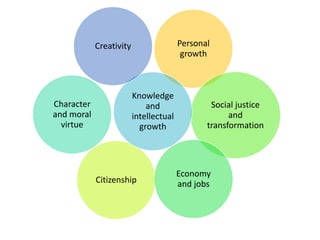
Personal
growth
Citizenship
Social justice
and
transformation
Economy
and jobs
Character
and moral
virtue
Knowledge
and
intellectual
growth
Creativity
Looking back in history: medieval
universities
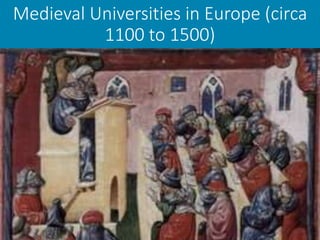
• The main ones: Bologna (1088), Paris, Oxford
(1000s), Cambridge (1209)
• Training for church and civil service
• Law and philosophy
• Men
• Authority of teachers
• Printing press 1440 (Caxton), 1470 (Gutenberg)
Medieval Universities in Europe (circa
1100 to 1500)
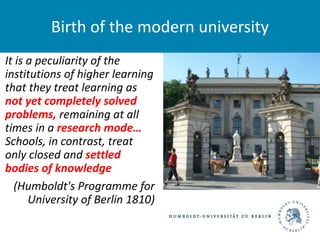
It is a peculiarity of the
institutions of higher learning
that they treat learning as
not yet completely solved
problems, remaining at all
times in a research mode…
Schools, in contrast, treat
only closed and settled
bodies of knowledge
(Humboldt's Programme for
University of Berlin 1810)
Birth of the modern university
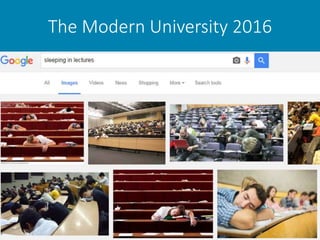
The Modern University 2016
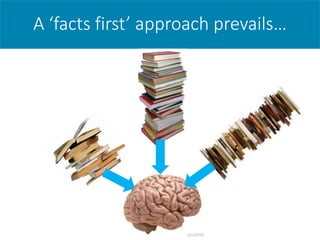
A ‘facts first’ approach prevails…
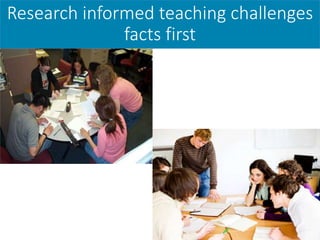
Research informed teaching challenges
facts first
Defining the terms
Please write short phrase post-its in response to these
questions (no right or wrong answers – go for gut feeling):
1) What is research? What words spring to mind to
define research?
2) What is teaching?
3) So what is research informed teaching?
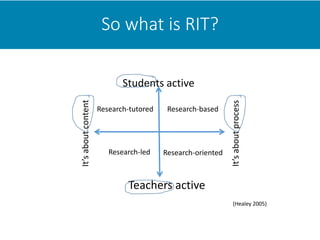
So what is RIT?
Teachers active
Students activeIt’saboutcontent
It’saboutprocess
Research-tutored
Research-orientedResearch-led
Research-based
(Healey 2005)
Take Five: Post it exercise
• Write down as many examples
of RIT that you have
experienced or led.
• Write down what prevents you
or your colleagues from doing
RIT.
• Populate the matrix nearest you
Five compelling reasons
1. The structure of our degrees demands it
2. It is challenging
3. It introduces students to the complexity of messy
problems
4. It is exciting, authentic and student-centred
5. It develops critical thinking, academic writing and
complex reasoning skills
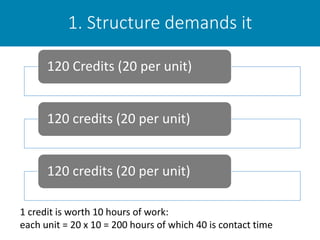
1. Structure demands it
120 Credits (20 per unit)
120 credits (20 per unit)
1 credit is worth 10 hours of work:
each unit = 20 x 10 = 200 hours of which 40 is contact time
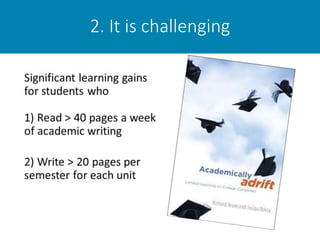
2. It is challenging
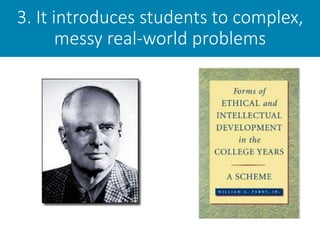
3. It introduces students to complex,
messy real-world problems
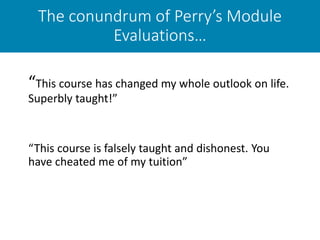
The conundrum of Perry’s Module
Evaluations…
“This course has changed my whole outlook on life.
Superbly taught!”
“This course is falsely taught and dishonest. You
have cheated me of my tuition”
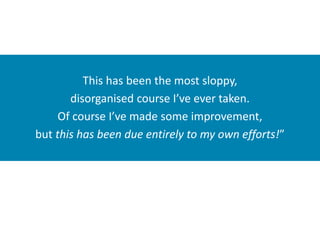
This has been the most sloppy,
disorganised course I’ve ever taken.
Of course I’ve made some improvement,
but this has been due entirely to my own efforts!”
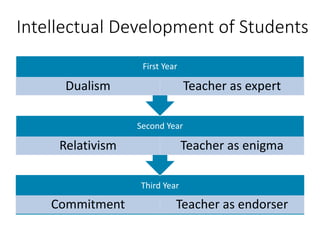
Intellectual Development of Students
Third Year
Commitment Teacher as endorser
Second Year
Relativism Teacher as enigma
First Year
Dualism Teacher as expert
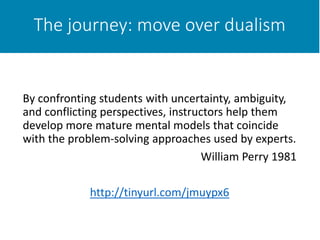
The journey: move over dualism
By confronting students with uncertainty, ambiguity,
and conflicting perspectives, instructors help them
develop more mature mental models that coincide
with the problem-solving approaches used by experts.
William Perry 1981
http://tinyurl.com/jmuypx6
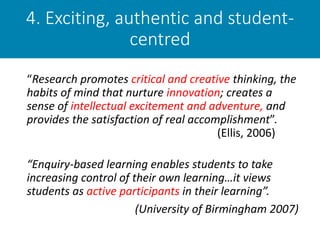
4. Exciting, authentic and student-
centred
“Research promotes critical and creative thinking, the
habits of mind that nurture innovation; creates a
sense of intellectual excitement and adventure, and
provides the satisfaction of real accomplishment”.
(Ellis, 2006)
“Enquiry-based learning enables students to take
increasing control of their own learning…it views
students as active participants in their learning”.
(University of Birmingham 2007)
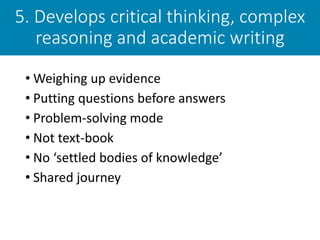
5. Develops critical thinking, complex
reasoning and academic writing
• Weighing up evidence
• Putting questions before answers
• Problem-solving mode
• Not text-book
• No ‘settled bodies of knowledge’
• Shared journey
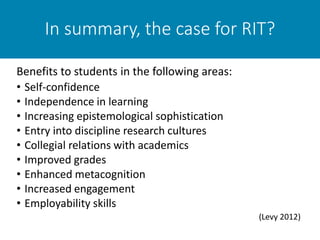
In summary, the case for RIT?
• Self-confidence
• Independence in learning
• Increasing epistemological sophistication
• Entry into discipline research cultures
• Collegial relations with academics
• Improved grades
• Enhanced metacognition
• Increased engagement
• Employability skills
(Levy 2012)
Benefits to students in the following areas:
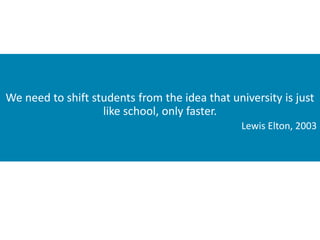
We need to shift students from the idea that university is just
like school, only faster.
Lewis Elton, 2003
Disciplinary action planning
1. What RIT are you currently doing on your degree?
2. How does it balance across the four quadrants of
Healey and Jenkins model?
3. What ‘blue skies’ dreams and aspirations do you
have for incorporating more RIT?
4. How could you do it?
5. What are the challenges?
References
Brew, A. 2003. Teaching and Research: New relationships and their implications for inquiry-
based teaching and learning in higher education, HERDSA. 3-18.
Brew, A. 1999. Research and teaching: Changing relationships in a changing context, Studies in
Higher Education, 24:3, 291-301.
Collini, S. 2012. What are Universities for? London: Penguin Books.
Elton, L. 2001. Research and Teaching: Conditions for a positive link, Teaching in Higher
Education, 6:1, 43-56.
Hattie, J. and H.W. Marsh, 1996. The Relationship between Research and Teaching: A Meta-
Analysis. Review of Educational Research, 66(4), 507-542.
Healey, M. and A. Jenkins, 2009. Developing undergraduate research and inquiry.
York: Higher Education Academy.
Healey, M., 2005. Linking Research and Teaching: disciplinary spaces In R. Barnett, ed, Reshaping
the university: new relationships between research, scholarship and teaching. Maidenhead:
McGraw-Hill/Open University Press, 30-42.
Jessop, T and Wu, Q. 2016 (forthcoming) Debunking common myths about RIT. Dialogue Journal
Perry, William 1981. Cognitive and Ethical Growth: The Making of Meaning. In Chickering, A.
1981. The Modern American College. San Francisco. Jossey Bass.
Shulman, L. 2004. Pedagogies of Substance. Chapter 7 In Teaching as Community Property:
essays on Higher Education. 128-139. San Francisco. Jossey-Bass.

Pedagogic implications of wider purpose of HE

  • 1.
    Pedagogic implications: The Casefor Research Informed Teaching Professor Tansy Jessop USW Senior Management Conference on L&T @tansyjtweets 28 November 2016
  • 2.
    This session 1) Fringepedagogic or front and centre? 2) Brief history 3) What is RIT? 4) What does it look like? 5) Five compelling reasons for RIT 6) Challenges 7) So why bother with RIT?
  • 3.
  • 4.
    Looking back inhistory: medieval universities • The main ones: Bologna (1088), Paris, Oxford (1000s), Cambridge (1209) • Training for church and civil service • Law and philosophy • Men • Authority of teachers • Printing press 1440 (Caxton), 1470 (Gutenberg)
  • 5.
    Medieval Universities inEurope (circa 1100 to 1500)
  • 6.
    It is apeculiarity of the institutions of higher learning that they treat learning as not yet completely solved problems, remaining at all times in a research mode… Schools, in contrast, treat only closed and settled bodies of knowledge (Humboldt's Programme for University of Berlin 1810) Birth of the modern university
  • 7.
  • 8.
    A ‘facts first’approach prevails…
  • 9.
    Research informed teachingchallenges facts first
  • 10.
    Defining the terms Pleasewrite short phrase post-its in response to these questions (no right or wrong answers – go for gut feeling): 1) What is research? What words spring to mind to define research? 2) What is teaching? 3) So what is research informed teaching?
  • 11.
    So what isRIT? Teachers active Students activeIt’saboutcontent It’saboutprocess Research-tutored Research-orientedResearch-led Research-based (Healey 2005)
  • 12.
    Take Five: Postit exercise • Write down as many examples of RIT that you have experienced or led. • Write down what prevents you or your colleagues from doing RIT. • Populate the matrix nearest you
  • 13.
    Five compelling reasons 1.The structure of our degrees demands it 2. It is challenging 3. It introduces students to the complexity of messy problems 4. It is exciting, authentic and student-centred 5. It develops critical thinking, academic writing and complex reasoning skills
  • 14.
    1. Structure demandsit 120 Credits (20 per unit) 120 credits (20 per unit) 120 credits (20 per unit) 1 credit is worth 10 hours of work: each unit = 20 x 10 = 200 hours of which 40 is contact time
  • 15.
    2. It ischallenging
  • 16.
    3. It introducesstudents to complex, messy real-world problems
  • 17.
    The conundrum ofPerry’s Module Evaluations… “This course has changed my whole outlook on life. Superbly taught!” “This course is falsely taught and dishonest. You have cheated me of my tuition”
  • 18.
    This has beenthe most sloppy, disorganised course I’ve ever taken. Of course I’ve made some improvement, but this has been due entirely to my own efforts!”
  • 19.
    Intellectual Development ofStudents Third Year Commitment Teacher as endorser Second Year Relativism Teacher as enigma First Year Dualism Teacher as expert
  • 20.
    The journey: moveover dualism By confronting students with uncertainty, ambiguity, and conflicting perspectives, instructors help them develop more mature mental models that coincide with the problem-solving approaches used by experts. William Perry 1981 http://tinyurl.com/jmuypx6
  • 21.
    4. Exciting, authenticand student- centred “Research promotes critical and creative thinking, the habits of mind that nurture innovation; creates a sense of intellectual excitement and adventure, and provides the satisfaction of real accomplishment”. (Ellis, 2006) “Enquiry-based learning enables students to take increasing control of their own learning…it views students as active participants in their learning”. (University of Birmingham 2007)
  • 22.
    5. Develops criticalthinking, complex reasoning and academic writing • Weighing up evidence • Putting questions before answers • Problem-solving mode • Not text-book • No ‘settled bodies of knowledge’ • Shared journey
  • 23.
    In summary, thecase for RIT? • Self-confidence • Independence in learning • Increasing epistemological sophistication • Entry into discipline research cultures • Collegial relations with academics • Improved grades • Enhanced metacognition • Increased engagement • Employability skills (Levy 2012) Benefits to students in the following areas:
  • 24.
    We need toshift students from the idea that university is just like school, only faster. Lewis Elton, 2003
  • 25.
    Disciplinary action planning 1.What RIT are you currently doing on your degree? 2. How does it balance across the four quadrants of Healey and Jenkins model? 3. What ‘blue skies’ dreams and aspirations do you have for incorporating more RIT? 4. How could you do it? 5. What are the challenges?
  • 26.
    References Brew, A. 2003.Teaching and Research: New relationships and their implications for inquiry- based teaching and learning in higher education, HERDSA. 3-18. Brew, A. 1999. Research and teaching: Changing relationships in a changing context, Studies in Higher Education, 24:3, 291-301. Collini, S. 2012. What are Universities for? London: Penguin Books. Elton, L. 2001. Research and Teaching: Conditions for a positive link, Teaching in Higher Education, 6:1, 43-56. Hattie, J. and H.W. Marsh, 1996. The Relationship between Research and Teaching: A Meta- Analysis. Review of Educational Research, 66(4), 507-542. Healey, M. and A. Jenkins, 2009. Developing undergraduate research and inquiry. York: Higher Education Academy. Healey, M., 2005. Linking Research and Teaching: disciplinary spaces In R. Barnett, ed, Reshaping the university: new relationships between research, scholarship and teaching. Maidenhead: McGraw-Hill/Open University Press, 30-42. Jessop, T and Wu, Q. 2016 (forthcoming) Debunking common myths about RIT. Dialogue Journal Perry, William 1981. Cognitive and Ethical Growth: The Making of Meaning. In Chickering, A. 1981. The Modern American College. San Francisco. Jossey Bass. Shulman, L. 2004. Pedagogies of Substance. Chapter 7 In Teaching as Community Property: essays on Higher Education. 128-139. San Francisco. Jossey-Bass.

Editor's Notes

  • #2 Technical rational apparatus – stakeholder, risk analysis etc
  • #9 Language of ‘covering material’ Should we be surprised?
  • #10 Language of ‘covering material’ Should we be surprised?
  • #12 Give examples from the PGCert: you do readings ; you write about readings (do you discuss them?), you do a student profiling research project
  • #18 An enigma wrapped in a riddle surrounded by a mystery. Puzzled.
  • #19 “The best teacher never pleases everybody!”
  • #21 Pedagogy of discomfort. Many students react to uncertainty with profound anxiety. Authentic learning exercises expose the messiness of real-life decision making, where there may not be a right or a wrong answer per se.