Research Informed Teaching
Tansy Jessop
2 November 2016
@solentlearning
Demystifying Research Informed
Teaching:
Do R & T occupy parallel universes?
Tansy Jessop
Learning Lunch
University of Winchester
4 April 2017
This session
1) Defining the terms
2) A brief history of RIT
3) What is RIT? What does it look like?
4) Three myths about RIT
5) Five compelling reasons for doing RIT
6) Impacts of RIT
Words that spring to mind….
1) What is research?
Go to www.menti.com and use the code 91 66 52
2) What is teaching?
Go to www.menti.com and use the code 99 76 07
3) So what is research informed teaching?
Go to www.menti.com and use the code 74 40 75
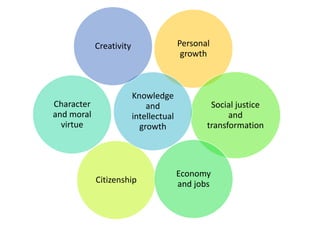
Personal
growth
Citizenship
Social justice
and
transformation
Economy
and jobs
Character
and moral
virtue
Knowledge
and
intellectual
growth
Creativity
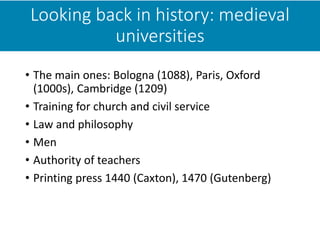
Looking back in history: medieval
universities
• The main ones: Bologna (1088), Paris, Oxford
(1000s), Cambridge (1209)
• Training for church and civil service
• Law and philosophy
• Men
• Authority of teachers
• Printing press 1440 (Caxton), 1470 (Gutenberg)
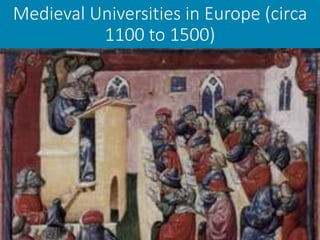
Medieval Universities in Europe (circa
1100 to 1500)
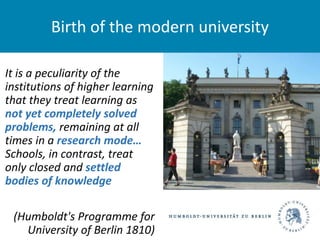
It is a peculiarity of the
institutions of higher learning
that they treat learning as
not yet completely solved
problems, remaining at all
times in a research mode…
Schools, in contrast, treat
only closed and settled
bodies of knowledge
(Humboldt's Programme for
University of Berlin 1810)
Birth of the modern university
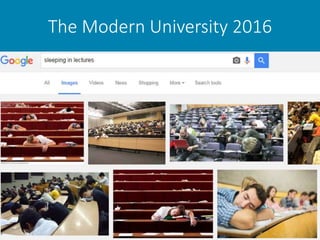
The Modern University 2016
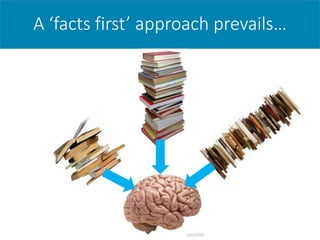
A ‘facts first’ approach prevails…
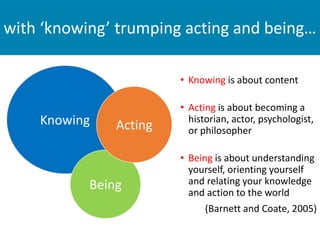
• Knowing is about content
• Acting is about becoming a
historian, actor, psychologist,
or philosopher
• Being is about understanding
yourself, orienting yourself
and relating your knowledge
and action to the world
(Barnett and Coate, 2005)
Knowing
Being
Acting
with ‘knowing’ trumping acting and being…
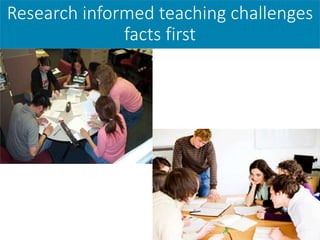
Research informed teaching challenges
facts first
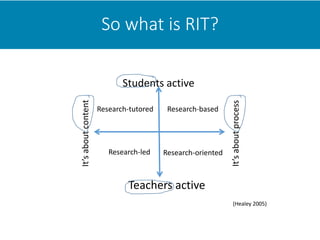
So what is RIT?
Teachers active
Students activeIt’saboutcontent
It’saboutprocess
Research-tutored
Research-orientedResearch-led
Research-based
(Healey 2005)
Take Five: Post it exercise
• Write down as many examples
of RIT that you have
experienced or led.
• Write down what prevents you
or your colleagues from doing
RIT.
• Populate the matrix nearest you
and the ‘prevent’ chart
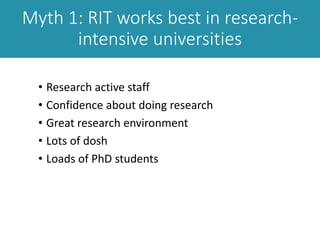
• Research active staff
• Confidence about doing research
• Great research environment
• Lots of dosh
• Loads of PhD students
Myth 1: RIT works best in research-
intensive universities
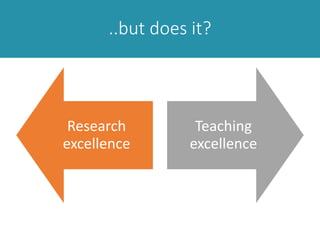
But does it?
Research
excellence
Teaching
excellence
..but does it?
A positive research and teaching link primarily depends
on the nature of students’ learning experiences…rather
than on particular inputs or outcomes…
(Elton 2001, 43 ).
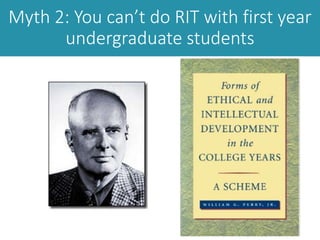
Myth 2: You can’t do RIT with first year
undergraduate students
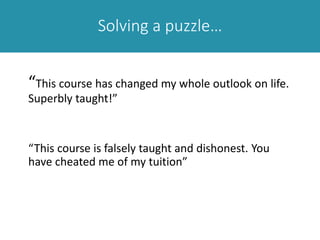
Solving a puzzle…
“This course has changed my whole outlook on life.
Superbly taught!”
“This course is falsely taught and dishonest. You
have cheated me of my tuition”
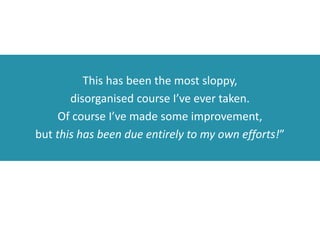
This has been the most sloppy,
disorganised course I’ve ever taken.
Of course I’ve made some improvement,
but this has been due entirely to my own efforts!”
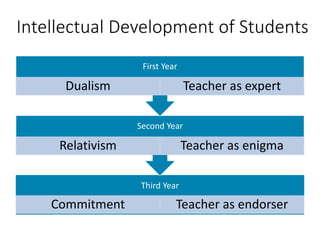
Intellectual Development of Students
Third Year
Commitment Teacher as endorser
Second Year
Relativism Teacher as enigma
First Year
Dualism Teacher as expert
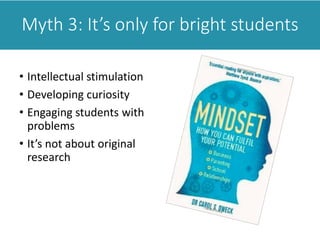
Myth 3: It’s only for bright students
• Intellectual stimulation
• Developing curiosity
• Engaging students with
problems
• It’s not about original
research
Five compelling reasons
1. The structure of our degrees demands it
2. It is challenging
3. It introduces students to the complexity of messy
problems
4. It is exciting, authentic and student-centred
5. It develops critical thinking, academic writing and
complex reasoning skills
1. Structure demands it
120 Credits (20 per unit)
120 credits (20 per unit)
1 credit is worth 10 hours of work:
each unit = 20 x 10 = 200 hours of which 40 is contact time
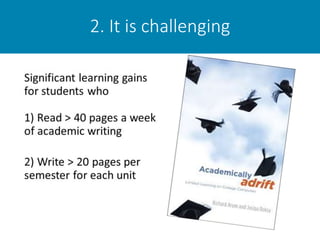
2. It is challenging
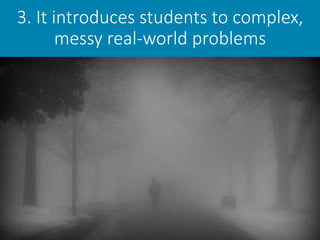
3. It introduces students to complex,
messy real-world problems
4. Exciting, authentic and student-
centred
“Research promotes critical and creative thinking, the
habits of mind that nurture innovation; creates a
sense of intellectual excitement and adventure, and
provides the satisfaction of real accomplishment”.
(Ellis, 2006)
“Enquiry-based learning enables students to take
increasing control of their own learning…it views
students as active participants in their learning”.
(University of Birmingham 2007)
5. Develops critical thinking, complex
reasoning and academic writing
• Weighing up evidence
• Putting questions before answers
• Problem-solving mode
• Not text-book
• No ‘settled bodies of knowledge’
• Shared journey
Institutional strategies
1. University Strategy and investment in RIT
2. Strategy working group – academics, leaders, students,
luminaries
3. Workshops, the PGCLTHE, CPD
4. TESTA’s new spin…
5. Research on RIT: documentary, interviews with 40
academics
6. Unearthing examples and replaying them
https://youtu.be/crRF51x__jQ
References
Arum, R. and J. Roksa. 2011. Academically Adrift: Limited Learning on College Campuses.
London: University of Chicago Press.
Barnett, R. and Coate, K. 2005. Engaging the Curriculum in Higher Education. SRHE.
Brew, A. 2012. Teaching and Research: New relationships and their implications for inquiry-
based teaching and learning in higher education, HERDSA. 3-18.
Brew, A. 1999. Research and teaching: Changing relationships in a changing context, Studies in
Higher Education, 24:3, 291-301.
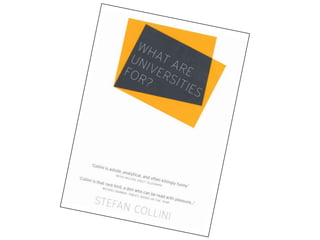
Collini, S. 2012. What are Universities for? London: Penguin Books.
Elton, L. 2001. Research and Teaching: Conditions for a positive link, Teaching in Higher
Education, 6:1, 43-56.
Hattie, J. and H.W. Marsh, 1996. The Relationship between Research and Teaching: A Meta-
Analysis. Review of Educational Research, 66(4), 507-542.
Healey, M. and A. Jenkins, 2009. Developing undergraduate research and inquiry.
York: Higher Education Academy.
Healey, M., 2005. Linking Research and Teaching: disciplinary spaces In R. Barnett, ed, Reshaping
the university: new relationships between research, scholarship and teaching. Maidenhead:
McGraw-Hill/Open University Press, 30-42.
Jessop, T and Wu, Q. 2016 (forthcoming) Debunking common myths about RIT. Dialogue Journal
Perry, William 1981. Cognitive and Ethical Growth: The Making of Meaning. In Chickering, A.
1981. The Modern American College. San Francisco. Jossey Bass.

RIT Winchester

  • 1.
    Research Informed Teaching TansyJessop 2 November 2016 @solentlearning Demystifying Research Informed Teaching: Do R & T occupy parallel universes? Tansy Jessop Learning Lunch University of Winchester 4 April 2017
  • 2.
    This session 1) Definingthe terms 2) A brief history of RIT 3) What is RIT? What does it look like? 4) Three myths about RIT 5) Five compelling reasons for doing RIT 6) Impacts of RIT
  • 3.
    Words that springto mind…. 1) What is research? Go to www.menti.com and use the code 91 66 52 2) What is teaching? Go to www.menti.com and use the code 99 76 07 3) So what is research informed teaching? Go to www.menti.com and use the code 74 40 75
  • 5.
  • 6.
    Looking back inhistory: medieval universities • The main ones: Bologna (1088), Paris, Oxford (1000s), Cambridge (1209) • Training for church and civil service • Law and philosophy • Men • Authority of teachers • Printing press 1440 (Caxton), 1470 (Gutenberg)
  • 7.
    Medieval Universities inEurope (circa 1100 to 1500)
  • 8.
    It is apeculiarity of the institutions of higher learning that they treat learning as not yet completely solved problems, remaining at all times in a research mode… Schools, in contrast, treat only closed and settled bodies of knowledge (Humboldt's Programme for University of Berlin 1810) Birth of the modern university
  • 9.
  • 10.
    A ‘facts first’approach prevails…
  • 11.
    • Knowing isabout content • Acting is about becoming a historian, actor, psychologist, or philosopher • Being is about understanding yourself, orienting yourself and relating your knowledge and action to the world (Barnett and Coate, 2005) Knowing Being Acting with ‘knowing’ trumping acting and being…
  • 12.
    Research informed teachingchallenges facts first
  • 13.
    So what isRIT? Teachers active Students activeIt’saboutcontent It’saboutprocess Research-tutored Research-orientedResearch-led Research-based (Healey 2005)
  • 14.
    Take Five: Postit exercise • Write down as many examples of RIT that you have experienced or led. • Write down what prevents you or your colleagues from doing RIT. • Populate the matrix nearest you and the ‘prevent’ chart
  • 15.
    • Research activestaff • Confidence about doing research • Great research environment • Lots of dosh • Loads of PhD students Myth 1: RIT works best in research- intensive universities
  • 16.
  • 17.
    A positive researchand teaching link primarily depends on the nature of students’ learning experiences…rather than on particular inputs or outcomes… (Elton 2001, 43 ).
  • 18.
    Myth 2: Youcan’t do RIT with first year undergraduate students
  • 19.
    Solving a puzzle… “Thiscourse has changed my whole outlook on life. Superbly taught!” “This course is falsely taught and dishonest. You have cheated me of my tuition”
  • 20.
    This has beenthe most sloppy, disorganised course I’ve ever taken. Of course I’ve made some improvement, but this has been due entirely to my own efforts!”
  • 21.
    Intellectual Development ofStudents Third Year Commitment Teacher as endorser Second Year Relativism Teacher as enigma First Year Dualism Teacher as expert
  • 22.
    Myth 3: It’sonly for bright students • Intellectual stimulation • Developing curiosity • Engaging students with problems • It’s not about original research
  • 23.
    Five compelling reasons 1.The structure of our degrees demands it 2. It is challenging 3. It introduces students to the complexity of messy problems 4. It is exciting, authentic and student-centred 5. It develops critical thinking, academic writing and complex reasoning skills
  • 24.
    1. Structure demandsit 120 Credits (20 per unit) 120 credits (20 per unit) 120 credits (20 per unit) 1 credit is worth 10 hours of work: each unit = 20 x 10 = 200 hours of which 40 is contact time
  • 25.
    2. It ischallenging
  • 26.
    3. It introducesstudents to complex, messy real-world problems
  • 27.
    4. Exciting, authenticand student- centred “Research promotes critical and creative thinking, the habits of mind that nurture innovation; creates a sense of intellectual excitement and adventure, and provides the satisfaction of real accomplishment”. (Ellis, 2006) “Enquiry-based learning enables students to take increasing control of their own learning…it views students as active participants in their learning”. (University of Birmingham 2007)
  • 28.
    5. Develops criticalthinking, complex reasoning and academic writing • Weighing up evidence • Putting questions before answers • Problem-solving mode • Not text-book • No ‘settled bodies of knowledge’ • Shared journey
  • 29.
    Institutional strategies 1. UniversityStrategy and investment in RIT 2. Strategy working group – academics, leaders, students, luminaries 3. Workshops, the PGCLTHE, CPD 4. TESTA’s new spin… 5. Research on RIT: documentary, interviews with 40 academics 6. Unearthing examples and replaying them https://youtu.be/crRF51x__jQ
  • 30.
    References Arum, R. andJ. Roksa. 2011. Academically Adrift: Limited Learning on College Campuses. London: University of Chicago Press. Barnett, R. and Coate, K. 2005. Engaging the Curriculum in Higher Education. SRHE. Brew, A. 2012. Teaching and Research: New relationships and their implications for inquiry- based teaching and learning in higher education, HERDSA. 3-18. Brew, A. 1999. Research and teaching: Changing relationships in a changing context, Studies in Higher Education, 24:3, 291-301. Collini, S. 2012. What are Universities for? London: Penguin Books. Elton, L. 2001. Research and Teaching: Conditions for a positive link, Teaching in Higher Education, 6:1, 43-56. Hattie, J. and H.W. Marsh, 1996. The Relationship between Research and Teaching: A Meta- Analysis. Review of Educational Research, 66(4), 507-542. Healey, M. and A. Jenkins, 2009. Developing undergraduate research and inquiry. York: Higher Education Academy. Healey, M., 2005. Linking Research and Teaching: disciplinary spaces In R. Barnett, ed, Reshaping the university: new relationships between research, scholarship and teaching. Maidenhead: McGraw-Hill/Open University Press, 30-42. Jessop, T and Wu, Q. 2016 (forthcoming) Debunking common myths about RIT. Dialogue Journal Perry, William 1981. Cognitive and Ethical Growth: The Making of Meaning. In Chickering, A. 1981. The Modern American College. San Francisco. Jossey Bass.

Editor's Notes

  • #11 Language of ‘covering material’ Should we be surprised?
  • #13 Language of ‘covering material’ Should we be surprised?
  • #14 Give examples from the PGCert: you do readings ; you write about readings (do you discuss them?), you do a student profiling research project
  • #17 You can’t assume a productive relationship between research and teaching – Jenkins and Healey. John Hattie meta analysis – no correlation.
  • #20 An enigma wrapped in a riddle surrounded by a mystery. Puzzled.
  • #21 “The best teacher never pleases everybody!”