Sparking learning in the context of metrics:
Cast Iron or Teflon?
@solentlearning
@tansyjtweets
Tansy Jessop
Business Librarians Conference
5 July 2017
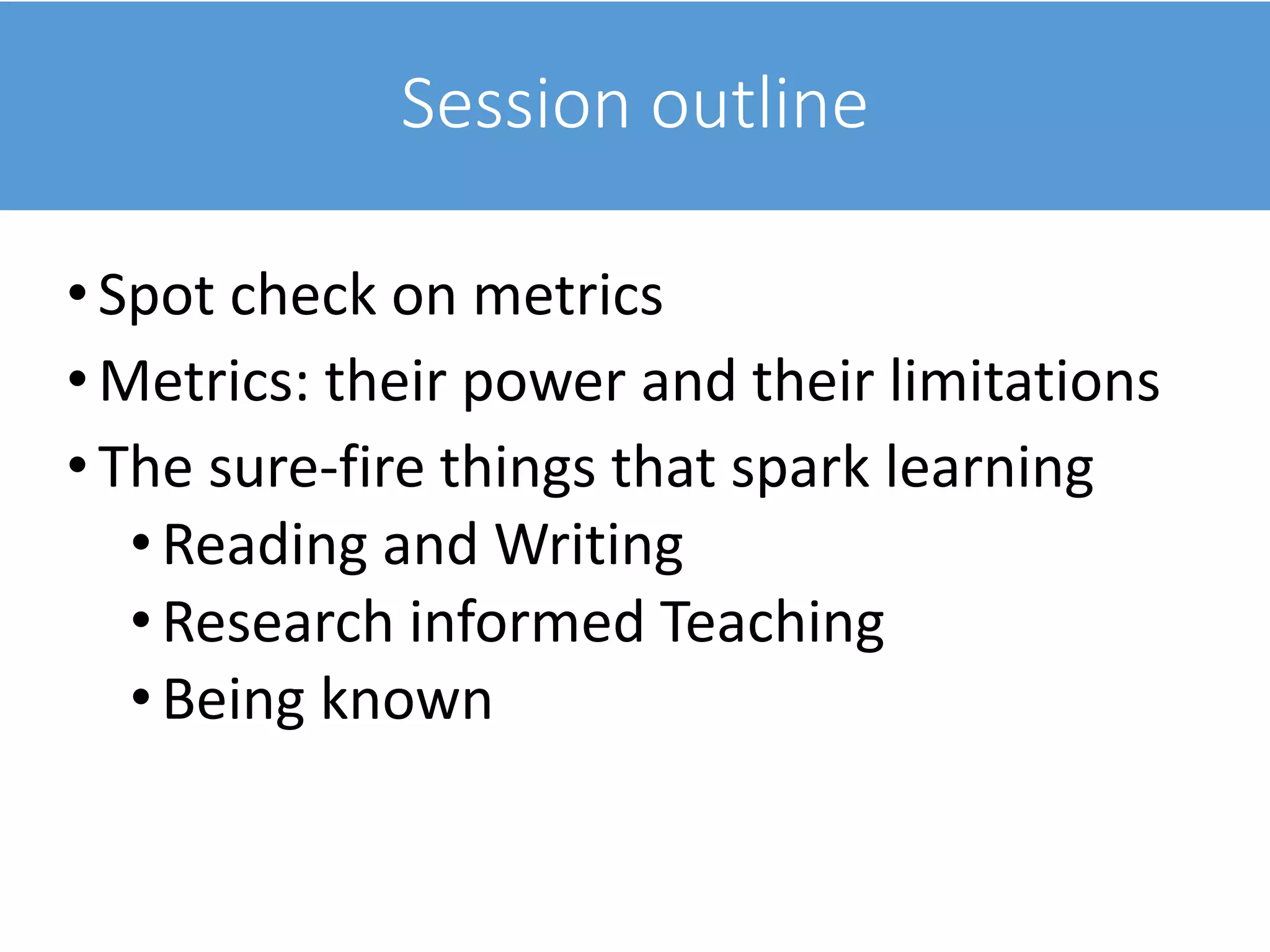
Session outline

• Spot check on metrics
• Metrics: their power and their limitations
• The sure-fire things that spark learning
•Reading and Writing
•Research informed Teaching
•Being known
How would you define excellent
teaching?
Go to www.menti.com and use the code 73 40 64
Type in three words or phrases which sum up
excellent teaching for you.
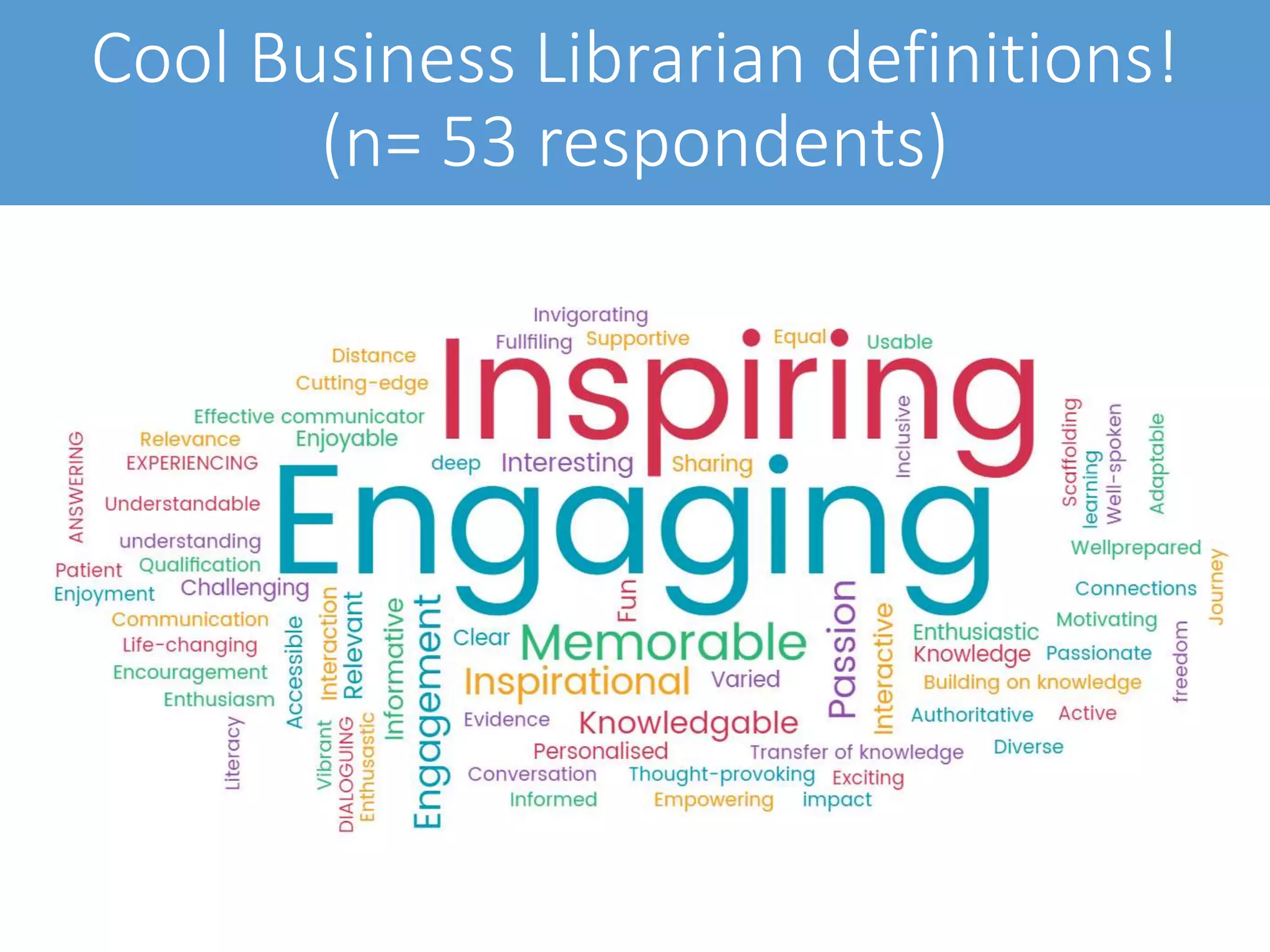
Cool Business Librarian definitions!
(n= 53 respondents)
How can you tell if teaching is
excellent?
Go to www.menti.com & use the code 58 64 46
Choose the top two indicators.
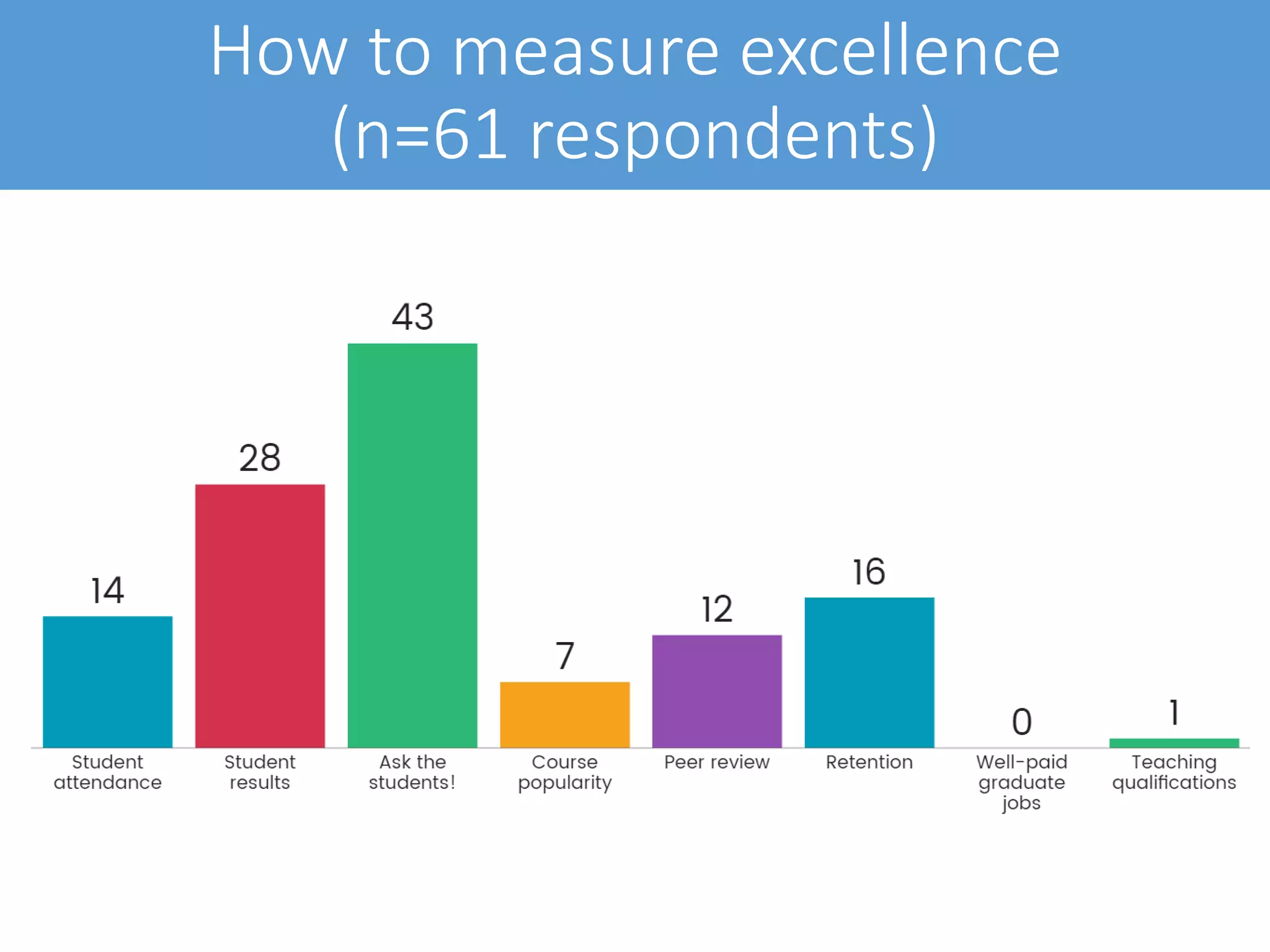
How to measure excellence
(n=61 respondents)
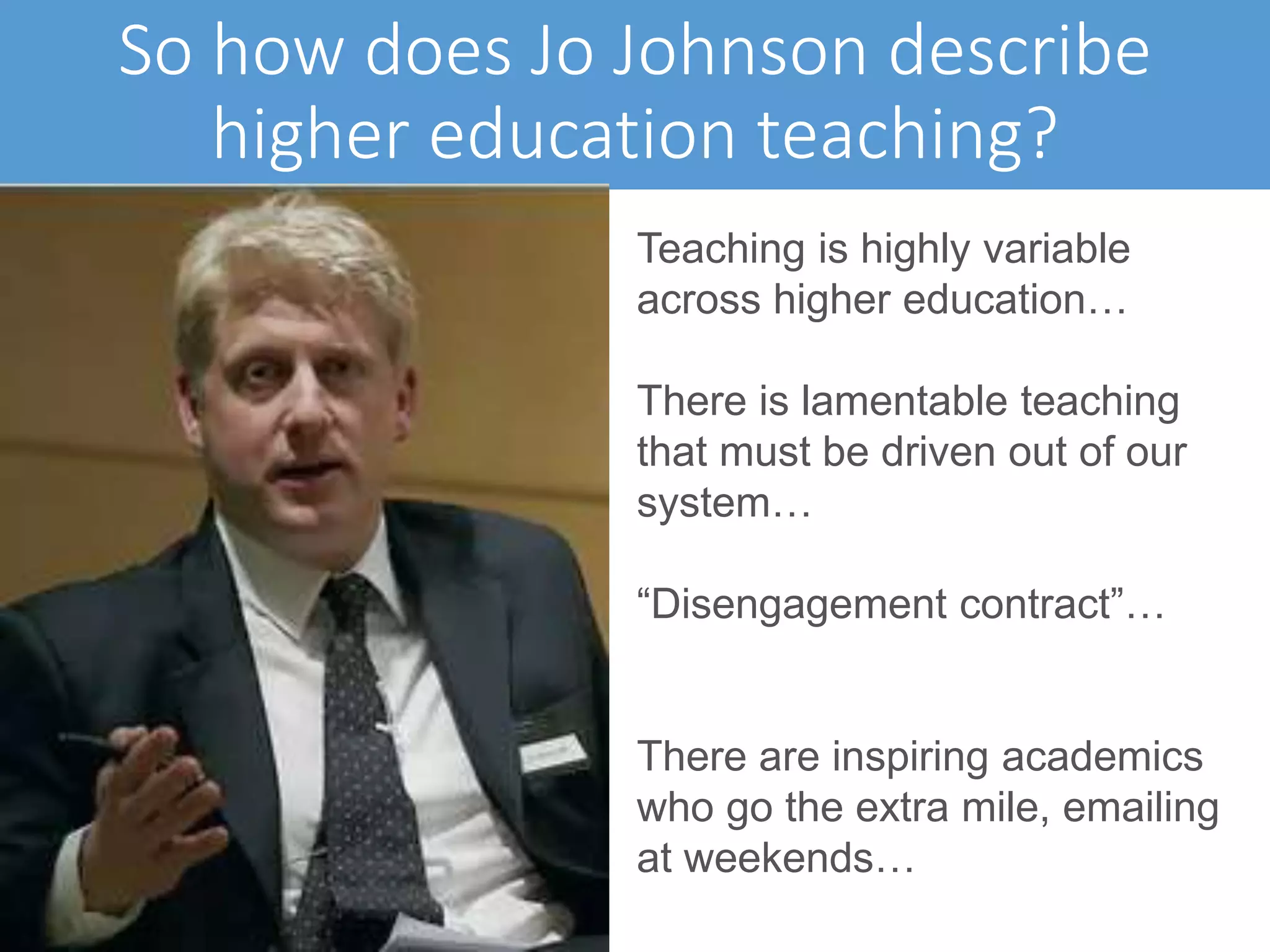
So how does Jo Johnson describe
higher education teaching?
Teaching is highly variable
across higher education…
There is lamentable teaching
that must be driven out of our
system…
“Disengagement contract”…
There are inspiring academics
who go the extra mile, emailing
at weekends…
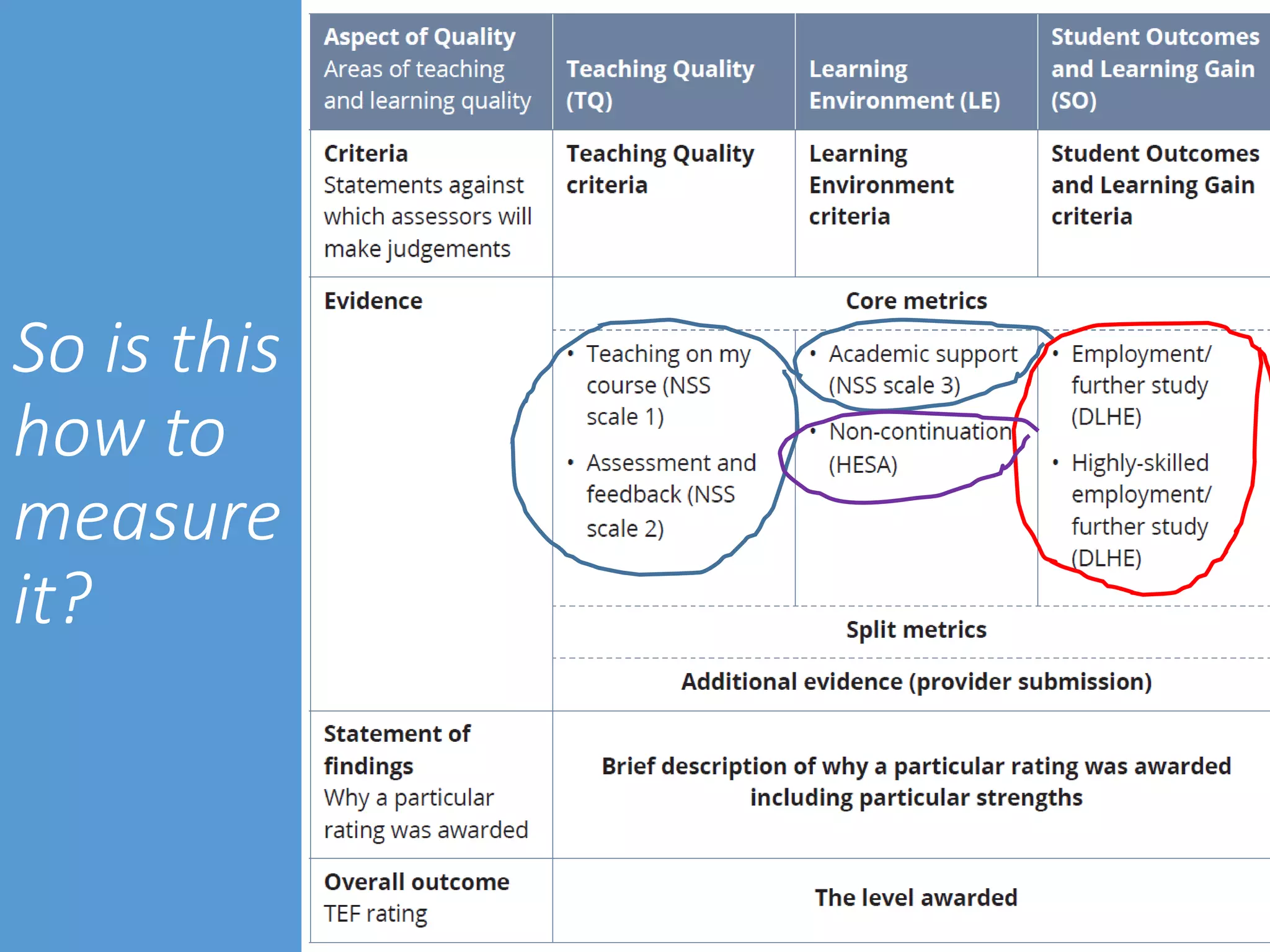
So is this
how to
measure
it?
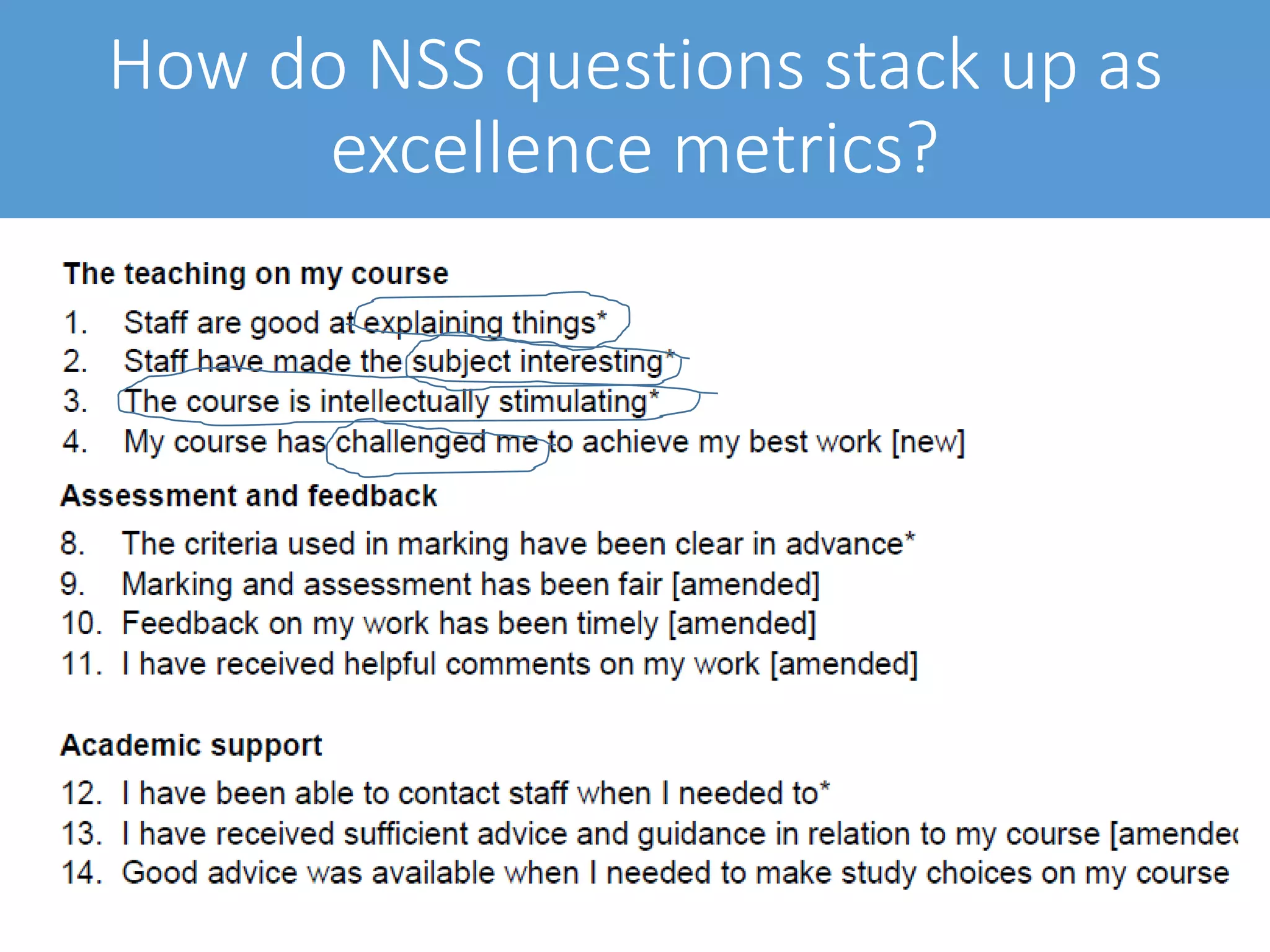
How do NSS questions stack up as
excellence metrics?
Do students get jobs as a result of teaching
quality?
Rank Teaching (NSS)
1
2
3
4
5
6
7
8
9
10
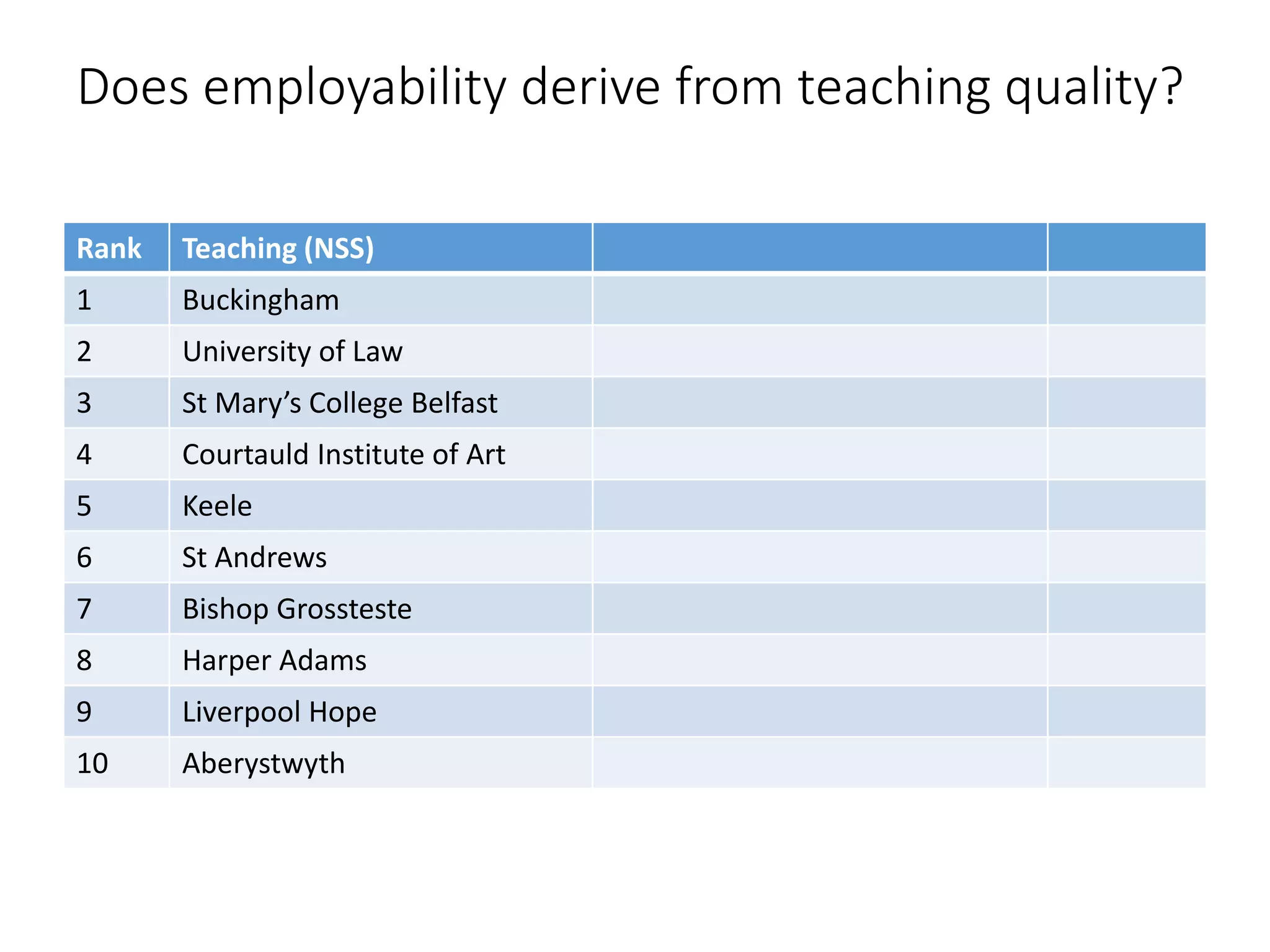
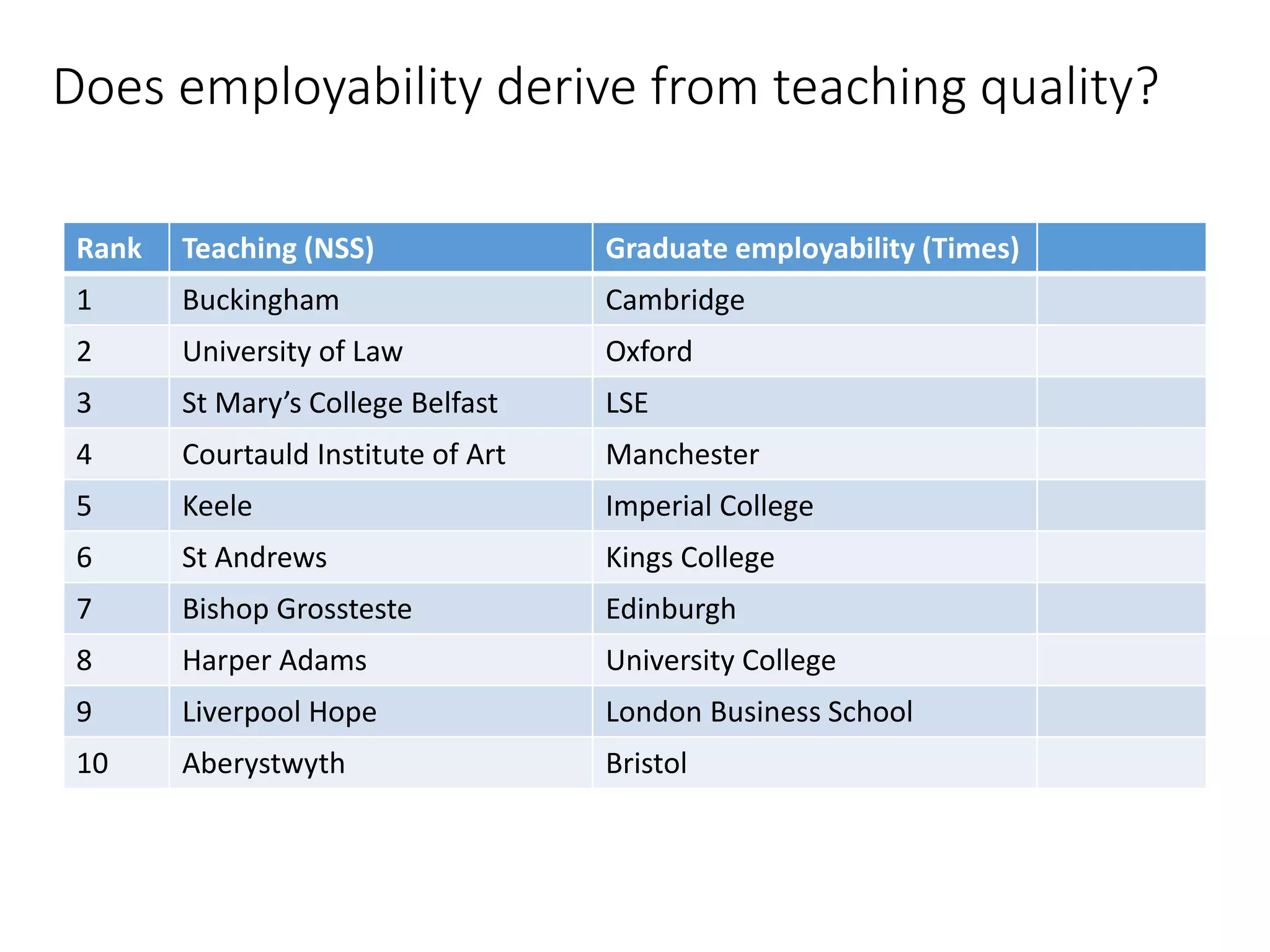
Does employability derive from teaching quality?
Rank Teaching (NSS)
1 Buckingham
2 University of Law
3 St Mary’s College Belfast
4 Courtauld Institute of Art
5 Keele
6 St Andrews
7 Bishop Grossteste
8 Harper Adams
9 Liverpool Hope
10 Aberystwyth
Does employability derive from teaching quality?
Rank Teaching (NSS) Graduate employability (Times)
1 Buckingham Cambridge
2 University of Law Oxford
3 St Mary’s College Belfast LSE
4 Courtauld Institute of Art Manchester
5 Keele Imperial College
6 St Andrews Kings College
7 Bishop Grossteste Edinburgh
8 Harper Adams University College
9 Liverpool Hope London Business School
10 Aberystwyth Bristol
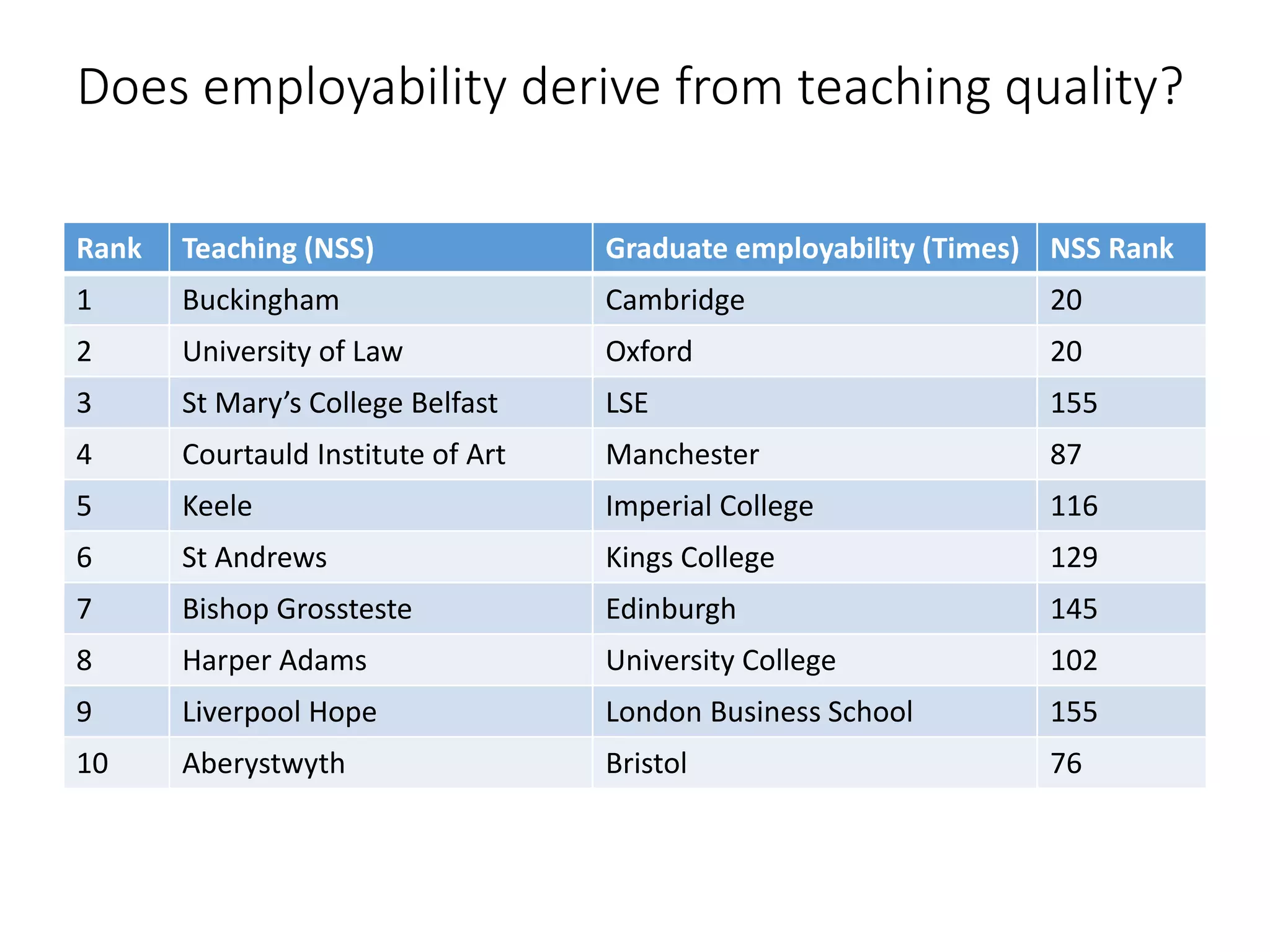
Does employability derive from teaching quality?
Rank Teaching (NSS) Graduate employability (Times) NSS Rank
1 Buckingham Cambridge 20
2 University of Law Oxford 20
3 St Mary’s College Belfast LSE 155
4 Courtauld Institute of Art Manchester 87
5 Keele Imperial College 116
6 St Andrews Kings College 129
7 Bishop Grossteste Edinburgh 145
8 Harper Adams University College 102
9 Liverpool Hope London Business School 155
10 Aberystwyth Bristol 76
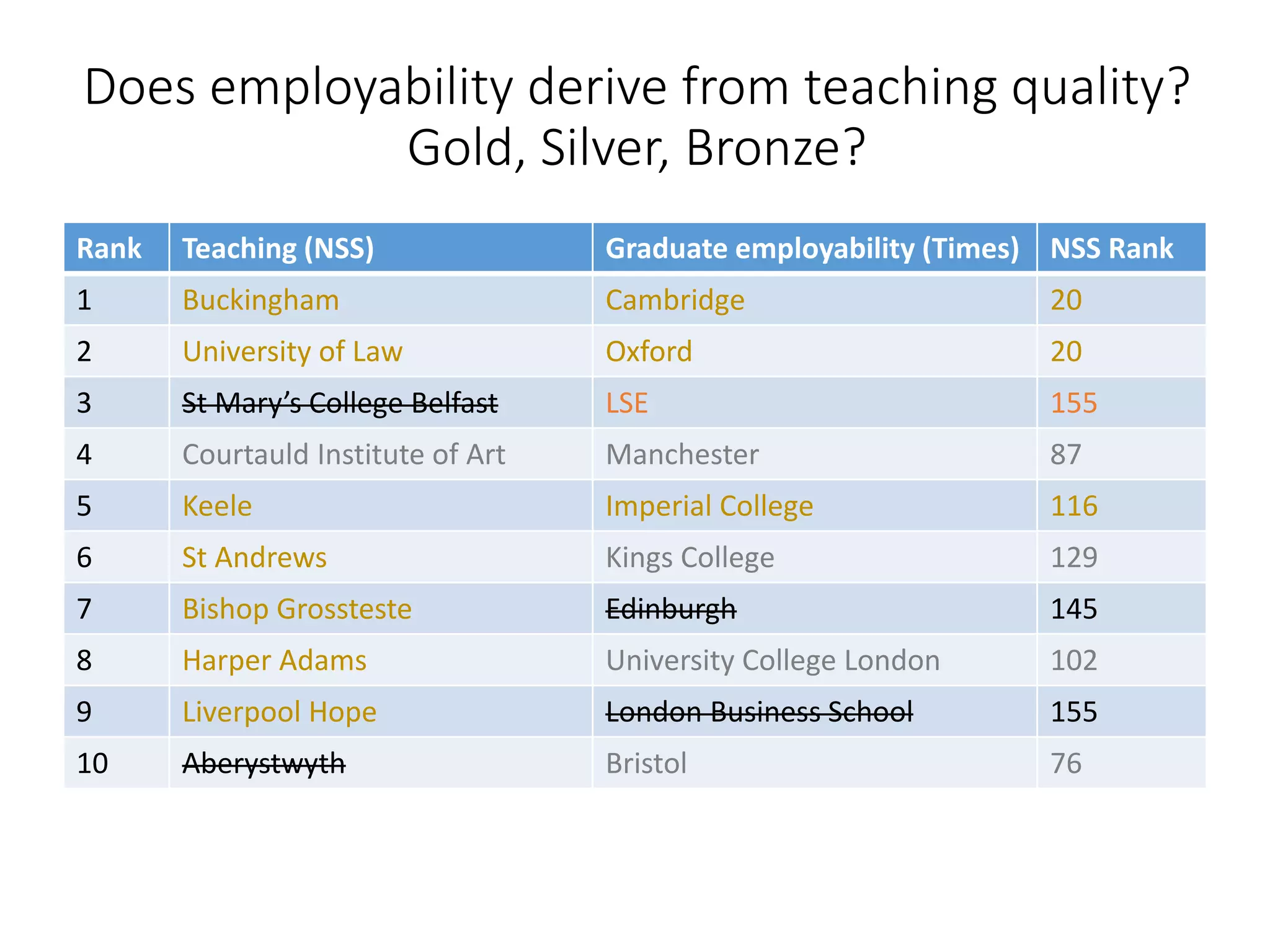
Does employability derive from teaching quality?
Gold, Silver, Bronze?
Rank Teaching (NSS) Graduate employability (Times) NSS Rank
1 Buckingham Cambridge 20
2 University of Law Oxford 20
3 St Mary’s College Belfast LSE 155
4 Courtauld Institute of Art Manchester 87
5 Keele Imperial College 116
6 St Andrews Kings College 129
7 Bishop Grossteste Edinburgh 145
8 Harper Adams University College London 102
9 Liverpool Hope London Business School 155
10 Aberystwyth Bristol 76
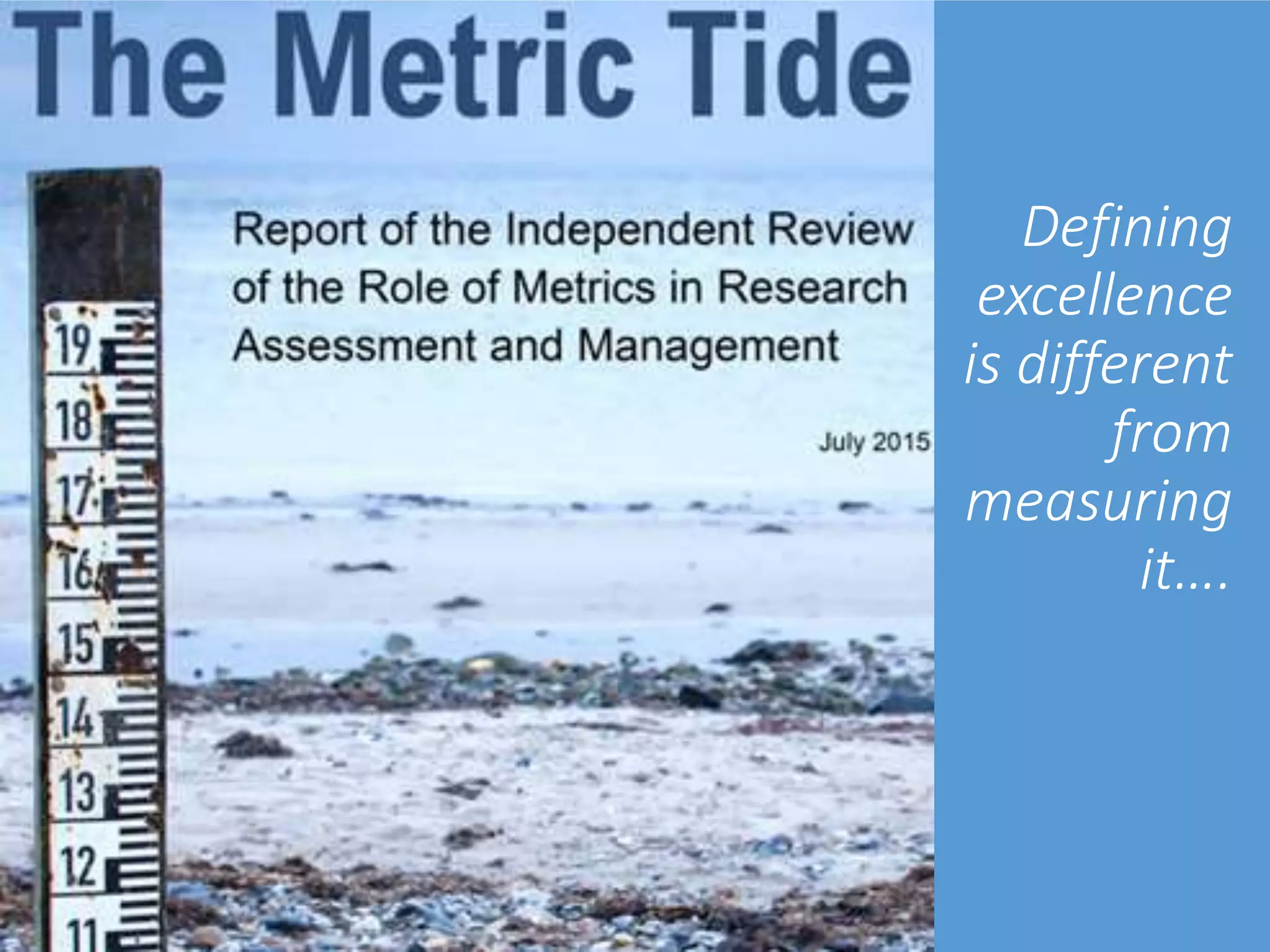
Defining
excellence
is different
from
measuring
it….
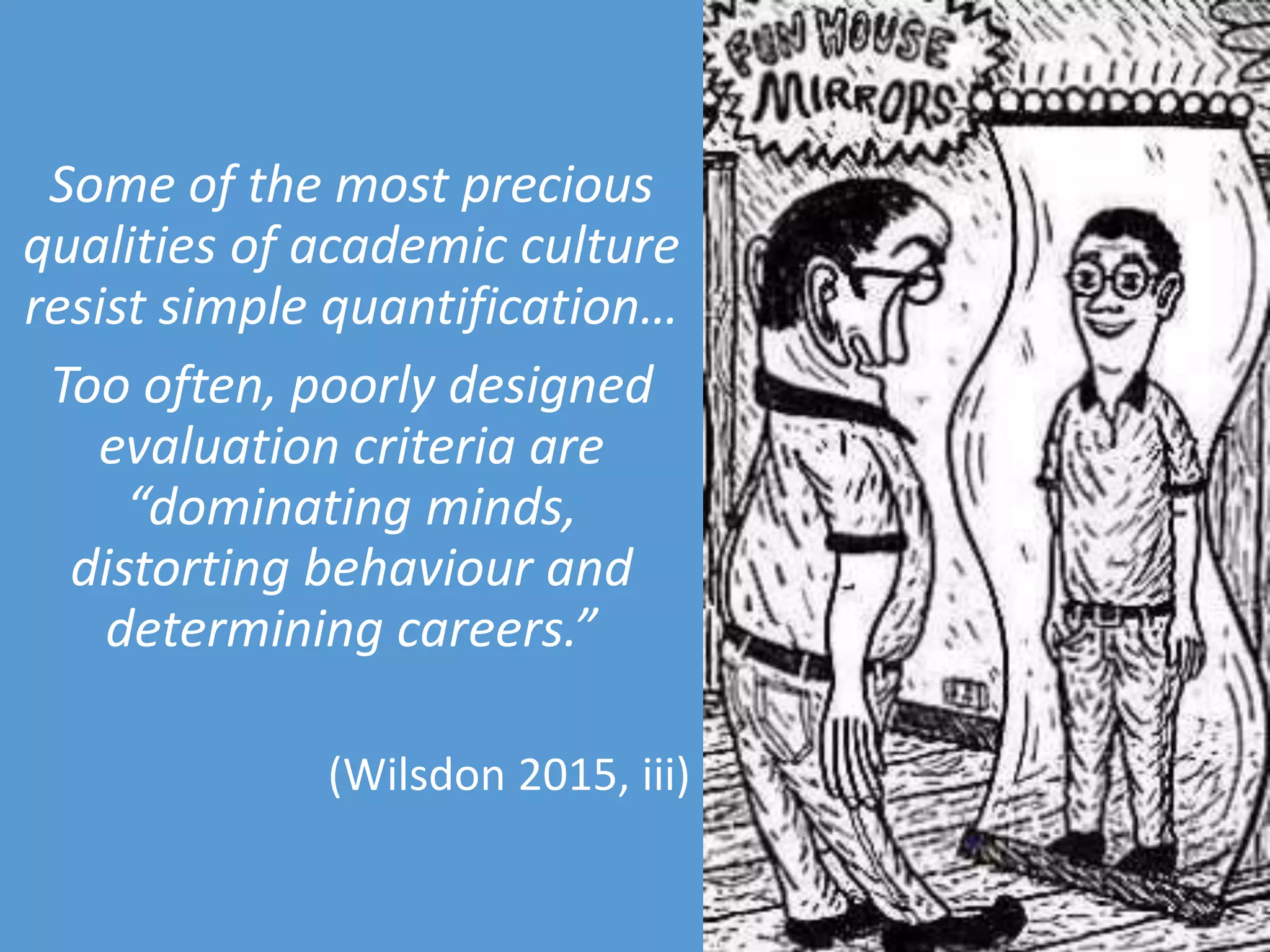
Some of the most precious
qualities of academic culture
resist simple quantification…
Too often, poorly designed
evaluation criteria are
“dominating minds,
distorting behaviour and
determining careers.”
(Wilsdon 2015, iii)
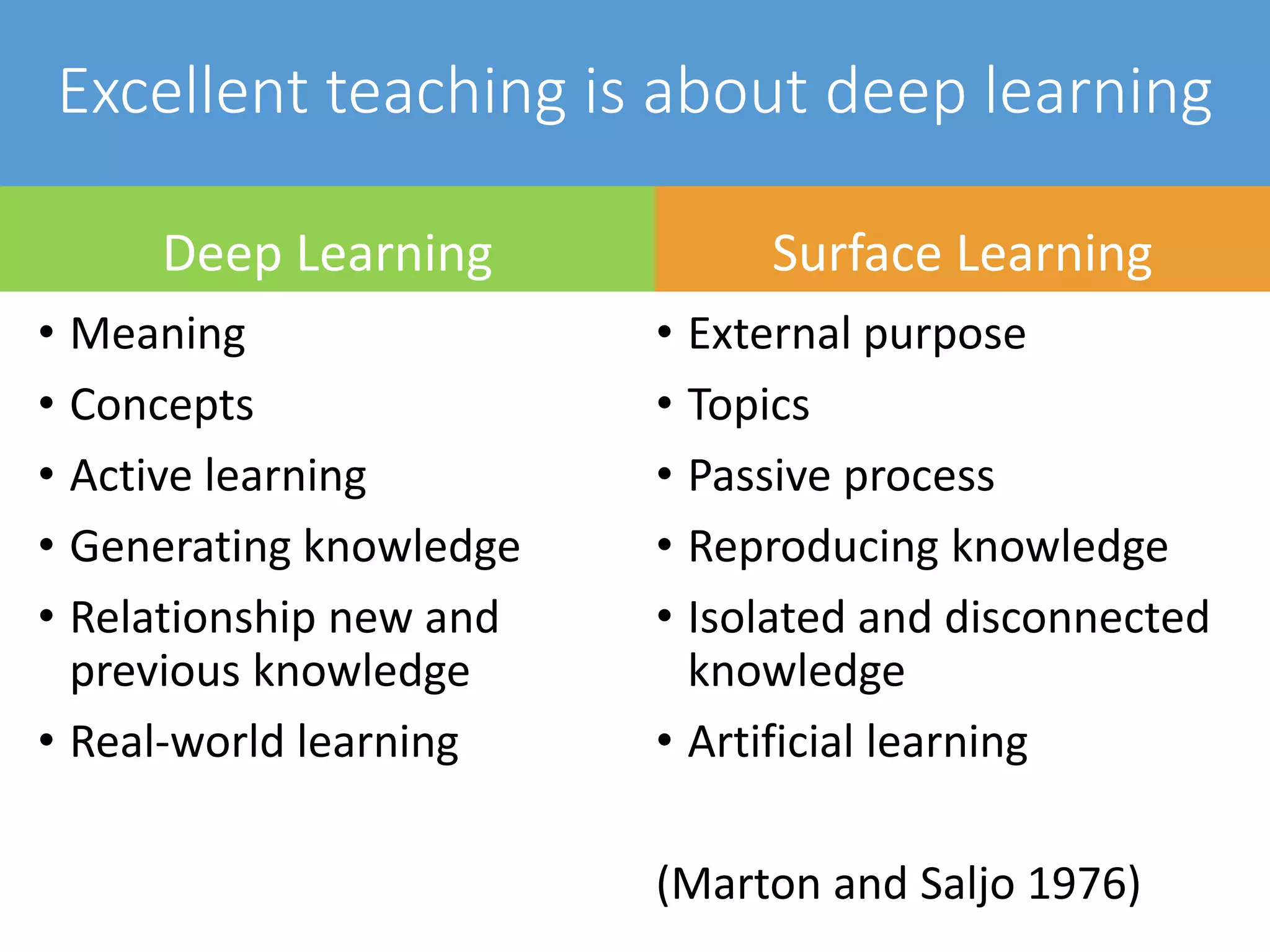
Excellent teaching is about deep learning
Deep Learning
• Meaning
• Concepts
• Active learning
• Generating knowledge
• Relationship new and
previous knowledge
• Real-world learning
Surface Learning
• External purpose
• Topics
• Passive process
• Reproducing knowledge
• Isolated and disconnected
knowledge
• Artificial learning
(Marton and Saljo 1976)
So what sparks inspiring learning?
•Academic reading and writing
•Research informed teaching
•Being known
Academic Reading and Writing
Academic reading: what students say
A lot of people don’t do wider reading. You just focus on
your essay question.
I always find myself going to the library and going ‘These
are the books related to this essay’ and that’s it.
You anticipate the questions coming up, and you learn the
materials that will definitely come up. It’s definitely a way
to focus your studies and to get a good mark, perhaps. But
is it is really the way to learn?
Your experience
Which of these
quotations resonates
and why?
Do you have any idea
why students don’t
read academic texts?
What strategies do you
have to encourage
students to read?
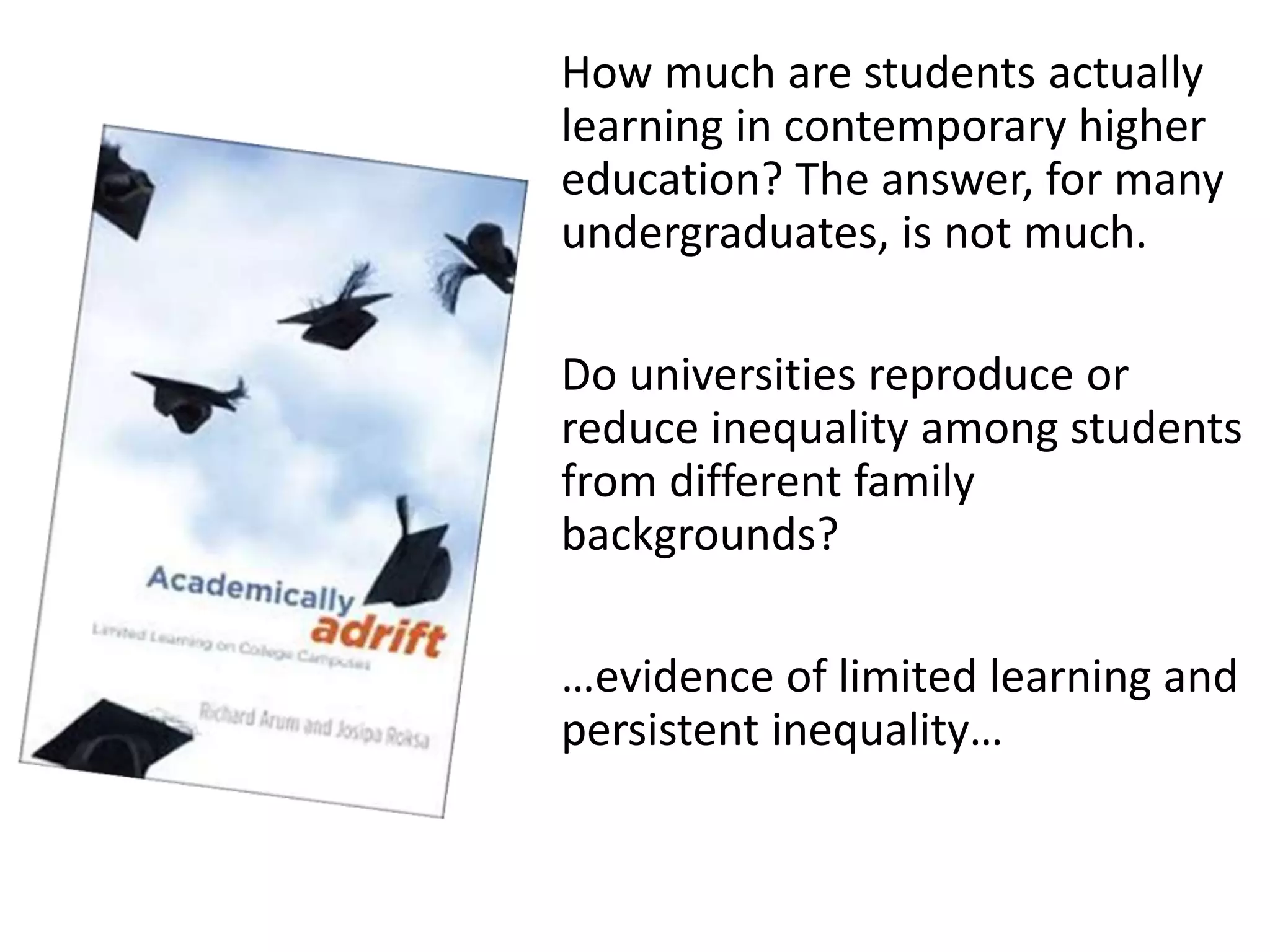
How much are students actually
learning in contemporary higher
education? The answer, for many
undergraduates, is not much.
Do universities reproduce or
reduce inequality among students
from different family
backgrounds?
…evidence of limited learning and
persistent inequality…
Research findings about academic
reading and writing
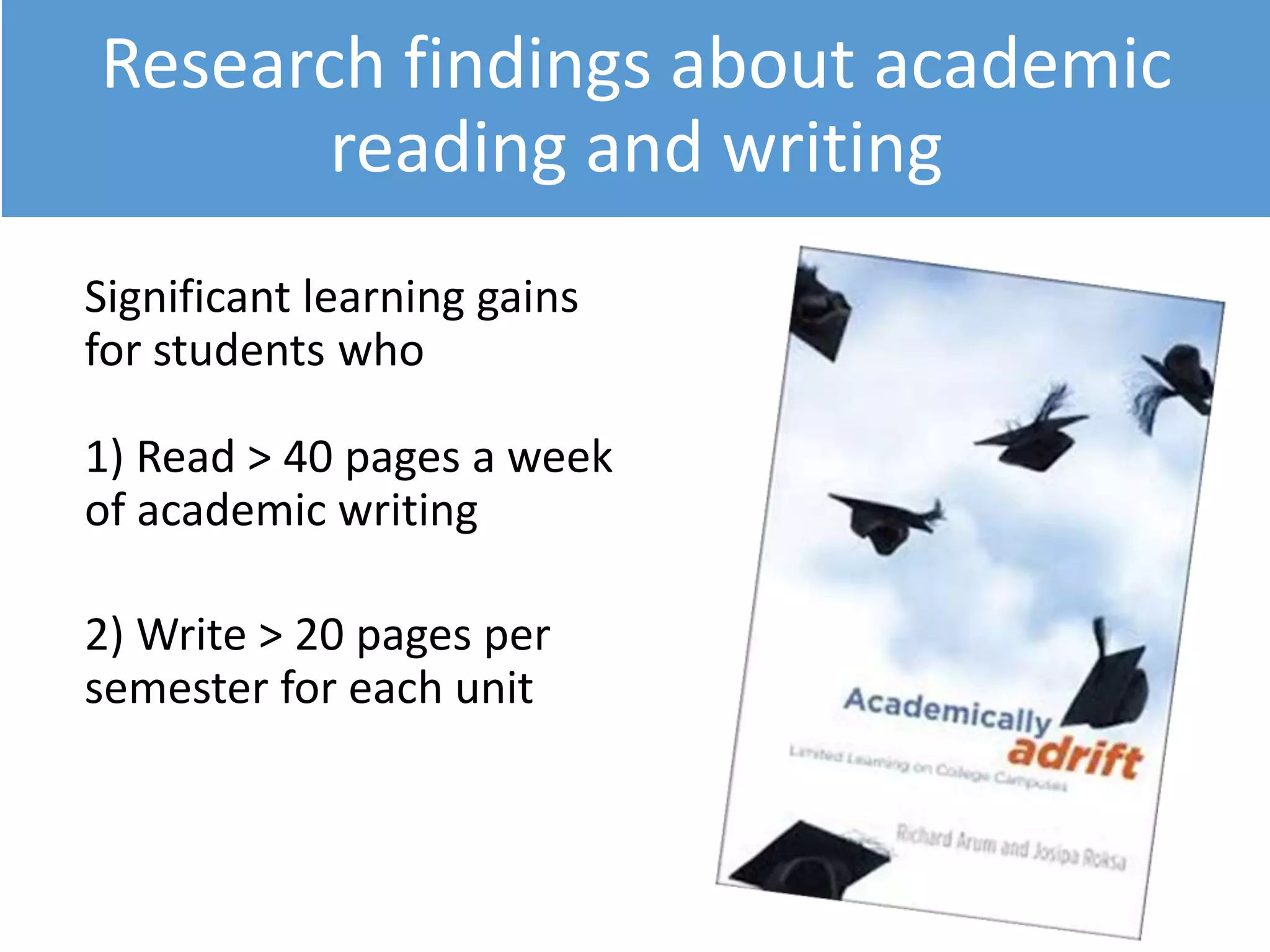
Significant learning gains
for students who
1) Read > 40 pages a week
of academic writing
2) Write > 20 pages per
semester for each unit
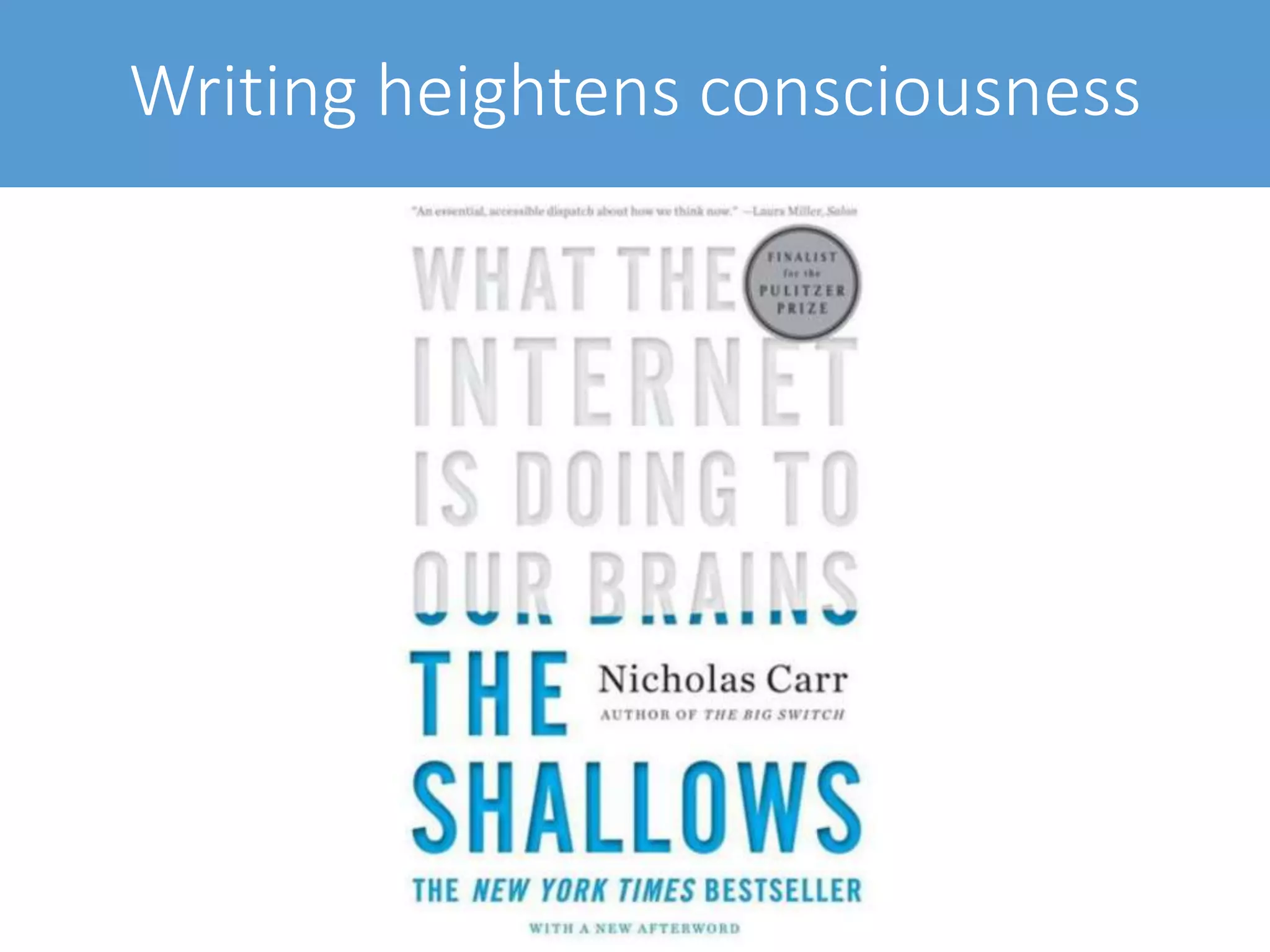
Writing heightens consciousness
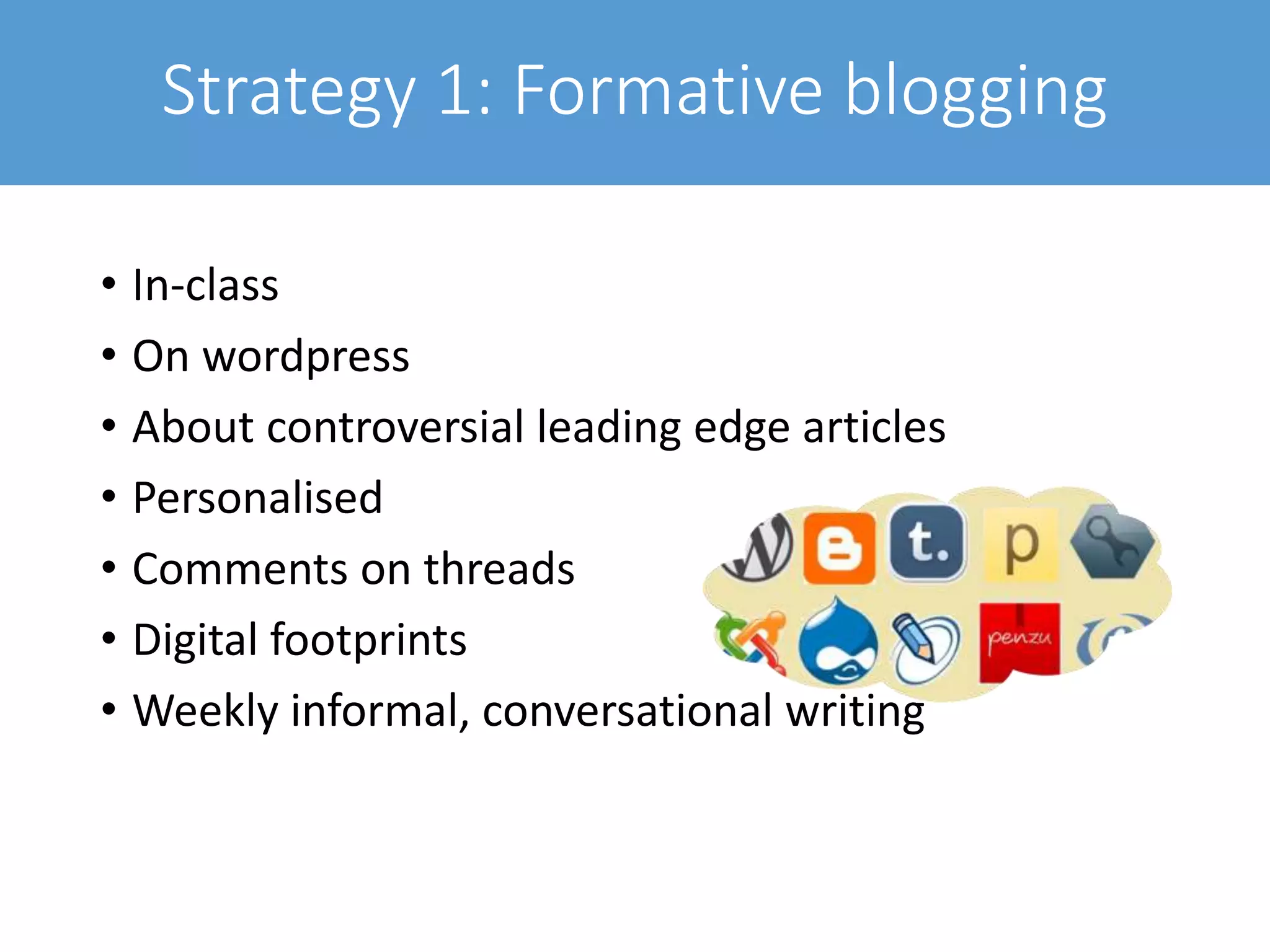
Strategy 1: Formative blogging
• In-class
• On wordpress
• About controversial leading edge articles
• Personalised
• Comments on threads
• Digital footprints
• Weekly informal, conversational writing
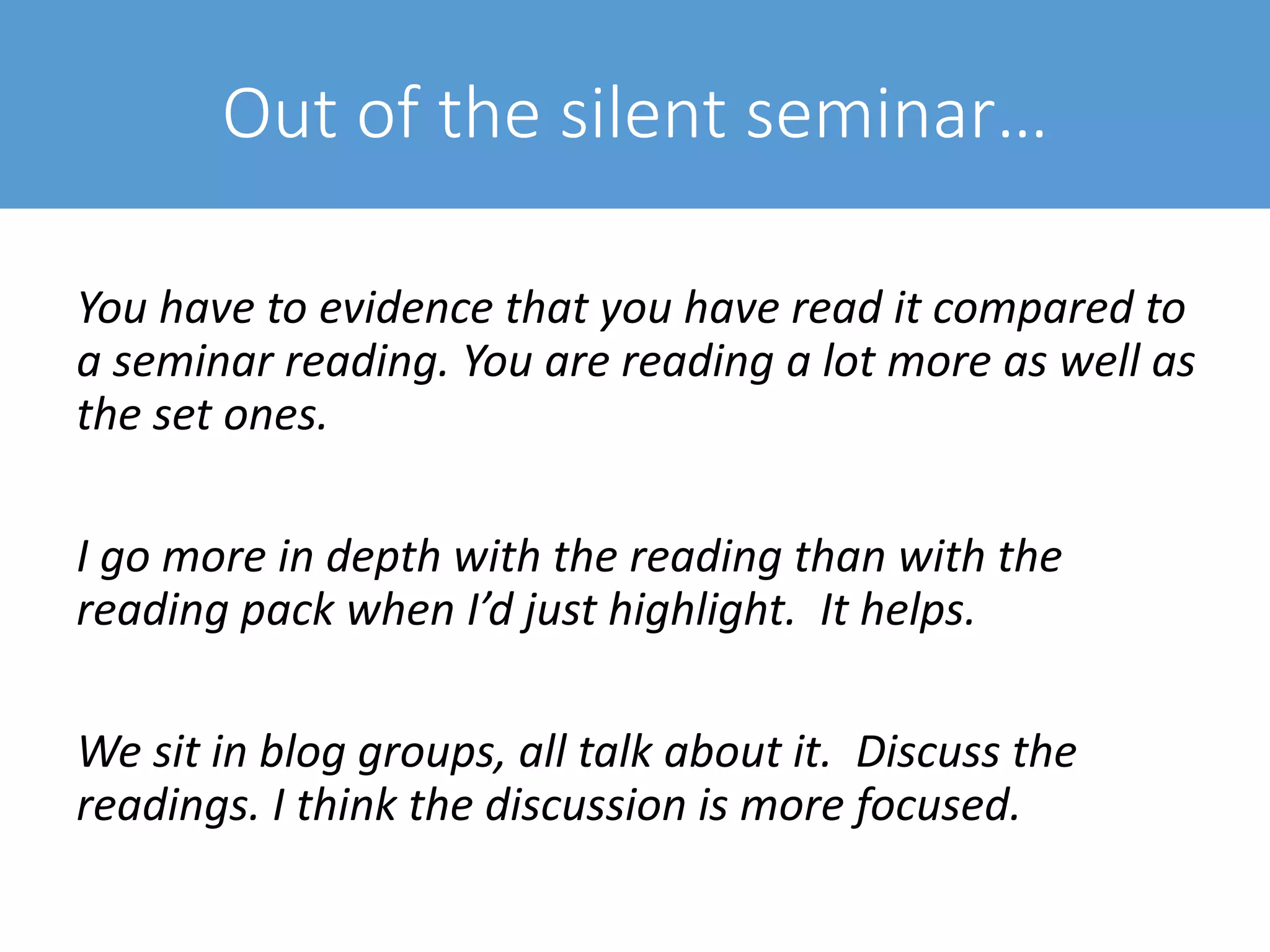
Out of the silent seminar…
You have to evidence that you have read it compared to
a seminar reading. You are reading a lot more as well as
the set ones.
I go more in depth with the reading than with the
reading pack when I’d just highlight. It helps.
We sit in blog groups, all talk about it. Discuss the
readings. I think the discussion is more focused.
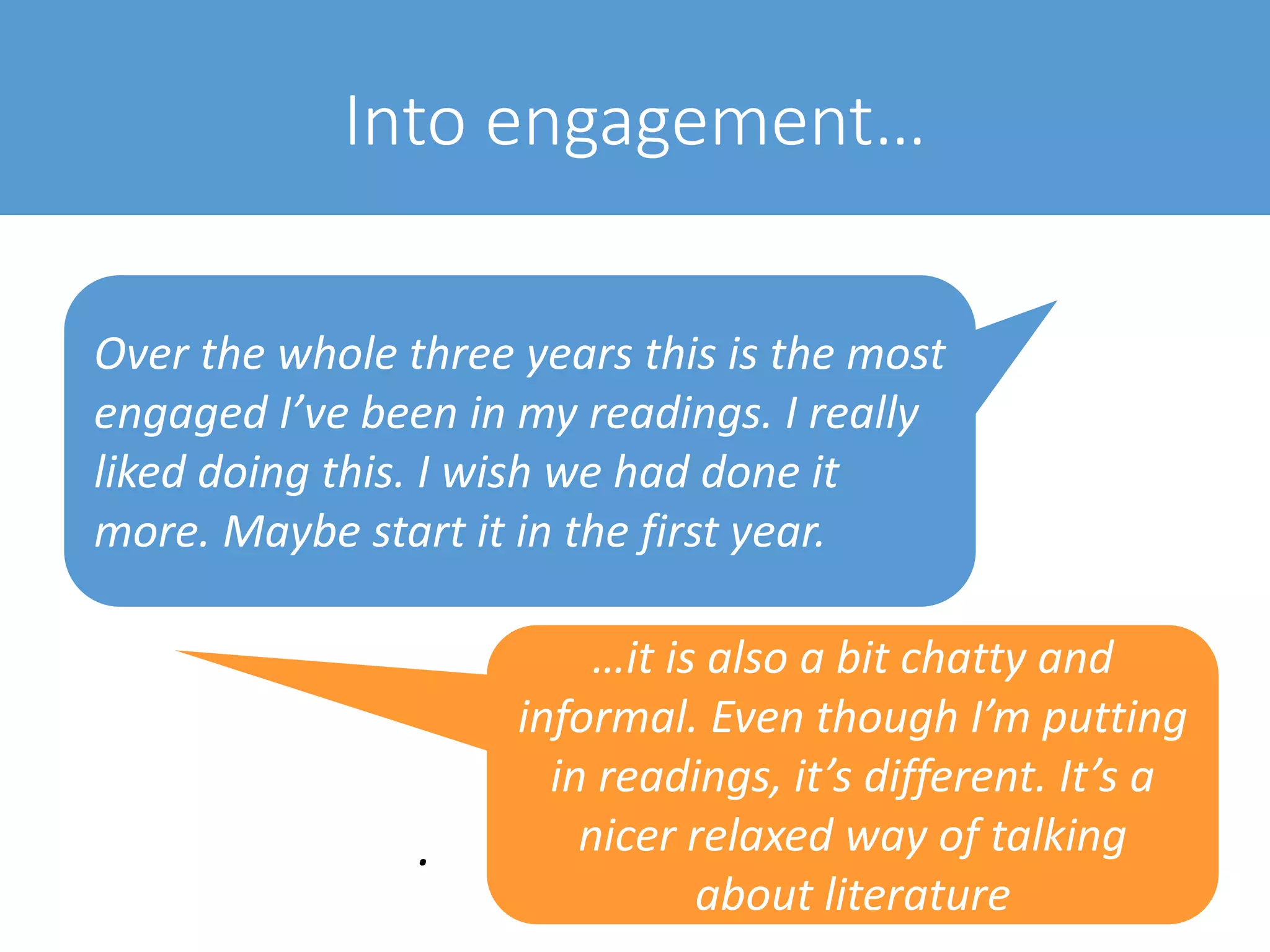
Into engagement…
Over the whole three years this is the most
engaged I’ve been in my readings. I really
liked doing this. I wish we had done it
more. Maybe start it in the first year.
.
…it is also a bit chatty and
informal. Even though I’m putting
in readings, it’s different. It’s a
nicer relaxed way of talking
about literature
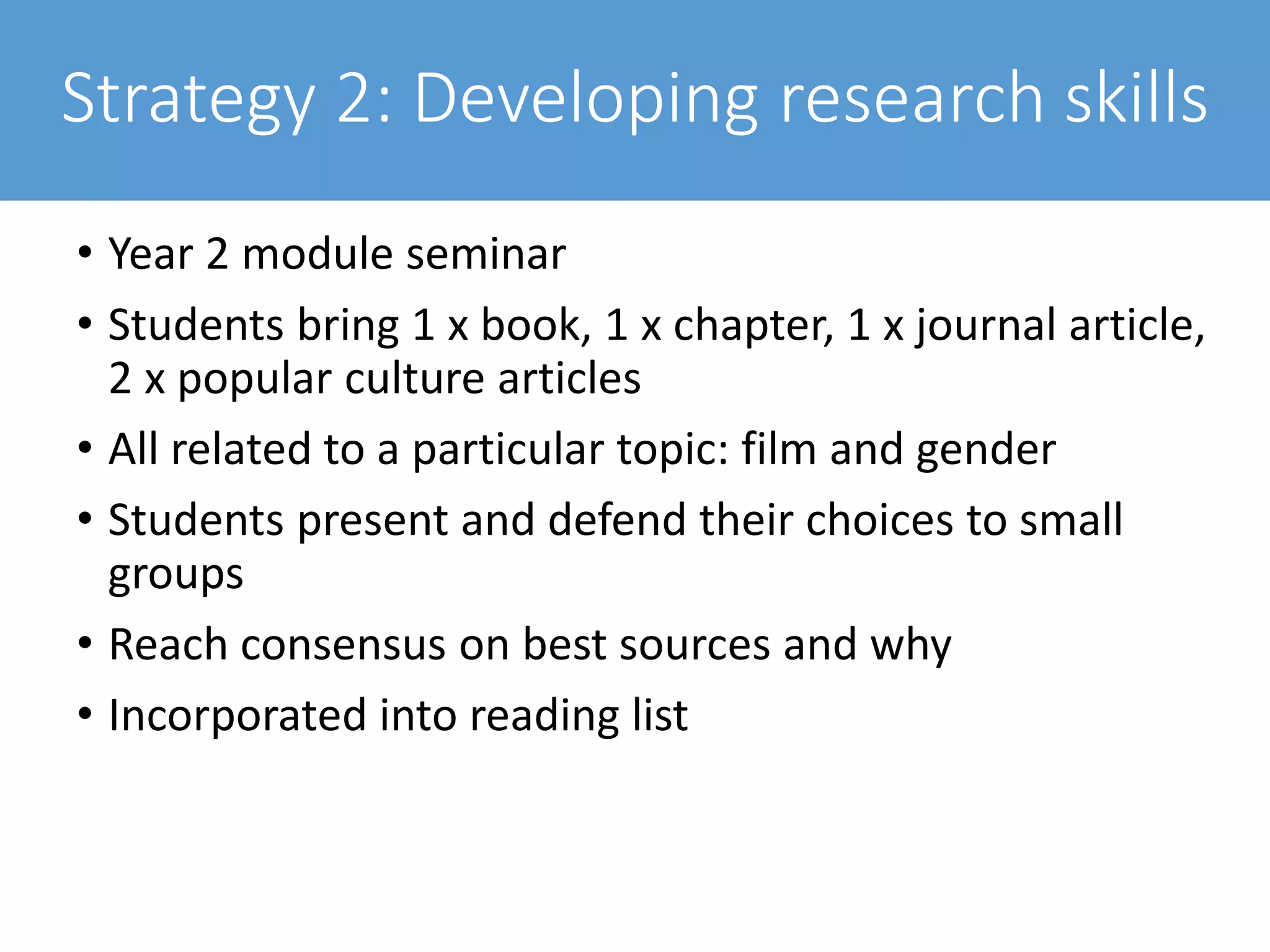
Strategy 2: Developing research skills
• Year 2 module seminar
• Students bring 1 x book, 1 x chapter, 1 x journal article,
2 x popular culture articles
• All related to a particular topic: film and gender
• Students present and defend their choices to small
groups
• Reach consensus on best sources and why
• Incorporated into reading list
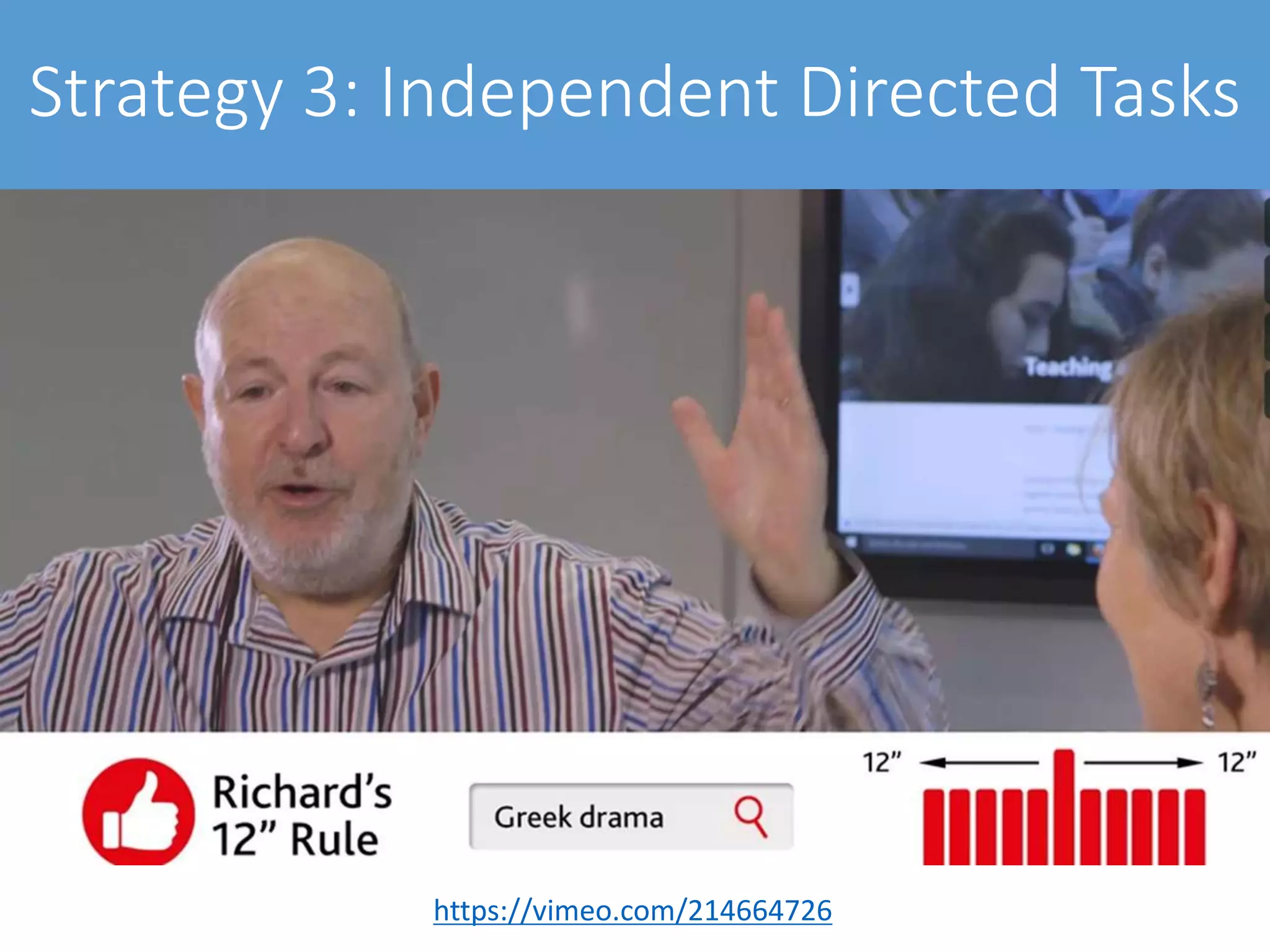
Strategy 3: Independent Directed Tasks
https://vimeo.com/214664726
Strategy 4: Writing in class
Use jottings and writing
exercises more in class!
Thinking power x 30
Teaching for introverts
http://www.bbc.co.uk/programmes/b06ry369
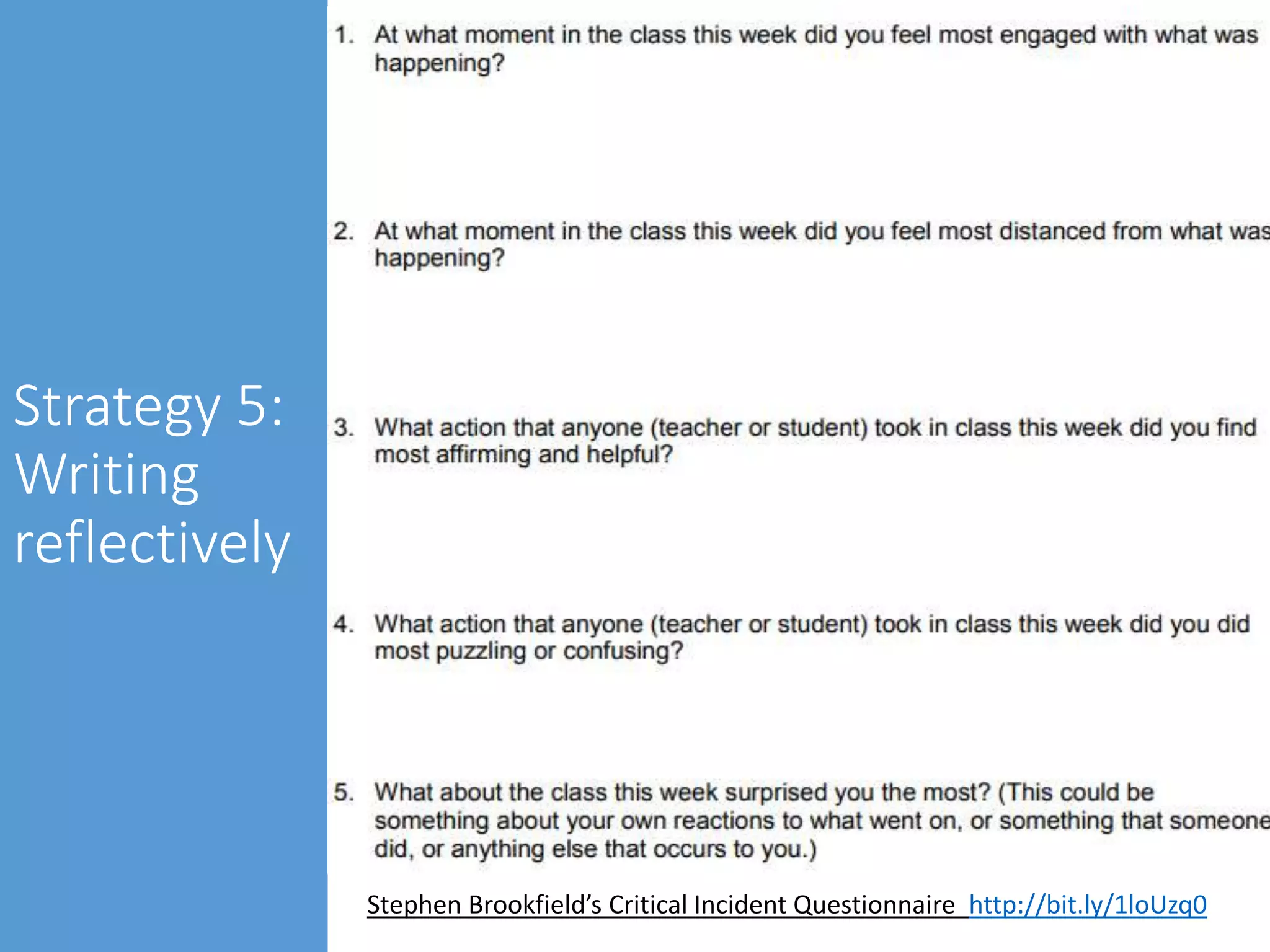
Strategy 5:
Writing
reflectively
Stephen Brookfield’s Critical Incident Questionnaire http://bit.ly/1loUzq0
Strategy 6: Visual ways in to writing
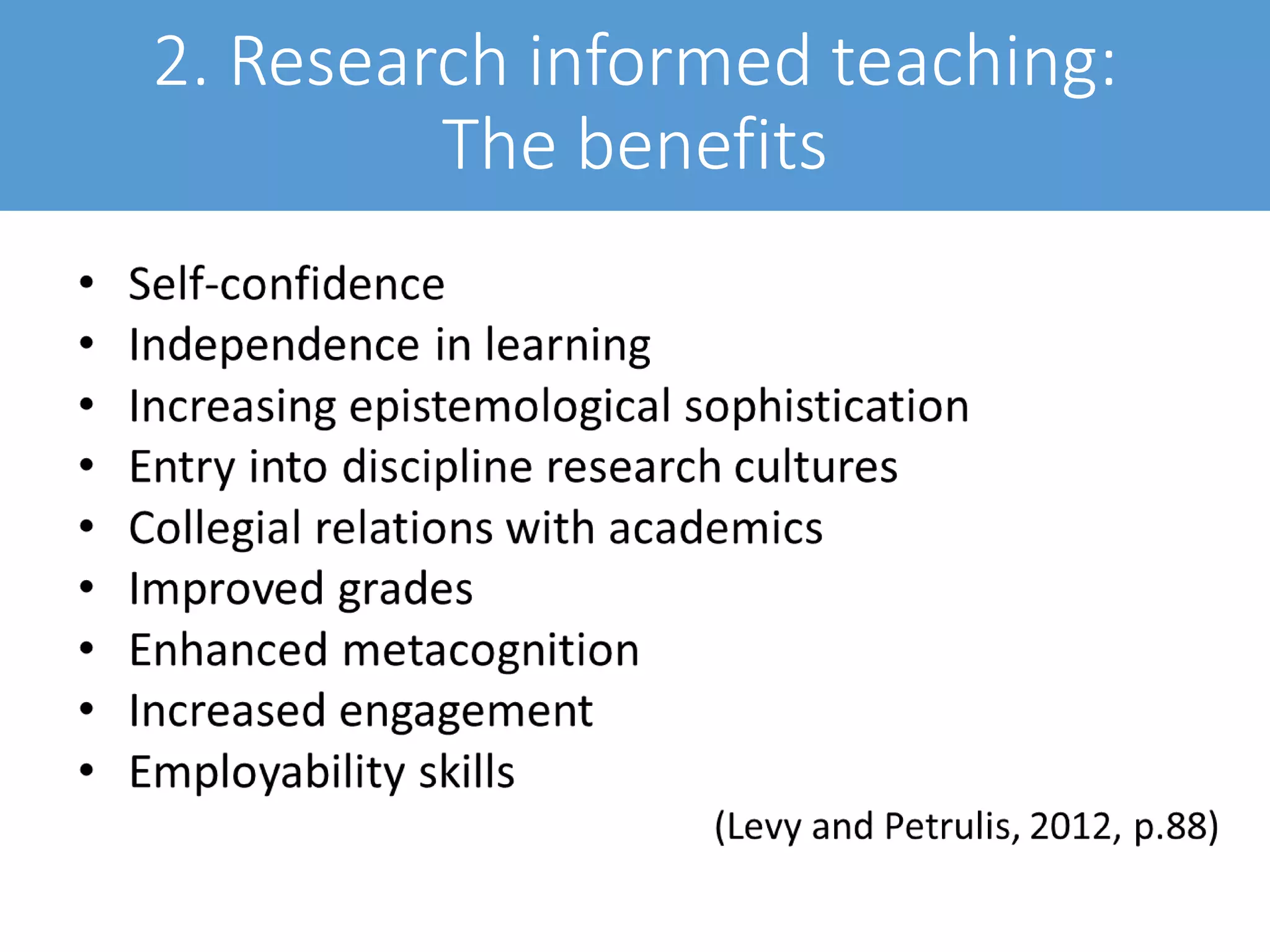
2. Research informed teaching:
The benefits
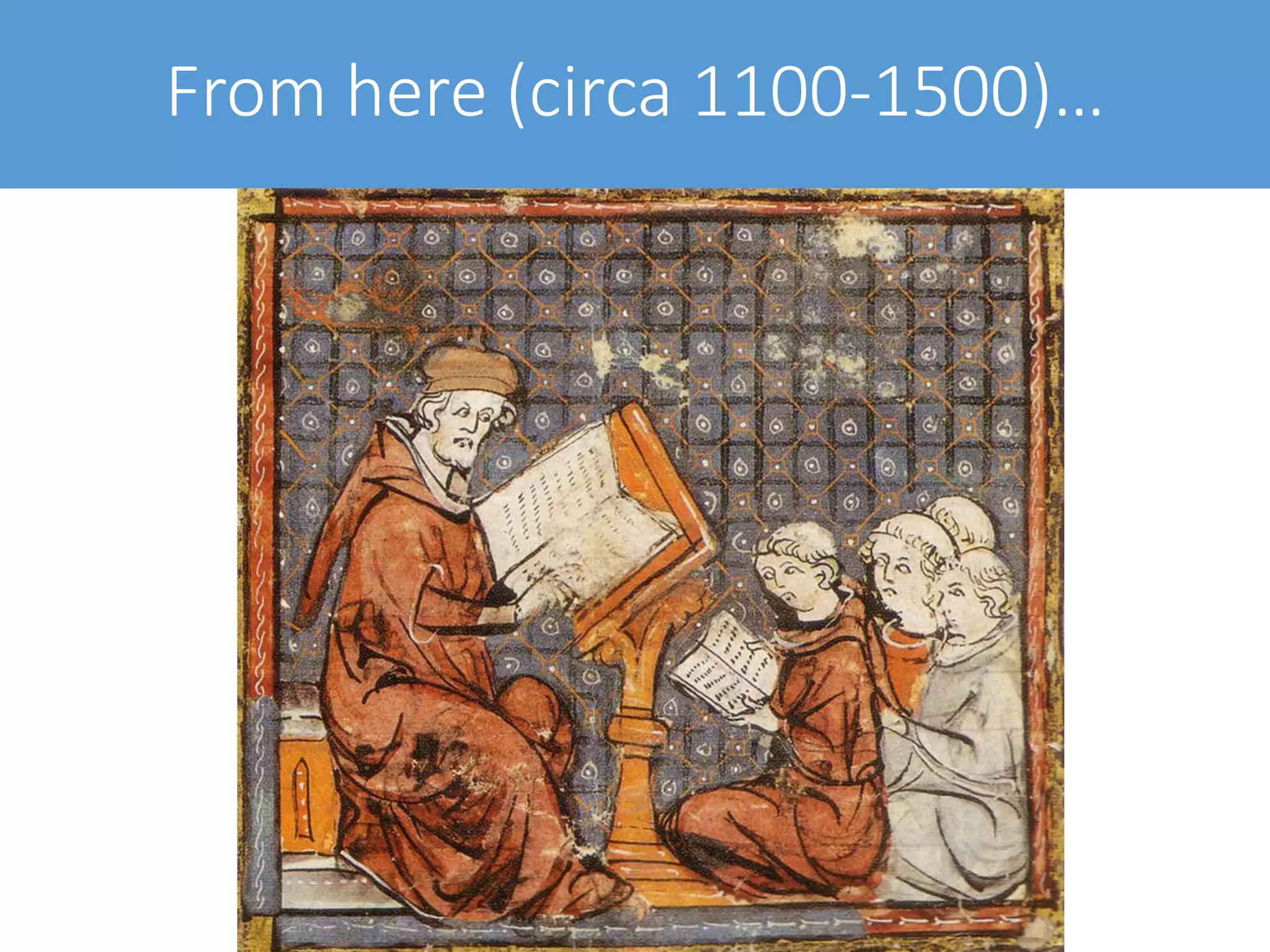
From here (circa 1100-1500)…
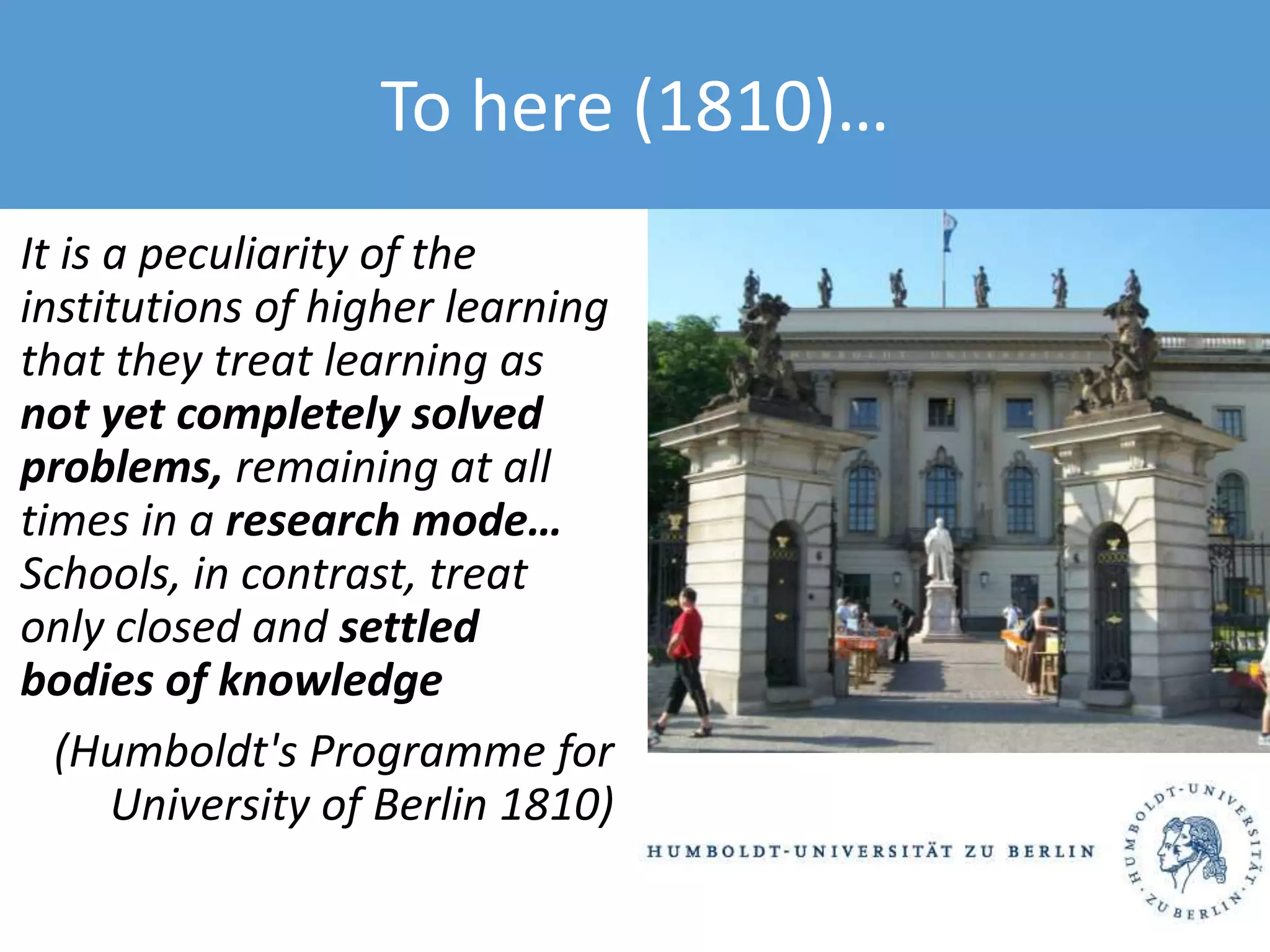
It is a peculiarity of the
institutions of higher learning
that they treat learning as
not yet completely solved
problems, remaining at all
times in a research mode…
Schools, in contrast, treat
only closed and settled
bodies of knowledge
(Humboldt's Programme for
University of Berlin 1810)
To here (1810)…
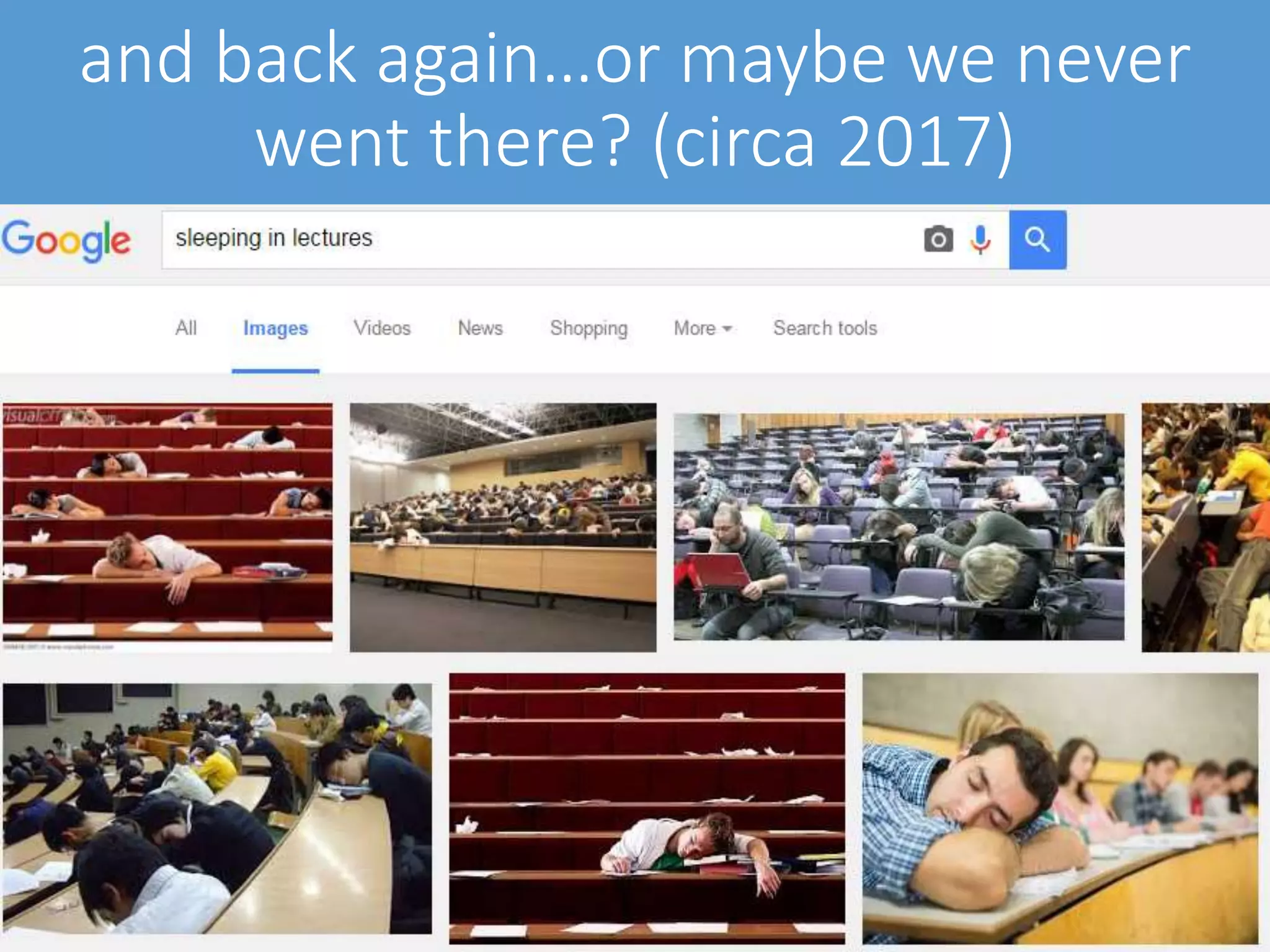
and back again…or maybe we never
went there? (circa 2017)
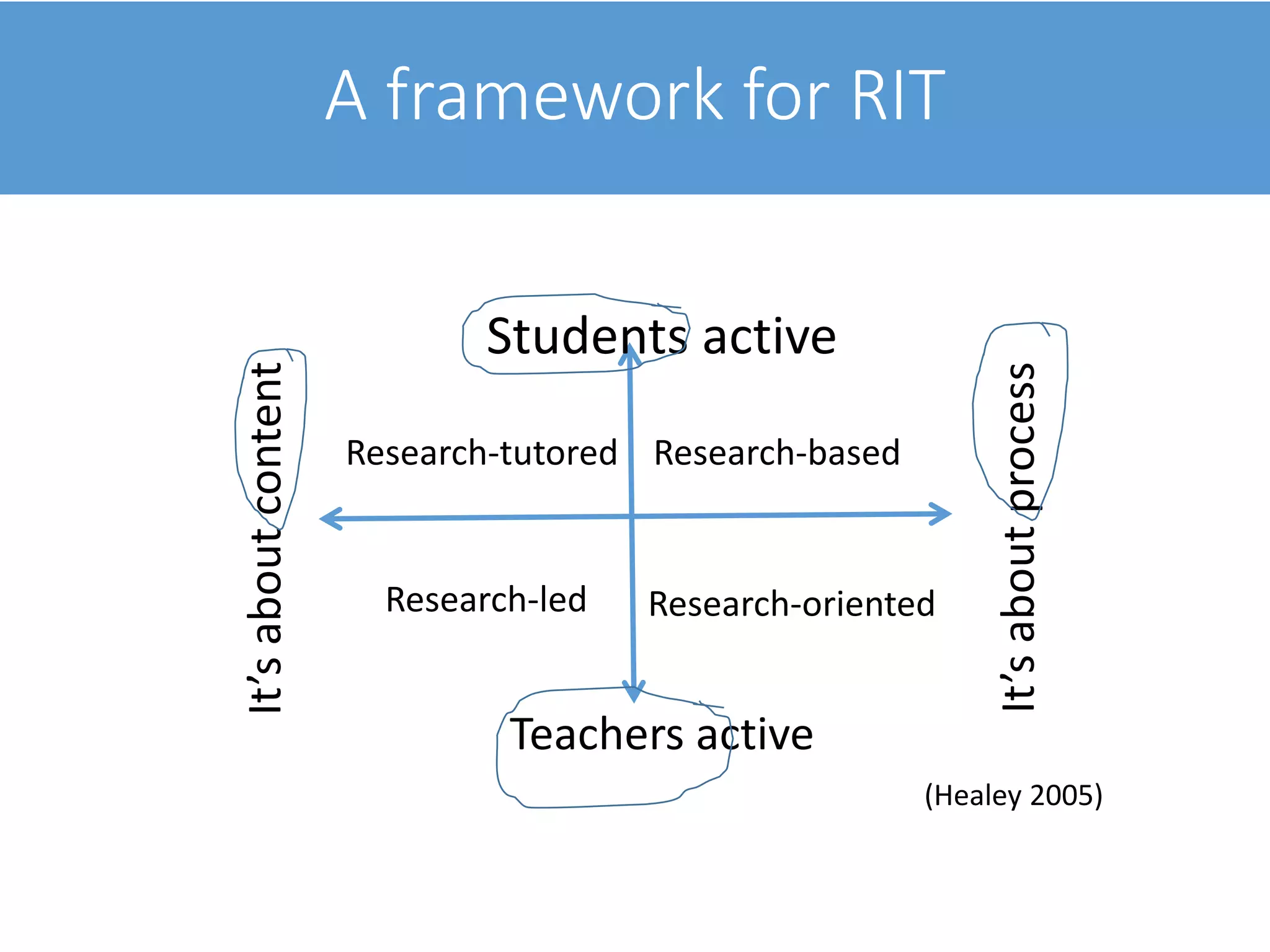
A framework for RIT
Teachers active
Students active
It’saboutcontent
It’saboutprocess
Research-tutored
Research-orientedResearch-led
Research-based
(Healey 2005)
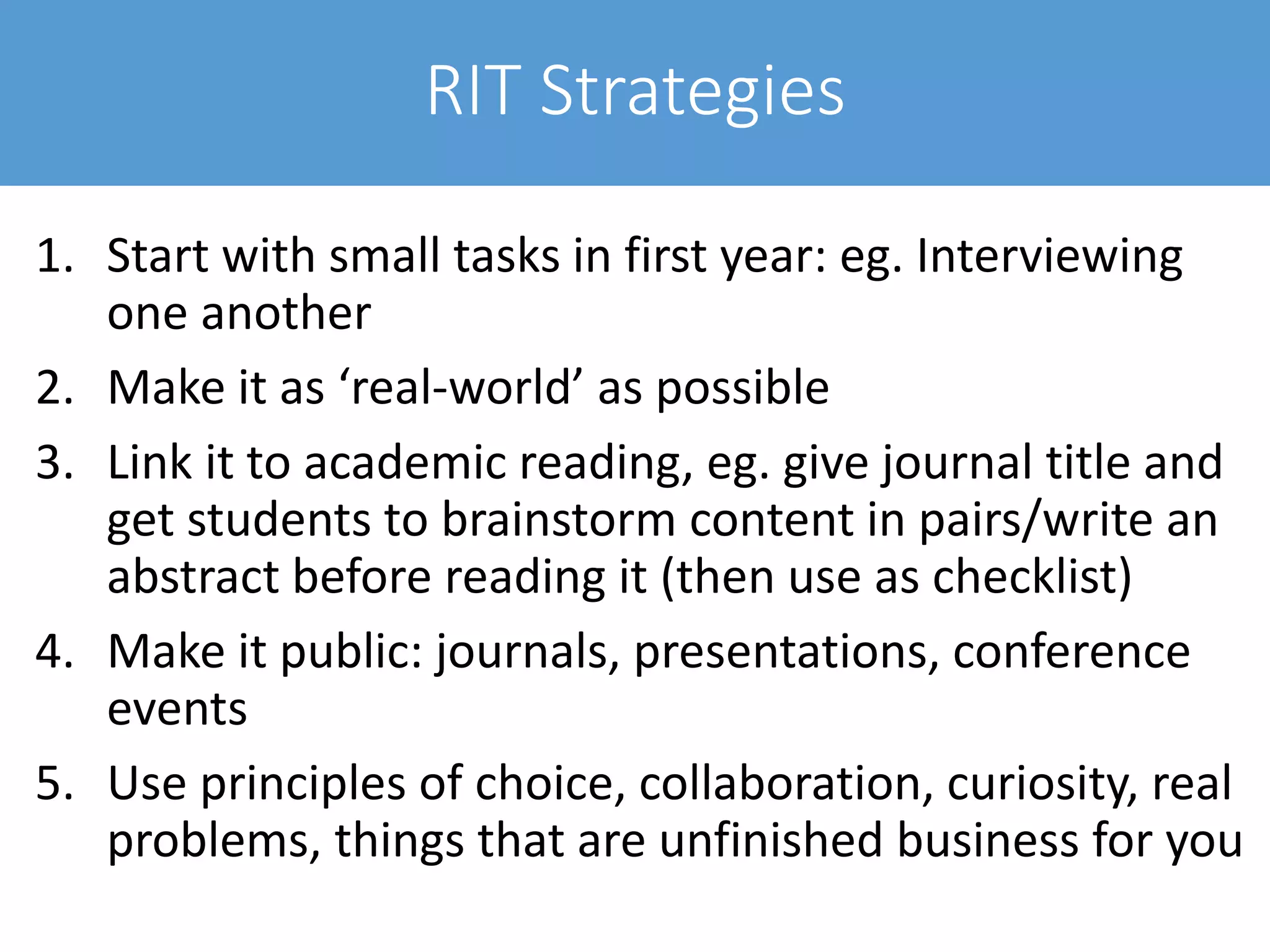
RIT Strategies
1. Start with small tasks in first year: eg. Interviewing
one another
2. Make it as ‘real-world’ as possible
3. Link it to academic reading, eg. give journal title and
get students to brainstorm content in pairs/write an
abstract before reading it (then use as checklist)
4. Make it public: journals, presentations, conference
events
5. Use principles of choice, collaboration, curiosity, real
problems, things that are unfinished business for you
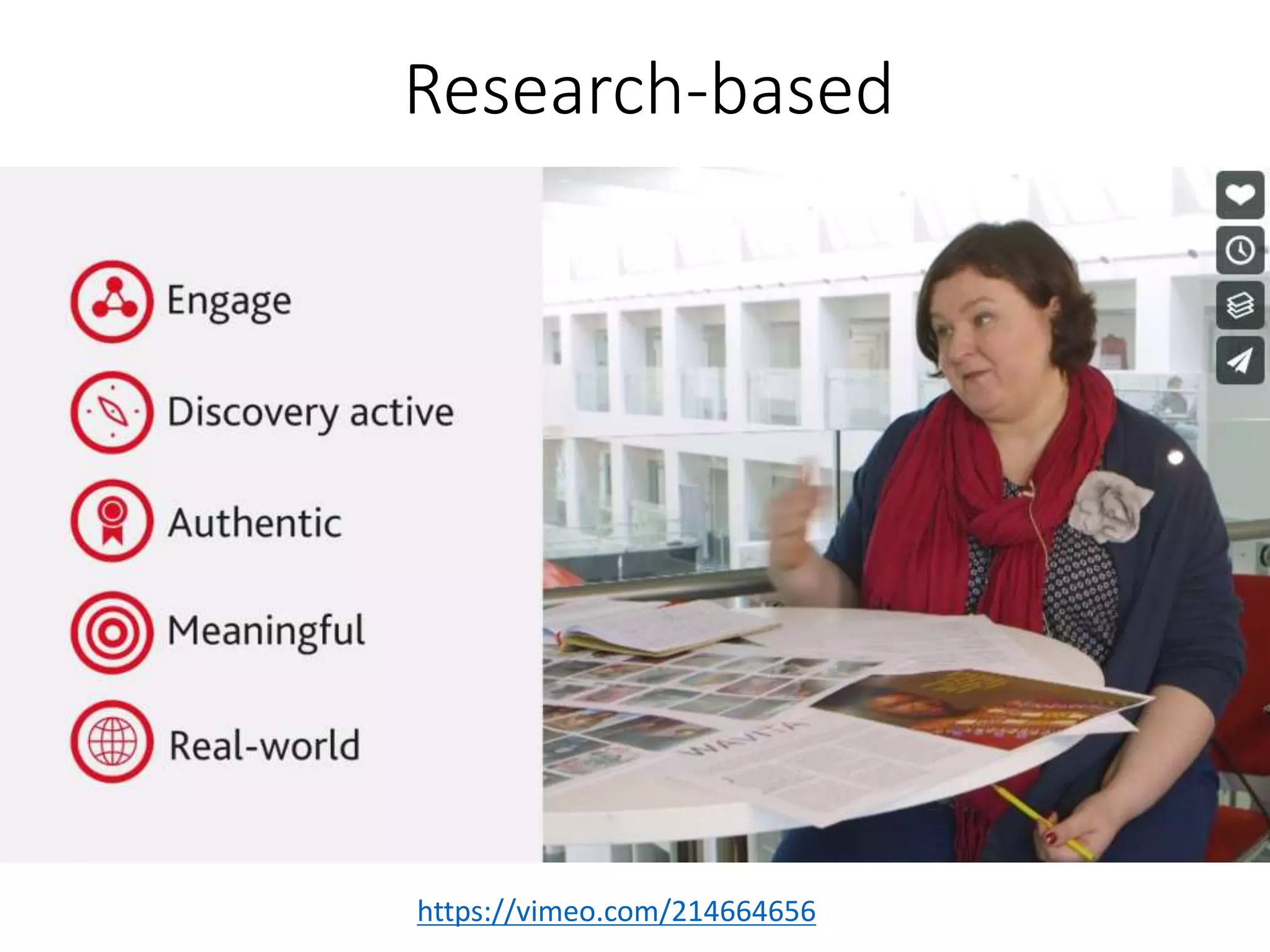
Research-based
https://vimeo.com/214664656
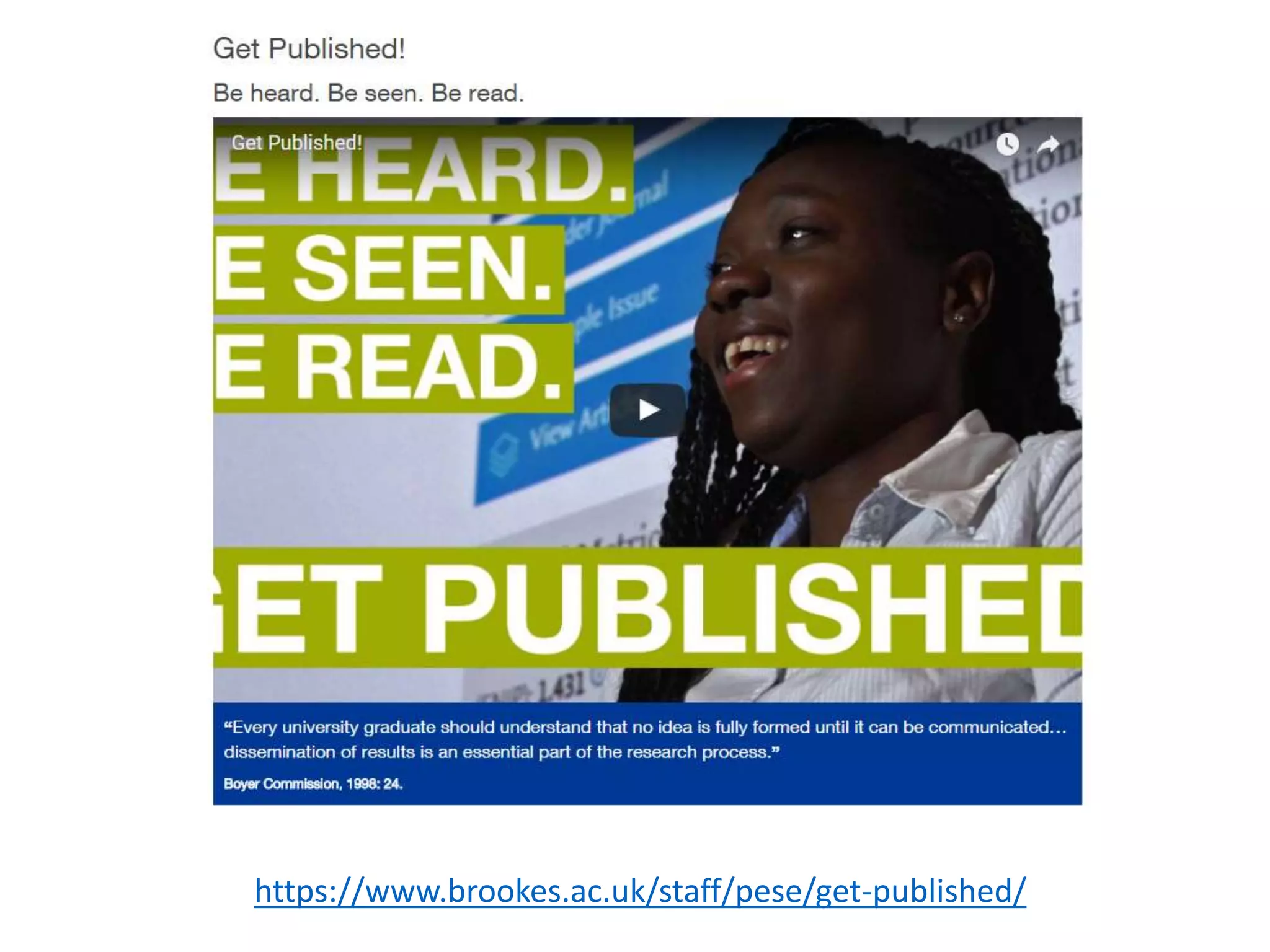
https://www.brookes.ac.uk/staff/pese/get-published/
Being known
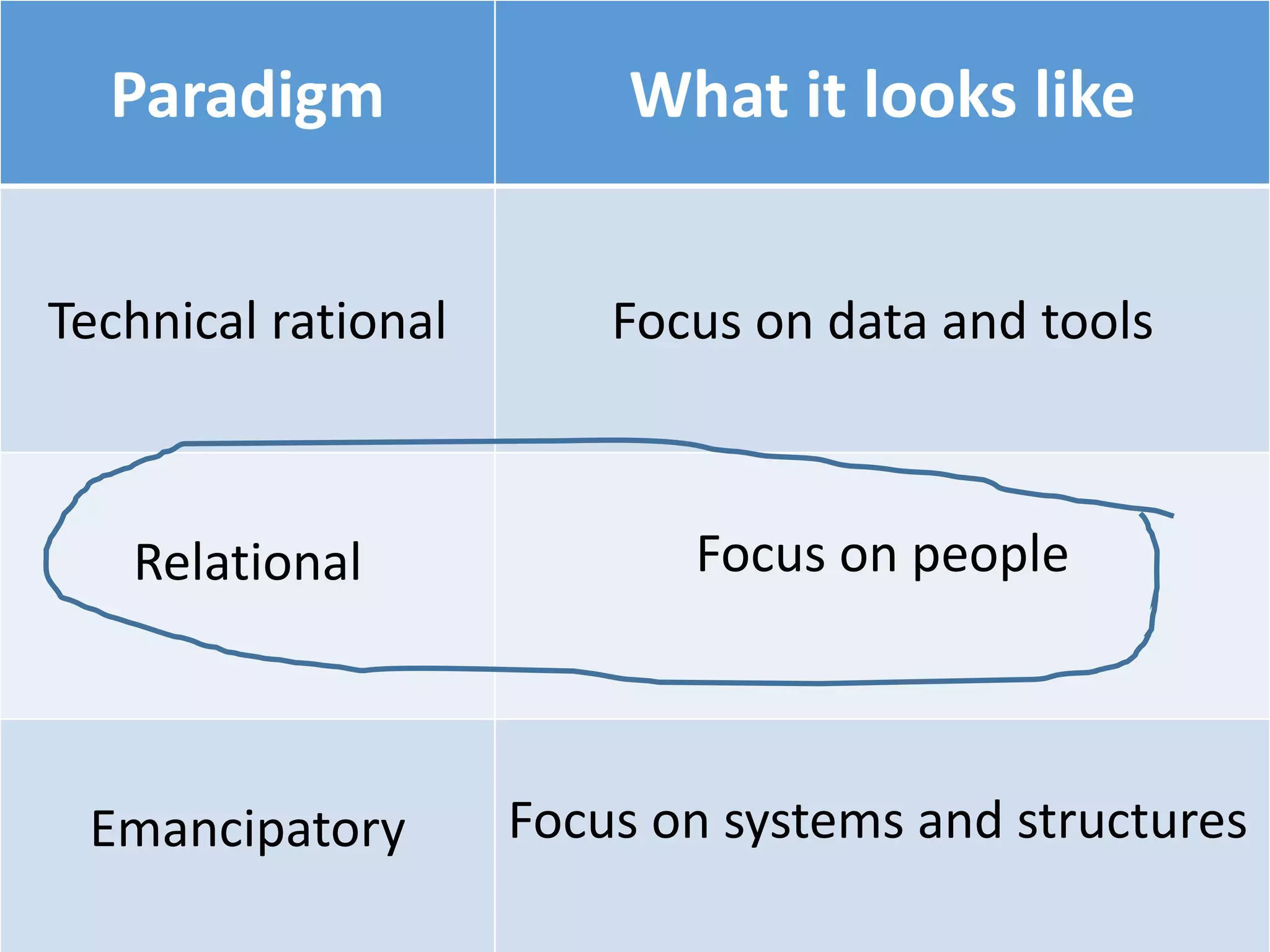
Paradigm What it looks like
Technical rational Focus on data and tools
Relational Focus on people
Emancipatory Focus on systems and structures
Arum R. and Roksa J. 2011. Academically Adrift: Limited Learning on College Campuses. University
of Chicago Press.
Barlow, A. and Jessop, T. 2016. “You can’t write a load of rubbish”: Why blogging works as formative
assessment. Educational Developments. 17(3), 12-15. SEDA.
Brookfield, S. (1995) Becoming a critically reflective teacher. Chapter 6. Understanding Classroom
dynamics: The Critical Incident Questionnaire. San Francisco. Jossey Bass.
Carr, N. 2010. The Shallows: How the internet is changing the way we read, think and remember.
New York. Newton and Company.
Dept. for Business, Energy and Industrial Strategy (2016) Building on Success and Learning from
Experience. (Stern Review)
https://www.gov.uk/government/uploads/system/uploads/attachment_data/file/541338/ind-16-9-
ref-stern-review.pdf
Dept. for Business, Innovation and Skills (2016) Success as a Knowledge Economy: Teaching
Excellence, Social mobility and student choice.
https://www.gov.uk/government/uploads/system/uploads/attachment_data/file/523546/bis-16-
265-success-as-a-knowledge-economy-web.pdf
Gibbs, G. 2017. TEF Presentation at Southampton Solent University.
Healey, M., 2005. Linking Research and Teaching: disciplinary spaces in R. Barnett, ed, Reshaping the
university: new relationships between research, scholarship and teaching. Maidenhead: McGraw-
Hill/Open University Press, 30-42.
Jessop, T and Wu, Q. 2017 Debunking common myths about RIT. Dialogue Journal. 69-78.
Lemov, D. 2014. Teach Like a Champion. San Francisco. Jossey Bass.
Levy, P. and Petrulis, R. (2012) How do first year students experience inquiry and research, and
what are the implications for the practice of inquiry-based learning? Studies in
Higher Education, 37:1, 85-101.
Marton. F. and Saljo, R. 1976. On qualitative differences in Learning: Outcomes and Processes.
British Journal of Educational Psychology. 46(1). 4-11.
Wilsdon, J., et al. (2015). The Metric Tide: Report of the Independent Review of the Role of Metrics
in Research Assessment and Management. DOI: 10.13140/RG.2.1.4929.1363
References

Sparking learning in the context of metrics: cast iron or teflon?

  • 1.
    Sparking learning inthe context of metrics: Cast Iron or Teflon? @solentlearning @tansyjtweets Tansy Jessop Business Librarians Conference 5 July 2017
  • 2.
    Session outline • Spotcheck on metrics • Metrics: their power and their limitations • The sure-fire things that spark learning •Reading and Writing •Research informed Teaching •Being known
  • 3.
    How would youdefine excellent teaching? Go to www.menti.com and use the code 73 40 64 Type in three words or phrases which sum up excellent teaching for you.
  • 4.
    Cool Business Librariandefinitions! (n= 53 respondents)
  • 5.
    How can youtell if teaching is excellent? Go to www.menti.com & use the code 58 64 46 Choose the top two indicators.
  • 6.
    How to measureexcellence (n=61 respondents)
  • 7.
    So how doesJo Johnson describe higher education teaching? Teaching is highly variable across higher education… There is lamentable teaching that must be driven out of our system… “Disengagement contract”… There are inspiring academics who go the extra mile, emailing at weekends…
  • 8.
    So is this howto measure it?
  • 9.
    How do NSSquestions stack up as excellence metrics?
  • 11.
    Do students getjobs as a result of teaching quality? Rank Teaching (NSS) 1 2 3 4 5 6 7 8 9 10
  • 12.
    Does employability derivefrom teaching quality? Rank Teaching (NSS) 1 Buckingham 2 University of Law 3 St Mary’s College Belfast 4 Courtauld Institute of Art 5 Keele 6 St Andrews 7 Bishop Grossteste 8 Harper Adams 9 Liverpool Hope 10 Aberystwyth
  • 13.
    Does employability derivefrom teaching quality? Rank Teaching (NSS) Graduate employability (Times) 1 Buckingham Cambridge 2 University of Law Oxford 3 St Mary’s College Belfast LSE 4 Courtauld Institute of Art Manchester 5 Keele Imperial College 6 St Andrews Kings College 7 Bishop Grossteste Edinburgh 8 Harper Adams University College 9 Liverpool Hope London Business School 10 Aberystwyth Bristol
  • 14.
    Does employability derivefrom teaching quality? Rank Teaching (NSS) Graduate employability (Times) NSS Rank 1 Buckingham Cambridge 20 2 University of Law Oxford 20 3 St Mary’s College Belfast LSE 155 4 Courtauld Institute of Art Manchester 87 5 Keele Imperial College 116 6 St Andrews Kings College 129 7 Bishop Grossteste Edinburgh 145 8 Harper Adams University College 102 9 Liverpool Hope London Business School 155 10 Aberystwyth Bristol 76
  • 15.
    Does employability derivefrom teaching quality? Gold, Silver, Bronze? Rank Teaching (NSS) Graduate employability (Times) NSS Rank 1 Buckingham Cambridge 20 2 University of Law Oxford 20 3 St Mary’s College Belfast LSE 155 4 Courtauld Institute of Art Manchester 87 5 Keele Imperial College 116 6 St Andrews Kings College 129 7 Bishop Grossteste Edinburgh 145 8 Harper Adams University College London 102 9 Liverpool Hope London Business School 155 10 Aberystwyth Bristol 76
  • 16.
  • 17.
    Some of themost precious qualities of academic culture resist simple quantification… Too often, poorly designed evaluation criteria are “dominating minds, distorting behaviour and determining careers.” (Wilsdon 2015, iii)
  • 20.
    Excellent teaching isabout deep learning Deep Learning • Meaning • Concepts • Active learning • Generating knowledge • Relationship new and previous knowledge • Real-world learning Surface Learning • External purpose • Topics • Passive process • Reproducing knowledge • Isolated and disconnected knowledge • Artificial learning (Marton and Saljo 1976)
  • 21.
    So what sparksinspiring learning? •Academic reading and writing •Research informed teaching •Being known
  • 22.
  • 24.
    Academic reading: whatstudents say A lot of people don’t do wider reading. You just focus on your essay question. I always find myself going to the library and going ‘These are the books related to this essay’ and that’s it. You anticipate the questions coming up, and you learn the materials that will definitely come up. It’s definitely a way to focus your studies and to get a good mark, perhaps. But is it is really the way to learn?
  • 25.
    Your experience Which ofthese quotations resonates and why? Do you have any idea why students don’t read academic texts? What strategies do you have to encourage students to read?
  • 26.
    How much arestudents actually learning in contemporary higher education? The answer, for many undergraduates, is not much. Do universities reproduce or reduce inequality among students from different family backgrounds? …evidence of limited learning and persistent inequality…
  • 27.
    Research findings aboutacademic reading and writing Significant learning gains for students who 1) Read > 40 pages a week of academic writing 2) Write > 20 pages per semester for each unit
  • 28.
  • 29.
    Strategy 1: Formativeblogging • In-class • On wordpress • About controversial leading edge articles • Personalised • Comments on threads • Digital footprints • Weekly informal, conversational writing
  • 30.
    Out of thesilent seminar… You have to evidence that you have read it compared to a seminar reading. You are reading a lot more as well as the set ones. I go more in depth with the reading than with the reading pack when I’d just highlight. It helps. We sit in blog groups, all talk about it. Discuss the readings. I think the discussion is more focused.
  • 31.
    Into engagement… Over thewhole three years this is the most engaged I’ve been in my readings. I really liked doing this. I wish we had done it more. Maybe start it in the first year. . …it is also a bit chatty and informal. Even though I’m putting in readings, it’s different. It’s a nicer relaxed way of talking about literature
  • 32.
    Strategy 2: Developingresearch skills • Year 2 module seminar • Students bring 1 x book, 1 x chapter, 1 x journal article, 2 x popular culture articles • All related to a particular topic: film and gender • Students present and defend their choices to small groups • Reach consensus on best sources and why • Incorporated into reading list
  • 33.
    Strategy 3: IndependentDirected Tasks https://vimeo.com/214664726
  • 34.
    Strategy 4: Writingin class Use jottings and writing exercises more in class! Thinking power x 30 Teaching for introverts http://www.bbc.co.uk/programmes/b06ry369
  • 35.
    Strategy 5: Writing reflectively Stephen Brookfield’sCritical Incident Questionnaire http://bit.ly/1loUzq0
  • 36.
    Strategy 6: Visualways in to writing
  • 37.
    2. Research informedteaching: The benefits
  • 38.
    From here (circa1100-1500)…
  • 39.
    It is apeculiarity of the institutions of higher learning that they treat learning as not yet completely solved problems, remaining at all times in a research mode… Schools, in contrast, treat only closed and settled bodies of knowledge (Humboldt's Programme for University of Berlin 1810) To here (1810)…
  • 40.
    and back again…ormaybe we never went there? (circa 2017)
  • 41.
    A framework forRIT Teachers active Students active It’saboutcontent It’saboutprocess Research-tutored Research-orientedResearch-led Research-based (Healey 2005)
  • 42.
    RIT Strategies 1. Startwith small tasks in first year: eg. Interviewing one another 2. Make it as ‘real-world’ as possible 3. Link it to academic reading, eg. give journal title and get students to brainstorm content in pairs/write an abstract before reading it (then use as checklist) 4. Make it public: journals, presentations, conference events 5. Use principles of choice, collaboration, curiosity, real problems, things that are unfinished business for you
  • 43.
  • 44.
  • 45.
  • 46.
    Paradigm What itlooks like Technical rational Focus on data and tools Relational Focus on people Emancipatory Focus on systems and structures
  • 47.
    Arum R. andRoksa J. 2011. Academically Adrift: Limited Learning on College Campuses. University of Chicago Press. Barlow, A. and Jessop, T. 2016. “You can’t write a load of rubbish”: Why blogging works as formative assessment. Educational Developments. 17(3), 12-15. SEDA. Brookfield, S. (1995) Becoming a critically reflective teacher. Chapter 6. Understanding Classroom dynamics: The Critical Incident Questionnaire. San Francisco. Jossey Bass. Carr, N. 2010. The Shallows: How the internet is changing the way we read, think and remember. New York. Newton and Company. Dept. for Business, Energy and Industrial Strategy (2016) Building on Success and Learning from Experience. (Stern Review) https://www.gov.uk/government/uploads/system/uploads/attachment_data/file/541338/ind-16-9- ref-stern-review.pdf Dept. for Business, Innovation and Skills (2016) Success as a Knowledge Economy: Teaching Excellence, Social mobility and student choice. https://www.gov.uk/government/uploads/system/uploads/attachment_data/file/523546/bis-16- 265-success-as-a-knowledge-economy-web.pdf Gibbs, G. 2017. TEF Presentation at Southampton Solent University. Healey, M., 2005. Linking Research and Teaching: disciplinary spaces in R. Barnett, ed, Reshaping the university: new relationships between research, scholarship and teaching. Maidenhead: McGraw- Hill/Open University Press, 30-42. Jessop, T and Wu, Q. 2017 Debunking common myths about RIT. Dialogue Journal. 69-78. Lemov, D. 2014. Teach Like a Champion. San Francisco. Jossey Bass. Levy, P. and Petrulis, R. (2012) How do first year students experience inquiry and research, and what are the implications for the practice of inquiry-based learning? Studies in Higher Education, 37:1, 85-101. Marton. F. and Saljo, R. 1976. On qualitative differences in Learning: Outcomes and Processes. British Journal of Educational Psychology. 46(1). 4-11. Wilsdon, J., et al. (2015). The Metric Tide: Report of the Independent Review of the Role of Metrics in Research Assessment and Management. DOI: 10.13140/RG.2.1.4929.1363 References

Editor's Notes

  • #2 Tansy
  • #3 TJ
  • #8 It is more variable within than across universities! 86% satisfaction rates with teaching across the sector = lamentable?
  • #10 TJ
  • #16 OK
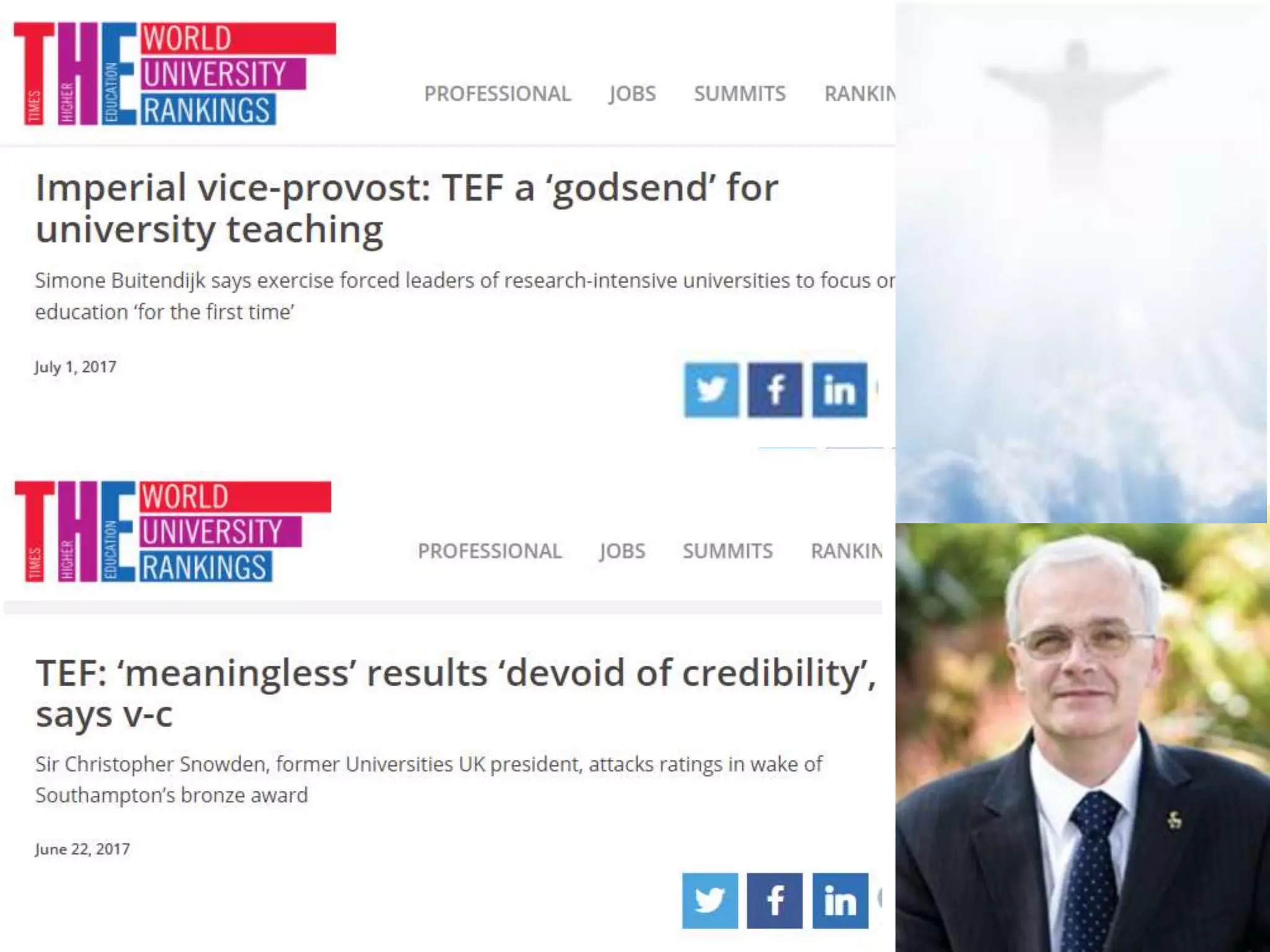
  • #20 They were a godsend for Imperial which was ranked 116th out of 140 for teaching quality in the NSS!