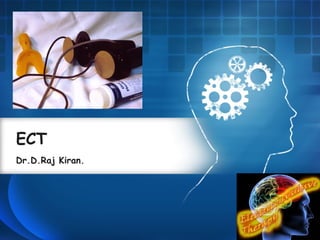
ECT
Dr.D.Raj Kiran.
What is ECT
• ECT- Application of electric current to the
head with the aim of inducing a controlled
tonic-clonic seizure, usually at regular
intervals, to achieve an improvement in an
abnormal mental state.
• Modified ECT- Induction of cerebral
seizure under anaesthesia.
• Unmodified ECT- Induction of cerebral
seizure without anaesthesia.
History
• In 16th century, the
Swiss alchemist
Paracelsus gave
camphor by mouth to
induce convulsions and
“cure lunacy.”
• In 18th & 19th century,
several cases of
convulsions induced by
chemical means were
documented.
History
• Manfred Sakel was the
developer of insulin
shock therapy.
• He noted that insulininduced coma and
convulsions had a change
in the mental state of
drug addicts and
psychotics.
• Complications were high.
History
• In 1934, Lazlo Meduna, a
Hungarian psychiatrist,
injected camphor in oil
into a catatonic
schizophrenia, causing
grand mal seizure.
• After series of such
treatments pts recovered.
• Later Camphor was
replaced by
pentylenetetrazol.
History
• Pentylenetetrazol
caused lot of
unpleasant
sensations.
• The concept of
applying electricity
was developed.
• Swiss scientists
induced seizures in
dogs using direct
electrical current.
Birth of ECT
• Italian scientists, Cerletti and Bini
subsequently succeeded in applying
electricity directly to the human scalp.
• In 1938, they treated an unidentified
39-year-old man who was found
delusional in a train station.
• He recovered fully after 11 treatments
without adverse Effects.
Birth of ECT
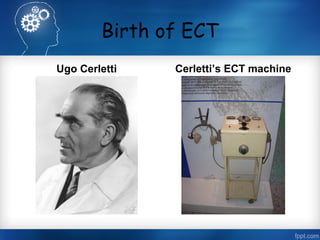
Ugo Cerletti

Cerletti’s ECT machine
Effects of ECT
• During ECT, brain imaging showsHypermetabolic state
– increases in cerebral blood flow (CBF).
– increase cerebral metabolic rate (CMR).

• Post-ictal state- functional suppression
– decreases in CBF.
– decrease in CMR.

• Also during & after ECT, there are δ waves
indicating reduction in neural activity.
Mechanism of action
• No “definitive theory” regarding the
mechanisms of action.
• Psychological theories- patient
expectation, placebo effects, forced
regression, and contribution of
retrograde amnesia to clinical response.
• These were proved to be incorrect.
Mechanism of action
• Biological theories- they are related to
ECT's anticonvulsant effects.
• These effects manifest during a course
of ECT.
• They include
–
–
–
–

progressive increases in seizure threshold.
progressive decrease in seizure duration.
increases in inhibitory neurotransmitters.
decreases in excitatory neurotransmitters.
Mechanism of action
• Recent studies– Transient induction of increased proinflammatory cytokines,
– Increased expression of brain-derived
neurotrophic factor (BDNF),
– Gene polymorphism,
– Enhanced activity in the GABAergic,
glutaminergic and dopaminergic systems,
– Enhance neurogenesis, synaptogenesis and
remodelling of synapses in hippocampus.
Electrical principles
• Waveforms
– Sine wave- more cognitive deficits
– Brief square wave- better efficacy & less
adverse effects.

• An adequate seizure is defined as
–
–
–
–

Motor seizure > 25 sec.
EEG seizure of 30-120 sec.
Rise of HR by > 50% during seizure.
Post-ictal rise in PRL.
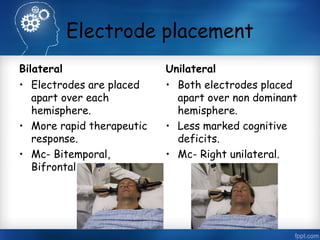
Electrode placement
Bilateral

Unilateral

• Electrodes are placed
apart over each
hemisphere.
• More rapid therapeutic
response.
• Mc- Bitemporal,
Bifrontal.

• Both electrodes placed
apart over non dominant
hemisphere.
• Less marked cognitive
deficits.
• Mc- Right unilateral.
Electrode placement
• Bilateral- electrode
is placed 2.5 -4cm
above the midpoint
of line joining tragus
& lateral canthus.
• Unilateral- another
electrode at vertex.
Indications
•
•
•
•
•
•
•
•
•
•

Major depression.
Mania.
Schizophrenia.
Catatonia.
Parkinson’s disease.
Intractable seizures.
Delirium.
Gilles de la tourette syndrome.
Hallucinogen induced psychosis.
Neuroleptic malignant syndrome (NMS).
Contra-indications
• Absolute- “none”
• Relative–
–
–
–
–
–
–
–

Space occupying intracranial lesion.
Raised ICP.
Recent MI with unstable cardiac function.
Vascular aneurysm.
Recent Intra cranial hemorrhage.
Retinal detachment.
Pheochromocytoma.
Anesthesia risk.

• Pregnancy is not a contraindication.
Pretreatment
• Informed consent
• Evaluation– History & Examination.
– Medical evaluation- systemic examination, fundus,
ECG, electrolytes.
– Anaesthetic evaluation.

• Bite block
• Anaesthetic agents- thiopental/propofol,
muscle relaxant (SCh), anticholinergics.
Adverse effects
• Nausea, vomiting, headache.
• CNS– Post-ictal confusion.
– Memory problems- retrograde > anterograde.

• Fractures & Muscle injuries- direct ECT.
• Death- 1 in 25,000. causes could be MI,
Ventricular arrhythmias, respiratory
complications.
Video….
• Video on Modified ECT
Electro Convulsive Therapy

Electro Convulsive Therapy

  • 1.
  • 2.
    What is ECT •ECT- Application of electric current to the head with the aim of inducing a controlled tonic-clonic seizure, usually at regular intervals, to achieve an improvement in an abnormal mental state. • Modified ECT- Induction of cerebral seizure under anaesthesia. • Unmodified ECT- Induction of cerebral seizure without anaesthesia.
  • 3.
    History • In 16thcentury, the Swiss alchemist Paracelsus gave camphor by mouth to induce convulsions and “cure lunacy.” • In 18th & 19th century, several cases of convulsions induced by chemical means were documented.
  • 4.
    History • Manfred Sakelwas the developer of insulin shock therapy. • He noted that insulininduced coma and convulsions had a change in the mental state of drug addicts and psychotics. • Complications were high.
  • 5.
    History • In 1934,Lazlo Meduna, a Hungarian psychiatrist, injected camphor in oil into a catatonic schizophrenia, causing grand mal seizure. • After series of such treatments pts recovered. • Later Camphor was replaced by pentylenetetrazol.
  • 6.
    History • Pentylenetetrazol caused lotof unpleasant sensations. • The concept of applying electricity was developed. • Swiss scientists induced seizures in dogs using direct electrical current.
  • 7.
    Birth of ECT •Italian scientists, Cerletti and Bini subsequently succeeded in applying electricity directly to the human scalp. • In 1938, they treated an unidentified 39-year-old man who was found delusional in a train station. • He recovered fully after 11 treatments without adverse Effects.
  • 8.
    Birth of ECT UgoCerletti Cerletti’s ECT machine
  • 9.
    Effects of ECT •During ECT, brain imaging showsHypermetabolic state – increases in cerebral blood flow (CBF). – increase cerebral metabolic rate (CMR). • Post-ictal state- functional suppression – decreases in CBF. – decrease in CMR. • Also during & after ECT, there are δ waves indicating reduction in neural activity.
  • 10.
    Mechanism of action •No “definitive theory” regarding the mechanisms of action. • Psychological theories- patient expectation, placebo effects, forced regression, and contribution of retrograde amnesia to clinical response. • These were proved to be incorrect.
  • 11.
    Mechanism of action •Biological theories- they are related to ECT's anticonvulsant effects. • These effects manifest during a course of ECT. • They include – – – – progressive increases in seizure threshold. progressive decrease in seizure duration. increases in inhibitory neurotransmitters. decreases in excitatory neurotransmitters.
  • 12.
    Mechanism of action •Recent studies– Transient induction of increased proinflammatory cytokines, – Increased expression of brain-derived neurotrophic factor (BDNF), – Gene polymorphism, – Enhanced activity in the GABAergic, glutaminergic and dopaminergic systems, – Enhance neurogenesis, synaptogenesis and remodelling of synapses in hippocampus.
  • 13.
    Electrical principles • Waveforms –Sine wave- more cognitive deficits – Brief square wave- better efficacy & less adverse effects. • An adequate seizure is defined as – – – – Motor seizure > 25 sec. EEG seizure of 30-120 sec. Rise of HR by > 50% during seizure. Post-ictal rise in PRL.
  • 14.
    Electrode placement Bilateral Unilateral • Electrodesare placed apart over each hemisphere. • More rapid therapeutic response. • Mc- Bitemporal, Bifrontal. • Both electrodes placed apart over non dominant hemisphere. • Less marked cognitive deficits. • Mc- Right unilateral.
  • 15.
    Electrode placement • Bilateral-electrode is placed 2.5 -4cm above the midpoint of line joining tragus & lateral canthus. • Unilateral- another electrode at vertex.
  • 16.
    Indications • • • • • • • • • • Major depression. Mania. Schizophrenia. Catatonia. Parkinson’s disease. Intractableseizures. Delirium. Gilles de la tourette syndrome. Hallucinogen induced psychosis. Neuroleptic malignant syndrome (NMS).
  • 17.
    Contra-indications • Absolute- “none” •Relative– – – – – – – – Space occupying intracranial lesion. Raised ICP. Recent MI with unstable cardiac function. Vascular aneurysm. Recent Intra cranial hemorrhage. Retinal detachment. Pheochromocytoma. Anesthesia risk. • Pregnancy is not a contraindication.
  • 18.
    Pretreatment • Informed consent •Evaluation– History & Examination. – Medical evaluation- systemic examination, fundus, ECG, electrolytes. – Anaesthetic evaluation. • Bite block • Anaesthetic agents- thiopental/propofol, muscle relaxant (SCh), anticholinergics.
  • 19.
    Adverse effects • Nausea,vomiting, headache. • CNS– Post-ictal confusion. – Memory problems- retrograde > anterograde. • Fractures & Muscle injuries- direct ECT. • Death- 1 in 25,000. causes could be MI, Ventricular arrhythmias, respiratory complications.
  • 20.