Lecture 6: Urban Water Security
Yoshifumi Masago
United Nations University
Institute for the Advanced Study of Sustainability (UNU-IAS)
2018/3/6 2018 ProSPER.Net Young Researchers’ School (YRS)
Today’s topics
• Sustainable Development Goals (SDGs)
• Urbanization, climate change, and urban water
• Water resource management in water-scarce region in La Paz and
El Alto, Bolivia
• Projecting future urban water environment: Jakarta case study
2
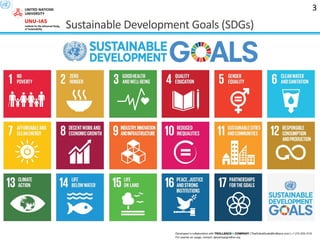
Sustainable Development Goals (SDGs)
3
“water” and “sanitation” in SDGs and MDGs
• How many SDGs and targets states “water”?
• How many SDGs and targets states “sanitation”?
• How many MDGs and targets states “water” and “sanitation”?
4
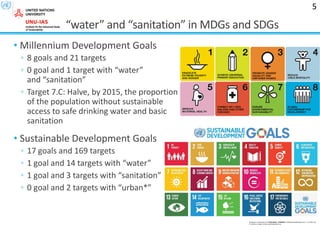
“water” and “sanitation” in MDGs and SDGs
• Millennium Development Goals
◦ 8 goals and 21 targets
◦ 0 goal and 1 target with “water”
and “sanitation”
◦ Target 7.C: Halve, by 2015, the proportion
of the population without sustainable
access to safe drinking water and basic
sanitation
• Sustainable Development Goals
◦ 17 goals and 169 targets
◦ 1 goal and 14 targets with “water”
◦ 1 goal and 3 targets with “sanitation”
◦ 0 goal and 2 targets with “urban*”
5
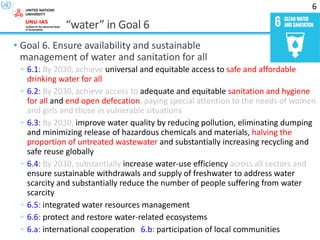
“water” in Goal 6
• Goal 6. Ensure availability and sustainable
management of water and sanitation for all
◦ 6.1: By 2030, achieve universal and equitable access to safe and affordable
drinking water for all
◦ 6.2: By 2030, achieve access to adequate and equitable sanitation and hygiene
for all and end open defecation, paying special attention to the needs of women
and girls and those in vulnerable situations
◦ 6.3: By 2030, improve water quality by reducing pollution, eliminating dumping
and minimizing release of hazardous chemicals and materials, halving the
proportion of untreated wastewater and substantially increasing recycling and
safe reuse globally
◦ 6.4: By 2030, substantially increase water-use efficiency across all sectors and
ensure sustainable withdrawals and supply of freshwater to address water
scarcity and substantially reduce the number of people suffering from water
scarcity
◦ 6.5: integrated water resources management
◦ 6.6: protect and restore water-related ecosystems
◦ 6.a: international cooperation 6.b: participation of local communities
6
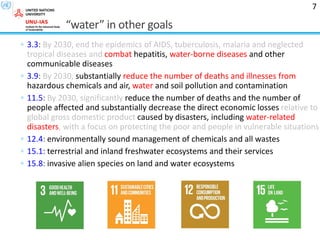
“water” in other goals
◦ 3.3: By 2030, end the epidemics of AIDS, tuberculosis, malaria and neglected
tropical diseases and combat hepatitis, water-borne diseases and other
communicable diseases
◦ 3.9: By 2030, substantially reduce the number of deaths and illnesses from
hazardous chemicals and air, water and soil pollution and contamination
◦ 11.5: By 2030, significantly reduce the number of deaths and the number of
people affected and substantially decrease the direct economic losses relative to
global gross domestic product caused by disasters, including water-related
disasters, with a focus on protecting the poor and people in vulnerable situations
◦ 12.4: environmentally sound management of chemicals and all wastes
◦ 15.1: terrestrial and inland freshwater ecosystems and their services
◦ 15.8: invasive alien species on land and water ecosystems
7
Facts about water and health
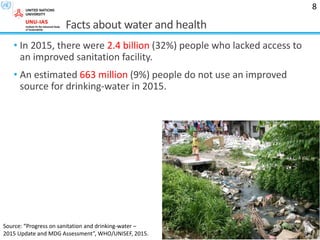
• In 2015, there were 2.4 billion (32%) people who lacked access to
an improved sanitation facility.
• An estimated 663 million (9%) people do not use an improved
source for drinking-water in 2015.
8
Source: “Progress on sanitation and drinking-water –
2015 Update and MDG Assessment”, WHO/UNISEF, 2015.
Facts about water and health
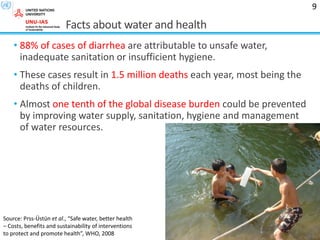
• 88% of cases of diarrhea are attributable to unsafe water,
inadequate sanitation or insufficient hygiene.
• These cases result in 1.5 million deaths each year, most being the
deaths of children.
• Almost one tenth of the global disease burden could be prevented
by improving water supply, sanitation, hygiene and management
of water resources.
9
Source: Prss-Üstün et al., “Safe water, better health
– Costs, benefits and sustainability of interventions
to protect and promote health”, WHO, 2008
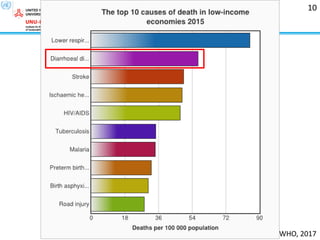
Hygiene & sanitation conditions
in Southeast Asian Nations
10
WHO, 2017
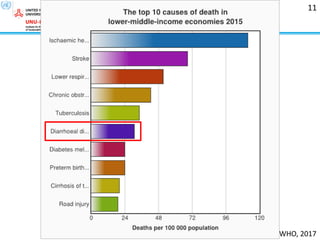
Hygiene & sanitation conditions
in Southeast Asian Nations
11
WHO, 2017
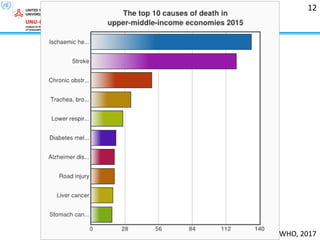
Hygiene & sanitation conditions
in Southeast Asian Nations
12
WHO, 2017
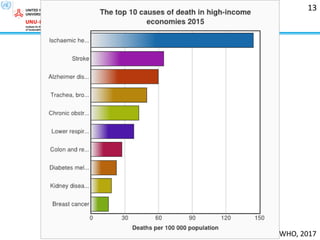
Hygiene & sanitation conditions
in Southeast Asian Nations
13
WHO, 2017
Urbanization, climate change,
and urban water
14
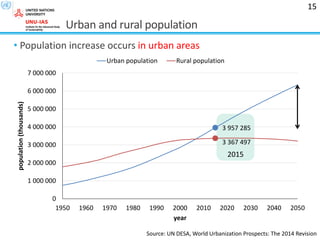
• Population increase occurs in urban areas
2015
3 957 285
3 367 497
0
1 000 000
2 000 000
3 000 000
4 000 000
5 000 000
6 000 000
7 000 000
1950 1960 1970 1980 1990 2000 2010 2020 2030 2040 2050
population(thousands)
year
Urban population Rural population
Urban and rural population
15
Source: UN DESA, World Urbanization Prospects: The 2014 Revision
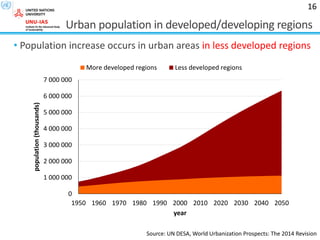
Urban population in developed/developing regions
• Population increase occurs in urban areas in less developed regions
16
0
1 000 000
2 000 000
3 000 000
4 000 000
5 000 000
6 000 000
7 000 000
1950 1960 1970 1980 1990 2000 2010 2020 2030 2040 2050
population(thousands)
year
More developed regions Less developed regions
Source: UN DESA, World Urbanization Prospects: The 2014 Revision
Top 10 urban agglomerations in Asia (2010)
0
5 000
10 000
15 000
20 000
25 000
30 000
35 000
40 000
1950 1960 1970 1980 1990 2000 2010 2020 2030
Population[thousand]
Year
Dhaka Beijing
Shanghai Delhi
Kolkata (Calcutta) Mumbai (Bombay)
Kinki M.M.A. (Osaka) Tokyo
Karachi Istanbul
Source: UN DESA
17
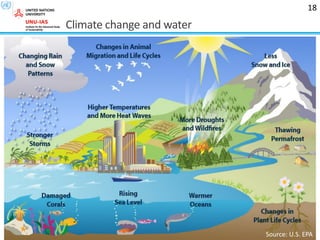
Climate change and water
18
Source: U.S. EPA
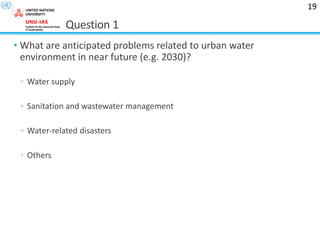
Question 1
• What are anticipated problems related to urban water
environment in near future (e.g. 2030)?
◦ Water supply
◦ Sanitation and wastewater management
◦ Water-related disasters
◦ Others
19
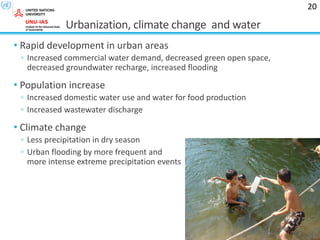
Urbanization, climate change and water
• Rapid development in urban areas
◦ Increased commercial water demand, decreased green open space,
decreased groundwater recharge, increased flooding
• Population increase
◦ Increased domestic water use and water for food production
◦ Increased wastewater discharge
• Climate change
◦ Less precipitation in dry season
◦ Urban flooding by more frequent and
more intense extreme precipitation events
20
Water resource management in water-
scarce region: La Paz and El Alto, Bolivia
21
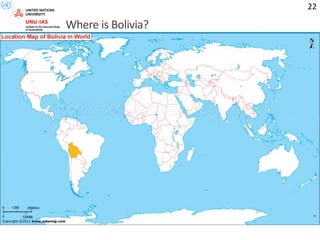
Where is Bolivia?
22
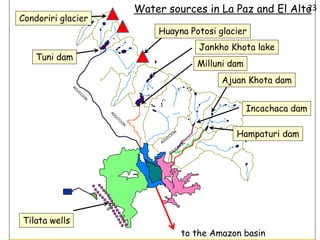
Incachaca dam
Hampaturi dam
Milluni dam
Ajuan Khota dam
Condoriri glacier
Tuni dam
Tilata wells
Jankho Khota lake
to the Amazon basin
Water sources in La Paz and El Alto
Huayna Potosi glacier
23
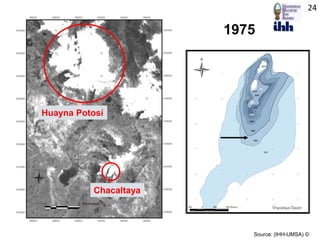
1975
Source: (IHH-UMSA) ©
Huayna Potosí
Chacaltaya
24
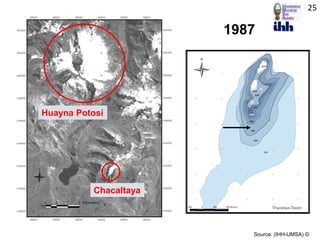
1987
Source: (IHH-UMSA) ©
Huayna Potosí
Chacaltaya
25
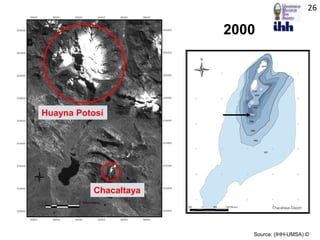
2000
Source: (IHH-UMSA) ©
Huayna Potosí
Chacaltaya
26
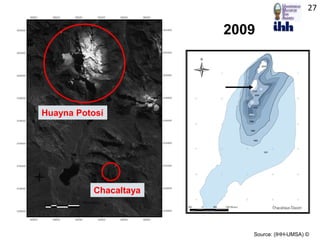
2009
Source: (IHH-UMSA) ©
Huayna Potosí
Chacaltaya
27
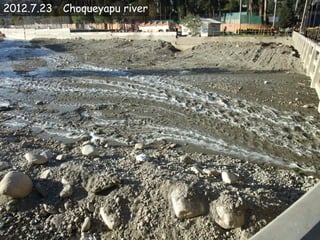
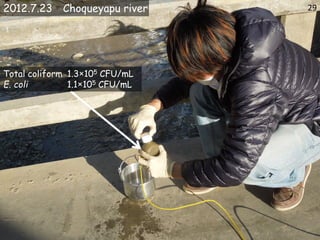
2012.7.23 Choqueyapu river 28
Total coliform 1.3×10⁵ CFU/mL
E. coli 1.1×10⁵ CFU/mL
2012.7.23 Choqueyapu river 29
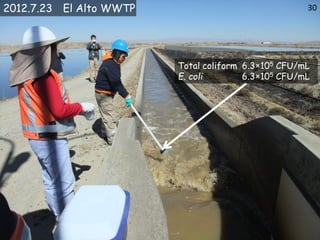
Total coliform 6.3×10⁵ CFU/mL
E. coli 6.3×10⁵ CFU/mL
2012.7.23 El Alto WWTP 30
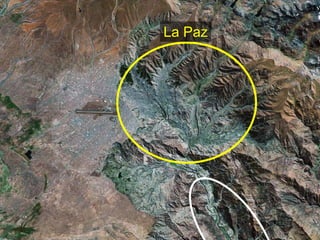
La Paz
31
32
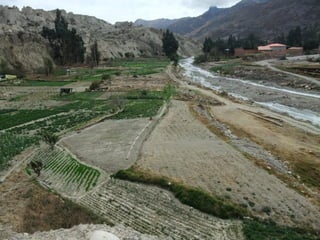
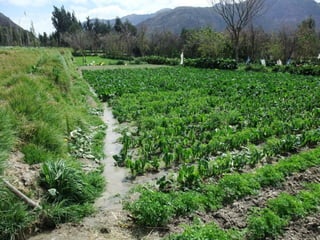
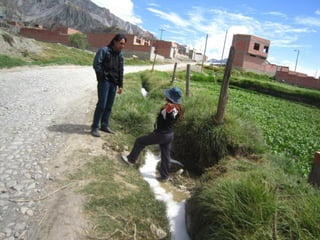
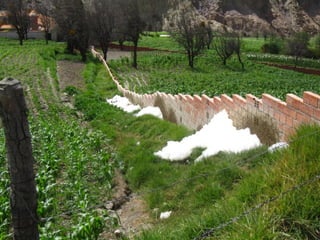
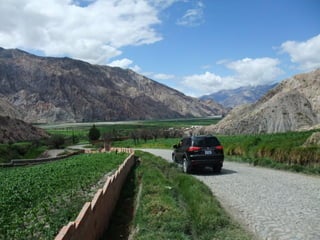
Wastewater reuse for agriculture
33
34
Wastewater reuse for agriculture
35
36
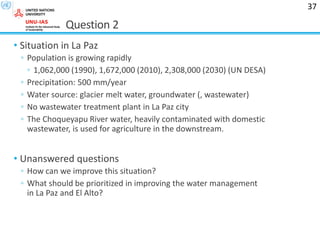
Question 2
• Situation in La Paz
◦ Population is growing rapidly
◦ 1,062,000 (1990), 1,672,000 (2010), 2,308,000 (2030) (UN DESA)
◦ Precipitation: 500 mm/year
◦ Water source: glacier melt water, groundwater (, wastewater)
◦ No wastewater treatment plant in La Paz city
◦ The Choqueyapu River water, heavily contaminated with domestic
wastewater, is used for agriculture in the downstream.
• Unanswered questions
◦ How can we improve this situation?
◦ What should be prioritized in improving the water management
in La Paz and El Alto?
37
Projecting future urban water
environment: Manila case study
38
39
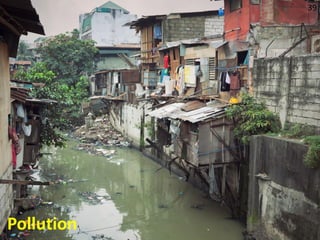
Pollution
40
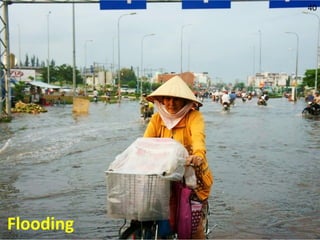
Flooding
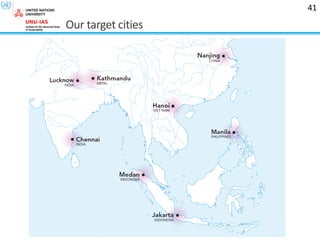
Our target cities
41
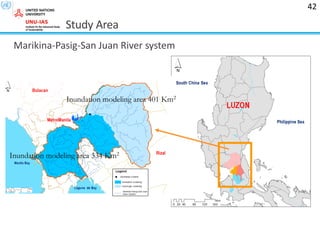
Study Area
Marikina-Pasig-San Juan River system
42
Inundation modeling area 334 Km2
Inundation modeling area 401 Km2
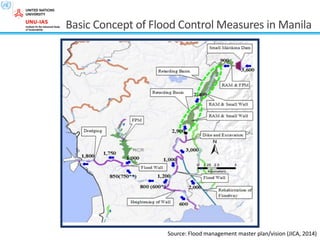
Basic Concept of Flood Control Measures in Manila
Source: Flood management master plan/vision (JICA, 2014)
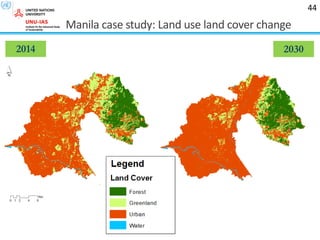
Manila case study: Land use land cover change
44
2014 2030
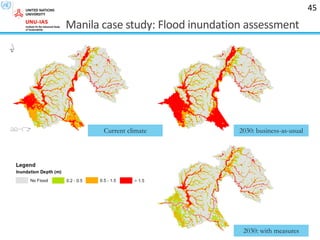
Manila case study: Flood inundation assessment
45
2030: business-as-usual
2030: with measures
Current climate
0
50
100
150
200
BOD(mg/L)
Location
2015 2030
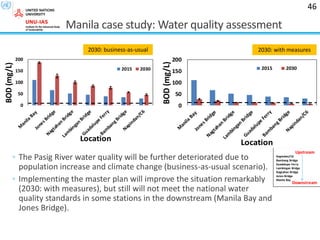
Manila case study: Water quality assessment
◦ The Pasig River water quality will be further deteriorated due to
population increase and climate change (business-as-usual scenario).
◦ Implementing the master plan will improve the situation remarkably
(2030: with measures), but still will not meet the national water
quality standards in some stations in the downstream (Manila Bay and
Jones Bridge).
46
Napindan/C6
Bambang Bridge
Guadalupe Ferry
Lambingan Bridge
Nagtahan Bridge
Jones Bridge
Manila Bay
Upstream
Downstream
0
50
100
150
200
BOD(mg/L)
Location
2015 2030
2030: business-as-usual 2030: with measures
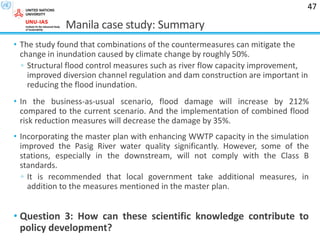
Manila case study: Summary
• The study found that combinations of the countermeasures can mitigate the
change in inundation caused by climate change by roughly 50%.
◦ Structural flood control measures such as river flow capacity improvement,
improved diversion channel regulation and dam construction are important in
reducing the flood inundation.
• In the business-as-usual scenario, flood damage will increase by 212%
compared to the current scenario. And the implementation of combined flood
risk reduction measures will decrease the damage by 35%.
• Incorporating the master plan with enhancing WWTP capacity in the simulation
improved the Pasig River water quality significantly. However, some of the
stations, especially in the downstream, will not comply with the Class B
standards.
◦ It is recommended that local government take additional measures, in
addition to the measures mentioned in the master plan.
• Question 3: How can these scientific knowledge contribute to
policy development?
47
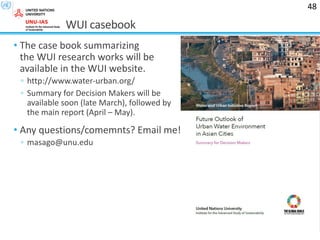
WUI casebook
• The case book summarizing
the WUI research works will be
available in the WUI website.
◦ http://www.water-urban.org/
◦ Summary for Decision Makers will be
available soon (late March), followed by
the main report (April – May).
• Any questions/comemnts? Email me!
◦ masago@unu.edu
48

Lecture 6: Urban Water Security

  • 1.
    Lecture 6: UrbanWater Security Yoshifumi Masago United Nations University Institute for the Advanced Study of Sustainability (UNU-IAS) 2018/3/6 2018 ProSPER.Net Young Researchers’ School (YRS)
  • 2.
    Today’s topics • SustainableDevelopment Goals (SDGs) • Urbanization, climate change, and urban water • Water resource management in water-scarce region in La Paz and El Alto, Bolivia • Projecting future urban water environment: Jakarta case study 2
  • 3.
  • 4.
    “water” and “sanitation”in SDGs and MDGs • How many SDGs and targets states “water”? • How many SDGs and targets states “sanitation”? • How many MDGs and targets states “water” and “sanitation”? 4
  • 5.
    “water” and “sanitation”in MDGs and SDGs • Millennium Development Goals ◦ 8 goals and 21 targets ◦ 0 goal and 1 target with “water” and “sanitation” ◦ Target 7.C: Halve, by 2015, the proportion of the population without sustainable access to safe drinking water and basic sanitation • Sustainable Development Goals ◦ 17 goals and 169 targets ◦ 1 goal and 14 targets with “water” ◦ 1 goal and 3 targets with “sanitation” ◦ 0 goal and 2 targets with “urban*” 5
  • 6.
    “water” in Goal6 • Goal 6. Ensure availability and sustainable management of water and sanitation for all ◦ 6.1: By 2030, achieve universal and equitable access to safe and affordable drinking water for all ◦ 6.2: By 2030, achieve access to adequate and equitable sanitation and hygiene for all and end open defecation, paying special attention to the needs of women and girls and those in vulnerable situations ◦ 6.3: By 2030, improve water quality by reducing pollution, eliminating dumping and minimizing release of hazardous chemicals and materials, halving the proportion of untreated wastewater and substantially increasing recycling and safe reuse globally ◦ 6.4: By 2030, substantially increase water-use efficiency across all sectors and ensure sustainable withdrawals and supply of freshwater to address water scarcity and substantially reduce the number of people suffering from water scarcity ◦ 6.5: integrated water resources management ◦ 6.6: protect and restore water-related ecosystems ◦ 6.a: international cooperation 6.b: participation of local communities 6
  • 7.
    “water” in othergoals ◦ 3.3: By 2030, end the epidemics of AIDS, tuberculosis, malaria and neglected tropical diseases and combat hepatitis, water-borne diseases and other communicable diseases ◦ 3.9: By 2030, substantially reduce the number of deaths and illnesses from hazardous chemicals and air, water and soil pollution and contamination ◦ 11.5: By 2030, significantly reduce the number of deaths and the number of people affected and substantially decrease the direct economic losses relative to global gross domestic product caused by disasters, including water-related disasters, with a focus on protecting the poor and people in vulnerable situations ◦ 12.4: environmentally sound management of chemicals and all wastes ◦ 15.1: terrestrial and inland freshwater ecosystems and their services ◦ 15.8: invasive alien species on land and water ecosystems 7
  • 8.
    Facts about waterand health • In 2015, there were 2.4 billion (32%) people who lacked access to an improved sanitation facility. • An estimated 663 million (9%) people do not use an improved source for drinking-water in 2015. 8 Source: “Progress on sanitation and drinking-water – 2015 Update and MDG Assessment”, WHO/UNISEF, 2015.
  • 9.
    Facts about waterand health • 88% of cases of diarrhea are attributable to unsafe water, inadequate sanitation or insufficient hygiene. • These cases result in 1.5 million deaths each year, most being the deaths of children. • Almost one tenth of the global disease burden could be prevented by improving water supply, sanitation, hygiene and management of water resources. 9 Source: Prss-Üstün et al., “Safe water, better health – Costs, benefits and sustainability of interventions to protect and promote health”, WHO, 2008
  • 10.
    Hygiene & sanitationconditions in Southeast Asian Nations 10 WHO, 2017
  • 11.
    Hygiene & sanitationconditions in Southeast Asian Nations 11 WHO, 2017
  • 12.
    Hygiene & sanitationconditions in Southeast Asian Nations 12 WHO, 2017
  • 13.
    Hygiene & sanitationconditions in Southeast Asian Nations 13 WHO, 2017
  • 14.
  • 15.
    • Population increaseoccurs in urban areas 2015 3 957 285 3 367 497 0 1 000 000 2 000 000 3 000 000 4 000 000 5 000 000 6 000 000 7 000 000 1950 1960 1970 1980 1990 2000 2010 2020 2030 2040 2050 population(thousands) year Urban population Rural population Urban and rural population 15 Source: UN DESA, World Urbanization Prospects: The 2014 Revision
  • 16.
    Urban population indeveloped/developing regions • Population increase occurs in urban areas in less developed regions 16 0 1 000 000 2 000 000 3 000 000 4 000 000 5 000 000 6 000 000 7 000 000 1950 1960 1970 1980 1990 2000 2010 2020 2030 2040 2050 population(thousands) year More developed regions Less developed regions Source: UN DESA, World Urbanization Prospects: The 2014 Revision
  • 17.
    Top 10 urbanagglomerations in Asia (2010) 0 5 000 10 000 15 000 20 000 25 000 30 000 35 000 40 000 1950 1960 1970 1980 1990 2000 2010 2020 2030 Population[thousand] Year Dhaka Beijing Shanghai Delhi Kolkata (Calcutta) Mumbai (Bombay) Kinki M.M.A. (Osaka) Tokyo Karachi Istanbul Source: UN DESA 17
  • 18.
    Climate change andwater 18 Source: U.S. EPA
  • 19.
    Question 1 • Whatare anticipated problems related to urban water environment in near future (e.g. 2030)? ◦ Water supply ◦ Sanitation and wastewater management ◦ Water-related disasters ◦ Others 19
  • 20.
    Urbanization, climate changeand water • Rapid development in urban areas ◦ Increased commercial water demand, decreased green open space, decreased groundwater recharge, increased flooding • Population increase ◦ Increased domestic water use and water for food production ◦ Increased wastewater discharge • Climate change ◦ Less precipitation in dry season ◦ Urban flooding by more frequent and more intense extreme precipitation events 20
  • 21.
    Water resource managementin water- scarce region: La Paz and El Alto, Bolivia 21
  • 22.
  • 23.
    Incachaca dam Hampaturi dam Millunidam Ajuan Khota dam Condoriri glacier Tuni dam Tilata wells Jankho Khota lake to the Amazon basin Water sources in La Paz and El Alto Huayna Potosi glacier 23
  • 24.
    1975 Source: (IHH-UMSA) © HuaynaPotosí Chacaltaya 24
  • 25.
    1987 Source: (IHH-UMSA) © HuaynaPotosí Chacaltaya 25
  • 26.
    2000 Source: (IHH-UMSA) © HuaynaPotosí Chacaltaya 26
  • 27.
    2009 Source: (IHH-UMSA) © HuaynaPotosí Chacaltaya 27
  • 28.
  • 29.
    Total coliform 1.3×10⁵CFU/mL E. coli 1.1×10⁵ CFU/mL 2012.7.23 Choqueyapu river 29
  • 30.
    Total coliform 6.3×10⁵CFU/mL E. coli 6.3×10⁵ CFU/mL 2012.7.23 El Alto WWTP 30
  • 31.
  • 32.
  • 33.
    Wastewater reuse foragriculture 33
  • 34.
  • 35.
    Wastewater reuse foragriculture 35
  • 36.
  • 37.
    Question 2 • Situationin La Paz ◦ Population is growing rapidly ◦ 1,062,000 (1990), 1,672,000 (2010), 2,308,000 (2030) (UN DESA) ◦ Precipitation: 500 mm/year ◦ Water source: glacier melt water, groundwater (, wastewater) ◦ No wastewater treatment plant in La Paz city ◦ The Choqueyapu River water, heavily contaminated with domestic wastewater, is used for agriculture in the downstream. • Unanswered questions ◦ How can we improve this situation? ◦ What should be prioritized in improving the water management in La Paz and El Alto? 37
  • 38.
    Projecting future urbanwater environment: Manila case study 38
  • 39.
  • 40.
  • 41.
  • 42.
    Study Area Marikina-Pasig-San JuanRiver system 42 Inundation modeling area 334 Km2 Inundation modeling area 401 Km2
  • 43.
    Basic Concept ofFlood Control Measures in Manila Source: Flood management master plan/vision (JICA, 2014)
  • 44.
    Manila case study:Land use land cover change 44 2014 2030
  • 45.
    Manila case study:Flood inundation assessment 45 2030: business-as-usual 2030: with measures Current climate
  • 46.
    0 50 100 150 200 BOD(mg/L) Location 2015 2030 Manila casestudy: Water quality assessment ◦ The Pasig River water quality will be further deteriorated due to population increase and climate change (business-as-usual scenario). ◦ Implementing the master plan will improve the situation remarkably (2030: with measures), but still will not meet the national water quality standards in some stations in the downstream (Manila Bay and Jones Bridge). 46 Napindan/C6 Bambang Bridge Guadalupe Ferry Lambingan Bridge Nagtahan Bridge Jones Bridge Manila Bay Upstream Downstream 0 50 100 150 200 BOD(mg/L) Location 2015 2030 2030: business-as-usual 2030: with measures
  • 47.
    Manila case study:Summary • The study found that combinations of the countermeasures can mitigate the change in inundation caused by climate change by roughly 50%. ◦ Structural flood control measures such as river flow capacity improvement, improved diversion channel regulation and dam construction are important in reducing the flood inundation. • In the business-as-usual scenario, flood damage will increase by 212% compared to the current scenario. And the implementation of combined flood risk reduction measures will decrease the damage by 35%. • Incorporating the master plan with enhancing WWTP capacity in the simulation improved the Pasig River water quality significantly. However, some of the stations, especially in the downstream, will not comply with the Class B standards. ◦ It is recommended that local government take additional measures, in addition to the measures mentioned in the master plan. • Question 3: How can these scientific knowledge contribute to policy development? 47
  • 48.
    WUI casebook • Thecase book summarizing the WUI research works will be available in the WUI website. ◦ http://www.water-urban.org/ ◦ Summary for Decision Makers will be available soon (late March), followed by the main report (April – May). • Any questions/comemnts? Email me! ◦ masago@unu.edu 48