Geography Lab
Geography 101L
Professor Lisa
Schmidt
MTWTh 10:15-12:20
Important Information
• Professor Lisa Schmidt
• Section 46246 Summer 2013
• 10:15 AM-12:20 PM
• Mon/Tues/Wed/Thurs
• Bldg 30 Rm 17
• Units: 1
• Lisa.Schmidt@Chaffey.edu
• Telephone ext.: 8585
• Office Hours: By appoint.
• http://schmidtvvclab.wikispaces.com/
Prerequisite
• Geography 101 lecture or concurrent
enrolment
– Recommended: English 6 and Math 50
Textbooks
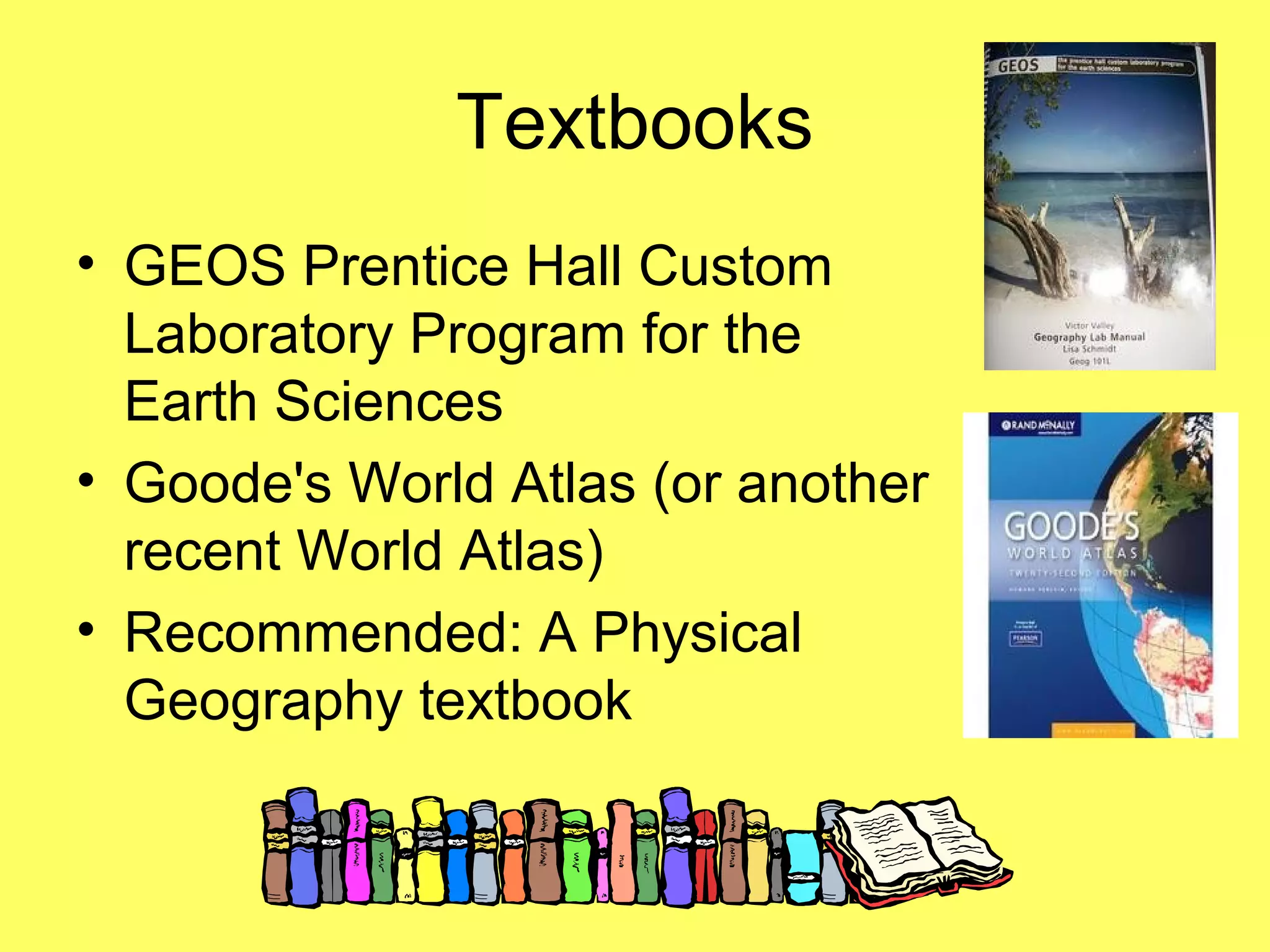
• GEOS Prentice Hall Custom
Laboratory Program for the
Earth Sciences
• Goode's World Atlas (or another
recent World Atlas)
• Recommended: A Physical
Geography textbook
Additional Materials
• Calculator, ruler, colored pencils/pens,
internet access
SLO’s
• Physical Geography laboratory provides the
student with experience in investigation and
interpretation of the physical environment. Upon
completion of this course you will be able to:
• 1. Analyze earth-sun relationships and describe
how they affect daylight, seasons, and time for
various place on earth.
• 2. Define weather data, interpret a weather map
and use weather instruments to collect and
record data about local temperature, humidity,
pressure and wind conditions.
SLO’s
• 3. Analyze the characteristics of different
climate categories and describe the unique flora
and fauna of each.
• 4. Identify the characteristics of landforms and
rocks that relate to specific tectonic and
magmatic processes.
• 5. Find location using the global grid of latitude
and longitude and be able to utilize GPS
technology.
• 6. Identify landforms created by the erosion of
water, wind and ice and describe the
characteristics of each.
What to expect
1. Each class will consist of a short explanation of the lab
exercise for the day and time in class to complete each
assignment.
2. All labs, except LAB SIX, will come from the GEOS
Workbook. You must bring the GEOS workbook to
class.
3. Students will be required to complete the worksheets in
the lab book, and then submit the answers on
Blackboard.
4. Labs must be completed on Blackboard by 9:45 AM one
week after they are assigned.
5. Exams will consist of problems like lab worksheets and
will also be given using Blackboard.
Grading
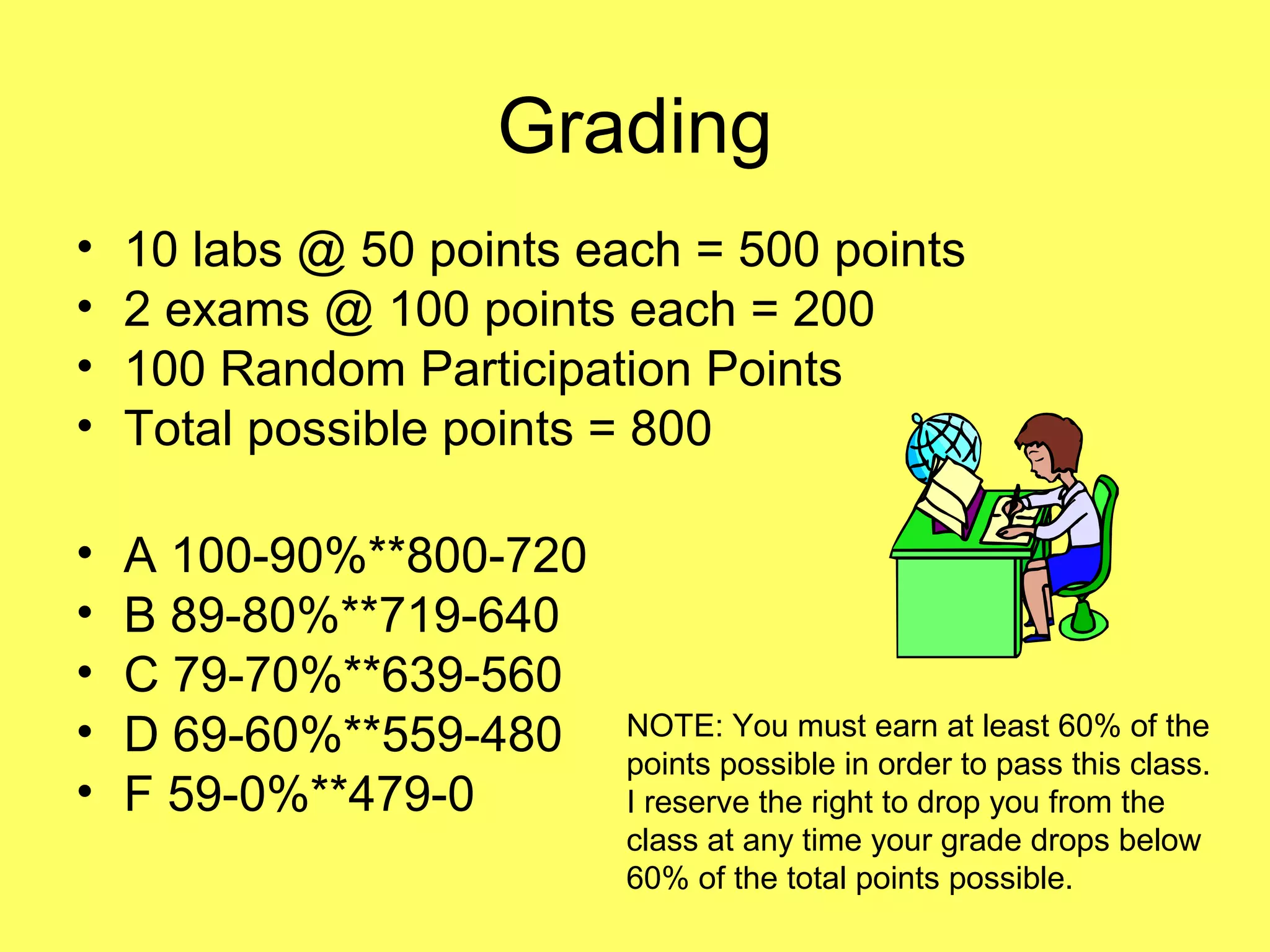
• 10 labs @ 50 points each = 500 points
• 2 exams @ 100 points each = 200
• 100 Random Participation Points
• Total possible points = 800
• A 100-90%**800-720
• B 89-80%**719-640
• C 79-70%**639-560
• D 69-60%**559-480
• F 59-0%**479-0
NOTE: You must earn at least 60% of the
points possible in order to pass this class.
I reserve the right to drop you from the
class at any time your grade drops below
60% of the total points possible.
Course Objectives
Physical Geography laboratory provides the student with experience in
investigation and interpretation of the physical environment. Upon completion of
this course the student will be able to understand the global grid of latitude and
longitude, our system of time, be able to analyze topographic maps, understand
earth-sun relationships as they affect daylight, seasons, and time, understand
the seasonal movement of angle and duration of solar insolation and how it
affects temperatures on earth, understand how temperature is affected by
specific variables relating to a region, understand how heat energy is transferred
through various processes, understand how moisture is transferred as water
changes phases, understand how differences in pressure occur and result in
wind, understand the driving forces in the atmosphere, understand many
interrelationships within the earth's weather patterns, climate, vegetation and soil
distributions, tectonic and gradational forces.
Late Work and Missed Exams
• Late work will not be accepted.
Labs are due on their stated
due dates and will not be
accepted late. Exams will be
given using Blackboard and
will be open for seven days,
there is no excuse to miss an
exam.
Absences and Tardiness
• I reserve the right to drop students
who miss class twice. If you have to
miss class, you should stay in
contact with me. You may be
dropped for excessive tardiness. If
you are going to be late, come in
quietly and take a seat WITHOUT
interrupting lecture. Excessive
tardiness is being more than five
minutes late three times. Directions
for completing lab worksheets will be
given at the beginning of class and
WILL NOT be repeated.
Extra Credit
• There may be some extra credit
opportunities. These will be given in class
and your attendance is required to take
advantage of them.
E-mailing Assignments
• Assignments will NOT be accepted by
e-mail. If you cannot make it to class,
take your assignment to my mailbox
which is located in Liberal Arts Building
where the faculty offices are.
Assignments can also be taken to the
switchboard operator, located in
building 53. If assignments are taken
to the switchboard operator, I will not
receive them immediately, so you
should contact me and let me know
that they have been taken there.
Dropping
• If you wish to drop this course, you must
do so formally. Not dropping the course
will likely result in an F.
Random Participation Points
• At any time I may give a pop
quiz, an in-class assignment,
or perhaps a second roll
after the break. These
activities or assignments
WILL not be announced in
advance and your presence
in class is required in order
to receive these points.
Graded Work
• It is your responsibility to pick up your
graded work. Graded work will be held for
30 days after the last day of class and
then recycled. It is highly recommended
that you keep your graded work until final
grades are submitted.
Academic Honesty
• Cheating of any sort will be reported to the
dean. Please refer to the college*s policy
on academic honesty.
Cell Phones/Texting
• Using a cell phone while in
class is distracting to your
classmates and inappropriate.
Cell phones should be turned
to silent mode while in class. If
you absolutely have to use
your phone during class, go
outside.
Blackboard
• Blackboard will be used during this
course. You must access Blackboard to
submit your labs EACH week and for your
exams. You can access blackboard at
http://vvc.blackboard.com
Class Web Page
• A web page has been created for your
class. You will find all of the class power
points, study guides, and more posted
there. You may access the web page at:
http://schmidtvvclab.wikispaces.com
Disabled Students Programs and
Services
• If you have, or think you have a
disability which may interfere with
your ability to perform in this class,
please speak with me immediately
and please contact the Disabled
Students Programs and Services
Office at (760) 245-4271 ext, 2212,
or stop by their office located in
building 50. There is help available.
Contacting Me
• The best way to reach me is by e-mail at
Lisa.Schmidt@Chaffey.edu.
Note About Schedule and Topics
• All dates, topics, point totals
and assignments are
tentative. I reserve the right
to make changes as they
may become necessary
throughout the semester.
Should you happen to miss
class, it is your responsibility
to obtain information about
and any changes.
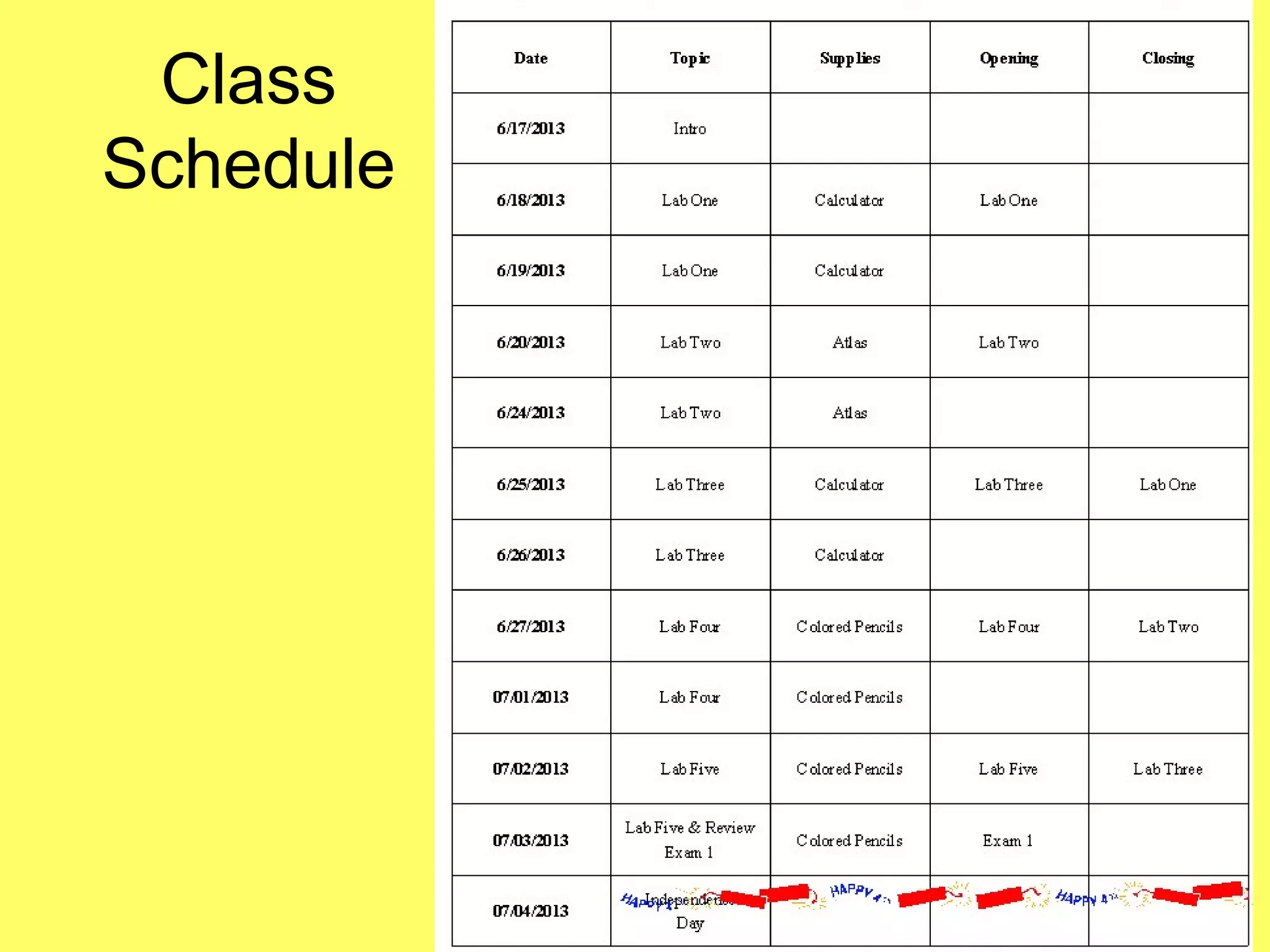
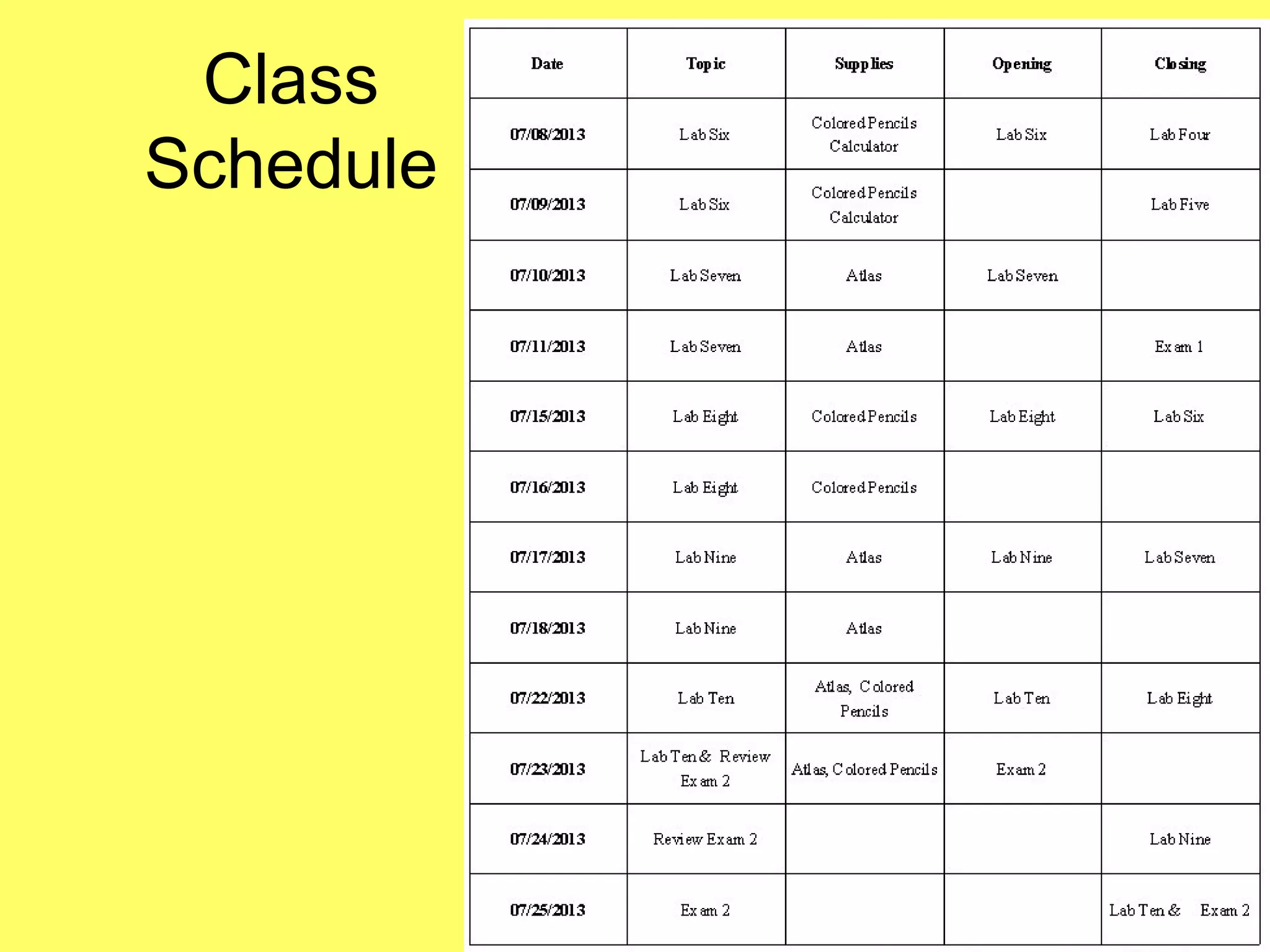
Class
Schedule
Class
Schedule
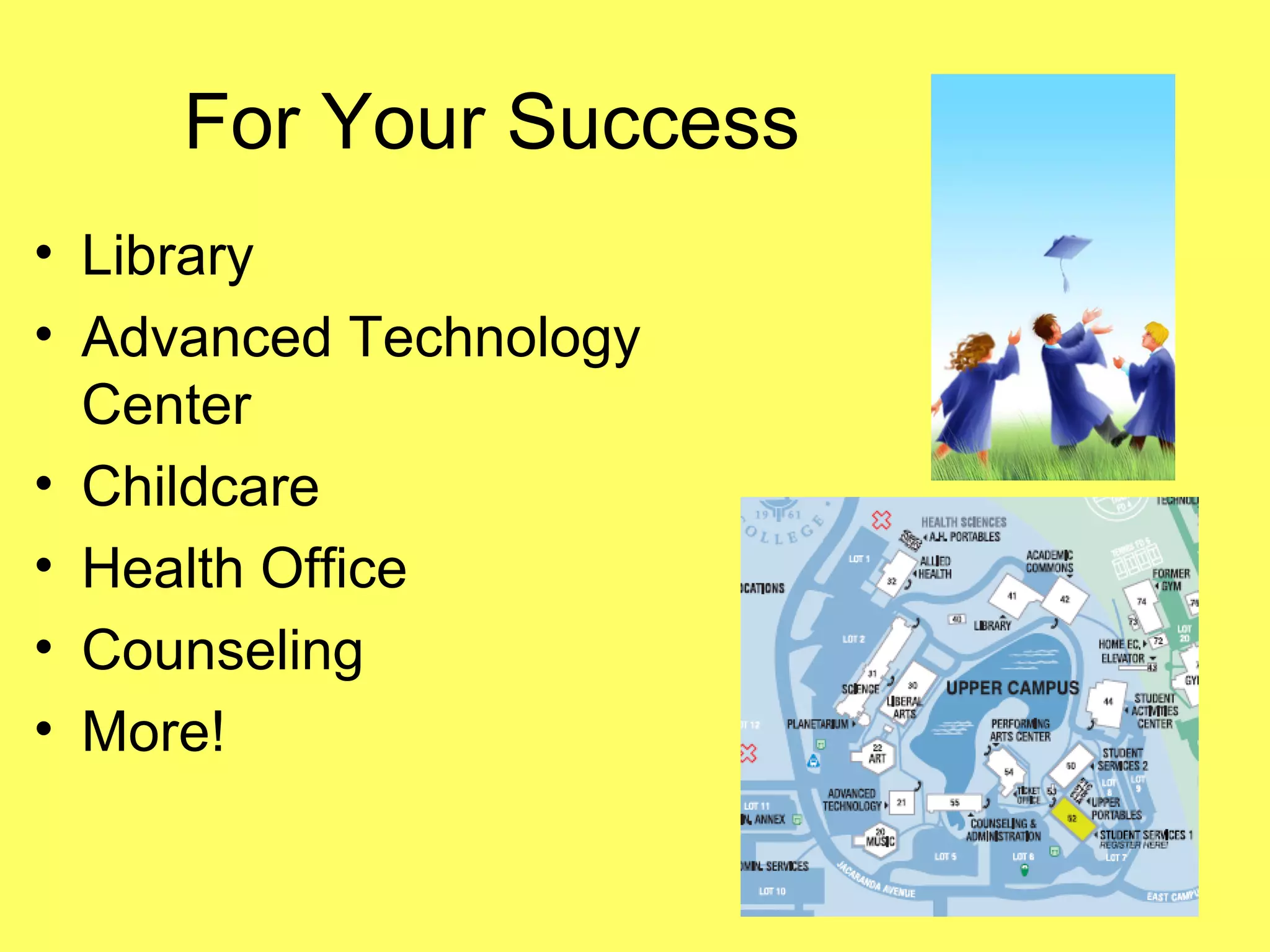
For Your Success
• Library
• Advanced Technology
Center
• Childcare
• Health Office
• Counseling
• More!
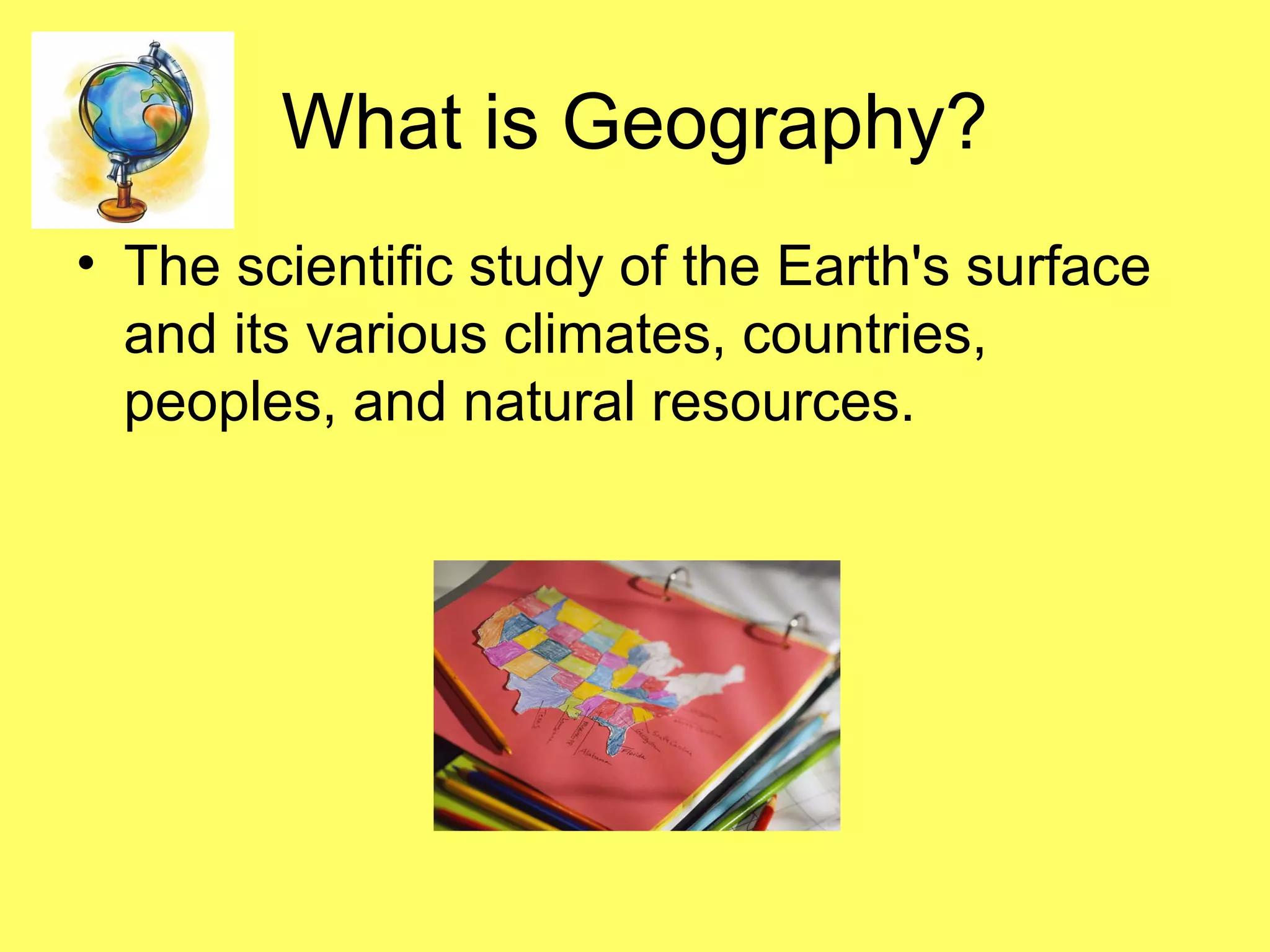
What is Geography?
• The scientific study of the Earth's surface
and its various climates, countries,
peoples, and natural resources.
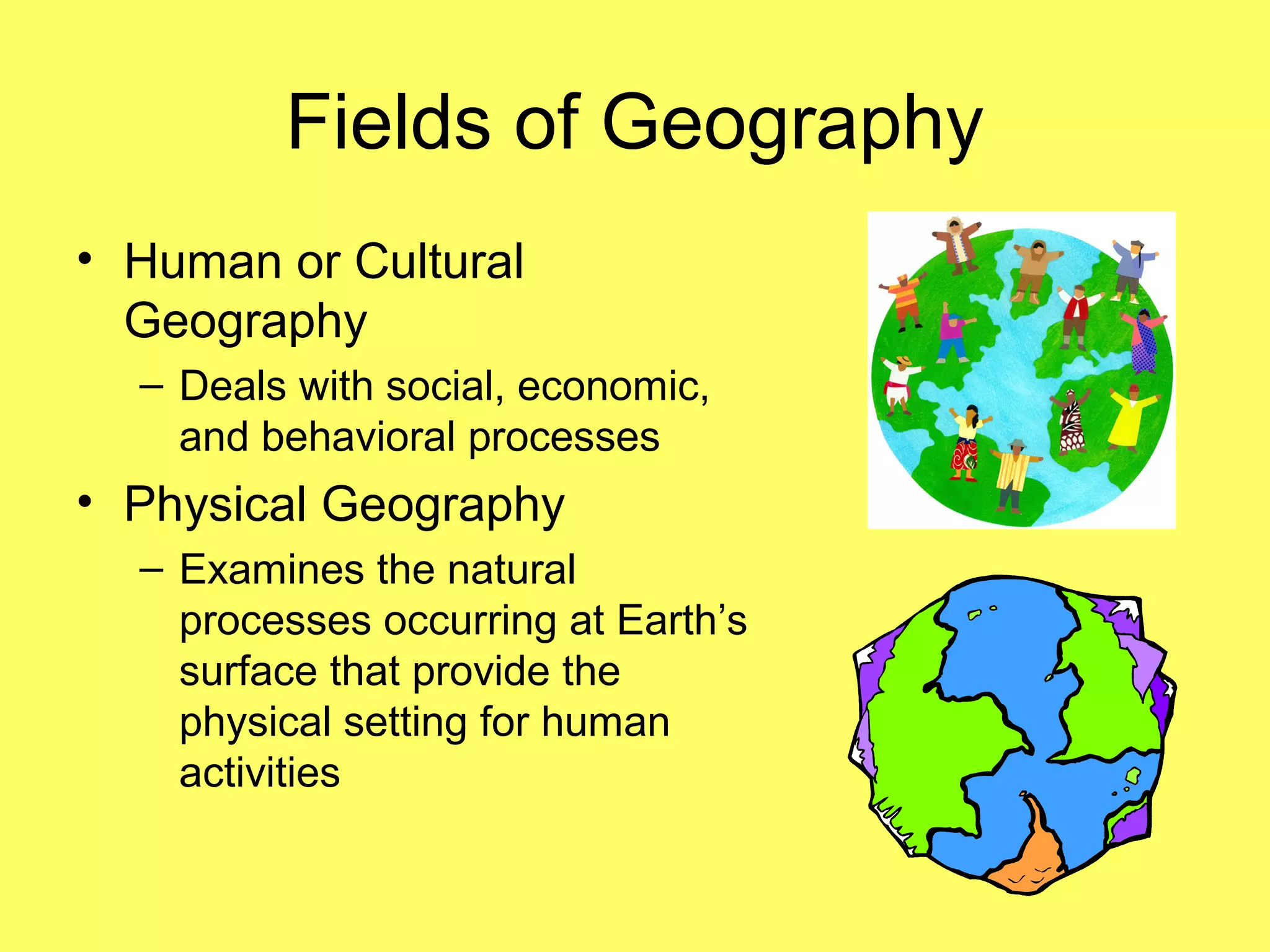
Fields of Geography
• Human or Cultural
Geography
– Deals with social, economic,
and behavioral processes
• Physical Geography
– Examines the natural
processes occurring at Earth’s
surface that provide the
physical setting for human
activities
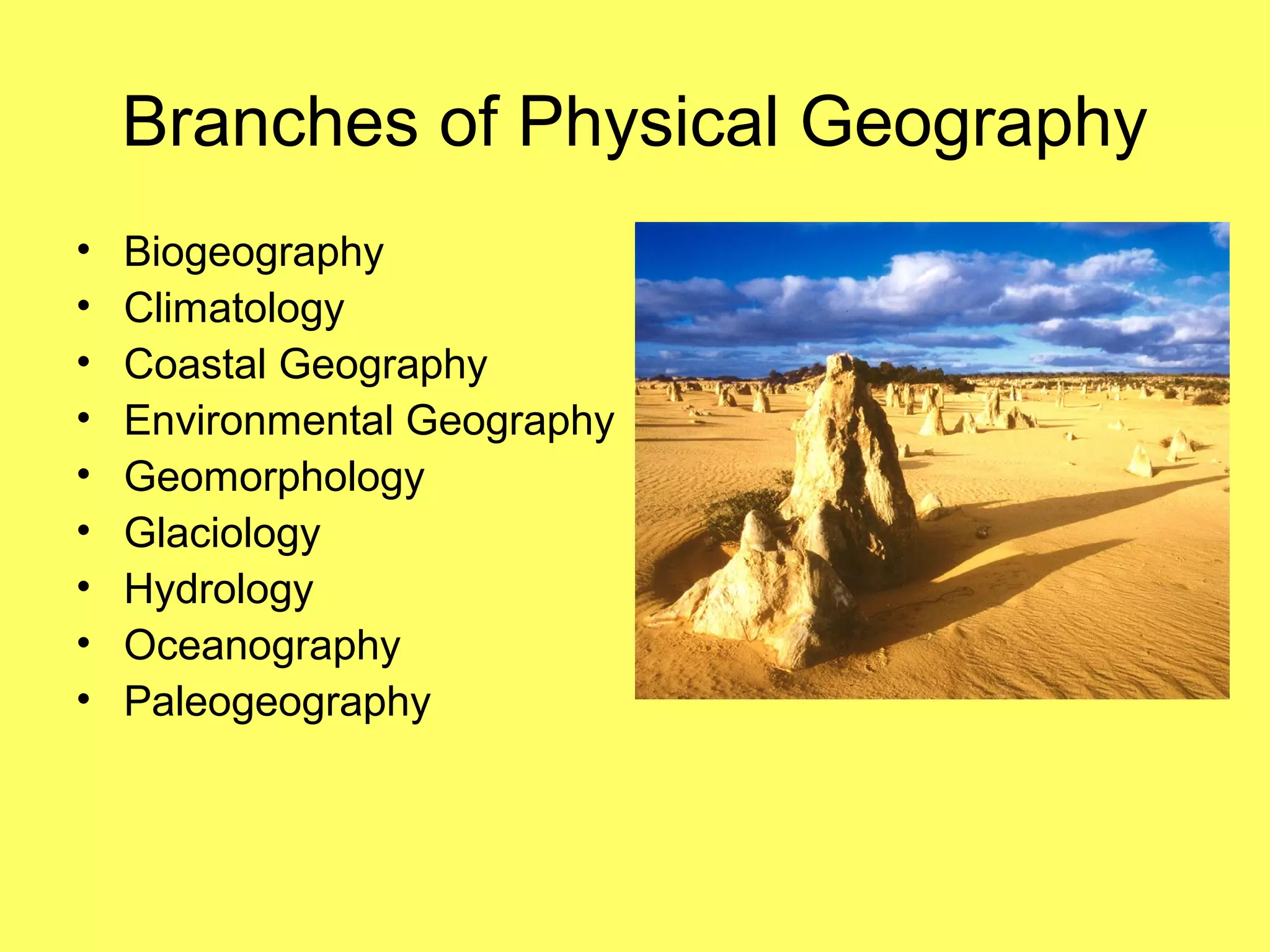
Branches of Physical Geography
• Biogeography
• Climatology
• Coastal Geography
• Environmental Geography
• Geomorphology
• Glaciology
• Hydrology
• Oceanography
• Paleogeography
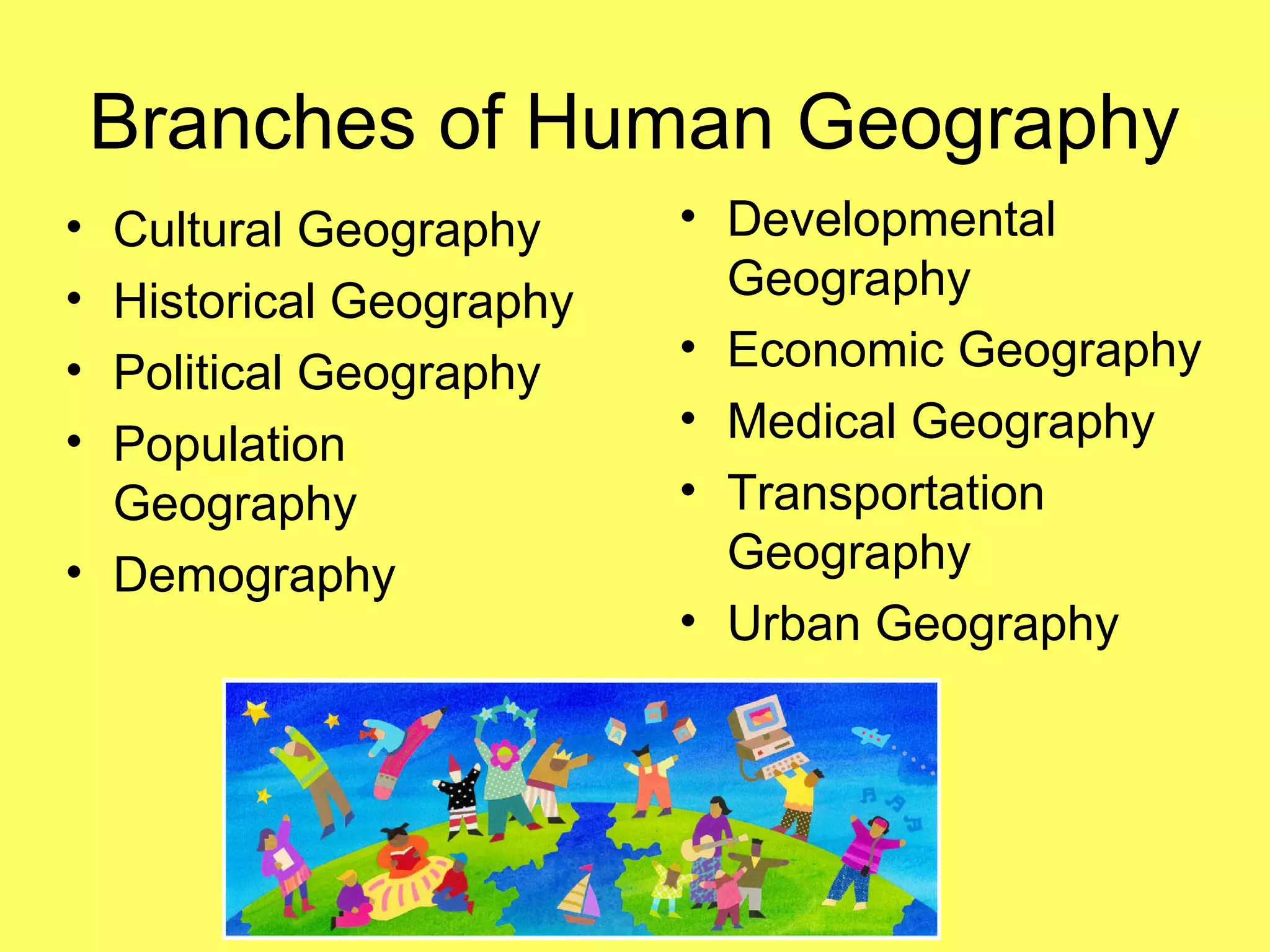
Branches of Human Geography
• Developmental
Geography
• Economic Geography
• Medical Geography
• Transportation
Geography
• Urban Geography
• Cultural Geography
• Historical Geography
• Political Geography
• Population
Geography
• Demography
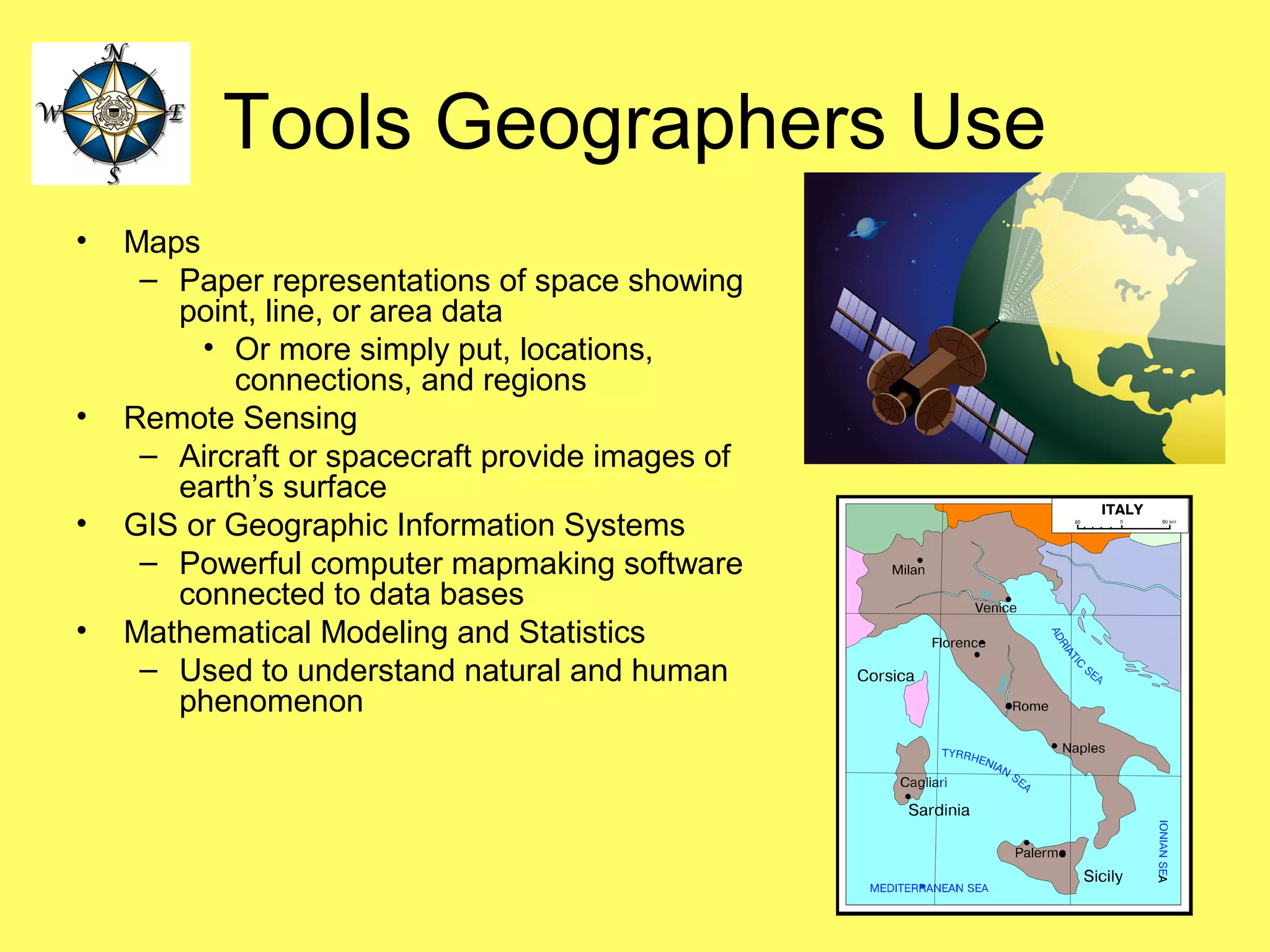
Tools Geographers Use
• Maps
– Paper representations of space showing
point, line, or area data
• Or more simply put, locations,
connections, and regions
• Remote Sensing
– Aircraft or spacecraft provide images of
earth’s surface
• GIS or Geographic Information Systems
– Powerful computer mapmaking software
connected to data bases
• Mathematical Modeling and Statistics
– Used to understand natural and human
phenomenon
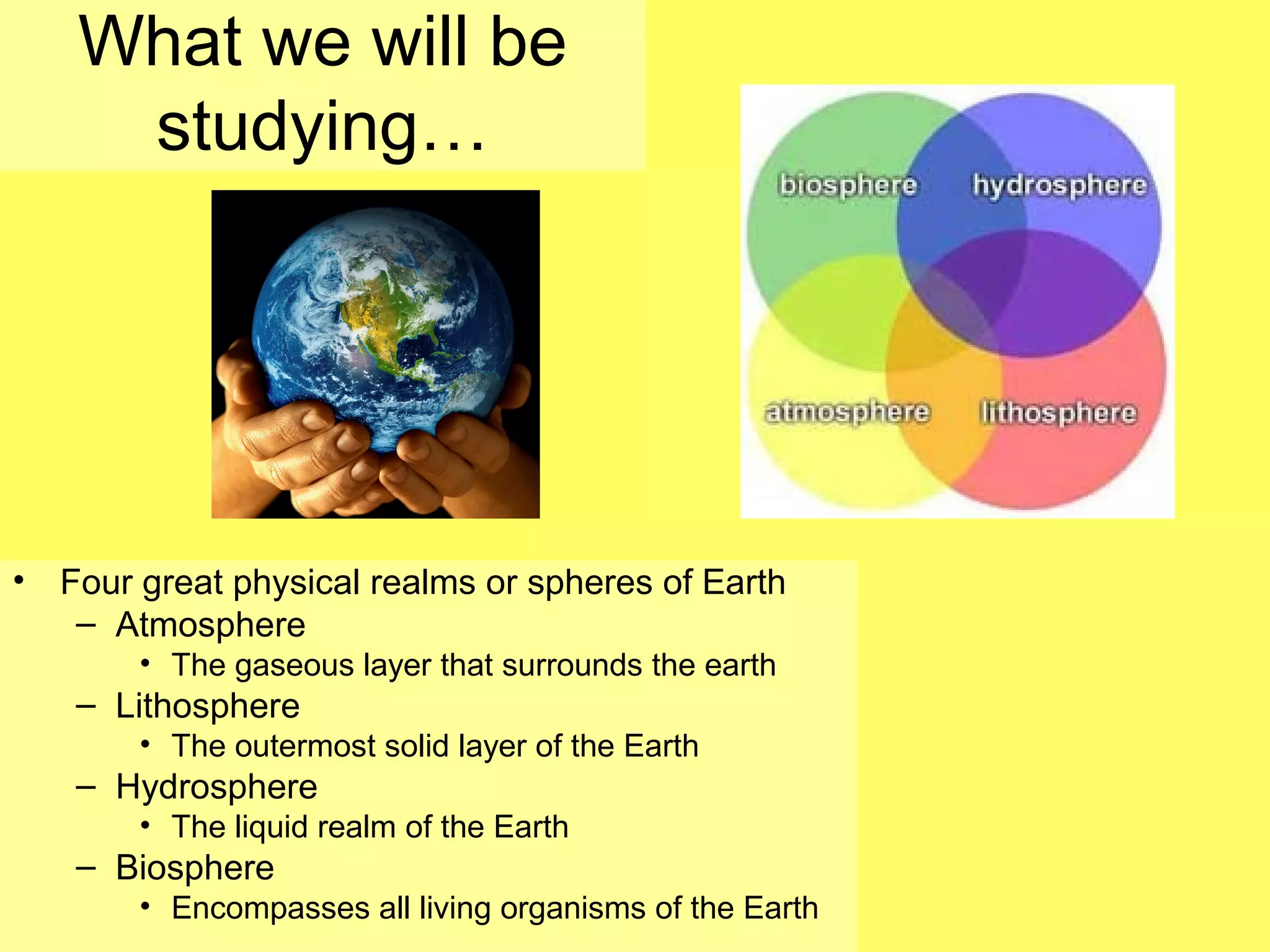
What we will be
studying…
• Four great physical realms or spheres of Earth
– Atmosphere
• The gaseous layer that surrounds the earth
– Lithosphere
• The outermost solid layer of the Earth
– Hydrosphere
• The liquid realm of the Earth
– Biosphere
• Encompasses all living organisms of the Earth
Next Class
• Lab One
• Bring your calculators!

Geography lab intro sum 2013

  • 1.
    Geography Lab Geography 101L ProfessorLisa Schmidt MTWTh 10:15-12:20
  • 2.
    Important Information • ProfessorLisa Schmidt • Section 46246 Summer 2013 • 10:15 AM-12:20 PM • Mon/Tues/Wed/Thurs • Bldg 30 Rm 17 • Units: 1 • Lisa.Schmidt@Chaffey.edu • Telephone ext.: 8585 • Office Hours: By appoint. • http://schmidtvvclab.wikispaces.com/
  • 3.
    Prerequisite • Geography 101lecture or concurrent enrolment – Recommended: English 6 and Math 50
  • 4.
    Textbooks • GEOS PrenticeHall Custom Laboratory Program for the Earth Sciences • Goode's World Atlas (or another recent World Atlas) • Recommended: A Physical Geography textbook
  • 5.
    Additional Materials • Calculator,ruler, colored pencils/pens, internet access
  • 6.
    SLO’s • Physical Geographylaboratory provides the student with experience in investigation and interpretation of the physical environment. Upon completion of this course you will be able to: • 1. Analyze earth-sun relationships and describe how they affect daylight, seasons, and time for various place on earth. • 2. Define weather data, interpret a weather map and use weather instruments to collect and record data about local temperature, humidity, pressure and wind conditions.
  • 7.
    SLO’s • 3. Analyzethe characteristics of different climate categories and describe the unique flora and fauna of each. • 4. Identify the characteristics of landforms and rocks that relate to specific tectonic and magmatic processes. • 5. Find location using the global grid of latitude and longitude and be able to utilize GPS technology. • 6. Identify landforms created by the erosion of water, wind and ice and describe the characteristics of each.
  • 8.
    What to expect 1.Each class will consist of a short explanation of the lab exercise for the day and time in class to complete each assignment. 2. All labs, except LAB SIX, will come from the GEOS Workbook. You must bring the GEOS workbook to class. 3. Students will be required to complete the worksheets in the lab book, and then submit the answers on Blackboard. 4. Labs must be completed on Blackboard by 9:45 AM one week after they are assigned. 5. Exams will consist of problems like lab worksheets and will also be given using Blackboard.
  • 9.
    Grading • 10 labs@ 50 points each = 500 points • 2 exams @ 100 points each = 200 • 100 Random Participation Points • Total possible points = 800 • A 100-90%**800-720 • B 89-80%**719-640 • C 79-70%**639-560 • D 69-60%**559-480 • F 59-0%**479-0 NOTE: You must earn at least 60% of the points possible in order to pass this class. I reserve the right to drop you from the class at any time your grade drops below 60% of the total points possible.
  • 10.
    Course Objectives Physical Geographylaboratory provides the student with experience in investigation and interpretation of the physical environment. Upon completion of this course the student will be able to understand the global grid of latitude and longitude, our system of time, be able to analyze topographic maps, understand earth-sun relationships as they affect daylight, seasons, and time, understand the seasonal movement of angle and duration of solar insolation and how it affects temperatures on earth, understand how temperature is affected by specific variables relating to a region, understand how heat energy is transferred through various processes, understand how moisture is transferred as water changes phases, understand how differences in pressure occur and result in wind, understand the driving forces in the atmosphere, understand many interrelationships within the earth's weather patterns, climate, vegetation and soil distributions, tectonic and gradational forces.
  • 11.
    Late Work andMissed Exams • Late work will not be accepted. Labs are due on their stated due dates and will not be accepted late. Exams will be given using Blackboard and will be open for seven days, there is no excuse to miss an exam.
  • 12.
    Absences and Tardiness •I reserve the right to drop students who miss class twice. If you have to miss class, you should stay in contact with me. You may be dropped for excessive tardiness. If you are going to be late, come in quietly and take a seat WITHOUT interrupting lecture. Excessive tardiness is being more than five minutes late three times. Directions for completing lab worksheets will be given at the beginning of class and WILL NOT be repeated.
  • 13.
    Extra Credit • Theremay be some extra credit opportunities. These will be given in class and your attendance is required to take advantage of them.
  • 14.
    E-mailing Assignments • Assignmentswill NOT be accepted by e-mail. If you cannot make it to class, take your assignment to my mailbox which is located in Liberal Arts Building where the faculty offices are. Assignments can also be taken to the switchboard operator, located in building 53. If assignments are taken to the switchboard operator, I will not receive them immediately, so you should contact me and let me know that they have been taken there.
  • 15.
    Dropping • If youwish to drop this course, you must do so formally. Not dropping the course will likely result in an F.
  • 16.
    Random Participation Points •At any time I may give a pop quiz, an in-class assignment, or perhaps a second roll after the break. These activities or assignments WILL not be announced in advance and your presence in class is required in order to receive these points.
  • 17.
    Graded Work • Itis your responsibility to pick up your graded work. Graded work will be held for 30 days after the last day of class and then recycled. It is highly recommended that you keep your graded work until final grades are submitted.
  • 18.
    Academic Honesty • Cheatingof any sort will be reported to the dean. Please refer to the college*s policy on academic honesty.
  • 19.
    Cell Phones/Texting • Usinga cell phone while in class is distracting to your classmates and inappropriate. Cell phones should be turned to silent mode while in class. If you absolutely have to use your phone during class, go outside.
  • 20.
    Blackboard • Blackboard willbe used during this course. You must access Blackboard to submit your labs EACH week and for your exams. You can access blackboard at http://vvc.blackboard.com
  • 21.
    Class Web Page •A web page has been created for your class. You will find all of the class power points, study guides, and more posted there. You may access the web page at: http://schmidtvvclab.wikispaces.com
  • 22.
    Disabled Students Programsand Services • If you have, or think you have a disability which may interfere with your ability to perform in this class, please speak with me immediately and please contact the Disabled Students Programs and Services Office at (760) 245-4271 ext, 2212, or stop by their office located in building 50. There is help available.
  • 23.
    Contacting Me • Thebest way to reach me is by e-mail at Lisa.Schmidt@Chaffey.edu.
  • 24.
    Note About Scheduleand Topics • All dates, topics, point totals and assignments are tentative. I reserve the right to make changes as they may become necessary throughout the semester. Should you happen to miss class, it is your responsibility to obtain information about and any changes.
  • 25.
  • 26.
  • 27.
    For Your Success •Library • Advanced Technology Center • Childcare • Health Office • Counseling • More!
  • 28.
    What is Geography? •The scientific study of the Earth's surface and its various climates, countries, peoples, and natural resources.
  • 29.
    Fields of Geography •Human or Cultural Geography – Deals with social, economic, and behavioral processes • Physical Geography – Examines the natural processes occurring at Earth’s surface that provide the physical setting for human activities
  • 30.
    Branches of PhysicalGeography • Biogeography • Climatology • Coastal Geography • Environmental Geography • Geomorphology • Glaciology • Hydrology • Oceanography • Paleogeography
  • 31.
    Branches of HumanGeography • Developmental Geography • Economic Geography • Medical Geography • Transportation Geography • Urban Geography • Cultural Geography • Historical Geography • Political Geography • Population Geography • Demography
  • 32.
    Tools Geographers Use •Maps – Paper representations of space showing point, line, or area data • Or more simply put, locations, connections, and regions • Remote Sensing – Aircraft or spacecraft provide images of earth’s surface • GIS or Geographic Information Systems – Powerful computer mapmaking software connected to data bases • Mathematical Modeling and Statistics – Used to understand natural and human phenomenon
  • 33.
    What we willbe studying… • Four great physical realms or spheres of Earth – Atmosphere • The gaseous layer that surrounds the earth – Lithosphere • The outermost solid layer of the Earth – Hydrosphere • The liquid realm of the Earth – Biosphere • Encompasses all living organisms of the Earth
  • 34.
    Next Class • LabOne • Bring your calculators!