By Student:
Sipan Hairan
Project Based Learning
Supervisor
dr.Najih
report
Design Terminology
Contect
 Project Based Learning
 Learning by doing
 Application
 Examples
 Architectural projects lend themselves well to
project-based learning
 Conclusion: The tension of design and learning
 Summary
Project Based Learning is a teaching method in which students gain
knowledge and skills by working for an extended period of time to
investigate and respond to an engaging and complex question, problem, or
challenge.
Learning by doing is essentially about getting involved in an activity and,
through the process of doing this activity, learning about things like:
 how that activity works,
 how you find (or feel about) the activity,
 what the activity makes you think about, and
 what doing this activity enables you to do.
Application:-
Question
Plan
Schedule
Monitor
Assess
Evaluate
Examples:-
In this study, three different architectural studio examples, .
 In the first case, . Students were asked to pretend that it is real, so
learning by doing was the aim.
 In the second case,. They were encouraged to be inventive, so
learning by doing and experimenting by living in it, was the aim.
 In the third case,. Integration of Architectural Technology III course
(which was also conducted in studio) and Architectural Design Studio
IV was aimed to strengthen.
Conclusion: The tension of design and learning:-
 Design is a beautiful collection of tensions.
 There is a constant pull between thinking and doing, the collective and
individual, digital and analog, problems and solutions, artistry and
engineering.
 At the heart of this lies creativity. The same is true in teaching and
learning.
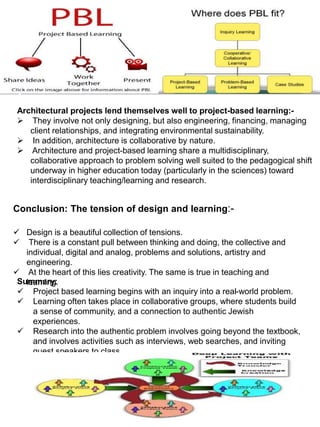
Architectural projects lend themselves well to project-based learning:-
 They involve not only designing, but also engineering, financing, managing
client relationships, and integrating environmental sustainability.
 In addition, architecture is collaborative by nature.
 Architecture and project-based learning share a multidisciplinary,
collaborative approach to problem solving well suited to the pedagogical shift
underway in higher education today (particularly in the sciences) toward
interdisciplinary teaching/learning and research.
Summary:
 Project based learning begins with an inquiry into a real-world problem.
 Learning often takes place in collaborative groups, where students build
a sense of community, and a connection to authentic Jewish
experiences.
 Research into the authentic problem involves going beyond the textbook,
and involves activities such as interviews, web searches, and inviting
guest speakers to class.

project based learning

  • 1.
    By Student: Sipan Hairan ProjectBased Learning Supervisor dr.Najih report Design Terminology
  • 2.
    Contect  Project BasedLearning  Learning by doing  Application  Examples  Architectural projects lend themselves well to project-based learning  Conclusion: The tension of design and learning  Summary
  • 3.
    Project Based Learningis a teaching method in which students gain knowledge and skills by working for an extended period of time to investigate and respond to an engaging and complex question, problem, or challenge. Learning by doing is essentially about getting involved in an activity and, through the process of doing this activity, learning about things like:  how that activity works,  how you find (or feel about) the activity,  what the activity makes you think about, and  what doing this activity enables you to do. Application:- Question Plan Schedule Monitor Assess Evaluate Examples:- In this study, three different architectural studio examples, .  In the first case, . Students were asked to pretend that it is real, so learning by doing was the aim.  In the second case,. They were encouraged to be inventive, so learning by doing and experimenting by living in it, was the aim.  In the third case,. Integration of Architectural Technology III course (which was also conducted in studio) and Architectural Design Studio IV was aimed to strengthen.
  • 4.
    Conclusion: The tensionof design and learning:-  Design is a beautiful collection of tensions.  There is a constant pull between thinking and doing, the collective and individual, digital and analog, problems and solutions, artistry and engineering.  At the heart of this lies creativity. The same is true in teaching and learning. Architectural projects lend themselves well to project-based learning:-  They involve not only designing, but also engineering, financing, managing client relationships, and integrating environmental sustainability.  In addition, architecture is collaborative by nature.  Architecture and project-based learning share a multidisciplinary, collaborative approach to problem solving well suited to the pedagogical shift underway in higher education today (particularly in the sciences) toward interdisciplinary teaching/learning and research. Summary:  Project based learning begins with an inquiry into a real-world problem.  Learning often takes place in collaborative groups, where students build a sense of community, and a connection to authentic Jewish experiences.  Research into the authentic problem involves going beyond the textbook, and involves activities such as interviews, web searches, and inviting guest speakers to class.