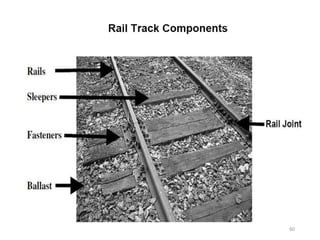

Prepared by : Prof. Kajol Panchal
Diwaliba Polytechnic 1
Topics
• Modes of transportation and its importance
• Classification of roads
• Types of pavements
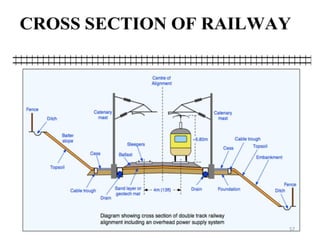
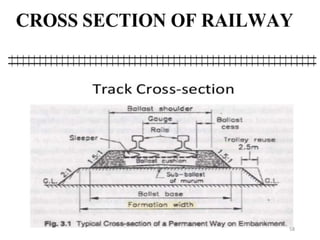
• Cross sections of road and railway
• Causes of damage to roads
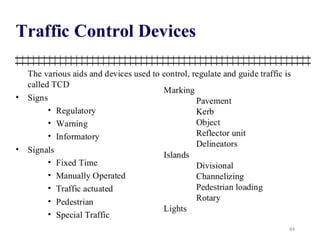
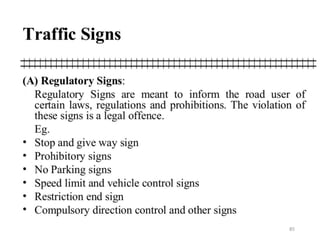
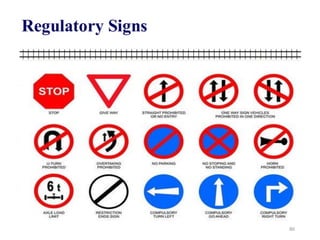
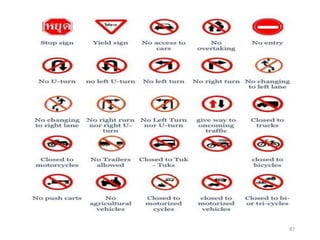
• Traffic signs and signals
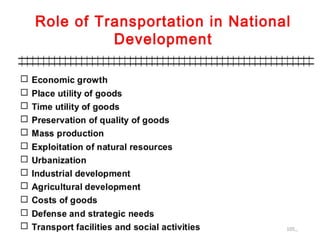
• Significance of transportation in nation's development
• Role of engineers in transportation.
2
3
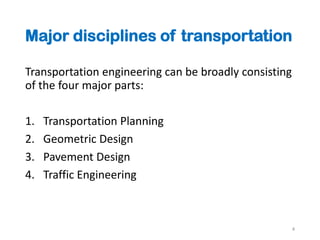
Major disciplines of transportation
Transportation engineering can be broadly consisting
of the four major parts:
1. Transportation Planning
2. Geometric Design
3. Pavement Design
4. Traffic Engineering
4
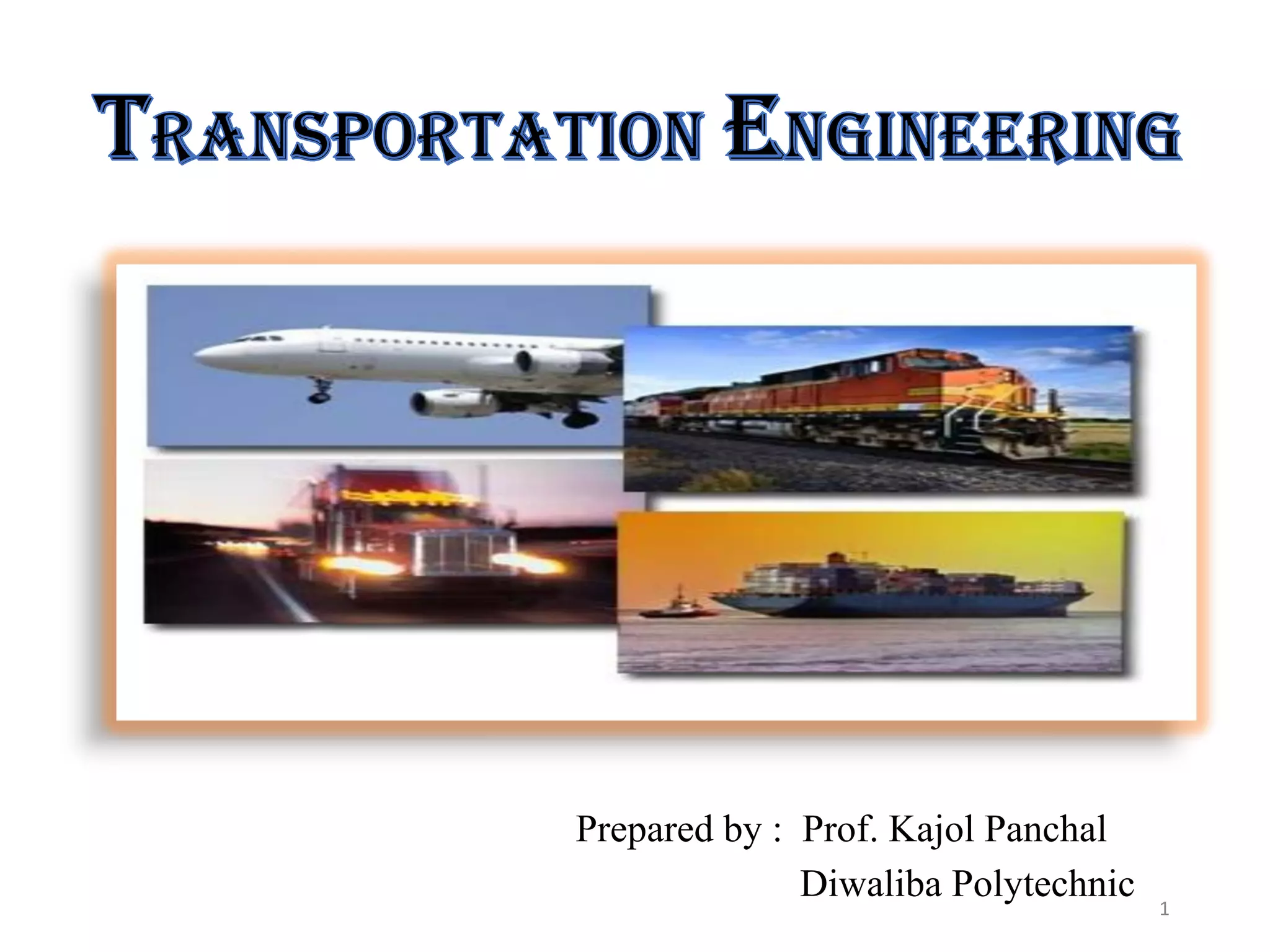
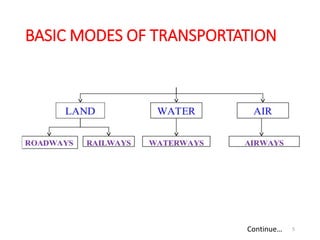
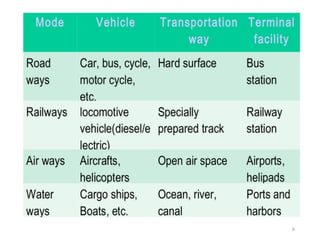
BASIC MODES OF TRANSPORTATION
5Continue…
6
Highway Components
7
8
9
Types of alignment
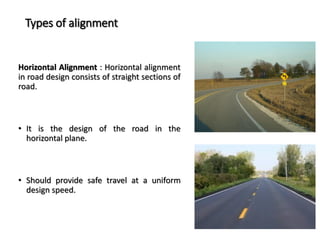
Horizontal Alignment : Horizontal alignment
in road design consists of straight sections of
road.
• It is the design of the road in the
horizontal plane.
• Should provide safe travel at a uniform
design speed.
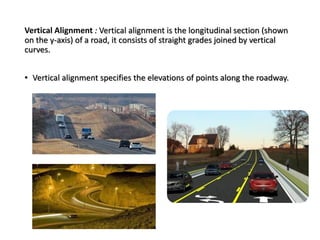
Vertical Alignment : Vertical alignment is the longitudinal section (shown
on the y-axis) of a road, it consists of straight grades joined by vertical
curves.
• Vertical alignment specifies the elevations of points along the roadway.
12
13
14
15
16
17
18
19
20
21
22
23
24
25
26
27
28
29
30
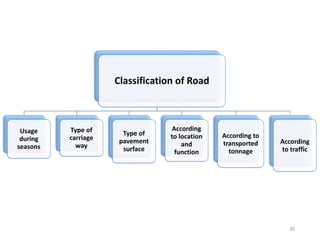
Classification of Road
Usage
during
seasons
Type of
carriage
way
Type of
pavement
surface
According
to location
and
function
According to
transported
tonnage
According
to traffic
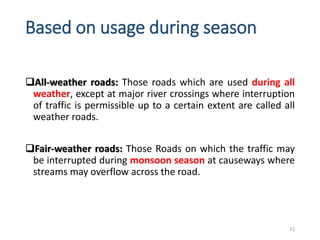
Based on usage during season
All-weather roads: Those roads which are used during all
weather, except at major river crossings where interruption
of traffic is permissible up to a certain extent are called all
weather roads.
Fair-weather roads: Those Roads on which the traffic may
be interrupted during monsoon season at causeways where
streams may overflow across the road.
31
Based on type of carriage way
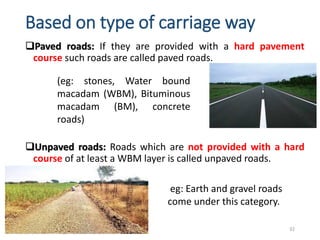
Paved roads: If they are provided with a hard pavement
course such roads are called paved roads.
Unpaved roads: Roads which are not provided with a hard
course of at least a WBM layer is called unpaved roads.
32
(eg: stones, Water bound
macadam (WBM), Bituminous
macadam (BM), concrete
roads)
eg: Earth and gravel roads
come under this category.
Based on type of pavement surface
Surfaced roads (BM, concrete): Roads which are provided
with a bituminous or cement concreting surface are called
surfaced roads.
Unsurfaced roads (soil/gravel): Roads which are not
provided with a bituminous or cement concreting surface
are called unsurfaced roads.
33
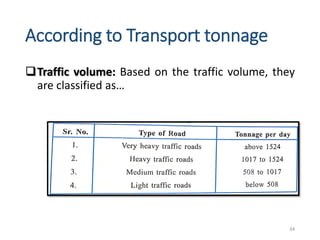
According to Transport tonnage
Traffic volume: Based on the traffic volume, they
are classified as…
34
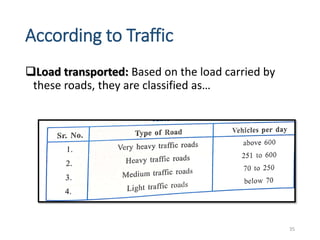
According to Traffic
Load transported: Based on the load carried by
these roads, they are classified as…
35
36
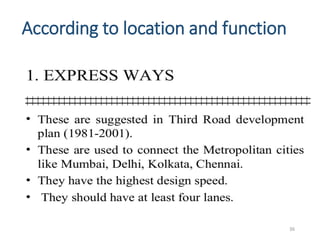
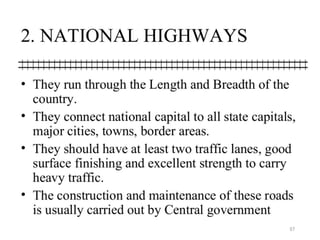
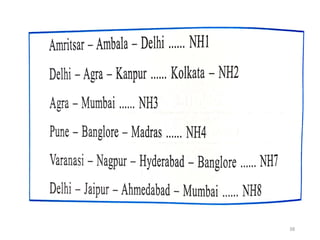
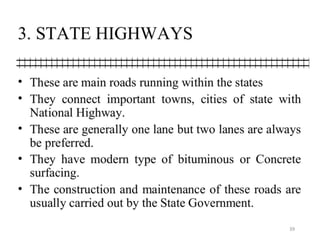
According to location and function
37
38
39
40
41
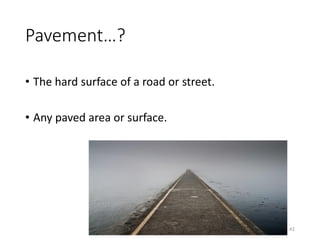
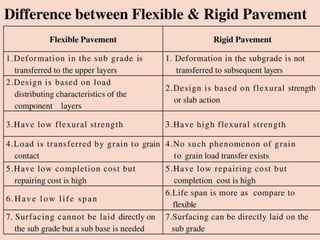
Pavement…?
• The hard surface of a road or street.
• Any paved area or surface.
42
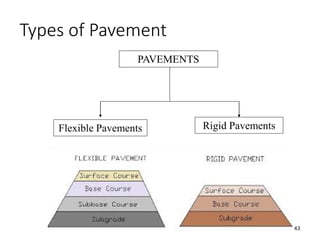
Types of Pavement
43
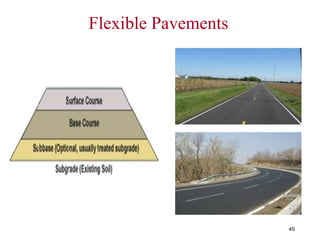
Flexible Pavements
PAVEMENTS
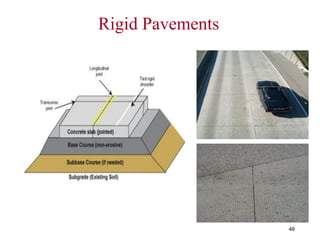
Rigid Pavements
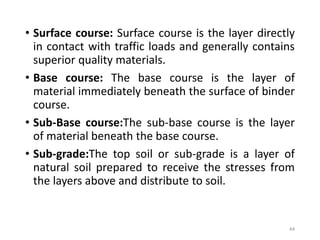
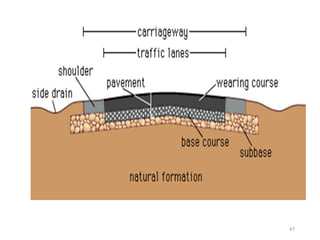
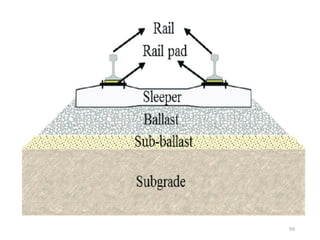
• Surface course: Surface course is the layer directly
in contact with traffic loads and generally contains
superior quality materials.
• Base course: The base course is the layer of
material immediately beneath the surface of binder
course.
• Sub-Base course:The sub-base course is the layer
of material beneath the base course.
• Sub-grade:The top soil or sub-grade is a layer of
natural soil prepared to receive the stresses from
the layers above and distribute to soil.
44
45
Flexible Pavements
46
Rigid Pavements
47
48
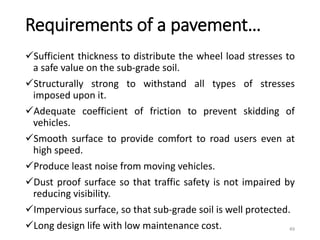
Requirements of a pavement…
Sufficient thickness to distribute the wheel load stresses to
a safe value on the sub-grade soil.
Structurally strong to withstand all types of stresses
imposed upon it.
Adequate coefficient of friction to prevent skidding of
vehicles.
Smooth surface to provide comfort to road users even at
high speed.
Produce least noise from moving vehicles.
Dust proof surface so that traffic safety is not impaired by
reducing visibility.
Impervious surface, so that sub-grade soil is well protected.
Long design life with low maintenance cost. 49
50
51
Causes of damage to roads
Use of substandard material.(use of inferior
material)
Low bearing capacity of sub strata.
Improper or no provision of drainage.
Improper supervision of site.
Faulty workmanship.
Tendency of taking more profit of contractor.
Inadequacies in the initial design, specifications
and construction standards of the bituminous
layers.
52
53
54
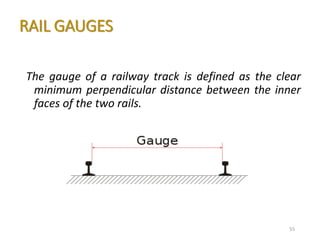
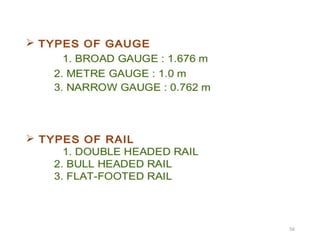
RAIL GAUGES
The gauge of a railway track is defined as the clear
minimum perpendicular distance between the inner
faces of the two rails.
55
56
57
58
59
60
61
62
63
64
65
66
67
68
69
70
71
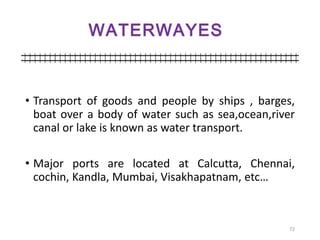
• Transport of goods and people by ships , barges,
boat over a body of water such as sea,ocean,river
canal or lake is known as water transport.
• Major ports are located at Calcutta, Chennai,
cochin, Kandla, Mumbai, Visakhapatnam, etc…
72
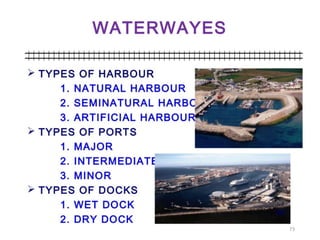
73
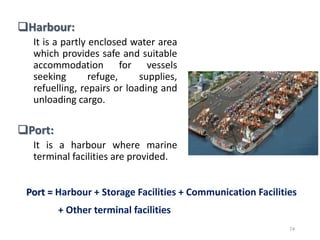
Harbour:
It is a partly enclosed water area
which provides safe and suitable
accommodation for vessels
seeking refuge, supplies,
refuelling, repairs or loading and
unloading cargo.
Port:
It is a harbour where marine
terminal facilities are provided.
74
Port = Harbour + Storage Facilities + Communication Facilities
+ Other terminal facilities
75
76
• The airport Authority of India (AAI) manages 126
airports, which include 14 International and 86
domestic airport.
International Airport:
1. New Delhi
2. Amritsar
3. Ahmedabad
4. Mumbai
5. Goa (Panji)
6. Pune
7. Cochin
77
8. Trivandrum
9. Chennai
10. Bangalore
11. Hyderabad
12. Kolkata
13. Guwahati
14. Jaipur
78
79
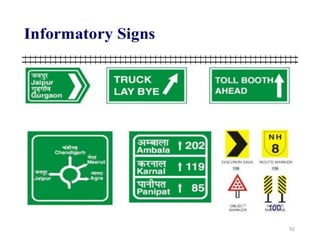
Traffic signs and signals
80
 123
81
82
83
84
85
86
87
88
89
90
91
92
93
94
95
96
97
98
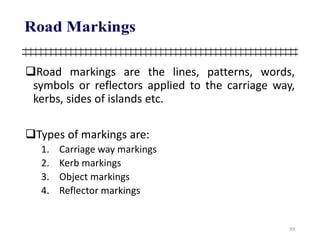
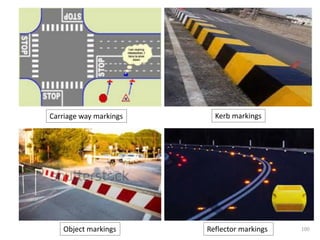
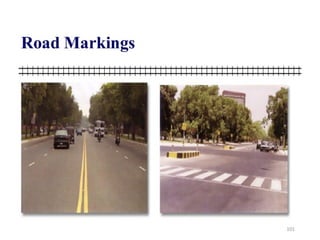
Road markings are the lines, patterns, words,
symbols or reflectors applied to the carriage way,
kerbs, sides of islands etc.
Types of markings are:
1. Carriage way markings
2. Kerb markings
3. Object markings
4. Reflector markings
99
100
Carriage way markings Kerb markings
Reflector markingsObject markings
101
102
103
104
105
106

Basics of Transportation Engineering

  • 1.
    Prepared by :Prof. Kajol Panchal Diwaliba Polytechnic 1
  • 2.
    Topics • Modes oftransportation and its importance • Classification of roads • Types of pavements • Cross sections of road and railway • Causes of damage to roads • Traffic signs and signals • Significance of transportation in nation's development • Role of engineers in transportation. 2
  • 3.
  • 4.
    Major disciplines oftransportation Transportation engineering can be broadly consisting of the four major parts: 1. Transportation Planning 2. Geometric Design 3. Pavement Design 4. Traffic Engineering 4
  • 5.
    BASIC MODES OFTRANSPORTATION 5Continue…
  • 6.
  • 7.
  • 8.
  • 9.
  • 10.
    Types of alignment HorizontalAlignment : Horizontal alignment in road design consists of straight sections of road. • It is the design of the road in the horizontal plane. • Should provide safe travel at a uniform design speed.
  • 11.
    Vertical Alignment :Vertical alignment is the longitudinal section (shown on the y-axis) of a road, it consists of straight grades joined by vertical curves. • Vertical alignment specifies the elevations of points along the roadway.
  • 12.
  • 13.
  • 14.
  • 15.
  • 16.
  • 17.
  • 18.
  • 19.
  • 20.
  • 21.
  • 22.
  • 23.
  • 24.
  • 25.
  • 26.
  • 27.
  • 28.
  • 29.
  • 30.
    30 Classification of Road Usage during seasons Typeof carriage way Type of pavement surface According to location and function According to transported tonnage According to traffic
  • 31.
    Based on usageduring season All-weather roads: Those roads which are used during all weather, except at major river crossings where interruption of traffic is permissible up to a certain extent are called all weather roads. Fair-weather roads: Those Roads on which the traffic may be interrupted during monsoon season at causeways where streams may overflow across the road. 31
  • 32.
    Based on typeof carriage way Paved roads: If they are provided with a hard pavement course such roads are called paved roads. Unpaved roads: Roads which are not provided with a hard course of at least a WBM layer is called unpaved roads. 32 (eg: stones, Water bound macadam (WBM), Bituminous macadam (BM), concrete roads) eg: Earth and gravel roads come under this category.
  • 33.
    Based on typeof pavement surface Surfaced roads (BM, concrete): Roads which are provided with a bituminous or cement concreting surface are called surfaced roads. Unsurfaced roads (soil/gravel): Roads which are not provided with a bituminous or cement concreting surface are called unsurfaced roads. 33
  • 34.
    According to Transporttonnage Traffic volume: Based on the traffic volume, they are classified as… 34
  • 35.
    According to Traffic Loadtransported: Based on the load carried by these roads, they are classified as… 35
  • 36.
  • 37.
  • 38.
  • 39.
  • 40.
  • 41.
  • 42.
    Pavement…? • The hardsurface of a road or street. • Any paved area or surface. 42
  • 43.
    Types of Pavement 43 FlexiblePavements PAVEMENTS Rigid Pavements
  • 44.
    • Surface course:Surface course is the layer directly in contact with traffic loads and generally contains superior quality materials. • Base course: The base course is the layer of material immediately beneath the surface of binder course. • Sub-Base course:The sub-base course is the layer of material beneath the base course. • Sub-grade:The top soil or sub-grade is a layer of natural soil prepared to receive the stresses from the layers above and distribute to soil. 44
  • 45.
  • 46.
  • 47.
  • 48.
  • 49.
    Requirements of apavement… Sufficient thickness to distribute the wheel load stresses to a safe value on the sub-grade soil. Structurally strong to withstand all types of stresses imposed upon it. Adequate coefficient of friction to prevent skidding of vehicles. Smooth surface to provide comfort to road users even at high speed. Produce least noise from moving vehicles. Dust proof surface so that traffic safety is not impaired by reducing visibility. Impervious surface, so that sub-grade soil is well protected. Long design life with low maintenance cost. 49
  • 50.
  • 51.
  • 52.
    Causes of damageto roads Use of substandard material.(use of inferior material) Low bearing capacity of sub strata. Improper or no provision of drainage. Improper supervision of site. Faulty workmanship. Tendency of taking more profit of contractor. Inadequacies in the initial design, specifications and construction standards of the bituminous layers. 52
  • 53.
  • 54.
  • 55.
    RAIL GAUGES The gaugeof a railway track is defined as the clear minimum perpendicular distance between the inner faces of the two rails. 55
  • 56.
  • 57.
  • 58.
  • 59.
  • 60.
  • 61.
  • 62.
  • 63.
  • 64.
  • 65.
  • 66.
  • 67.
  • 68.
  • 69.
  • 70.
  • 71.
  • 72.
    • Transport ofgoods and people by ships , barges, boat over a body of water such as sea,ocean,river canal or lake is known as water transport. • Major ports are located at Calcutta, Chennai, cochin, Kandla, Mumbai, Visakhapatnam, etc… 72
  • 73.
  • 74.
    Harbour: It is apartly enclosed water area which provides safe and suitable accommodation for vessels seeking refuge, supplies, refuelling, repairs or loading and unloading cargo. Port: It is a harbour where marine terminal facilities are provided. 74 Port = Harbour + Storage Facilities + Communication Facilities + Other terminal facilities
  • 75.
  • 76.
  • 77.
    • The airportAuthority of India (AAI) manages 126 airports, which include 14 International and 86 domestic airport. International Airport: 1. New Delhi 2. Amritsar 3. Ahmedabad 4. Mumbai 5. Goa (Panji) 6. Pune 7. Cochin 77 8. Trivandrum 9. Chennai 10. Bangalore 11. Hyderabad 12. Kolkata 13. Guwahati 14. Jaipur
  • 78.
  • 79.
  • 80.
  • 81.
  • 82.
  • 83.
  • 84.
  • 85.
  • 86.
  • 87.
  • 88.
  • 89.
  • 90.
  • 91.
  • 92.
  • 93.
  • 94.
  • 95.
  • 96.
  • 97.
  • 98.
  • 99.
    Road markings arethe lines, patterns, words, symbols or reflectors applied to the carriage way, kerbs, sides of islands etc. Types of markings are: 1. Carriage way markings 2. Kerb markings 3. Object markings 4. Reflector markings 99
  • 100.
    100 Carriage way markingsKerb markings Reflector markingsObject markings
  • 101.
  • 102.
  • 103.
  • 104.
  • 105.
  • 106.