Face recognition
(pattern matching & bio-metrics)
CATEGORY- IMAGE PROCESSING
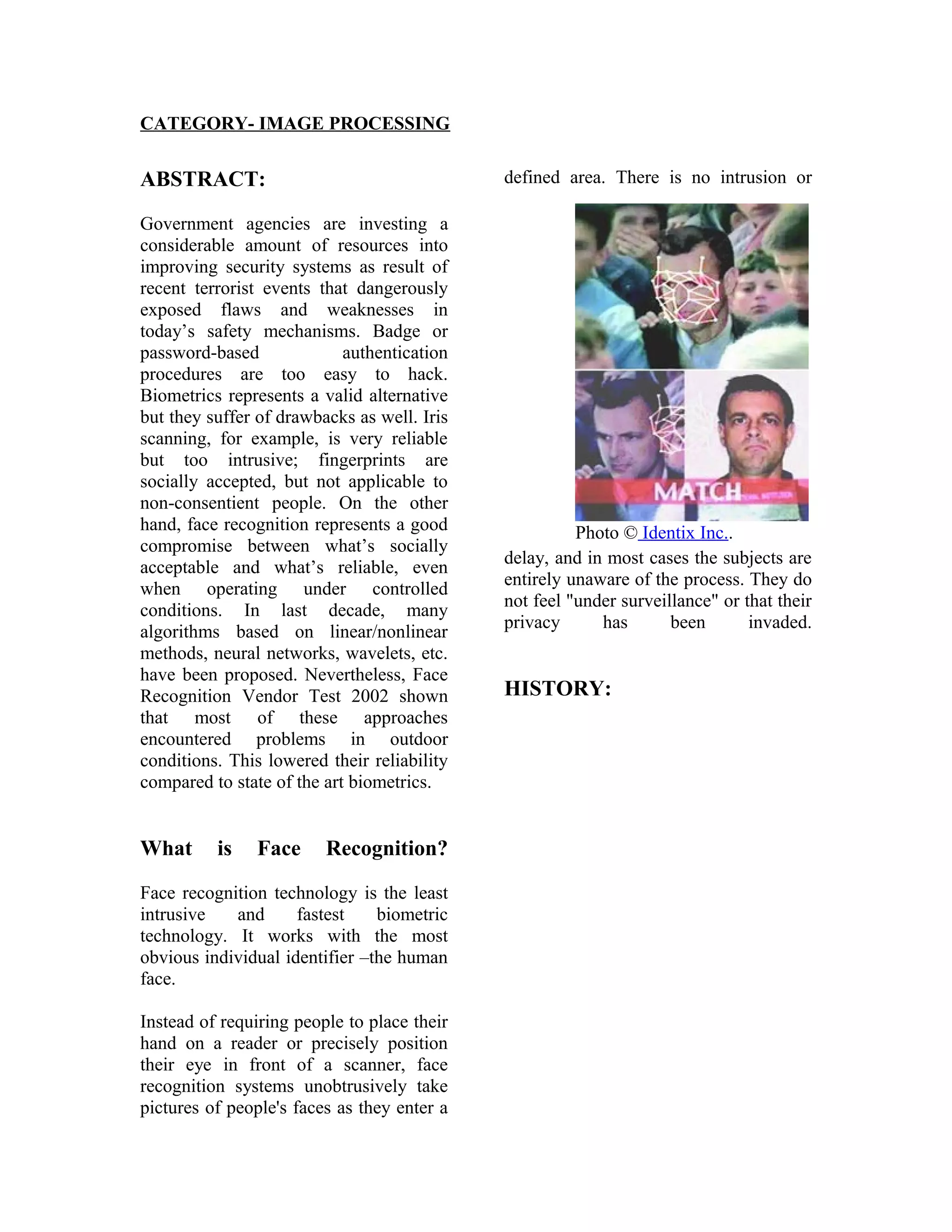
defined area. There is no intrusion or

ABSTRACT:
Government agencies are investing a
considerable amount of resources into
improving security systems as result of
recent terrorist events that dangerously
exposed flaws and weaknesses in
today’s safety mechanisms. Badge or
password-based
authentication
procedures are too easy to hack.
Biometrics represents a valid alternative
but they suffer of drawbacks as well. Iris
scanning, for example, is very reliable
but too intrusive; fingerprints are
socially accepted, but not applicable to
non-consentient people. On the other
hand, face recognition represents a good
compromise between what’s socially
acceptable and what’s reliable, even
when operating under controlled
conditions. In last decade, many
algorithms based on linear/nonlinear
methods, neural networks, wavelets, etc.
have been proposed. Nevertheless, Face
Recognition Vendor Test 2002 shown
that most of these approaches
encountered problems in outdoor
conditions. This lowered their reliability
compared to state of the art biometrics.

What

is

Face

Recognition?

Face recognition technology is the least
intrusive
and
fastest
biometric
technology. It works with the most
obvious individual identifier –the human
face.
Instead of requiring people to place their
hand on a reader or precisely position
their eye in front of a scanner, face
recognition systems unobtrusively take
pictures of people's faces as they enter a

Photo © Identix Inc..
delay, and in most cases the subjects are
entirely unaware of the process. They do
not feel "under surveillance" or that their
privacy
has
been
invaded.

HISTORY:
Humans have always had the innate
ability to recognize and distinguish
between faces, yet computers only
recently have shown the same ability. In
the mid 1960s, scientists began work on
using the computer to recognize human
faces. Since then, facial recognition
software has come a long way.
Identix®, a company based in
Minnesota, is one of many developers of
facial recognition technology. Its
software, FaceIt®, can pick someone's
face out of a crowd, extract the face
from the rest of the scene and compare it
to a database of stored images. In order
for this software to work, it has to know
how to differentiate between a basic face
and the rest of the background. Facial
recognition software is based on the
ability to recognize a face and then
measure the various features of the face.
Every
face
has
numerous,
distinguishable landmarks, the different
peaks and valleys that make up facial
features. FaceIt defines these landmarks
as nodal points. Each human face has
approximately 80 nodal points. Some of
these measured by the software are:
•
•
•
•
•

Distance between the eyes
Width of the nose
Depth of the eye sockets
The shape of the cheekbones
The length of the jaw line

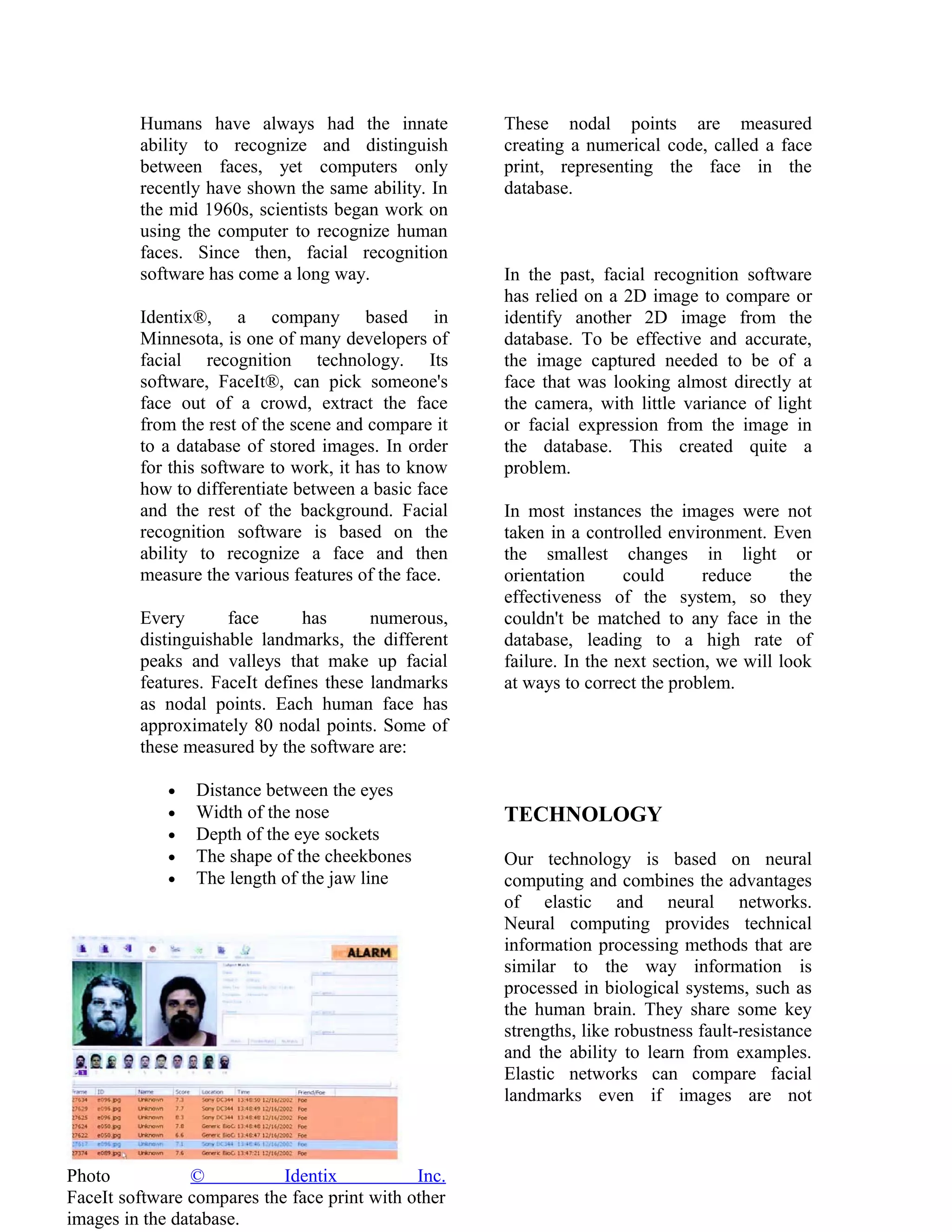
Photo
©
Identix
Inc.
FaceIt software compares the face print with other
images in the database.

These nodal points are measured
creating a numerical code, called a face
print, representing the face in the
database.

In the past, facial recognition software
has relied on a 2D image to compare or
identify another 2D image from the
database. To be effective and accurate,
the image captured needed to be of a
face that was looking almost directly at
the camera, with little variance of light
or facial expression from the image in
the database. This created quite a
problem.
In most instances the images were not
taken in a controlled environment. Even
the smallest changes in light or
orientation
could
reduce
the
effectiveness of the system, so they
couldn't be matched to any face in the
database, leading to a high rate of
failure. In the next section, we will look
at ways to correct the problem.

TECHNOLOGY
Our technology is based on neural
computing and combines the advantages
of elastic and neural networks.
Neural computing provides technical
information processing methods that are
similar to the way information is
processed in biological systems, such as
the human brain. They share some key
strengths, like robustness fault-resistance
and the ability to learn from examples.
Elastic networks can compare facial
landmarks even if images are not
identical, as is practically always the
case in real-world situations. Neural
networks can learn to recognize
similarities through pattern recognition.

Capturing a real-time 3D image of a
person's facial surface, 3D facial
recognition uses distinctive features of
the face -- where rigid tissue and bone is
most apparent, such as the curves of the
eye socket, nose and chin -- to identify
the subject. These areas are all unique
and don't change over time.
Using depth and an axis of measurement
that is not affected by lighting, 3D facial
recognition can even be used in darkness
and has the ability to recognize a subject
at different view angles with the
potential to recognize up to 90 degrees
(a face in profile).

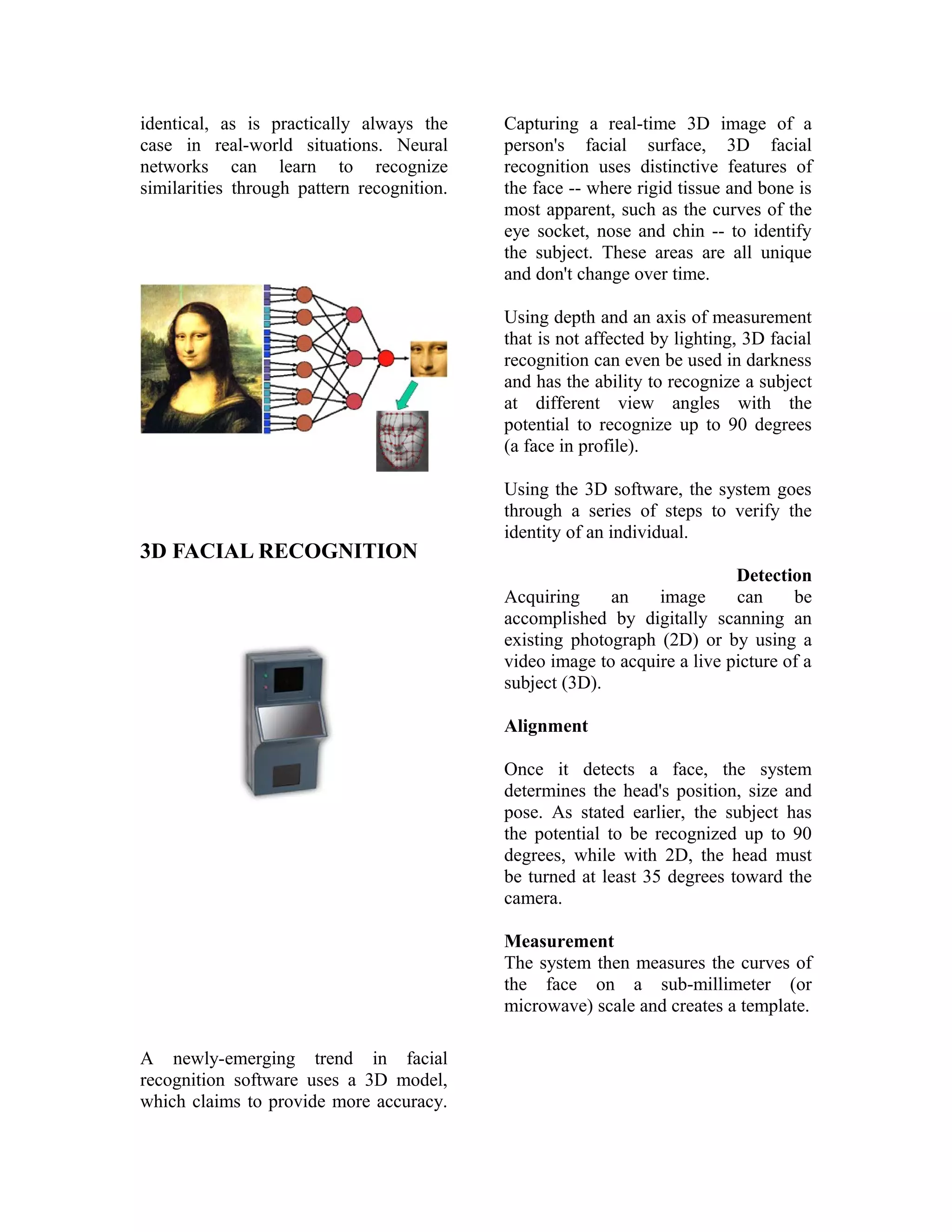
3D FACIAL RECOGNITION

Using the 3D software, the system goes
through a series of steps to verify the
identity of an individual.
Detection
Acquiring
an
image
can
be
accomplished by digitally scanning an
existing photograph (2D) or by using a
video image to acquire a live picture of a
subject (3D).
Alignment
Once it detects a face, the system
determines the head's position, size and
pose. As stated earlier, the subject has
the potential to be recognized up to 90
degrees, while with 2D, the head must
be turned at least 35 degrees toward the
camera.
Measurement
The system then measures the curves of
the face on a sub-millimeter (or
microwave) scale and creates a template.

A newly-emerging trend in facial
recognition software uses a 3D model,
which claims to provide more accuracy.
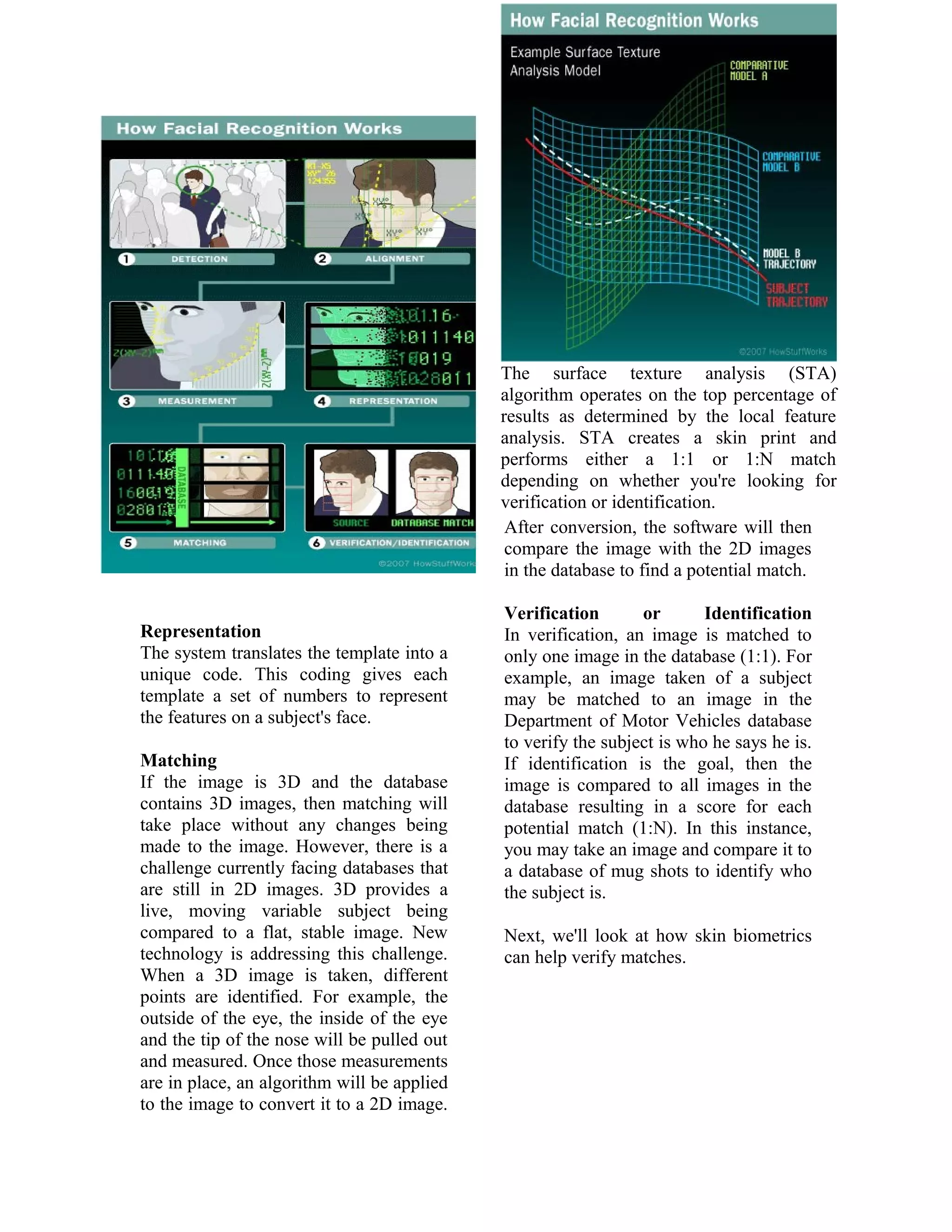
The surface texture analysis (STA)
algorithm operates on the top percentage of
results as determined by the local feature
analysis. STA creates a skin print and
performs either a 1:1 or 1:N match
depending on whether you're looking for
verification or identification.
After conversion, the software will then
compare the image with the 2D images
in the database to find a potential match.
Representation
The system translates the template into a
unique code. This coding gives each
template a set of numbers to represent
the features on a subject's face.
Matching
If the image is 3D and the database
contains 3D images, then matching will
take place without any changes being
made to the image. However, there is a
challenge currently facing databases that
are still in 2D images. 3D provides a
live, moving variable subject being
compared to a flat, stable image. New
technology is addressing this challenge.
When a 3D image is taken, different
points are identified. For example, the
outside of the eye, the inside of the eye
and the tip of the nose will be pulled out
and measured. Once those measurements
are in place, an algorithm will be applied
to the image to convert it to a 2D image.

Verification
or
Identification
In verification, an image is matched to
only one image in the database (1:1). For
example, an image taken of a subject
may be matched to an image in the
Department of Motor Vehicles database
to verify the subject is who he says he is.
If identification is the goal, then the
image is compared to all images in the
database resulting in a score for each
potential match (1:N). In this instance,
you may take an image and compare it to
a database of mug shots to identify who
the subject is.
Next, we'll look at how skin biometrics
can help verify matches.
the skin features in the image,
which contains the most detailed
information.

SURFACETEXTURE
ANALYSIS
The image may not always be verified or
identified in facial recognition alone.
Identix® has created a new product to
help with precision. The development of
FaceIt®Argus uses skin biometrics, the
uniqueness of skin texture, to yield even
more accurate results.
The process, called Surface Texture
Analysis, works much the same way
facial recognition does. A picture is
taken of a patch of skin, called a skin
print. That patch is then broken up into
smaller blocks. Using algorithms to turn
the patch into a mathematical,
measurable space, the system will then
distinguish any lines, pores and the
actual skin texture. It can identify
differences between identical twins,
which is not yet possible using facial
recognition software alone. According to
Identix, by combining facial recognition
with surface texture analysis, accurate
identification can increase by 20 to 25
percent.
FaceIt currently uses three different
templates to confirm or identify the
subject: vector, local feature analysis and
surface texture analysis.
•

•

•

The vector template is very small
and is used for rapid searching
over the entire database primarily
for one-to-many searching.
The local feature analysis (LFA)
template performs a secondary
search of ordered matches
following the vector template.
The surface texture analysis
(STA) is the largest of the three.
It performs a final pass after the
LFA template search, relying on

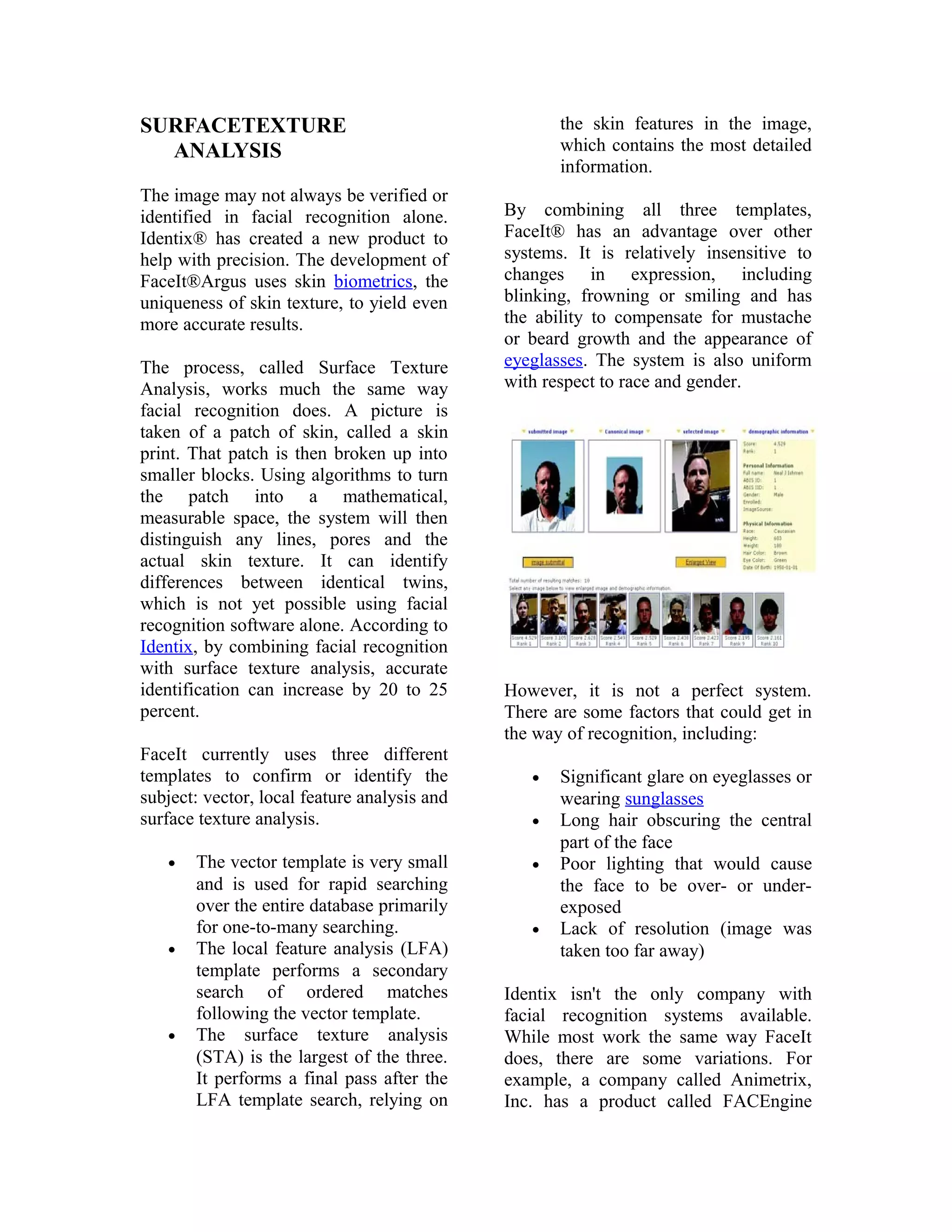
By combining all three templates,
FaceIt® has an advantage over other
systems. It is relatively insensitive to
changes in expression, including
blinking, frowning or smiling and has
the ability to compensate for mustache
or beard growth and the appearance of
eyeglasses. The system is also uniform
with respect to race and gender.

However, it is not a perfect system.
There are some factors that could get in
the way of recognition, including:
•
•
•

•

Significant glare on eyeglasses or
wearing sunglasses
Long hair obscuring the central
part of the face
Poor lighting that would cause
the face to be over- or underexposed
Lack of resolution (image was
taken too far away)

Identix isn't the only company with
facial recognition systems available.
While most work the same way FaceIt
does, there are some variations. For
example, a company called Animetrix,
Inc. has a product called FACEngine
ID® SetLight that can correct lighting
conditions that cannot normally be used,
reducing the risk of false matches.
Sensible Vision, Inc. has a product that
can secure a computer using facial
recognition. The computer will only
power on and stay accessible as long as
the correct user is in front of the screen.
Once the user moves out of the line of
sight, the computer is automatically
secured from other users.

have his photograph taken. The
fingerprints and photograph are checked
against a database of known criminals
and suspected terrorists. When the
traveler arrives in the United States at
the port of entry, those same fingerprints
and photographs will be used to verify
that the person who received the visa is
the same person attempting to gain
entry.

CURRENT & FUTURE USES
OF
FACIAL
RECOGNITION SYSTEMS

Hard to fool

The ideal solution
All of this makes face recognition
ideal for high traffic areas open to
the general public, such as:
- Airports and railway stations
- Casinos
- Cash points
- Stadiums
- Public transportation
- Financial institutions
- Government offices
- Businesses of all kinds
In the past, the primary users of facial
recognition software have been law
enforcement agencies, who used the
system to capture random faces in
crowds. Some government agencies
have also been using the systems for
security and to eliminate voter fraud.
The U.S. government has recently begun
a program called US-VISIT (United
States Visitor and Immigrant Status
Indicator Technology), aimed at foreign
travelers gaining entry to the United
States. When a foreign traveler receives
his visa, he will submit fingerprints and

Face recognition is also very difficult to
fool. It works by comparing facial
landmarks - specific proportions and
angles of defined facial features - which
cannot easily be concealed by beards,
eyeglasses or makeup.
However, there are now many more
situations where the software is
becoming popular.
• As the systems become less
expensive, making their use more
widespread.
• They are now compatible with
cameras and computers that are
already in use by banks and
airports. Registered Traveler
program will provide speedy
security screening for passengers
who volunteer information. At
the airport there will be specific
lines for the Registered Traveler
to go through that will move
more quickly, verifying the
traveler by their facial features.
• Other potential applications
include ATM and check-cashing
security. After a customer
consents, the ATM or checkcashing kiosk captures a digital
image of him. The FaceIt
•

software then generates a face
print of the photograph to protect
customers against identity theft
and fraudulent transactions.
By using the facial recognition
software, there's no need for a
picture ID, bankcard or personal
identification number (PIN) to
verify a customer's identity. This
way business can prevent fraud
from occurring.

DRAWBACKS
TECHNOLOGY

OF

THIS

While all the examples above work with
the permission of the individual, not all
systems are used with your knowledge.
These systems were taking pictures of all
visitors without their knowledge or their
permission. Opponents of the systems
note that while they do provide security
in some instances, it is not enough to
override a sense of liberty and freedom.
Many feel that privacy infringement is
too great with the use of these systems,
but their concerns don't end there.
They also point out the risk involved
with identity theft. Even facial
recognition corporations admit that the
more use the technology gets, the higher
the likelihood of identity theft or fraud.

CONCLUSION
As with many developing technologies,
the incredible potential of facial
recognition
comes
with
some
drawbacks, but manufacturers are
striving to enhance the usability and
accuracy of the systems. Face
recognition promises latest security
invents in the upcoming trends based on

bio-metrics and pattern
techniques and algorithms.

matching

REFERENCES:
• "Using your body as a key;
legal aspects of biometrics".
http://cwis.kub.nl/~frw/peop
le/kraling/content/biomet.ht
m
• Biometrics Consortuim:
www.biometrics.org
•

Y. Adini, Y. Moses, and S.
Ullman, “Face recognition:
the problem of compensating
for changes in illumination
direction,” IEEE Trans.
Pattern Anal. Machine Intell.,
vol. 19, pp. 721–732, July
1997.

Facerecognition

  • 1.
  • 2.
    CATEGORY- IMAGE PROCESSING definedarea. There is no intrusion or ABSTRACT: Government agencies are investing a considerable amount of resources into improving security systems as result of recent terrorist events that dangerously exposed flaws and weaknesses in today’s safety mechanisms. Badge or password-based authentication procedures are too easy to hack. Biometrics represents a valid alternative but they suffer of drawbacks as well. Iris scanning, for example, is very reliable but too intrusive; fingerprints are socially accepted, but not applicable to non-consentient people. On the other hand, face recognition represents a good compromise between what’s socially acceptable and what’s reliable, even when operating under controlled conditions. In last decade, many algorithms based on linear/nonlinear methods, neural networks, wavelets, etc. have been proposed. Nevertheless, Face Recognition Vendor Test 2002 shown that most of these approaches encountered problems in outdoor conditions. This lowered their reliability compared to state of the art biometrics. What is Face Recognition? Face recognition technology is the least intrusive and fastest biometric technology. It works with the most obvious individual identifier –the human face. Instead of requiring people to place their hand on a reader or precisely position their eye in front of a scanner, face recognition systems unobtrusively take pictures of people's faces as they enter a Photo © Identix Inc.. delay, and in most cases the subjects are entirely unaware of the process. They do not feel "under surveillance" or that their privacy has been invaded. HISTORY:
  • 3.
    Humans have alwayshad the innate ability to recognize and distinguish between faces, yet computers only recently have shown the same ability. In the mid 1960s, scientists began work on using the computer to recognize human faces. Since then, facial recognition software has come a long way. Identix®, a company based in Minnesota, is one of many developers of facial recognition technology. Its software, FaceIt®, can pick someone's face out of a crowd, extract the face from the rest of the scene and compare it to a database of stored images. In order for this software to work, it has to know how to differentiate between a basic face and the rest of the background. Facial recognition software is based on the ability to recognize a face and then measure the various features of the face. Every face has numerous, distinguishable landmarks, the different peaks and valleys that make up facial features. FaceIt defines these landmarks as nodal points. Each human face has approximately 80 nodal points. Some of these measured by the software are: • • • • • Distance between the eyes Width of the nose Depth of the eye sockets The shape of the cheekbones The length of the jaw line Photo © Identix Inc. FaceIt software compares the face print with other images in the database. These nodal points are measured creating a numerical code, called a face print, representing the face in the database. In the past, facial recognition software has relied on a 2D image to compare or identify another 2D image from the database. To be effective and accurate, the image captured needed to be of a face that was looking almost directly at the camera, with little variance of light or facial expression from the image in the database. This created quite a problem. In most instances the images were not taken in a controlled environment. Even the smallest changes in light or orientation could reduce the effectiveness of the system, so they couldn't be matched to any face in the database, leading to a high rate of failure. In the next section, we will look at ways to correct the problem. TECHNOLOGY Our technology is based on neural computing and combines the advantages of elastic and neural networks. Neural computing provides technical information processing methods that are similar to the way information is processed in biological systems, such as the human brain. They share some key strengths, like robustness fault-resistance and the ability to learn from examples. Elastic networks can compare facial landmarks even if images are not
  • 4.
    identical, as ispractically always the case in real-world situations. Neural networks can learn to recognize similarities through pattern recognition. Capturing a real-time 3D image of a person's facial surface, 3D facial recognition uses distinctive features of the face -- where rigid tissue and bone is most apparent, such as the curves of the eye socket, nose and chin -- to identify the subject. These areas are all unique and don't change over time. Using depth and an axis of measurement that is not affected by lighting, 3D facial recognition can even be used in darkness and has the ability to recognize a subject at different view angles with the potential to recognize up to 90 degrees (a face in profile). 3D FACIAL RECOGNITION Using the 3D software, the system goes through a series of steps to verify the identity of an individual. Detection Acquiring an image can be accomplished by digitally scanning an existing photograph (2D) or by using a video image to acquire a live picture of a subject (3D). Alignment Once it detects a face, the system determines the head's position, size and pose. As stated earlier, the subject has the potential to be recognized up to 90 degrees, while with 2D, the head must be turned at least 35 degrees toward the camera. Measurement The system then measures the curves of the face on a sub-millimeter (or microwave) scale and creates a template. A newly-emerging trend in facial recognition software uses a 3D model, which claims to provide more accuracy.
  • 5.
    The surface textureanalysis (STA) algorithm operates on the top percentage of results as determined by the local feature analysis. STA creates a skin print and performs either a 1:1 or 1:N match depending on whether you're looking for verification or identification. After conversion, the software will then compare the image with the 2D images in the database to find a potential match. Representation The system translates the template into a unique code. This coding gives each template a set of numbers to represent the features on a subject's face. Matching If the image is 3D and the database contains 3D images, then matching will take place without any changes being made to the image. However, there is a challenge currently facing databases that are still in 2D images. 3D provides a live, moving variable subject being compared to a flat, stable image. New technology is addressing this challenge. When a 3D image is taken, different points are identified. For example, the outside of the eye, the inside of the eye and the tip of the nose will be pulled out and measured. Once those measurements are in place, an algorithm will be applied to the image to convert it to a 2D image. Verification or Identification In verification, an image is matched to only one image in the database (1:1). For example, an image taken of a subject may be matched to an image in the Department of Motor Vehicles database to verify the subject is who he says he is. If identification is the goal, then the image is compared to all images in the database resulting in a score for each potential match (1:N). In this instance, you may take an image and compare it to a database of mug shots to identify who the subject is. Next, we'll look at how skin biometrics can help verify matches.
  • 6.
    the skin featuresin the image, which contains the most detailed information. SURFACETEXTURE ANALYSIS The image may not always be verified or identified in facial recognition alone. Identix® has created a new product to help with precision. The development of FaceIt®Argus uses skin biometrics, the uniqueness of skin texture, to yield even more accurate results. The process, called Surface Texture Analysis, works much the same way facial recognition does. A picture is taken of a patch of skin, called a skin print. That patch is then broken up into smaller blocks. Using algorithms to turn the patch into a mathematical, measurable space, the system will then distinguish any lines, pores and the actual skin texture. It can identify differences between identical twins, which is not yet possible using facial recognition software alone. According to Identix, by combining facial recognition with surface texture analysis, accurate identification can increase by 20 to 25 percent. FaceIt currently uses three different templates to confirm or identify the subject: vector, local feature analysis and surface texture analysis. • • • The vector template is very small and is used for rapid searching over the entire database primarily for one-to-many searching. The local feature analysis (LFA) template performs a secondary search of ordered matches following the vector template. The surface texture analysis (STA) is the largest of the three. It performs a final pass after the LFA template search, relying on By combining all three templates, FaceIt® has an advantage over other systems. It is relatively insensitive to changes in expression, including blinking, frowning or smiling and has the ability to compensate for mustache or beard growth and the appearance of eyeglasses. The system is also uniform with respect to race and gender. However, it is not a perfect system. There are some factors that could get in the way of recognition, including: • • • • Significant glare on eyeglasses or wearing sunglasses Long hair obscuring the central part of the face Poor lighting that would cause the face to be over- or underexposed Lack of resolution (image was taken too far away) Identix isn't the only company with facial recognition systems available. While most work the same way FaceIt does, there are some variations. For example, a company called Animetrix, Inc. has a product called FACEngine
  • 7.
    ID® SetLight thatcan correct lighting conditions that cannot normally be used, reducing the risk of false matches. Sensible Vision, Inc. has a product that can secure a computer using facial recognition. The computer will only power on and stay accessible as long as the correct user is in front of the screen. Once the user moves out of the line of sight, the computer is automatically secured from other users. have his photograph taken. The fingerprints and photograph are checked against a database of known criminals and suspected terrorists. When the traveler arrives in the United States at the port of entry, those same fingerprints and photographs will be used to verify that the person who received the visa is the same person attempting to gain entry. CURRENT & FUTURE USES OF FACIAL RECOGNITION SYSTEMS Hard to fool The ideal solution All of this makes face recognition ideal for high traffic areas open to the general public, such as: - Airports and railway stations - Casinos - Cash points - Stadiums - Public transportation - Financial institutions - Government offices - Businesses of all kinds In the past, the primary users of facial recognition software have been law enforcement agencies, who used the system to capture random faces in crowds. Some government agencies have also been using the systems for security and to eliminate voter fraud. The U.S. government has recently begun a program called US-VISIT (United States Visitor and Immigrant Status Indicator Technology), aimed at foreign travelers gaining entry to the United States. When a foreign traveler receives his visa, he will submit fingerprints and Face recognition is also very difficult to fool. It works by comparing facial landmarks - specific proportions and angles of defined facial features - which cannot easily be concealed by beards, eyeglasses or makeup. However, there are now many more situations where the software is becoming popular. • As the systems become less expensive, making their use more widespread. • They are now compatible with cameras and computers that are already in use by banks and airports. Registered Traveler program will provide speedy security screening for passengers who volunteer information. At the airport there will be specific lines for the Registered Traveler to go through that will move more quickly, verifying the traveler by their facial features. • Other potential applications include ATM and check-cashing security. After a customer consents, the ATM or checkcashing kiosk captures a digital image of him. The FaceIt
  • 8.
    • software then generatesa face print of the photograph to protect customers against identity theft and fraudulent transactions. By using the facial recognition software, there's no need for a picture ID, bankcard or personal identification number (PIN) to verify a customer's identity. This way business can prevent fraud from occurring. DRAWBACKS TECHNOLOGY OF THIS While all the examples above work with the permission of the individual, not all systems are used with your knowledge. These systems were taking pictures of all visitors without their knowledge or their permission. Opponents of the systems note that while they do provide security in some instances, it is not enough to override a sense of liberty and freedom. Many feel that privacy infringement is too great with the use of these systems, but their concerns don't end there. They also point out the risk involved with identity theft. Even facial recognition corporations admit that the more use the technology gets, the higher the likelihood of identity theft or fraud. CONCLUSION As with many developing technologies, the incredible potential of facial recognition comes with some drawbacks, but manufacturers are striving to enhance the usability and accuracy of the systems. Face recognition promises latest security invents in the upcoming trends based on bio-metrics and pattern techniques and algorithms. matching REFERENCES: • "Using your body as a key; legal aspects of biometrics". http://cwis.kub.nl/~frw/peop le/kraling/content/biomet.ht m • Biometrics Consortuim: www.biometrics.org • Y. Adini, Y. Moses, and S. Ullman, “Face recognition: the problem of compensating for changes in illumination direction,” IEEE Trans. Pattern Anal. Machine Intell., vol. 19, pp. 721–732, July 1997.