PATTERN
RECOGNITION
1
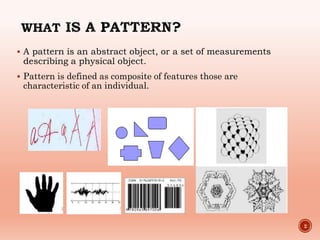
 A pattern is an abstract object, or a set of measurements
describing a physical object.
 Pattern is defined as composite of features those are
characteristic of an individual.
2
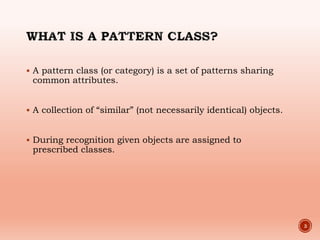
 A pattern class (or category) is a set of patterns sharing
common attributes.
 A collection of “similar” (not necessarily identical) objects.
 During recognition given objects are assigned to
prescribed classes.
3
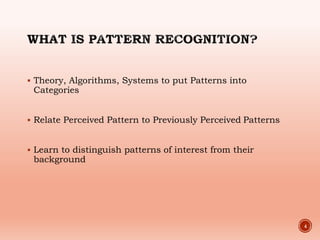
 Theory, Algorithms, Systems to put Patterns into
Categories
 Relate Perceived Pattern to Previously Perceived Patterns
 Learn to distinguish patterns of interest from their
background
4
HUMAN PERCEPTION
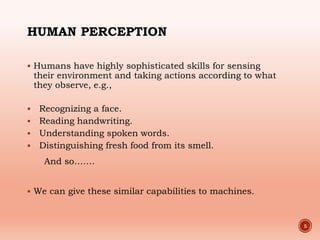
 Humans have highly sophisticated skills for sensing
their environment and taking actions according to what
they observe, e.g.,
 Recognizing a face.
 Reading handwriting.
 Understanding spoken words.
 Distinguishing fresh food from its smell.
And so…….
 We can give these similar capabilities to machines.
5
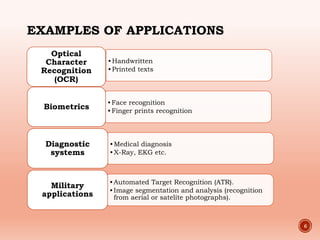
EXAMPLES OF APPLICATIONS
•Handwritten
•Printed texts
Optical
Character
Recognition
(OCR)
•Face recognition
•Finger prints recognition
Biometrics
•Medical diagnosis
•X-Ray, EKG etc.
Diagnostic
systems
•Automated Target Recognition (ATR).
•Image segmentation and analysis (recognition
from aerial or satelite photographs).
Military
applications
6
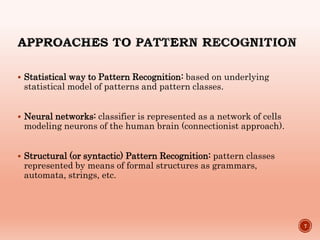
 Statistical way to Pattern Recognition: based on underlying
statistical model of patterns and pattern classes.
 Neural networks: classifier is represented as a network of cells
modeling neurons of the human brain (connectionist approach).
 Structural (or syntactic) Pattern Recognition: pattern classes
represented by means of formal structures as grammars,
automata, strings, etc.
7
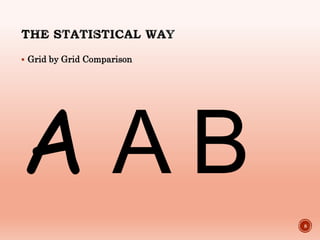
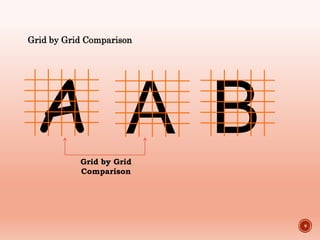
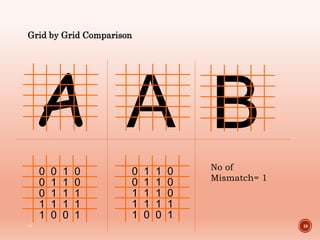
 Grid by Grid Comparison
A A B
8
9
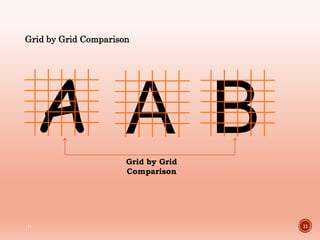
A A B
Grid by Grid
Comparison
Grid by Grid Comparison
A A B
10
0 0 1 0
0 1 1 0
0 1 1 1
1 1 1 1
1 0 0 1
0 1 1 0
0 1 1 0
1 1 1 0
1 1 1 1
1 0 0 1
No of
Mismatch= 1
10
Grid by Grid Comparison
A A B
Grid by Grid
Comparison
11
Grid by Grid Comparison
11
A A B
12
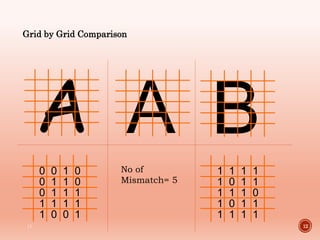
0 0 1 0
0 1 1 0
0 1 1 1
1 1 1 1
1 0 0 1
1 1 1 1
1 0 1 1
1 1 1 0
1 0 1 1
1 1 1 1
No of
Mismatch= 5
Grid by Grid Comparison
12
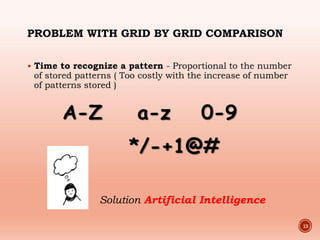
PROBLEM WITH GRID BY GRID COMPARISON
 Time to recognize a pattern - Proportional to the number
of stored patterns ( Too costly with the increase of number
of patterns stored )
13
A-Z a-z 0-9
*/-+1@#
Solution Artificial Intelligence
ARTIFICIAL INTELLIGENCE
Two Phases :
 Learning and
 Detection.
14
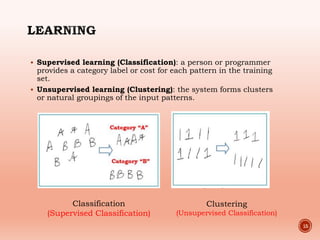
 Supervised learning (Classification): a person or programmer
provides a category label or cost for each pattern in the training
set.
 Unsupervised learning (Clustering): the system forms clusters
or natural groupings of the input patterns.
15
Classification
(Supervised Classification)
Clustering
(Unsupervised Classification)
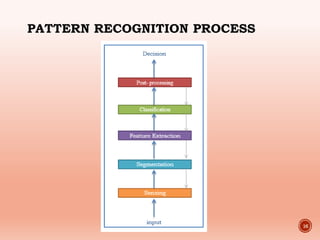
PATTERN RECOGNITION PROCESS
16
PATTERN RECOGNITION PROCESS
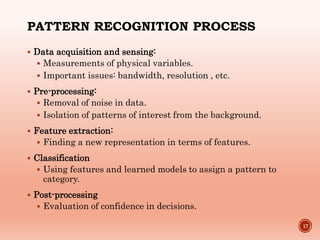
 Data acquisition and sensing:
 Measurements of physical variables.
 Important issues: bandwidth, resolution , etc.
 Pre-processing:
 Removal of noise in data.
 Isolation of patterns of interest from the background.
 Feature extraction:
 Finding a new representation in terms of features.
 Classification
 Using features and learned models to assign a pattern to
category.
 Post-processing
 Evaluation of confidence in decisions.
17
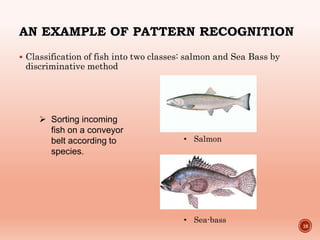
AN EXAMPLE OF PATTERN RECOGNITION
 Classification of fish into two classes: salmon and Sea Bass by
discriminative method
18
 Sorting incoming
fish on a conveyor
belt according to
species.
• Salmon
• Sea-bass
Steps of the process:
1. Capture image
2. Take measurements
 Length
 Width
 Number and shape of fins
 Position of the mouth, etc…
3. Make decision
19
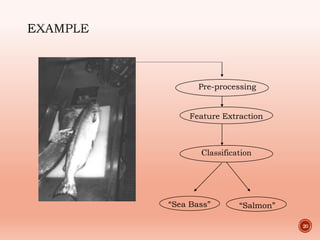
20
Pre-processing
Feature Extraction
Classification
“Sea Bass” “Salmon”
 Pre-Processing:
i. Image enhancement
ii. Isolate fishes from one another and from the background
iii. Finding the boundary of the fish
 Feature extractor:
i. Reduce the data by measuring certain features.
ii. To improve recognition, we might have to use more than
one feature at a time.
21
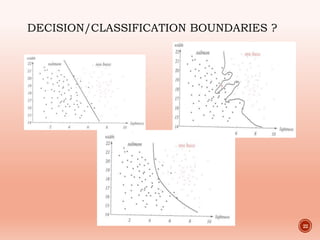
Fish x = [x1, x2]
Lightness width
DECISION/CLASSIFICATION BOUNDARIES ?
22
THANK YOU
23

Pattern Recognition.pptx

  • 1.
  • 2.
     A patternis an abstract object, or a set of measurements describing a physical object.  Pattern is defined as composite of features those are characteristic of an individual. 2
  • 3.
     A patternclass (or category) is a set of patterns sharing common attributes.  A collection of “similar” (not necessarily identical) objects.  During recognition given objects are assigned to prescribed classes. 3
  • 4.
     Theory, Algorithms,Systems to put Patterns into Categories  Relate Perceived Pattern to Previously Perceived Patterns  Learn to distinguish patterns of interest from their background 4
  • 5.
    HUMAN PERCEPTION  Humanshave highly sophisticated skills for sensing their environment and taking actions according to what they observe, e.g.,  Recognizing a face.  Reading handwriting.  Understanding spoken words.  Distinguishing fresh food from its smell. And so…….  We can give these similar capabilities to machines. 5
  • 6.
    EXAMPLES OF APPLICATIONS •Handwritten •Printedtexts Optical Character Recognition (OCR) •Face recognition •Finger prints recognition Biometrics •Medical diagnosis •X-Ray, EKG etc. Diagnostic systems •Automated Target Recognition (ATR). •Image segmentation and analysis (recognition from aerial or satelite photographs). Military applications 6
  • 7.
     Statistical wayto Pattern Recognition: based on underlying statistical model of patterns and pattern classes.  Neural networks: classifier is represented as a network of cells modeling neurons of the human brain (connectionist approach).  Structural (or syntactic) Pattern Recognition: pattern classes represented by means of formal structures as grammars, automata, strings, etc. 7
  • 8.
     Grid byGrid Comparison A A B 8
  • 9.
    9 A A B Gridby Grid Comparison Grid by Grid Comparison
  • 10.
    A A B 10 00 1 0 0 1 1 0 0 1 1 1 1 1 1 1 1 0 0 1 0 1 1 0 0 1 1 0 1 1 1 0 1 1 1 1 1 0 0 1 No of Mismatch= 1 10 Grid by Grid Comparison
  • 11.
    A A B Gridby Grid Comparison 11 Grid by Grid Comparison 11
  • 12.
    A A B 12 00 1 0 0 1 1 0 0 1 1 1 1 1 1 1 1 0 0 1 1 1 1 1 1 0 1 1 1 1 1 0 1 0 1 1 1 1 1 1 No of Mismatch= 5 Grid by Grid Comparison 12
  • 13.
    PROBLEM WITH GRIDBY GRID COMPARISON  Time to recognize a pattern - Proportional to the number of stored patterns ( Too costly with the increase of number of patterns stored ) 13 A-Z a-z 0-9 */-+1@# Solution Artificial Intelligence
  • 14.
    ARTIFICIAL INTELLIGENCE Two Phases:  Learning and  Detection. 14
  • 15.
     Supervised learning(Classification): a person or programmer provides a category label or cost for each pattern in the training set.  Unsupervised learning (Clustering): the system forms clusters or natural groupings of the input patterns. 15 Classification (Supervised Classification) Clustering (Unsupervised Classification)
  • 16.
  • 17.
    PATTERN RECOGNITION PROCESS Data acquisition and sensing:  Measurements of physical variables.  Important issues: bandwidth, resolution , etc.  Pre-processing:  Removal of noise in data.  Isolation of patterns of interest from the background.  Feature extraction:  Finding a new representation in terms of features.  Classification  Using features and learned models to assign a pattern to category.  Post-processing  Evaluation of confidence in decisions. 17
  • 18.
    AN EXAMPLE OFPATTERN RECOGNITION  Classification of fish into two classes: salmon and Sea Bass by discriminative method 18  Sorting incoming fish on a conveyor belt according to species. • Salmon • Sea-bass
  • 19.
    Steps of theprocess: 1. Capture image 2. Take measurements  Length  Width  Number and shape of fins  Position of the mouth, etc… 3. Make decision 19
  • 20.
  • 21.
     Pre-Processing: i. Imageenhancement ii. Isolate fishes from one another and from the background iii. Finding the boundary of the fish  Feature extractor: i. Reduce the data by measuring certain features. ii. To improve recognition, we might have to use more than one feature at a time. 21 Fish x = [x1, x2] Lightness width
  • 22.
  • 23.