RECENT ADVANCES
IN IRRIGATION
SYSTEMSDr Hemant
Mahala
PG Student
INTRODUCTION
Endodontic treatment consists of three basic phases
namely diagnostic phase, preparatory phase and
obturation phase.
The preparatory phase which is chemomechanical
debridement is most essential for endodontic success.
The purpose of this phase is to eliminate pulpal tissue,
microbiota, their by-products, organic and inorganic
debris by using instruments and intracanal irrigants.
It is impossible to shape and clean the root canal
completely because of the intricate nature of the canal
configuration.
Even with the use of rotary instrumentation, the nickel
titanium instruments currently available only act on the
central body of the canal, leaving canal fins, isthmi and
cul-de-sacs untouched after completion of the
preparation.
Therefore irrigation is an essential part of root canal
For the effectiveness of the irrigation, the
endodontic irrigants must be brought into direct
contact with the entire canal wall surfaces,
particularly for the apical portions of small root
canals.
Throughout the history of the endodontics, various
methods have been developed in order to provide
effective endodontic irrigant delivery.
These systems might be devided into 2 broad
catergories:
IRRIGATION AGITATION
TECHNIQUES AND DEVICES
Manual-
Syringe irrigation with needles/cannulas -
End-venting; side-venting
Brushes -Endobrush; NaviTip FX
Manual-dynamic agitation -
Hand-activated well-filling gutta-percha
Machine-assisted
Rotary brushes- Ruddle brush; CanalBrush
Continuous irrigation during rotary
instrumentation Quantec-E
Sonic- Rispisonic file; EndoActivator
Ultrasonic -Continuous :Nusstien’s needle
holding device
-Intermittent: Ultrasonic file;
smooth wire
Pressure alternation devices -EndoVac;
RinsEndo
Self-adjusting file
SYRINGE IRRIGATION WITH
NEEDLESConventional irrigation with syringes has been widely practiced
by both general practitioner and endodontists.
The technique involves dispensing of irrigant into a canal
through needles either passively or with agitation.
These needles are designed to dispense an irrigant through
their most distal ends or closed-ended side-vented channels.
It is crucial that the needle should remain loose in the canal
during irrigation so that it allows debris to be displaced
coronally and avoid inadvertent extrusion of the irrigant
The syringe irrigation gives advantage
of easy control of the depth of the
needle penetration within the canal.
DISADVANTAGES-
Weak mechanical flushing action.
The irrigating solution delivered only 1mm deeper
than the tip of the needle.
Smear layer removal in the apical third not effective.
Periapical extrusion of irrigant.
BRUSHES
They are used as adjuncts for debridement of the canal
walls or agitation of root canal irrigant.
A 30-gauge irrigation needle covered with a brush
(NaviTip FX; Ultradent Products Inc, South Jordan, UT) was
introduced commercially.
A study reported improved cleanliness of the coronal third
of instrumented root canal walls irrigated and agitated
with the NaviTip FX needle over the brushless type of
NaviTip needle.
The results might have been improved if the
brush-covered needle was mechanically
activated so that it can perform active
scrubbing action against.
But, friction created between the brush bristles
and the canal irregularities might result in the
dislodgement of the radiolucent bristles in the
canals that are not easily recognized by
clinicians, even with the use of a surgical
microscope.
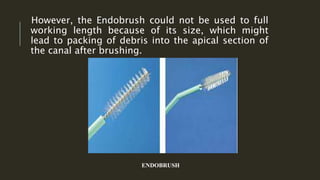
Keir et al in early 1990s, performed a study and used
Endobrush for improved canal debridement.
The Endobrush (C&S Microinstruments Ltd, Markham, Ontario,
Canada) is a spiral brush designed for endodontic use that
consists of nylon bristles set in twisted wires with an attached
handle and has a relatively constant diameter along the entire
length.
In that study the bristles of the brush were claimed to extend
to the non instrumented canal walls and into the fins, cul-de-
sacs, and isthmi of the canal system to remove trapped tissue
and debris.
However, the Endobrush could not be used to full
working length because of its size, which might
lead to packing of debris into the apical section of
the canal after brushing.
ENDOBRUSH
MANUAL DYNAMIC
IRRIGATIONAn irrigant must be in direct contact with the canal walls for
effective action.
However, it is often difficult for the irrigant to reach the apical
portion of the canal because of the so-called vapor lock effect.
Research has shown that gently moving a well fitting gutta-
percha master cone up and down in short 2-3 mm strokes
(manual dynamic irrigation) within an instrumented canal can
produce an effective hydrodynamic effect and improve the
displacement of any given reagent.
It has demonstrated that manual dynamic irrigation was
Although manual-dynamic irrigation is simple and cost-
effectiveness, the laborious nature of this hand-activated
procedure still hinders its application in routine clinical
practice.
Therefore, there are a number of automated devices
designed for agitation of root canal irrigants.
MACHINE ASSISTED
IRRIGATION
ROTARY BRUSHES
Ruddle used a micro brush attached to rotary handpiece.
The brush includes a shaft and a tapered brush section. The
latter has multiple bristles extending radially from a central
wire core.
This micro brush rotates at about 300 rpm, causing the
bristles to deform and go into the irregularities of the
preparation & displace residual debris out of the canal in a
coronal direction.
Commercially available endodontic microbrush is
Canalbrush (Coltene Whaledent, Langenau,
Germany).
This is highly flexible and is molded entirely from
polypropylene.
It might be used manually with a rotary action.
However, it is more efficacious when attached to a
contra-angle handpiece running at 600 rpm.
CONTINUOUS IRRIGATION
DURING ROTARY
INSTRUMENTATION:
QUANTEC - E
Continuous irrigant agitation during active
rotary instrumentation would generate:
1) Increased volume of irrigant.
2) Increase irrigant contact time.
3) Greater depth of irrigant penetration inside
the root canal.
The Quantec-E irrigation system (SybronEndo,
Orange, CA) is attached to the Quantec-E Endo
System.
It uses:
1. Pump console.
2. Two irrigation reservoirs.
3. Tubing to provide continuous irrigation during
rotary instrumentation.
Quantec-E irrigation did result in cleaner canal
walls and more complete debris and smear layer
removal in the coronal third of the canal walls.
However, these advantages were not observed in
the middle and apical thirds of the root canal.
SONIC IRRIGATION
FREQUENCY AND OSCILLATING PATTERN OF SONIC INSTRUMENTS
Tronstad et al were the first to report the use of a sonic instrument
for endodontics in 1985.
Sonic irrigation is different from ultrasonic irrigation in that
1) It operates at a lower frequency (1–6 kHz)
2) Produces smaller shear stresses .
3) Generates significantly higher amplitude or greater back-and-
forth tip movement.
Moreover, the oscillating patterns of the sonic devices are different
compared with ultrasonically driven instruments.
When the movement of the sonic file is constrained, the sideway
oscillation disappears. This results in a pure longitudinal file
oscillation.
This mode of vibration has been shown to be particularly efficient
for root canal debridement.
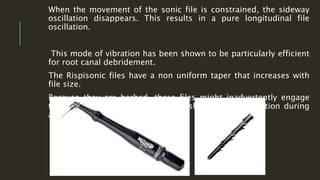
The Rispisonic files have a non uniform taper that increases with
file size.
Because they are barbed, these files might inadvertently engage
the canal wall and damage the finished canal preparation during
agitation.
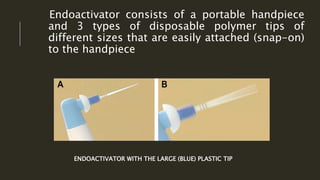
Endoactivator consists of a portable handpiece
and 3 types of disposable polymer tips of
different sizes that are easily attached (snap-on)
to the handpiece
ENDOACTIVATOR WITH THE LARGE (BLUE) PLASTIC TIP
These tips are claimed to be strong and flexible and do not
break easily.
Because they are smooth, they do not cut dentin.
It does not deliver new irrigant to the canal but it facilitates
the penetration of the irrigant in the canal.
A recent study have indicated that the use of endoactivator
facilitates irrigant penetration and mechanical cleansing
compared with needle irrigation, with no increase in the risk
of irrigant extrusion through the apex.
ULTRASONICS
Ultrasonic devices were first introduced in endodontics by
Richman.
Ultrasonic energy produces higher frequencies (25- 30 kHz)
than sonic energy but low amplitudes.
They operate in transverse vibration.
Two types of ultrasonic irrigation are available for use.
The first type is simultaneous ultrasonic instrumentation and
irrigation (UI), and the second type is referred to as passive
UI is shown to be less effective than PUI. This can be explained by a
reduction of acoustic streaming and cavitation.
In UI, the file contacts the root canal wall, so the oscillations are
dampened and becomes too weak to maintain acoustic streaming.
For proper acoustic streaming, the ultrasonic file should move freely in
the canal without making contact with the canal wall.
A canal size of at least 30-40 file is required to maintain free oscillation.
(Irrigant can also penetrate more easily into apical part).
Disadvantage of UI is difficult to control the cutting of dentin during
ultrasonic preparation which can result in apical perforation & irregular
canal shapes.
PUI was first described by Weller et al.
The term passive relates to non cutting action of
ultrasonically activated file.
The active streaming of the irrigant, increases its
potential to contact a greater surface area of the
canal wall.
After the canal has been shaped to MAF, a small file or a
smooth wire is introduced at the centre of the canal, as far
as the apical region.
Canal is then filled with irrigating solution, and
ultrasonically oscillating file activates the irrigant.
Using this non cutting methodology, the potential to create
aberrant shapes within root canals are reduced to a
minimum.
Ultrasonics is not able to effectively get through the apical
vapor lock in the apical 3 mm of the canal.
It has been shown that once a sonic or ultrasonically
activated tip leaves the irrigant and enters the apical vapor
lock, acoustic microstreaming and/or cavitation becomes
physically impossible which is not the case with the apical
negative pressure irrigation technique.
This is because acoustic microstreaming or cavitation is only
possible in fluids/liquids, not in gases.
Ultrasonics can help in debridement of anastomoses
CONTINUOUS ULTRASONIC
IRRIGATION
Chlorine, which is responsible for the dissolution of
organic tissues and the antibacterial property of
NaOCl, is unstable and is consumed rapidly during
the first phase of tissue dissolution, probably within 2
minutes.
Therefore, an improved delivery system that is
capable of continuous replenishment of root canal
irrigants is highly desirable.
Recently, a needle-holding adapter to an ultrasonic
During ultrasonic activation, a 25-gauge irrigation
needle is used instead of an endosonic file.
The unique feature of this needle-holding adapter is
that the needle is simultaneously activated by the
ultrasonic handpiece, & at the same time maintains a
continuous flow of fresh irrigant.
This technique resulted in:
1. Greater reduction in colony forming units.
2. Reduction in time required for irrigation.
INTERMITTENT FLUSH ULTRASONIC
IRRIGATION
In intermittent flushed ultrasonic irrigation, the irrigant is
delivered to the root canal by a syringe needle.
The irrigant is then activated with the use of an
ultrasonically oscillating instrument.
The root canal is then flushed with fresh irrigant to remove
the dissolved remnants from the canal walls.
PRESSURE ALTERNATING DEVICES
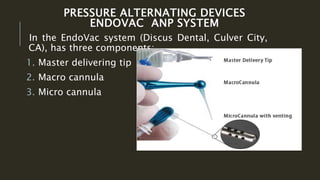
ENDOVAC ANP SYSTEM
In the EndoVac system (Discus Dental, Culver City,
CA), has three components:
1. Master delivering tip
2. Macro cannula
3. Micro cannula
Master delivering tip simultaneously delivers and evacuates the
irrigant from the pulp chamber.
The plastic macro cannula has a size 55 open end with a .02 taper
and is attached to a titanium handle.
It is used to suction irrigant from the chamber to the coronal and
middle segments of the canal.
The ISO size 0.32 stainless steel micro cannula has 4 sets of 3
laser-cut, laterally positioned, offset holes (total 12 holes) adjacent
to its closed end.
The holes are 100 microns in diameter and spaced 100 microns
apart.
This is attached to a finger-piece for irrigation of the apical
part of the canal by positioning it at the working length.
The micro cannula can be used in canals that are enlarged to
size 35/.04 or larger.
The Master Delivery Tip is connected to a syringe of irrigant.
The macro cannula or micro cannula is connected via tubing
to the high-speed suction of a dental unit.
During irrigation, the Master Delivery Tip tip delivers irrigant
to the pulp chamber and siphons off the excess irrigant to
The cannula in the canal simultaneously exerts negative
pressure that pulls irrigant from its fresh supply in the
chamber, down the canal to the tip of the cannula, into
the cannula, and out through the suction hose.
Thus, a constant flow of fresh irrigant is being delivered
by negative pressure to working length.
ADVANTAGE:
1. Avoid air entrapment.
2. Avoid undue extrusion.
3. Maintains a gentle flow rate.
Apical negative pressure has been shown to enable
irrigants to reach the apical third and help overcome the
issue of apical vapor lock.
In a comparing the Endoactivator, passive ultrasonic, the
F file, the manual dynamic max-i-probe, the pressure
ultrasonic, and the endovac, only the endovac was
capable of cleaning 100% of the isthmus area.
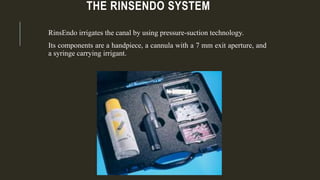
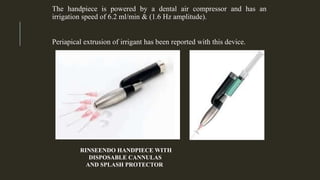
THE RINSENDO SYSTEM
RinsEndo irrigates the canal by using pressure-suction technology.
Its components are a handpiece, a cannula with a 7 mm exit aperture, and
a syringe carrying irrigant.
The handpiece is powered by a dental air compressor and has an
irrigation speed of 6.2 ml/min & (1.6 Hz amplitude).
Periapical extrusion of irrigant has been reported with this device.
RINSEENDO HANDPIECE WITH
DISPOSABLE CANNULAS
AND SPLASH PROTECTOR
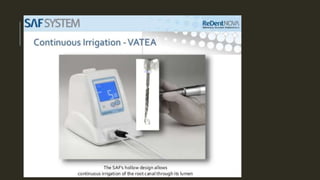
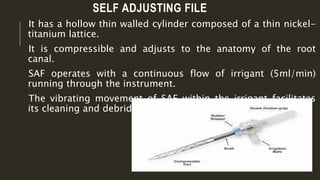
SELF ADJUSTING FILE
It has a hollow thin walled cylinder composed of a thin nickel-
titanium lattice.
It is compressible and adjusts to the anatomy of the root
canal.
SAF operates with a continuous flow of irrigant (5ml/min)
running through the instrument.
The vibrating movement of SAF within the irrigant facilitates
its cleaning and debriding effects.
Root canals vary greatly in their cross-sectional anatomy,
and oval, flat, and C-shaped canals are commonly found
SAF is designed to efficiently prepare root canals that do
not have a round cross section because the compressible
file adapts its shape to the canal anatomy.
It is operated with a modified KaVo handpiece that
generates in and out vibrations with 5000vibrations/min
and 0.4mm amplitude.
A VATEA irrigation unit is used to deliver a constant flow of
irrigant.
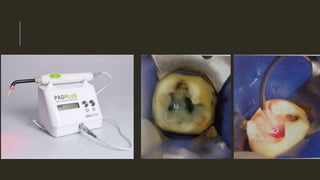
PHOTOACTIVATION DISINFECTION
Photoactivated disinfection is a new antimicrobial method for
root canal disinfection, based on photodynamic therapy
Photodynamic therapy is based on the idea that nontoxic
photosensitive agent, called photosensitizer, preferentially
localizes in target tissues. The photosensitizer is then activated
by light with susceptible wavelength and produces singlet
oxygen and free radicals, which are cytotoxic for the target cells
Phenothiazine dyes – Methylene blue (MB) and Toluidine blue
(TBO) are the most commonly used photosensitizers in dental
practices.
The use of red light producing diode laser is used for activation
of the photosensitizer.
CONCLUSION
Various irrigation devices have been developed to
give the effective cleaning and superior debris
removal in order to replace the older needle
irrigation method.
The safety factors, capacity of high volume
irrigant delivery and ease of application the newer
irrigation devices may change the insight of
conventional endodontic treatment.
Recent advances in irrigation systems

Recent advances in irrigation systems

  • 1.
  • 2.
    INTRODUCTION Endodontic treatment consistsof three basic phases namely diagnostic phase, preparatory phase and obturation phase. The preparatory phase which is chemomechanical debridement is most essential for endodontic success. The purpose of this phase is to eliminate pulpal tissue, microbiota, their by-products, organic and inorganic debris by using instruments and intracanal irrigants.
  • 3.
    It is impossibleto shape and clean the root canal completely because of the intricate nature of the canal configuration. Even with the use of rotary instrumentation, the nickel titanium instruments currently available only act on the central body of the canal, leaving canal fins, isthmi and cul-de-sacs untouched after completion of the preparation. Therefore irrigation is an essential part of root canal
  • 4.
    For the effectivenessof the irrigation, the endodontic irrigants must be brought into direct contact with the entire canal wall surfaces, particularly for the apical portions of small root canals. Throughout the history of the endodontics, various methods have been developed in order to provide effective endodontic irrigant delivery. These systems might be devided into 2 broad catergories:
  • 5.
    IRRIGATION AGITATION TECHNIQUES ANDDEVICES Manual- Syringe irrigation with needles/cannulas - End-venting; side-venting Brushes -Endobrush; NaviTip FX Manual-dynamic agitation - Hand-activated well-filling gutta-percha
  • 6.
    Machine-assisted Rotary brushes- Ruddlebrush; CanalBrush Continuous irrigation during rotary instrumentation Quantec-E Sonic- Rispisonic file; EndoActivator Ultrasonic -Continuous :Nusstien’s needle holding device -Intermittent: Ultrasonic file; smooth wire Pressure alternation devices -EndoVac; RinsEndo Self-adjusting file
  • 7.
    SYRINGE IRRIGATION WITH NEEDLESConventionalirrigation with syringes has been widely practiced by both general practitioner and endodontists. The technique involves dispensing of irrigant into a canal through needles either passively or with agitation. These needles are designed to dispense an irrigant through their most distal ends or closed-ended side-vented channels. It is crucial that the needle should remain loose in the canal during irrigation so that it allows debris to be displaced coronally and avoid inadvertent extrusion of the irrigant
  • 8.
    The syringe irrigationgives advantage of easy control of the depth of the needle penetration within the canal. DISADVANTAGES- Weak mechanical flushing action. The irrigating solution delivered only 1mm deeper than the tip of the needle. Smear layer removal in the apical third not effective. Periapical extrusion of irrigant.
  • 9.
    BRUSHES They are usedas adjuncts for debridement of the canal walls or agitation of root canal irrigant. A 30-gauge irrigation needle covered with a brush (NaviTip FX; Ultradent Products Inc, South Jordan, UT) was introduced commercially. A study reported improved cleanliness of the coronal third of instrumented root canal walls irrigated and agitated with the NaviTip FX needle over the brushless type of NaviTip needle.
  • 10.
    The results mighthave been improved if the brush-covered needle was mechanically activated so that it can perform active scrubbing action against. But, friction created between the brush bristles and the canal irregularities might result in the dislodgement of the radiolucent bristles in the canals that are not easily recognized by clinicians, even with the use of a surgical microscope.
  • 11.
    Keir et alin early 1990s, performed a study and used Endobrush for improved canal debridement. The Endobrush (C&S Microinstruments Ltd, Markham, Ontario, Canada) is a spiral brush designed for endodontic use that consists of nylon bristles set in twisted wires with an attached handle and has a relatively constant diameter along the entire length. In that study the bristles of the brush were claimed to extend to the non instrumented canal walls and into the fins, cul-de- sacs, and isthmi of the canal system to remove trapped tissue and debris.
  • 12.
    However, the Endobrushcould not be used to full working length because of its size, which might lead to packing of debris into the apical section of the canal after brushing. ENDOBRUSH
  • 13.
    MANUAL DYNAMIC IRRIGATIONAn irrigantmust be in direct contact with the canal walls for effective action. However, it is often difficult for the irrigant to reach the apical portion of the canal because of the so-called vapor lock effect. Research has shown that gently moving a well fitting gutta- percha master cone up and down in short 2-3 mm strokes (manual dynamic irrigation) within an instrumented canal can produce an effective hydrodynamic effect and improve the displacement of any given reagent. It has demonstrated that manual dynamic irrigation was
  • 14.
    Although manual-dynamic irrigationis simple and cost- effectiveness, the laborious nature of this hand-activated procedure still hinders its application in routine clinical practice. Therefore, there are a number of automated devices designed for agitation of root canal irrigants.
  • 15.
    MACHINE ASSISTED IRRIGATION ROTARY BRUSHES Ruddleused a micro brush attached to rotary handpiece. The brush includes a shaft and a tapered brush section. The latter has multiple bristles extending radially from a central wire core. This micro brush rotates at about 300 rpm, causing the bristles to deform and go into the irregularities of the preparation & displace residual debris out of the canal in a coronal direction.
  • 16.
    Commercially available endodonticmicrobrush is Canalbrush (Coltene Whaledent, Langenau, Germany). This is highly flexible and is molded entirely from polypropylene. It might be used manually with a rotary action. However, it is more efficacious when attached to a contra-angle handpiece running at 600 rpm.
  • 17.
    CONTINUOUS IRRIGATION DURING ROTARY INSTRUMENTATION: QUANTEC- E Continuous irrigant agitation during active rotary instrumentation would generate: 1) Increased volume of irrigant. 2) Increase irrigant contact time. 3) Greater depth of irrigant penetration inside the root canal. The Quantec-E irrigation system (SybronEndo, Orange, CA) is attached to the Quantec-E Endo System.
  • 18.
    It uses: 1. Pumpconsole. 2. Two irrigation reservoirs. 3. Tubing to provide continuous irrigation during rotary instrumentation. Quantec-E irrigation did result in cleaner canal walls and more complete debris and smear layer removal in the coronal third of the canal walls. However, these advantages were not observed in the middle and apical thirds of the root canal.
  • 19.
    SONIC IRRIGATION FREQUENCY ANDOSCILLATING PATTERN OF SONIC INSTRUMENTS Tronstad et al were the first to report the use of a sonic instrument for endodontics in 1985. Sonic irrigation is different from ultrasonic irrigation in that 1) It operates at a lower frequency (1–6 kHz) 2) Produces smaller shear stresses . 3) Generates significantly higher amplitude or greater back-and- forth tip movement. Moreover, the oscillating patterns of the sonic devices are different compared with ultrasonically driven instruments.
  • 20.
    When the movementof the sonic file is constrained, the sideway oscillation disappears. This results in a pure longitudinal file oscillation. This mode of vibration has been shown to be particularly efficient for root canal debridement. The Rispisonic files have a non uniform taper that increases with file size. Because they are barbed, these files might inadvertently engage the canal wall and damage the finished canal preparation during agitation.
  • 21.
    Endoactivator consists ofa portable handpiece and 3 types of disposable polymer tips of different sizes that are easily attached (snap-on) to the handpiece ENDOACTIVATOR WITH THE LARGE (BLUE) PLASTIC TIP
  • 22.
    These tips areclaimed to be strong and flexible and do not break easily. Because they are smooth, they do not cut dentin. It does not deliver new irrigant to the canal but it facilitates the penetration of the irrigant in the canal. A recent study have indicated that the use of endoactivator facilitates irrigant penetration and mechanical cleansing compared with needle irrigation, with no increase in the risk of irrigant extrusion through the apex.
  • 23.
    ULTRASONICS Ultrasonic devices werefirst introduced in endodontics by Richman. Ultrasonic energy produces higher frequencies (25- 30 kHz) than sonic energy but low amplitudes. They operate in transverse vibration. Two types of ultrasonic irrigation are available for use. The first type is simultaneous ultrasonic instrumentation and irrigation (UI), and the second type is referred to as passive
  • 24.
    UI is shownto be less effective than PUI. This can be explained by a reduction of acoustic streaming and cavitation. In UI, the file contacts the root canal wall, so the oscillations are dampened and becomes too weak to maintain acoustic streaming. For proper acoustic streaming, the ultrasonic file should move freely in the canal without making contact with the canal wall. A canal size of at least 30-40 file is required to maintain free oscillation. (Irrigant can also penetrate more easily into apical part). Disadvantage of UI is difficult to control the cutting of dentin during ultrasonic preparation which can result in apical perforation & irregular canal shapes.
  • 25.
    PUI was firstdescribed by Weller et al. The term passive relates to non cutting action of ultrasonically activated file. The active streaming of the irrigant, increases its potential to contact a greater surface area of the canal wall.
  • 26.
    After the canalhas been shaped to MAF, a small file or a smooth wire is introduced at the centre of the canal, as far as the apical region. Canal is then filled with irrigating solution, and ultrasonically oscillating file activates the irrigant. Using this non cutting methodology, the potential to create aberrant shapes within root canals are reduced to a minimum.
  • 27.
    Ultrasonics is notable to effectively get through the apical vapor lock in the apical 3 mm of the canal. It has been shown that once a sonic or ultrasonically activated tip leaves the irrigant and enters the apical vapor lock, acoustic microstreaming and/or cavitation becomes physically impossible which is not the case with the apical negative pressure irrigation technique. This is because acoustic microstreaming or cavitation is only possible in fluids/liquids, not in gases. Ultrasonics can help in debridement of anastomoses
  • 28.
    CONTINUOUS ULTRASONIC IRRIGATION Chlorine, whichis responsible for the dissolution of organic tissues and the antibacterial property of NaOCl, is unstable and is consumed rapidly during the first phase of tissue dissolution, probably within 2 minutes. Therefore, an improved delivery system that is capable of continuous replenishment of root canal irrigants is highly desirable. Recently, a needle-holding adapter to an ultrasonic
  • 29.
    During ultrasonic activation,a 25-gauge irrigation needle is used instead of an endosonic file. The unique feature of this needle-holding adapter is that the needle is simultaneously activated by the ultrasonic handpiece, & at the same time maintains a continuous flow of fresh irrigant. This technique resulted in: 1. Greater reduction in colony forming units. 2. Reduction in time required for irrigation.
  • 30.
    INTERMITTENT FLUSH ULTRASONIC IRRIGATION Inintermittent flushed ultrasonic irrigation, the irrigant is delivered to the root canal by a syringe needle. The irrigant is then activated with the use of an ultrasonically oscillating instrument. The root canal is then flushed with fresh irrigant to remove the dissolved remnants from the canal walls.
  • 31.
    PRESSURE ALTERNATING DEVICES ENDOVACANP SYSTEM In the EndoVac system (Discus Dental, Culver City, CA), has three components: 1. Master delivering tip 2. Macro cannula 3. Micro cannula
  • 32.
    Master delivering tipsimultaneously delivers and evacuates the irrigant from the pulp chamber. The plastic macro cannula has a size 55 open end with a .02 taper and is attached to a titanium handle. It is used to suction irrigant from the chamber to the coronal and middle segments of the canal. The ISO size 0.32 stainless steel micro cannula has 4 sets of 3 laser-cut, laterally positioned, offset holes (total 12 holes) adjacent to its closed end. The holes are 100 microns in diameter and spaced 100 microns apart.
  • 33.
    This is attachedto a finger-piece for irrigation of the apical part of the canal by positioning it at the working length. The micro cannula can be used in canals that are enlarged to size 35/.04 or larger. The Master Delivery Tip is connected to a syringe of irrigant. The macro cannula or micro cannula is connected via tubing to the high-speed suction of a dental unit. During irrigation, the Master Delivery Tip tip delivers irrigant to the pulp chamber and siphons off the excess irrigant to
  • 34.
    The cannula inthe canal simultaneously exerts negative pressure that pulls irrigant from its fresh supply in the chamber, down the canal to the tip of the cannula, into the cannula, and out through the suction hose. Thus, a constant flow of fresh irrigant is being delivered by negative pressure to working length. ADVANTAGE: 1. Avoid air entrapment. 2. Avoid undue extrusion. 3. Maintains a gentle flow rate.
  • 35.
    Apical negative pressurehas been shown to enable irrigants to reach the apical third and help overcome the issue of apical vapor lock. In a comparing the Endoactivator, passive ultrasonic, the F file, the manual dynamic max-i-probe, the pressure ultrasonic, and the endovac, only the endovac was capable of cleaning 100% of the isthmus area.
  • 36.
    THE RINSENDO SYSTEM RinsEndoirrigates the canal by using pressure-suction technology. Its components are a handpiece, a cannula with a 7 mm exit aperture, and a syringe carrying irrigant.
  • 37.
    The handpiece ispowered by a dental air compressor and has an irrigation speed of 6.2 ml/min & (1.6 Hz amplitude). Periapical extrusion of irrigant has been reported with this device. RINSEENDO HANDPIECE WITH DISPOSABLE CANNULAS AND SPLASH PROTECTOR
  • 38.
    SELF ADJUSTING FILE Ithas a hollow thin walled cylinder composed of a thin nickel- titanium lattice. It is compressible and adjusts to the anatomy of the root canal. SAF operates with a continuous flow of irrigant (5ml/min) running through the instrument. The vibrating movement of SAF within the irrigant facilitates its cleaning and debriding effects.
  • 39.
    Root canals varygreatly in their cross-sectional anatomy, and oval, flat, and C-shaped canals are commonly found SAF is designed to efficiently prepare root canals that do not have a round cross section because the compressible file adapts its shape to the canal anatomy. It is operated with a modified KaVo handpiece that generates in and out vibrations with 5000vibrations/min and 0.4mm amplitude. A VATEA irrigation unit is used to deliver a constant flow of irrigant.
  • 41.
    PHOTOACTIVATION DISINFECTION Photoactivated disinfectionis a new antimicrobial method for root canal disinfection, based on photodynamic therapy Photodynamic therapy is based on the idea that nontoxic photosensitive agent, called photosensitizer, preferentially localizes in target tissues. The photosensitizer is then activated by light with susceptible wavelength and produces singlet oxygen and free radicals, which are cytotoxic for the target cells Phenothiazine dyes – Methylene blue (MB) and Toluidine blue (TBO) are the most commonly used photosensitizers in dental practices. The use of red light producing diode laser is used for activation of the photosensitizer.
  • 43.
    CONCLUSION Various irrigation deviceshave been developed to give the effective cleaning and superior debris removal in order to replace the older needle irrigation method. The safety factors, capacity of high volume irrigant delivery and ease of application the newer irrigation devices may change the insight of conventional endodontic treatment.