DEFINITION
PERIODONTITIS refersto an inflammation of the gingival tissues in
association with some loss of both the attachment of periodontal ligament
and bony support
APICAL PERIODONTITIS is the inflammation of the periodontal ligament
around the root apex
It characteristically causes tenderness of the tooth in its socket
Apical periodontitis can be Acute and Chronic
3.
ETIOLOGY
Infection
Trauma
Chemical irritation
When a tooth experiences trauma, like a
strong blow, it can damage the blood
vessels at the root apex, causing the pulp
(the nerve tissue inside the tooth) to die;
this necrotic pulp then becomes
susceptible to bacterial infection from the
gums, leading to inflammation and
infection in the surrounding bone tissue, a
condition known as apical periodontitis.
4.
ACUTE APICAL PERIODONTITIS
Clinical features
Pain due to previous pulpitis
Due to the collection of imflammatory oedema in the periodontal
ligament, the tooth is slightly elevated in its socket
A large carious cavity or filling in the affected tooth, or it may be
discoloured due to death of the pulp earlier
Gingiva over the root is red and tender
There is no swelling while inflammation is confined within the bone
Pain of apical periodontitis is accurately localised
5.
Radiographic features
Radiographic appearanceis
essentially normal at this stage
Immediately round the apex, the lamina
dura may appear slightly hazy
The periodontal space may be slightly
widened
CHRONIC APICAL PERIODONTITIS
Clinical features
Chronic periodontitis is a low grade infection
Present over long time of period
It may follow an acute infection that has been inadequately drained and
ncompletely resolved
The tooth is non-vital and may be slightly tender to percussion
Symptoms may be minimal
Chronic periodontitis is first recognised as a round area of radiolucency at
the apex of a tooth (‘apical granuloma’)in a routine radiograph
8.
COMPLICATIONS
Periapical granuloma:Aperiapical granuloma, also known as a radicular or
apical granuloma, is a chronic inflammatory mass of bacteria and granulation
tissue that develops at the tip of a tooth’s root. It’s a common growth that forms
in response to dead tissue in the tooth’s pulp chamber. Periapical granulomas
can be a diagnostic marker for chronic apical periodontitis. If left untreated,
they can cause fistulas and more pain.
Radicitar cyst:A periapical cyst, also known as a dental or radicular cyst, is a
fluid-filled sac that forms at the tip of a nonviable tooth’s root. It’s the most
common odontogenic cyst and is caused by dental pulp necrosis, which
reduces blood, oxygen, and nutrient supply to the soft tissue beneath the
tooth’s hardest layer. Symptoms include pain, tenderness, swelling, and
drainage. If left untreated, chronic inflammation from the cyst can lead to bone
loss around the tooth.
9.
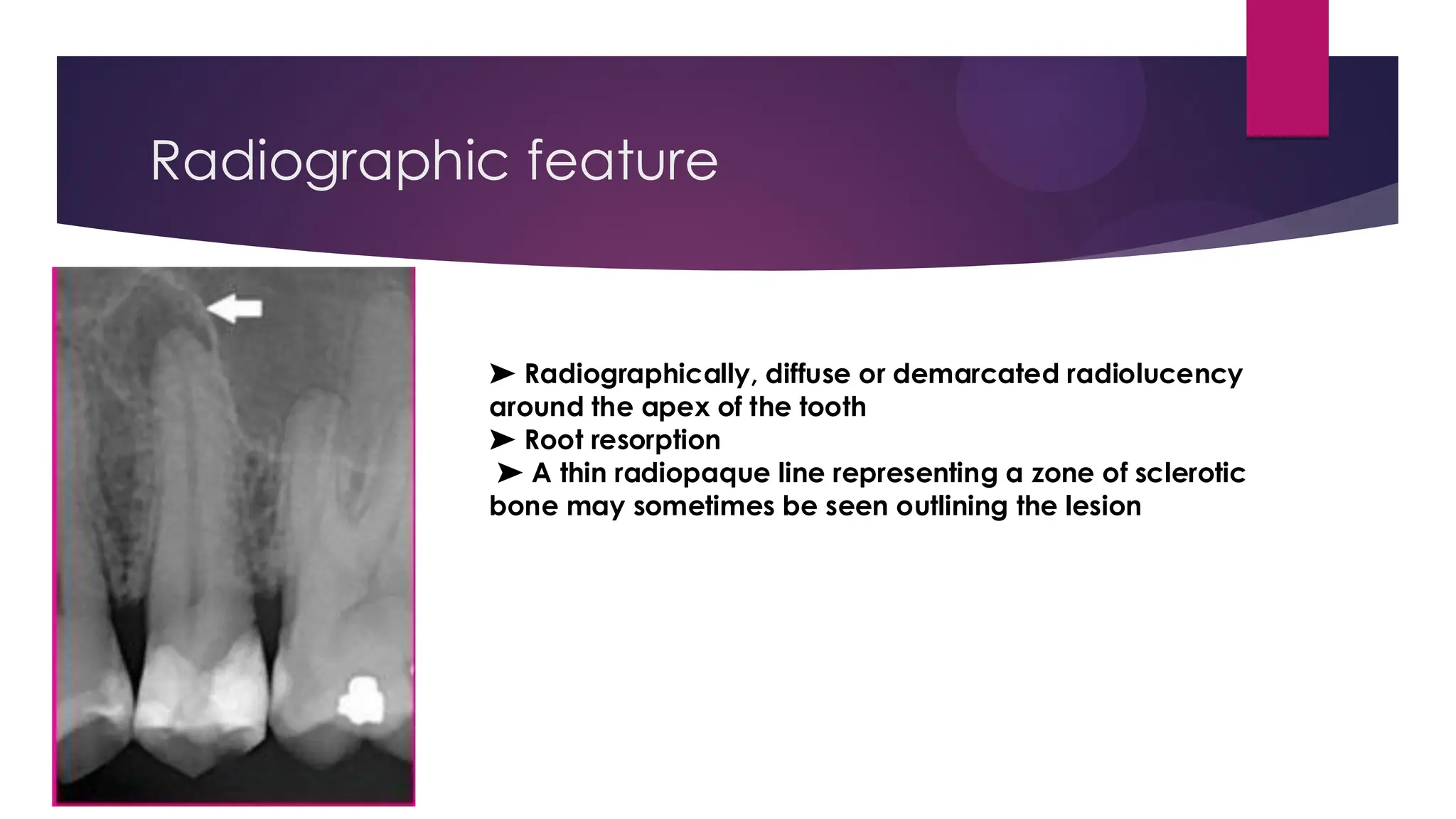
Radiographic feature
➤ Radiographically,diffuse or demarcated radiolucency
around the apex of the tooth
➤ Root resorption
➤ A thin radiopaque line representing a zone of sclerotic
bone may sometimes be seen outlining the lesion
10.
• RCT isthe first-line treatment.
• Surgical options are considered if RCT fails.
• Extraction is done only if the tooth cannot be saved.
Treatments
11.
ACUTE APICAL PERIODONTITIS
Acute onset
Spontaneous intense and throbbing pain
Tender on percussion
Pus formation
Previous history of pulpitis
Thermal changes do not induce pain
Tooth is elevated from the socket
12.
1. Gradual onsetwith mild or no symptoms.
2. Mild pain or discomfort on biting or chewing (may be asymptomatic).
3. Slight tenderness to percussion (may not always be present).
4. Tooth is non-vital (no response to vitality tests).
5. May have a sinus tract with intermittent pus discharge (if chronic abscess
develops).
6. Radiographic features: Well-defined periapical radiolucency.
7. Sequelae of pulpitis or acute apical periodontitis.
8. Can progress to:Periapical granuloma (chronic inflammatory response).Periapical
cyst (if epithelial proliferation occurs).Chronic periapical abscess (if pus
accumulation persists).
8 Points for chronic apical
periodontitis








![Presentation1 [Autosaved].pdf diagnosiss](https://cdn.slidesharecdn.com/ss_thumbnails/presentation1autosaved-250812162634-6365894a-thumbnail.jpg?width=640&height=640&fit=bounds)


