PERIAPICALABSCESS
BY – Dr NISHANT SINGH
DEPARTMENT OF PEDODONTICS AND
PREVENTIVE DENTISTRY
INDEX
• Introduction to pulp and periapical region
• Etiology to Periradicular Tissue Lesion
• Classification of periradicular tissue lesion
• Acute Periapical Abscess
• Phoenix Abscess
• Chronic Periapical Abscess
INTRODUCTION TO PULP AND
PERIAPICAL REGION
• Dental pulp is soft tissue of mesenchymal origin located in
centre of the tooth. It consist of specialised cells, Odontoblast
arranged peripherally in direct contact with dentin matrix. This
close relation between pulp and dentin is known as Pulp-
Dentin complex.
• Dental pulp consist of vascular connective tissue confined
within hard dentin wall. It is the principal source of pain in oral
cavity and also a major site of attention in endodontics and
restorative procedures
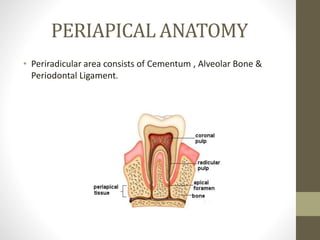
PERIAPICAL ANATOMY
• Periradicular area consists of Cementum , Alveolar Bone &
Periodontal Ligament.
ETIOLOGY OF PERIRADICULAR
DISEASES
• Various Etiological Factors for Pulp and Periapical lesions can
be:
A) Bacterial : Most common cause of pulpal injury is bacteria or
their by products which may enter the pulp through a break in
dentin.
-Caries
-Accidental Exposure
- Percolation around a restoration
- Extension of infection from gingival sulcus
- Periodontal Pocket and abscess
- Anachoresis
ETIOLOGY OF PERIRADICULAR
DISEASE
B) Traumatic
- Acute trauma like fracture, luxation, or avulsion of teeth.
- Chronic trauma like parafunctional habits like bruxism
C) Iatrogenic
- Thermal changes during tooth prepration
- Orthodontic movement
- Periodontal Curettage
- Periapical Curettage
- Chemicals like Temporary and Permanent restorations.
D) Idiopathic
- Aging
- Resorption ; internal or external
CLASSIFICATION OF
PERIRADICULAR PATHOLOGIES
• Symptomatic Periradicular Diseases :
• Symptomatic apical periodontitis previously known as acute apical
periodontitis (AAP):
i. Vital
ii. Non vital
• Acute Alveolar Abscess
• Phoenix Abscess
• Asymptomatic Periradicular Diseases:
• Asymptomatic apical Periodontitis
• Radicular cyst
• Condensing osteitis
• Chronic alveolar abscess
• External Root Resorption
• Persistent Apical Periodontitis
Acute Apical Abscess
• Synonyms : Acute abscess, Acute Dentoalveolar abscess,
Acute Periapical Abscess, Acute Radicular Abscess.
• It is an inflammatory reaction to pulp infection and necrosis
characterized by rapid onset , pus formation , spontaneous
pain , tenderness on percusion , and eventually swelling of
associated tissues.
ETIOLOGY
• Most common cause is invasion of bacteria from necrotic pulp
tissue
• Trauma , Chemical , or any mechanical injury resulting in pulp
necrosis
• Irritation of periapical tissue by chemical or mechanical
treatment during root canal treatment
CLINICAL PRESENTATION
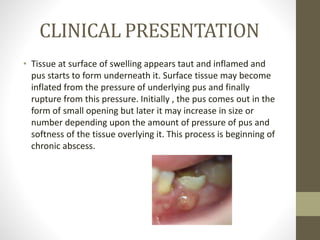
• Tissue at surface of swelling appears taut and inflamed and
pus starts to form underneath it. Surface tissue may become
inflated from the pressure of underlying pus and finally
rupture from this pressure. Initially , the pus comes out in the
form of small opening but later it may increase in size or
number depending upon the amount of pressure of pus and
softness of the tissue overlying it. This process is beginning of
chronic abscess.
PATHOPHYSIOLOGY OF APICAL
ABSCESS FORMATION
• Increase in pulpal pressure
|
• Collapse of venous circulation
|
• Hypoxia and anoxia of local tissue
|
• Localized destruction of pulp tissue
|
• Formation of pupal abscess because of breakdown of PMNs ,
bacteria and lysis of pulp remnants s
SYMPTOMS
• In early stage, there is tenderness of tooth which is relived by
continued slight pressure on extruded tooth to push it back
into alveolus
• Later on, throbbing pain develops with diffuse swelling of
overlying tissue
• Tooth becomes more painful, elongated , and mobile as
infection increases in later stages
• Patient may have systemic symptoms like fever and increased
WBC count
• Spread of lesion toward a surface may take place causing
erosion of cortical bone or it may diffuse and spread widely
leading to formation of cellulitis
HISTOPATHOLOGY
• Polymorphonuclear leukocytes infiltrate and inflammatory response
|
• Accumulation of inflammatory exudates in response to active infection
|
• Distention of Periodontal Ligament
|
• Extrusion of tooth
|
• If the process continues , separation of periodontal ligament
|
• Tooth becomes mobile
|
• Bone resorption at apex
|
• Localized lesion of liquefaction necrosis containing polymorphonuclear
leukocytes , debris , cell remnants , and purulent exudates
DIAGNOSIS
• Clinical examination
• In initial stages , locating a tooth is difficult due to diffuse pain.
Location of the offending tooth becomes easier when tooth
gets slightly extruded from socket
• Negative response to pulp vitality test
• Tenderness on percussion and palpation
• Tooth may be slightly mobile and extruded from its socket
• Radiograph helpful in determining the affected tooth as it may
show caries or evidence of bone destruction at root apex
TREATMENT
• Drainage of abscess should be initiated as early as possible.
This may include
a) Nonsurgical endodontic treatment
b) Incision and drainage
c) Extraction
• In case of localized infections , systemic antibiotics provide no
additional benefit over drainage of abscess
• In case of systemic complication such as fever ,
lymphadenopathy , cellulitis , or patients who are
immunocompromised , antibiotics should be given in addition
to drainage of tooth
• Relive the tooth out of occlusion in hyper occlusion cases
• To control postoperative pain following endodontic therapy ,
non steroidal anti-inflammatory drugs should be given
PHOENIX ABSCESS
• Phoenix abscess is defined as an acute inflammatory reaction
superimposed on an existing asymptomatic apical
periodontitis
ETIOLOGY
• Chronic periradicular lesions such as granulomas are in a state
of equilibrium during which they can be completely
asymptomatic. But sometimes influx of necrotic products from
diseased pulp or bacteria and there toxins can cause the
dormant lesion to react. This leads to initiation of acute
inflammatory response. Lowered body defense also trigger an
inflammatory response.
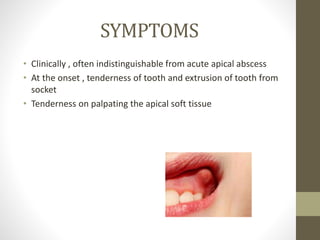
SYMPTOMS
• Clinically , often indistinguishable from acute apical abscess
• At the onset , tenderness of tooth and extrusion of tooth from
socket
• Tenderness on palpating the apical soft tissue
DIAGNOSIS
• Most commonly associated with initiation of root canal
treatment
• History from patient
• Pulp test shows negative response
• Radiographs show large area of radiolucency in the apex
created by inflammatory connective tissue which has replaced
bone at the root apex
• Phoenix abscess should be differentiated from acute alveolar
abscess by patient’s history , symptoms , and clinical test
results
TREATMENT
• Establishment of drainage
• Once symptoms subside – complete root canal treatment
CHRONIC ALVEOLAR
ABSCESS
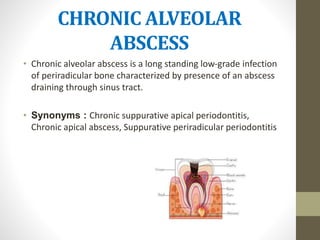
• Chronic alveolar abscess is a long standing low-grade infection
of periradicular bone characterized by presence of an abscess
draining through sinus tract.
• Synonyms : Chronic suppurative apical periodontitis,
Chronic apical abscess, Suppurative periradicular periodontitis
ETIOLOGY
• Most common cause is invasion of bacteria from necrotic pulp
tissue
• Trauma, Chemical, or any mechanical injury resulting in pulp
necrosis
• Irritation of periradicular tissue chemical or mechanical
treatment during root canal treatment
SYMPTOMS
• Generally asymptomatic
• Detected either by presence of sinus tract or on routine
radiograph
• In case of open carious activity, drainage through root canal
sinus tract prevents swelling or exacerbration of lesion
DIAGNOSIS
• Chronic apical abscess is associated with asymptomatic or
partially symptomatic tooth
• Patient may give history of sudden sharp pain which subsided
and has recurred
• Clinical examination may show a large carious exposure,
discoloration of crown, or restoration
• Vitality test shows negative response because of presence of
necrotic pulp
• Site of origin is diagnosed by radiograph after insertion of
gutta-percha in sinus tract
• Radiographic examination shows diffuse area of refraction.
The rarefied area is so diffuse that fades into indistinctly into
normal bone
TREATMENT
• Removal of irritants from root canal and establishing drainage
is the main objective of the treatment. Sinus tract resolves
following endodontic treatment.
Draining sinus is active with pus discharge surrounded by
reddish pink color mucosa. It can be detected by inserting gutta-
percha. Healed sinus shows absence of pus discharge and normal
colored mucosa.
Periapical Abscess.pptx

Periapical Abscess.pptx

  • 1.
    PERIAPICALABSCESS BY – DrNISHANT SINGH DEPARTMENT OF PEDODONTICS AND PREVENTIVE DENTISTRY
  • 2.
    INDEX • Introduction topulp and periapical region • Etiology to Periradicular Tissue Lesion • Classification of periradicular tissue lesion • Acute Periapical Abscess • Phoenix Abscess • Chronic Periapical Abscess
  • 3.
    INTRODUCTION TO PULPAND PERIAPICAL REGION • Dental pulp is soft tissue of mesenchymal origin located in centre of the tooth. It consist of specialised cells, Odontoblast arranged peripherally in direct contact with dentin matrix. This close relation between pulp and dentin is known as Pulp- Dentin complex. • Dental pulp consist of vascular connective tissue confined within hard dentin wall. It is the principal source of pain in oral cavity and also a major site of attention in endodontics and restorative procedures
  • 4.
    PERIAPICAL ANATOMY • Periradiculararea consists of Cementum , Alveolar Bone & Periodontal Ligament.
  • 5.
    ETIOLOGY OF PERIRADICULAR DISEASES •Various Etiological Factors for Pulp and Periapical lesions can be: A) Bacterial : Most common cause of pulpal injury is bacteria or their by products which may enter the pulp through a break in dentin. -Caries -Accidental Exposure - Percolation around a restoration - Extension of infection from gingival sulcus - Periodontal Pocket and abscess - Anachoresis
  • 6.
    ETIOLOGY OF PERIRADICULAR DISEASE B)Traumatic - Acute trauma like fracture, luxation, or avulsion of teeth. - Chronic trauma like parafunctional habits like bruxism C) Iatrogenic - Thermal changes during tooth prepration - Orthodontic movement - Periodontal Curettage - Periapical Curettage - Chemicals like Temporary and Permanent restorations. D) Idiopathic - Aging - Resorption ; internal or external
  • 7.
    CLASSIFICATION OF PERIRADICULAR PATHOLOGIES •Symptomatic Periradicular Diseases : • Symptomatic apical periodontitis previously known as acute apical periodontitis (AAP): i. Vital ii. Non vital • Acute Alveolar Abscess • Phoenix Abscess • Asymptomatic Periradicular Diseases: • Asymptomatic apical Periodontitis • Radicular cyst • Condensing osteitis • Chronic alveolar abscess • External Root Resorption • Persistent Apical Periodontitis
  • 8.
    Acute Apical Abscess •Synonyms : Acute abscess, Acute Dentoalveolar abscess, Acute Periapical Abscess, Acute Radicular Abscess. • It is an inflammatory reaction to pulp infection and necrosis characterized by rapid onset , pus formation , spontaneous pain , tenderness on percusion , and eventually swelling of associated tissues.
  • 9.
    ETIOLOGY • Most commoncause is invasion of bacteria from necrotic pulp tissue • Trauma , Chemical , or any mechanical injury resulting in pulp necrosis • Irritation of periapical tissue by chemical or mechanical treatment during root canal treatment
  • 10.
    CLINICAL PRESENTATION • Tissueat surface of swelling appears taut and inflamed and pus starts to form underneath it. Surface tissue may become inflated from the pressure of underlying pus and finally rupture from this pressure. Initially , the pus comes out in the form of small opening but later it may increase in size or number depending upon the amount of pressure of pus and softness of the tissue overlying it. This process is beginning of chronic abscess.
  • 11.
    PATHOPHYSIOLOGY OF APICAL ABSCESSFORMATION • Increase in pulpal pressure | • Collapse of venous circulation | • Hypoxia and anoxia of local tissue | • Localized destruction of pulp tissue | • Formation of pupal abscess because of breakdown of PMNs , bacteria and lysis of pulp remnants s
  • 12.
    SYMPTOMS • In earlystage, there is tenderness of tooth which is relived by continued slight pressure on extruded tooth to push it back into alveolus • Later on, throbbing pain develops with diffuse swelling of overlying tissue • Tooth becomes more painful, elongated , and mobile as infection increases in later stages • Patient may have systemic symptoms like fever and increased WBC count • Spread of lesion toward a surface may take place causing erosion of cortical bone or it may diffuse and spread widely leading to formation of cellulitis
  • 13.
    HISTOPATHOLOGY • Polymorphonuclear leukocytesinfiltrate and inflammatory response | • Accumulation of inflammatory exudates in response to active infection | • Distention of Periodontal Ligament | • Extrusion of tooth | • If the process continues , separation of periodontal ligament | • Tooth becomes mobile | • Bone resorption at apex | • Localized lesion of liquefaction necrosis containing polymorphonuclear leukocytes , debris , cell remnants , and purulent exudates
  • 14.
    DIAGNOSIS • Clinical examination •In initial stages , locating a tooth is difficult due to diffuse pain. Location of the offending tooth becomes easier when tooth gets slightly extruded from socket • Negative response to pulp vitality test • Tenderness on percussion and palpation • Tooth may be slightly mobile and extruded from its socket • Radiograph helpful in determining the affected tooth as it may show caries or evidence of bone destruction at root apex
  • 15.
    TREATMENT • Drainage ofabscess should be initiated as early as possible. This may include a) Nonsurgical endodontic treatment b) Incision and drainage c) Extraction • In case of localized infections , systemic antibiotics provide no additional benefit over drainage of abscess • In case of systemic complication such as fever , lymphadenopathy , cellulitis , or patients who are immunocompromised , antibiotics should be given in addition to drainage of tooth • Relive the tooth out of occlusion in hyper occlusion cases • To control postoperative pain following endodontic therapy , non steroidal anti-inflammatory drugs should be given
  • 16.
    PHOENIX ABSCESS • Phoenixabscess is defined as an acute inflammatory reaction superimposed on an existing asymptomatic apical periodontitis
  • 17.
    ETIOLOGY • Chronic periradicularlesions such as granulomas are in a state of equilibrium during which they can be completely asymptomatic. But sometimes influx of necrotic products from diseased pulp or bacteria and there toxins can cause the dormant lesion to react. This leads to initiation of acute inflammatory response. Lowered body defense also trigger an inflammatory response.
  • 18.
    SYMPTOMS • Clinically ,often indistinguishable from acute apical abscess • At the onset , tenderness of tooth and extrusion of tooth from socket • Tenderness on palpating the apical soft tissue
  • 19.
    DIAGNOSIS • Most commonlyassociated with initiation of root canal treatment • History from patient • Pulp test shows negative response • Radiographs show large area of radiolucency in the apex created by inflammatory connective tissue which has replaced bone at the root apex • Phoenix abscess should be differentiated from acute alveolar abscess by patient’s history , symptoms , and clinical test results
  • 20.
    TREATMENT • Establishment ofdrainage • Once symptoms subside – complete root canal treatment
  • 21.
    CHRONIC ALVEOLAR ABSCESS • Chronicalveolar abscess is a long standing low-grade infection of periradicular bone characterized by presence of an abscess draining through sinus tract. • Synonyms : Chronic suppurative apical periodontitis, Chronic apical abscess, Suppurative periradicular periodontitis
  • 22.
    ETIOLOGY • Most commoncause is invasion of bacteria from necrotic pulp tissue • Trauma, Chemical, or any mechanical injury resulting in pulp necrosis • Irritation of periradicular tissue chemical or mechanical treatment during root canal treatment
  • 23.
    SYMPTOMS • Generally asymptomatic •Detected either by presence of sinus tract or on routine radiograph • In case of open carious activity, drainage through root canal sinus tract prevents swelling or exacerbration of lesion
  • 24.
    DIAGNOSIS • Chronic apicalabscess is associated with asymptomatic or partially symptomatic tooth • Patient may give history of sudden sharp pain which subsided and has recurred • Clinical examination may show a large carious exposure, discoloration of crown, or restoration • Vitality test shows negative response because of presence of necrotic pulp • Site of origin is diagnosed by radiograph after insertion of gutta-percha in sinus tract • Radiographic examination shows diffuse area of refraction. The rarefied area is so diffuse that fades into indistinctly into normal bone
  • 25.
    TREATMENT • Removal ofirritants from root canal and establishing drainage is the main objective of the treatment. Sinus tract resolves following endodontic treatment. Draining sinus is active with pus discharge surrounded by reddish pink color mucosa. It can be detected by inserting gutta- percha. Healed sinus shows absence of pus discharge and normal colored mucosa.