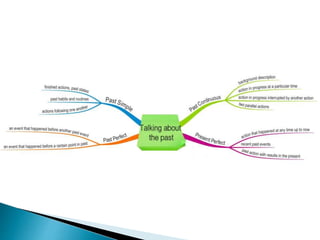
Past Simple
Past Continuous
Past Perfect
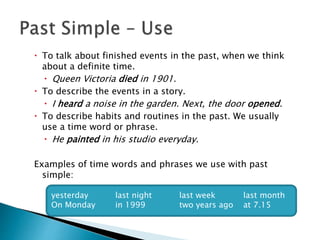
 To talk about finished events in the past, when we think
about a definite time.
 Queen Victoria died in 1901.
 To describe the events in a story.
 I heard a noise in the garden. Next, the door opened.
 To describe habits and routines in the past. We usually
use a time word or phrase.
 He painted in his studio everyday.
Examples of time words and phrases we use with past
simple:
yesterday last night last week last month
On Monday in 1999 two years ago at 7.15
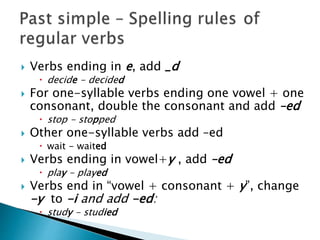
 Verbs ending in e, add _d
 decide - decided
 For one-syllable verbs ending one vowel + one
consonant, double the consonant and add –ed
 stop - stopped
 Other one-syllable verbs add –ed
 wait - waited
 Verbs ending in vowel+y , add –ed
 play - played
 Verbs end in “vowel + consonant + y”, change
-y to -i and add -ed:
 study - studied
 for a continuing unfinished action interrupted
by a sudden past action.
◦ While we were doing the maths test, the fire alarm went off
 for activities as background description.
◦ The rainforest was full of sounds. Birds were calling from
the trees and thousands of insects were buzzing and
humming.
 for two continuing events happening at the
same time.
◦ While Cortes was talking to the emperor; his army was
taking over the palace.
 Use while with past continuous for the time
the event was happening.
 Use when with past simple for actions.
 We can use other more descriptive time
phrases instead of when.
◦ At the moment the earthquake struck, most people
were sleeping peacefully.
 Use past perfect simple to describe a past
evenUt which happens before another event
in the past. Only
 Use it when it is important to make clear that
one event in the past happened before
another.
 On 12July 1771, Cook's ship The Endeavour arrived
back in Britain. Cook had not discovered a new
continent, but he had visited places never seen before.
◦ In this example, 'not discovered' happened before
'arrived'.
 We do not use past perfect simple simply to
show that an event happened a very long
time ago.
 We can sometimes use “before” or “after” with
past simple to make the order of events clear.
◦ By the time the ship reached the island, more then
twenty sailors had died.
◦ More than twenty sailors died before the ship
reached the island.
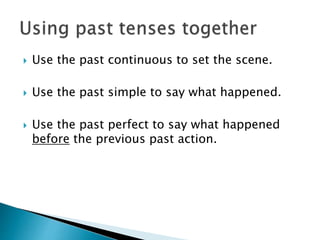
 Use the past continuous to set the scene.
 Use the past simple to say what happened.
 Use the past perfect to say what happened
before the previous past action.
Past tenses

Past tenses

  • 1.
  • 2.
     To talkabout finished events in the past, when we think about a definite time.  Queen Victoria died in 1901.  To describe the events in a story.  I heard a noise in the garden. Next, the door opened.  To describe habits and routines in the past. We usually use a time word or phrase.  He painted in his studio everyday. Examples of time words and phrases we use with past simple: yesterday last night last week last month On Monday in 1999 two years ago at 7.15
  • 3.
     Verbs endingin e, add _d  decide - decided  For one-syllable verbs ending one vowel + one consonant, double the consonant and add –ed  stop - stopped  Other one-syllable verbs add –ed  wait - waited  Verbs ending in vowel+y , add –ed  play - played  Verbs end in “vowel + consonant + y”, change -y to -i and add -ed:  study - studied
  • 4.
     for acontinuing unfinished action interrupted by a sudden past action. ◦ While we were doing the maths test, the fire alarm went off  for activities as background description. ◦ The rainforest was full of sounds. Birds were calling from the trees and thousands of insects were buzzing and humming.  for two continuing events happening at the same time. ◦ While Cortes was talking to the emperor; his army was taking over the palace.
  • 5.
     Use whilewith past continuous for the time the event was happening.  Use when with past simple for actions.  We can use other more descriptive time phrases instead of when. ◦ At the moment the earthquake struck, most people were sleeping peacefully.
  • 6.
     Use pastperfect simple to describe a past evenUt which happens before another event in the past. Only  Use it when it is important to make clear that one event in the past happened before another.  On 12July 1771, Cook's ship The Endeavour arrived back in Britain. Cook had not discovered a new continent, but he had visited places never seen before. ◦ In this example, 'not discovered' happened before 'arrived'.
  • 7.
     We donot use past perfect simple simply to show that an event happened a very long time ago.  We can sometimes use “before” or “after” with past simple to make the order of events clear. ◦ By the time the ship reached the island, more then twenty sailors had died. ◦ More than twenty sailors died before the ship reached the island.
  • 8.
     Use thepast continuous to set the scene.  Use the past simple to say what happened.  Use the past perfect to say what happened before the previous past action.