Past Simple Past Continuous Past Perfect Simple
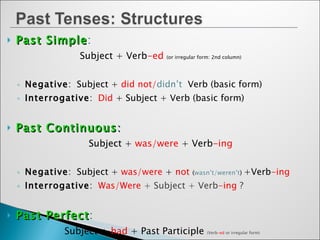
Past Simple :  Subject + Verb -ed   (or irregular form: 2nd column) Negative :  Subject +  did not/ didn’t  Verb (basic form) Interrogative :  Did  + Subject + Verb (basic form) Past Continuous :   Subject +  was/were  + Verb -ing Negative :  Subject +  was/were  +  not   ( wasn’t/weren’t )  +Verb -ing Interrogative :   Was/Were  + Subject + Verb -ing  ? Past Perfect :  Subject +  had   + Past Participle  (Verb -ed  or irregular form) Negative : Subject  +  had  +  not   ( hadn’t )+  Past Participle  Interrogative :  Had  +  Subject  +  Past Participle
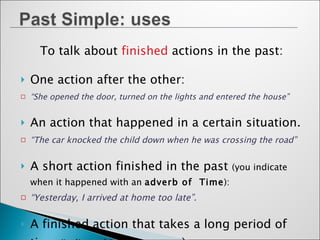
To talk about  finished   actions in the past: One action after the other: “ She opened the door, turned on the lights and entered the house” An action that happened in a certain situation. “ The car knocked the child down when he was crossing the road” A short action finished in the past  (you indicate when it happened with an  adverb of  Time ): “ Yesterday, I arrived at home too late”. A finished action that takes a long period of time  (indicated in the sentence ): “ I lived in Britain when I was young”
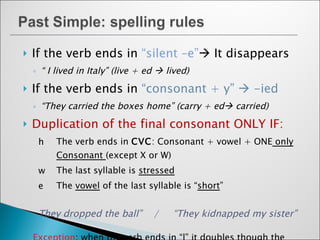
If the verb ends in  “silent –e”   It disappears “  I lived in Italy” (live + ed    lived) If the verb ends in  “consonant + y”    -ied “ They carried the boxes home” (carry + ed   carried) Duplication of the final consonant ONLY IF: The verb ends in  CVC : Consonant + vowel + ONE  only Consonant  (except X or W) The last syllable is  stressed The  vowel  of the last syllable is “ short ” They dropped the ball”  /  “They kidnapped my sister” Exception : when the verb ends in “l” it doubles though the last syllable is not stressed. (example:  “travelled”)
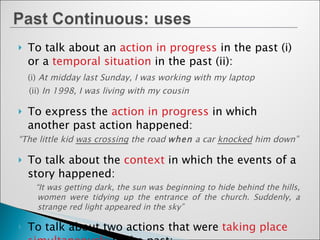
To talk about an  action in progress  in the past (i) or a  temporal situation  in the past (ii): (i)  At midday last Sunday, I was working with my laptop (ii)  In 1998, I was living with my cousin To express the  action in progress  in which another past action happened: “ The little kid  was crossing  the road  when  a car  knocked  him down” To talk about the  context  in which the events of a story happened: “ It was getting dark, the sun was beginning to hide behind the hills, women were tidying up the entrance of the church. Suddenly, a strange red light appeared in the sky” To talk about two actions that were  taking place simultaneously  in the past: “ My wife was talking on the phone  while  I was surfing the web”
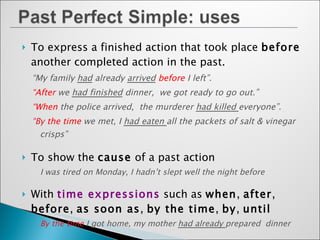
To express a finished action that took place  before  another completed action in the past. “ My family  had  already  arrived   before   I left”. “ After   we  had finished  dinner,  we got ready to go out.” “ When   the police arrived,  the murderer  had killed  everyone”.  “ By  the time   we met, I  had eaten  all the packets of salt & vinegar crisps” To show the  cause  of a past action I was tired on Monday, I hadn’t slept well the night before With  time expressions  such as  when ,  after ,  before ,  as soon as ,  by the time ,  by ,  until By the time  I got home, my mother  had already  prepared  dinner With  adverbs  such as  ever, never, already, yet, just, so far  and  still I  had never been  to such a beautiful place  before
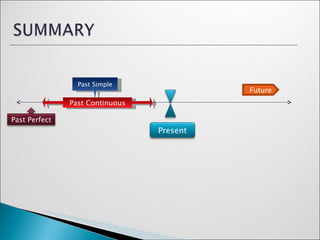
Past Continuous Future Past Simple Past Perfect Present
FOR  +  a period of time  (duration) I  stayed  in Scotland  for two years . SINCE  +  a year, an event, etc.  (indicates starting point) I know him  since  my wedding. Since  1978 people can vote in Spain. BEFORE [PAST PERFECT]   WHEN  +  PAST SIMPLE BY THE TIME  I  had (already) bought  my house  before  I got married /   before   I moved to UK   when  I got married  /  when   I moved to UK   by the time  I got married  /  by the time  I moved to UK WHILE   /AS  + past continuous or past simple  =  WHEN  +  past simple,  past continuous As/ while  I  was walking , I  phoned  my grandmother  =  When  I  phoned  her, I  was walking
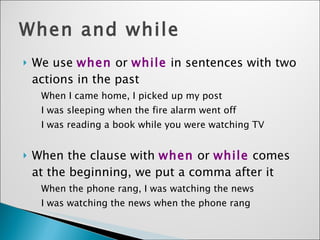
When and while We use  when  or  while  in sentences with two actions in the past When I came home, I picked up my post I was sleeping when the fire alarm went off I was reading a book while you were watching TV When the clause with  when  or  while  comes at the beginning, we put a comma after it When the phone rang, I was watching the news I was watching the news when the phone rang
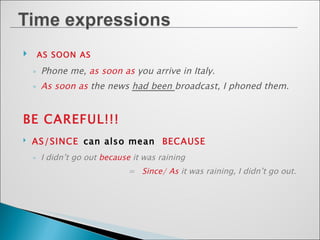
AS SOON AS Phone me,  as soon as  you arrive in Italy. As soon as  the news  had been  broadcast, I phoned them. BE CAREFUL!!!   AS/SINCE   can also mean  BECAUSE I didn’t go out  because  it was raining  =  Since/ As  it was raining, I didn’t go out.

Past tenses

  • 1.
    Past Simple PastContinuous Past Perfect Simple
  • 2.
    Past Simple : Subject + Verb -ed (or irregular form: 2nd column) Negative : Subject + did not/ didn’t Verb (basic form) Interrogative : Did + Subject + Verb (basic form) Past Continuous : Subject + was/were + Verb -ing Negative : Subject + was/were + not ( wasn’t/weren’t ) +Verb -ing Interrogative : Was/Were + Subject + Verb -ing ? Past Perfect : Subject + had + Past Participle (Verb -ed or irregular form) Negative : Subject + had + not ( hadn’t )+ Past Participle Interrogative : Had + Subject + Past Participle
  • 3.
    To talk about finished actions in the past: One action after the other: “ She opened the door, turned on the lights and entered the house” An action that happened in a certain situation. “ The car knocked the child down when he was crossing the road” A short action finished in the past (you indicate when it happened with an adverb of Time ): “ Yesterday, I arrived at home too late”. A finished action that takes a long period of time (indicated in the sentence ): “ I lived in Britain when I was young”
  • 4.
    If the verbends in “silent –e”  It disappears “ I lived in Italy” (live + ed  lived) If the verb ends in “consonant + y”  -ied “ They carried the boxes home” (carry + ed  carried) Duplication of the final consonant ONLY IF: The verb ends in CVC : Consonant + vowel + ONE only Consonant (except X or W) The last syllable is stressed The vowel of the last syllable is “ short ” They dropped the ball” / “They kidnapped my sister” Exception : when the verb ends in “l” it doubles though the last syllable is not stressed. (example: “travelled”)
  • 5.
    To talk aboutan action in progress in the past (i) or a temporal situation in the past (ii): (i) At midday last Sunday, I was working with my laptop (ii) In 1998, I was living with my cousin To express the action in progress in which another past action happened: “ The little kid was crossing the road when a car knocked him down” To talk about the context in which the events of a story happened: “ It was getting dark, the sun was beginning to hide behind the hills, women were tidying up the entrance of the church. Suddenly, a strange red light appeared in the sky” To talk about two actions that were taking place simultaneously in the past: “ My wife was talking on the phone while I was surfing the web”
  • 6.
    To express afinished action that took place before another completed action in the past. “ My family had already arrived before I left”. “ After we had finished dinner, we got ready to go out.” “ When the police arrived, the murderer had killed everyone”. “ By the time we met, I had eaten all the packets of salt & vinegar crisps” To show the cause of a past action I was tired on Monday, I hadn’t slept well the night before With time expressions such as when , after , before , as soon as , by the time , by , until By the time I got home, my mother had already prepared dinner With adverbs such as ever, never, already, yet, just, so far and still I had never been to such a beautiful place before
  • 7.
    Past Continuous FuturePast Simple Past Perfect Present
  • 8.
    FOR + a period of time (duration) I stayed in Scotland for two years . SINCE + a year, an event, etc. (indicates starting point) I know him since my wedding. Since 1978 people can vote in Spain. BEFORE [PAST PERFECT] WHEN + PAST SIMPLE BY THE TIME I had (already) bought my house before I got married / before I moved to UK when I got married / when I moved to UK by the time I got married / by the time I moved to UK WHILE /AS + past continuous or past simple = WHEN + past simple, past continuous As/ while I was walking , I phoned my grandmother = When I phoned her, I was walking
  • 9.
    When and whileWe use when or while in sentences with two actions in the past When I came home, I picked up my post I was sleeping when the fire alarm went off I was reading a book while you were watching TV When the clause with when or while comes at the beginning, we put a comma after it When the phone rang, I was watching the news I was watching the news when the phone rang
  • 10.
    AS SOON ASPhone me, as soon as you arrive in Italy. As soon as the news had been broadcast, I phoned them. BE CAREFUL!!!   AS/SINCE can also mean BECAUSE I didn’t go out because it was raining = Since/ As it was raining, I didn’t go out.