FORM
[was/were + present participle]
Examples:
 You were studying when she called.
 Were you studying when she called?
 You were not studying when she called.
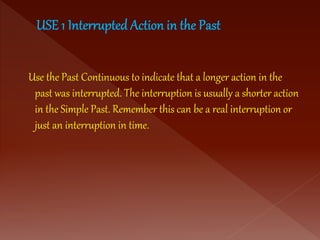
Use the Past Continuous to indicate that a longer action in the
past was interrupted. The interruption is usually a shorter action
in the Simple Past. Remember this can be a real interruption or
just an interruption in time.
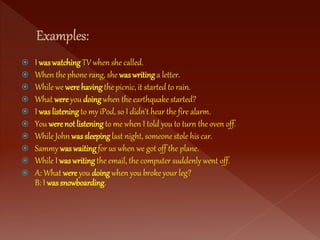
 I was watching TV when she called.
 When the phone rang, she was writing a letter.
 While we were having the picnic, it started to rain.
 What wereyou doing when the earthquake started?
 I was listening to my iPod, so I didn't hear the fire alarm.
 You werenot listening to me when I told you to turn the oven off.
 While John was sleeping last night, someone stole his car.
 Sammy was waiting for us when we got off the plane.
 While I was writing the email, the computer suddenly went off.
 A: What were you doing when you broke your leg?
B: I was snowboarding.
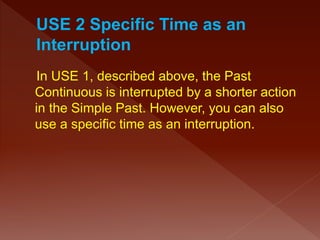
In USE 1, described above, the Past
Continuous is interrupted by a shorter action
in the Simple Past. However, you can also
use a specific time as an interruption.
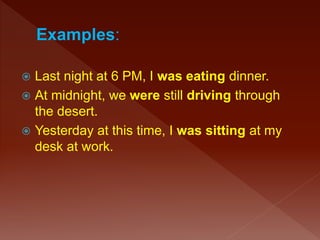
 Last night at 6 PM, I was eating dinner.
 At midnight, we were still driving through
the desert.
 Yesterday at this time, I was sitting at my
desk at work.
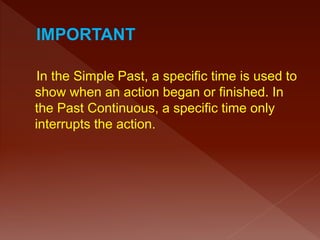
In the Simple Past, a specific time is used to
show when an action began or finished. In
the Past Continuous, a specific time only
interrupts the action.
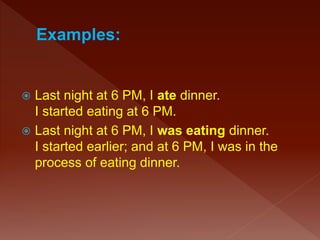
 Last night at 6 PM, I ate dinner.
I started eating at 6 PM.
 Last night at 6 PM, I was eating dinner.
I started earlier; and at 6 PM, I was in the
process of eating dinner.
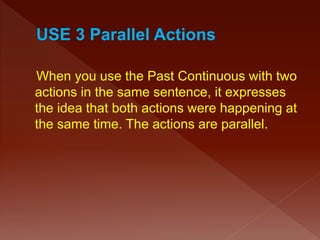
When you use the Past Continuous with two
actions in the same sentence, it expresses
the idea that both actions were happening at
the same time. The actions are parallel.
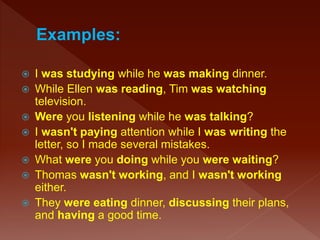
 I was studying while he was making dinner.
 While Ellen was reading, Tim was watching
television.
 Were you listening while he was talking?
 I wasn't paying attention while I was writing the
letter, so I made several mistakes.
 What were you doing while you were waiting?
 Thomas wasn't working, and I wasn't working
either.
 They were eating dinner, discussing their plans,
and having a good time.
In English, we often use a series of parallel
actions to describe the atmosphere at a
particular time in the past.
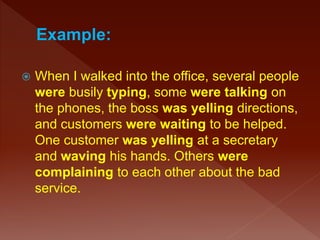
 When I walked into the office, several people
were busily typing, some were talking on
the phones, the boss was yelling directions,
and customers were waiting to be helped.
One customer was yelling at a secretary
and waving his hands. Others were
complaining to each other about the bad
service.
The Past Continuous with words such as
"always" or "constantly" expresses the idea
that something irritating or shocking often
happened in the past. The concept is very
similar to the expression "used to" but with
negative emotion. Remember to put the
words "always" or "constantly" between "be"
and "verb+ing."
 She was always coming to class late.
 He was constantly talking. He annoyed
everyone.
 I didn't like them because they were always
complaining.
Clauses are groups of words which have meaning,
but are often not complete sentences. Some
clauses begin with the word "when" such as "when
she called" or "when it bit me." Other clauses begin
with "while" such as "while she was sleeping" and
"while he was surfing." When you talk about things
in the past, "when" is most often followed by the
verb tense Simple Past, whereas "while" is usually
followed by Past Continuous. "While" expresses the
idea of "during that time." Study the examples
below. They have similar meanings, but they
emphasize different parts of the sentence.
 I was studying when she called.
 While I was studying, she called.
It is important to remember that Non-
Continuous Verbs cannot be used in any
continuous tenses. Also, certain non-
continuous meanings for Mixed Verbs cannot
be used in continuous tenses. Instead of
using Past Continuous with these verbs, you
must use Simple Past.
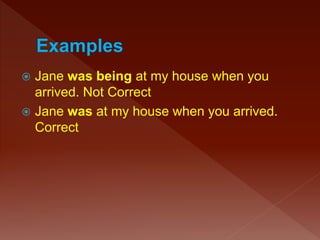
 Jane was being at my house when you
arrived. Not Correct
 Jane was at my house when you arrived.
Correct
The examples below show the placement for
grammar adverbs such as: always, only,
never, ever, still, just, etc.
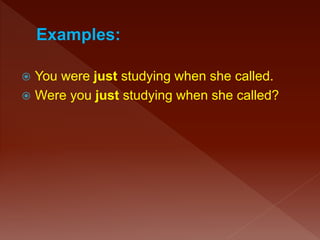
 You were just studying when she called.
 Were you just studying when she called?
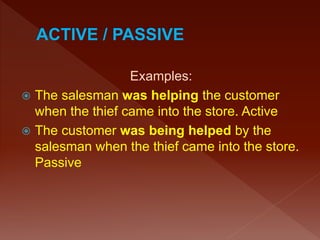
Examples:
 The salesman was helping the customer
when the thief came into the store. Active
 The customer was being helped by the
salesman when the thief came into the store.
Passive
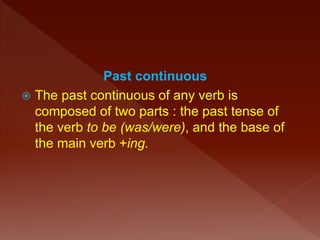
Past continuous
 The past continuous of any verb is
composed of two parts : the past tense of
the verb to be (was/were), and the base of
the main verb +ing.
The past continuous describes actions or
events in a time before now, which began in
the past and was still going on at the time
of speaking. In other words, it expresses an
unfinished or incomplete action in the
past.
 often, to describe the background in a story written in the past tense,
e.g. "The sun was shining and the birds were singing as the
elephant came out of the jungle. The other animals were relaxing in
the shade of the trees, but the elephant moved very quickly. She was
looking for her baby, and she didn't notice the hunter who was
watching her through his binoculars. When the shot rang out, she was
running towards the river..."
 to describe an unfinished action that was interrupted by another event
or action: "I was having a beautiful dream when the alarm clock rang."
 to express a change of mind: e.g. "I was going to spend the day at the
beach but I've decided to go on an excursion instead."
 with 'wonder', to make a very polite request: e.g. "I was wondering if
you could baby-sit for me tonight."
 They were waiting for the bus when the
accident happened.
 Caroline was skiing when she broke her
leg.
 When we arrived he was having a bath.
 When the fire started I was watching
television
The past continuous tense is most often used
for actions happening at some time in the
past.
 When we want to talk about an action that was happening over
a period of time in the past, we use the past continuous tense.
Look at these examples:
 At this time last week I was lying on the beach in Florida.
 My mother was working in the garden so she didn't hear the
telephone when I called her yesterday.
 I had my car fixed because it wasn't working properly.
 Sorry, I wasn't listening. Can you say it again please?
 What were you doing at 8 o'clock yesterday?
 Why were you talking to John when I saw you in the cafeteria
yesterday?
 I went to lunch too early. The food was still being cooked.
(passive)
The past continuous is very often used with
the past simple to say that something
happened in the middle of something else. In
each of the following examples, the single
event (past simple) happens in the middle of
a longer action (past continuous).
 You phoned while I was having a bath.
 When I got home yesterday, a cat was sitting on the roof.
 It started to rain just as we were getting ready to have our picnic.
 The boy was standing on the table when the principal came into the
room.
 Many people were shopping in the market when the bomb exploded.
 I saw Noriko in town yesterday. She was wearing a pink dress and an
orange hat!
 When I went to bed last night the sun was already beginning to rise.
 It was lucky we weren't sitting under that tree when the lightning hit.
 What were you doing when the lights went off last night?
 Were you watching me when I showed you how to do it?
 How fast was she driving when she had the accident?
FINISH :D

Ninfa

  • 2.
    FORM [was/were + presentparticiple] Examples:  You were studying when she called.  Were you studying when she called?  You were not studying when she called.
  • 3.
    Use the PastContinuous to indicate that a longer action in the past was interrupted. The interruption is usually a shorter action in the Simple Past. Remember this can be a real interruption or just an interruption in time.
  • 4.
     I waswatching TV when she called.  When the phone rang, she was writing a letter.  While we were having the picnic, it started to rain.  What wereyou doing when the earthquake started?  I was listening to my iPod, so I didn't hear the fire alarm.  You werenot listening to me when I told you to turn the oven off.  While John was sleeping last night, someone stole his car.  Sammy was waiting for us when we got off the plane.  While I was writing the email, the computer suddenly went off.  A: What were you doing when you broke your leg? B: I was snowboarding.
  • 5.
    In USE 1,described above, the Past Continuous is interrupted by a shorter action in the Simple Past. However, you can also use a specific time as an interruption.
  • 6.
     Last nightat 6 PM, I was eating dinner.  At midnight, we were still driving through the desert.  Yesterday at this time, I was sitting at my desk at work.
  • 7.
    In the SimplePast, a specific time is used to show when an action began or finished. In the Past Continuous, a specific time only interrupts the action.
  • 8.
     Last nightat 6 PM, I ate dinner. I started eating at 6 PM.  Last night at 6 PM, I was eating dinner. I started earlier; and at 6 PM, I was in the process of eating dinner.
  • 9.
    When you usethe Past Continuous with two actions in the same sentence, it expresses the idea that both actions were happening at the same time. The actions are parallel.
  • 10.
     I wasstudying while he was making dinner.  While Ellen was reading, Tim was watching television.  Were you listening while he was talking?  I wasn't paying attention while I was writing the letter, so I made several mistakes.  What were you doing while you were waiting?  Thomas wasn't working, and I wasn't working either.  They were eating dinner, discussing their plans, and having a good time.
  • 11.
    In English, weoften use a series of parallel actions to describe the atmosphere at a particular time in the past.
  • 12.
     When Iwalked into the office, several people were busily typing, some were talking on the phones, the boss was yelling directions, and customers were waiting to be helped. One customer was yelling at a secretary and waving his hands. Others were complaining to each other about the bad service.
  • 13.
    The Past Continuouswith words such as "always" or "constantly" expresses the idea that something irritating or shocking often happened in the past. The concept is very similar to the expression "used to" but with negative emotion. Remember to put the words "always" or "constantly" between "be" and "verb+ing."
  • 14.
     She wasalways coming to class late.  He was constantly talking. He annoyed everyone.  I didn't like them because they were always complaining.
  • 15.
    Clauses are groupsof words which have meaning, but are often not complete sentences. Some clauses begin with the word "when" such as "when she called" or "when it bit me." Other clauses begin with "while" such as "while she was sleeping" and "while he was surfing." When you talk about things in the past, "when" is most often followed by the verb tense Simple Past, whereas "while" is usually followed by Past Continuous. "While" expresses the idea of "during that time." Study the examples below. They have similar meanings, but they emphasize different parts of the sentence.
  • 16.
     I wasstudying when she called.  While I was studying, she called.
  • 17.
    It is importantto remember that Non- Continuous Verbs cannot be used in any continuous tenses. Also, certain non- continuous meanings for Mixed Verbs cannot be used in continuous tenses. Instead of using Past Continuous with these verbs, you must use Simple Past.
  • 18.
     Jane wasbeing at my house when you arrived. Not Correct  Jane was at my house when you arrived. Correct
  • 19.
    The examples belowshow the placement for grammar adverbs such as: always, only, never, ever, still, just, etc.
  • 20.
     You werejust studying when she called.  Were you just studying when she called?
  • 21.
    Examples:  The salesmanwas helping the customer when the thief came into the store. Active  The customer was being helped by the salesman when the thief came into the store. Passive
  • 22.
    Past continuous  Thepast continuous of any verb is composed of two parts : the past tense of the verb to be (was/were), and the base of the main verb +ing.
  • 23.
    The past continuousdescribes actions or events in a time before now, which began in the past and was still going on at the time of speaking. In other words, it expresses an unfinished or incomplete action in the past.
  • 24.
     often, todescribe the background in a story written in the past tense, e.g. "The sun was shining and the birds were singing as the elephant came out of the jungle. The other animals were relaxing in the shade of the trees, but the elephant moved very quickly. She was looking for her baby, and she didn't notice the hunter who was watching her through his binoculars. When the shot rang out, she was running towards the river..."  to describe an unfinished action that was interrupted by another event or action: "I was having a beautiful dream when the alarm clock rang."  to express a change of mind: e.g. "I was going to spend the day at the beach but I've decided to go on an excursion instead."  with 'wonder', to make a very polite request: e.g. "I was wondering if you could baby-sit for me tonight."
  • 25.
     They werewaiting for the bus when the accident happened.  Caroline was skiing when she broke her leg.  When we arrived he was having a bath.  When the fire started I was watching television
  • 26.
    The past continuoustense is most often used for actions happening at some time in the past.
  • 27.
     When wewant to talk about an action that was happening over a period of time in the past, we use the past continuous tense. Look at these examples:  At this time last week I was lying on the beach in Florida.  My mother was working in the garden so she didn't hear the telephone when I called her yesterday.  I had my car fixed because it wasn't working properly.  Sorry, I wasn't listening. Can you say it again please?  What were you doing at 8 o'clock yesterday?  Why were you talking to John when I saw you in the cafeteria yesterday?  I went to lunch too early. The food was still being cooked. (passive)
  • 28.
    The past continuousis very often used with the past simple to say that something happened in the middle of something else. In each of the following examples, the single event (past simple) happens in the middle of a longer action (past continuous).
  • 29.
     You phonedwhile I was having a bath.  When I got home yesterday, a cat was sitting on the roof.  It started to rain just as we were getting ready to have our picnic.  The boy was standing on the table when the principal came into the room.  Many people were shopping in the market when the bomb exploded.  I saw Noriko in town yesterday. She was wearing a pink dress and an orange hat!  When I went to bed last night the sun was already beginning to rise.  It was lucky we weren't sitting under that tree when the lightning hit.  What were you doing when the lights went off last night?  Were you watching me when I showed you how to do it?  How fast was she driving when she had the accident?
  • 30.