Created By:Dilmi Shanika
simple present tense

Present continuous tense

Present perfect tense

Present perfect continuous
tense
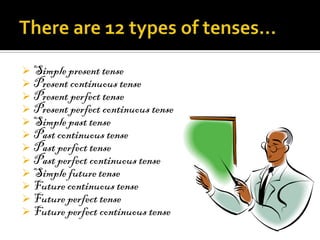
 Simple present tense
 Present continuous tense
 Present perfect tense
 Present perfect continuous tense
 Simple past tense
 Past continuous tense
 Past perfect tense
 Past perfect continuous tense
 Simple future tense
 Future continuous tense
 Future perfect tense
 Future perfect continuous tense
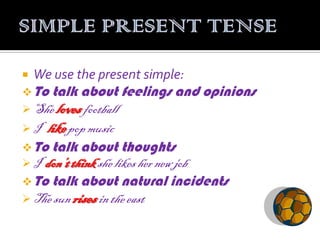
   We use the present simple:
 To talk about feelings    and opinions
 She loves football
I  like pop music
 To talk about thoughts
 I don’t think she likes her new job
 To talk about natural incidents
 The sun rises in the east
 To talk about a present habit
 Present simple can be used with frequency
  adverbs like
 Always
 Never
 Sometimes
 Ever
 Usually
 Often
 Fortnightly
 Regularly
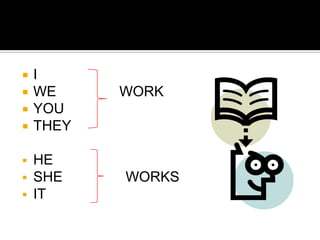
   I
   WE     WORK
   YOU
   THEY

   HE
   SHE    WORKS
   IT
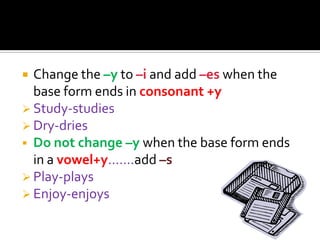
 Add –s for most verbs
 Work-works
 Buy-buys
 Add –es for verbs that end in –ch,-ss,-sh,-x
 -o,-z
 Watch-watches
 Go-goes
 Coo-coos
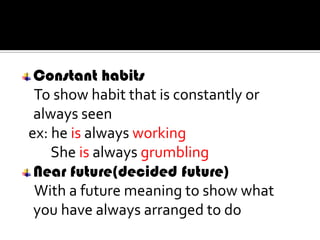
 Change the –y to –i and add –es when the
  base form ends in consonant +y
 Study-studies
 Dry-dries
 Do not change –y when the base form ends
  in a vowel+y…….add –s
 Play-plays
 Enjoy-enjoys
The present continuous tense is used to express:
  Momentary actions
 what is happening now or around the time of
 speaking
 A momentary action can be understood by
 Seeing
 Hearing
 Feeling
Ex:she is coming
   It is aching
Constant habits
 To show habit that is constantly or
 always seen
ex: he is always working
    She is always grumbling
 Near future(decided future)
 With a future meaning to show what
 you have always arranged to do
   I      am coming

   WE
   YOU    are coming
   THEY

   HE
   SHE     is coming
   IT
   The present continuous is normally used with
    words such as:
    Now
    Right now
    Just now
    At the moment
    At the present moment
    presently
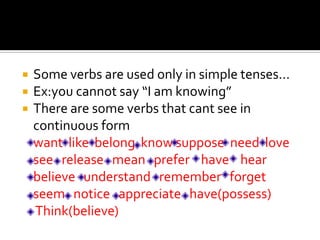
   Some verbs are used only in simple tenses…
   Ex:you cannot say “I am knowing”
   There are some verbs that cant see in
    continuous form
    want like belong know suppose need love
    see release mean prefer have hear
    believe understand remember forget
    seem notice appreciate have(possess)
    Think(believe)
 When a verb ends in a single “e” it is dropped before adding
  “ing”
Ex:Waste-wasting
 This does not happen when a verb ends in “ee”, “oe”, “ye”,
  “ge”
Ex:See-seeing
    Dye-dyeing
 When verbs of two or more syllables whose last syllable
  contains only one vowel and ends in a single consonant we
  have to double this consonant if the stress falls on the last
  syllable
Ex: Run-running
   Cut-cutting
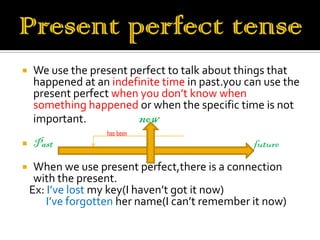
   We use the present perfect to talk about things that
    happened at an indefinite time in past.you can use the
    present perfect when you don’t know when
    something happened or when the specific time is not
    important.          now
                   has been
   Past                                         future
    When we use present perfect,there is a connection
     with the present.
    Ex: I’ve lost my key(I haven’t got it now)
        I’ve forgotten her name(I can’t remember it now)
   We often use the present perfect to give new
    information or to announce a recent
    happening
   Ex:do you know about Dilrukshi ?she has
    gone to Japan.
   You can use the present perfect with “just”
    (a short time ago)
    Ex:no thanks.i’ve just had lunch

   You can use present perfect with “already” to
    say that something has happened sooner
    than expected.
    Ex: when is seetha going to start her new job?she has
    already started.
   Use the present perfect with ‘since’ or ‘for’ to
    talk about something than began in the past and
    continued to the present.(and may continue into
    the future)
 Use the present perfect with since+point in time to show
  when something is started.
 Since can also introduce a time clause
   If the action ended in the past ,use the past simple in the time clause.
   If the action still continuous in the present,use the present perfect in the
    time clause
    Ex: I haven’t seen him since Monday.
 use  the present perfect with „for‟+length of
 time to show how long a present situation
 has lasted.
 Ex:He has lived in london for six years

 We     often use “ever” and “never” in present
  perfect.
 ex:Have you ever eaten cuttle fish?
     I have never smoked a cigarrete.
   We use present perfect after a superlative
    Ex:you are the prettiest girl I’ve ever met in my life

   we have to use the present perfect with
    “this is the first time……..”
   Ex:This is the first time I have faced such a problem
 We use the present perfect when we talk
  about a period of time that continuous up to
  the present or something that has happened
  several times up to the present.
Ex:I haven’t seen him recently.have you?
 we often use the present perfect with “yet”
  shows that the speaker is expecting
  something to happen.
Ex:Hasn’t it stopped raining yet?
 We use present perfect with this
  morning,this evening,today,this
  week,this term ,etc…if the period
  indicated by these times are nor over at the
  time of speaking
  Ex:I have drunk four bottles of coca cola today.
 We use present perfect with ‘been’ to show
  continuous actions
Ex:We have been angry with each other for two years
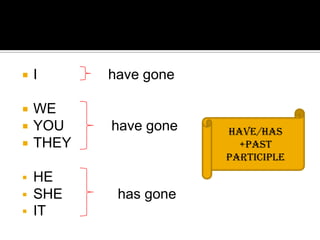
   I      have gone

   WE
   YOU    have gone   Have/has
   THEY                 +past
                       participle
   HE
   SHE     has gone
   IT
   We use present perfect continuous for an
    action or situation that began in the past and
    continuous until now.
                      now

    Past                                f uture


           have been+ing
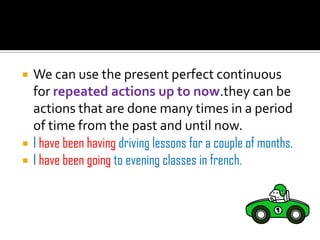
   We can use the present perfect continuous
    for repeated actions up to now.they can be
    actions that are done many times in a period
    of time from the past and until now.
   I have been having driving lessons for a couple of months.
   I have been going to evening classes in french.
   We can also use it to talk about an action
    which has just stopped and has a present
    result.
Ex :It has been raining.that’s why the ground is wet.
 We can use present perfect continuous
  with for ,since,how long, recently,
  lately…..
   Ex :I have been attending this class for three months
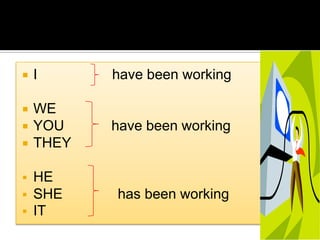
   I      have been working

   WE
   YOU    have been working
   THEY

   HE
   SHE    has been working
   IT
   http://www.englisch-
    hilfen.de/en/exercises/questions/simple_pres
    ent2.htm
   http://www.englishmaven.org/HP6/Present%
    20Tense%20Exercise%204.htm
   http://www.englishexercises.org/buscador/bu
    scar.asp?nivel=any&age=0&contents=presen
    t+simple
   http://www.usingenglish.com/quizzes/65.htm
    l
   http://www.englishexercises.org/buscador/buscar.asp
    ?nivel=any&age=0&tipo=any&contents=present+cont
    inuous
   http://www.perfect-english-grammar.com/present-
    continuous-exercise-1.html
   http://www.englishpage.com/verbpage/verbs1.htm
   http://www.englishpage.com/verbpage/verbs2.htm
   http://www.englisch-
    hilfen.de/en/exercises/tenses/simple_present_progres
    sive.htm
   http://www.englishexercises.org/buscador/bu
    scar.asp?nivel=any&age=0&tipo=any&conten
    ts=present+perfect
   http://www.really-learn-english.com/present-
    perfect-exercises.html
   http://www.englishpage.com/verbpage/verbs
    7.htm
   http://www.englishpage.com/verbpage/verbs
    8.htm
   http://www.autoenglish.org/gr.percon.i.htm
   http://www.e-grammar.org/present-perfect-
    simple-continuous/

Tenses

  • 1.
  • 2.
    simple present tense Presentcontinuous tense Present perfect tense Present perfect continuous tense
  • 3.
     Simple presenttense  Present continuous tense  Present perfect tense  Present perfect continuous tense  Simple past tense  Past continuous tense  Past perfect tense  Past perfect continuous tense  Simple future tense  Future continuous tense  Future perfect tense  Future perfect continuous tense
  • 4.
    We use the present simple:  To talk about feelings and opinions  She loves football I like pop music  To talk about thoughts  I don’t think she likes her new job  To talk about natural incidents  The sun rises in the east
  • 5.
     To talkabout a present habit  Present simple can be used with frequency adverbs like  Always  Never  Sometimes  Ever  Usually  Often  Fortnightly  Regularly
  • 6.
    I  WE WORK  YOU  THEY  HE  SHE WORKS  IT
  • 7.
     Add –sfor most verbs  Work-works  Buy-buys  Add –es for verbs that end in –ch,-ss,-sh,-x  -o,-z  Watch-watches  Go-goes  Coo-coos
  • 8.
     Change the–y to –i and add –es when the base form ends in consonant +y  Study-studies  Dry-dries  Do not change –y when the base form ends in a vowel+y…….add –s  Play-plays  Enjoy-enjoys
  • 9.
    The present continuoustense is used to express: Momentary actions what is happening now or around the time of speaking A momentary action can be understood by Seeing Hearing Feeling Ex:she is coming It is aching
  • 10.
    Constant habits Toshow habit that is constantly or always seen ex: he is always working She is always grumbling Near future(decided future) With a future meaning to show what you have always arranged to do
  • 11.
    I am coming  WE  YOU are coming  THEY  HE  SHE is coming  IT
  • 12.
    The present continuous is normally used with words such as: Now Right now Just now At the moment At the present moment presently
  • 13.
    Some verbs are used only in simple tenses…  Ex:you cannot say “I am knowing”  There are some verbs that cant see in continuous form want like belong know suppose need love see release mean prefer have hear believe understand remember forget seem notice appreciate have(possess) Think(believe)
  • 14.
     When averb ends in a single “e” it is dropped before adding “ing” Ex:Waste-wasting  This does not happen when a verb ends in “ee”, “oe”, “ye”, “ge” Ex:See-seeing Dye-dyeing  When verbs of two or more syllables whose last syllable contains only one vowel and ends in a single consonant we have to double this consonant if the stress falls on the last syllable Ex: Run-running Cut-cutting
  • 15.
    We use the present perfect to talk about things that happened at an indefinite time in past.you can use the present perfect when you don’t know when something happened or when the specific time is not important. now has been  Past future  When we use present perfect,there is a connection with the present. Ex: I’ve lost my key(I haven’t got it now) I’ve forgotten her name(I can’t remember it now)
  • 16.
    We often use the present perfect to give new information or to announce a recent happening  Ex:do you know about Dilrukshi ?she has gone to Japan.
  • 17.
    You can use the present perfect with “just” (a short time ago) Ex:no thanks.i’ve just had lunch  You can use present perfect with “already” to say that something has happened sooner than expected. Ex: when is seetha going to start her new job?she has already started.
  • 18.
    Use the present perfect with ‘since’ or ‘for’ to talk about something than began in the past and continued to the present.(and may continue into the future)  Use the present perfect with since+point in time to show when something is started.  Since can also introduce a time clause  If the action ended in the past ,use the past simple in the time clause.  If the action still continuous in the present,use the present perfect in the time clause Ex: I haven’t seen him since Monday.
  • 19.
     use the present perfect with „for‟+length of time to show how long a present situation has lasted. Ex:He has lived in london for six years  We often use “ever” and “never” in present perfect. ex:Have you ever eaten cuttle fish? I have never smoked a cigarrete.
  • 20.
    We use present perfect after a superlative Ex:you are the prettiest girl I’ve ever met in my life  we have to use the present perfect with “this is the first time……..”  Ex:This is the first time I have faced such a problem
  • 21.
     We usethe present perfect when we talk about a period of time that continuous up to the present or something that has happened several times up to the present. Ex:I haven’t seen him recently.have you?  we often use the present perfect with “yet” shows that the speaker is expecting something to happen. Ex:Hasn’t it stopped raining yet?
  • 22.
     We usepresent perfect with this morning,this evening,today,this week,this term ,etc…if the period indicated by these times are nor over at the time of speaking Ex:I have drunk four bottles of coca cola today.  We use present perfect with ‘been’ to show continuous actions Ex:We have been angry with each other for two years
  • 23.
    I have gone  WE  YOU have gone Have/has  THEY +past participle  HE  SHE has gone  IT
  • 24.
    We use present perfect continuous for an action or situation that began in the past and continuous until now. now Past f uture have been+ing
  • 25.
    We can use the present perfect continuous for repeated actions up to now.they can be actions that are done many times in a period of time from the past and until now.  I have been having driving lessons for a couple of months.  I have been going to evening classes in french.
  • 26.
    We can also use it to talk about an action which has just stopped and has a present result. Ex :It has been raining.that’s why the ground is wet.  We can use present perfect continuous with for ,since,how long, recently, lately…..  Ex :I have been attending this class for three months
  • 27.
    I have been working  WE  YOU have been working  THEY  HE  SHE has been working  IT
  • 28.
    http://www.englisch- hilfen.de/en/exercises/questions/simple_pres ent2.htm  http://www.englishmaven.org/HP6/Present% 20Tense%20Exercise%204.htm  http://www.englishexercises.org/buscador/bu scar.asp?nivel=any&age=0&contents=presen t+simple  http://www.usingenglish.com/quizzes/65.htm l
  • 29.
    http://www.englishexercises.org/buscador/buscar.asp ?nivel=any&age=0&tipo=any&contents=present+cont inuous  http://www.perfect-english-grammar.com/present- continuous-exercise-1.html  http://www.englishpage.com/verbpage/verbs1.htm  http://www.englishpage.com/verbpage/verbs2.htm  http://www.englisch- hilfen.de/en/exercises/tenses/simple_present_progres sive.htm
  • 30.
    http://www.englishexercises.org/buscador/bu scar.asp?nivel=any&age=0&tipo=any&conten ts=present+perfect  http://www.really-learn-english.com/present- perfect-exercises.html
  • 31.
    http://www.englishpage.com/verbpage/verbs 7.htm  http://www.englishpage.com/verbpage/verbs 8.htm  http://www.autoenglish.org/gr.percon.i.htm  http://www.e-grammar.org/present-perfect- simple-continuous/