Should have
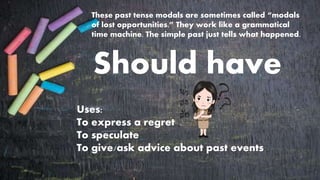
Uses:
To express a regret
To speculate
To give/ask advice about past events
These past tense modals are sometimes called “modals
of lost opportunities.” They work like a grammatical
time machine. The simple past just tells what happened.
Should have
We use this modal whenever or always we talk
about something that we should have done, but
ultimately did not. For example:
• We should have studied more for the exam.
Deberíamos haber estudiado más para el
examen.
• You should have called first.
Deberías haber llamado primero.
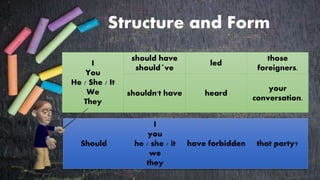
I
You
He / She / It
We
They
should have
should´ve
led
those
foreigners.
shouldn't have heard
your
conversation.
Should
I
you
he / she / it
we
they
have forbidden that party?
Structure and Form
Should have means that something did not
happen, but we wish it had happened. We use
should have to talk about past mistakes. A
worried mother might say:
“I was so worried about you. You shouldn´t have
gone to the party. It´s too late!”
Should have is common in apologies. For example:
I’m sorry that I’m late for work. I should have
woken up earlier.
You might remember Lieutenant Dan in the
movie Forrest Gump. In the movie, Dan loses both of
his legs in the Vietnam War. He would have died, but
Forrest saved him.
Listen for should have as Dan confronts Forrest.
“You listen to me. We all have a destiny. Nothing just
happens. It’s all part of a plan. I should have
died out there with my men. But now I’m nothing but
a cripple!”
Pages from the
book
Page 40:
Listening
Exercise A and B
Grammar:
Exercise A
Page 41
Pronunciation:
Exercise A and B
Page 123
Exercise 2A and 2B

Should have

  • 1.
    Should have Uses: To expressa regret To speculate To give/ask advice about past events These past tense modals are sometimes called “modals of lost opportunities.” They work like a grammatical time machine. The simple past just tells what happened.
  • 2.
    Should have We usethis modal whenever or always we talk about something that we should have done, but ultimately did not. For example: • We should have studied more for the exam. Deberíamos haber estudiado más para el examen. • You should have called first. Deberías haber llamado primero.
  • 3.
    I You He / She/ It We They should have should´ve led those foreigners. shouldn't have heard your conversation. Should I you he / she / it we they have forbidden that party? Structure and Form
  • 4.
    Should have meansthat something did not happen, but we wish it had happened. We use should have to talk about past mistakes. A worried mother might say: “I was so worried about you. You shouldn´t have gone to the party. It´s too late!” Should have is common in apologies. For example: I’m sorry that I’m late for work. I should have woken up earlier.
  • 5.
    You might rememberLieutenant Dan in the movie Forrest Gump. In the movie, Dan loses both of his legs in the Vietnam War. He would have died, but Forrest saved him. Listen for should have as Dan confronts Forrest. “You listen to me. We all have a destiny. Nothing just happens. It’s all part of a plan. I should have died out there with my men. But now I’m nothing but a cripple!”
  • 7.
    Pages from the book Page40: Listening Exercise A and B Grammar: Exercise A Page 41 Pronunciation: Exercise A and B Page 123 Exercise 2A and 2B