гүндэгмаа
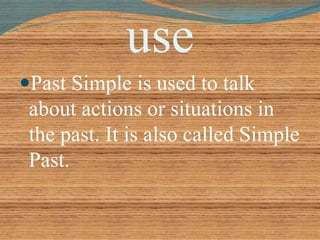
use 
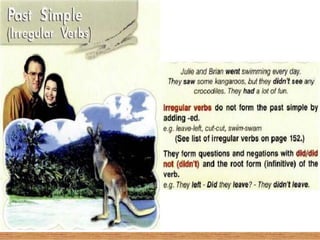
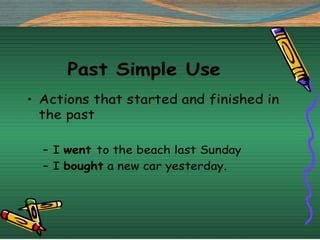
Past Simple is used to talk 
about actions or situations in 
the past. It is also called Simple 
Past.
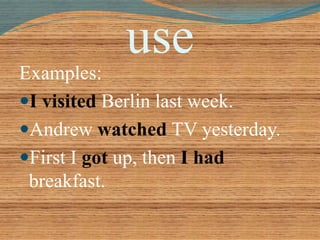
use 
Examples: 
I visited Berlin last week. 
Andrew watched TV yesterday. 
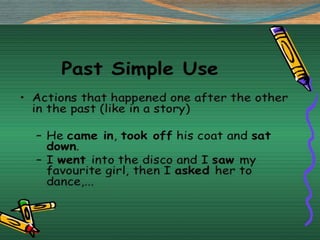
First I got up, then I had 
breakfast.
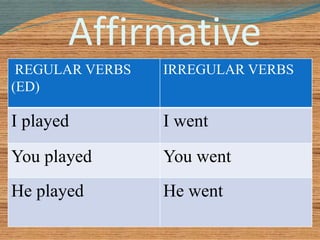
Affirmative 
REGULAR VERBS 
(ED) 
IRREGULAR VERBS 
I played I went 
You played You went 
He played He went
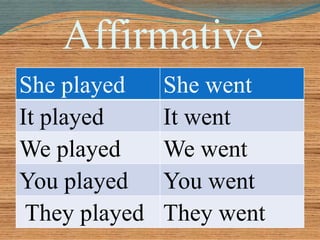
Affirmative 
She played She went 
It played It went 
We played We went 
You played You went 
They played They went
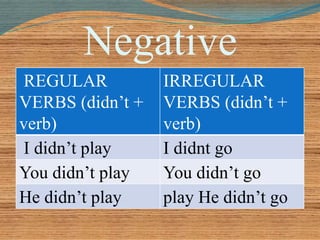
Negative 
REGULAR 
VERBS (didn’t + 
verb) 
IRREGULAR 
VERBS (didn’t + 
verb) 
I didn’t play I didnt go 
You didn’t play You didn’t go 
He didn’t play play He didn’t go
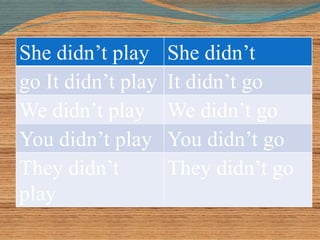
She didn’t play She didn’t 
go It didn’t play It didn’t go 
We didn’t play We didn’t go 
You didn’t play You didn’t go 
They didn’t 
play 
They didn’t go
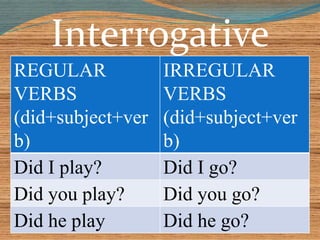
Interrogative 
REGULAR 
VERBS 
(did+subject+ver 
b) 
IRREGULAR 
VERBS 
(did+subject+ver 
b) 
Did I play? Did I go? 
Did you play? Did you go? 
Did he play Did he go?
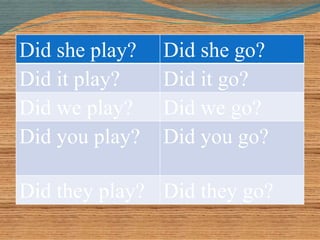
Did she play? Did she go? 
Did it play? Did it go? 
Did we play? Did we go? 
Did you play? Did you go? 
Did they play? Did they go?
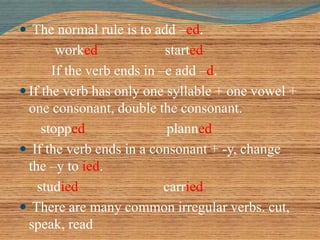
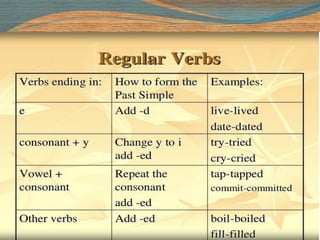
 The normal rule is to add –ed. 
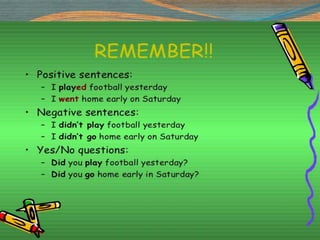
worked started 
If the verb ends in –e add –d. 

 If the verb has only one syllable + one vowel + 
one consonant, double the consonant. 
stopped planned 
 If the verb ends in a consonant + -y, change 
the –y to ied. 
studied carried 
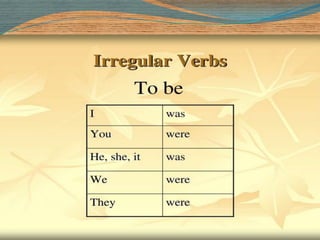
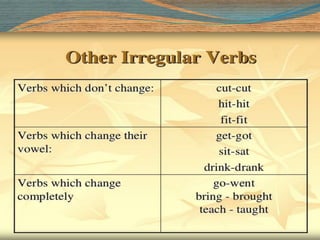
 There are many common irregular verbs. cut, 
speak, read
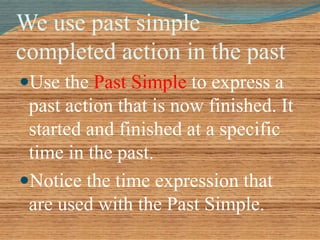
We use past simple 
completed action in the past 
Use the Past Simple to express a 
past action that is now finished. It 
started and finished at a specific 
time in the past. 
Notice the time expression that 
are used with the Past Simple.
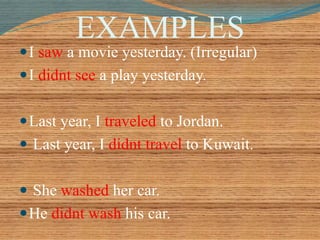
EXAMPLES 
 I saw a movie yesterday. (Irregular) 
 I didnt see a play yesterday. 
Last year, I traveled to Jordan. 
 Last year, I didnt travel to Kuwait. 
 She washed her car. 
He didnt wash his car.
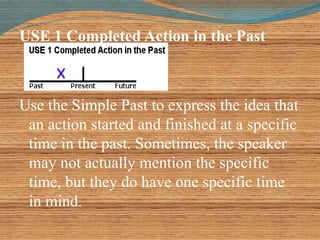
USE 1 Completed Action in the Past 
Use the Simple Past to express the idea that 
an action started and finished at a specific 
time in the past. Sometimes, the speaker 
may not actually mention the specific 
time, but they do have one specific time 
in mind.
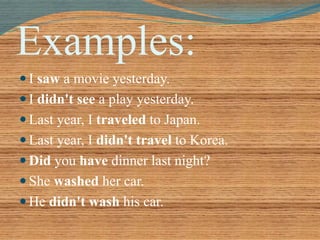
Examples: 
 I saw a movie yesterday. 
 I didn't see a play yesterday. 
 Last year, I traveled to Japan. 
 Last year, I didn't travel to Korea. 
 Did you have dinner last night? 
 She washed her car. 
 He didn't wash his car.
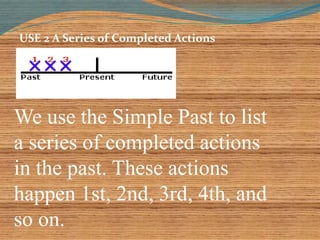
USE 2 A Series of Completed Actions 
We use the Simple Past to list 
a series of completed actions 
in the past. These actions 
happen 1st, 2nd, 3rd, 4th, and 
so on.
Examples: 
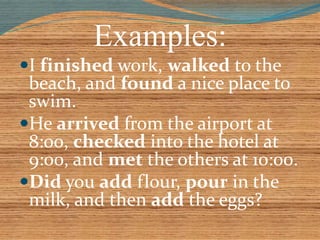
I finished work, walked to the 
beach, and found a nice place to 
swim. 
He arrived from the airport at 
8:00, checked into the hotel at 
9:00, and met the others at 10:00. 
Did you add flour, pour in the 
milk, and then add the eggs?
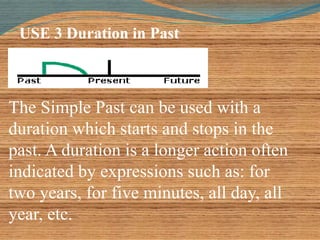
USE 3 Duration in Past 
The Simple Past can be used with a 
duration which starts and stops in the 
past. A duration is a longer action often 
indicated by expressions such as: for 
two years, for five minutes, all day, all 
year, etc.
Examples: 
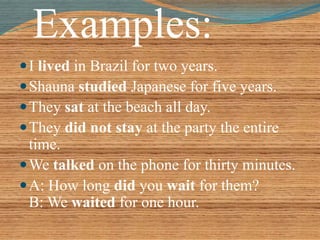
 I lived in Brazil for two years. 
Shauna studied Japanese for five years. 
They sat at the beach all day. 
They did not stay at the party the entire 
time. 
We talked on the phone for thirty minutes. 
A: How long did you wait for them? 
B: We waited for one hour.
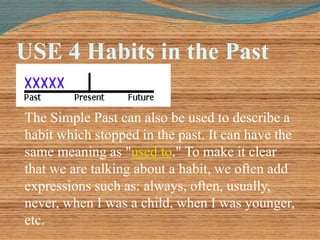
USE 4 Habits in the Past 
The Simple Past can also be used to describe a 
habit which stopped in the past. It can have the 
same meaning as "used to." To make it clear 
that we are talking about a habit, we often add 
expressions such as: always, often, usually, 
never, when I was a child, when I was younger, 
etc.
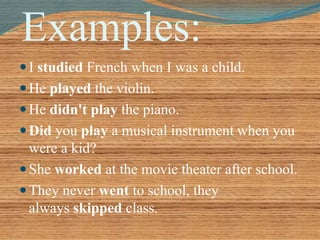
Examples: 
 I studied French when I was a child. 
He played the violin. 
He didn't play the piano. 
Did you play a musical instrument when you 
were a kid? 
 She worked at the movie theater after school. 
 They never went to school, they 
always skipped class.
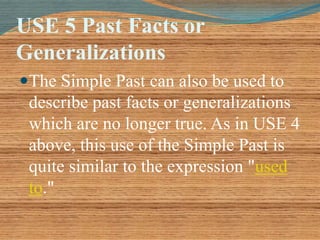
USE 5 Past Facts or 
Generalizations 
The Simple Past can also be used to 
describe past facts or generalizations 
which are no longer true. As in USE 4 
above, this use of the Simple Past is 
quite similar to the expression "used 
to."
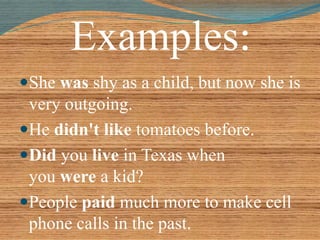
Examples: 
She was shy as a child, but now she is 
very outgoing. 
He didn't like tomatoes before. 
Did you live in Texas when 
you were a kid? 
People paid much more to make cell 
phone calls in the past.
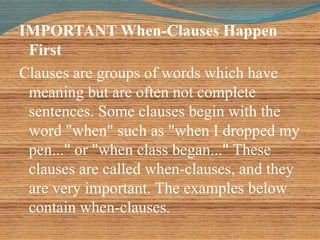
IMPORTANT When-Clauses Happen 
First 
Clauses are groups of words which have 
meaning but are often not complete 
sentences. Some clauses begin with the 
word "when" such as "when I dropped my 
pen..." or "when class began..." These 
clauses are called when-clauses, and they 
are very important. The examples below 
contain when-clauses.
Examples: 
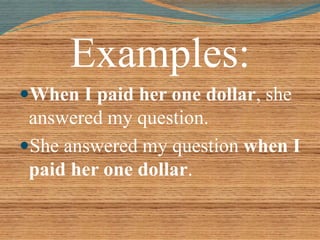
When I paid her one dollar, she 
answered my question. 
She answered my question when I 
paid her one dollar.
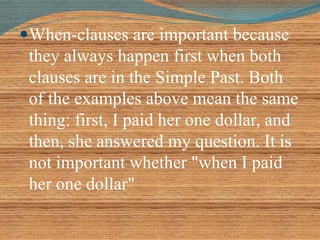
When-clauses are important because 
they always happen first when both 
clauses are in the Simple Past. Both 
of the examples above mean the same 
thing: first, I paid her one dollar, and 
then, she answered my question. It is 
not important whether "when I paid 
her one dollar"
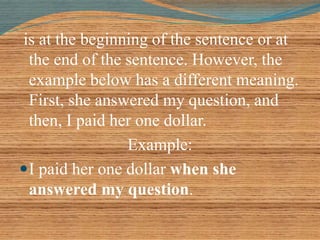
is at the beginning of the sentence or at 
the end of the sentence. However, the 
example below has a different meaning. 
First, she answered my question, and 
then, I paid her one dollar. 
Example: 
I paid her one dollar when she 
answered my question.
ADVERB PLACEMENT 
The examples below show 
the placement for grammar 
adverbs such as: always, 
only, never, ever, still, just, 
etc.
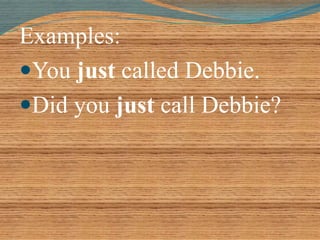
Examples: 
You just called Debbie. 
Did you just call Debbie?
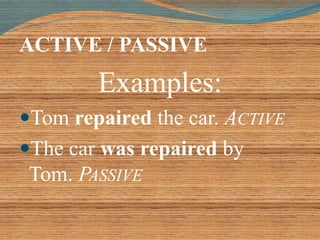
ACTIVE / PASSIVE 
Examples: 
Tom repaired the car. ACTIVE 
The car was repaired by 
Tom. PASSIVE
english
english
english
english
english
english
english
english

english

  • 1.
  • 2.
    use Past Simpleis used to talk about actions or situations in the past. It is also called Simple Past.
  • 3.
    use Examples: Ivisited Berlin last week. Andrew watched TV yesterday. First I got up, then I had breakfast.
  • 4.
    Affirmative REGULAR VERBS (ED) IRREGULAR VERBS I played I went You played You went He played He went
  • 5.
    Affirmative She playedShe went It played It went We played We went You played You went They played They went
  • 6.
    Negative REGULAR VERBS(didn’t + verb) IRREGULAR VERBS (didn’t + verb) I didn’t play I didnt go You didn’t play You didn’t go He didn’t play play He didn’t go
  • 7.
    She didn’t playShe didn’t go It didn’t play It didn’t go We didn’t play We didn’t go You didn’t play You didn’t go They didn’t play They didn’t go
  • 8.
    Interrogative REGULAR VERBS (did+subject+ver b) IRREGULAR VERBS (did+subject+ver b) Did I play? Did I go? Did you play? Did you go? Did he play Did he go?
  • 9.
    Did she play?Did she go? Did it play? Did it go? Did we play? Did we go? Did you play? Did you go? Did they play? Did they go?
  • 10.
     The normalrule is to add –ed. worked started If the verb ends in –e add –d.  If the verb has only one syllable + one vowel + one consonant, double the consonant. stopped planned  If the verb ends in a consonant + -y, change the –y to ied. studied carried  There are many common irregular verbs. cut, speak, read
  • 11.
    We use pastsimple completed action in the past Use the Past Simple to express a past action that is now finished. It started and finished at a specific time in the past. Notice the time expression that are used with the Past Simple.
  • 12.
    EXAMPLES  Isaw a movie yesterday. (Irregular)  I didnt see a play yesterday. Last year, I traveled to Jordan.  Last year, I didnt travel to Kuwait.  She washed her car. He didnt wash his car.
  • 14.
    USE 1 CompletedAction in the Past Use the Simple Past to express the idea that an action started and finished at a specific time in the past. Sometimes, the speaker may not actually mention the specific time, but they do have one specific time in mind.
  • 15.
    Examples:  Isaw a movie yesterday.  I didn't see a play yesterday.  Last year, I traveled to Japan.  Last year, I didn't travel to Korea.  Did you have dinner last night?  She washed her car.  He didn't wash his car.
  • 16.
    USE 2 ASeries of Completed Actions We use the Simple Past to list a series of completed actions in the past. These actions happen 1st, 2nd, 3rd, 4th, and so on.
  • 17.
    Examples: I finishedwork, walked to the beach, and found a nice place to swim. He arrived from the airport at 8:00, checked into the hotel at 9:00, and met the others at 10:00. Did you add flour, pour in the milk, and then add the eggs?
  • 18.
    USE 3 Durationin Past The Simple Past can be used with a duration which starts and stops in the past. A duration is a longer action often indicated by expressions such as: for two years, for five minutes, all day, all year, etc.
  • 19.
    Examples:  Ilived in Brazil for two years. Shauna studied Japanese for five years. They sat at the beach all day. They did not stay at the party the entire time. We talked on the phone for thirty minutes. A: How long did you wait for them? B: We waited for one hour.
  • 20.
    USE 4 Habitsin the Past The Simple Past can also be used to describe a habit which stopped in the past. It can have the same meaning as "used to." To make it clear that we are talking about a habit, we often add expressions such as: always, often, usually, never, when I was a child, when I was younger, etc.
  • 21.
    Examples:  Istudied French when I was a child. He played the violin. He didn't play the piano. Did you play a musical instrument when you were a kid?  She worked at the movie theater after school.  They never went to school, they always skipped class.
  • 22.
    USE 5 PastFacts or Generalizations The Simple Past can also be used to describe past facts or generalizations which are no longer true. As in USE 4 above, this use of the Simple Past is quite similar to the expression "used to."
  • 23.
    Examples: She wasshy as a child, but now she is very outgoing. He didn't like tomatoes before. Did you live in Texas when you were a kid? People paid much more to make cell phone calls in the past.
  • 24.
    IMPORTANT When-Clauses Happen First Clauses are groups of words which have meaning but are often not complete sentences. Some clauses begin with the word "when" such as "when I dropped my pen..." or "when class began..." These clauses are called when-clauses, and they are very important. The examples below contain when-clauses.
  • 25.
    Examples: When Ipaid her one dollar, she answered my question. She answered my question when I paid her one dollar.
  • 26.
    When-clauses are importantbecause they always happen first when both clauses are in the Simple Past. Both of the examples above mean the same thing: first, I paid her one dollar, and then, she answered my question. It is not important whether "when I paid her one dollar"
  • 27.
    is at thebeginning of the sentence or at the end of the sentence. However, the example below has a different meaning. First, she answered my question, and then, I paid her one dollar. Example: I paid her one dollar when she answered my question.
  • 28.
    ADVERB PLACEMENT Theexamples below show the placement for grammar adverbs such as: always, only, never, ever, still, just, etc.
  • 29.
    Examples: You justcalled Debbie. Did you just call Debbie?
  • 30.
    ACTIVE / PASSIVE Examples: Tom repaired the car. ACTIVE The car was repaired by Tom. PASSIVE