““Structural Transformations of PassiveStructural Transformations of Passive
Electrical Networks and SystemElectrical Networks and System
PropertiesProperties””
Professor Nicos Karcanias
Athens, 17 January 2013
NTUA
Systems & Control Research Centre,
EEIE Department
School of Engineering & Mathematical Sciences
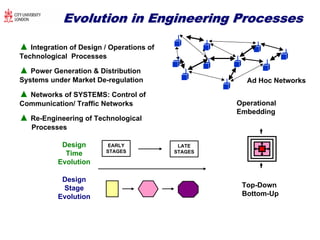
General Problem :ThemeGeneral Problem :Theme
TRADITIONAL CONTROL: THE SYSTEM IS ASSUMED FIXED
INTEGRATED SYSTEMS DESIGN: THE SYSTEM EVOLVES
THROUGH THE DIFFERENT DESIGN STAGES.
CONTROL AS INSTRUMENT IN GENERALISED DESIGN.
NEW PARADIGM: “STRUCTURE EVOLVING SYSTEMS”
SPECIAL CASE: “Passive Networks Redesign”
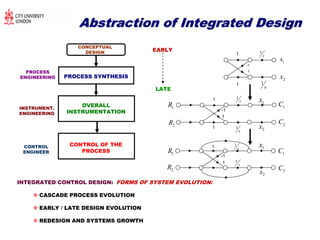
Evolution in Engineering ProcessesEvolution in Engineering Processes
Ad Hoc Networks
Operational
Embedding
Top-Down
Bottom-Up
Design
Stage
Evolution
EARLY
STAGES
LATE
STAGES
Design
Time
Evolution
▲ Integration of Design / Operations of
Technological Processes
▲ Power Generation & Distribution
Systems under Market De-regulation
▲ Networks of SYSTEMS: Control of
Communication/ Traffic Networks
▲ Re-Engineering of Technological
Processes
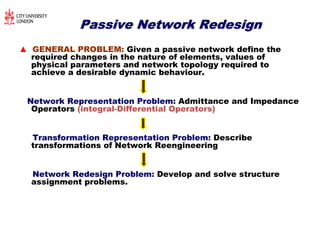
Abstraction of Integrated DesignAbstraction of Integrated Design
CONCEPTUAL
DESIGN
PROCESS SYNTHESIS
OVERALL
INSTRUMENTATION
CONTROL OF THE
PROCESS
EARLY
LATE
INTEGRATED CONTROL DESIGN: FORMS OF SYSTEM EVOLUTION:
 CASCADE PROCESS EVOLUTION
 EARLY / LATE DESIGN EVOLUTION
 REDESIGN AND SYSTEMS GROWTH
PROCESS
ENGINEERING
INSTRUMENT.
ENGINEERING
CONTROL
ENGINEER
1 1
s
1x
2x
-1
1
1 1
s
1R
2R
1
1
1
-1
2x
1x
1
s
1
s
1C
2C
1R
2R
1C
2C
-1
1
1
2x
1x1
s
1
s
Passive Network RedesignPassive Network Redesign
▲ GENERAL PROBLEM: Given a passive network define the
required changes in the nature of elements, values of
physical parameters and network topology required to
achieve a desirable dynamic behaviour.
Network Representation Problem: Admittance and Impedance
Operators (integral-Differential Operators)
Transformation Representation Problem: Describe
transformations of Network Reengineering
Network Redesign Problem: Develop and solve structure
assignment problems.
Classification of LampedClassification of Lamped
Physical ElementsPhysical Elements
• A-TYPE ELEMENTS: Translational mass; Inertia;
Electrical capacitance; Fluid capacitance; Thermal
capacitance
• T-TYPE ELEMENTS: Translational spring; Rotational
spring; Inductance; Fluid inertance
• D-TYPE ELEMENTS: Translational damper; Rotational
damper; Electrical resistance; Fluid resistance;
Thermal resistance
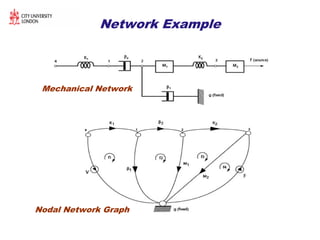
Network Example
Mechanical Network
Nodal Network Graph
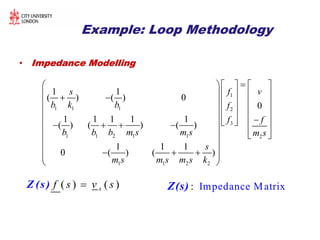
Example: Loop Methodology
•• Impedance ModellingImpedance Modelling
1
1 1 1 2
3
1 1 2 1 1 2
1 1 2 2
1 1
( ) ( ) 0
0
1 1 1 1 1
( ) ( ) ( )
1 1 1
0 ( ) ( )
s f v
b k b f
f f
b b b m s m s m s
s
m s m s m s k
     
      
     
     
           
  
 
   
 
( ) ( )sf s v sZ (s) Impedance M r x: at iZ(s)
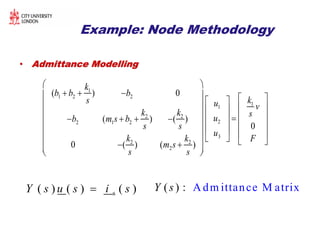
Example: Node Methodology
•• Admittance ModellingAdmittance Modelling
Adm ittance M atrix( ) :Y s
(b1  b2 
k1
s
) b2 0
b2 (m1s  b2 
k2
s
) (
k2
s
)
0 (
k2
s
) (m2s 
k2
s
)


















u1
u2
u3











k1
s
v
0
F












s( ) ( ) ( )Y s u s i s
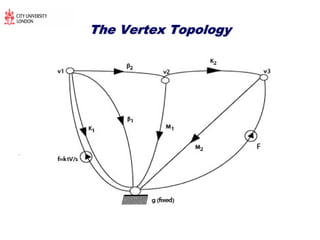
The Vertex TopologyThe Vertex Topology
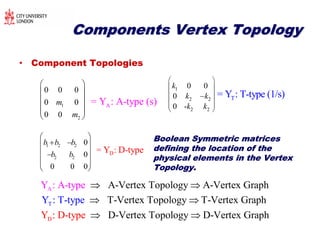
Components Vertex TopologyComponents Vertex Topology
• Component Topologies
1 2 2
2 2
0
0
0 0 0
b b b
b b
 
  
 
  
 
D= :Y D-type
1
2 2
2 2
0 0
0
0 -
k
k k
k k
 
 
 
 
 
 
 T= Y : T-type (1/s)
1
2
0 0 0
0 0
0 0
m
m
 
 
 
  
 
A= Y : A-type (s)
Boolean Symmetric matricesBoolean Symmetric matrices
defining the location of thedefining the location of the
physical elements in the Vertexphysical elements in the Vertex
Topology.Topology.
A A-Vertex TopologyY : A-typ A-Vertexe hGrap 
T T-Vertex TopologyY : T-typ T-Vertexe hGrap 
D D-Vertex TopologyY : D-typ D-Vertexe hGrap 
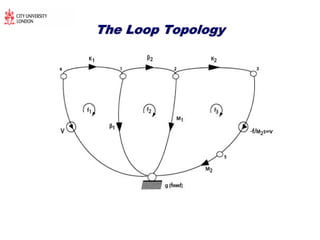
The Loop TopologyThe Loop Topology
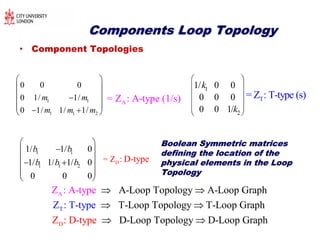
Components Loop TopologyComponents Loop Topology
• Component Topologies
1 1
1 1 2
1/ 1/ 0
1/ 1/ 1/ 0
0 0 0
b b
b b b
 
 
  
  
 
D= Z : D-type
1
2
1/ 0 0
0 0 0
0 0 1/
k
k
 
 
 
 
 
 
T= Z : T-type (s)1 1
1 1 2
0 0 0
0 1/ 1/
0 1/ 1/ 1/
m m
m m m
 
 
 
    
A= Z : A-type (1/s)
Boolean Symmetric matricesBoolean Symmetric matrices
defining the location of thedefining the location of the
physical elements in the Loopphysical elements in the Loop
TopologyTopology
A A-Loop TopologyZ : A-ty A-Loope p Graph 
T T-Loop TopologyZ : T-ty T-Loopp phe Gra 
D D-Loop TopologyZ : D-ty D-Loopp phe Gra 
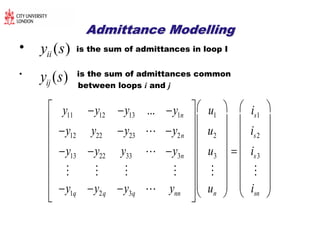
Admittance ModellingAdmittance Modelling
• is the sum of admittances in loop I
• is the sum of admittances common
between loops i and j
y11 y12 y13 ... y1n
y12 y22 y23  y2n
y13 y22 y33  y3n
   
y1q y2q y3q  ynn


















u1
u2
u3

un

















is1
is2
is3

isn
















yii (s)
yij (s)
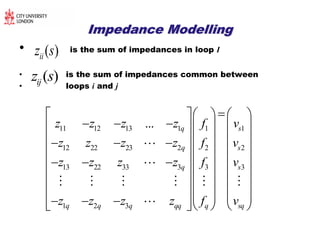
Impedance ModellingImpedance Modelling
• is the sum of impedances in loop I
• is the sum of impedances common between
• loops i and j
11 12 13 1 1 1
12 22 23 2 2 2
13 22 33 3 3 3
1 2 3
... q s
q s
q s
q q q qq q sq
z z z z f v
z z z z f v
z z z z f v
z z z z f v
    
       
      
    
       
    
    
          


     

zii(s)
( )ijz s
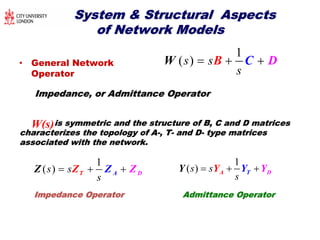
System & Structural AspectsSystem & Structural Aspects
of Network Modelsof Network Models
• General Network
Operator
1
( )s s
s
  B CW D
Impedance, or Admittance OperatorImpedance, or Admittance Operator
W(s)is symmetric and the structure of B, C and D matricis symmetric and the structure of B, C and D matriceses
characterizes the topology of Acharacterizes the topology of A--, T, T-- and Dand D-- type matricestype matrices
associated with the network.associated with the network.
1
( )s s
s
  TA DY Y Y Y
1
( )s s
s
  AT DZ Z Z Z
Impedance OperatorImpedance Operator Admittance OperatorAdmittance Operator
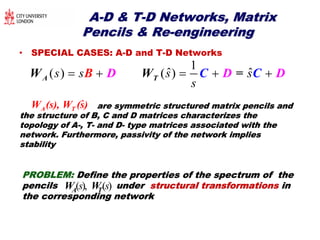
AA--D & TD & T--D Networks, MatrixD Networks, Matrix
Pencils & RePencils & Re--engineeringengineering
• SPECIAL CASES: A-D and T-D Networks
1
ˆ ˆ( ) ( )s s s s
s
    A TW W D =CD CB D
ˆA TW (s), W (s) are symmetric structured matrix penare symmetric structured matrix pencils andcils and
the structure of B, C and D matrices characterizes thethe structure of B, C and D matrices characterizes the
topology of Atopology of A--, T, T-- and Dand D-- type matrices associated with thetype matrices associated with the
network. Furthermore, passivity of the network impliesnetwork. Furthermore, passivity of the network implies
stabilitystability
PROBLEM:PROBLEM: Define the properties of the spectrum of theDefine the properties of the spectrum of the
pencils underpencils under structural transformationsstructural transformations inin
the corresponding networkthe corresponding network
( ), ( )s sTAW W
Basics of Network TopologyBasics of Network Topology
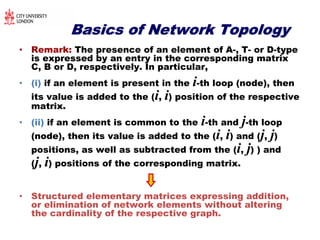
• Remark: The presence of an element of A-, T- or D-type
is expressed by an entry in the corresponding matrix
C, B or D, respectively. In particular,
• (i) if an element is present in the i-th loop (node), then
its value is added to the (i, i) position of the respective
matrix.
• (ii) if an element is common to the i-th and j-th loop
(node), then its value is added to the (i, i) and (j, j)
positions, as well as subtracted from the (i, j) ) and
(j, i) positions of the corresponding matrix.
• Structured elementary matrices expressing addition,
or elimination of network elements without altering
the cardinality of the respective graph.
The RC, RL Matrix PencilThe RC, RL Matrix Pencil
•• PROPERTIES OF THE RC, OR RL NETWORK OPERATORPROPERTIES OF THE RC, OR RL NETWORK OPERATOR
[ ]s



 
kxk
t t
sF + G
(sF + G) (sF + G) 0 F G 0
F = F 0, G = G 0
Given the network pencil we have the following properties :
(i) is regular, ie det and ker{ } ker{ } = { }
(ii) and all eigenvalues are real and non - posi
1 1fk  


  
}
}
:kxk
1
1,
sF + G
sF + G (sF + G) F
F G 0 T 0
tive
(iii) All finite eigenvalues are real and index{
(iv) If index{ then deg{det } = rank{ }
(v) If ker{ } ker{ } = { }, and diag{ },,..., 
0
{ } fk k k
t
T sF + G T = sI + sI sIblock - diag{ }  
Passive Networks Redesign
Problem
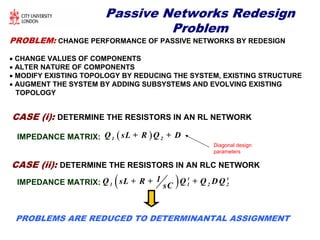
PROBLEM: CHANGE PERFORMANCE OF PASSIVE NETWORKS BY REDESIGN
 CHANGE VALUES OF COMPONENTS
 ALTER NATURE OF COMPONENTS
 MODIFY EXISTING TOPOLOGY BY REDUCING THE SYSTEM, EXISTING STRUCTURE
 AUGMENT THE SYSTEM BY ADDING SUBSYSTEMS AND EVOLVING EXISTING
TOPOLOGY
CASE (i): DETERMINE THE RESISTORS IN AN RL NETWORK
IMPEDANCE MATRIX:  1 2Q sL + R Q + D
Diagonal design
parameters
CASE (ii): DETERMINE THE RESISTORS IN AN RLC NETWORK
IMPEDANCE MATRIX:   t t
1 1 2 2
1Q sL + R + Q + Q DQ
sC
PROBLEMS ARE REDUCED TO DETERMINANTAL ASSIGNMENT
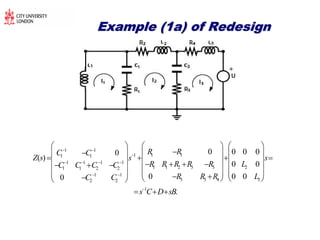
Example (1a) of RedesignExample (1a) of Redesign
1 1
1 111 1
1 1 1 1
1 1 2 3 3 21 1 2 2
1 1
3 3 4 32 2
1
0 0 0 00
( )
0 0
0 0 00
.
R RC C
Z s s s
R R R R R LC C C C
R R R LC C
s C D sB
 

   
 

     
     
                  
           
  
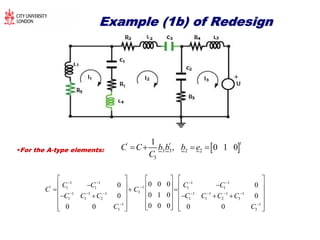
Example (1b) of RedesignExample (1b) of Redesign
 '
3 3 2 2
3
1
, 0 1 0
tt
C C b b b e
C
   
1 1 1 1
' 11 1 1 1
31 1 1 1 1 1 1
1 1 2 1 1 2 3
1 1
3 3
0 0 00 0
0 1 00 0
0 0 00 0 0 0
C C C C
C C
C C C C C C C
C C
   

      
 
     
                 
     
        
For the A-type elements:
Example (1c) of RedesignExample (1c) of Redesign
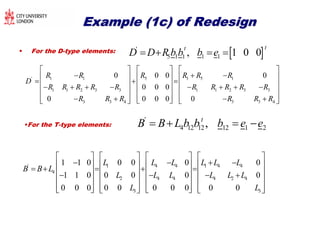
 For the D-type elements:
 '
5 1 1 1 1, 1 0 0
tt
D D R b b b e   
1 1 5 1 5 1'
1 1 2 3 3 1 1 2 3 3
3 3 4 3 3 4
0 0 0 0
0 0 0
0 0 0 0 0
R R R R R R
D
R R R R R R R R R R
R R R R R R
     
                     
     
           
For the T-type elements:
'
4 12 12 12 1 2,t
B B L b b b e e   
1 4 4 1 4 4'
4
2 4 4 4 2 4
3 3
1 1 0 0 0 0 0
1 1 0 0 0 0 0
0 0 0 0 0 0 0 0 0 0
L L L L L L
B B L
L L L L L L
L L
       
                        
       
            
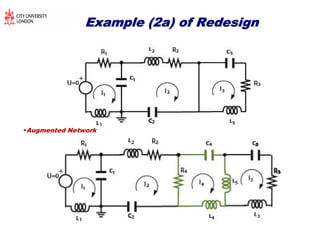
Example (2a) of RedesignExample (2a) of Redesign
Augmented Network
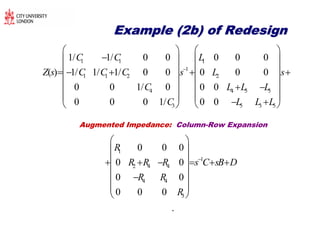
Example (2b) of RedesignExample (2b) of Redesign
1 1 1
1
1 1 2 2
4 4 5 5
3 5 3 5
1
1
2 4 4
4 4
3
1/ 1/ 0 0 0 0 0
( ) 1/ 1/ 1/ 0 0 0 0 0
0 0 1/ 0 0 0
0 0 0 1/ 0 0
0 0 0
0 0
0 0
0 0 0
C C L
Z s C C C s L s
C L L L
C L L L
R
R R R s C sB D
R R
R


   
   
       
   
    
       
 
 
      
 
 
 
 
.
Augmented Impedance: Column-Row Expansion
AA--D & TD & T--D Networks: singleD Networks: single
Parameter PerturbationsParameter Perturbations
• PROBLEM: [ ]s

kxk
'
sF + G
F F + F(x,b), G = G + G(x,b),
F(x,b),G(x,b) = xbb
Given investigate the effect
of perturbations on the pencil of the type :
where
, , 


t
i i jb = e b = e e
f(s,F,G, x,b)= det(s(F + F(x,b))+ G)
f(s,F
or
Study the determinantal assignment problems
,G, x,b)= det(sF + G + (G(x,b))
The Network CharacteristicThe Network Characteristic
PolynomialPolynomial (a)(a)
• Problem Formulation: Binet-Cauchy Theorem




( )
[ ]

i
i j
k
k
-k b = e
b = e e
f(s,F,G, x,b)= det s(F + F(x,b))+ G =
I
= det sF + G, I
sF(x,b)
(second order
(firs
variatio
node or loop graph a t order variation)nd or
n)
Assume :
   2k
k
2k1
k
x

 

 
  
 
[ ]
t
kt
k k k
g(s,F,G) p(s, x,b)
I
g(s,F,G) = C sF + G, I , p(s, x,b) = C
sF(x,b)
g(s,F,G) :
p(s, x,b) : Grass
Grassmann vector of
mann vector of the
the netw
structu
ork
ralperturbation
The Network CharacteristicThe Network Characteristic
PolynomialPolynomial (b)(b)
• Lemma: Grassmann vector of Structural Perturbation
, ,
( )=( , ( )
i
sx
sign

    
  

    

k,2k
[ ],
) Q
( ) ( ) ( )
j
1,0,..,a 0,...,0 a
1,.., -1, +1,k,...k+
b= e
b=
p(s,x,b),
p s,x,e =
p(s,x,b)e e
firstorder variation
secondorder varia
hasthestructure:
tion : ha-
:
1 2 3 4,
( ) , r= ( )
( )=( , ( )=(
i
r
j j i j j j
r sx r
   
  
 
 
k,2k
[ ]
) Q
( ) , , ,j ( ) ( ) ( ) ( )
( )
1,0,..,a 0,...,0,a 0,...,0,a 0,...,0,a 0,...,0
a 1,2,3,4 1
1 1,2,.., -1, +1,...,k,k+ 2 1,2,.., -1, +1,...,k,k+
p s,x,e e =
sthestructure:
-
,
( )=( , ( )=(i i i i j 

 
k,2k
k,2k k,2k
) Q
) Q ) Q3 1,2,..,i -1, +1,...,k,k+ 4 1,2,.., -1, +1,...,k,k+
The Network CharacteristicThe Network Characteristic
PolynomialPolynomial (c)(c)
• LEMMA: GRASSMANN VECTORS OF STRUCTURAL
PERTURBATIONS
, ,
( )=( , ( )
i
sx
sign

    
  

    

k,2k
[ ],
) Q
( )
firstorder variation
secondorder
hasthestructure:
variation ha:-
:
( ) ( )
j
1,0,..,a 0,...,0 a
1,.., -1, +1,k,...k+
p(s,x,b),
p s,x,e =
p(s,
b= e
b= e e x,b)
1 2 3 4,
( ) , r= ( )
( )=( , ( )=(
i
r
j j i j j j
r sx r
   
  
 
 
k,2k
[ ]
) Q
( ) , , ,
sthestructure:
- j ( ) ( ) ( ) ( )
( )
1,0,..,a 0,...,0,a 0,...,0,a 0,...,0,a 0,...,0
a 1,2,3,4 1
1 1,2,.., -1, +1,...,k,k+ 2 1,2,.., -1, +1,...,k,k+
p s,x,e e =
,
( )=( , ( )=(i i i i j 

 
k,2k
k,2k k,2k
) Q
) Q ) Q3 1,2,..,i -1, +1,...,k,k+ 4 1,2,.., -1, +1,...,k,k+
RC, RL Single Variations asRC, RL Single Variations as
Root Locus ProblemRoot Locus Problem
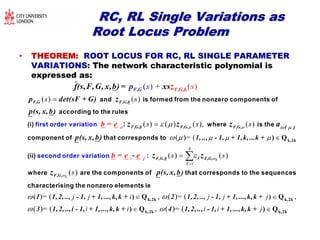
•• THEOREM:THEOREM: ROOT LOCUS FOR RC, RL SINGLE PARAMETER
VARIATIONS: The network characteristic polynomial is
expressed as:
( ) ( )
+) ( )(
s s
ss


and is formed from the nonzero compon
first order variation
ents of
according to the rules
(i)
F,G F,G,b
F, F,G,bG
p det(sF + G)
p(s,
b =
x,b)
e
f(s,F,G, x,b) =
z
p xsz
4
1
( ) ( ) ( ), ( )
( )= (
( )i
s s s
s
  

 
  
 
 




 
k,2k) Q
where is the
component of that corr
second order variation
esponds to
(ii :) -
: F,G,b F,G, F,G,
F,G,bj F,G,
( )
1, .., - 1, + 1,k, ...k +
b = e e
p(s, x,b)
z z z a
z z

( )
( )
( )= ( , ( )= (j j i j j j
s
s
  k,2k k) Q ) Q
where are the components of that corresponds to the sequences
characterising the nonzero elements ie
F,G,
1 1,2, .., - 1, + 1, ...,k,k + 2 1,2, .., - 1, + 1, ...,k,k +
p(s, x,b)z


,
( )= ( , ( )= (i i i i j  
,2k
k,2k k,2k) Q ) Q3 1,2, ..,i - 1, + 1, ...,k,k + 4 1,2, .., - 1, + 1, ...,k,k +
Root Locus & Fixed ModesRoot Locus & Fixed Modes
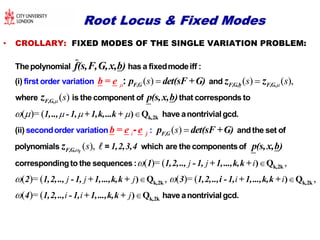
• CROLLARY: FIXED MODES OF THE SINGLE VARIATION PROBLEM:
( ) ( ) ( ),
( )
( )
s s s
s
 
 
 
Thepolynomial has a fixedmodeiff :
(i) and
where is the component of that corr
first order variatio
esponds to
n : F,G F,G,b F,G,
F,G,
p det(sF +b = e G)
p(s,x,b)
f(s,F,G,x,b)
z z
z
= (
( )
( ),
i s
s
   

k,2k) Q
secondord
have anontrivialgcd.
(ii) andthe set of
polynomials = which are the compon
er variati
entso
on
f
:- F,Gj
F,G,
1,.., - 1, + 1,k,...k +
1,2,3,4
b = e e p det(sF +G)
p(s,xz 

( )= ( ,
( )= ( , ( )= ( ,
( )= (
j j i
j j j i i
i i j

 


 

k,2k
k,2k k,2k
k,2k
) Q
) Q ) Q
) Q
correspondingto the sequences:
have a
1 1,2,.., -1, + 1,...,k,k +
2 1,2,.., -1, + 1,...,k,k + 3 1,2,..,i -1, + 1,...,k,k +
4 1,2,.., -1, + 1,...,k,k +
,b)
nontrivialgcd.
Properties of Root LocusProperties of Root Locus
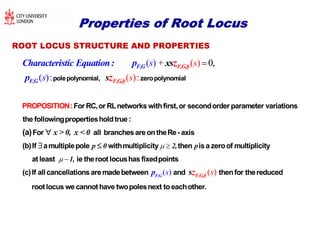
ROOT LOCUS STRUCTURE AND PROPERTIES
+ 0( ) ,
( )
( )
:( ):
ss
s s
F,G,F,G
F,G
b
F,G,b
Characte xsristic Equation: p
sp
z
zpolepolynomial, zeropolynomial
For RC,or RLnetworks withfirst,or secondorder parameter varPROP iatiOSITION: ons
the




p 0 2, p
1,
x > 0, x < 0
followingpropertiesholdtrue:
For all branchesareontheRe- axis
(b)If amultiplepole withmultiplicity then isa zeroof multiplicity
at least ie theroot
(a)
 

( ) ( )s sF,G F,G,bp sz
locushas fixedpoints
(c)If allcancellationsaremadebetween and thenfor thereduced
root locus wecannot have twopolesnext toeachother.
Interlacing Properties of RootInterlacing Properties of Root
LocusLocus
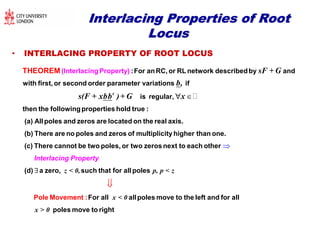
• INTERLACING PROPERTY OF ROOT LOCUS
t
sF + G
b,
s(F + xbb )+ G x
:For anRC, or RL network describedby and
with first, or second order parameter variations if
is regular,
then t
(Interlacing
he
Property)THEOREM

followingproperties hold true :
(a) Allpoles and zeros are located on the real axis.
(b) There are no poles and zeros of multiplicity higher than one.
(c) There cannot be two poles, or two zeros nex 

z < 0, p, p < z
x < 0
t to each other
(d) a zero, such that for allpoles
For all allpoles move to tPole Mo hvement : e l

Interlacing Property
x > 0
eft and for all
poles move to right
Future ResearchFuture Research
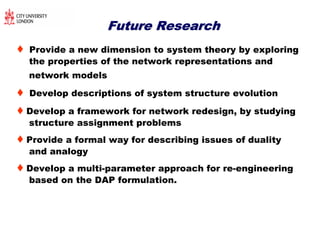
♦ Provide a new dimension to system theory by exploring
the properties of the network representations and
network models
♦ Develop descriptions of system structure evolution
♦ Develop a framework for network redesign, by studying
structure assignment problems
♦ Provide a formal way for describing issues of duality
and analogy
♦ Develop a multi-parameter approach for re-engineering
based on the DAP formulation.
APPENDIXAPPENDIX
Dimensional Variability ofDimensional Variability of
Interconnection GraphInterconnection Graph
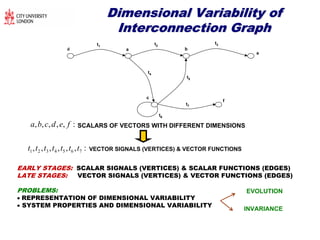
f
t4
t5
e
ba
t6
c
d
t1
t2
t3
t7
, , , , , :a b c d e f SCALARS OF VECTORS WITH DIFFERENT DIMENSIONS
1 2 3 4 5 6 7, , , , , , :t t t t t t t VECTOR SIGNALS (VERTICES) & VECTOR FUNCTIONS
EARLY STAGES: SCALAR SIGNALS (VERTICES) & SCALAR FUNCTIONS (EDGES)
LATE STAGES: VECTOR SIGNALS (VERTICES) & VECTOR FUNCTIONS (EDGES)
PROBLEMS:
 REPRESENTATION OF DIMENSIONAL VARIABILITY
 SYSTEM PROPERTIES AND DIMENSIONAL VARIABILITY
INVARIANCE
EVOLUTION
Life Cycle Evolution of Systems:Life Cycle Evolution of Systems:
Growth, DeathGrowth, Death
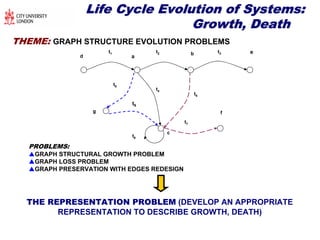
THEME: GRAPH STRUCTURE EVOLUTION PROBLEMS
t6
t9
t8
t4
g
c
d a
b e
f
t1 t2 t3
t5
t7
PROBLEMS:
GRAPH STRUCTURAL GROWTH PROBLEM
GRAPH LOSS PROBLEM
GRAPH PRESERVATION WITH EDGES REDESIGN
THE REPRESENTATION PROBLEM (DEVELOP AN APPROPRIATE
REPRESENTATION TO DESCRIBE GROWTH, DEATH)
Canonical ExampleCanonical Example
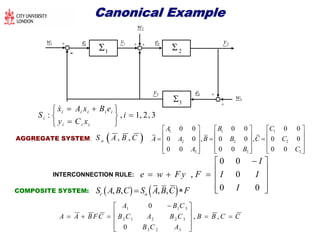
1 2
3 +
+
+ + +
-
1w 1e 1y
2w
2e 2y
3y 3e
3w
: , 1, 2, 3
i i i i i
i
i i i
x A x B e
S i
y C x
  
 
 

AGGREGATE SYSTEM:  , ,aS A B C
1 1 1
2 2 2
3 3 3
0 0 0 0 0 0
0 0 , 0 0 , 0 0
0 0 0 0 0 0
A B C
A A B B C C
A B C
     
            
          
INTERCONNECTION RULE:
0 0
, 0
0 0
I
e w F y F I I
I
 
     
  COMPOSITE SYSTEM:    , , , ,c aS A B C S A B C F 
1 1 3
2 1 2 2 3
3 2 3
0
, ,
0
A B C
A A BFC B C A B C B B C C
B C A
 
      
  
Composition, Completeness &
Equivalent Feedback Configuration
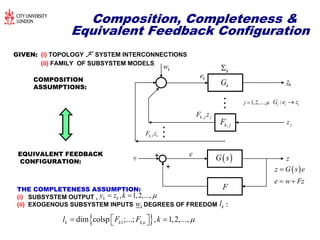
GIVEN: (i) TOPOLOGY  SYSTEM INTERCONNECTIONS
(ii) FAMILY OF SUBSYSTEM MODELS
COMPOSITION
ASSUMPTIONS:
ke

kG
,k jF
,1 1kF z 
,k j jF z
kw
k
kz
jz
1,2,...,j  : i i iG e z
EQUIVALENT FEEDBACK
CONFIGURATION:
w +
+
e
 G s
F
z
 
 
z G s e
e w Fz
THE COMPLETENESS ASSUMPTION:
(i) SUBSYSTEM OUTPUT ,
(ii) EXOGENOUS SUBSYSTEM INPUTS DEGREES OF FREEDOM :
, 1,2,...,k ky z k  
kw kl
 1dim colsp ;...; , 1,2,...,k k kl F F k    
Equivalent Feedback Configuration:
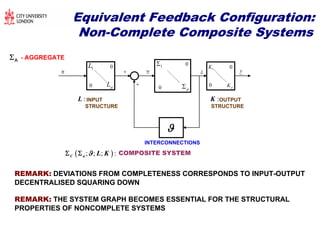
Non-Complete Composite Systems
INTERCONNECTIONS
REMARK: DEVIATIONS FROM COMPLETENESS CORRESPONDS TO INPUT-OUTPUT
DECENTRALISED SQUARING DOWN
REMARK: THE SYSTEM GRAPH BECOMES ESSENTIAL FOR THE STRUCTURAL
PROPERTIES OF NONCOMPLETE SYSTEMS
- AGGREGATE A
INPUT
STRUCTURE
:L OUTPUT
STRUCTURE
:K
u
1L
L0
0


w
1
0
0

z y1K
K
0
0
COMPOSITE SYSTEM ; ; ; :C a L K 
Design Time Dependent EvolutionDesign Time Dependent Evolution
In Integrated DesignIn Integrated Design
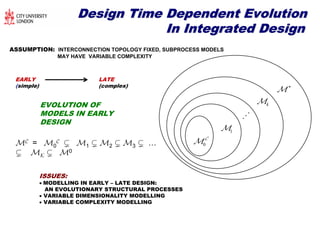
ASSUMPTION: INTERCONNECTION TOPOLOGY FIXED, SUBPROCESS MODELS
MAY HAVE VARIABLE COMPLEXITY
EARLY
(simple)
LATE
(complex)
EVOLUTION OF
MODELS IN EARLY
DESIGN
 = 0
  1  2  3  …
   0
ISSUES:
 MODELLING IN EARLY – LATE DESIGN:
AN EVOLUTIONARY STRUCTURAL PROCESSES
 VARIABLE DIMENSIONALITY MODELLING
 VARIABLE COMPLEXITY MODELLING
0


1
k



Variable Complexity Modelling
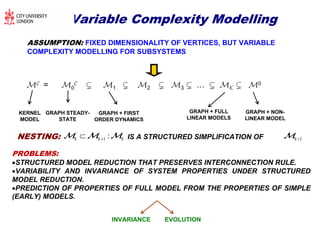
ASSUMPTION: FIXED DIMENSIONALITY OF VERTICES, BUT VARIABLE
COMPLEXITY MODELLING FOR SUBSYSTEMS
 = 0
  1  2  3  …    0
KERNEL
MODEL
GRAPH STEADY-
STATE
GRAPH + FIRST
ORDER DYNAMICS
GRAPH + FULL
LINEAR MODELS
GRAPH + NON-
LINEAR MODEL
1 :k k k   1kNESTING: IS A STRUCTURED SIMPLIFICATION OF
PROBLEMS:
STRUCTURED MODEL REDUCTION THAT PRESERVES INTERCONNECTION RULE.
VARIABILITY AND INVARIANCE OF SYSTEM PROPERTIES UNDER STRUCTURED
MODEL REDUCTION.
PREDICTION OF PROPERTIES OF FULL MODEL FROM THE PROPERTIES OF SIMPLE
(EARLY) MODELS.
INVARIANCE EVOLUTION
The Notion of Kernel ModelThe Notion of Kernel Model
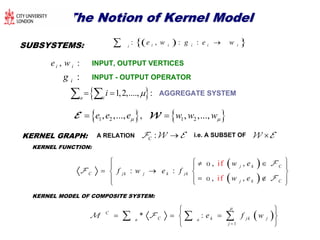
  : , : :i i i i ii
e w g e wSUBSYSTEMS:
, :i ie w INPUT, OUTPUT VERTICES
:ig INPUT - OUTPUT OPERATOR
 1,2,...., :a i
i    AGGREGATE SYSTEM
   1 2 1 2, ,..., , , ,...,e e e w w w   
KERNEL GRAPH: A RELATION :C    i.e. A SUBSET OF  
KERNEL FUNCTION:
 
 
, ,
: :
, ,
if
if
j k C
C jk j k jk
j k C
w e
f w e f
w e
     
   
    





KERNEL MODEL OF COMPOSITE SYSTEM:
 
1
* :C
C k jk ja a
j
e f w


 
   
 
   

Passive network-redesign-ntua

  • 1.
    ““Structural Transformations ofPassiveStructural Transformations of Passive Electrical Networks and SystemElectrical Networks and System PropertiesProperties”” Professor Nicos Karcanias Athens, 17 January 2013 NTUA Systems & Control Research Centre, EEIE Department School of Engineering & Mathematical Sciences
  • 2.
    General Problem :ThemeGeneralProblem :Theme TRADITIONAL CONTROL: THE SYSTEM IS ASSUMED FIXED INTEGRATED SYSTEMS DESIGN: THE SYSTEM EVOLVES THROUGH THE DIFFERENT DESIGN STAGES. CONTROL AS INSTRUMENT IN GENERALISED DESIGN. NEW PARADIGM: “STRUCTURE EVOLVING SYSTEMS” SPECIAL CASE: “Passive Networks Redesign”
  • 3.
    Evolution in EngineeringProcessesEvolution in Engineering Processes Ad Hoc Networks Operational Embedding Top-Down Bottom-Up Design Stage Evolution EARLY STAGES LATE STAGES Design Time Evolution ▲ Integration of Design / Operations of Technological Processes ▲ Power Generation & Distribution Systems under Market De-regulation ▲ Networks of SYSTEMS: Control of Communication/ Traffic Networks ▲ Re-Engineering of Technological Processes
  • 4.
    Abstraction of IntegratedDesignAbstraction of Integrated Design CONCEPTUAL DESIGN PROCESS SYNTHESIS OVERALL INSTRUMENTATION CONTROL OF THE PROCESS EARLY LATE INTEGRATED CONTROL DESIGN: FORMS OF SYSTEM EVOLUTION:  CASCADE PROCESS EVOLUTION  EARLY / LATE DESIGN EVOLUTION  REDESIGN AND SYSTEMS GROWTH PROCESS ENGINEERING INSTRUMENT. ENGINEERING CONTROL ENGINEER 1 1 s 1x 2x -1 1 1 1 s 1R 2R 1 1 1 -1 2x 1x 1 s 1 s 1C 2C 1R 2R 1C 2C -1 1 1 2x 1x1 s 1 s
  • 5.
    Passive Network RedesignPassiveNetwork Redesign ▲ GENERAL PROBLEM: Given a passive network define the required changes in the nature of elements, values of physical parameters and network topology required to achieve a desirable dynamic behaviour. Network Representation Problem: Admittance and Impedance Operators (integral-Differential Operators) Transformation Representation Problem: Describe transformations of Network Reengineering Network Redesign Problem: Develop and solve structure assignment problems.
  • 6.
    Classification of LampedClassificationof Lamped Physical ElementsPhysical Elements • A-TYPE ELEMENTS: Translational mass; Inertia; Electrical capacitance; Fluid capacitance; Thermal capacitance • T-TYPE ELEMENTS: Translational spring; Rotational spring; Inductance; Fluid inertance • D-TYPE ELEMENTS: Translational damper; Rotational damper; Electrical resistance; Fluid resistance; Thermal resistance
  • 7.
  • 8.
    Example: Loop Methodology ••Impedance ModellingImpedance Modelling 1 1 1 1 2 3 1 1 2 1 1 2 1 1 2 2 1 1 ( ) ( ) 0 0 1 1 1 1 1 ( ) ( ) ( ) 1 1 1 0 ( ) ( ) s f v b k b f f f b b b m s m s m s s m s m s m s k                                                 ( ) ( )sf s v sZ (s) Impedance M r x: at iZ(s)
  • 9.
    Example: Node Methodology ••Admittance ModellingAdmittance Modelling Adm ittance M atrix( ) :Y s (b1  b2  k1 s ) b2 0 b2 (m1s  b2  k2 s ) ( k2 s ) 0 ( k2 s ) (m2s  k2 s )                   u1 u2 u3            k1 s v 0 F             s( ) ( ) ( )Y s u s i s
  • 10.
    The Vertex TopologyTheVertex Topology
  • 11.
    Components Vertex TopologyComponentsVertex Topology • Component Topologies 1 2 2 2 2 0 0 0 0 0 b b b b b             D= :Y D-type 1 2 2 2 2 0 0 0 0 - k k k k k              T= Y : T-type (1/s) 1 2 0 0 0 0 0 0 0 m m            A= Y : A-type (s) Boolean Symmetric matricesBoolean Symmetric matrices defining the location of thedefining the location of the physical elements in the Vertexphysical elements in the Vertex Topology.Topology. A A-Vertex TopologyY : A-typ A-Vertexe hGrap  T T-Vertex TopologyY : T-typ T-Vertexe hGrap  D D-Vertex TopologyY : D-typ D-Vertexe hGrap 
  • 12.
    The Loop TopologyTheLoop Topology
  • 13.
    Components Loop TopologyComponentsLoop Topology • Component Topologies 1 1 1 1 2 1/ 1/ 0 1/ 1/ 1/ 0 0 0 0 b b b b b             D= Z : D-type 1 2 1/ 0 0 0 0 0 0 0 1/ k k             T= Z : T-type (s)1 1 1 1 2 0 0 0 0 1/ 1/ 0 1/ 1/ 1/ m m m m m            A= Z : A-type (1/s) Boolean Symmetric matricesBoolean Symmetric matrices defining the location of thedefining the location of the physical elements in the Loopphysical elements in the Loop TopologyTopology A A-Loop TopologyZ : A-ty A-Loope p Graph  T T-Loop TopologyZ : T-ty T-Loopp phe Gra  D D-Loop TopologyZ : D-ty D-Loopp phe Gra 
  • 14.
    Admittance ModellingAdmittance Modelling •is the sum of admittances in loop I • is the sum of admittances common between loops i and j y11 y12 y13 ... y1n y12 y22 y23  y2n y13 y22 y33  y3n     y1q y2q y3q  ynn                   u1 u2 u3  un                  is1 is2 is3  isn                 yii (s) yij (s)
  • 15.
    Impedance ModellingImpedance Modelling •is the sum of impedances in loop I • is the sum of impedances common between • loops i and j 11 12 13 1 1 1 12 22 23 2 2 2 13 22 33 3 3 3 1 2 3 ... q s q s q s q q q qq q sq z z z z f v z z z z f v z z z z f v z z z z f v                                                                zii(s) ( )ijz s
  • 16.
    System & StructuralAspectsSystem & Structural Aspects of Network Modelsof Network Models • General Network Operator 1 ( )s s s   B CW D Impedance, or Admittance OperatorImpedance, or Admittance Operator W(s)is symmetric and the structure of B, C and D matricis symmetric and the structure of B, C and D matriceses characterizes the topology of Acharacterizes the topology of A--, T, T-- and Dand D-- type matricestype matrices associated with the network.associated with the network. 1 ( )s s s   TA DY Y Y Y 1 ( )s s s   AT DZ Z Z Z Impedance OperatorImpedance Operator Admittance OperatorAdmittance Operator
  • 17.
    AA--D & TD& T--D Networks, MatrixD Networks, Matrix Pencils & RePencils & Re--engineeringengineering • SPECIAL CASES: A-D and T-D Networks 1 ˆ ˆ( ) ( )s s s s s     A TW W D =CD CB D ˆA TW (s), W (s) are symmetric structured matrix penare symmetric structured matrix pencils andcils and the structure of B, C and D matrices characterizes thethe structure of B, C and D matrices characterizes the topology of Atopology of A--, T, T-- and Dand D-- type matrices associated with thetype matrices associated with the network. Furthermore, passivity of the network impliesnetwork. Furthermore, passivity of the network implies stabilitystability PROBLEM:PROBLEM: Define the properties of the spectrum of theDefine the properties of the spectrum of the pencils underpencils under structural transformationsstructural transformations inin the corresponding networkthe corresponding network ( ), ( )s sTAW W
  • 18.
    Basics of NetworkTopologyBasics of Network Topology • Remark: The presence of an element of A-, T- or D-type is expressed by an entry in the corresponding matrix C, B or D, respectively. In particular, • (i) if an element is present in the i-th loop (node), then its value is added to the (i, i) position of the respective matrix. • (ii) if an element is common to the i-th and j-th loop (node), then its value is added to the (i, i) and (j, j) positions, as well as subtracted from the (i, j) ) and (j, i) positions of the corresponding matrix. • Structured elementary matrices expressing addition, or elimination of network elements without altering the cardinality of the respective graph.
  • 19.
    The RC, RLMatrix PencilThe RC, RL Matrix Pencil •• PROPERTIES OF THE RC, OR RL NETWORK OPERATORPROPERTIES OF THE RC, OR RL NETWORK OPERATOR [ ]s      kxk t t sF + G (sF + G) (sF + G) 0 F G 0 F = F 0, G = G 0 Given the network pencil we have the following properties : (i) is regular, ie det and ker{ } ker{ } = { } (ii) and all eigenvalues are real and non - posi 1 1fk        } } :kxk 1 1, sF + G sF + G (sF + G) F F G 0 T 0 tive (iii) All finite eigenvalues are real and index{ (iv) If index{ then deg{det } = rank{ } (v) If ker{ } ker{ } = { }, and diag{ },,...,  0 { } fk k k t T sF + G T = sI + sI sIblock - diag{ }  
  • 20.
    Passive Networks Redesign Problem PROBLEM:CHANGE PERFORMANCE OF PASSIVE NETWORKS BY REDESIGN  CHANGE VALUES OF COMPONENTS  ALTER NATURE OF COMPONENTS  MODIFY EXISTING TOPOLOGY BY REDUCING THE SYSTEM, EXISTING STRUCTURE  AUGMENT THE SYSTEM BY ADDING SUBSYSTEMS AND EVOLVING EXISTING TOPOLOGY CASE (i): DETERMINE THE RESISTORS IN AN RL NETWORK IMPEDANCE MATRIX:  1 2Q sL + R Q + D Diagonal design parameters CASE (ii): DETERMINE THE RESISTORS IN AN RLC NETWORK IMPEDANCE MATRIX:   t t 1 1 2 2 1Q sL + R + Q + Q DQ sC PROBLEMS ARE REDUCED TO DETERMINANTAL ASSIGNMENT
  • 21.
    Example (1a) ofRedesignExample (1a) of Redesign 1 1 1 111 1 1 1 1 1 1 1 2 3 3 21 1 2 2 1 1 3 3 4 32 2 1 0 0 0 00 ( ) 0 0 0 0 00 . R RC C Z s s s R R R R R LC C C C R R R LC C s C D sB                                                        
  • 22.
    Example (1b) ofRedesignExample (1b) of Redesign  ' 3 3 2 2 3 1 , 0 1 0 tt C C b b b e C     1 1 1 1 ' 11 1 1 1 31 1 1 1 1 1 1 1 1 2 1 1 2 3 1 1 3 3 0 0 00 0 0 1 00 0 0 0 00 0 0 0 C C C C C C C C C C C C C C C                                                      For the A-type elements:
  • 23.
    Example (1c) ofRedesignExample (1c) of Redesign  For the D-type elements:  ' 5 1 1 1 1, 1 0 0 tt D D R b b b e    1 1 5 1 5 1' 1 1 2 3 3 1 1 2 3 3 3 3 4 3 3 4 0 0 0 0 0 0 0 0 0 0 0 0 R R R R R R D R R R R R R R R R R R R R R R R                                               For the T-type elements: ' 4 12 12 12 1 2,t B B L b b b e e    1 4 4 1 4 4' 4 2 4 4 4 2 4 3 3 1 1 0 0 0 0 0 1 1 0 0 0 0 0 0 0 0 0 0 0 0 0 0 0 L L L L L L B B L L L L L L L L L                                                      
  • 24.
    Example (2a) ofRedesignExample (2a) of Redesign Augmented Network
  • 25.
    Example (2b) ofRedesignExample (2b) of Redesign 1 1 1 1 1 1 2 2 4 4 5 5 3 5 3 5 1 1 2 4 4 4 4 3 1/ 1/ 0 0 0 0 0 ( ) 1/ 1/ 1/ 0 0 0 0 0 0 0 1/ 0 0 0 0 0 0 1/ 0 0 0 0 0 0 0 0 0 0 0 0 C C L Z s C C C s L s C L L L C L L L R R R R s C sB D R R R                                                       . Augmented Impedance: Column-Row Expansion
  • 26.
    AA--D & TD& T--D Networks: singleD Networks: single Parameter PerturbationsParameter Perturbations • PROBLEM: [ ]s  kxk ' sF + G F F + F(x,b), G = G + G(x,b), F(x,b),G(x,b) = xbb Given investigate the effect of perturbations on the pencil of the type : where , ,    t i i jb = e b = e e f(s,F,G, x,b)= det(s(F + F(x,b))+ G) f(s,F or Study the determinantal assignment problems ,G, x,b)= det(sF + G + (G(x,b))
  • 27.
    The Network CharacteristicTheNetwork Characteristic PolynomialPolynomial (a)(a) • Problem Formulation: Binet-Cauchy Theorem     ( ) [ ]  i i j k k -k b = e b = e e f(s,F,G, x,b)= det s(F + F(x,b))+ G = I = det sF + G, I sF(x,b) (second order (firs variatio node or loop graph a t order variation)nd or n) Assume :    2k k 2k1 k x            [ ] t kt k k k g(s,F,G) p(s, x,b) I g(s,F,G) = C sF + G, I , p(s, x,b) = C sF(x,b) g(s,F,G) : p(s, x,b) : Grass Grassmann vector of mann vector of the the netw structu ork ralperturbation
  • 28.
    The Network CharacteristicTheNetwork Characteristic PolynomialPolynomial (b)(b) • Lemma: Grassmann vector of Structural Perturbation , , ( )=( , ( ) i sx sign                 k,2k [ ], ) Q ( ) ( ) ( ) j 1,0,..,a 0,...,0 a 1,.., -1, +1,k,...k+ b= e b= p(s,x,b), p s,x,e = p(s,x,b)e e firstorder variation secondorder varia hasthestructure: tion : ha- : 1 2 3 4, ( ) , r= ( ) ( )=( , ( )=( i r j j i j j j r sx r            k,2k [ ] ) Q ( ) , , ,j ( ) ( ) ( ) ( ) ( ) 1,0,..,a 0,...,0,a 0,...,0,a 0,...,0,a 0,...,0 a 1,2,3,4 1 1 1,2,.., -1, +1,...,k,k+ 2 1,2,.., -1, +1,...,k,k+ p s,x,e e = sthestructure: - , ( )=( , ( )=(i i i i j     k,2k k,2k k,2k ) Q ) Q ) Q3 1,2,..,i -1, +1,...,k,k+ 4 1,2,.., -1, +1,...,k,k+
  • 29.
    The Network CharacteristicTheNetwork Characteristic PolynomialPolynomial (c)(c) • LEMMA: GRASSMANN VECTORS OF STRUCTURAL PERTURBATIONS , , ( )=( , ( ) i sx sign                 k,2k [ ], ) Q ( ) firstorder variation secondorder hasthestructure: variation ha:- : ( ) ( ) j 1,0,..,a 0,...,0 a 1,.., -1, +1,k,...k+ p(s,x,b), p s,x,e = p(s, b= e b= e e x,b) 1 2 3 4, ( ) , r= ( ) ( )=( , ( )=( i r j j i j j j r sx r            k,2k [ ] ) Q ( ) , , , sthestructure: - j ( ) ( ) ( ) ( ) ( ) 1,0,..,a 0,...,0,a 0,...,0,a 0,...,0,a 0,...,0 a 1,2,3,4 1 1 1,2,.., -1, +1,...,k,k+ 2 1,2,.., -1, +1,...,k,k+ p s,x,e e = , ( )=( , ( )=(i i i i j     k,2k k,2k k,2k ) Q ) Q ) Q3 1,2,..,i -1, +1,...,k,k+ 4 1,2,.., -1, +1,...,k,k+
  • 30.
    RC, RL SingleVariations asRC, RL Single Variations as Root Locus ProblemRoot Locus Problem •• THEOREM:THEOREM: ROOT LOCUS FOR RC, RL SINGLE PARAMETER VARIATIONS: The network characteristic polynomial is expressed as: ( ) ( ) +) ( )( s s ss   and is formed from the nonzero compon first order variation ents of according to the rules (i) F,G F,G,b F, F,G,bG p det(sF + G) p(s, b = x,b) e f(s,F,G, x,b) = z p xsz 4 1 ( ) ( ) ( ), ( ) ( )= ( ( )i s s s s                    k,2k) Q where is the component of that corr second order variation esponds to (ii :) - : F,G,b F,G, F,G, F,G,bj F,G, ( ) 1, .., - 1, + 1,k, ...k + b = e e p(s, x,b) z z z a z z  ( ) ( ) ( )= ( , ( )= (j j i j j j s s   k,2k k) Q ) Q where are the components of that corresponds to the sequences characterising the nonzero elements ie F,G, 1 1,2, .., - 1, + 1, ...,k,k + 2 1,2, .., - 1, + 1, ...,k,k + p(s, x,b)z   , ( )= ( , ( )= (i i i i j   ,2k k,2k k,2k) Q ) Q3 1,2, ..,i - 1, + 1, ...,k,k + 4 1,2, .., - 1, + 1, ...,k,k +
  • 31.
    Root Locus &Fixed ModesRoot Locus & Fixed Modes • CROLLARY: FIXED MODES OF THE SINGLE VARIATION PROBLEM: ( ) ( ) ( ), ( ) ( ) s s s s       Thepolynomial has a fixedmodeiff : (i) and where is the component of that corr first order variatio esponds to n : F,G F,G,b F,G, F,G, p det(sF +b = e G) p(s,x,b) f(s,F,G,x,b) z z z = ( ( ) ( ), i s s      k,2k) Q secondord have anontrivialgcd. (ii) andthe set of polynomials = which are the compon er variati entso on f :- F,Gj F,G, 1,.., - 1, + 1,k,...k + 1,2,3,4 b = e e p det(sF +G) p(s,xz   ( )= ( , ( )= ( , ( )= ( , ( )= ( j j i j j j i i i i j         k,2k k,2k k,2k k,2k ) Q ) Q ) Q ) Q correspondingto the sequences: have a 1 1,2,.., -1, + 1,...,k,k + 2 1,2,.., -1, + 1,...,k,k + 3 1,2,..,i -1, + 1,...,k,k + 4 1,2,.., -1, + 1,...,k,k + ,b) nontrivialgcd.
  • 32.
    Properties of RootLocusProperties of Root Locus ROOT LOCUS STRUCTURE AND PROPERTIES + 0( ) , ( ) ( ) :( ): ss s s F,G,F,G F,G b F,G,b Characte xsristic Equation: p sp z zpolepolynomial, zeropolynomial For RC,or RLnetworks withfirst,or secondorder parameter varPROP iatiOSITION: ons the     p 0 2, p 1, x > 0, x < 0 followingpropertiesholdtrue: For all branchesareontheRe- axis (b)If amultiplepole withmultiplicity then isa zeroof multiplicity at least ie theroot (a)    ( ) ( )s sF,G F,G,bp sz locushas fixedpoints (c)If allcancellationsaremadebetween and thenfor thereduced root locus wecannot have twopolesnext toeachother.
  • 33.
    Interlacing Properties ofRootInterlacing Properties of Root LocusLocus • INTERLACING PROPERTY OF ROOT LOCUS t sF + G b, s(F + xbb )+ G x :For anRC, or RL network describedby and with first, or second order parameter variations if is regular, then t (Interlacing he Property)THEOREM  followingproperties hold true : (a) Allpoles and zeros are located on the real axis. (b) There are no poles and zeros of multiplicity higher than one. (c) There cannot be two poles, or two zeros nex   z < 0, p, p < z x < 0 t to each other (d) a zero, such that for allpoles For all allpoles move to tPole Mo hvement : e l  Interlacing Property x > 0 eft and for all poles move to right
  • 34.
    Future ResearchFuture Research ♦Provide a new dimension to system theory by exploring the properties of the network representations and network models ♦ Develop descriptions of system structure evolution ♦ Develop a framework for network redesign, by studying structure assignment problems ♦ Provide a formal way for describing issues of duality and analogy ♦ Develop a multi-parameter approach for re-engineering based on the DAP formulation.
  • 35.
  • 36.
    Dimensional Variability ofDimensionalVariability of Interconnection GraphInterconnection Graph f t4 t5 e ba t6 c d t1 t2 t3 t7 , , , , , :a b c d e f SCALARS OF VECTORS WITH DIFFERENT DIMENSIONS 1 2 3 4 5 6 7, , , , , , :t t t t t t t VECTOR SIGNALS (VERTICES) & VECTOR FUNCTIONS EARLY STAGES: SCALAR SIGNALS (VERTICES) & SCALAR FUNCTIONS (EDGES) LATE STAGES: VECTOR SIGNALS (VERTICES) & VECTOR FUNCTIONS (EDGES) PROBLEMS:  REPRESENTATION OF DIMENSIONAL VARIABILITY  SYSTEM PROPERTIES AND DIMENSIONAL VARIABILITY INVARIANCE EVOLUTION
  • 37.
    Life Cycle Evolutionof Systems:Life Cycle Evolution of Systems: Growth, DeathGrowth, Death THEME: GRAPH STRUCTURE EVOLUTION PROBLEMS t6 t9 t8 t4 g c d a b e f t1 t2 t3 t5 t7 PROBLEMS: GRAPH STRUCTURAL GROWTH PROBLEM GRAPH LOSS PROBLEM GRAPH PRESERVATION WITH EDGES REDESIGN THE REPRESENTATION PROBLEM (DEVELOP AN APPROPRIATE REPRESENTATION TO DESCRIBE GROWTH, DEATH)
  • 38.
    Canonical ExampleCanonical Example 12 3 + + + + + - 1w 1e 1y 2w 2e 2y 3y 3e 3w : , 1, 2, 3 i i i i i i i i i x A x B e S i y C x         AGGREGATE SYSTEM:  , ,aS A B C 1 1 1 2 2 2 3 3 3 0 0 0 0 0 0 0 0 , 0 0 , 0 0 0 0 0 0 0 0 A B C A A B B C C A B C                               INTERCONNECTION RULE: 0 0 , 0 0 0 I e w F y F I I I           COMPOSITE SYSTEM:    , , , ,c aS A B C S A B C F  1 1 3 2 1 2 2 3 3 2 3 0 , , 0 A B C A A BFC B C A B C B B C C B C A            
  • 39.
    Composition, Completeness & EquivalentFeedback Configuration GIVEN: (i) TOPOLOGY  SYSTEM INTERCONNECTIONS (ii) FAMILY OF SUBSYSTEM MODELS COMPOSITION ASSUMPTIONS: ke  kG ,k jF ,1 1kF z  ,k j jF z kw k kz jz 1,2,...,j  : i i iG e z EQUIVALENT FEEDBACK CONFIGURATION: w + + e  G s F z     z G s e e w Fz THE COMPLETENESS ASSUMPTION: (i) SUBSYSTEM OUTPUT , (ii) EXOGENOUS SUBSYSTEM INPUTS DEGREES OF FREEDOM : , 1,2,...,k ky z k   kw kl  1dim colsp ;...; , 1,2,...,k k kl F F k    
  • 40.
    Equivalent Feedback Configuration: Non-CompleteComposite Systems INTERCONNECTIONS REMARK: DEVIATIONS FROM COMPLETENESS CORRESPONDS TO INPUT-OUTPUT DECENTRALISED SQUARING DOWN REMARK: THE SYSTEM GRAPH BECOMES ESSENTIAL FOR THE STRUCTURAL PROPERTIES OF NONCOMPLETE SYSTEMS - AGGREGATE A INPUT STRUCTURE :L OUTPUT STRUCTURE :K u 1L L0 0   w 1 0 0  z y1K K 0 0 COMPOSITE SYSTEM ; ; ; :C a L K 
  • 41.
    Design Time DependentEvolutionDesign Time Dependent Evolution In Integrated DesignIn Integrated Design ASSUMPTION: INTERCONNECTION TOPOLOGY FIXED, SUBPROCESS MODELS MAY HAVE VARIABLE COMPLEXITY EARLY (simple) LATE (complex) EVOLUTION OF MODELS IN EARLY DESIGN  = 0   1  2  3  …    0 ISSUES:  MODELLING IN EARLY – LATE DESIGN: AN EVOLUTIONARY STRUCTURAL PROCESSES  VARIABLE DIMENSIONALITY MODELLING  VARIABLE COMPLEXITY MODELLING 0   1 k   
  • 42.
    Variable Complexity Modelling ASSUMPTION:FIXED DIMENSIONALITY OF VERTICES, BUT VARIABLE COMPLEXITY MODELLING FOR SUBSYSTEMS  = 0   1  2  3  …    0 KERNEL MODEL GRAPH STEADY- STATE GRAPH + FIRST ORDER DYNAMICS GRAPH + FULL LINEAR MODELS GRAPH + NON- LINEAR MODEL 1 :k k k   1kNESTING: IS A STRUCTURED SIMPLIFICATION OF PROBLEMS: STRUCTURED MODEL REDUCTION THAT PRESERVES INTERCONNECTION RULE. VARIABILITY AND INVARIANCE OF SYSTEM PROPERTIES UNDER STRUCTURED MODEL REDUCTION. PREDICTION OF PROPERTIES OF FULL MODEL FROM THE PROPERTIES OF SIMPLE (EARLY) MODELS. INVARIANCE EVOLUTION
  • 43.
    The Notion ofKernel ModelThe Notion of Kernel Model   : , : :i i i i ii e w g e wSUBSYSTEMS: , :i ie w INPUT, OUTPUT VERTICES :ig INPUT - OUTPUT OPERATOR  1,2,...., :a i i    AGGREGATE SYSTEM    1 2 1 2, ,..., , , ,...,e e e w w w    KERNEL GRAPH: A RELATION :C    i.e. A SUBSET OF   KERNEL FUNCTION:     , , : : , , if if j k C C jk j k jk j k C w e f w e f w e                     KERNEL MODEL OF COMPOSITE SYSTEM:   1 * :C C k jk ja a j e f w              