

ENGL 123-2
Writing II
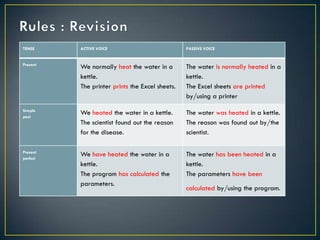
TENSE ACTIVE VOICE PASSIVE VOICE
Present
We normally heat the water in a
kettle.
The printer prints the Excel sheets.
The water is normally heated in a
kettle.
The Excel sheets are printed
by/using a printer
Simple
past
We heated the water in a kettle.
The scientist found out the reason
for the disease.
The water was heated in a kettle.
The reason was found out by/the
scientist.
Present
perfect
We have heated the water in a
kettle.
The program has calculated the
parameters.
The water has been heated in a
kettle.
The parameters have been
calculated by/using the program.
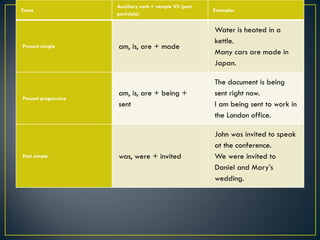
Tense
Auxiliary verb + sample V3 (past
participle)
Examples
Present simple am, is, are + made
Water is heated in a
kettle.
Many cars are made in
Japan.
Present progressive
am, is, are + being +
sent
The document is being
sent right now.
I am being sent to work in
the London office.
Past simple was, were + invited
John was invited to speak
at the conference.
We were invited to
Daniel and Mary’s
wedding.
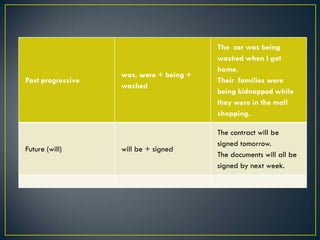
Past progressive
was, were + being +
washed
The car was being
washed when I got
home.
Their families were
being kidnapped while
they were in the mall
shopping.
Future (will) will be + signed
The contract will be
signed tomorrow.
The documents will all be
signed by next week.
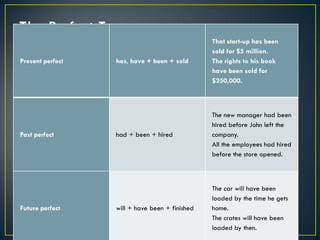
Present perfect has, have + been + sold
That start-up has been
sold for $5 million.
The rights to his book
have been sold for
$250,000.
Past perfect had + been + hired
The new manager had been
hired before John left the
company.
All the employees had hired
before the store opened.
Future perfect will + have been + finished
The car will have been
loaded by the time he gets
home.
The crates will have been
loaded by then.
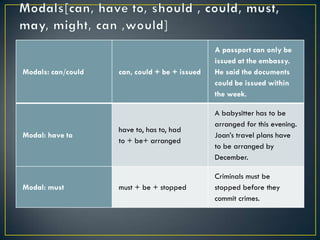
Modals: can/could can, could + be + issued
A passport can only be
issued at the embassy.
He said the documents
could be issued within
the week.
Modal: have to
have to, has to, had
to + be+ arranged
A babysitter has to be
arranged for this evening.
Joan’s travel plans have
to be arranged by
December.
Modal: must must + be + stopped
Criminals must be
stopped before they
commit crimes.
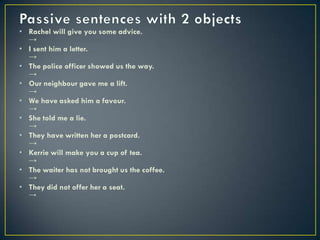
• Rachel will give you some advice.
→
• I sent him a letter.
→
• The police officer showed us the way.
→
• Our neighbour gave me a lift.
→
• We have asked him a favour.
→
• She told me a lie.
→
• They have written her a postcard.
→
• Kerrie will make you a cup of tea.
→
• The waiter has not brought us the coffee.
→
• They did not offer her a seat.
→
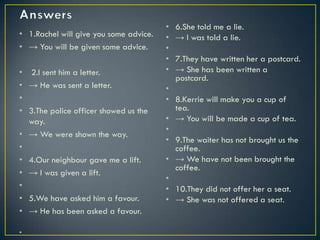
• 1.Rachel will give you some advice.
• → You will be given some advice.
• 2.I sent him a letter.
• → He was sent a letter.
•
• 3.The police officer showed us the
way.
• → We were shown the way.
•
• 4.Our neighbour gave me a lift.
• → I was given a lift.
•
• 5.We have asked him a favour.
• → He has been asked a favour.
•
• 6.She told me a lie.
• → I was told a lie.
•
• 7.They have written her a postcard.
• → She has been written a
postcard.
•
• 8.Kerrie will make you a cup of
tea.
• → You will be made a cup of tea.
•
• 9.The waiter has not brought us the
coffee.
• → We have not been brought the
coffee.
•
• 10.They did not offer her a seat.
• → She was not offered a seat.
• 1.People know that she is a good swimmer.
• →
• 2.They say that Francis is in hospital.
• →
• 3.They think that the children are in bed.
• →
• 4.People believe that the robber has worked in the bank.
• →
• 5.People believe that nuclear power stations are dangerous.
• →
• 6.His collegues thought that he was on holiday.
• →
• 7.People know that cars pollute the environment.
• →
• 8.They suppose that the new product will come out soon.
• →
• 9.They found that the mission was impossible.
• →
• 10.They believe that she will win a gold medal.
• →
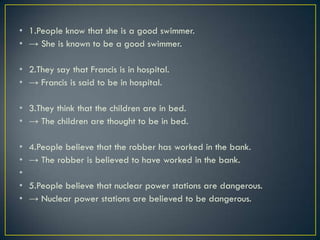
• 1.People know that she is a good swimmer.
• → She is known to be a good swimmer.
• 2.They say that Francis is in hospital.
• → Francis is said to be in hospital.
• 3.They think that the children are in bed.
• → The children are thought to be in bed.
• 4.People believe that the robber has worked in the bank.
• → The robber is believed to have worked in the bank.
•
• 5.People believe that nuclear power stations are dangerous.
• → Nuclear power stations are believed to be dangerous.
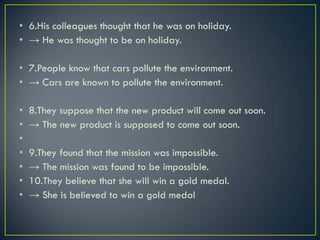
• 6.His colleagues thought that he was on holiday.
• → He was thought to be on holiday.
• 7.People know that cars pollute the environment.
• → Cars are known to pollute the environment.
• 8.They suppose that the new product will come out soon.
• → The new product is supposed to come out soon.
•
• 9.They found that the mission was impossible.
• → The mission was found to be impossible.
• 10.They believe that she will win a gold medal.
• → She is believed to win a gold medal
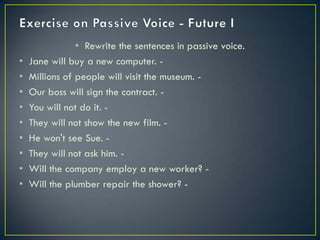
• Rewrite the sentences in passive voice.
• Jane will buy a new computer. -
• Millions of people will visit the museum. -
• Our boss will sign the contract. -
• You will not do it. -
• They will not show the new film. -
• He won't see Sue. -
• They will not ask him. -
• Will the company employ a new worker? -
• Will the plumber repair the shower? -
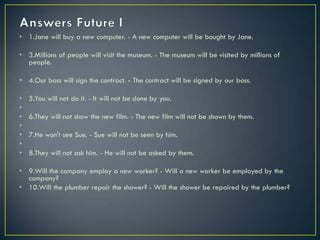
• 1.Jane will buy a new computer. - A new computer will be bought by Jane.
• 3.Millions of people will visit the museum. - The museum will be visited by millions of
people.
• 4.Our boss will sign the contract. - The contract will be signed by our boss.
• 5.You will not do it. - It will not be done by you.
•
• 6.They will not show the new film. - The new film will not be shown by them.
•
• 7.He won't see Sue. - Sue will not be seen by him.
•
• 8.They will not ask him. - He will not be asked by them.
• 9.Will the company employ a new worker? - Will a new worker be employed by the
company?
• 10.Will the plumber repair the shower? - Will the shower be repaired by the plumber?
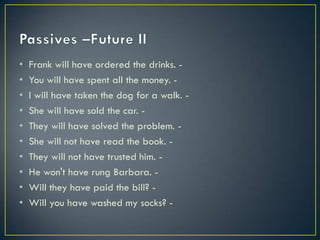
• Frank will have ordered the drinks. -
• You will have spent all the money. -
• I will have taken the dog for a walk. -
• She will have sold the car. -
• They will have solved the problem. -
• She will not have read the book. -
• They will not have trusted him. -
• He won't have rung Barbara. -
• Will they have paid the bill? -
• Will you have washed my socks? -
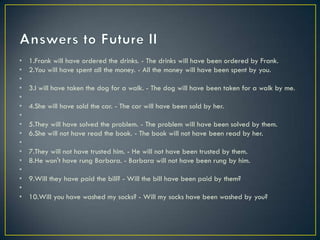
• 1.Frank will have ordered the drinks. - The drinks will have been ordered by Frank.
• 2.You will have spent all the money. - All the money will have been spent by you.
•
• 3.I will have taken the dog for a walk. - The dog will have been taken for a walk by me.
•
• 4.She will have sold the car. - The car will have been sold by her.
•
• 5.They will have solved the problem. - The problem will have been solved by them.
• 6.She will not have read the book. - The book will not have been read by her.
•
• 7.They will not have trusted him. - He will not have been trusted by them.
• 8.He won't have rung Barbara. - Barbara will not have been rung by him.
•
• 9.Will they have paid the bill? - Will the bill have been paid by them?
•
• 10.Will you have washed my socks? - Will my socks have been washed by you?
Passive Voice - Exercise with Auxiliary Verbs
• Rewrite the sentences in passive voice.
• I can answer the question. -
• She would carry the box. -
• You should open the window. -
• We might play cards. -
• You ought to wash the car. -
• He must fill in the form. -
• They need not buy bread. -
• He could not read the sentence. -
• Will the teacher test our English? -
• Could Jenny lock the door? -
• Portal dolmens(be) ____________ancient tombs.
• They(build) ____________about 6000 years ago.
• In order to build such a tomb, ancient people(put) _________up big stones.
• These standing stones then(form) ____________the walls.
• Another huge stone, the cap stone,(place) __________on top of the other
stones.
• Finally, the tomb(have) _______________the form of a little chamber.
• In that chamber, the dead person(bury)__________ .
• Then the entrance to the tomb(close)____________ with another stone.
• Nowadays, portal dolmens(see / can) _________in Ireland, Wales and
Scotland.
• They(call)______ portal dolmens because they (look) _____like a huge
doorway (or portal
• Portal dolmens are ancient tombs.
• They were built about 6000 years ago.
• In order to build such a tomb, ancient people put up big stones.
• These standing stones then formed the walls.
• Another huge stone, the cap stone, was placed on top of the other
stones.
• Finally, the tomb had the form of a little chamber.
• In that chamber, the dead person was buried.
• Then the entrance to the tomb was closed with another stone.
• Nowadays, portal dolmens can be seen in Ireland, Wales and
Scotland.
• They are called portal dolmens because they look like a huge
doorway (or portal).
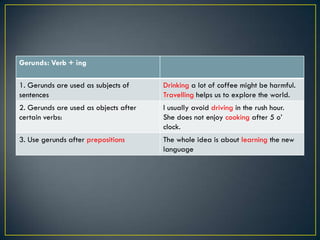
Gerunds: Verb + ing
1. Gerunds are used as subjects of
sentences
Drinking a lot of coffee might be harmful.
Travelling helps us to explore the world.
2. Gerunds are used as objects after
certain verbs:
I usually avoid driving in the rush hour.
She does not enjoy cooking after 5 o’
clock.
3. Use gerunds after prepositions The whole idea is about learning the new
language
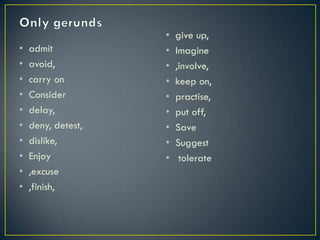
• admit
• avoid,
• carry on
• Consider
• delay,
• deny, detest,
• dislike,
• Enjoy
• ,excuse
• ,finish,
• give up,
• Imagine
• ,involve,
• keep on,
• practise,
• put off,
• Save
• Suggest
• tolerate
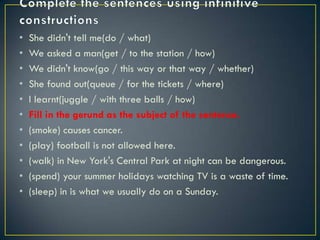
• She didn't tell me(do / what)
• We asked a man(get / to the station / how)
• We didn't know(go / this way or that way / whether)
• She found out(queue / for the tickets / where)
• I learnt(juggle / with three balls / how)
• Fill in the gerund as the subject of the sentence.
• (smoke) causes cancer.
• (play) football is not allowed here.
• (walk) in New York's Central Park at night can be dangerous.
• (spend) your summer holidays watching TV is a waste of time.
• (sleep) in is what we usually do on a Sunday.
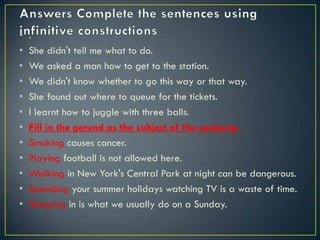
• .
• She didn't tell me what to do.
• We asked a man how to get to the station.
• We didn't know whether to go this way or that way.
• She found out where to queue for the tickets.
• I learnt how to juggle with three balls.
• Fill in the gerund as the subject of the sentence.
• Smoking causes cancer.
• Playing football is not allowed here.
• Walking in New York's Central Park at night can be dangerous.
• Spending your summer holidays watching TV is a waste of time.
• Sleeping in is what we usually do on a Sunday.
Passive and gerunds revision

Passive and gerunds revision

  • 1.
  • 2.
    TENSE ACTIVE VOICEPASSIVE VOICE Present We normally heat the water in a kettle. The printer prints the Excel sheets. The water is normally heated in a kettle. The Excel sheets are printed by/using a printer Simple past We heated the water in a kettle. The scientist found out the reason for the disease. The water was heated in a kettle. The reason was found out by/the scientist. Present perfect We have heated the water in a kettle. The program has calculated the parameters. The water has been heated in a kettle. The parameters have been calculated by/using the program.
  • 3.
    Tense Auxiliary verb +sample V3 (past participle) Examples Present simple am, is, are + made Water is heated in a kettle. Many cars are made in Japan. Present progressive am, is, are + being + sent The document is being sent right now. I am being sent to work in the London office. Past simple was, were + invited John was invited to speak at the conference. We were invited to Daniel and Mary’s wedding.
  • 4.
    Past progressive was, were+ being + washed The car was being washed when I got home. Their families were being kidnapped while they were in the mall shopping. Future (will) will be + signed The contract will be signed tomorrow. The documents will all be signed by next week.
  • 5.
    Present perfect has,have + been + sold That start-up has been sold for $5 million. The rights to his book have been sold for $250,000. Past perfect had + been + hired The new manager had been hired before John left the company. All the employees had hired before the store opened. Future perfect will + have been + finished The car will have been loaded by the time he gets home. The crates will have been loaded by then.
  • 6.
    Modals: can/could can,could + be + issued A passport can only be issued at the embassy. He said the documents could be issued within the week. Modal: have to have to, has to, had to + be+ arranged A babysitter has to be arranged for this evening. Joan’s travel plans have to be arranged by December. Modal: must must + be + stopped Criminals must be stopped before they commit crimes.
  • 8.
    • Rachel willgive you some advice. → • I sent him a letter. → • The police officer showed us the way. → • Our neighbour gave me a lift. → • We have asked him a favour. → • She told me a lie. → • They have written her a postcard. → • Kerrie will make you a cup of tea. → • The waiter has not brought us the coffee. → • They did not offer her a seat. →
  • 9.
    • 1.Rachel willgive you some advice. • → You will be given some advice. • 2.I sent him a letter. • → He was sent a letter. • • 3.The police officer showed us the way. • → We were shown the way. • • 4.Our neighbour gave me a lift. • → I was given a lift. • • 5.We have asked him a favour. • → He has been asked a favour. • • 6.She told me a lie. • → I was told a lie. • • 7.They have written her a postcard. • → She has been written a postcard. • • 8.Kerrie will make you a cup of tea. • → You will be made a cup of tea. • • 9.The waiter has not brought us the coffee. • → We have not been brought the coffee. • • 10.They did not offer her a seat. • → She was not offered a seat.
  • 10.
    • 1.People knowthat she is a good swimmer. • → • 2.They say that Francis is in hospital. • → • 3.They think that the children are in bed. • → • 4.People believe that the robber has worked in the bank. • → • 5.People believe that nuclear power stations are dangerous. • → • 6.His collegues thought that he was on holiday. • → • 7.People know that cars pollute the environment. • → • 8.They suppose that the new product will come out soon. • → • 9.They found that the mission was impossible. • → • 10.They believe that she will win a gold medal. • →
  • 11.
    • 1.People knowthat she is a good swimmer. • → She is known to be a good swimmer. • 2.They say that Francis is in hospital. • → Francis is said to be in hospital. • 3.They think that the children are in bed. • → The children are thought to be in bed. • 4.People believe that the robber has worked in the bank. • → The robber is believed to have worked in the bank. • • 5.People believe that nuclear power stations are dangerous. • → Nuclear power stations are believed to be dangerous.
  • 12.
    • 6.His colleaguesthought that he was on holiday. • → He was thought to be on holiday. • 7.People know that cars pollute the environment. • → Cars are known to pollute the environment. • 8.They suppose that the new product will come out soon. • → The new product is supposed to come out soon. • • 9.They found that the mission was impossible. • → The mission was found to be impossible. • 10.They believe that she will win a gold medal. • → She is believed to win a gold medal
  • 13.
    • Rewrite thesentences in passive voice. • Jane will buy a new computer. - • Millions of people will visit the museum. - • Our boss will sign the contract. - • You will not do it. - • They will not show the new film. - • He won't see Sue. - • They will not ask him. - • Will the company employ a new worker? - • Will the plumber repair the shower? -
  • 14.
    • 1.Jane willbuy a new computer. - A new computer will be bought by Jane. • 3.Millions of people will visit the museum. - The museum will be visited by millions of people. • 4.Our boss will sign the contract. - The contract will be signed by our boss. • 5.You will not do it. - It will not be done by you. • • 6.They will not show the new film. - The new film will not be shown by them. • • 7.He won't see Sue. - Sue will not be seen by him. • • 8.They will not ask him. - He will not be asked by them. • 9.Will the company employ a new worker? - Will a new worker be employed by the company? • 10.Will the plumber repair the shower? - Will the shower be repaired by the plumber?
  • 15.
    • Frank willhave ordered the drinks. - • You will have spent all the money. - • I will have taken the dog for a walk. - • She will have sold the car. - • They will have solved the problem. - • She will not have read the book. - • They will not have trusted him. - • He won't have rung Barbara. - • Will they have paid the bill? - • Will you have washed my socks? -
  • 16.
    • 1.Frank willhave ordered the drinks. - The drinks will have been ordered by Frank. • 2.You will have spent all the money. - All the money will have been spent by you. • • 3.I will have taken the dog for a walk. - The dog will have been taken for a walk by me. • • 4.She will have sold the car. - The car will have been sold by her. • • 5.They will have solved the problem. - The problem will have been solved by them. • 6.She will not have read the book. - The book will not have been read by her. • • 7.They will not have trusted him. - He will not have been trusted by them. • 8.He won't have rung Barbara. - Barbara will not have been rung by him. • • 9.Will they have paid the bill? - Will the bill have been paid by them? • • 10.Will you have washed my socks? - Will my socks have been washed by you?
  • 17.
    Passive Voice -Exercise with Auxiliary Verbs • Rewrite the sentences in passive voice. • I can answer the question. - • She would carry the box. - • You should open the window. - • We might play cards. - • You ought to wash the car. - • He must fill in the form. - • They need not buy bread. - • He could not read the sentence. - • Will the teacher test our English? - • Could Jenny lock the door? -
  • 18.
    • Portal dolmens(be)____________ancient tombs. • They(build) ____________about 6000 years ago. • In order to build such a tomb, ancient people(put) _________up big stones. • These standing stones then(form) ____________the walls. • Another huge stone, the cap stone,(place) __________on top of the other stones. • Finally, the tomb(have) _______________the form of a little chamber. • In that chamber, the dead person(bury)__________ . • Then the entrance to the tomb(close)____________ with another stone. • Nowadays, portal dolmens(see / can) _________in Ireland, Wales and Scotland. • They(call)______ portal dolmens because they (look) _____like a huge doorway (or portal
  • 19.
    • Portal dolmensare ancient tombs. • They were built about 6000 years ago. • In order to build such a tomb, ancient people put up big stones. • These standing stones then formed the walls. • Another huge stone, the cap stone, was placed on top of the other stones. • Finally, the tomb had the form of a little chamber. • In that chamber, the dead person was buried. • Then the entrance to the tomb was closed with another stone. • Nowadays, portal dolmens can be seen in Ireland, Wales and Scotland. • They are called portal dolmens because they look like a huge doorway (or portal).
  • 21.
    Gerunds: Verb +ing 1. Gerunds are used as subjects of sentences Drinking a lot of coffee might be harmful. Travelling helps us to explore the world. 2. Gerunds are used as objects after certain verbs: I usually avoid driving in the rush hour. She does not enjoy cooking after 5 o’ clock. 3. Use gerunds after prepositions The whole idea is about learning the new language
  • 22.
    • admit • avoid, •carry on • Consider • delay, • deny, detest, • dislike, • Enjoy • ,excuse • ,finish, • give up, • Imagine • ,involve, • keep on, • practise, • put off, • Save • Suggest • tolerate
  • 23.
    • She didn'ttell me(do / what) • We asked a man(get / to the station / how) • We didn't know(go / this way or that way / whether) • She found out(queue / for the tickets / where) • I learnt(juggle / with three balls / how) • Fill in the gerund as the subject of the sentence. • (smoke) causes cancer. • (play) football is not allowed here. • (walk) in New York's Central Park at night can be dangerous. • (spend) your summer holidays watching TV is a waste of time. • (sleep) in is what we usually do on a Sunday.
  • 24.
    • . • Shedidn't tell me what to do. • We asked a man how to get to the station. • We didn't know whether to go this way or that way. • She found out where to queue for the tickets. • I learnt how to juggle with three balls. • Fill in the gerund as the subject of the sentence. • Smoking causes cancer. • Playing football is not allowed here. • Walking in New York's Central Park at night can be dangerous. • Spending your summer holidays watching TV is a waste of time. • Sleeping in is what we usually do on a Sunday.