Complex Structures
Passive gerund  (being done) Passive infinitive  (to be done) Use: To describe actions which are done to the subject. She loves  being told  how beautiful she is. My car needs  to be serviced
Perfect gerund  ( having done) Perfect infinitive  ( to have done) Use: when we want to emphasize an action that is completed or in the past. Having studied  one language before makes it easier to learn another. By the time I’m 30 I  hope to have started  a business
Often there is  no difference  between a simple gerund or infinitive and a perfect gerund or infinitive. Compare: He denied stealing/having stolen the money. We were silly not to lock/not to have locked the car.
Perfect infinitive is used after: Would like Would love  Would hate Would prefer Would rather Refers to an earlier action. I  would like to see  the Eiffel tower I  would like to have seen  the Eiffel tower
(to be + verb + ing) Use an action is in progress around the time of use. I’d like to be lying  on the beach right now!
A  gerund  is used after certain expressions with it or there. E.g.  There  is no point  worrying It’s  not worth  thinking  about.
Used after nouns formed from verbs which take the infinitive. Agree/plan/hope etc. Our  plan is to take  the CAE in June.
After expressions  with quantifiers : enough, too much, a lot etc.. Is there anything to eat? When  we want to refer to the subject of the infinitive verb  we use for + person or object pronoun before the infinitive. It’s very difficult  for me to decide  what to do.
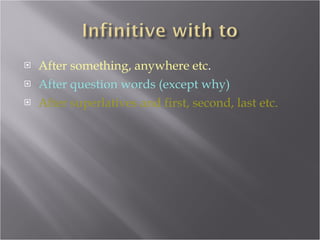
After something, anywhere etc . After question words (except why) After superlatives and first, second, last etc.

Advanced gerund inf

  • 1.
  • 2.
    Passive gerund (being done) Passive infinitive (to be done) Use: To describe actions which are done to the subject. She loves being told how beautiful she is. My car needs to be serviced
  • 3.
    Perfect gerund ( having done) Perfect infinitive ( to have done) Use: when we want to emphasize an action that is completed or in the past. Having studied one language before makes it easier to learn another. By the time I’m 30 I hope to have started a business
  • 4.
    Often there is no difference between a simple gerund or infinitive and a perfect gerund or infinitive. Compare: He denied stealing/having stolen the money. We were silly not to lock/not to have locked the car.
  • 5.
    Perfect infinitive isused after: Would like Would love Would hate Would prefer Would rather Refers to an earlier action. I would like to see the Eiffel tower I would like to have seen the Eiffel tower
  • 6.
    (to be +verb + ing) Use an action is in progress around the time of use. I’d like to be lying on the beach right now!
  • 7.
    A gerund is used after certain expressions with it or there. E.g. There is no point worrying It’s not worth thinking about.
  • 8.
    Used after nounsformed from verbs which take the infinitive. Agree/plan/hope etc. Our plan is to take the CAE in June.
  • 9.
    After expressions with quantifiers : enough, too much, a lot etc.. Is there anything to eat? When we want to refer to the subject of the infinitive verb we use for + person or object pronoun before the infinitive. It’s very difficult for me to decide what to do.
  • 10.
    After something, anywhereetc . After question words (except why) After superlatives and first, second, last etc.