REPORTED SPEECH
WAYS OF RELATING WHAT A PERSON HAS SAID DIRECT Repeat the original speaker´s exact words: He said, “I have lost my umbrella” INDIRECT Give the speaker´s exact meanig without using the speakers exact words: He said (that) he had lost his umbrella.
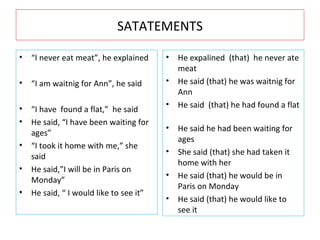
SATATEMENTS “ I never eat meat”, he explained  “ I am waitnig for Ann”, he said  “ I have  found a flat,”  he said  He said, “I have been waiting for ages”  “ I took it home with me,” she said  He said,”I will be in Paris on Monday” He said, “ I would like to see it” He expalined  (that)  he never ate meat He said (that) he was waitnig for Ann  He said  (that) he had found a flat  He said he had been waiting for ages  She said (that) she had taken it home with her  He said (that) he would be in Paris on Monday  He said (that) he would like to see it
UNREAL PAST (SUBJUNCTIVE) “ We wish we didn´t have to take exams”,said the children  “ Bill wants to go alone,” said Ann, “but I´d rather he went with a group  It is time we began planning our holidays,”he said  “ The children had better go to bed early,” said Tom The children said (that) they wished they didn´t have to take exams  Ann said that Bill wanted to go alone but that she´d rather he went with a group  He said that it was time they began planning their holidays  Tom said that the children had better go to bed early
MODALS IN REPORTED SPEECH MIGHT:  remains unchanged  He said, “ann might ring today”: He said that ann might ring (that day) BUT!!! “ You might post this letters for me”: He asked me to post the letters hor him OUGHT TO/SHOULD:  unchanged for advice or reported by  advice+object+infinitive: “ You should read the instructions,” Ann said: Ann adivised/warned me to read the instrustions: Ann said that I should read the instrcutions USED TO:  doesn´t change “  know the place well because I used to live there”,he explained: He explained that he knew the place well because he used to live there CAN/COULD:  unchanged/be allowed to He said, “I could stand on my head “ : He said that he could stand on his head “ If I had the tools, I could mend it “, he said: He said that if he had the tools he could mend it IF I WERE YOU I WOULD…:  unchanged Or we use advise
EXPRESSIONS OF TIME AND PLACE AND PRONOUNS TODAY YESTERDAY THE DAY BEFORE YESTERDAY TOMORROW  THE DAY AFTER TOMORROW  NEXT WEEK/YEAR  LAST WEEK/YEAR  A YEAR/MONTH AGO  HERE  THAT DAY  THE DAY BEFORE  TWO  DAYS BEF ORE  THE NEXT DAY/THE FOLL OWING DAY  IN TWO DAYS´TIME  THE FOLLOWING WEEK  THE PREVIOUS WEEK  A YEAR BEFORE/THE PREVIOUS  THERE
PRONOUNS AND ADJECTIVES THIS: TIME EXPRESSION  THIS/THESE: ADJECTIVIES  He said, “I´ve bought this pearl /these pearlsfor his mother” THIS/THESE: PRONOUN He said, “we will discuss this tomorrow” THAT  THE He said that he had bought the pearl f/pearls for his mother IT/THEY/THEM He said he would discuss it/the matter the following day
SAY  &  TELL  IN STATEMENTS DIRECT:  SAY Tomsaid, “I have  heard the news” “ I have  heard the news,”Tom said “ I have  heard the new”, said Tom “ I have heard the news,”Tom said to me INDIRECT: SAY Tom said that he had just heard the news DIRECT:  TELL “ I am leaving at once” Tom told me  INDIRECT:  TELL  He told me that he had heard the news
QUESTIONS IN INDIRECT SPEECH Tenses, pronouns, possessive adjectives, adverbs of time change as in statements. The interrogative form and question mark are omitted The introductory verb  say  must be chaged to a verb of inquiry:  ask, inquire, want to know,wonder,etc. Ask  can be followed by the person addressed The question words are repeated in indirect questions Yes-no questions: whether-if He said, “where is she going?”: He asked where she was going He said, “Where does she live?”: He asked where she lived He asked, “Where is thestation?”: He asked where the station was “ Did you see the accident or not?”the policeman asked The policeman asked if I had seen the accident or not/whether or not I had seen the accident “ Is anyone there?, he asked: He asked if/whether anyone was there “ Do you know Bill?” he said He asked if I knew Bill
REQUESTS, OFFERS AND SUGGESTIONS REQUESTS: for information and instructions “ Shall I ever see him again?”, he wondered-He wondered if he should ever see him again “ What shall I do with it?”, he asked-He asked what he should do with it:he asked what to do OFFERS: “ Shall I bring you some tea?”, he asked- He asked to bring some tea: He asked if he shoul bring us some tea SUGGESTION: “ Shall we meet at the theatre?” He asked- He suggested meeting at the theatre
COMMANDS, REQUESTS AND ADVICE INTRODUCTORY VERBS:  Advise,Ask,Beg,Command,Encourage,Forbid,Implore,  Invite,Order,  Recommend, Tell, Urge, Warn +   OBJECT +   INFINITIVE
COMMANDS, REQUESTS, ADVICE: EXAMPLES He said, “Get your coat,tom!” He told Tom to get his coat “ Don´t swim too far, boys!”I said   I told the boys not to swim too far “ He said,Go away!” He told us to go away FURTHER EXAMPLES: “ If I were you, I would stop taking tranquilizers,” I said I advised him to stop taking tranquilizers “ Could/would you show me your passport ,please? He asked me to show him his passport/He asked to see my passport/He asked me for my passport “ Please, please don´t take any risks” said  his wife His wife begged/implred him not to take any risks “ Don´t forget to order the wine”, said Mrs Pitt   Mrs Pitt reminded her husband to order the wine “ Go on, apply for the job2, said Jack   Jack encouraged me to apply for the job
LET´S, LET US, LET HIM/THEM IN INDIRECT SPEECH He said, “Let´s leave the case at the station: He suggested leaving the case at the station He suggested that they should leave the case at the station He said, “Let´s stop now and finsh it later”: He suggested stopping then and finishing it later He suggested that they should stop then and finish it later “ It´s not my business. Let the goverment do it” said the postman: The postman said that it wasn´t his business and that the goverment should do something about it

215 reported speech

  • 1.
  • 2.
    WAYS OF RELATINGWHAT A PERSON HAS SAID DIRECT Repeat the original speaker´s exact words: He said, “I have lost my umbrella” INDIRECT Give the speaker´s exact meanig without using the speakers exact words: He said (that) he had lost his umbrella.
  • 3.
    SATATEMENTS “ Inever eat meat”, he explained “ I am waitnig for Ann”, he said “ I have found a flat,” he said He said, “I have been waiting for ages” “ I took it home with me,” she said He said,”I will be in Paris on Monday” He said, “ I would like to see it” He expalined (that) he never ate meat He said (that) he was waitnig for Ann He said (that) he had found a flat He said he had been waiting for ages She said (that) she had taken it home with her He said (that) he would be in Paris on Monday He said (that) he would like to see it
  • 4.
    UNREAL PAST (SUBJUNCTIVE)“ We wish we didn´t have to take exams”,said the children “ Bill wants to go alone,” said Ann, “but I´d rather he went with a group It is time we began planning our holidays,”he said “ The children had better go to bed early,” said Tom The children said (that) they wished they didn´t have to take exams Ann said that Bill wanted to go alone but that she´d rather he went with a group He said that it was time they began planning their holidays Tom said that the children had better go to bed early
  • 5.
    MODALS IN REPORTEDSPEECH MIGHT: remains unchanged He said, “ann might ring today”: He said that ann might ring (that day) BUT!!! “ You might post this letters for me”: He asked me to post the letters hor him OUGHT TO/SHOULD: unchanged for advice or reported by advice+object+infinitive: “ You should read the instructions,” Ann said: Ann adivised/warned me to read the instrustions: Ann said that I should read the instrcutions USED TO: doesn´t change “ know the place well because I used to live there”,he explained: He explained that he knew the place well because he used to live there CAN/COULD: unchanged/be allowed to He said, “I could stand on my head “ : He said that he could stand on his head “ If I had the tools, I could mend it “, he said: He said that if he had the tools he could mend it IF I WERE YOU I WOULD…: unchanged Or we use advise
  • 6.
    EXPRESSIONS OF TIMEAND PLACE AND PRONOUNS TODAY YESTERDAY THE DAY BEFORE YESTERDAY TOMORROW THE DAY AFTER TOMORROW NEXT WEEK/YEAR LAST WEEK/YEAR A YEAR/MONTH AGO HERE THAT DAY THE DAY BEFORE TWO DAYS BEF ORE THE NEXT DAY/THE FOLL OWING DAY IN TWO DAYS´TIME THE FOLLOWING WEEK THE PREVIOUS WEEK A YEAR BEFORE/THE PREVIOUS THERE
  • 7.
    PRONOUNS AND ADJECTIVESTHIS: TIME EXPRESSION THIS/THESE: ADJECTIVIES He said, “I´ve bought this pearl /these pearlsfor his mother” THIS/THESE: PRONOUN He said, “we will discuss this tomorrow” THAT THE He said that he had bought the pearl f/pearls for his mother IT/THEY/THEM He said he would discuss it/the matter the following day
  • 8.
    SAY & TELL IN STATEMENTS DIRECT: SAY Tomsaid, “I have heard the news” “ I have heard the news,”Tom said “ I have heard the new”, said Tom “ I have heard the news,”Tom said to me INDIRECT: SAY Tom said that he had just heard the news DIRECT: TELL “ I am leaving at once” Tom told me INDIRECT: TELL He told me that he had heard the news
  • 9.
    QUESTIONS IN INDIRECTSPEECH Tenses, pronouns, possessive adjectives, adverbs of time change as in statements. The interrogative form and question mark are omitted The introductory verb say must be chaged to a verb of inquiry: ask, inquire, want to know,wonder,etc. Ask can be followed by the person addressed The question words are repeated in indirect questions Yes-no questions: whether-if He said, “where is she going?”: He asked where she was going He said, “Where does she live?”: He asked where she lived He asked, “Where is thestation?”: He asked where the station was “ Did you see the accident or not?”the policeman asked The policeman asked if I had seen the accident or not/whether or not I had seen the accident “ Is anyone there?, he asked: He asked if/whether anyone was there “ Do you know Bill?” he said He asked if I knew Bill
  • 10.
    REQUESTS, OFFERS ANDSUGGESTIONS REQUESTS: for information and instructions “ Shall I ever see him again?”, he wondered-He wondered if he should ever see him again “ What shall I do with it?”, he asked-He asked what he should do with it:he asked what to do OFFERS: “ Shall I bring you some tea?”, he asked- He asked to bring some tea: He asked if he shoul bring us some tea SUGGESTION: “ Shall we meet at the theatre?” He asked- He suggested meeting at the theatre
  • 11.
    COMMANDS, REQUESTS ANDADVICE INTRODUCTORY VERBS: Advise,Ask,Beg,Command,Encourage,Forbid,Implore, Invite,Order, Recommend, Tell, Urge, Warn + OBJECT + INFINITIVE
  • 12.
    COMMANDS, REQUESTS, ADVICE:EXAMPLES He said, “Get your coat,tom!” He told Tom to get his coat “ Don´t swim too far, boys!”I said I told the boys not to swim too far “ He said,Go away!” He told us to go away FURTHER EXAMPLES: “ If I were you, I would stop taking tranquilizers,” I said I advised him to stop taking tranquilizers “ Could/would you show me your passport ,please? He asked me to show him his passport/He asked to see my passport/He asked me for my passport “ Please, please don´t take any risks” said his wife His wife begged/implred him not to take any risks “ Don´t forget to order the wine”, said Mrs Pitt Mrs Pitt reminded her husband to order the wine “ Go on, apply for the job2, said Jack Jack encouraged me to apply for the job
  • 13.
    LET´S, LET US,LET HIM/THEM IN INDIRECT SPEECH He said, “Let´s leave the case at the station: He suggested leaving the case at the station He suggested that they should leave the case at the station He said, “Let´s stop now and finsh it later”: He suggested stopping then and finishing it later He suggested that they should stop then and finish it later “ It´s not my business. Let the goverment do it” said the postman: The postman said that it wasn´t his business and that the goverment should do something about it