New Synthetic Technology for Efficient
Construction of r-Hydroxy-β-amino
Amides via the Passerini Reaction1
J. Edward Semple,* Timothy D. Owens, Khanh Nguyen, and Odile E. Levy
Department of Medicinal Chemistry, CorVas International, Inc.,
3030 Science Park Road, San Diego, California 92121
ed•semple@corVas.com
Received June 1, 2000
ABSTRACT
The Passerini reaction of N-protected amino aldehydes, isonitriles, and TFA using pyridine-type bases proceeds under mild conditions and
directly affords r-hydroxy-β-amino amide derivatives in moderate to high yields. These adducts are readily hydrolyzed to r-hydroxy-β-amino
carboxylic acids. Application of these key intermediates to concise syntheses of P1-r-ketoamide protease inhibitors is illustrated.
R-Hydroxy-β-amino carboxylic acid and amide subunits are
found in numerous pharmaceuticals and natural products that
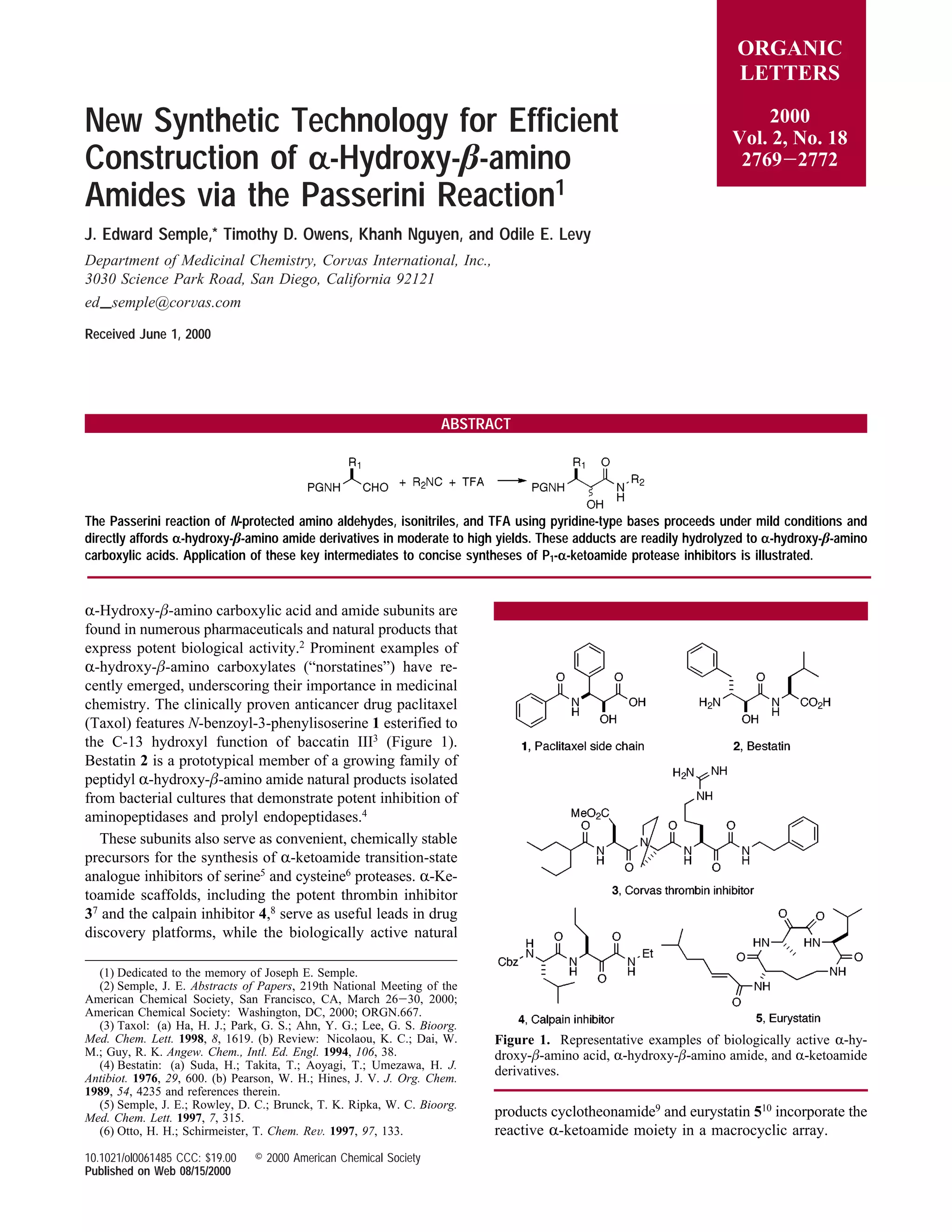
express potent biological activity.2 Prominent examples of
R-hydroxy-β-amino carboxylates (“norstatines”) have re-
cently emerged, underscoring their importance in medicinal
chemistry. The clinically proven anticancer drug paclitaxel
(Taxol) features N-benzoyl-3-phenylisoserine 1 esterified to
the C-13 hydroxyl function of baccatin III3 (Figure 1).
Bestatin 2 is a prototypical member of a growing family of
peptidyl R-hydroxy-β-amino amide natural products isolated
from bacterial cultures that demonstrate potent inhibition of
aminopeptidases and prolyl endopeptidases.4
These subunits also serve as convenient, chemically stable
precursors for the synthesis of R-ketoamide transition-state
analogue inhibitors of serine5
and cysteine6
proteases. R-Ke-
toamide scaffolds, including the potent thrombin inhibitor
37
and the calpain inhibitor 4,8
serve as useful leads in drug
discovery platforms, while the biologically active natural
products cyclotheonamide9 and eurystatin 510 incorporate the
reactive R-ketoamide moiety in a macrocyclic array.
(1) Dedicated to the memory of Joseph E. Semple.
(2) Semple, J. E. Abstracts of Papers, 219th National Meeting of the
American Chemical Society, San Francisco, CA, March 26-30, 2000;
American Chemical Society: Washington, DC, 2000; ORGN.667.
(3) Taxol: (a) Ha, H. J.; Park, G. S.; Ahn, Y. G.; Lee, G. S. Bioorg.
Med. Chem. Lett. 1998, 8, 1619. (b) Review: Nicolaou, K. C.; Dai, W.
M.; Guy, R. K. Angew. Chem., Intl. Ed. Engl. 1994, 106, 38.
(4) Bestatin: (a) Suda, H.; Takita, T.; Aoyagi, T.; Umezawa, H. J.
Antibiot. 1976, 29, 600. (b) Pearson, W. H.; Hines, J. V. J. Org. Chem.
1989, 54, 4235 and references therein.
(5) Semple, J. E.; Rowley, D. C.; Brunck, T. K. Ripka, W. C. Bioorg.
Med. Chem. Lett. 1997, 7, 315.
(6) Otto, H. H.; Schirmeister, T. Chem. ReV. 1997, 97, 133.
Figure 1. Representative examples of biologically active R-hy-
droxy-β-amino acid, R-hydroxy-β-amino amide, and R-ketoamide
derivatives.
ORGANIC
LETTERS
2000
Vol. 2, No. 18
2769-2772
10.1021/ol0061485 CCC: $19.00 © 2000 American Chemical Society
Published on Web 08/15/2000
As a result of their diverse structural variety, profound
biological activity, and synthetic utility, approaches to
R-hydroxy-β-amino carboxylate classes have received in-
creased attention over the past decade. Although these
methods often proceed with satisfactory to high levels of
stereocontrol,11
final target preparation usually requires many
steps. Classical approaches, such as homologation of R-amino
aldehydes 6 via cyanohydrin,12
2-(TMS)-thiazole,13
or
orthothioformate14
procedures, continue to receive consider-
able attention due to their utility and practicality, even though
products obtained by these protocols are diastereomeric at
the newly created R-hydroxy center. Although each of the
above methods has merits, limitations in scope are also
evident.
Our exploratory programs on small molecule covalent
inhibitors of the blood coagulation proteases thrombin (fIIa)15
and factor Xa (fXa),16 the plasminogen activator urokinase
(uPA),17 and the NS3A hepatitis C virus (HCV) protease18
necessitated the development of new synthetic technology
for the rapid construction of diverse R-hydroxy-β-amino
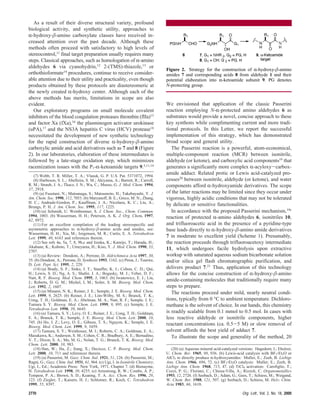
carboxylic amide and acid derivatives such as 7 and 8 (Figure
2). In our laboratories, elaboration of these intermediates is
followed by a late-stage oxidation step, which minimizes
racemization issues with the P1-R-ketoamide targets 9.5,11,14
We envisioned that application of the classic Passerini
reaction employing N-R-protected amino aldehydes 6 as
substrates would provide a novel, concise approach to these
key synthons while complimenting current and more tradi-
tional protocols. In this Letter, we report the successful
implementation of this strategy, which has demonstrated
broad scope and general utility.
The Passerini reaction is a powerful, atom-economical,
multiple-component reaction (MCR) between isonitrile,
aldehyde (or ketone), and carboxylic acid components19
that
generates a significantly more complex R-acyloxy-carbox-
amide adduct. Related protic or Lewis acid-catalyzed pro-
cesses20 between isonitrile, aldehyde (or ketone), and water
components afford R-hydroxyamide derivatives. The scope
of the latter reactions may be limited since they occur under
vigorous, highly acidic conditions that may not be tolerated
by delicate or sensitive functionalities.
In accordance with the proposed Passerini mechanism,19c
reaction of protected R-amino aldehydes 6, isonitriles 10,
and trifluoroacetic acid in the presence of a pyridine-type
base leads directly to R-hydroxy-β-amino amide derivatives
7 in moderate to excellent yield (Scheme 1). Presumably,
the reaction proceeds through trifluoroacetoxy intermediate
11, which undergoes facile hydrolysis upon extractive
workup with saturated aqueous sodium bicarbonate solution
and/or silica gel flash chromatographic purification, and
delivers product 7.21 Thus, application of this technology
allows for the concise construction of R-hydroxy-β-amino
amide-containing molecules that traditionally require many
steps to prepare.
The reactions proceed under mild, nearly neutral condi-
tions, typically from 0 °C to ambient temperature. Dichloro-
methane is the solvent of choice. In our hands, this chemistry
is readily scalable from 0.1 mmol to 0.5 mol. In cases with
less reactive aldehyde or isonitrile components, higher
reactant concentrations (ca. 0.5-5 M) or slow removal of
solvent affords the best yield of adduct 7.
To illustrate the scope and generality of the method, 20
(7) Webb, T. R. Miller, T. A.; Vlasuk, G. P. U.S. Pat. 5371072, 1994.
(8) Harbeson, S. L.; Abelleira, S. M.; Akiyama, A.; Barrett, R.; Carroll,
R. M.; Straub, J. A.; Tkacz, J. N.; Wu, C.; Musso, G. J. Med. Chem. 1994,
37, 2918.
(9) (a) Fusetani, N.; Matsunaga, S.; Matsumoto, H.; Takebayashi, Y. J.
Am. Chem. Soc. 1990, 112, 7053. (b) Maryanoff, B. E.; Greco, M. N.; Zhang,
H. C.; Andrade-Gordon, P.; Kauffman, J. A.; Nicolaou, K. C.; Liu, A.;
Brungs, P. H. J. Am. Chem. Soc. 1995, 117, 1225.
(10) (a) Schmidt, U. Weinbrenner, S. J. Chem. Soc., Chem. Commun.
1994, 1003. (b) Wasserman, H. H.; Peterson, A. K. J. Org. Chem. 1997,
62, 8972.
(11) For an excellent compilation of the leading stereospecific and
asymmetric approaches to R-hydroxy-β-amino acids and amides, see:
Wasserman, H. H.; Xia, M.; Jorgensen, M. R.; Curtis, E. A. Tetrahedron
Lett. 1999, 40, 6163 and references therein.
(12) See refs 4a, 5a, 7, 8, 9b,c and Iizuka, K.; Kamijo, T.; Harada, H.;
Akahane, K.; Kuboto, T.; Umeyama, H.; Kiso, Y. J. Med. Chem. 1990, 33,
2707.
(13) (a) Review: Dondoni, A.; Perrone, D. Aldrichimica Acta 1997, 30,
35. (b) Dondoni, A.; Perrone, D. Synthesis 1993, 1162. (c) Piron, J.; Tourwe,
D. Lett. Pept. Sci. 1995, 2, 229.
(14) (a) Brady, S. F.; Sisko, J. T.; Stauffer, K. J.; Colton, C. D.; Qui,
H.; Lewis, S. D.; Ng, A. S.; Shafer, J. A.; Bogusky, M. J.; Veber, D. F.;
Nutt, R. F. Bioorg. Med. Chem. 1995, 3, 1063. (b) Iwanowicz, E. J.; Lin,
J.; Roberts, D. G. M.; Michel, I, M.; Seiler, S. M. Bioorg. Med. Chem.
Lett. 1992, 2, 1607.
(15) (a) Minami, N. K.; Reiner, J. E.; Semple, J. E. Bioorg. Med. Chem.
Lett. 1999, 9, 2625. (b) Reiner, J. E.; Lim-Wilby, M. S.; Brunck, T. K.;
Uong, T. H.; Goldman, E. A.; Abelman, M. A.; Nutt, R. F.; Semple. J. E.;
Tamura S. Y. Bioorg. Med. Chem. Lett. 1999, 9, 895. (c) Semple, J. E.
Tetrahedron Lett. 1998, 39, 6645.
(16) (a) Tamura, S. Y.; Levy, O. E.; Reiner, J. E.; Uong, T. H.; Goldman,
E. A.; Brunck, T. K.; Semple, J. E. Bioorg. Med. Chem. Lett. 2000, 10,
745. (b) Ho, J. Z.; Levy, O. E.; Gibson, T. S.; Nguyen, K.; Semple, J. E.
Bioorg. Med. Chem. Lett. 1999, 9, 3459.
(17) Tamura, S. Y.; Weinhouse, M. I.; Roberts, C. A.; Goldman, E. A.;
Masukawa, K.; Anderson, S. M.; Cohen, C. R.; Bradbury, A. E.; Bernadino,
V. T.; Dixon, S. A.; Ma, M. G.; Nolan, T. G.; Brunck, T. K. Bioorg. Med.
Chem. Lett. 2000, 10, 983.
(18) Han, W.; Hu, Z.; Jiang, X.; Decicco, C. P. Bioorg. Med. Chem.
Lett. 2000, 10, 711 and references therein.
(19) (a) Passerini, M. Gazz. Chim. Ital. 1921, 51, 126. (b) Passerini, M.;
Ragni, G.; Gazz. Chim. Ital. 1931, 61, 964. (c) Ugi, I. in Isonitrile Chemistry;
Ugi, I., Ed.; Academic Press: New York, 1971, Chapter 7. (d) Bienayme,
H. Tetrahedron Lett. 1998, 39, 4255. (e) Armstrong, R. W.; Combs, A. P.;
Tempest, P. A.; Brown, S. D.; Keating, T. A. Acc. Chem. Res. 1996, 29,
123. (f) Ziegler, T.; Kaisers, H. J.; Schlomer, R.; Koch, C. Tetrahedron
1999, 55, 8397.
(20) (a) Aqueous mineral acid-catalyzed versions: Hagedorn, I.; Eholzer,
U. Chem. Ber. 1965, 98, 936. (b) Lewis-acid catalysis with BF3‚Et2O or
AlCl3 to directly produce R-hydroxyamides: Muller, E.; Zeeh, B. Liebigs
Ann. Chem. 1966, 696, 72. (c) BF3‚Et2O catalysis: Muller, E.; Zeeh, B.
Liebigs Ann. Chem. 1968, 715, 47. (d) TiCl4 activation: Carofiglio, T.;
Cozzi, P. G.; Floriani, C.; Chiesa-Villa, A.; Rizzoli, C. Organometallics
1993, 12, 2726. (f) Seebach, D.; Adam, G.; Gees, T.; Schiess, M.; Weigand,
W. Chem. Ber. 1988, 121, 507. (g) Seebach, D.; Schiess, M. HelV. Chim.
Acta 1983, 66, 1618.
Figure 2. Strategy for the construction of R-hydroxy-β-amino
amides 7 and corresponding acids 8 from aldehyde 1 and their
potential elaboration into R-ketoamide subunit 9. PG denotes
N-protecting group.
2770 Org. Lett., Vol. 2, No. 18, 2000
protected R-amino aldehyde derivatives 622 and 7 representa-
tive isonitriles 1019
were subjected to the reaction conditions.
The resulting products 7a-y are collected in Table 1, where
25 examples embracing a variety of R-N-protecting groups
and assorted side-chain functionalities are shown.23 Allyl
ester derivatives 7k-y, featuring orthogonal protecting
groups, served as versatile intermediates for the construction
of focused R-ketoamide protease inhibitor libraries. Full
details of this chemistry will be disclosed in a separate
communication.24
In agreement with literature precedent, formation of the
new hydroxy methine center proceeds without appreciable
stereoselectivity.19f,20f We typically observed ca. 1:1 to 3:1
diastereomeric ratios by NMR and HPLC analysis. However,
we note retention of configuration at the original aldehyde
and isonitrile (cf. 7j) chiral centers. For applications to our
ultimate R-ketoamide targets (cf. 17 below), the stereochem-
istry at the R-hydroxy center is inconsequential since it is
removed during a late-stage oxidation step. Nonetheless, we
are intrigued by the prospect of effecting a stereocontrolled
Passerini reaction since this would further enhance the utility
of the technology.
While TFA serves as an essential component of this MCR,
it is also a relatively strong acid (pKa ) 0.3) whose presence
may lead to undesired side reactions. Indeed, in the absence
of pyridine, complex mixtures resulted when reactants
containing N-Boc or tert-butyl ester protecting groups were
employed. Using the formation of intermediate 7o from allyl
isocyanoacetate and N-R-Fmoc-nVal-H as a model reaction,
we surveyed a variety of organic bases whose pKa values
ranged from 5 to 11. In general, tertiary trialkylamines gave
inferior results. Pyridine, 2,6-lutidine, 2,4,6-collidine, and 2,6-
di-tert-butylpyridine, with pKa’s of 5.2-7.4, were optimal
and provided adduct 7o in 68-87% yield. Furthermore,
utilization of these mild pyridine bases minimizes the
potential for R-amino aldehyde racemization that may occur
in the presence of stronger trialkylamine bases.22 Although
other more subtle mechanistic factors cannot be excluded,20d,21
our results suggest that the pyridine-type additives simply
serve as mild and efficient bases in these Passerini reactions.
We quickly adapted this technology to a concise synthesis
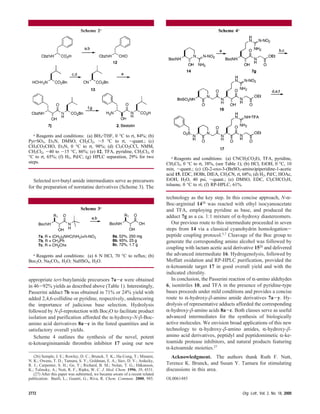
of bestatin 24 (Scheme 2). Thus, reaction of N-R-Cbz-d-
Phe-H 12 and the isonitrile derivative 13 (each freshly
prepared in two steps as outlined and utilized immediately)
with TFA in pyridine produced adduct 7j in 65% yield. NMR
and HPLC analysis of 7j indicated a ca. 1.5:1 mixture of
diastereomers at the new hydroxy center with retained
configuration at the original aldehyde and isonitrile chiral
centers. Separation of the R-hydroxy diastereomers, hydro-
genolysis, and HPLC separation afforded bestatin 2 in
satisfactory overall yield.25
(21) Passerini reaction of simple aldehydes and ketones with TFA and
pyridine: Lumma, W. J. Org. Chem. 1981, 46, 3668.
(22) (a) Myers, A. G.; Zhong, B.; Movassaghi, M.; Kung, D. W.;
Lanman, B. A.; Kwon, S. Tetrahedron Lett. 2000, 41, 1359. (b) Jurczak,
J.; Golebiowski, A. Chem. ReV. 1989, 89, 149. (c) Ho, P. T.; Ngu, K. J.
Org. Chem. 1993, 58, 2313. (d) Hyun, S. I.; Kim, Y. G. Tetrahedron Lett.
1998, 39, 4299. (e) Fehrentz, J. A.; Pothion, C.; Califano, J. C.; Loffet, A.;
Martinez, J. Tetrahedron Lett. 1994, 35, 9031.
(23) All new compounds were characterized by full spectroscopic (NMR,
low/high resolution MS) data. Yields refer to spectroscopically and
chromatographically homogeneous (g95% by HPLC, TLC) materials.
General procedure for the synthesis of 7a-y: Trifluoroacetic acid (2.0
equiv) was added dropwise to a cooled solution (-10 to 0 °C) of freshly
prepared R-N-protected-amino aldehyde (1.0 equiv), isonitrile (1.2-1.5
equiv), and pyridine (4.0 equiv) in dichloromethane [0.25-2.0 M] under a
nitrogen atmosphere while maintaining the temperature at e0 °C. After
0.5-2 h at 0 °C, the bath was removed and the reaction was stirred at
ambient temperature for 12 to 72 h. In cases with sluggish reactants, the
solution was slowly concentrated to afford a heavy oil, which was further
stirred until TLC or HPLC analysis revealed complete consumption of the
R-amino aldehyde component. The resultant slurry was dissolved in ethyl
acetate and extracted successively with three portions each of 1 N HCl, a
saturated NaHCO3 solution, and brine. The organic layer was dried over
anhydrous Na2SO4, filtered, and concentrated. The crude product was either
recrystallized or purified by flash column chromatography on silica gel using
ethyl acetate/hexane or dichloromethane/methanol gradient systems. Pure
products were obtained as either nearly colorless solids or as colorless to
pale yellow viscous oils.
(24) Levy, O. E.; Nguyen, K.; Owens, T. D.; Semple, J. E. 16th American
Peptide Symposium, Minneapolis, MN, June 26-July 1, 1999; P.6653.
(25) 1H NMR and 13C NMR data for bestatin 2 was in full agreement
with literature values4b and matched an authentic commercial sample
(Sigma). Chiral HPLC: tR ) 14.0 min (Chiracel AD column; 2-propanol,
hexane 10-30% gradient; 0.5 mL/min flow rate).
Scheme 1a
a Reagents and conditions: (a) 2 equiv of TFA, 4 equiv of
pyridine, CH2Cl2, 0 °C to rt; (b) extractive workup or silica gel
flash chromatography.
Table 1. R-Hydroxy-β-amino Amides 7a-y Produced via
TFA-Catalyzed Passerini Reaction of Scheme 1
compd
7 PG R1 R2
%
yield
a Boc (CH2)3NHC(dNH)NHNO2 t-Bu 92
b Boc CH2Ph t-Bu 78a
c Boc CH2Chx t-Bu 46
d Boc CH2SMe CH2CO2Me 62
e Fmoc CH(CH3)2 CH2CO2t-Bu 68
f Fmoc CH2Ph-4-(t-BuO) CH2CO2Et 69
g Boc (CH2)3NHC(dNH)NHNO2 CH2CO2Et 37
h Fmoc (CH2)3NHC(dNH)NHPmc CH2CH2Ph 75
i Boc CH2Ph CH2CO2Allyl 67
j Cbz d-CH2Ph (S)-CH(i-Bu)CO2Bn 65
k Fmoc H CH2CO2Allyl 77
l Fmoc CH3 CH2CO2Allyl 83
m Fmoc CH2CH3 CH2CO2Allyl 73
n Fmoc CH(CH3)2 CH2CO2Allyl 68
o Fmoc (CH2)2CH3 CH2CO2Allyl 87
p Fmoc CH2CH(CH3)2 CH2CO2Allyl 85
q Fmoc (CH2)3CH3 CH2CO2Allyl 69
r Fmoc CH2Ph CH2CO2Allyl 67
s Fmoc CH2Ph-4-(t-BuO) CH2CO2Allyl 66
t Fmoc CH2Ot-Bu CH2CO2Allyl 68
u Fmoc CH2CO2t-Bu CH2CO2Allyl 60
v Fmoc (CH2)3NHC(dNH)NHPmc CH2CO2Allyl 76
w Fmoc (CH2)4NHBoc CH2CO2Allyl 79
x Fmoc CH3(CH)Ot-Bu CH2CO2Allyl 62
y Fmoc allo-CH3(CH)Ot-Bu CH2CO2Allyl 74
a Yield of 7b using 2,4,6-collidine as base.
Org. Lett., Vol. 2, No. 18, 2000 2771
Selected tert-butyl amide intermediates serve as precursors
for the preparation of norstatine derivatives (Scheme 3). The
appropriate tert-butylamide precursors 7a-c were obtained
in 46-92% yields as described above (Table 1). Interestingly,
Passerini adduct 7b was obtained in 71% or 24% yield with
added 2,4,6-collidine or pyridine, respectively, underscoring
the importance of judicious base selection. Hydrolysis
followed by N-β-reprotection with Boc2O to facilitate product
isolation and purification afforded the R-hydroxy-N-β-Boc-
amino acid derivatives 8a-c in the listed quantities and in
satisfactory overall yields.
Scheme 4 outlines the synthesis of the novel, potent
R-ketoargininamide thrombin inhibitor 17 using our new
technology as the key step. In this concise approach, N-R-
Boc-argininal 1426
was reacted with ethyl isocyanoacetate
and TFA, employing pyridine as base, and produced the
adduct 7g as a ca. 1:1 mixture of R-hydroxy diastereomers.
Our previous route to this intermediate proceeded in seven
steps from 14 via a classical cyanohydrin homologation-
peptide coupling protocol.5,7
Cleavage of the Boc group to
generate the corresponding amino alcohol was followed by
coupling with lactam acetic acid derivative 1526 and delivered
the advanced intermediate 16. Hydrogenolysis, followed by
Moffatt oxidation and RP-HPLC purification, provided the
R-ketoamide target 17 in good overall yield and with the
indicated chirality.
In conclusion, the Passerini reaction of R-amino aldehydes
6, isonitriles 10, and TFA in the presence of pyridine-type
bases proceeds under mild conditions and provides a concise
route to R-hydroxy-β-amino amide derivatives 7a-y. Hy-
drolysis of representative adducts afforded the corresponding
R-hydroxy-β-amino acids 8a-c. Both classes serve as useful
advanced intermediates for the synthesis of biologically
active molecules. We envision broad applications of this new
technology to R-hydroxy-β-amino amides, R-hydroxy-β-
amino acid derivatives, peptidyl and peptidomimetic R-ke-
toamide protease inhibitors, and natural products featuring
R-ketoamide moieties.27
Acknowledgment. The authors thank Ruth F. Nutt,
Terence K. Brunck, and Susan Y. Tamura for stimulating
discussions in this area.
OL0061485
(26) Semple, J. E.; Rowley, D. C.; Brunck, T. K.; Ha-Uong, T.; Minami,
N. K.; Owens, T. D.; Tamura, S. Y.; Goldman, E. A.; Siev, D. V.; Ardecky,
R. J.; Carpenter, S. H.; Ge, Y.; Richard, B. M.; Nolan, T. G.; Håkanson,
K.; Tulinsky, A.; Nutt, R. F.; Ripka, W. C. J. Med. Chem. 1996, 39, 4531.
(27) After this paper was submitted, we became aware of a recent related
publication: Banfi, L.; Guanti, G.; Riva, R. Chem. Commun. 2000, 985.
Scheme 2a
a Reagents and conditions: (a) BH3‚THF, 0 °C to rt, 84%; (b)
Pyr‚SO3, Et3N, DMSO, CH2Cl2, ∼5 °C to rt, ∼quant.; (c)
CH3CO2CHO, Et3N, 0 °C to rt, 98%; (d) Cl3CO2CCl, NMM,
CH2Cl2, -40 to -15 °C, 86%; (e) 12, TFA, pyridine, CH2Cl2, 0
°C to rt, 65%; (f) H2, Pd/C; (g) HPLC separation, 29% for two
steps.
Scheme 3a
a Reagents and conditions: (a) 6 N HCl, 70 °C to reflux; (b)
Boc2O, Na2CO3, H2O; NaHSO4, H2O.
Scheme 4a
a Reagents and conditions: (a) CNCH2CO2Et, TFA, pyridine,
CH2Cl2, 0 °C to rt, 38%, (see Table 1); (b) HCl, EtOH, 0 °C, 10
min, ∼quant.; (c) (S)-2-oxo-3-(BnSO2-amino)piperidine-1-acetic
acid 15, EDC, HOBt, DIEA, CH3CN, rt, 68%; (d) H2, Pd/C, HOAc,
EtOH, H2O, 40 psi, ∼quant.; (e) DMSO, EDC, Cl2CHCO2H,
toluene, 0 °C to rt; (f) RP-HPLC, 61%.
2772 Org. Lett., Vol. 2, No. 18, 2000

TFA Passerini JES Org Lett

  • 1.
    New Synthetic Technologyfor Efficient Construction of r-Hydroxy-β-amino Amides via the Passerini Reaction1 J. Edward Semple,* Timothy D. Owens, Khanh Nguyen, and Odile E. Levy Department of Medicinal Chemistry, CorVas International, Inc., 3030 Science Park Road, San Diego, California 92121 ed•semple@corVas.com Received June 1, 2000 ABSTRACT The Passerini reaction of N-protected amino aldehydes, isonitriles, and TFA using pyridine-type bases proceeds under mild conditions and directly affords r-hydroxy-β-amino amide derivatives in moderate to high yields. These adducts are readily hydrolyzed to r-hydroxy-β-amino carboxylic acids. Application of these key intermediates to concise syntheses of P1-r-ketoamide protease inhibitors is illustrated. R-Hydroxy-β-amino carboxylic acid and amide subunits are found in numerous pharmaceuticals and natural products that express potent biological activity.2 Prominent examples of R-hydroxy-β-amino carboxylates (“norstatines”) have re- cently emerged, underscoring their importance in medicinal chemistry. The clinically proven anticancer drug paclitaxel (Taxol) features N-benzoyl-3-phenylisoserine 1 esterified to the C-13 hydroxyl function of baccatin III3 (Figure 1). Bestatin 2 is a prototypical member of a growing family of peptidyl R-hydroxy-β-amino amide natural products isolated from bacterial cultures that demonstrate potent inhibition of aminopeptidases and prolyl endopeptidases.4 These subunits also serve as convenient, chemically stable precursors for the synthesis of R-ketoamide transition-state analogue inhibitors of serine5 and cysteine6 proteases. R-Ke- toamide scaffolds, including the potent thrombin inhibitor 37 and the calpain inhibitor 4,8 serve as useful leads in drug discovery platforms, while the biologically active natural products cyclotheonamide9 and eurystatin 510 incorporate the reactive R-ketoamide moiety in a macrocyclic array. (1) Dedicated to the memory of Joseph E. Semple. (2) Semple, J. E. Abstracts of Papers, 219th National Meeting of the American Chemical Society, San Francisco, CA, March 26-30, 2000; American Chemical Society: Washington, DC, 2000; ORGN.667. (3) Taxol: (a) Ha, H. J.; Park, G. S.; Ahn, Y. G.; Lee, G. S. Bioorg. Med. Chem. Lett. 1998, 8, 1619. (b) Review: Nicolaou, K. C.; Dai, W. M.; Guy, R. K. Angew. Chem., Intl. Ed. Engl. 1994, 106, 38. (4) Bestatin: (a) Suda, H.; Takita, T.; Aoyagi, T.; Umezawa, H. J. Antibiot. 1976, 29, 600. (b) Pearson, W. H.; Hines, J. V. J. Org. Chem. 1989, 54, 4235 and references therein. (5) Semple, J. E.; Rowley, D. C.; Brunck, T. K. Ripka, W. C. Bioorg. Med. Chem. Lett. 1997, 7, 315. (6) Otto, H. H.; Schirmeister, T. Chem. ReV. 1997, 97, 133. Figure 1. Representative examples of biologically active R-hy- droxy-β-amino acid, R-hydroxy-β-amino amide, and R-ketoamide derivatives. ORGANIC LETTERS 2000 Vol. 2, No. 18 2769-2772 10.1021/ol0061485 CCC: $19.00 © 2000 American Chemical Society Published on Web 08/15/2000
  • 2.
    As a resultof their diverse structural variety, profound biological activity, and synthetic utility, approaches to R-hydroxy-β-amino carboxylate classes have received in- creased attention over the past decade. Although these methods often proceed with satisfactory to high levels of stereocontrol,11 final target preparation usually requires many steps. Classical approaches, such as homologation of R-amino aldehydes 6 via cyanohydrin,12 2-(TMS)-thiazole,13 or orthothioformate14 procedures, continue to receive consider- able attention due to their utility and practicality, even though products obtained by these protocols are diastereomeric at the newly created R-hydroxy center. Although each of the above methods has merits, limitations in scope are also evident. Our exploratory programs on small molecule covalent inhibitors of the blood coagulation proteases thrombin (fIIa)15 and factor Xa (fXa),16 the plasminogen activator urokinase (uPA),17 and the NS3A hepatitis C virus (HCV) protease18 necessitated the development of new synthetic technology for the rapid construction of diverse R-hydroxy-β-amino carboxylic amide and acid derivatives such as 7 and 8 (Figure 2). In our laboratories, elaboration of these intermediates is followed by a late-stage oxidation step, which minimizes racemization issues with the P1-R-ketoamide targets 9.5,11,14 We envisioned that application of the classic Passerini reaction employing N-R-protected amino aldehydes 6 as substrates would provide a novel, concise approach to these key synthons while complimenting current and more tradi- tional protocols. In this Letter, we report the successful implementation of this strategy, which has demonstrated broad scope and general utility. The Passerini reaction is a powerful, atom-economical, multiple-component reaction (MCR) between isonitrile, aldehyde (or ketone), and carboxylic acid components19 that generates a significantly more complex R-acyloxy-carbox- amide adduct. Related protic or Lewis acid-catalyzed pro- cesses20 between isonitrile, aldehyde (or ketone), and water components afford R-hydroxyamide derivatives. The scope of the latter reactions may be limited since they occur under vigorous, highly acidic conditions that may not be tolerated by delicate or sensitive functionalities. In accordance with the proposed Passerini mechanism,19c reaction of protected R-amino aldehydes 6, isonitriles 10, and trifluoroacetic acid in the presence of a pyridine-type base leads directly to R-hydroxy-β-amino amide derivatives 7 in moderate to excellent yield (Scheme 1). Presumably, the reaction proceeds through trifluoroacetoxy intermediate 11, which undergoes facile hydrolysis upon extractive workup with saturated aqueous sodium bicarbonate solution and/or silica gel flash chromatographic purification, and delivers product 7.21 Thus, application of this technology allows for the concise construction of R-hydroxy-β-amino amide-containing molecules that traditionally require many steps to prepare. The reactions proceed under mild, nearly neutral condi- tions, typically from 0 °C to ambient temperature. Dichloro- methane is the solvent of choice. In our hands, this chemistry is readily scalable from 0.1 mmol to 0.5 mol. In cases with less reactive aldehyde or isonitrile components, higher reactant concentrations (ca. 0.5-5 M) or slow removal of solvent affords the best yield of adduct 7. To illustrate the scope and generality of the method, 20 (7) Webb, T. R. Miller, T. A.; Vlasuk, G. P. U.S. Pat. 5371072, 1994. (8) Harbeson, S. L.; Abelleira, S. M.; Akiyama, A.; Barrett, R.; Carroll, R. M.; Straub, J. A.; Tkacz, J. N.; Wu, C.; Musso, G. J. Med. Chem. 1994, 37, 2918. (9) (a) Fusetani, N.; Matsunaga, S.; Matsumoto, H.; Takebayashi, Y. J. Am. Chem. Soc. 1990, 112, 7053. (b) Maryanoff, B. E.; Greco, M. N.; Zhang, H. C.; Andrade-Gordon, P.; Kauffman, J. A.; Nicolaou, K. C.; Liu, A.; Brungs, P. H. J. Am. Chem. Soc. 1995, 117, 1225. (10) (a) Schmidt, U. Weinbrenner, S. J. Chem. Soc., Chem. Commun. 1994, 1003. (b) Wasserman, H. H.; Peterson, A. K. J. Org. Chem. 1997, 62, 8972. (11) For an excellent compilation of the leading stereospecific and asymmetric approaches to R-hydroxy-β-amino acids and amides, see: Wasserman, H. H.; Xia, M.; Jorgensen, M. R.; Curtis, E. A. Tetrahedron Lett. 1999, 40, 6163 and references therein. (12) See refs 4a, 5a, 7, 8, 9b,c and Iizuka, K.; Kamijo, T.; Harada, H.; Akahane, K.; Kuboto, T.; Umeyama, H.; Kiso, Y. J. Med. Chem. 1990, 33, 2707. (13) (a) Review: Dondoni, A.; Perrone, D. Aldrichimica Acta 1997, 30, 35. (b) Dondoni, A.; Perrone, D. Synthesis 1993, 1162. (c) Piron, J.; Tourwe, D. Lett. Pept. Sci. 1995, 2, 229. (14) (a) Brady, S. F.; Sisko, J. T.; Stauffer, K. J.; Colton, C. D.; Qui, H.; Lewis, S. D.; Ng, A. S.; Shafer, J. A.; Bogusky, M. J.; Veber, D. F.; Nutt, R. F. Bioorg. Med. Chem. 1995, 3, 1063. (b) Iwanowicz, E. J.; Lin, J.; Roberts, D. G. M.; Michel, I, M.; Seiler, S. M. Bioorg. Med. Chem. Lett. 1992, 2, 1607. (15) (a) Minami, N. K.; Reiner, J. E.; Semple, J. E. Bioorg. Med. Chem. Lett. 1999, 9, 2625. (b) Reiner, J. E.; Lim-Wilby, M. S.; Brunck, T. K.; Uong, T. H.; Goldman, E. A.; Abelman, M. A.; Nutt, R. F.; Semple. J. E.; Tamura S. Y. Bioorg. Med. Chem. Lett. 1999, 9, 895. (c) Semple, J. E. Tetrahedron Lett. 1998, 39, 6645. (16) (a) Tamura, S. Y.; Levy, O. E.; Reiner, J. E.; Uong, T. H.; Goldman, E. A.; Brunck, T. K.; Semple, J. E. Bioorg. Med. Chem. Lett. 2000, 10, 745. (b) Ho, J. Z.; Levy, O. E.; Gibson, T. S.; Nguyen, K.; Semple, J. E. Bioorg. Med. Chem. Lett. 1999, 9, 3459. (17) Tamura, S. Y.; Weinhouse, M. I.; Roberts, C. A.; Goldman, E. A.; Masukawa, K.; Anderson, S. M.; Cohen, C. R.; Bradbury, A. E.; Bernadino, V. T.; Dixon, S. A.; Ma, M. G.; Nolan, T. G.; Brunck, T. K. Bioorg. Med. Chem. Lett. 2000, 10, 983. (18) Han, W.; Hu, Z.; Jiang, X.; Decicco, C. P. Bioorg. Med. Chem. Lett. 2000, 10, 711 and references therein. (19) (a) Passerini, M. Gazz. Chim. Ital. 1921, 51, 126. (b) Passerini, M.; Ragni, G.; Gazz. Chim. Ital. 1931, 61, 964. (c) Ugi, I. in Isonitrile Chemistry; Ugi, I., Ed.; Academic Press: New York, 1971, Chapter 7. (d) Bienayme, H. Tetrahedron Lett. 1998, 39, 4255. (e) Armstrong, R. W.; Combs, A. P.; Tempest, P. A.; Brown, S. D.; Keating, T. A. Acc. Chem. Res. 1996, 29, 123. (f) Ziegler, T.; Kaisers, H. J.; Schlomer, R.; Koch, C. Tetrahedron 1999, 55, 8397. (20) (a) Aqueous mineral acid-catalyzed versions: Hagedorn, I.; Eholzer, U. Chem. Ber. 1965, 98, 936. (b) Lewis-acid catalysis with BF3‚Et2O or AlCl3 to directly produce R-hydroxyamides: Muller, E.; Zeeh, B. Liebigs Ann. Chem. 1966, 696, 72. (c) BF3‚Et2O catalysis: Muller, E.; Zeeh, B. Liebigs Ann. Chem. 1968, 715, 47. (d) TiCl4 activation: Carofiglio, T.; Cozzi, P. G.; Floriani, C.; Chiesa-Villa, A.; Rizzoli, C. Organometallics 1993, 12, 2726. (f) Seebach, D.; Adam, G.; Gees, T.; Schiess, M.; Weigand, W. Chem. Ber. 1988, 121, 507. (g) Seebach, D.; Schiess, M. HelV. Chim. Acta 1983, 66, 1618. Figure 2. Strategy for the construction of R-hydroxy-β-amino amides 7 and corresponding acids 8 from aldehyde 1 and their potential elaboration into R-ketoamide subunit 9. PG denotes N-protecting group. 2770 Org. Lett., Vol. 2, No. 18, 2000
  • 3.
    protected R-amino aldehydederivatives 622 and 7 representa- tive isonitriles 1019 were subjected to the reaction conditions. The resulting products 7a-y are collected in Table 1, where 25 examples embracing a variety of R-N-protecting groups and assorted side-chain functionalities are shown.23 Allyl ester derivatives 7k-y, featuring orthogonal protecting groups, served as versatile intermediates for the construction of focused R-ketoamide protease inhibitor libraries. Full details of this chemistry will be disclosed in a separate communication.24 In agreement with literature precedent, formation of the new hydroxy methine center proceeds without appreciable stereoselectivity.19f,20f We typically observed ca. 1:1 to 3:1 diastereomeric ratios by NMR and HPLC analysis. However, we note retention of configuration at the original aldehyde and isonitrile (cf. 7j) chiral centers. For applications to our ultimate R-ketoamide targets (cf. 17 below), the stereochem- istry at the R-hydroxy center is inconsequential since it is removed during a late-stage oxidation step. Nonetheless, we are intrigued by the prospect of effecting a stereocontrolled Passerini reaction since this would further enhance the utility of the technology. While TFA serves as an essential component of this MCR, it is also a relatively strong acid (pKa ) 0.3) whose presence may lead to undesired side reactions. Indeed, in the absence of pyridine, complex mixtures resulted when reactants containing N-Boc or tert-butyl ester protecting groups were employed. Using the formation of intermediate 7o from allyl isocyanoacetate and N-R-Fmoc-nVal-H as a model reaction, we surveyed a variety of organic bases whose pKa values ranged from 5 to 11. In general, tertiary trialkylamines gave inferior results. Pyridine, 2,6-lutidine, 2,4,6-collidine, and 2,6- di-tert-butylpyridine, with pKa’s of 5.2-7.4, were optimal and provided adduct 7o in 68-87% yield. Furthermore, utilization of these mild pyridine bases minimizes the potential for R-amino aldehyde racemization that may occur in the presence of stronger trialkylamine bases.22 Although other more subtle mechanistic factors cannot be excluded,20d,21 our results suggest that the pyridine-type additives simply serve as mild and efficient bases in these Passerini reactions. We quickly adapted this technology to a concise synthesis of bestatin 24 (Scheme 2). Thus, reaction of N-R-Cbz-d- Phe-H 12 and the isonitrile derivative 13 (each freshly prepared in two steps as outlined and utilized immediately) with TFA in pyridine produced adduct 7j in 65% yield. NMR and HPLC analysis of 7j indicated a ca. 1.5:1 mixture of diastereomers at the new hydroxy center with retained configuration at the original aldehyde and isonitrile chiral centers. Separation of the R-hydroxy diastereomers, hydro- genolysis, and HPLC separation afforded bestatin 2 in satisfactory overall yield.25 (21) Passerini reaction of simple aldehydes and ketones with TFA and pyridine: Lumma, W. J. Org. Chem. 1981, 46, 3668. (22) (a) Myers, A. G.; Zhong, B.; Movassaghi, M.; Kung, D. W.; Lanman, B. A.; Kwon, S. Tetrahedron Lett. 2000, 41, 1359. (b) Jurczak, J.; Golebiowski, A. Chem. ReV. 1989, 89, 149. (c) Ho, P. T.; Ngu, K. J. Org. Chem. 1993, 58, 2313. (d) Hyun, S. I.; Kim, Y. G. Tetrahedron Lett. 1998, 39, 4299. (e) Fehrentz, J. A.; Pothion, C.; Califano, J. C.; Loffet, A.; Martinez, J. Tetrahedron Lett. 1994, 35, 9031. (23) All new compounds were characterized by full spectroscopic (NMR, low/high resolution MS) data. Yields refer to spectroscopically and chromatographically homogeneous (g95% by HPLC, TLC) materials. General procedure for the synthesis of 7a-y: Trifluoroacetic acid (2.0 equiv) was added dropwise to a cooled solution (-10 to 0 °C) of freshly prepared R-N-protected-amino aldehyde (1.0 equiv), isonitrile (1.2-1.5 equiv), and pyridine (4.0 equiv) in dichloromethane [0.25-2.0 M] under a nitrogen atmosphere while maintaining the temperature at e0 °C. After 0.5-2 h at 0 °C, the bath was removed and the reaction was stirred at ambient temperature for 12 to 72 h. In cases with sluggish reactants, the solution was slowly concentrated to afford a heavy oil, which was further stirred until TLC or HPLC analysis revealed complete consumption of the R-amino aldehyde component. The resultant slurry was dissolved in ethyl acetate and extracted successively with three portions each of 1 N HCl, a saturated NaHCO3 solution, and brine. The organic layer was dried over anhydrous Na2SO4, filtered, and concentrated. The crude product was either recrystallized or purified by flash column chromatography on silica gel using ethyl acetate/hexane or dichloromethane/methanol gradient systems. Pure products were obtained as either nearly colorless solids or as colorless to pale yellow viscous oils. (24) Levy, O. E.; Nguyen, K.; Owens, T. D.; Semple, J. E. 16th American Peptide Symposium, Minneapolis, MN, June 26-July 1, 1999; P.6653. (25) 1H NMR and 13C NMR data for bestatin 2 was in full agreement with literature values4b and matched an authentic commercial sample (Sigma). Chiral HPLC: tR ) 14.0 min (Chiracel AD column; 2-propanol, hexane 10-30% gradient; 0.5 mL/min flow rate). Scheme 1a a Reagents and conditions: (a) 2 equiv of TFA, 4 equiv of pyridine, CH2Cl2, 0 °C to rt; (b) extractive workup or silica gel flash chromatography. Table 1. R-Hydroxy-β-amino Amides 7a-y Produced via TFA-Catalyzed Passerini Reaction of Scheme 1 compd 7 PG R1 R2 % yield a Boc (CH2)3NHC(dNH)NHNO2 t-Bu 92 b Boc CH2Ph t-Bu 78a c Boc CH2Chx t-Bu 46 d Boc CH2SMe CH2CO2Me 62 e Fmoc CH(CH3)2 CH2CO2t-Bu 68 f Fmoc CH2Ph-4-(t-BuO) CH2CO2Et 69 g Boc (CH2)3NHC(dNH)NHNO2 CH2CO2Et 37 h Fmoc (CH2)3NHC(dNH)NHPmc CH2CH2Ph 75 i Boc CH2Ph CH2CO2Allyl 67 j Cbz d-CH2Ph (S)-CH(i-Bu)CO2Bn 65 k Fmoc H CH2CO2Allyl 77 l Fmoc CH3 CH2CO2Allyl 83 m Fmoc CH2CH3 CH2CO2Allyl 73 n Fmoc CH(CH3)2 CH2CO2Allyl 68 o Fmoc (CH2)2CH3 CH2CO2Allyl 87 p Fmoc CH2CH(CH3)2 CH2CO2Allyl 85 q Fmoc (CH2)3CH3 CH2CO2Allyl 69 r Fmoc CH2Ph CH2CO2Allyl 67 s Fmoc CH2Ph-4-(t-BuO) CH2CO2Allyl 66 t Fmoc CH2Ot-Bu CH2CO2Allyl 68 u Fmoc CH2CO2t-Bu CH2CO2Allyl 60 v Fmoc (CH2)3NHC(dNH)NHPmc CH2CO2Allyl 76 w Fmoc (CH2)4NHBoc CH2CO2Allyl 79 x Fmoc CH3(CH)Ot-Bu CH2CO2Allyl 62 y Fmoc allo-CH3(CH)Ot-Bu CH2CO2Allyl 74 a Yield of 7b using 2,4,6-collidine as base. Org. Lett., Vol. 2, No. 18, 2000 2771
  • 4.
    Selected tert-butyl amideintermediates serve as precursors for the preparation of norstatine derivatives (Scheme 3). The appropriate tert-butylamide precursors 7a-c were obtained in 46-92% yields as described above (Table 1). Interestingly, Passerini adduct 7b was obtained in 71% or 24% yield with added 2,4,6-collidine or pyridine, respectively, underscoring the importance of judicious base selection. Hydrolysis followed by N-β-reprotection with Boc2O to facilitate product isolation and purification afforded the R-hydroxy-N-β-Boc- amino acid derivatives 8a-c in the listed quantities and in satisfactory overall yields. Scheme 4 outlines the synthesis of the novel, potent R-ketoargininamide thrombin inhibitor 17 using our new technology as the key step. In this concise approach, N-R- Boc-argininal 1426 was reacted with ethyl isocyanoacetate and TFA, employing pyridine as base, and produced the adduct 7g as a ca. 1:1 mixture of R-hydroxy diastereomers. Our previous route to this intermediate proceeded in seven steps from 14 via a classical cyanohydrin homologation- peptide coupling protocol.5,7 Cleavage of the Boc group to generate the corresponding amino alcohol was followed by coupling with lactam acetic acid derivative 1526 and delivered the advanced intermediate 16. Hydrogenolysis, followed by Moffatt oxidation and RP-HPLC purification, provided the R-ketoamide target 17 in good overall yield and with the indicated chirality. In conclusion, the Passerini reaction of R-amino aldehydes 6, isonitriles 10, and TFA in the presence of pyridine-type bases proceeds under mild conditions and provides a concise route to R-hydroxy-β-amino amide derivatives 7a-y. Hy- drolysis of representative adducts afforded the corresponding R-hydroxy-β-amino acids 8a-c. Both classes serve as useful advanced intermediates for the synthesis of biologically active molecules. We envision broad applications of this new technology to R-hydroxy-β-amino amides, R-hydroxy-β- amino acid derivatives, peptidyl and peptidomimetic R-ke- toamide protease inhibitors, and natural products featuring R-ketoamide moieties.27 Acknowledgment. The authors thank Ruth F. Nutt, Terence K. Brunck, and Susan Y. Tamura for stimulating discussions in this area. OL0061485 (26) Semple, J. E.; Rowley, D. C.; Brunck, T. K.; Ha-Uong, T.; Minami, N. K.; Owens, T. D.; Tamura, S. Y.; Goldman, E. A.; Siev, D. V.; Ardecky, R. J.; Carpenter, S. H.; Ge, Y.; Richard, B. M.; Nolan, T. G.; Håkanson, K.; Tulinsky, A.; Nutt, R. F.; Ripka, W. C. J. Med. Chem. 1996, 39, 4531. (27) After this paper was submitted, we became aware of a recent related publication: Banfi, L.; Guanti, G.; Riva, R. Chem. Commun. 2000, 985. Scheme 2a a Reagents and conditions: (a) BH3‚THF, 0 °C to rt, 84%; (b) Pyr‚SO3, Et3N, DMSO, CH2Cl2, ∼5 °C to rt, ∼quant.; (c) CH3CO2CHO, Et3N, 0 °C to rt, 98%; (d) Cl3CO2CCl, NMM, CH2Cl2, -40 to -15 °C, 86%; (e) 12, TFA, pyridine, CH2Cl2, 0 °C to rt, 65%; (f) H2, Pd/C; (g) HPLC separation, 29% for two steps. Scheme 3a a Reagents and conditions: (a) 6 N HCl, 70 °C to reflux; (b) Boc2O, Na2CO3, H2O; NaHSO4, H2O. Scheme 4a a Reagents and conditions: (a) CNCH2CO2Et, TFA, pyridine, CH2Cl2, 0 °C to rt, 38%, (see Table 1); (b) HCl, EtOH, 0 °C, 10 min, ∼quant.; (c) (S)-2-oxo-3-(BnSO2-amino)piperidine-1-acetic acid 15, EDC, HOBt, DIEA, CH3CN, rt, 68%; (d) H2, Pd/C, HOAc, EtOH, H2O, 40 psi, ∼quant.; (e) DMSO, EDC, Cl2CHCO2H, toluene, 0 °C to rt; (f) RP-HPLC, 61%. 2772 Org. Lett., Vol. 2, No. 18, 2000